


 Скачать презентацию Taking Learning Development outside of the university Catherine
4ea2fa5184e706ddaff27092a68d18df.ppt
- Количество слайдов: 16
 Taking Learning Development outside of the university Catherine Mc. Connell, University of Brighton
 ‘Providing Support and Guidance for Studying in HE’ ⇢ ⇢ ⇢ Institutional context Module aims and rationale Module contents Learning outcomes Assessment tasks Q&A and some considerations
 Institutional context ⇢ Learning Development is situated within the Centre for Learning and Teaching – an Academic Department ⇢ LD is called Student Academic Success and Partnership – we run PASS, student involvement schemes, an Academic Skills online resource, curriculum development for academic skills


 Module aims ⇢ to engage colleagues working in FE and sixth-form ⇢ to provide some context of the HE sector ⇢ to develop their understanding of how learning, teaching, assessment and feedback in HE is designed and delivered ⇢ to develop their capacity to advise and prepare their own students academically for degree level study.
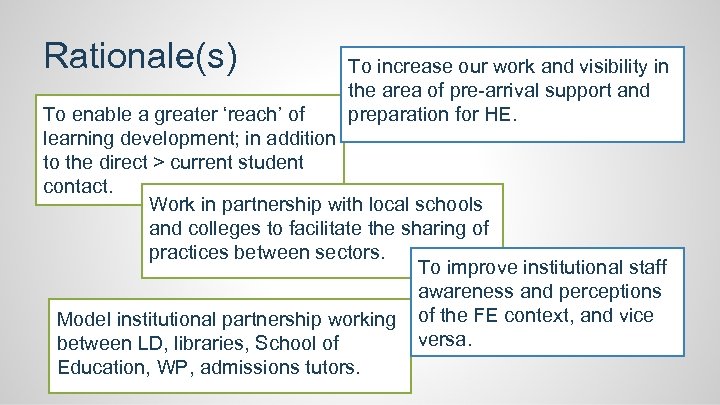 Rationale(s) To increase our work and visibility in the area of pre-arrival support and preparation for HE. To enable a greater ‘reach’ of learning development; in addition to the direct > current student contact. Work in partnership with local schools and colleges to facilitate the sharing of practices between sectors. To improve institutional staff awareness and perceptions Model institutional partnership working of the FE context, and vice versa. between LD, libraries, School of Education, WP, admissions tutors.
 Module contents 1. The current HE context. Types of institutions, providers, courses on offer, modes of delivery – and who these might suit; e. g. mature, part-time, distance, ‘traditional’, ‘non-traditional. Funding and tuition fees, HE application processes. University Strategy, Learning and Teaching Strategy – how this compares to their institutional values and mission. Student Charter. 2. Learning and teaching in HE. What are the similarities and differences between FE and HE? Include digital/ blended learning environments, peer learning, pedagogical approaches, engagement, theory and practice. Curriculum design.
 Module contents 3. Assessment and feedback. What types of HE assessment are there? Variation of assessment methods, in terms of equality and diversity. Protocol for assessment and marking. Academic misconduct. e. Submission. Methods of feedback – technology, traditional. 4. Academic skills. What will students need to come with? What will they develop in HE? What will they need to leave HE with? Graduate attributes 5. Governmental and policy agendas – e. g. employability, widening participation, student engagement, inclusion, equality, community participation, internationalisation
 Learning outcomes By the end of the module participants should be able to: • Operate within and across institutional contexts (FE and HE), to offer effective guidance and preparation for HE to students in their own educational context. • Demonstrate deep and systematic understanding and application of techniques that develop students’ effective learning skills for HE. • Evaluate, reflect on, and develop critical responses to theoretical and practical discourses of further and higher education.
 Learning outcomes (cont. ) • Evaluate and implement improvements to own practice of Information Advice and Guidance and skills development, including engaging with the critical and ethical dimension of research and practice, drawing on innovative or sectoral best practice. • Use personal reflection to analyse own and others actions to information seeking and offering guidance about higher education choices and preparation.
 Assessment tasks A written review and development of own practice, to include: Reflection on current practice A small scale action-research project (e. g. implementing an intervention in own context and reflecting on impact) Own professional development plan Total: 4000 words The task will be marked on a percentage basis. The pass mark will be 50%.
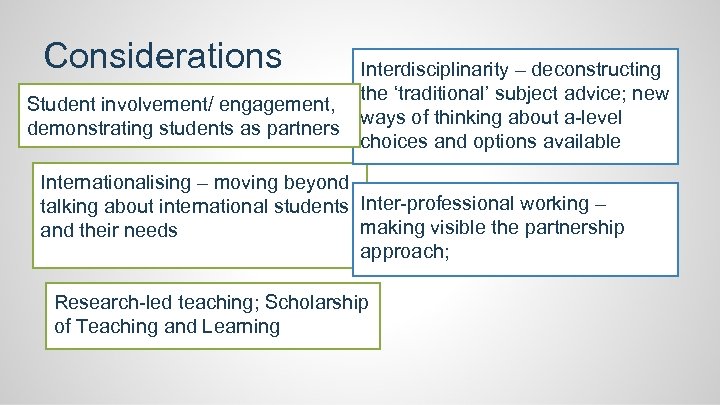 Considerations Interdisciplinarity – deconstructing the ‘traditional’ subject advice; new Student involvement/ engagement, ways of thinking about a-level demonstrating students as partners choices and options available Internationalising – moving beyond talking about international students Inter-professional working – making visible the partnership and their needs approach; Research-led teaching; Scholarship of Teaching and Learning
 Next Steps ⇢ ⇢ ⇢ Scheduling taught sessions Approaching cross-institutional staff Recruiting participants Evaluating the module Disseminating findings Roll-out module beyond initial pilot
 Contact: C. Mc. Connell@brighton. ac. uk