


 Скачать презентацию Taking Action in Tough Times Spring Faculty Meeting
f62b22a2d2d55d66ed771f731d95f5a1.ppt
- Количество слайдов: 33
 Taking Action in Tough Times Spring Faculty Meeting William L. Roper, MD, MPH April 21, 2009
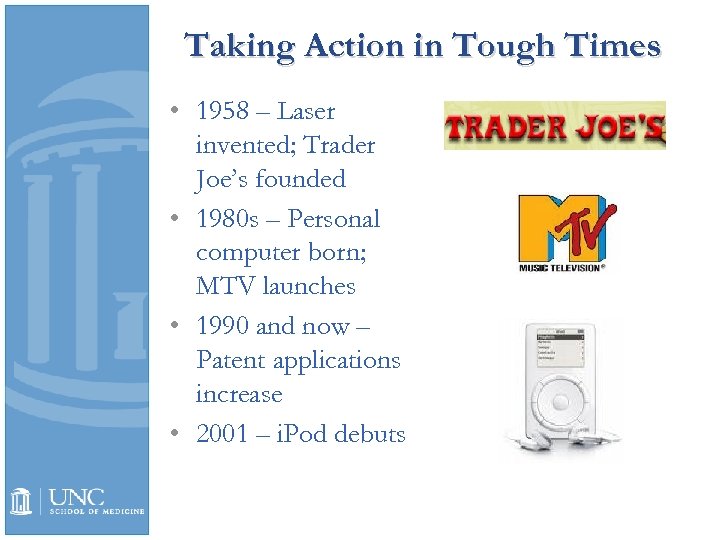 Taking Action in Tough Times • 1958 – Laser invented; Trader Joe’s founded • 1980 s – Personal computer born; MTV launches • 1990 and now – Patent applications increase • 2001 – i. Pod debuts
 Economy
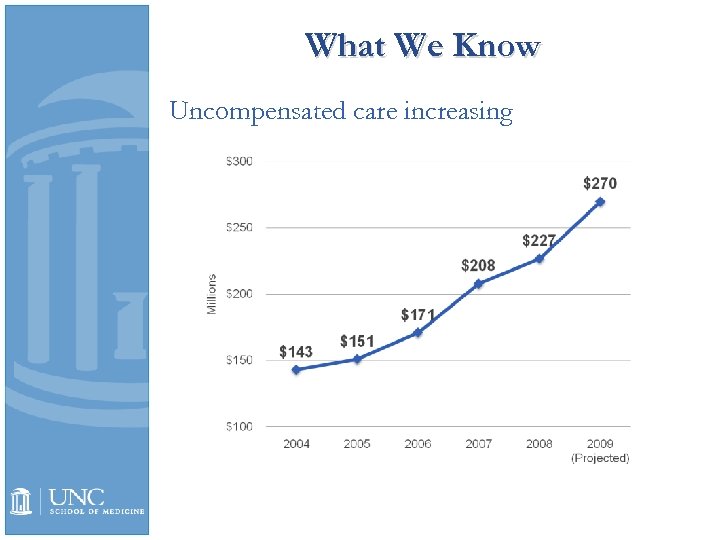 What We Know Uncompensated care increasing
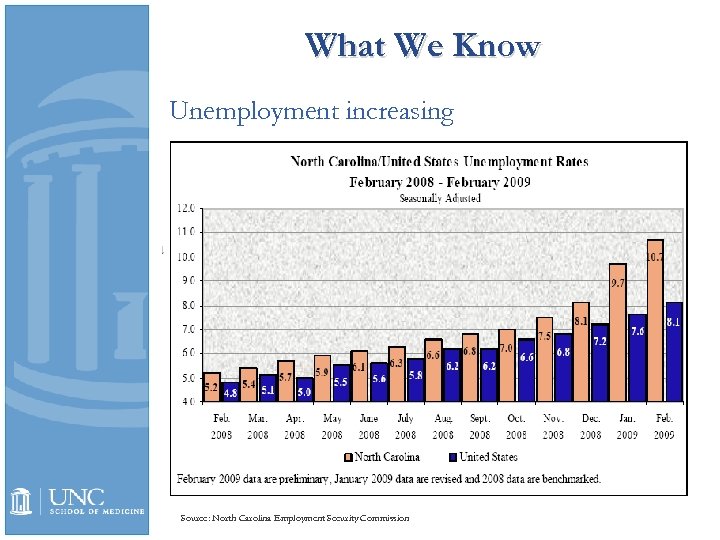 What We Know Unemployment increasing Source: North Carolina Employment Security Commission
 What We Don’t Know • • • State budget Volumes Research dollars Medical school expansion timeline Health care reform outcomes Bottom of economy?
 Guiding Principles • We are one academic health care system, and we will succeed together. • We will continue to meet our mission, but we must improve the way we manage patient care, teaching, research and service to the state, so we can handle them with fewer and limited resources. • We value our faculty and staff and will work hard to keep the organization true to our mission in the face of reduced resources.
 Action All of us must maintain our focus on our patients, students and research and tell our stories – to legislators, in particular.
 Uninsured
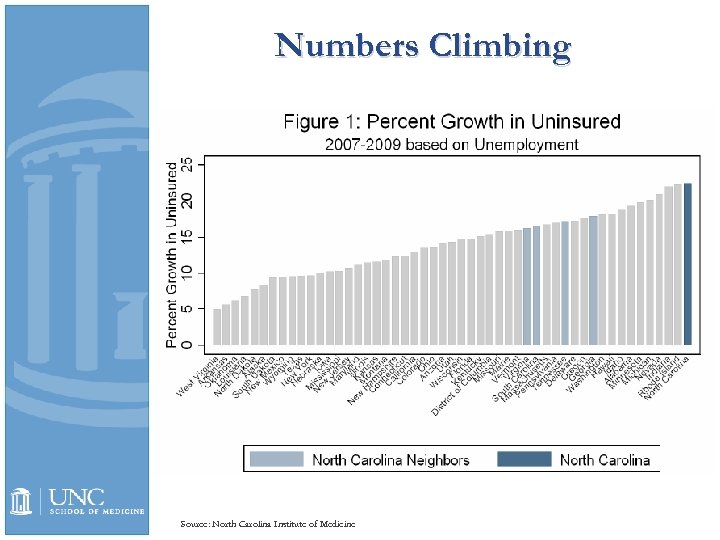 Numbers Climbing Source: North Carolina Institute of Medicine
 Impact on UNC Health Care For every one percent increase in unemployment, we lose $14. 4 million. Since unemployment rate has gone from the 4% range to more than 10%, the impact is nearly $100 million.
 Financial Policies • Approved in July 2008 • Allows elective care to be postponed for patients who have not applied for financial assistance • Also asking all patients to pay co-pays and deposits at the time of their visit • Financial counselors are always available • Working with Piedmont Health to establish medical homes for patients
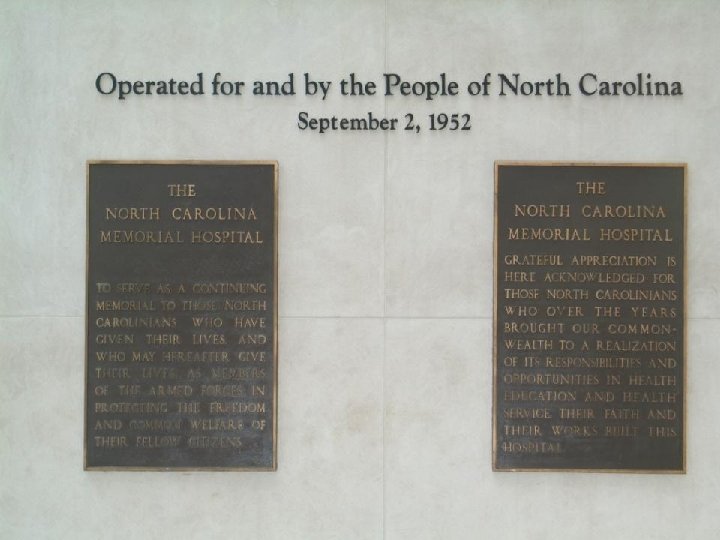 Telling the Story
 Action We all need to work together to execute our policies so we can serve our patients and referring physicians. Most importantly, we need to give all of our patients – insured or uninsured – the quality health care they deserve.
 Budget
 UNC HCS/SOM Budget Steps • • • Curtailed travel Postponed hires Deferred capital expenditures Reduced supply and contract expenses In SOM, have reduced current year state funding by 7% • Office of State Budget and Management has implemented a hard freeze on expenditures • Not in position to increase salaries for faculty and staff in next fiscal year
 State Budget Update • Senate passed budget • Awaiting passage of a new revenue package • Maintains strong support for UNC HCS and SOM » » » Continues support of the hospitals Adds to funding for indigent care Funds the growth of UCRF to $50 million/year Supports SOM expansion Fully funds the BRIC • House now debating the budget
 Moving Forward • Positions » 300 new hires with NC Cancer Hospital and UNC Hospitals bed expansion • Sharing in success » Beginning in June, funds that you help us save – by documenting medical services required, reducing supply costs, improving patient satisfaction – will be shared with P&A and the hospitals » Share could range from zero dollars to almost $5. 5 million
 Research • • NIH funding growth CTSA: More than $4 million Stimulus grants and building funds UCRF new hires » Don Rosenstein » Bill Goldman • DNA Sequencing Facility
 Research • Hettleman Award: Blossom Damania (Microbiology) and Jason Lieb(Genome Sciences) • Burroughs Wellcome Cancer Award for Medical Sciences: Alex Duncan (Medicine and Inflammatory Disease Institute) • Howard Hughes Early Career Scientist: Jim Bear (Cell and Developmental Biology) • PEW Scholar: John Rawls and Molecular Physiology) (Cell • Beckman Young Investigator Award: Zefeng Wang (Pharmacology) • Burroughs Wellcome Foundation Investigator in Pathogenesis of Infectious Disease Award: Miriam Braunstein (Microbiology) • Rita Allen Foundation Scholar: Ian Davis (Pediatrics) • Ellison New Scholar Award: Arjun Deb(Medicine)
 Research • Kenan Professors » Jenny Ting (Microbiology and Immunology) » Yi Zhang (Biochemistry and Biophysics) » Richard Tidwell (Pathology) • Southeast Regional biodefense grant transfer and renewal » Fred Sparling • Wellstone Centers » Jude Samulski (Gene Therapy) » Bill Powers (Neurology)
 Research • Space » New buildings and needs » Hamner Institute partnership • Toxicology center • Vector Production laboratories » Strategic space plan • Leslie Parise, Charles Jennette » Research Core Strategic Planning Committee • Gary Johnson
 Research • Research compliance » Kevin Fitz. Gerald, Robert Sandler • Research computing » Terry Magnuson • Graduate school recruitment » Virginia Miller » First-year students enter Biological and Biomedical Studies Program
 Action The School of Medicine and Health Care System are developing their budgets together. You can help by keeping our revenues strong by using UNC for your own care, for your patients, for their ancillary testing, inpatient admissions and outpatient visits.
 Hillsborough
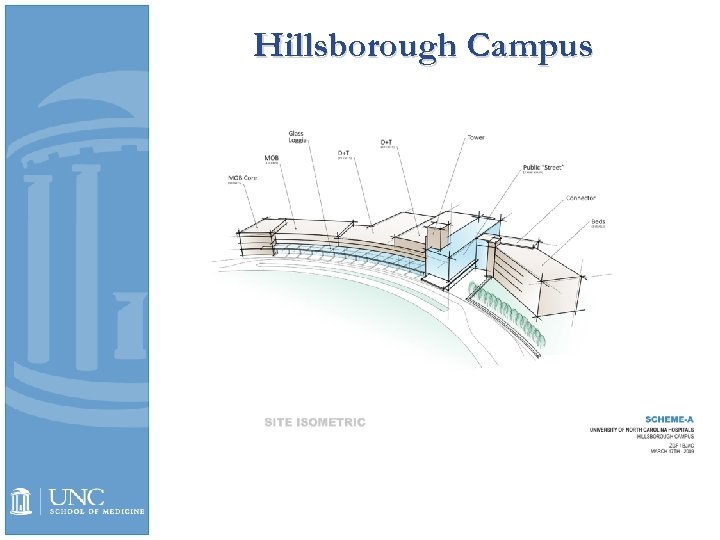
 Hillsborough Campus • Biggest challenge: inpatient bed capacity • Signed letter of intent to purchase property at the Waterstone development • Filed CON last week • If approved, would begin providing services by FY 2014
 Hillsborough Campus
 Action We all must help employees understand that this hospital is a long-term investment, which will help the health care system continue to grow and provide jobs, as well as provide high quality patient care. Show our support through letters and testimony at public hearings for the new facility’s certificate of need.
 Summary
 Taking Action in Tough Times • Maintain our focus on patients – whether they are insured or uninsured • Tell our stories – to legislators, regulators and communities • Be well versed in our policies • Be mindful of our budgets and look for innovative ways to use our dollars wisely • Support our vital research mission • Use UNC Health Care first • Help everyone understand why we need to invest in growth
 If you get care, you pay a share The Herald-Sun Apr 21, 2009 Free medical care is great, if you can get it. And many people are just so blessed every year at UNC Hospitals. The problem with such gift-giving, of course, is that the billing write-offs cost UNC Health Care vast amounts, and also result in those of us who have insurance paying ever more for care because hospitals inflate costs assessed to insured patients to cover the gap for the uninsured. UNC Health Care announced last week that it will have to assume the obligation for $270 million in unpaid health costs this year, and that number is likely to jump to $300 million next year. The trajectory is alarming. In 2004, for instance, the unpaid portion of medical bills was $140 million. So in just five years, that burden nearly doubled at 93 percent.
 There a variety of reasons for the lack of payments. There are the true hard-luck cases involving indigent families with no ability to pay the costs for doctors, their services, supplies and all the rest that goes into care. As unemployment rises, more people are left without insurance and no way to pay those bills. And as the number of immigrants rises -- both legal and undocumented -- the pool of people who don't have the means to pay for their health care escalates. In an effort to reverse that devastating trend, UNC Health Care began on Monday to ask for deposits or co-payments from all patients before receiving treatment in clinics or having diagnostic work performed. The goal is for uninsured patients to pay all the costs associated with their service. More realistically, the plan seeks a $100 deposit for a new visit ($80 for a return trip) and a $20 deposit for labs, X-rays and such.
 For those truly unable to pay, there is no worry that they will be turned away at the door. As a public facility, UNC Hospitals must treat all patients regardless of ability to pay. And UNC Health Care plans to continue its kinder, gentler approach to bill collecting. It seems some recipients in the past didn't like the notion of actually having to pay for their treatment and didn't like being constantly reminded of their lingering debt. The deposits are a practical and essential method to begin recouping some of that lost money. They won't cover all the bills associated with the care provided, but will help somewhat to offset the balance sheets. The bigger plus may be eliminating the entitlement mind set that care must be given for free, while conveniently ignoring the fact that someone else is actually footing the bill. © 2009 by The Durham Herald Company. All rights reserved.