Скачать презентацию Taking a Data-Driven Approach to IT Transformation A
cd9bc0ad048824bbcf454a8c33694620.ppt
- Количество слайдов: 32
 Taking a Data-Driven Approach to IT Transformation A Management Overview Introducing MIKE 2. 0 An Open Source Methodology for Information Development http: //www. openmethodology. org
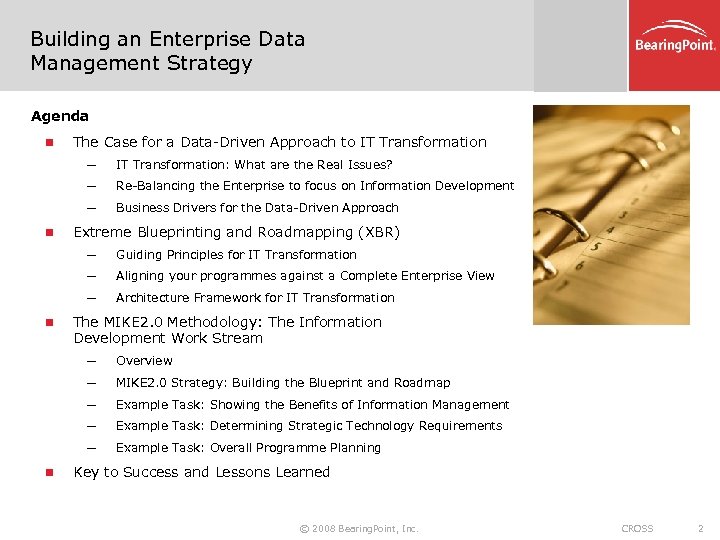 Building an Enterprise Data Management Strategy Agenda n The Case for a Data-Driven Approach to IT Transformation ─ ─ Re-Balancing the Enterprise to focus on Information Development ─ n IT Transformation: What are the Real Issues? Business Drivers for the Data-Driven Approach Extreme Blueprinting and Roadmapping (XBR) ─ ─ Aligning your programmes against a Complete Enterprise View ─ n Guiding Principles for IT Transformation Architecture Framework for IT Transformation The MIKE 2. 0 Methodology: The Information Development Work Stream ─ ─ MIKE 2. 0 Strategy: Building the Blueprint and Roadmap ─ Example Task: Showing the Benefits of Information Management ─ Example Task: Determining Strategic Technology Requirements ─ n Overview Example Task: Overall Programme Planning Key to Success and Lessons Learned © 2008 Bearing. Point, Inc. CROSS 2
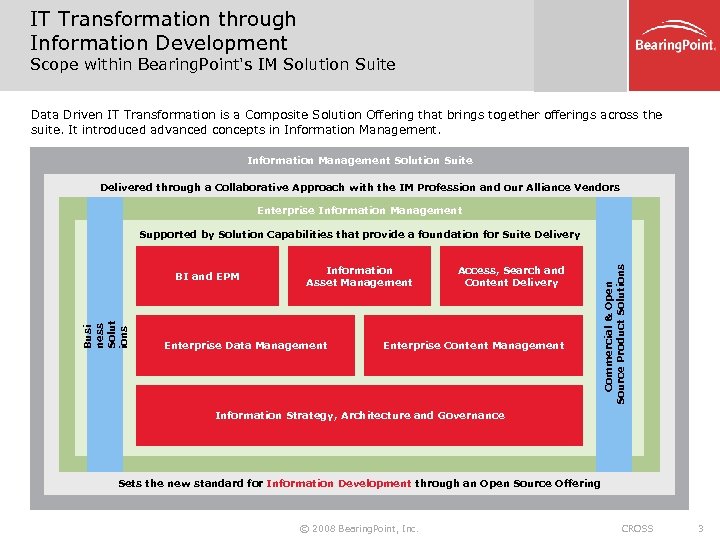 IT Transformation through Information Development Scope within Bearing. Point's IM Solution Suite Data Driven IT Transformation is a Composite Solution Offering that brings together offerings across the suite. It introduced advanced concepts in Information Management Solution Suite Delivered through a Collaborative Approach with the IM Profession and our Alliance Vendors Enterprise Information Management Busi ness Solut ions BI and EPM Information Asset Management Enterprise Data Management Access, Search and Content Delivery Enterprise Content Management Commercial & Open Source Product Solutions Supported by Solution Capabilities that provide a foundation for Suite Delivery Information Strategy, Architecture and Governance Sets the new standard for Information Development through an Open Source Offering © 2008 Bearing. Point, Inc. CROSS 3
 IT Transformation What are the Real Issues? The "IT Transformation" of an organisation from its legacy environment to the next generation of technology is one of the most complex and expensive changes an organisation can undergo. Most organisations focus primarily on functional capabilities and business process when designing their Transformation strategy. We believe these programmes are starting in the wrong place; they aren't dealing with the Real Problems: n How to improve and optimise business processes n How to manage information across the enterprise n How to safely migrate from the legacy to the contemporary environment n How to deliver on a transition strategy that provides incremental functionality while mitigating risk and staying within budget n How to define an improvement strategy for your people, processes, and organisation as well as the technology Of all these factors, how information is managed is often the biggest limiter to success. We call our comprehensive approach is that area Information Development. © 2008 Bearing. Point, Inc. CROSS 4
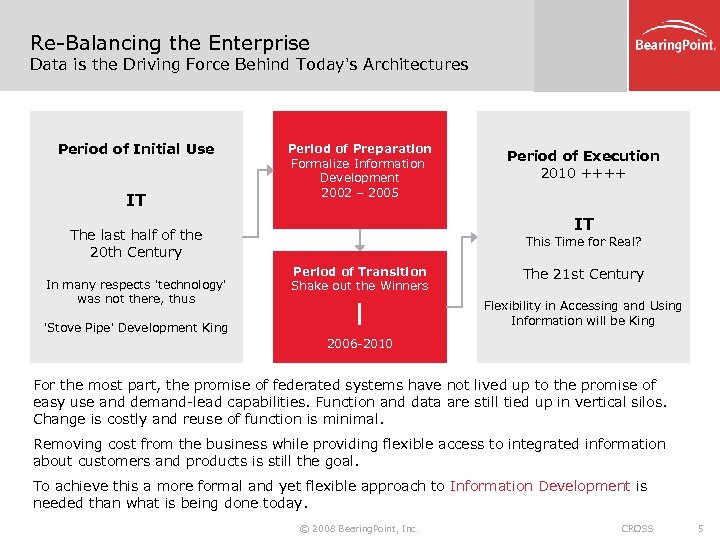 Re-Balancing the Enterprise Data is the Driving Force Behind Today's Architectures Period of Initial Use IT Period of Preparation Formalize Information Development 2002 – 2005 IT The last half of the 20 th Century In many respects 'technology' was not there, thus Period of Execution 2010 ++++ This Time for Real? Period of Transition Shake out the Winners The 21 st Century Flexibility in Accessing and Using Information will be King 'Stove Pipe' Development King 2006 -2010 For the most part, the promise of federated systems have not lived up to the promise of easy use and demand-lead capabilities. Function and data are still tied up in vertical silos. Change is costly and reuse of function is minimal. Removing cost from the business while providing flexible access to integrated information about customers and products is still the goal. To achieve this a more formal and yet flexible approach to Information Development is needed than what is being done today. © 2008 Bearing. Point, Inc. CROSS 5
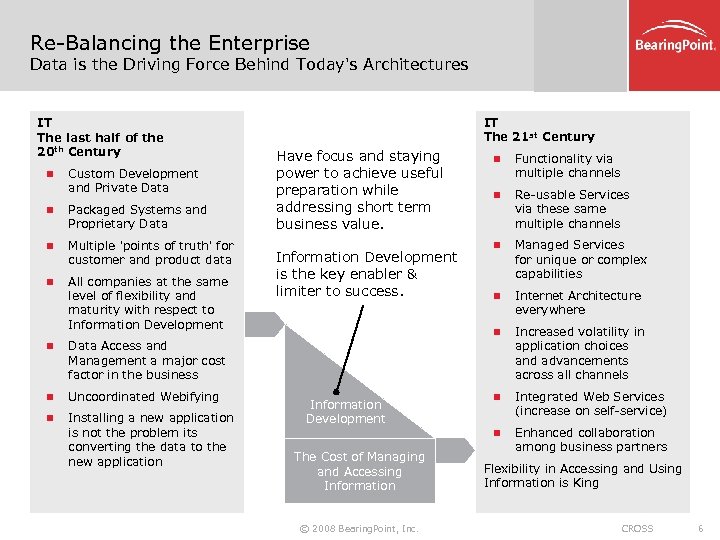 Re-Balancing the Enterprise Data is the Driving Force Behind Today's Architectures IT The last half of the 20 th Century n Custom Development and Private Data n Packaged Systems and Proprietary Data n Multiple 'points of truth' for customer and product data n All companies at the same level of flexibility and maturity with respect to Information Development n Uncoordinated Webifying n Installing a new application is not the problem its converting the data to the new application Have focus and staying power to achieve useful preparation while addressing short term business value. Functionality via multiple channels n Re-usable Services via these same multiple channels n Managed Services for unique or complex capabilities n Internet Architecture everywhere n Increased volatility in application choices and advancements across all channels n Integrated Web Services (increase on self-service) n Information Development is the key enabler & limiter to success. n Enhanced collaboration among business partners Data Access and Management a major cost factor in the business n IT The 21 st Century Information Development The Cost of Managing and Accessing Information © 2008 Bearing. Point, Inc. Flexibility in Accessing and Using Information is King CROSS 6
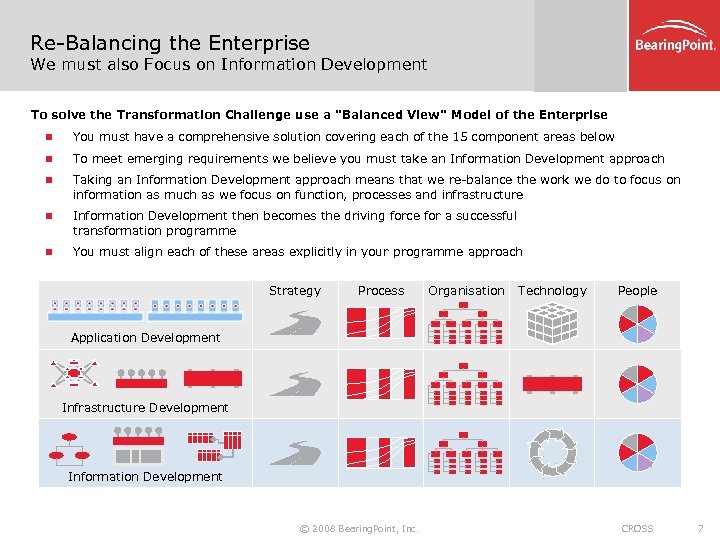 Re-Balancing the Enterprise We must also Focus on Information Development To solve the Transformation Challenge use a "Balanced View" Model of the Enterprise n You must have a comprehensive solution covering each of the 15 component areas below n To meet emerging requirements we believe you must take an Information Development approach n Taking an Information Development approach means that we re-balance the work we do to focus on information as much as we focus on function, processes and infrastructure n Information Development then becomes the driving force for a successful transformation programme n You must align each of these areas explicitly in your programme approach Strategy Process Organisation Technology People Application Development Infrastructure Development Information Development © 2008 Bearing. Point, Inc. CROSS 7
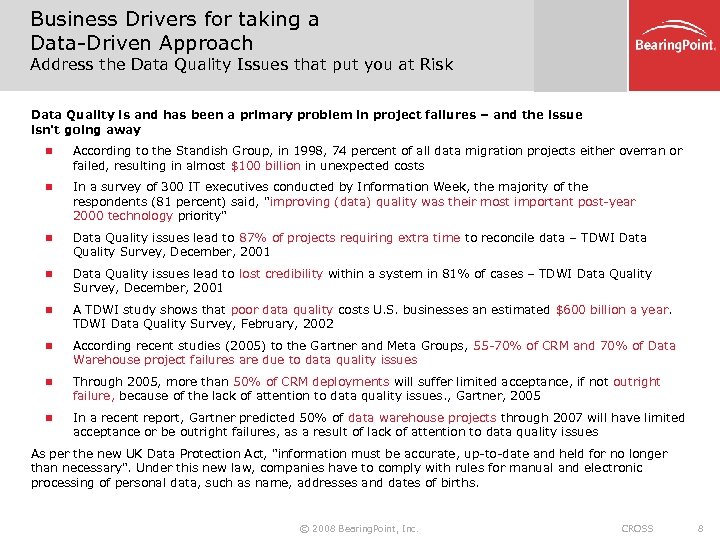 Business Drivers for taking a Data-Driven Approach Address the Data Quality Issues that put you at Risk Data Quality is and has been a primary problem in project failures – and the issue isn't going away n According to the Standish Group, in 1998, 74 percent of all data migration projects either overran or failed, resulting in almost $100 billion in unexpected costs n In a survey of 300 IT executives conducted by Information Week, the majority of the respondents (81 percent) said, "improving (data) quality was their most important post-year 2000 technology priority" n Data Quality issues lead to 87% of projects requiring extra time to reconcile data – TDWI Data Quality Survey, December, 2001 n Data Quality issues lead to lost credibility within a system in 81% of cases – TDWI Data Quality Survey, December, 2001 n A TDWI study shows that poor data quality costs U. S. businesses an estimated $600 billion a year. TDWI Data Quality Survey, February, 2002 n According recent studies (2005) to the Gartner and Meta Groups, 55 -70% of CRM and 70% of Data Warehouse project failures are due to data quality issues n Through 2005, more than 50% of CRM deployments will suffer limited acceptance, if not outright failure, because of the lack of attention to data quality issues. , Gartner, 2005 n In a recent report, Gartner predicted 50% of data warehouse projects through 2007 will have limited acceptance or be outright failures, as a result of lack of attention to data quality issues As per the new UK Data Protection Act, "information must be accurate, up-to-date and held for no longer than necessary". Under this new law, companies have to comply with rules for manual and electronic processing of personal data, such as name, addresses and dates of births. © 2008 Bearing. Point, Inc. CROSS 8
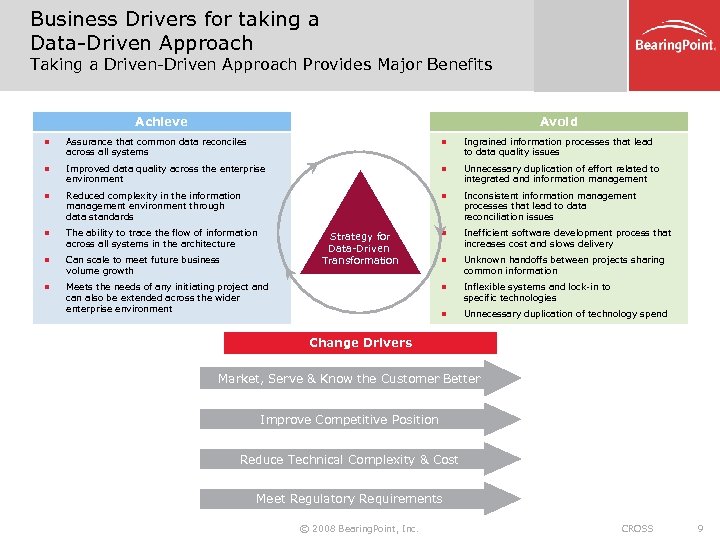 Business Drivers for taking a Data-Driven Approach Taking a Driven-Driven Approach Provides Major Benefits Achieve Avoid n Assurance that common data reconciles across all systems n Ingrained information processes that lead to data quality issues n Improved data quality across the enterprise environment n Unnecessary duplication of effort related to integrated and information management n Reduced complexity in the information management environment through data standards n Inconsistent information management processes that lead to data reconciliation issues n The ability to trace the flow of information across all systems in the architecture n Inefficient software development process that increases cost and slows delivery n Can scale to meet future business volume growth n Unknown handoffs between projects sharing common information n Meets the needs of any initiating project and can also be extended across the wider enterprise environment n Inflexible systems and lock-in to specific technologies n Unnecessary duplication of technology spend Strategy for Data-Driven Transformation Change Drivers Market, Serve & Know the Customer Better Improve Competitive Position Reduce Technical Complexity & Cost Meet Regulatory Requirements © 2008 Bearing. Point, Inc. CROSS 9
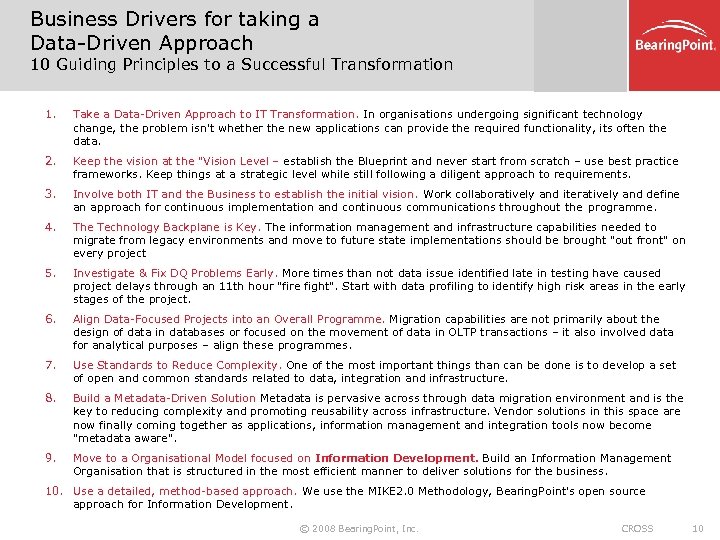 Business Drivers for taking a Data-Driven Approach 10 Guiding Principles to a Successful Transformation 1. Take a Data-Driven Approach to IT Transformation. In organisations undergoing significant technology change, the problem isn't whether the new applications can provide the required functionality, its often the data. 2. Keep the vision at the "Vision Level – establish the Blueprint and never start from scratch – use best practice frameworks. Keep things at a strategic level while still following a diligent approach to requirements. 3. Involve both IT and the Business to establish the initial vision. Work collaboratively and iteratively and define an approach for continuous implementation and continuous communications throughout the programme. 4. The Technology Backplane is Key. The information management and infrastructure capabilities needed to migrate from legacy environments and move to future state implementations should be brought "out front" on every project 5. Investigate & Fix DQ Problems Early. More times than not data issue identified late in testing have caused project delays through an 11 th hour "fire fight". Start with data profiling to identify high risk areas in the early stages of the project. 6. Align Data-Focused Projects into an Overall Programme. Migration capabilities are not primarily about the design of data in databases or focused on the movement of data in OLTP transactions – it also involved data for analytical purposes – align these programmes. 7. Use Standards to Reduce Complexity. One of the most important things than can be done is to develop a set of open and common standards related to data, integration and infrastructure. 8. Build a Metadata-Driven Solution Metadata is pervasive across through data migration environment and is the key to reducing complexity and promoting reusability across infrastructure. Vendor solutions in this space are now finally coming together as applications, information management and integration tools now become "metadata aware". 9. Move to a Organisational Model focused on Information Development. Build an Information Management Organisation that is structured in the most efficient manner to deliver solutions for the business. 10. Use a detailed, method-based approach. We use the MIKE 2. 0 Methodology, Bearing. Point's open source approach for Information Development. © 2008 Bearing. Point, Inc. CROSS 10
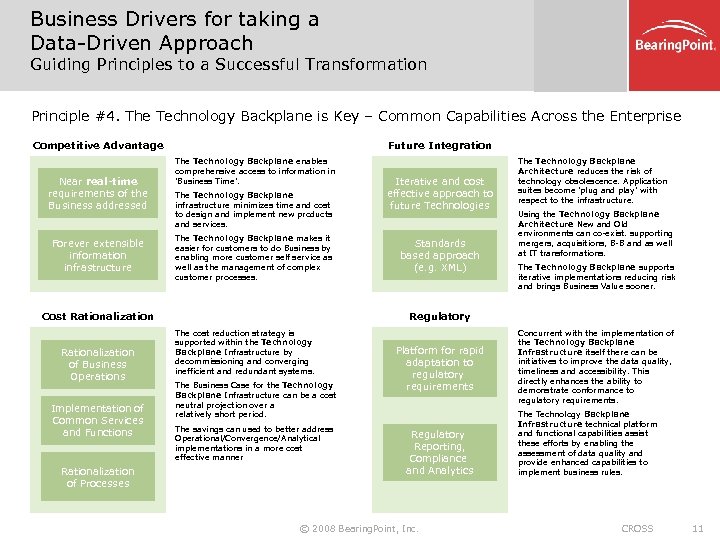 Business Drivers for taking a Data-Driven Approach Guiding Principles to a Successful Transformation Principle #4. The Technology Backplane is Key – Common Capabilities Across the Enterprise Competitive Advantage Near real-time requirements of the Business addressed Forever extensible information infrastructure Future Integration The Technology Backplane enables comprehensive access to information in 'Business Time'. The Technology Backplane infrastructure minimizes time and cost to design and implement new products and services. The Technology Backplane makes it easier for customers to do Business by enabling more customer self service as well as the management of complex customer processes. Cost Rationalization of Business Operations Implementation of Common Services and Functions Rationalization of Processes Iterative and cost effective approach to future Technologies Standards based approach (e. g. XML) The Technology Backplane Architecture reduces the risk of technology obsolescence. Application suites become 'plug and play' with respect to the infrastructure. Using the Technology Backplane Architecture New and Old environments can co-exist. supporting mergers, acquisitions, B-B and as well at IT transformations. The Technology Backplane supports iterative implementations reducing risk and brings Business Value sooner. Regulatory The cost reduction strategy is supported within the Technology Backplane Infrastructure by decommissioning and converging inefficient and redundant systems. The Business Case for the Technology Backplane Infrastructure can be a cost neutral projection over a relatively short period. The savings can used to better address Operational/Convergence/Analytical implementations in a more cost effective manner Platform for rapid adaptation to regulatory requirements Regulatory Reporting, Compliance and Analytics © 2008 Bearing. Point, Inc. Concurrent with the implementation of the Technology Backplane Infrastructure itself there can be initiatives to improve the data quality, timeliness and accessibility. This directly enhances the ability to demonstrate conformance to regulatory requirements. The Technology Backplane Infrastructure technical platform and functional capabilities assist these efforts by enabling the assessment of data quality and provide enhanced capabilities to implement business rules. CROSS 11
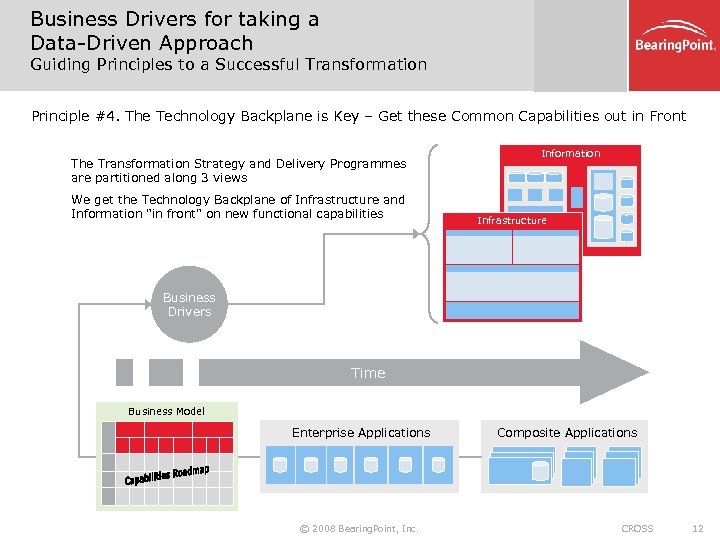 Business Drivers for taking a Data-Driven Approach Guiding Principles to a Successful Transformation Principle #4. The Technology Backplane is Key – Get these Common Capabilities out in Front The Transformation Strategy and Delivery Programmes are partitioned along 3 views We get the Technology Backplane of Infrastructure and Information "in front" on new functional capabilities Information Infrastructure Business Drivers Time Business Model Enterprise Applications © 2008 Bearing. Point, Inc. Composite Applications CROSS 12
 XBR – Extreme Blueprinting & Roadmapping The Blueprint and the Roadmap XBR (Extreme Blueprinting and Roadmapping) involves a set of methods and activities used to formulate a Future State Blueprint and Roadmap. It is analogous to Extreme Programming, with a focus on iterative delivery, continuous communication and interactive work processes. This approach provides a clear set of deliverables that aligns strategic to tactical and business to technology. We call this approach using the SAFE Architecture doing "IT Transformation the SAFE Way". What is the Blueprint? n A relatively high-level vision of an organisations' envisaged Future-State n The XBR Blueprint is inclusive of Strategy, Organization, People, Process, and Technology and the Solution Definition n Driven by the established Technology Principles and Business Priorities n Much of the focus of this phase of work is on the Business Strategy and Technology Architecture n Once completed, the Blueprint is thought of as a relatively static representation of the Current-State and Future-State with identified intermediate states What is the Roadmap? n The Roadmap is derived from the Blueprint n It is a translation of the Blueprint into a dynamic representation of 'what it takes' to actually do the implementation n It is a plan that can be directly implemented n It is complemented in Phase 3 by Foundation Activities – those areas of Data Management and Infrastructure that are required first in the implementation stages of a project © 2008 Bearing. Point, Inc. CROSS 13
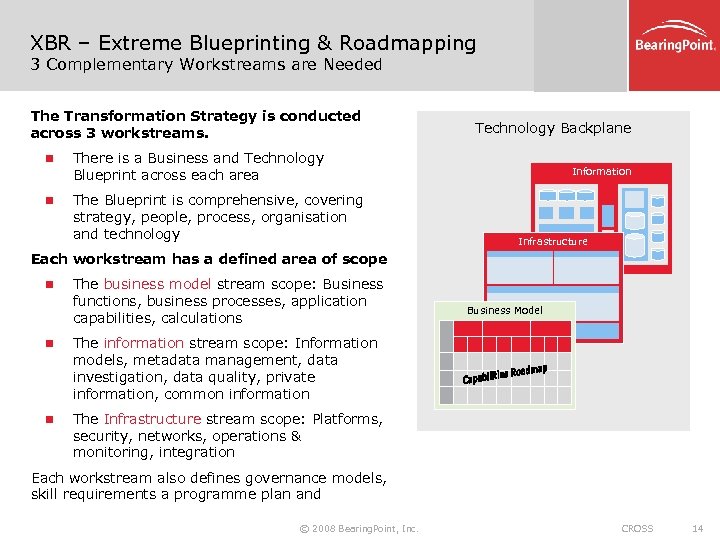 XBR – Extreme Blueprinting & Roadmapping 3 Complementary Workstreams are Needed The Transformation Strategy is conducted across 3 workstreams. n There is a Business and Technology Blueprint across each area n The Blueprint is comprehensive, covering strategy, people, process, organisation and technology Technology Backplane Information Infrastructure Each workstream has a defined area of scope n The business model stream scope: Business functions, business processes, application capabilities, calculations n The information stream scope: Information models, metadata management, data investigation, data quality, private information, common information n Business Model The Infrastructure stream scope: Platforms, security, networks, operations & monitoring, integration Each workstream also defines governance models, skill requirements a programme plan and © 2008 Bearing. Point, Inc. CROSS 14
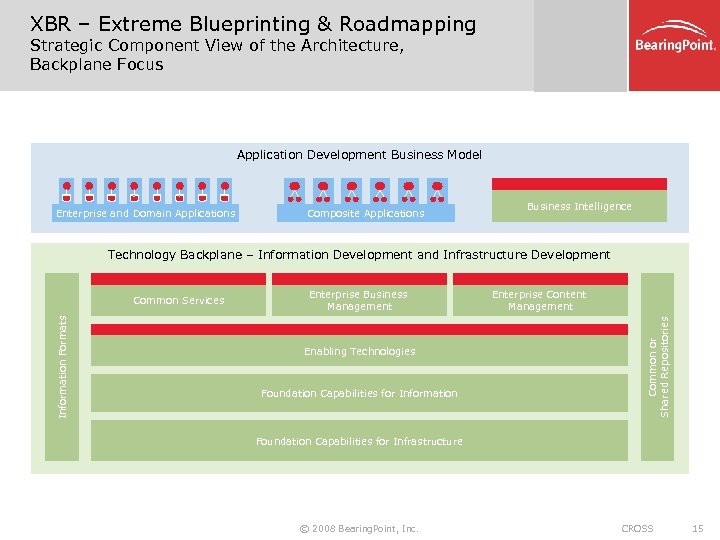 XBR – Extreme Blueprinting & Roadmapping Strategic Component View of the Architecture, Backplane Focus Application Development Business Model Enterprise and Domain Applications Composite Applications Business Intelligence Technology Backplane – Information Development and Infrastructure Development Enterprise Business Management Enabling Technologies Foundation Capabilities for Information Enterprise Content Management Common or Shared Repositories Information Formats Common Services Foundation Capabilities for Infrastructure © 2008 Bearing. Point, Inc. CROSS 15
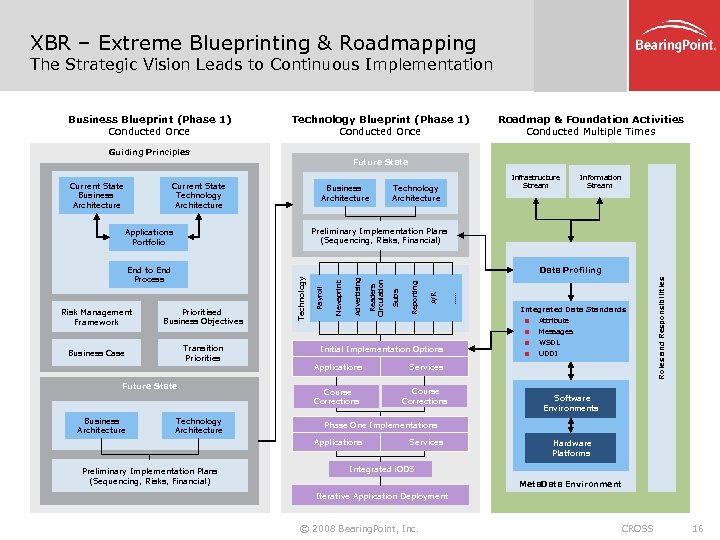 XBR – Extreme Blueprinting & Roadmapping The Strategic Vision Leads to Continuous Implementation Business Blueprint (Phase 1) Conducted Once Technology Blueprint (Phase 1) Conducted Once Guiding Principles Future State Current State Technology Architecture Business Architecture End to End Process Integrated Data Standards Transition Priorities Business Case Future State Technology Architecture n Initial Implementation Options Applications Course Corrections WSDL n UDDI Software Environments Phase One Implementations Applications Preliminary Implementation Plans (Sequencing, Risks, Financial) Messages n Services Course Corrections Attribute Roles and Responsibilities …… A/R Reporting Subs Readers Circulation Advertising Newsprint Prioritised Business Objectives n Business Architecture Information Stream Data Profiling Technology Risk Management Framework Infrastructure Stream Technology Architecture Preliminary Implementation Plans (Sequencing, Risks, Financial) Applications Portfolio Payroll Current State Business Architecture Roadmap & Foundation Activities Conducted Multiple Times Services Hardware Platforms Integrated i. ODS Meta. Data Environment Iterative Application Deployment © 2008 Bearing. Point, Inc. CROSS 16
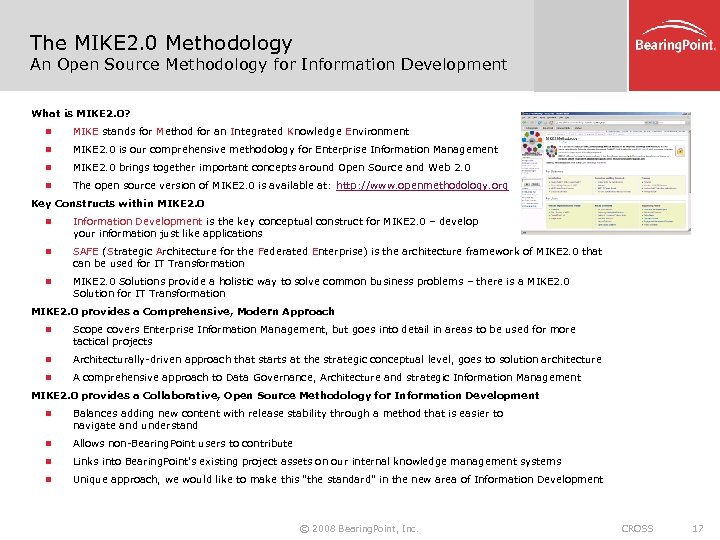 The MIKE 2. 0 Methodology An Open Source Methodology for Information Development What is MIKE 2. 0? n MIKE stands for Method for an Integrated Knowledge Environment n MIKE 2. 0 is our comprehensive methodology for Enterprise Information Management n MIKE 2. 0 brings together important concepts around Open Source and Web 2. 0 n The open source version of MIKE 2. 0 is available at: http: //www. openmethodology. org Key Constructs within MIKE 2. 0 n Information Development is the key conceptual construct for MIKE 2. 0 – develop your information just like applications n SAFE (Strategic Architecture for the Federated Enterprise) is the architecture framework of MIKE 2. 0 that can be used for IT Transformation n MIKE 2. 0 Solutions provide a holistic way to solve common business problems – there is a MIKE 2. 0 Solution for IT Transformation MIKE 2. 0 provides a Comprehensive, Modern Approach n Scope covers Enterprise Information Management, but goes into detail in areas to be used for more tactical projects n Architecturally-driven approach that starts at the strategic conceptual level, goes to solution architecture n A comprehensive approach to Data Governance, Architecture and strategic Information Management MIKE 2. 0 provides a Collaborative, Open Source Methodology for Information Development n Balances adding new content with release stability through a method that is easier to navigate and understand n Allows non-Bearing. Point users to contribute n Links into Bearing. Point's existing project assets on our internal knowledge management systems n Unique approach, we would like to make this "the standard" in the new area of Information Development © 2008 Bearing. Point, Inc. CROSS 17
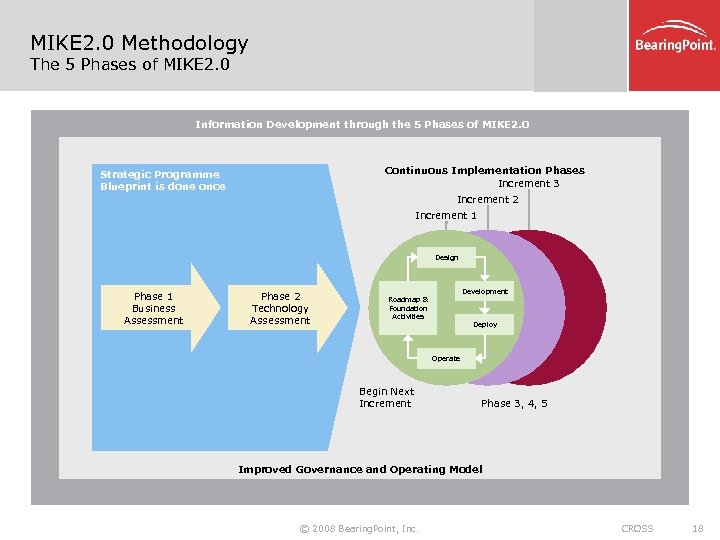 MIKE 2. 0 Methodology The 5 Phases of MIKE 2. 0 Information Development through the 5 Phases of MIKE 2. 0 Continuous Implementation Phases Increment 3 Strategic Programme Blueprint is done once Increment 2 Increment 1 Design Phase 1 Business Assessment Phase 2 Technology Assessment Development Roadmap & Foundation Activities Deploy Operate Begin Next Increment Phase 3, 4, 5 Improved Governance and Operating Model © 2008 Bearing. Point, Inc. CROSS 18
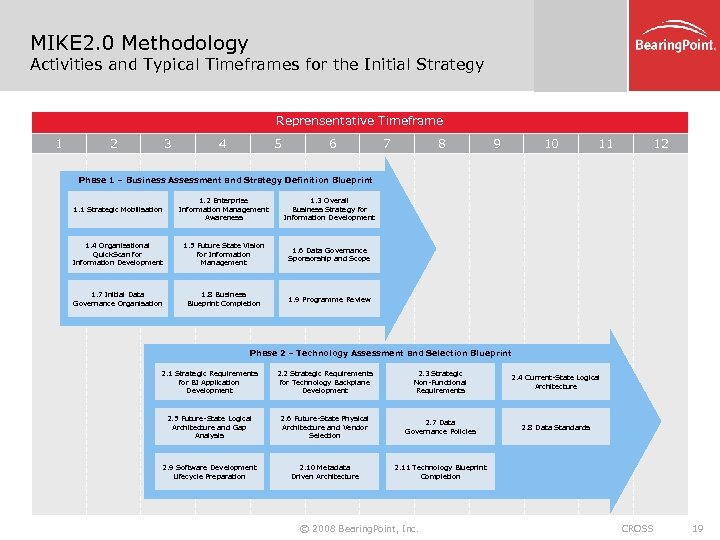 MIKE 2. 0 Methodology Activities and Typical Timeframes for the Initial Strategy Reprensentative Timeframe 1 2 3 4 5 6 7 8 9 10 11 12 Phase 1 – Business Assessment and Strategy Definition Blueprint 1. 1 Strategic Mobilisation 1. 2 Enterprise Information Management Awareness 1. 3 Overall Business Strategy for Information Development 1. 4 Organisational Quick. Scan for Information Development 1. 5 Future State Vision for Information Management 1. 6 Data Governance Sponsorship and Scope 1. 7 Initial Data Governance Organisation 1. 8 Business Blueprint Completion 1. 9 Programme Review Phase 2 – Technology Assessment and Selection Blueprint 2. 1 Strategic Requirements for BI Application Development 2. 2 Strategic Requirements for Technology Backplane Development 2. 3 Strategic Non-Functional Requirements 2. 4 Current-State Logical Architecture 2. 5 Future-State Logical Architecture and Gap Analysis 2. 6 Future-State Physical Architecture and Vendor Selection 2. 7 Data Governance Policies 2. 8 Data Standards 2. 9 Software Development Lifecycle Preparation 2. 10 Metadata Driven Architecture 2. 11 Technology Blueprint Completion © 2008 Bearing. Point, Inc. CROSS 19
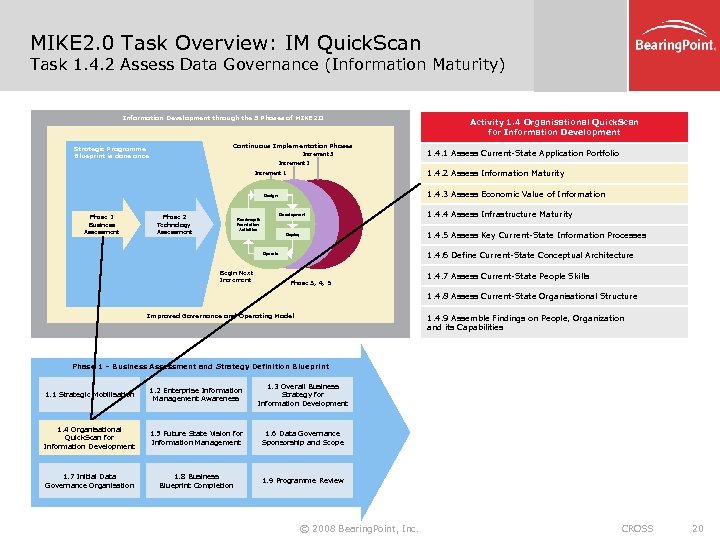 MIKE 2. 0 Task Overview: IM Quick. Scan Task 1. 4. 2 Assess Data Governance (Information Maturity) Information Development through the 5 Phases of MIKE 2. 0 Continuous Implementation Phases Strategic Programme Blueprint is done once Increment 3 Activity 1. 4 Organisational Quick. Scan for Information Development 1. 4. 1 Assess Current-State Application Portfolio Increment 2 1. 4. 2 Assess Information Maturity Increment 1 1. 4. 3 Assess Economic Value of Information Design Phase 1 Business Assessment Development Phase 2 Technology Assessment Roadmap & Foundation Activities 1. 4. 5 Assess Key Current-State Information Processes Deploy 1. 4. 6 Define Current-State Conceptual Architecture Operate Begin Next Increment 1. 4. 4 Assess Infrastructure Maturity Phase 3, 4, 5 1. 4. 7 Assess Current-State People Skills 1. 4. 8 Assess Current-State Organisational Structure Improved Governance and Operating Model 1. 4. 9 Assemble Findings on People, Organization and its Capabilities Phase 1 – Business Assessment and Strategy Definition Blueprint 1. 1 Strategic Mobilisation 1. 2 Enterprise Information Management Awareness 1. 3 Overall Business Strategy for Information Development 1. 4 Organisational Quick. Scan for Information Development 1. 5 Future State Vision for Information Management 1. 6 Data Governance Sponsorship and Scope 1. 7 Initial Data Governance Organisation 1. 8 Business Blueprint Completion 1. 9 Programme Review © 2008 Bearing. Point, Inc. CROSS 20
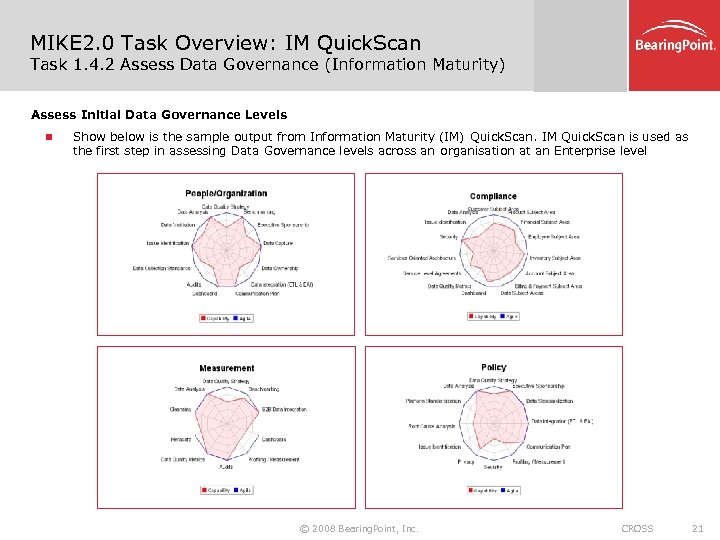 MIKE 2. 0 Task Overview: IM Quick. Scan Task 1. 4. 2 Assess Data Governance (Information Maturity) Assess Initial Data Governance Levels n Show below is the sample output from Information Maturity (IM) Quick. Scan. IM Quick. Scan is used as the first step in assessing Data Governance levels across an organisation at an Enterprise level © 2008 Bearing. Point, Inc. CROSS 21
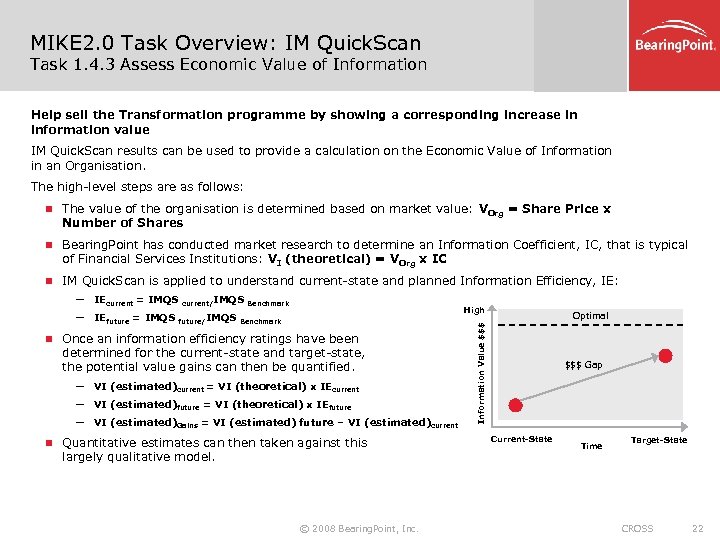 MIKE 2. 0 Task Overview: IM Quick. Scan Task 1. 4. 3 Assess Economic Value of Information Help sell the Transformation programme by showing a corresponding increase in information value IM Quick. Scan results can be used to provide a calculation on the Economic Value of Information in an Organisation. The high-level steps are as follows: n The value of the organisation is determined based on market value: VOrg = Share Price x Number of Shares n Bearing. Point has conducted market research to determine an Information Coefficient, IC, that is typical of Financial Services Institutions: VI (theoretical) = VOrg x IC n IM Quick. Scan is applied to understand current-state and planned Information Efficiency, IE: IEcurrent = IMQS ─ IEfuture = IMQS current/IMQS Benchmark High future/IMQS Benchmark n Once an information efficiency ratings have been determined for the current-state and target-state, the potential value gains can then be quantified. ─ VI (estimated)current = VI (theoretical) x IEcurrent ─ VI (estimated)future = VI (theoretical) x IEfuture ─ VI (estimated)Gains = VI (estimated) future – VI (estimated)current n Quantitative estimates can then taken against this largely qualitative model. © 2008 Bearing. Point, Inc. Optimal Information Value $$$ ─ $$$ Gap Current-State Time Target-State CROSS 22
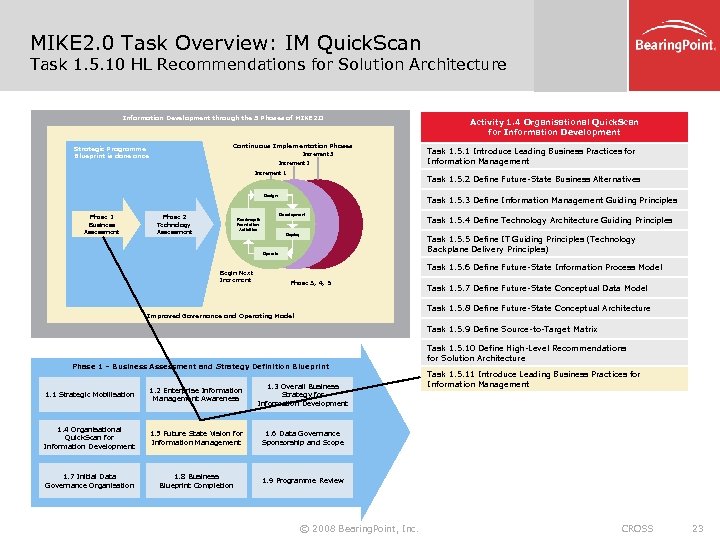 MIKE 2. 0 Task Overview: IM Quick. Scan Task 1. 5. 10 HL Recommendations for Solution Architecture Information Development through the 5 Phases of MIKE 2. 0 Continuous Implementation Phases Strategic Programme Blueprint is done once Increment 3 Increment 2 Increment 1 Task 1. 5. 3 Define Information Management Guiding Principles Development Phase 2 Technology Assessment Roadmap & Foundation Activities Deploy Task 1. 5. 4 Define Technology Architecture Guiding Principles Task 1. 5. 5 Define IT Guiding Principles (Technology Backplane Delivery Principles) Operate Begin Next Increment Task 1. 5. 1 Introduce Leading Business Practices for Information Management Task 1. 5. 2 Define Future-State Business Alternatives Design Phase 1 Business Assessment Activity 1. 4 Organisational Quick. Scan for Information Development Task 1. 5. 6 Define Future-State Information Process Model Phase 3, 4, 5 Task 1. 5. 7 Define Future-State Conceptual Data Model Task 1. 5. 8 Define Future-State Conceptual Architecture Improved Governance and Operating Model Task 1. 5. 9 Define Source-to-Target Matrix Phase 1 – Business Assessment and Strategy Definition Blueprint 1. 1 Strategic Mobilisation 1. 2 Enterprise Information Management Awareness 1. 3 Overall Business Strategy for Information Development 1. 4 Organisational Quick. Scan for Information Development 1. 5 Future State Vision for Information Management 1. 8 Business Blueprint Completion Task 1. 5. 11 Introduce Leading Business Practices for Information Management 1. 6 Data Governance Sponsorship and Scope 1. 7 Initial Data Governance Organisation Task 1. 5. 10 Define High-Level Recommendations for Solution Architecture 1. 9 Programme Review © 2008 Bearing. Point, Inc. CROSS 23
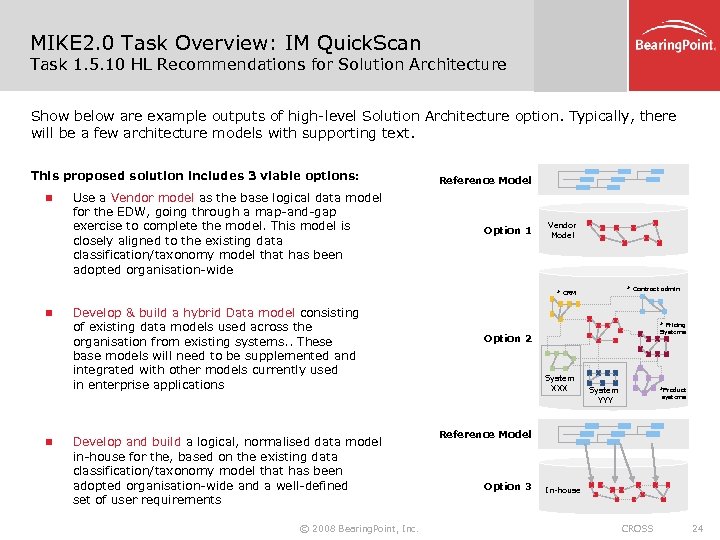 MIKE 2. 0 Task Overview: IM Quick. Scan Task 1. 5. 10 HL Recommendations for Solution Architecture Show below are example outputs of high-level Solution Architecture option. Typically, there will be a few architecture models with supporting text. This proposed solution includes 3 viable options: n Use a Vendor model as the base logical data model for the EDW, going through a map-and-gap exercise to complete the model. This model is closely aligned to the existing data classification/taxonomy model that has been adopted organisation-wide Reference Model Option 1 Vendor Model * Contract admin * CRM n n Develop & build a hybrid Data model consisting of existing data models used across the organisation from existing systems. . These base models will need to be supplemented and integrated with other models currently used in enterprise applications Develop and build a logical, normalised data model in-house for the, based on the existing data classification/taxonomy model that has been adopted organisation-wide and a well-defined set of user requirements © 2008 Bearing. Point, Inc. * Pricing Systems Option 2 System XXX System YYY *Product systems Reference Model Option 3 In-house CROSS 24
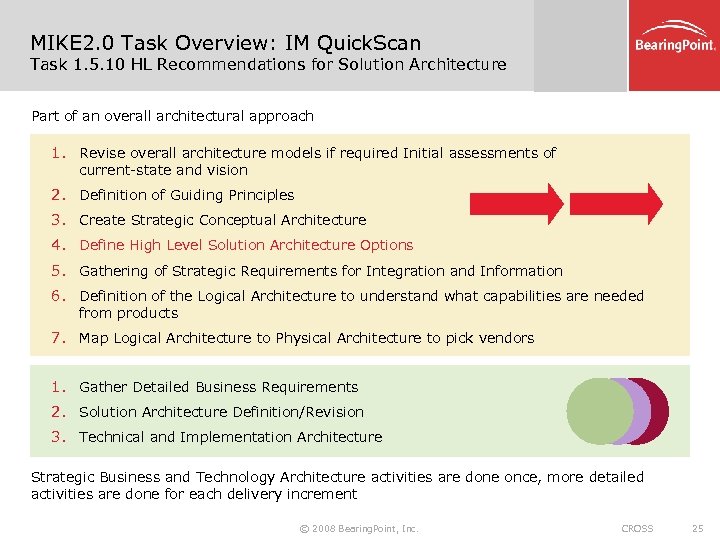 MIKE 2. 0 Task Overview: IM Quick. Scan Task 1. 5. 10 HL Recommendations for Solution Architecture Part of an overall architectural approach 1. Revise overall architecture models if required Initial assessments of current-state and vision 2. Definition of Guiding Principles 3. Create Strategic Conceptual Architecture 4. Define High Level Solution Architecture Options 5. Gathering of Strategic Requirements for Integration and Information 6. Definition of the Logical Architecture to understand what capabilities are needed from products 7. Map Logical Architecture to Physical Architecture to pick vendors 1. Gather Detailed Business Requirements 2. Solution Architecture Definition/Revision 3. Technical and Implementation Architecture Strategic Business and Technology Architecture activities are done once, more detailed activities are done for each delivery increment © 2008 Bearing. Point, Inc. CROSS 25
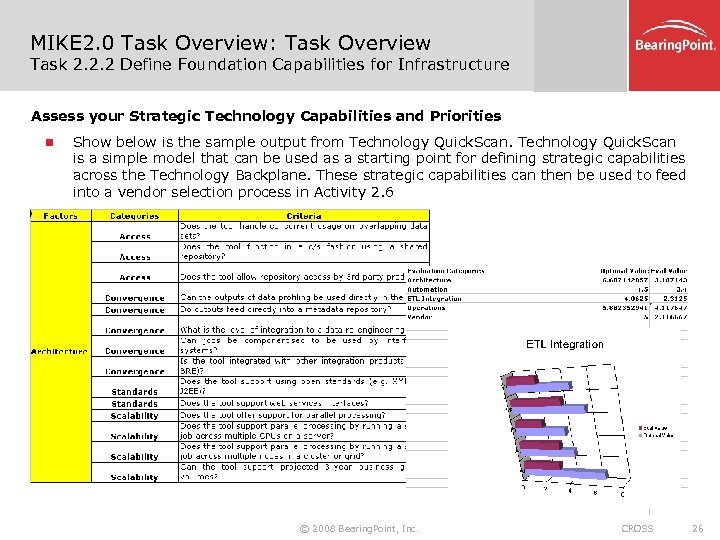 MIKE 2. 0 Task Overview: Task Overview Task 2. 2. 2 Define Foundation Capabilities for Infrastructure Assess your Strategic Technology Capabilities and Priorities n Show below is the sample output from Technology Quick. Scan is a simple model that can be used as a starting point for defining strategic capabilities across the Technology Backplane. These strategic capabilities can then be used to feed into a vendor selection process in Activity 2. 6 © 2008 Bearing. Point, Inc. CROSS 26
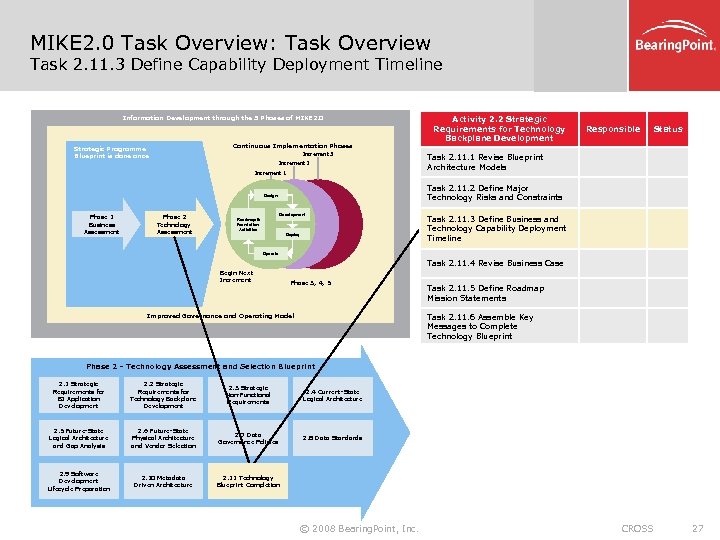 MIKE 2. 0 Task Overview: Task Overview Task 2. 11. 3 Define Capability Deployment Timeline Information Development through the 5 Phases of MIKE 2. 0 Continuous Implementation Phases Strategic Programme Blueprint is done once Increment 3 Increment 2 Increment 1 Phase 2 Technology Assessment Responsible Status Task 2. 11. 1 Revise Blueprint Architecture Models Task 2. 11. 2 Define Major Technology Risks and Constraints Design Phase 1 Business Assessment Activity 2. 2 Strategic Requirements for Technology Backplane Development Roadmap & Foundation Activities Deploy Task 2. 11. 3 Define Business and Technology Capability Deployment Timeline Operate Task 2. 11. 4 Revise Business Case Begin Next Increment Phase 3, 4, 5 Task 2. 11. 5 Define Roadmap Mission Statements Task 2. 11. 6 Assemble Key Messages to Complete Technology Blueprint Improved Governance and Operating Model Phase 2 – Technology Assessment and Selection Blueprint 2. 1 Strategic Requirements for BI Application Development 2. 2 Strategic Requirements for Technology Backplane Development 2. 3 Strategic Non-Functional Requirements 2. 4 Current-State Logical Architecture 2. 5 Future-State Logical Architecture and Gap Analysis 2. 6 Future-State Physical Architecture and Vendor Selection 2. 7 Data Governance Policies 2. 8 Data Standards 2. 9 Software Development Lifecycle Preparation 2. 10 Metadata Driven Architecture 2. 11 Technology Blueprint Completion © 2008 Bearing. Point, Inc. CROSS 27
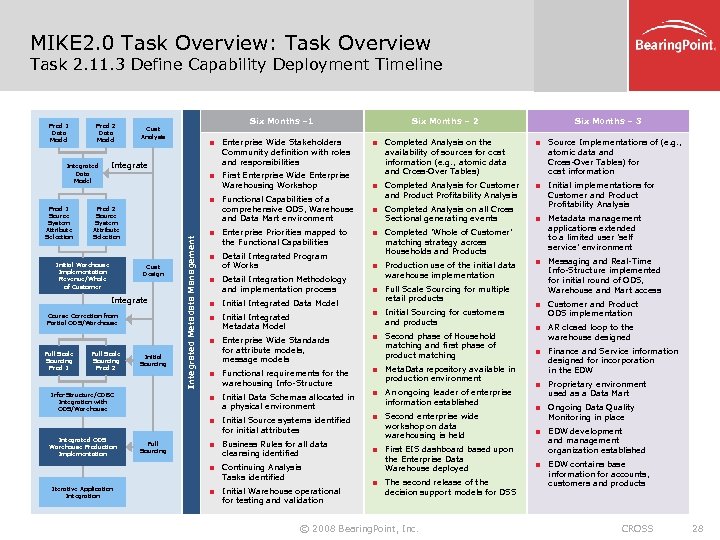 MIKE 2. 0 Task Overview: Task Overview Task 2. 11. 3 Define Capability Deployment Timeline Prod 1 Data Model Prod 2 Data Model Six Months – 1 Cust Analysis n First Enterprise Wide Enterprise Warehousing Workshop Functional Capabilities of a comprehensive ODS, Warehouse and Data Mart environment Integrate Prod 2 Source System Attribute Selection Initial Warehouse Implementation Revenue/Whole of Customer Cust Design Integrated Metadata Management Prod 1 Source System Attribute Selection Enterprise Wide Stakeholders Community definition with roles and responsibilities n Integrated Data Model n Six Months – 2 n Completed Analysis on the availability of sources for cost information (e. g. , atomic data and Cross-Over Tables) n Source Implementations of (e. g. , atomic data and Cross-Over Tables) for cost information n Completed Analysis for Customer and Product Profitability Analysis n n Completed Analysis on all Cross Sectional generating events Initial implementations for Customer and Product Profitability Analysis n n Completed 'Whole of Customer' matching strategy across Households and Products Metadata management applications extended to a limited user 'self service' environment n Messaging and Real-Time Info-Structure implemented for initial round of ODS, Warehouse and Mart access n Customer and Product ODS implementation n AR closed loop to the warehouse designed n Finance and Service information designed for incorporation in the EDW n Proprietary environment used as a Data Mart n Ongoing Data Quality Monitoring in place n EDW development and management organization established n EDW contains base information for accounts, customers and products n Enterprise Priorities mapped to the Functional Capabilities n Detail Integrated Program of Works n Detail Integration Methodology and implementation process Production use of the initial data warehouse implementation n Full Scale Sourcing for multiple retail products n Initial Sourcing Info-Structure/ODBC Integration with ODS/Warehouse Integrated ODS Warehouse Production Implementation Iterative Application Integration Full Sourcing Initial Integrated Metadata Model n Initial Sourcing for customers and products n Enterprise Wide Standards for attribute models, message models n Second phase of Household matching and first phase of product matching n Functional requirements for the warehousing Info-Structure n Meta. Data repository available in production environment Initial Data Schemas allocated in a physical environment n An ongoing leader of enterprise information established Initial Source systems identified for initial attributes n n Business Rules for all data cleansing identified Second enterprise wide workshop on data warehousing is held n Full Scale Sourcing Prod 2 Initial Integrated Data Model n n Full Scale Sourcing Prod 1 n n Course Correction from Partial ODS/Warehouse Six Months – 3 Continuing Analysis Tasks identified n Initial Warehouse operational for testing and validation n n First EIS dashboard based upon the Enterprise Data Warehouse deployed The second release of the decision support models for DSS © 2008 Bearing. Point, Inc. CROSS 28
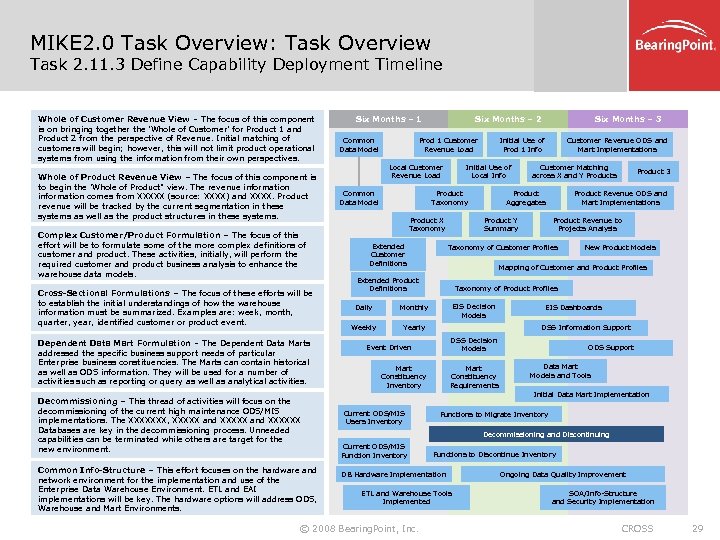 MIKE 2. 0 Task Overview: Task Overview Task 2. 11. 3 Define Capability Deployment Timeline Whole of Customer Revenue View – The focus of this component is on bringing together the 'Whole of Customer' for Product 1 and Product 2 from the perspective of Revenue. Initial matching of customers will begin; however, this will not limit product operational systems from using the information from their own perspectives. Whole of Product Revenue View – The focus of this component is to begin the 'Whole of Product" view. The revenue information comes from XXXXX (source: XXXX) and XXXX. Product revenue will be tracked by the current segmentation in these systems as well as the product structures in these systems. Complex Customer/Product Formulation – The focus of this effort will be to formulate some of the more complex definitions of customer and product. These activities, initially, will perform the required customer and product business analysis to enhance the warehouse data models. Cross-Sectional Formulations – The focus of these efforts will be to establish the initial understandings of how the warehouse information must be summarized. Examples are: week, month, quarter, year, identified customer or product event. Dependent Data Mart Formulation – The Dependent Data Marts addressed the specific business support needs of particular Enterprise business constituencies. The Marts can contain historical as well as ODS information. They will be used for a number of activities such as reporting or query as well as analytical activities. Decommissioning – This thread of activities will focus on the decommissioning of the current high maintenance ODS/MIS implementations. The XXXXXXX, XXXXX and XXXXXX Databases are key in the decommissioning process. Unneeded capabilities can be terminated while others are target for the new environment. Common Info-Structure – This effort focuses on the hardware and network environment for the implementation and use of the Enterprise Data Warehouse Environment. ETL and EAI implementations will be key. The hardware options will address ODS, Warehouse and Mart Environments. Six Months – 1 Common Data Model Six Months – 2 Prod 1 Customer Revenue Load Local Customer Revenue Load Common Data Model Initial Use of Prod 1 Info Initial Use of Local Info Product Taxonomy Product X Taxonomy Extended Customer Definitions Customer Matching across X and Y Products Product Aggregates Product 3 Product Revenue ODS and Mart Implementations Product Revenue to Projects Analysis Taxonomy of Customer Profiles New Product Models Mapping of Customer and Product Profiles Taxonomy of Product Profiles EIS Decision Models Monthly Weekly Customer Revenue ODS and Mart Implementations Product Y Summary Extended Product Definitions Daily Six Months – 3 Yearly EIS Dashboards DSS Information Support DSS Decision Models Event Driven Mart Constituency Inventory Mart Constituency Requirements ODS Support Data Mart Models and Tools Initial Data Mart Implementation Current ODS/MIS Users Inventory Functions to Migrate Inventory Decommissioning and Discontinuing Current ODS/MIS Function Inventory Functions to Discontinue Inventory DB Hardware Implementation ETL and Warehouse Tools Implemented © 2008 Bearing. Point, Inc. Ongoing Data Quality Improvement SOA/Info-Structure and Security Implementation CROSS 29
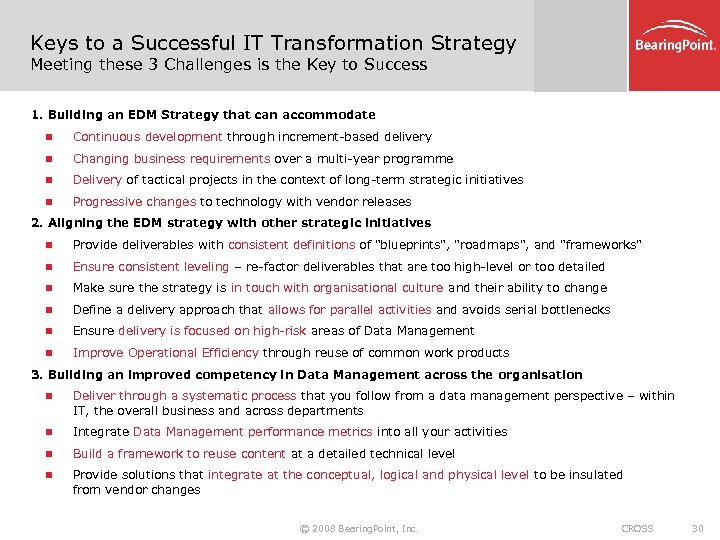 Keys to a Successful IT Transformation Strategy Meeting these 3 Challenges is the Key to Success 1. Building an EDM Strategy that can accommodate n Continuous development through increment-based delivery n Changing business requirements over a multi-year programme n Delivery of tactical projects in the context of long-term strategic initiatives n Progressive changes to technology with vendor releases 2. Aligning the EDM strategy with other strategic initiatives n Provide deliverables with consistent definitions of "blueprints", "roadmaps", and "frameworks" n Ensure consistent leveling – re-factor deliverables that are too high-level or too detailed n Make sure the strategy is in touch with organisational culture and their ability to change n Define a delivery approach that allows for parallel activities and avoids serial bottlenecks n Ensure delivery is focused on high-risk areas of Data Management n Improve Operational Efficiency through reuse of common work products 3. Building an improved competency in Data Management across the organisation n Deliver through a systematic process that you follow from a data management perspective – within IT, the overall business and across departments n Integrate Data Management performance metrics into all your activities n Build a framework to reuse content at a detailed technical level n Provide solutions that integrate at the conceptual, logical and physical level to be insulated from vendor changes © 2008 Bearing. Point, Inc. CROSS 30
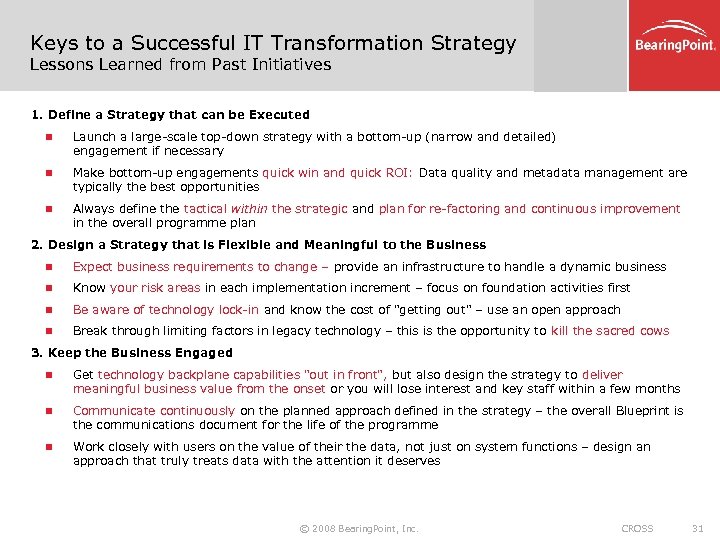 Keys to a Successful IT Transformation Strategy Lessons Learned from Past Initiatives 1. Define a Strategy that can be Executed n Launch a large-scale top-down strategy with a bottom-up (narrow and detailed) engagement if necessary n Make bottom-up engagements quick win and quick ROI: Data quality and metadata management are typically the best opportunities n Always define the tactical within the strategic and plan for re-factoring and continuous improvement in the overall programme plan 2. Design a Strategy that is Flexible and Meaningful to the Business n Expect business requirements to change – provide an infrastructure to handle a dynamic business n Know your risk areas in each implementation increment – focus on foundation activities first n Be aware of technology lock-in and know the cost of "getting out" – use an open approach n Break through limiting factors in legacy technology – this is the opportunity to kill the sacred cows 3. Keep the Business Engaged n Get technology backplane capabilities "out in front", but also design the strategy to deliver meaningful business value from the onset or you will lose interest and key staff within a few months n Communicate continuously on the planned approach defined in the strategy – the overall Blueprint is the communications document for the life of the programme n Work closely with users on the value of their the data, not just on system functions – design an approach that truly treats data with the attention it deserves © 2008 Bearing. Point, Inc. CROSS 31