


 Скачать презентацию TAKE YOUR TECHNOLOGY TO THE LIMIT Center for
241c4b21dd8c0c0462933a33c21cb08c.ppt
- Количество слайдов: 22
 TAKE YOUR TECHNOLOGY TO THE LIMIT! Center for Innovation and Technology Entrepreneurship T e c h n o l o g y E n t r e p r e n e u r s h i p f r o m I n n o v a t i o n t o B u s i n e s s V e n t u r e The Foundation: Structuring Your New Venture and Raising the Cash Center for Innovation and Technology Entrepreneurship UTSA Colleges of Business and Engineering CITE Boot. Camp September 2010 1
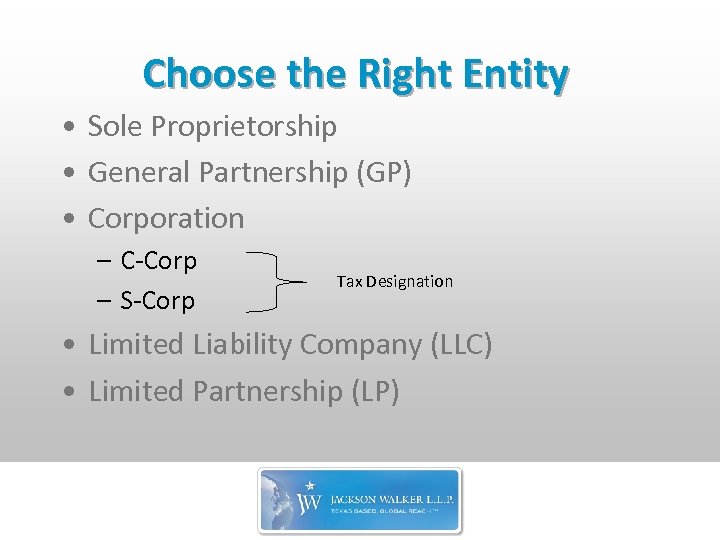 Choose the Right Entity • Sole Proprietorship • General Partnership (GP) • Corporation – C-Corp – S-Corp Tax Designation • Limited Liability Company (LLC) • Limited Partnership (LP)
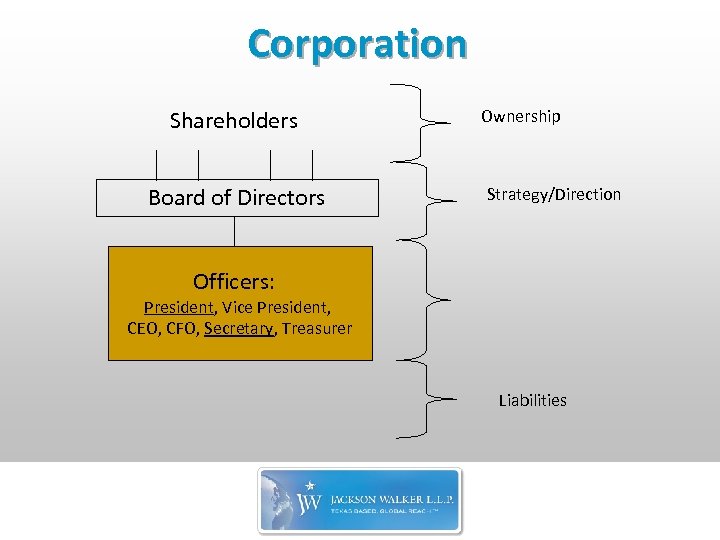 Corporation Shareholders Board of Directors Ownership Strategy/Direction Officers: President, Vice President, CEO, CFO, Secretary, Treasurer Liabilities
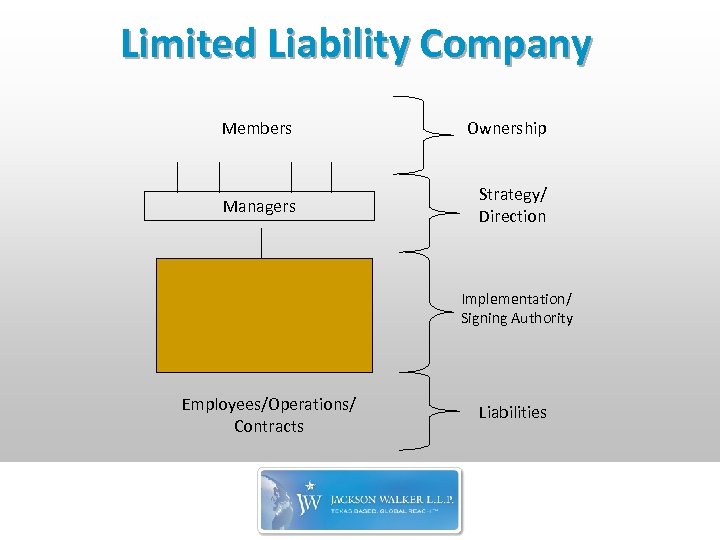 Limited Liability Company Members Ownership Managers Strategy/ Direction Implementation/ Signing Authority Employees/Operations/ Contracts Liabilities
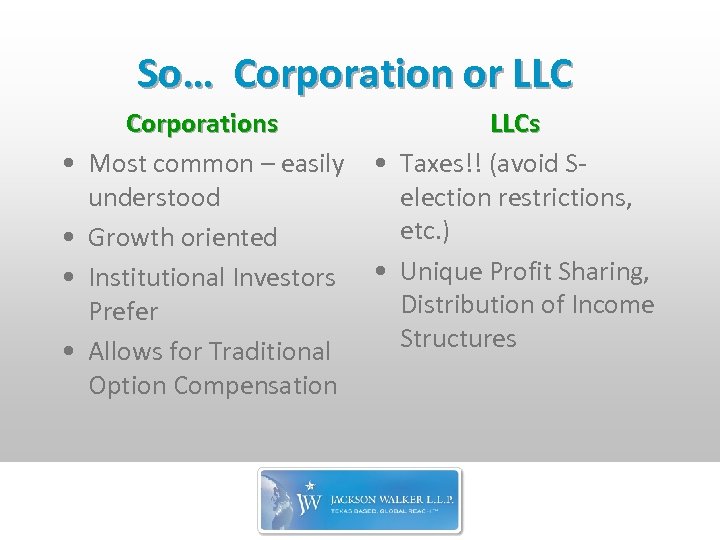 So… Corporation or LLC • • Corporations Most common – easily understood Growth oriented Institutional Investors Prefer Allows for Traditional Option Compensation LLCs • Taxes!! (avoid Selection restrictions, etc. ) • Unique Profit Sharing, Distribution of Income Structures
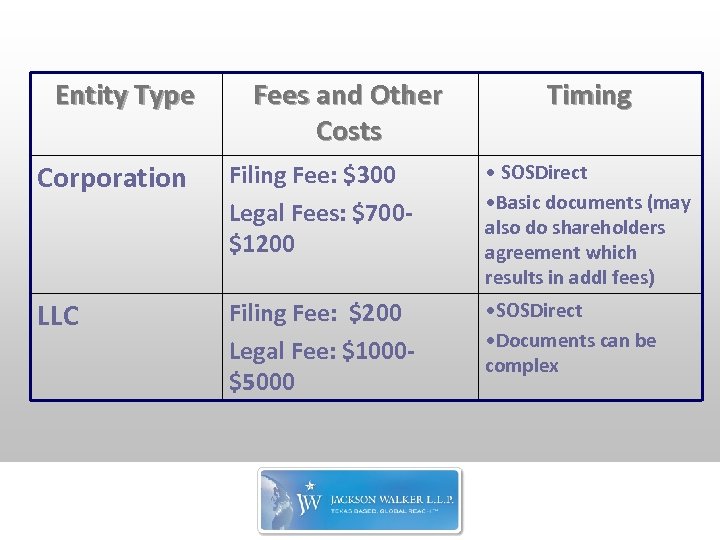 Entity Type Fees and Other Costs Timing Corporation Filing Fee: $300 Legal Fees: $700$1200 • SOSDirect • Basic documents (may also do shareholders agreement which results in addl fees) LLC Filing Fee: $200 Legal Fee: $1000$5000 • SOSDirect • Documents can be complex
 Joint Ownership Issues • Not only your partner, but … • Buy-sell/Shareholders agreements – What if I don’t want to keep doing this? – What if my partner dies? Gets divorced? Files for bankruptcy? • Issues are always easier to resolve before money is a factor
 Annual Maintenance • Annual Minutes – Shareholders Elect Directors – Directors Elect Officers • Special Meeting Minutes • State Filings – Public Information Report (PIR) – Tax Return
 RULES FOR RAISING FUNDS Starting Place: Registration Required • All offerings must be registered with the SEC • Unless, that offering is exempt from Registration • Doesn’t matter if small private sale or an offering which is immediately listed on the NYSE
 Offer vs. Sale • Offer triggers compliance requirements • Compliance must happen before selling process starts
 Private Offerings = Exempt • Privately negotiated sales • Must not involve any general solicitation or general advertising • Section 4(2)* - the private-offering exemption “transactions by an issuer not involving any public offering” * Securities Act of 1933 (the “Securities Act”)
 Reg D • Rule 504 provides an exemption for the offer and sale of up to $1 million of securities in a 12 -month period • Rule 505 provides an exemption for offers and sales of securities totaling up to $5 million in any 12 -month period. • Rule 506 provides another exemption for sales of securities under Section 4(2) with no dollar limit.
 Rule 506 • Unlimited number of “accredited investors” and 35 “sophisticated” nonaccredited investors • Popular if integration is a concern • Popular to comply with Blue Sky (National Securities Markets Improvement Act of 1996 (NSMIA) removed offerings under Rule 506 from state regulation)
 “Accredited Investor” • a bank, insurance company, registered investment company, etc. • an employee benefit plan • a charitable organization, corporation or partnership with assets ≥ $5 million • a director, executive officer or general partner of the company selling the securities • a business in which all the equity owners are accredited investors • a natural person with a net worth of at least $1 million (not including house) • a natural person with income exceeding $200, 000 in each of the two most recent years or joint income with a spouse exceeding $300, 000 • a trust with assets of at least $5 million
 Why Only Accredited Investors? • Private placement memorandum (“PPM”) that meets Reg D requirements = $$$$$ • If more than $1 million is raised in a 12 -month period, Rule 504 is not available • Under Rule 505 and 506, a PPM would be required to offer securities to nonaccredited investors • NOTE: Even if not required, delivering a PPM or at least a detailed business plan is probably advisable for liability and marketing reasons, particularly in fulfilling the antifraud requirement
 Traditional and Non-Traditional Lenders • Most major traditional banks do not lend to startups/do so only rarely • Comerica, Square 1 Bank, Silicon Valley Bank lend to entrepreneurial companies • Accts Receivable, Inventory, Fixed Assets • Very sensitive to market conditions – this last down turn caused them to become risk adverse • Terms may include: company’s stock, fees, collateral, agreement to pay for AR audits, monthly reporting, audited financial statements, compliance reporting, financial covenants plus all banking relationships – checking, credit cards, investments, etc. must be with lender
 Angel Investors • Friends and Family • Angel Funding – wealthy private individuals, with background in business, usually smaller than VC’s ($25 K $250 K). They prefer to deal directly with the entrepreneur, like local deals, often want to develop a relationship with owners, they are limited in the number of investments they will do concurrently. Usually easier to deal with than VC’s. Invaluable to start-ups. Must Still Comply with Applicable Securities Laws: • Exemption (“accredited investors”) • Notice Filings
 Venture Capital ($1 million - $50 million) Advantages • Excellent source of capital / funding committed to your business • VC’s often are prepared to invest in continued rounds as the business grows and achieve its milestones • Bring valuable skills, contacts, experience and discipline to your business • VC’s have common goals with the entrepreneur – growth, profitability and increased value of the business • VC’s time horizon is often 3 – 7 years before exiting. • Looking to have a 3 – 7 times return on their capital • Exiting usually in the form of a Public Offering or Sale to a larger business after reaching certain milestones.
 Venture Capital ($1 million - $50 million) Disadvantages • Raising Equity Capital – demanding, costly, time consuming. Your business suffers as you devote your time to answering questions • Due Diligence process can be brutal – background checks, justification of your business plan, legal review, patent review, financial forecasts, etc. (Note: this can be a very useful process to force management to think through every issue. This is valuable even if funding doesn’t occur) • Often the entrepreneur will lose control after 2 nd round of financing. VC’s may want to bring in a marquee CEO, CFO, etc. to run the business. • Management reporting to the VC’s is often onerous, requiring 4 to 6 board meetings per year plus answering questions, providing updates and monthly reporting.
 Other Options • Grants • Governmental Funds • Strategic Partnerships
 READ EVERYTHING … • “Boilerplate” = Most important provisions, do NOT ignore • Don’t assume a provision can’t be changed • Don’t sign contracts until reviewed by a lawyer
 Nicole Gewinner Associate – Jackson Walker L. L. P. Nicole Gewinner in Austin at 512. 2366 Ngewinner@jw. com 100 Congress Avenue, Suite 1100 Austin, Texas 78701 www. jw. com