


 Скачать презентацию TAKE YOUR TECHNOLOGY TO THE LIMIT Center for
969b194cfdb3fcf2a21f074d3be26ff8.ppt
- Количество слайдов: 27
 TAKE YOUR TECHNOLOGY TO THE LIMIT! Center for Innovation and Technology Entrepreneurship T e c h n o l o g y E n t r e p r e n e u r s h i p f r o m I n n o v a t i o n t o B u s i n e s s V e n t u r e The Foundation: Structuring Your New Venture and Raising the Cash Stephanie L. Chandler and George Karutz January 28, 2012 Center for Innovation and Technology Entrepreneurship UTSA Colleges of Business and Engineering Jackson Walker L. L. P. www. jw. com Karutz Flavin Wells Investment Banking www. kfwib. com CITE Boot. Camp September 2010 1
 Stephanie Chandler George Karutz , Jr. , CFA Partner – Jackson Walker L. L. P. Partner – Karutz Flavin Wells Firmwide Head of JW’s Technology Section, Startech Board, Emerging Technology Fund Local Selection Committee Regional Investment Bank advising technology start-up ventures on financial, strategic and operational matters
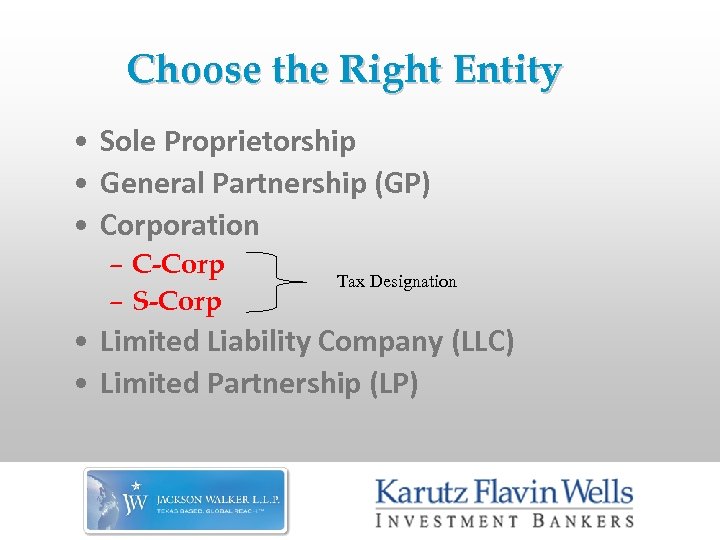 Choose the Right Entity • Sole Proprietorship • General Partnership (GP) • Corporation – C-Corp – S-Corp Tax Designation • Limited Liability Company (LLC) • Limited Partnership (LP)
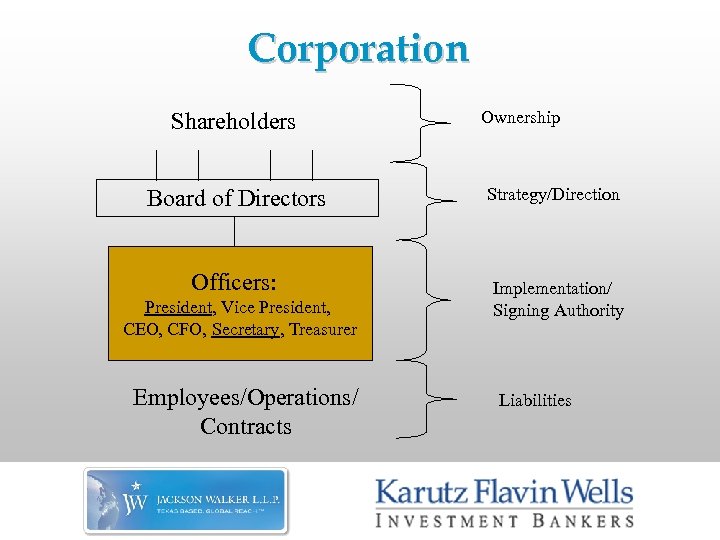 Corporation Shareholders Board of Directors Officers: President, Vice President, CEO, CFO, Secretary, Treasurer Employees/Operations/ Contracts Ownership Strategy/Direction Implementation/ Signing Authority Liabilities
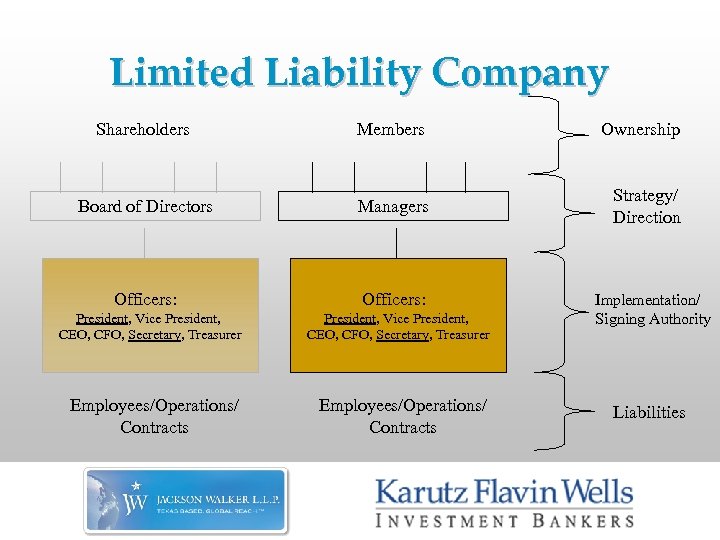 Limited Liability Company Shareholders Members Ownership Board of Directors Managers Strategy/ Direction Officers: President, Vice President, CEO, CFO, Secretary, Treasurer Employees/Operations/ Contracts Implementation/ Signing Authority Liabilities
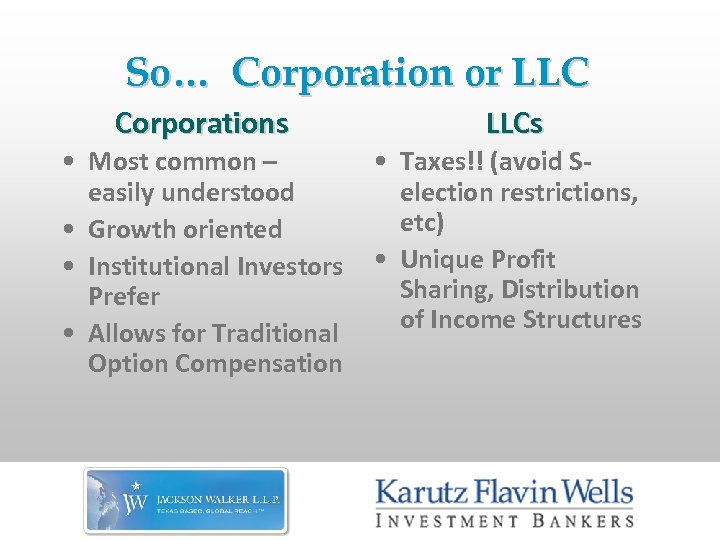 So… Corporation or LLC Corporations LLCs • Most common – easily understood • Growth oriented • Institutional Investors Prefer • Allows for Traditional Option Compensation • Taxes!! (avoid Selection restrictions, etc) • Unique Profit Sharing, Distribution of Income Structures
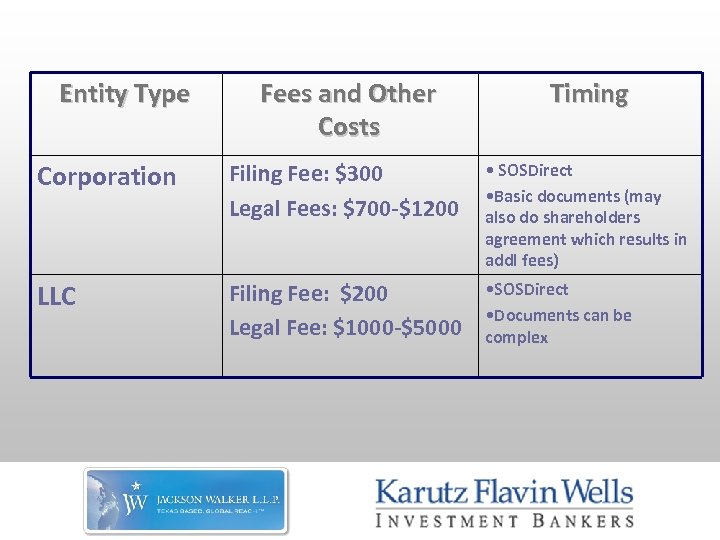 Entity Type Fees and Other Costs Timing Corporation Filing Fee: $300 Legal Fees: $700 -$1200 • SOSDirect • Basic documents (may also do shareholders agreement which results in addl fees) LLC Filing Fee: $200 Legal Fee: $1000 -$5000 • SOSDirect • Documents can be complex
 Joint Ownership Issues Not only your partner, but … Buy-sell/Shareholders agreements What if I don’t want to keep doing this? What if my partner dies? Gets divorced? Files for bankruptcy? Issues are always easier to resolve before money is a factor
 Annual Maintenance • Annual Minutes – Shareholders Elect Directors – Directors Elect Officers • Special Meeting Minutes • State Filings – Public Information Report (PIR) – Tax Return
 RULES FOR RAISING FUNDS Starting Place: Registration Required • All offerings must be registered with the SEC • Unless, that offering is exempt from Registration • Doesn’t matter if small private sale or an offering which is immediately listed on the NYSE
 Offer vs. Sale • Offer triggers compliance requirements • Compliance must happen before selling process starts
 Private Offerings = Exempt • Privately negotiated sales • Must not involve any general solicitation or general advertising • Section 4(2)* - the private-offering exemption “transactions by an issuer not involving any public offering” * Securities Act of 1933 (the “Securities Act”)
 Reg D • Rule 504 provides an exemption for the offer and sale of up to $1 million of securities in a 12 -month period • Rule 505 provides an exemption for offers and sales of securities totaling up to $5 million in any 12 -month period. • Rule 506 provides another exemption for sales of securities under Section 4(2) with no dollar limit.
 Rule 506 • Unlimited number of “accredited investors” and 35 “sophisticated” nonaccredited investors • Popular if Integration is a concern • Popular to comply with Blue Sky (National Securities Markets Improvement Act of 1996 (NSMIA) removed offerings under Rule 506 from state regulation)
 “Accredited Investor” • • a bank, insurance company, registered investment company, etc. an employee benefit plan a charitable organization, corporation or partnership with assets ≥ $5 million a director, executive officer or general partner of the company selling the securities a business in which all the equity owners are accredited investors a natural person with a net worth of at least $1 million (not including house) a natural person with income exceeding $200, 000 in each of the two most recent years or joint income with a spouse exceeding $300, 000 a trust with assets of at least $5 million
 Why Only Accredited Investors? Private placement memorandum (“PPM”) that meets Reg D requirements = $$$$$ If more than $1 million is raised in a 12 -month period, Rule 504 is not available Under Rule 505 and 506, a PPM would be required to offer securities to nonaccredited investors NOTE: Even if not required, delivering a PPM or at least a detailed business plan is probably advisable for liability and marketing reasons, particularly in fulfilling the antifraud requirement.
 Traditional and Non-Traditional Lenders Most major traditional banks do not lend to startups/do so only rarely Comerica, Square 1 Bank, Silicon Valley Bank lend to entrepreneurial companies (positive c/f) Accts Receivable, Inventory, Fixed Assets Very sensitive to market conditions – this last down turn caused them to become risk adverse Terms may include: company’s stock, fees, collateral, agreement to pay for AR audits, monthly reporting, audited financial statements, compliance reporting, financial covenants plus all banking relationships – checking, credit cards, investments, etc. must be with lender
 Angel Investors q q Friends and Family Angel Funding – wealthy private individuals, with background in business, usually smaller than VC’s ($25 K - $250 K). They prefer to deal directly with the entrepreneur, like local deals, often want to develop a relationship with owners, they are limited in the number of investments they will do concurrently. Usually easier to deal with than VC’s. Invaluable to startups. Must Still Comply with Applicable Securities Laws: • Exemption (“accredited investors”) • Notice Filings
 Venture Capital ($1 million - $50 million) Advantages q q q q Excellent source of capital / funding committed to your business VC’s often are prepared to invest in continued rounds as the business grows and achieve it’s milestones Bring valuable skills, contacts, experience and discipline to your business VC’s have common goals with the entrepreneur – growth, profitability and increased value of the business VC’s time horizon is often 3 – 7 years before exiting. Looking to have a 3 – 7 times return on their capital Exiting usually in the form of a Public Offering or Sale to a larger business after reaching certain milestones.
 Venture Capital ($1 million - $50 million) Disadvantages q q Raising Equity Capital – demanding, costly, time consuming. Your business suffers as you devote your time to answering questions Due Diligence process can be brutal – background checks, justification of your business plan, legal review, patent review, financial forecasts, etc (note: this can be a very useful process to force management to think through every issue. This is valuable even if funding doesn’t occur) q q Often the entrepreneur will lose control after 2 nd round of financing. VC’s may want to bring in a marquee CEO, CFO, etc. to run the business. Management reporting to the VC’s is often onerous, requiring 4 to 6 board meetings per year plus answering questions, providing updates and monthly reporting. [war story]
 Grants • GRANTS. gov • STTR (Small Business Technology Transfer) – 5 federal departments participate – 0. 3% of the relevant agencies' extramural research budgets • CPRIT (Cancer Prevention and Research Institute of Texas)
 Governmental Funds • Texas Emerging Technology Fund (ETF) – Apply through Startech (South Texas) – Emerging scientific or technology fields that have a reasonable probability of enhancing this state ’s national and global economic competitiveness. – Additional preference is given to proposals that: • May result in a medical or scientific breakthrough; • Have previous equity investment into the company; • Have a demonstrable economic development benefit to this state; or • Guarantee commercialization or manufacturing in Texas if successful – Must have partnership with Texas State institution
 Strategic Partnering • Strategic Private Investors/Partners – Large corporations • Potential Acquirors • Potential Customers
 Getting Comfortable with Investor Terminology • NVCA Model Legal Documents – www. nvca. org - Model Legal Docs Button • Know Offering Terminology
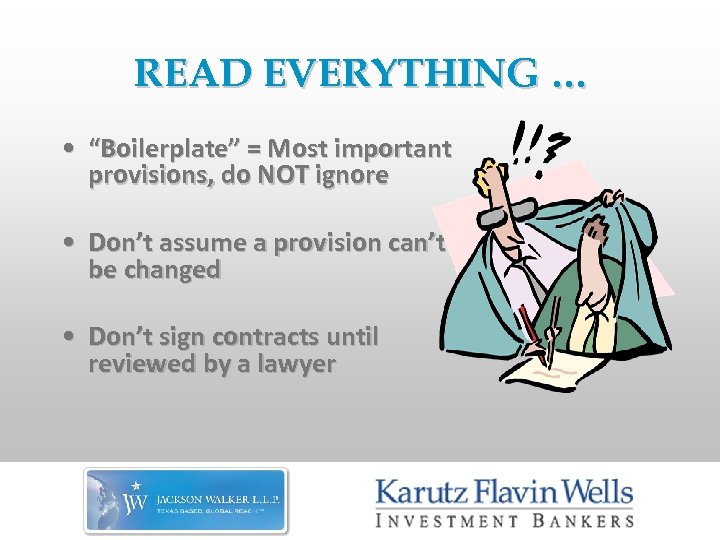 READ EVERYTHING … • “Boilerplate” = Most important provisions, do NOT ignore • Don’t assume a provision can’t be changed • Don’t sign contracts until reviewed by a lawyer
 Stephanie Chandler Jackson Walker L. L. P. 210. 978. 7704 schandler@jw. com 112 E. Pecan Street, Ste. 2400 San Antonio, Texas 78205 www. jw. com George Karutz Flavin 210. 804. 4240 karutz@kwfib. com 115 W. El Prado, Suite 1 San Antonio, Texas 78212 www. kfwib. com
 TAKE YOUR TECHNOLOGY TO THE LIMIT! Center for Innovation and Technology Entrepreneurship T e c h n o l o g y E n t r e p r e n e u r s h i p f r o m I n n o v a t i o n t o B u s i n e s s V e n t u r e The Foundation: Structuring Your New Venture and Raising the Cash Stephanie L. Chandler and George Karutz January 29, 2011 Center for Innovation and Technology Entrepreneurship UTSA Colleges of Business and Engineering Jackson Walker L. L. P. www. jw. com Karutz Flavin Wells Investment Banking www. kfwib. com CITE Boot. Camp September 2010 27