 Скачать презентацию Так ли туманно будущее ПИФов Россияне теряют интерес
12 bonds, capital markets.pptx
- Количество слайдов: 59



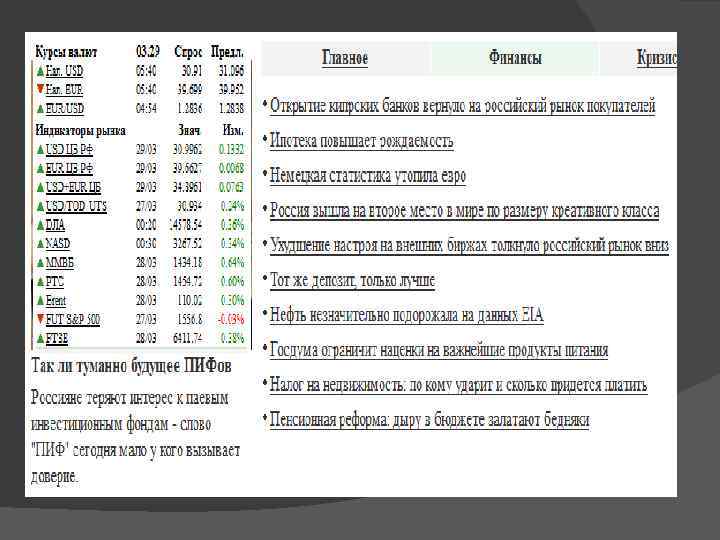
Так ли туманно будущее ПИФов Россияне теряют интерес к паевым инвестиционным фондам - слово «ПИФ» сегодня мало у кого вызывает доверие. Между тем управление фондами основано на выборе лучших акций крупнейших российских компаний на базе фундаментального анализа бизнеса и отрасли либо на выборе эмитентов облигаций с хорошим кредитным качеством, позволяющих обеспечить стабильный прирост капитала при высоком уровне ликвидности и диверсифицированном кредитном риске. При управлении фондами используется сочетание макроэкономического анализа рынков и анализа конкретных эмитентов. И осуществляют управление ПИФами профессионалы. Так почему же теряется интерес к инвестированию в ПИФы – связано ли это с потерей доверия к управляющим компаниям, или на то есть другие причины? Самая главная причина потери интереса россиян к инвестициям в ПИФы кроется прежде всего в слабой динамике российского фондового рынка в последние годы. Кризис сделал свое дело – аппетит к риску у большинства инвесторов пропал, а российские эмитенты принадлежат именно к рисковым активам. Снижение интереса к российскому фондовому рынку в целом не могло не сказаться и на ПИФах. За прошедший год из них было выведено около 10 млрд рублей – рекордная сумма за весь посткризисный период. Максимальные потери отечественный рынок коллективных инвестиций понес в кризисные 2008 -2009 годы - тогда клиенты вывели 16, 5 и 11, 7 млрд рублей соответственно. http: //lf. rbc. ru/recommendation/pif/2013/03/28/224540. shtml
The Economist. com news Michalis Sarris, the finance minister of Cyprus, said that capital controls would remain in place for “a matter of weeks” to stop money rushing out of the country after its bail-out. Markets were unsettled by a succession of mixed messages from European officials about whether the Cypriot deal was a template for other bailouts. The sense of confusion was underscored by the resignation of the chairman of Bank of Cyprus, apparently because no one had discussed the bank’s forced restructuring with its management. Michael Dell’s attempt to buy out the computer company he founded got a little complicated, as two rival bids emerged. Blackstone, a private-equity group, made an informal approach worth $14. 25 a share for Dell, while Carl Icahn, an activist investor, said he might be interested in buying 58% of the company for $15 a share. Both offers are higher than the $13. 65 a share that Mr Dell has proposed, but which Dell’s biggest external shareholders say is not enough. Goldman Sachs and Warren Buffett reworked the arrangement they reached in 2008 when Mr Buffett came to the bank’s rescue, by turning his initial investment in warrants into a stake of around 2%. Mr Buffett recalled that his relationship with Goldman stretches back to 1940, when as a boy he met Sidney Weinberg (“Mr Wall Street”). The bank said it was pleased he remains “a long-term investor”.
The Securities and Exchange Commission approved NASDAQ ’s proposal to pay $62 m to brokers in compensation for the glitches that beset the first day of trading in Facebook’s IPO last May. NASDAQ insists it is under no obligation to fork out for the brokers’ losses, which total around $500 m, $360 m of them at UBS, a Swiss bank. The European Union and Japan agreed to start talks on a free-trade pact, the latest instance of countries trying to establish trading arrangements outside the auspices of the listless World Trade Organisation. The EU and America plan to start negotiating a deal of their own and America is at the forefront of the push for a pan. Pacific concord.
Foxconn, which assembles many of the electronic products designed by Apple, Samsung and others, reported a record annual profit of $3. 2 billion. Around 30% of its revenues come from making the i. Phone. Its Chinese factories benefited from last year’s release of the i. Phone 5. Meanwhile, Chinese state media ran a prominent attack on Apple for the second time in as many weeks, criticising its customer service. Earlier, an official research paper warned against the dominance of Google’s mobile operating system, Android. China-watchers wonder if the government is trying to advance the interests of domestic smartphone-makers, such as ZTE and Lenovo.
House prices in America are rising at their fastest pace since mid-2006, according to the Case-Shiller index, which grew by 8. 1% in January on an annual basis. Places that endured the most spectacular property crashes are now seeing some of the biggest spurts: prices were up by 23% in Phoenix, 15% in Las Vegas, 11% in Miami and 10% in San Diego. Cheniere Energy, which is based in Houston, struck a big deal to ship liquefied natural gas to Centrica, Britain’s largest gas supplier. The contract, which starts in 2018 and lasts for 20 years, illustrates how the shale boom is increasing American gas exports.
A private-equity firm bought the British arm of Blockbuster, which entered administration in January. Half the British stores operated by the DVD-rental chain will be saved, along with 2, 000 jobs. Blockbuster’s American parent went through a similar process in order to leave bankruptcy protection in 2011. Boeing conducted the first test flight of a 787 Dreamliner fitted with a rejigged lithium-ion battery system. The jet has been grounded worldwide since January because of problems caused by overheating batteries. Yahoo extended its reach on mobile devices by acquiring Summly, an app that delivers snippets of news. Summly was a bestselling app for Apple last year. The deal turns its 17 -yearold creator, Nick D’Aloisio, into a millionaire. He has secured a job in Yahoo’s London office—for when he finishes school.
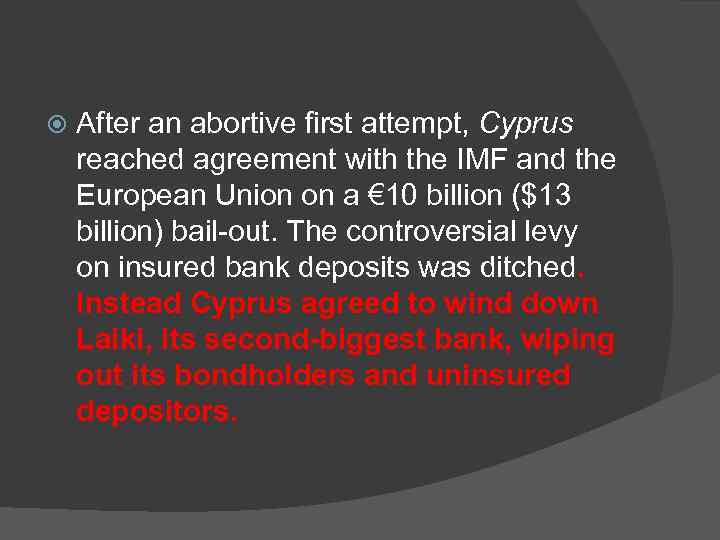
After an abortive first attempt, Cyprus reached agreement with the IMF and the European Union on a € 10 billion ($13 billion) bail-out. The controversial levy on insured bank deposits was ditched. Instead Cyprus agreed to wind down Laiki, its second-biggest bank, wiping out its bondholders and uninsured depositors.
CH 12 THE CAPITAL MARKETS: BONDS
Overview Capital Market 1. Participants and trading 2. Listing II. Capital Market securities 1. Treasury Bonds 2. Treasury STRIPS 3. Municipal Bonds 4. Corporate bonds I.
I. Capital Markets Original maturity is greater than one year Best known capital market securities: Stocks and bonds Primary issuers of securities: Federal and local governments Corporations Largest purchasers of securities: Institutional & individual investors
Capital Market Trading 1. Primary market for initial sale (IPO) • • 2. To raise money To improve the company's profile and increase the potential for the mergers and acquisitions. Secondary market Over-the-counter Organized exchanges (i. e. , NYSE)
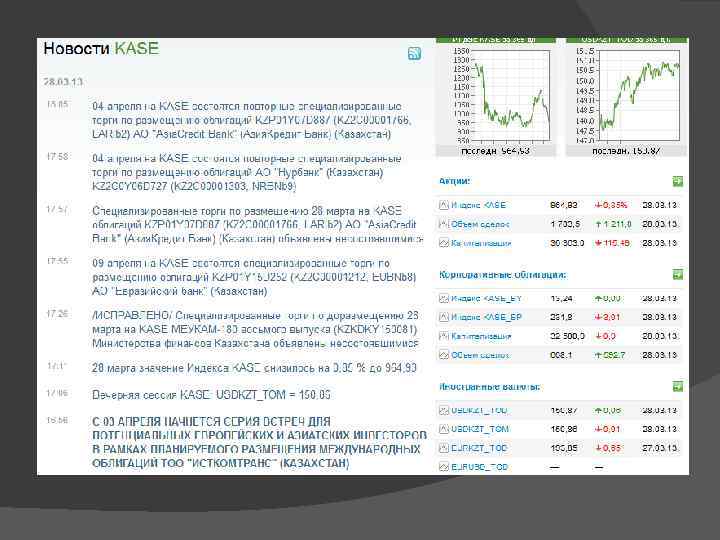
Listing is the procedure to allow the securities to be traded at the Exchange Through the listing the following is achieved : Transparency of the listing companies’ activities and financial positions Information disclosure Assignment of the particular category to the share (e. g. A or B for the stocks according to the KASE regulation) Market price of the security! Listing requirements vary across the countries
Number of Listed Companies Yearly Comparison with NYSE, AMEX, and Nasdaq Page 339
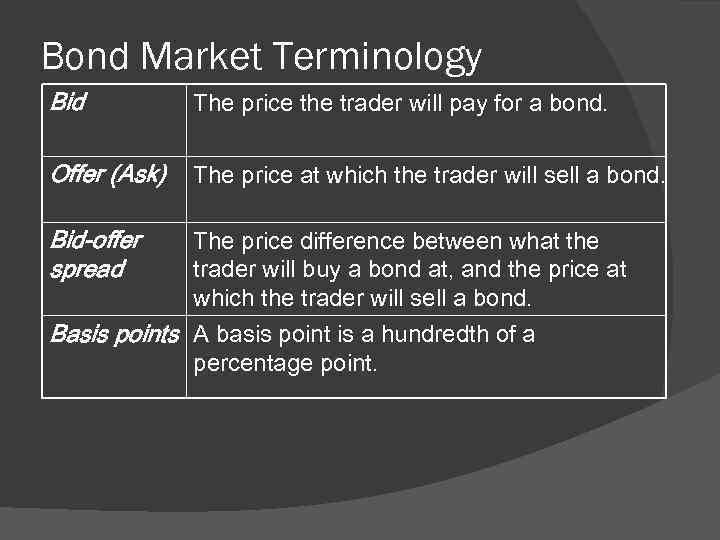
Bond Market Terminology Bid The price the trader will pay for a bond. Offer (Ask) The price at which the trader will sell a bond. Bid-offer spread The price difference between what the trader will buy a bond at, and the price at which the trader will sell a bond. Basis points A basis point is a hundredth of a percentage point.
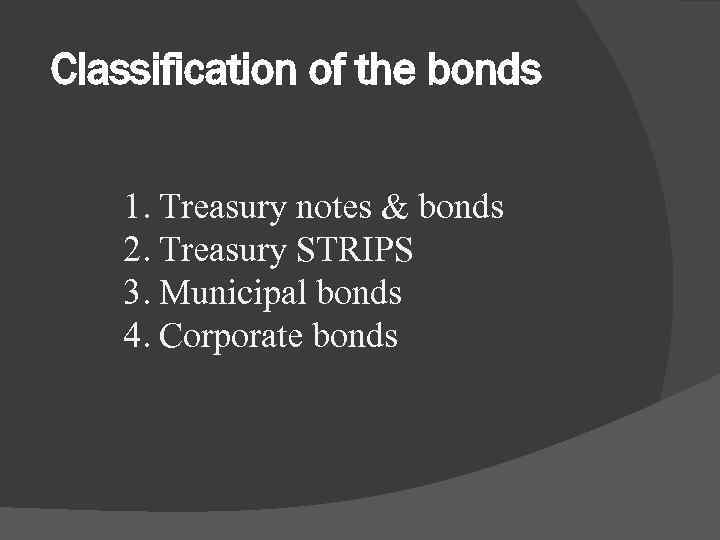
Classification of the bonds 1. Treasury notes & bonds 2. Treasury STRIPS 3. Municipal bonds 4. Corporate bonds
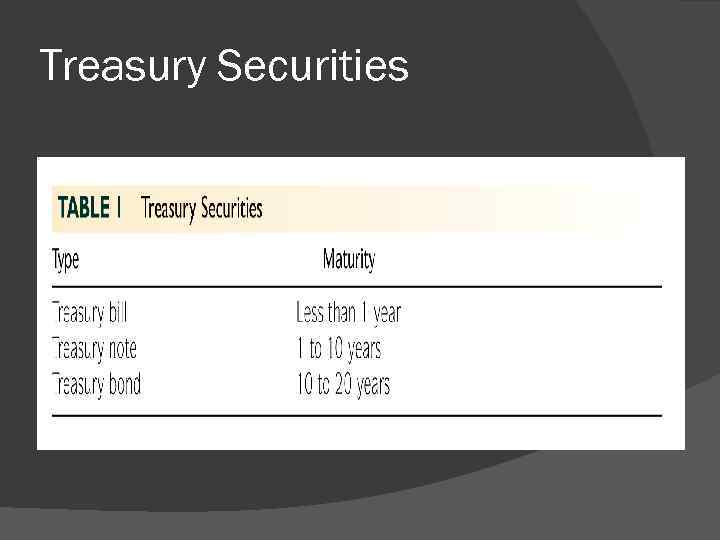
Treasury Securities
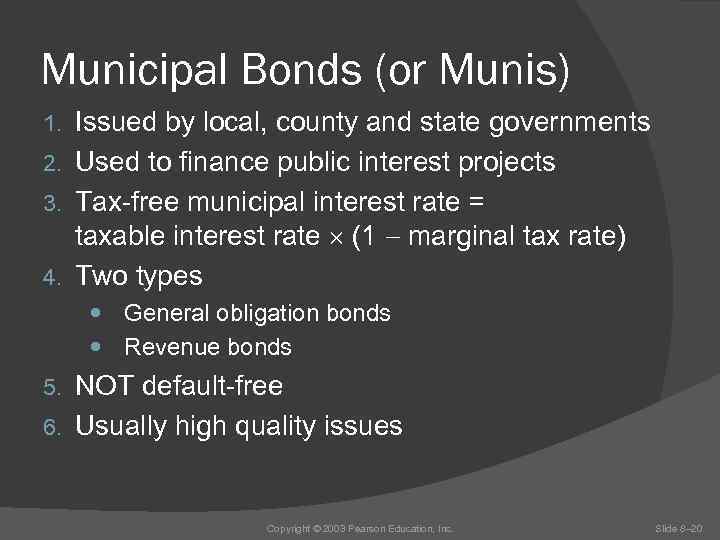
Municipal Bonds (or Munis) Issued by local, county and state governments 2. Used to finance public interest projects 3. Tax-free municipal interest rate = taxable interest rate (1 marginal tax rate) 4. Two types 1. General obligation bonds Revenue bonds NOT default-free 6. Usually high quality issues 5. Copyright © 2003 Pearson Education, Inc. Slide 8– 20
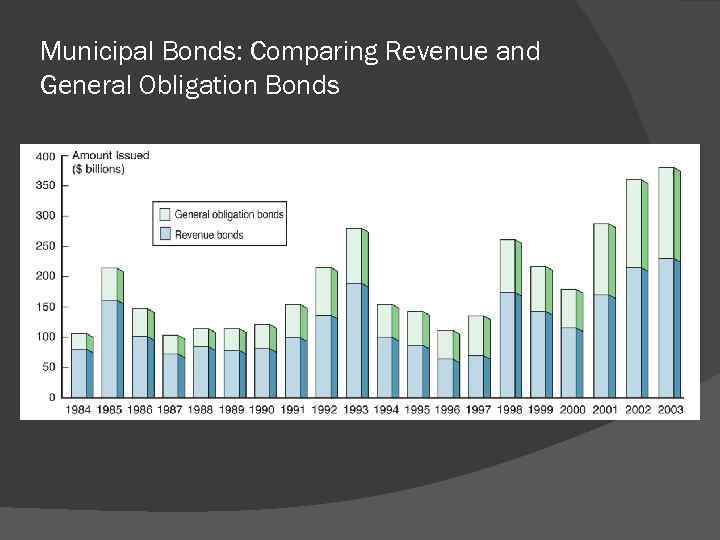
Municipal Bonds: Comparing Revenue and General Obligation Bonds
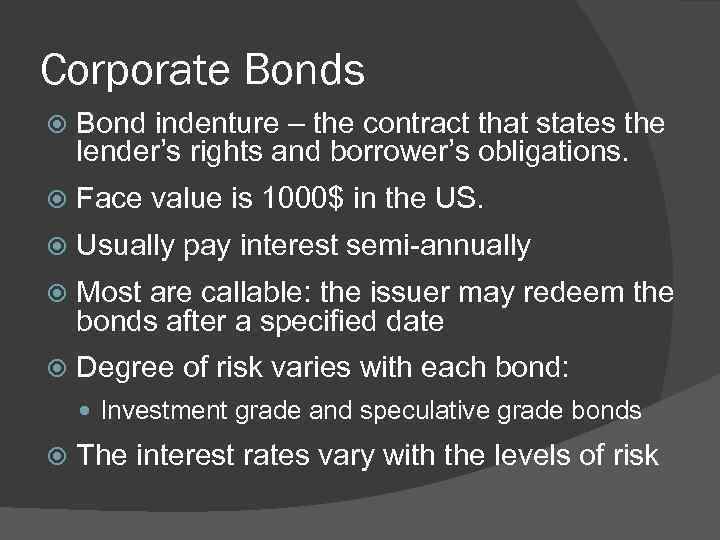
Corporate Bonds Bond indenture – the contract that states the lender’s rights and borrower’s obligations. Face value is 1000$ in the US. Usually pay interest semi-annually Most are callable: the issuer may redeem the bonds after a specified date Degree of risk varies with each bond: Investment grade and speculative grade bonds The interest rates vary with the levels of risk
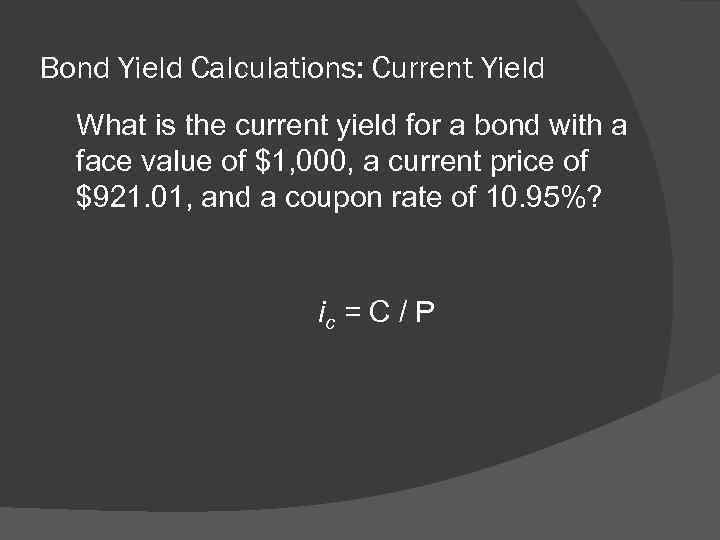
Bond Yield Calculations: Current Yield What is the current yield for a bond with a face value of $1, 000, a current price of $921. 01, and a coupon rate of 10. 95%? ic = C / P
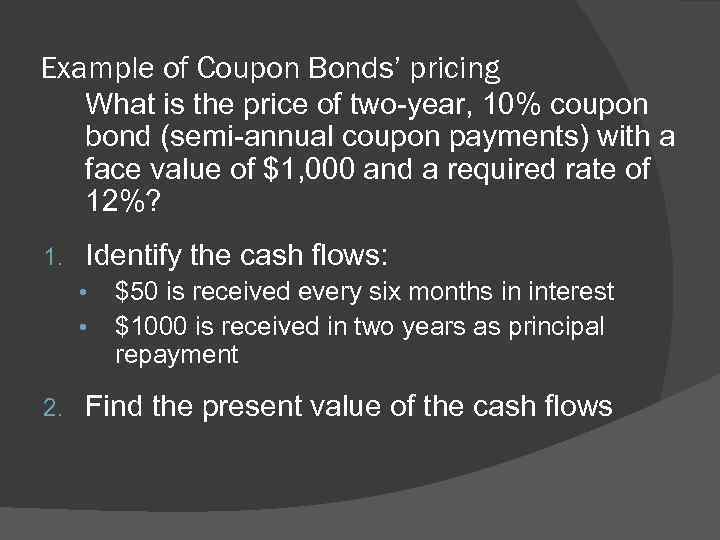
Example of Coupon Bonds’ pricing What is the price of two-year, 10% coupon bond (semi-annual coupon payments) with a face value of $1, 000 and a required rate of 12%? 1. Identify the cash flows: • • 2. $50 is received every six months in interest $1000 is received in two years as principal repayment Find the present value of the cash flows
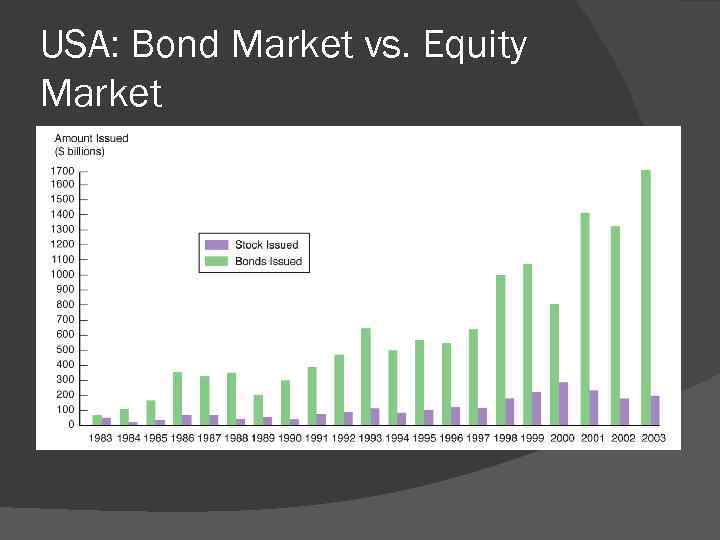
USA: Bond Market vs. Equity Market

Page 315 descriptions Copyright © 2003 Pearson Education, Inc. Slide 8– 26
Ch 13 The Capital Markets: Stocks
Overview Capital market securities: stocks II. Valuation of the Common Stock Price: Ø Dividend discount model Ø Dividend growth model Ø P/E ratio model Ø Errors in valuation III. Stock Indexes I.
I. CAPITAL MARKET SECURITIES : STOCKS 1. 2. 3. 4. 5. 6. Represents ownership in a firm Earn a return in two ways Price of the stock rises over time Dividends are paid to the stockholder Stockholders have claim on all assets Right to vote for directors and on certain issues Common stocks (right to vote, receive dividends) Preferred stocks (Receive a fixed dividends, do not usually vote)
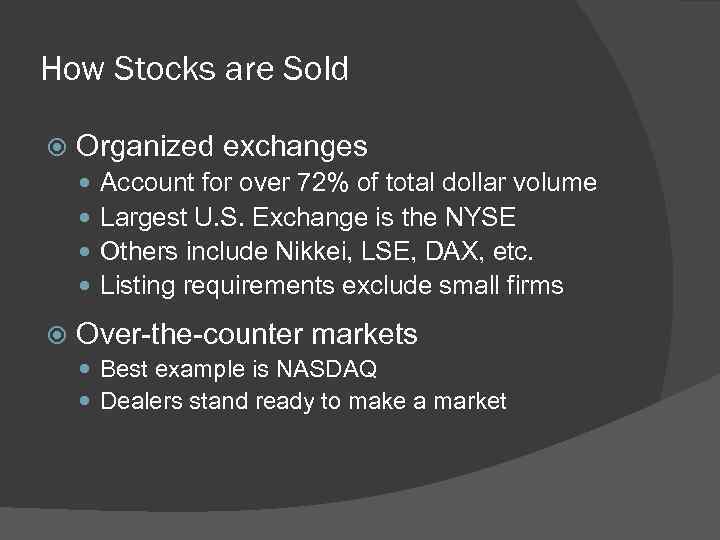
How Stocks are Sold Organized exchanges Account for over 72% of total dollar volume Largest U. S. Exchange is the NYSE Others include Nikkei, LSE, DAX, etc. Listing requirements exclude small firms Over-the-counter markets Best example is NASDAQ Dealers stand ready to make a market
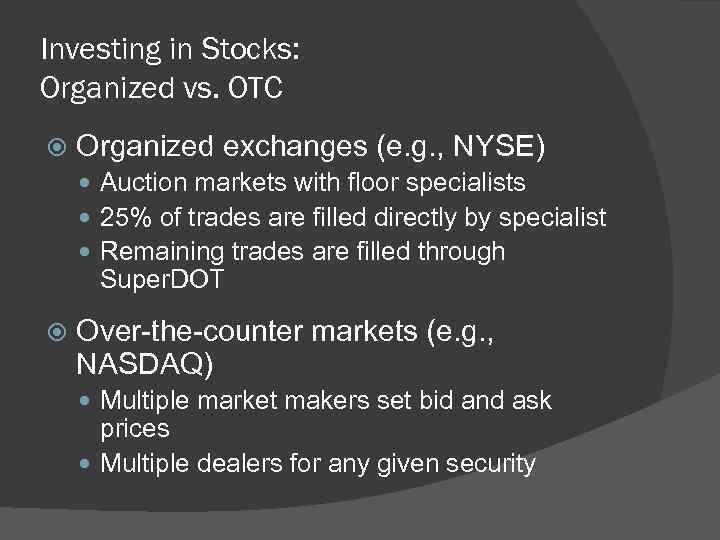
Investing in Stocks: Organized vs. OTC Organized exchanges (e. g. , NYSE) Auction markets with floor specialists 25% of trades are filled directly by specialist Remaining trades are filled through Super. DOT Over-the-counter markets (e. g. , NASDAQ) Multiple market makers set bid and ask prices Multiple dealers for any given security
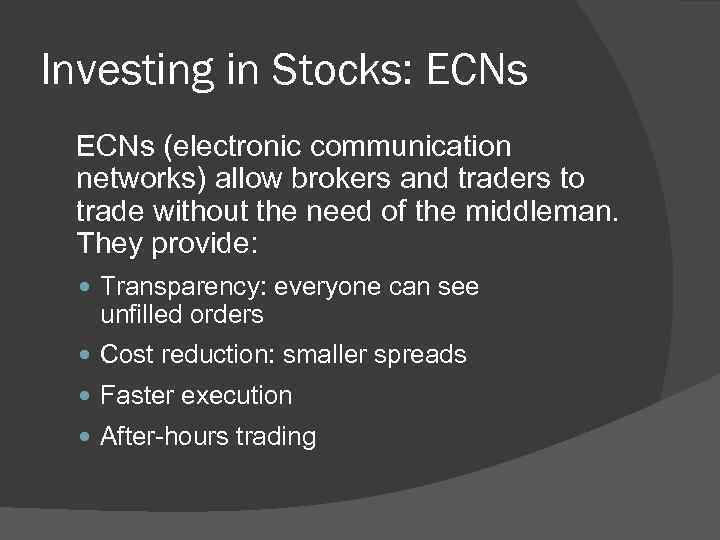
Investing in Stocks: ECNs (electronic communication networks) allow brokers and traders to trade without the need of the middleman. They provide: Transparency: everyone can see unfilled orders Cost reduction: smaller spreads Faster execution After-hours trading
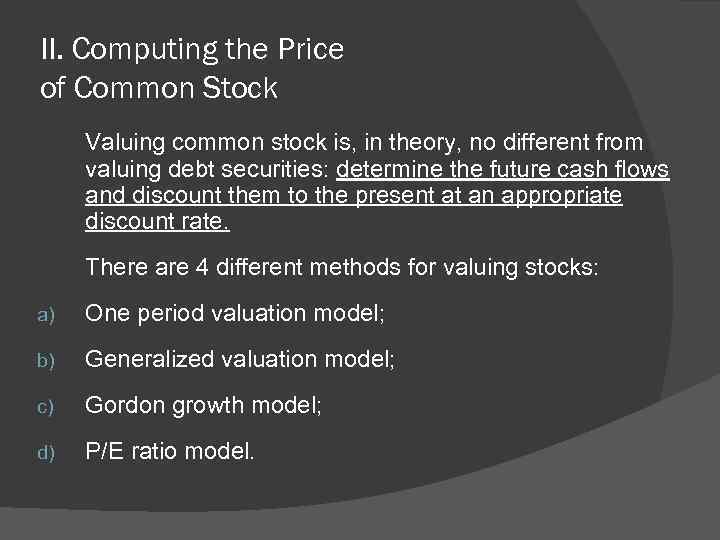
II. Computing the Price of Common Stock Valuing common stock is, in theory, no different from valuing debt securities: determine the future cash flows and discount them to the present at an appropriate discount rate. There are 4 different methods for valuing stocks: a) One period valuation model; b) Generalized valuation model; c) Gordon growth model; d) P/E ratio model.
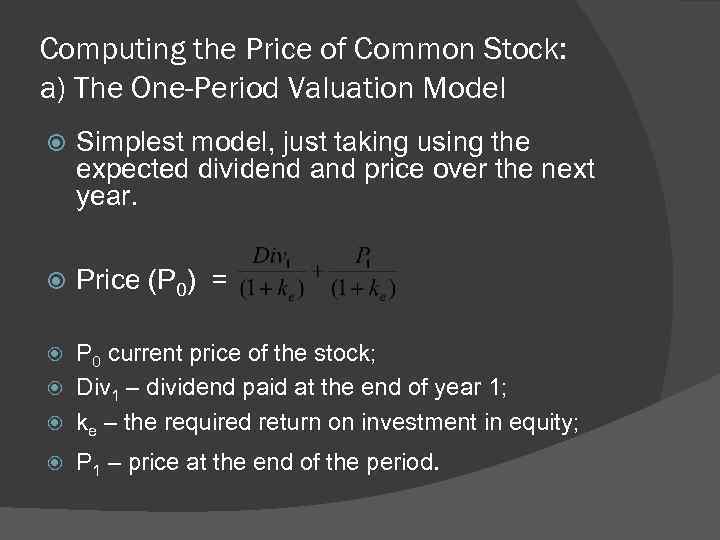
Computing the Price of Common Stock: a) The One-Period Valuation Model Simplest model, just taking using the expected dividend and price over the next year. Price (P 0) = P 0 current price of the stock; Div 1 – dividend paid at the end of year 1; ke – the required return on investment in equity; P 1 – price at the end of the period.
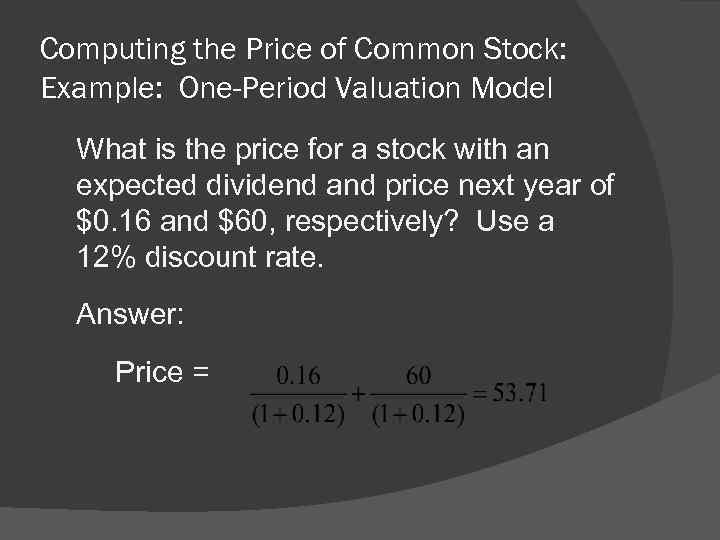
Computing the Price of Common Stock: Example: One-Period Valuation Model What is the price for a stock with an expected dividend and price next year of $0. 16 and $60, respectively? Use a 12% discount rate. Answer: Price =
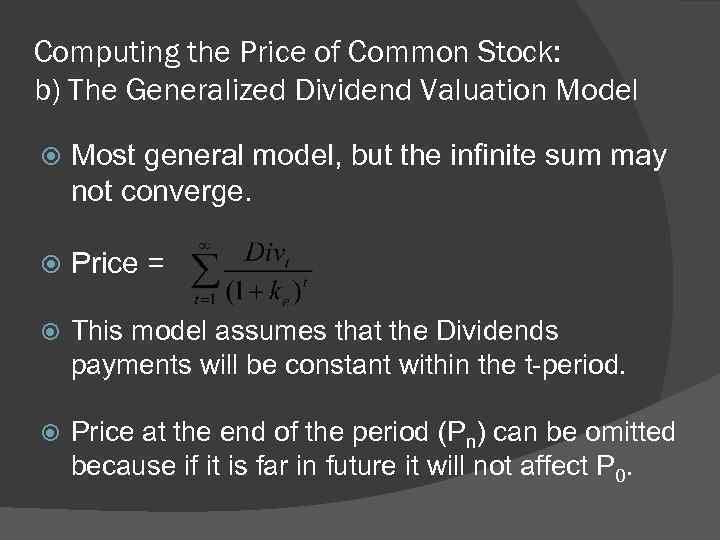
Computing the Price of Common Stock: b) The Generalized Dividend Valuation Model Most general model, but the infinite sum may not converge. Price = This model assumes that the Dividends payments will be constant within the t-period. Price at the end of the period (Pn) can be omitted because if it is far in future it will not affect P 0.
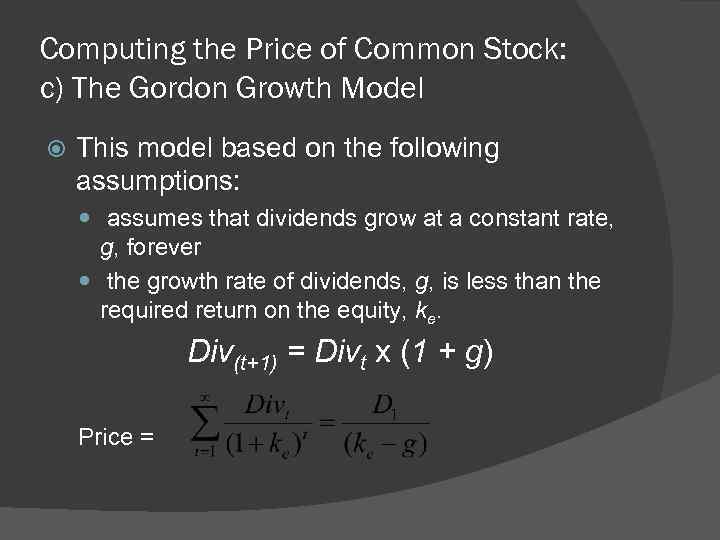
Computing the Price of Common Stock: c) The Gordon Growth Model This model based on the following assumptions: assumes that dividends grow at a constant rate, g, forever the growth rate of dividends, g, is less than the required return on the equity, ke. Div(t+1) = Divt x (1 + g) Price =
Price Earning Ratio: P/E = Market Value per Share Earnings per Share (EPS) Tells how much investors are willing to pay per dollar of earning. P/E = 20 means that investors are willing to pay 20$ for every 1$ of earnings company generates. P/E ratio is much better indicator of the value of a stock than the market price alone. Comparison is valuable only within one industry and the company’s growth rate should justify the high P/E
P/E ratio A high P/e ratio has 2 explanations: If P/E ratio is above the industry average, it may mean that the market expects earnings to rise in the future. This would return the P/E ratio to a more normal level. High P/E ratio may indicate that the firm’s earnings are very low risk and the market is willing to pay a premium (higher price) them. Note that high P/E ratio should be justified with high growth of the company.
P/E ratio It is difficult to say in general if a particular P/E ratio is high or low without taking into account 2 main factors: 1. Company growth rates: if growth rate is low (say 5%) and P/E is very high (compare with industry P/E) – the stocks are overvalued. 2. Industry – each industry has its own level of P/E, hence you can compare companies only within one industry.
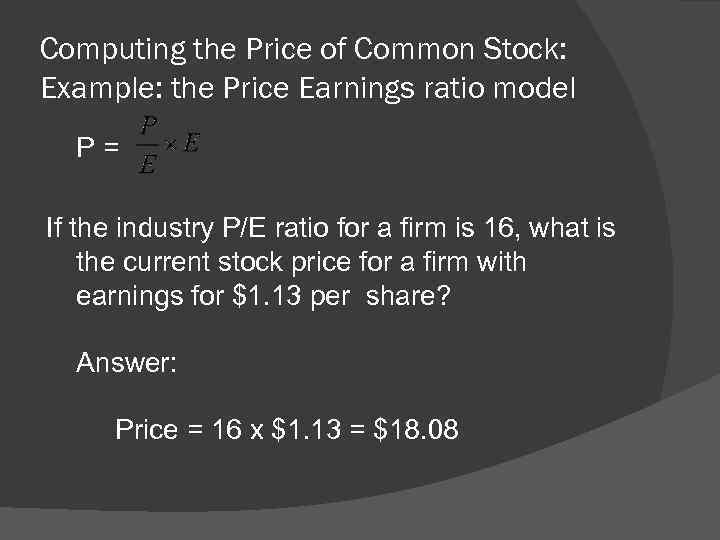
Computing the Price of Common Stock: Example: the Price Earnings ratio model P= If the industry P/E ratio for a firm is 16, what is the current stock price for a firm with earnings for $1. 13 per share? Answer: Price = 16 x $1. 13 = $18. 08
Errors in Valuations Although the pricing models are useful, market participants frequently encounter problems in using them. Any of these can have a significant impact on price: Problems with Estimating Growth Problems with Estimating Risk Problems with Forecasting Dividends
Difficulties in valuing stocks The constant growth model requires analyst to estimate the constant rate of growth of the firm (sales) – based on historical growth rate in dividends, sales or net profits - fails to consider any changes in the firm or economy to growth rate Competition prevents high growth firms to maintain their historical growth rate But still studies show that stock prices of historically high growth firm tend to reflect a continuation of the high growth rate Even experts have difficult estimating growth rate = a stock with $2 dividend and growth range of 115%, may have its stock price range to be between 14. 43 -228
How the market sets the security prices? The price is set by the buyer willing to pay the highest price The market price will be set by the buyer who can take best advantage of the assets (know and fix the car) Superior information about the asset can increase its value by reducing its risk
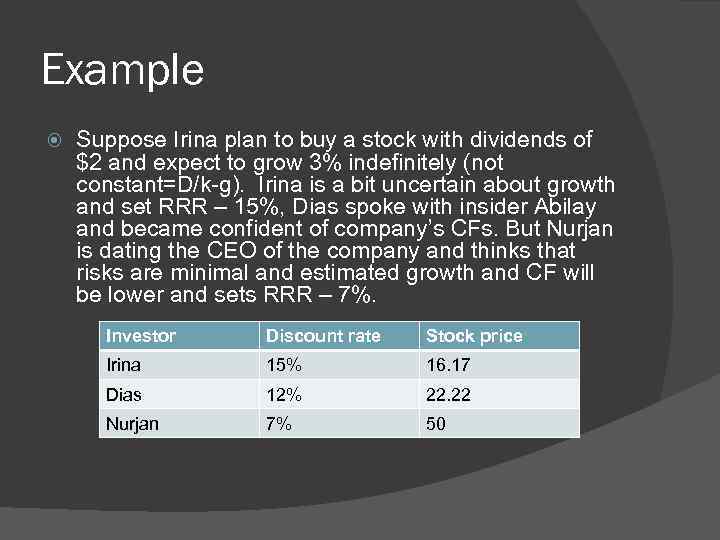
Example Suppose Irina plan to buy a stock with dividends of $2 and expect to grow 3% indefinitely (not constant=D/k-g). Irina is a bit uncertain about growth and set RRR – 15%, Dias spoke with insider Abilay and became confident of company’s CFs. But Nurjan is dating the CEO of the company and thinks that risks are minimal and estimated growth and CF will be lower and sets RRR – 7%. Investor Discount rate Stock price Irina 15% 16. 17 Dias 12% 22. 22 Nurjan 7% 50

Stock price quotes from google finance
What courses Stock prices change? Prices are set in competitive markets and changed by supply and demand forces. However, investors have strong preferences for some stocks and dislike other stocks. Why? The buyer willing to pay the most for an asset usually dictates the prices. Superior information can play an important role in setting stock prices
Buying Foreign Stocks Buying foreign stocks is useful from a diversification perspective. However, the purchase may be complicated if the shares are not traded in the U. S. American depository receipts (ADRs) allow foreign firms to trade on U. S. exchanges, facilitating their purchase. U. S. banks buy foreign shares and issue receipts against the shares in U. S. markets.
III. STOCK INDEXES Monitor and measure market movements Economic indicators Benchmarks in fund management Creation of new products (Index funds, options, futures indices) Analysts’ forecast, risk management etc.
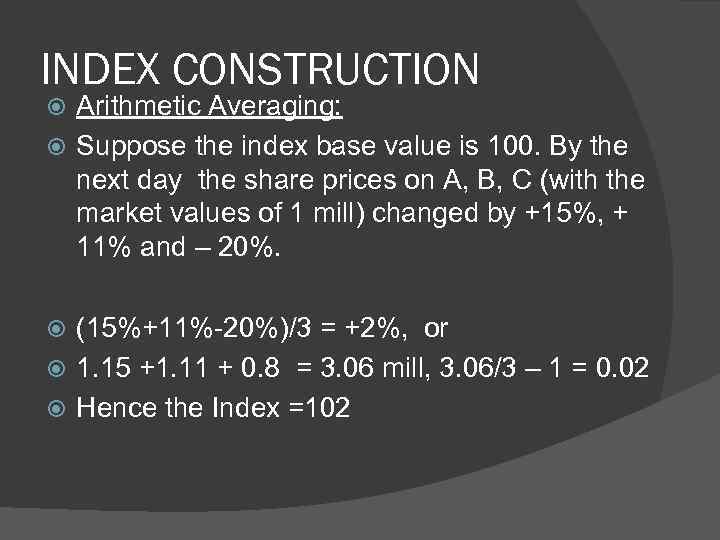
INDEX CONSTRUCTION Arithmetic Averaging: Suppose the index base value is 100. By the next day the share prices on A, B, C (with the market values of 1 mill) changed by +15%, + 11% and – 20%. (15%+11%-20%)/3 = +2%, or 1. 15 +1. 11 + 0. 8 = 3. 06 mill, 3. 06/3 – 1 = 0. 02 Hence the Index =102
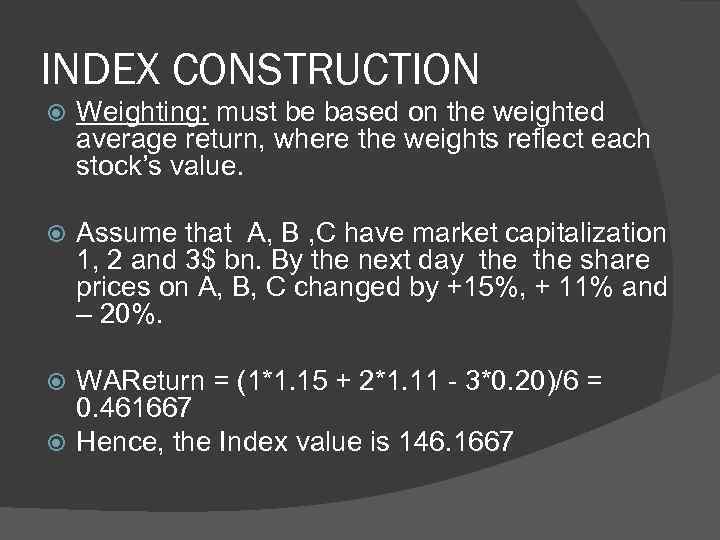
INDEX CONSTRUCTION Weighting: must be based on the weighted average return, where the weights reflect each stock’s value. Assume that A, B , C have market capitalization 1, 2 and 3$ bn. By the next day the share prices on A, B, C changed by +15%, + 11% and – 20%. WAReturn = (1*1. 15 + 2*1. 11 - 3*0. 20)/6 = 0. 461667 Hence, the Index value is 146. 1667
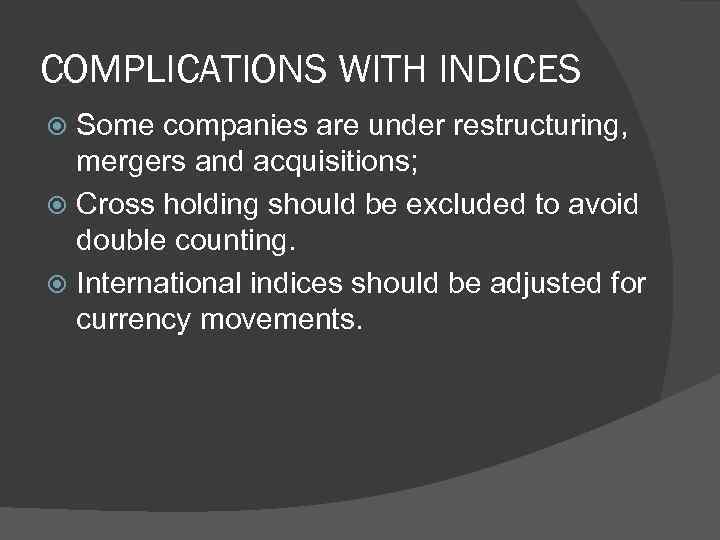
COMPLICATIONS WITH INDICES Some companies are under restructuring, mergers and acquisitions; Cross holding should be excluded to avoid double counting. International indices should be adjusted for currency movements.
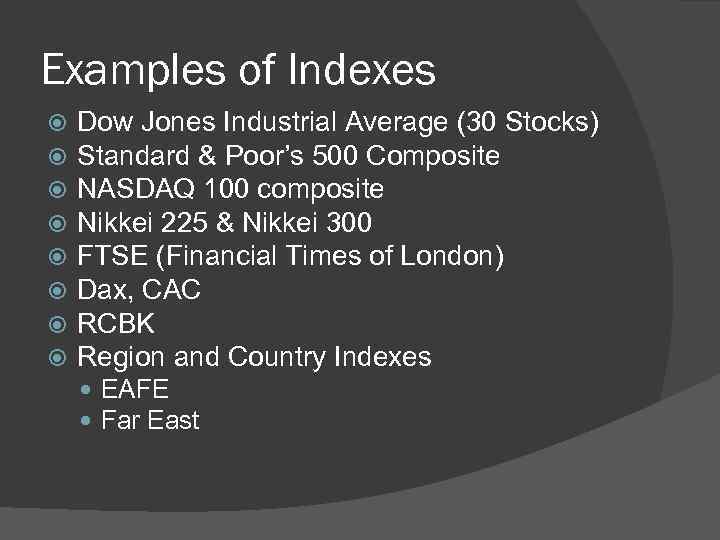
Examples of Indexes Dow Jones Industrial Average (30 Stocks) Standard & Poor’s 500 Composite NASDAQ 100 composite Nikkei 225 & Nikkei 300 FTSE (Financial Times of London) Dax, CAC RCBK Region and Country Indexes EAFE Far East
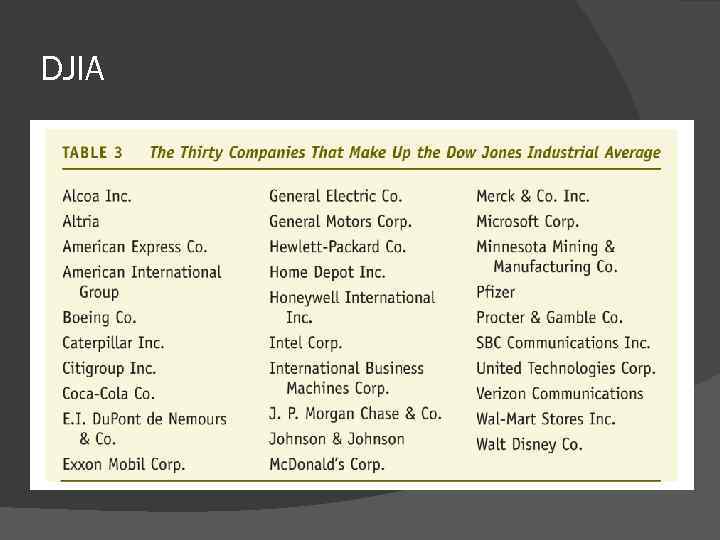
DJIA

Samryk 30

MMVB 30
Stock Market Indexes The next two slides show the Dow Jones Industrial Average from 1980– 2004. As can be seen, $1. 00 invested in the DJIA back in 1980, when the DJIA was around 800, would have grown to about $12. 50 in 2004, when the Dow reached 10, 000. This represented an annual growth rate around 10. 6%.
Standard & Poor’s 500 Based on a portfolio of 500 different stocks: 400 industrials, 40 utilities, 20 transportation companies, 40 financial institutions. Based on market capitalization weighting; The index is account for 80% of the market capitalization of all the stocks listed on NYSE
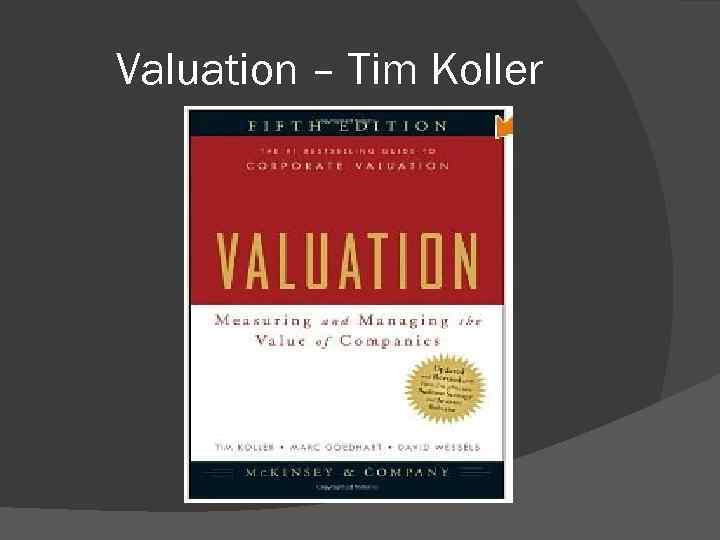
Valuation – Tim Koller
Скачать презентацию Так ли туманно будущее ПИФов Россияне теряют интерес
12 bonds, capital markets.pptx