


 Скачать презентацию Taiwan s High-tech Industry at the Turn of the
fcbbdb919478a15c3b5e389f5a4f4f57.ppt
- Количество слайдов: 36
 Taiwan’s High-tech Industry at the Turn of the Century Chi Schive President Taiwan Academy of Banking and Finance Advisor Council for Economic Planning and Development Industrial Restructuring in Asia Thammasat University September 18, 2000 1
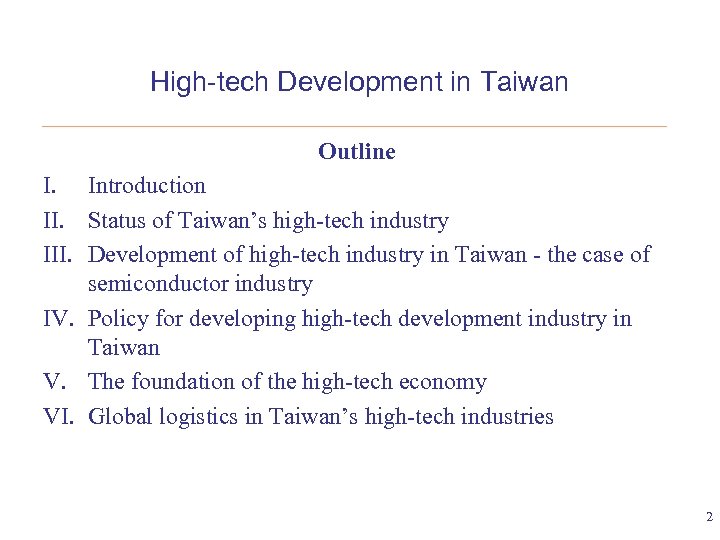 High-tech Development in Taiwan Outline I. Introduction II. Status of Taiwan’s high-tech industry III. Development of high-tech industry in Taiwan - the case of semiconductor industry IV. Policy for developing high-tech development industry in Taiwan V. The foundation of the high-tech economy VI. Global logistics in Taiwan’s high-tech industries 2
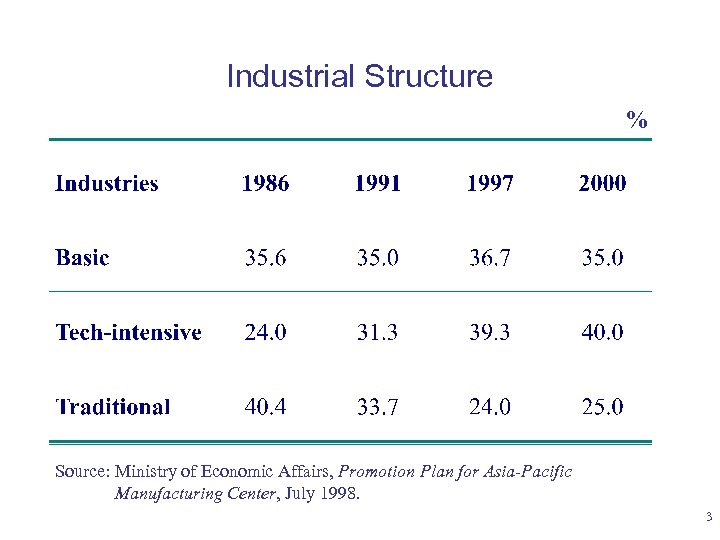 Industrial Structure % Source: Ministry of Economic Affairs, Promotion Plan for Asia-Pacific Manufacturing Center, July 1998. 3
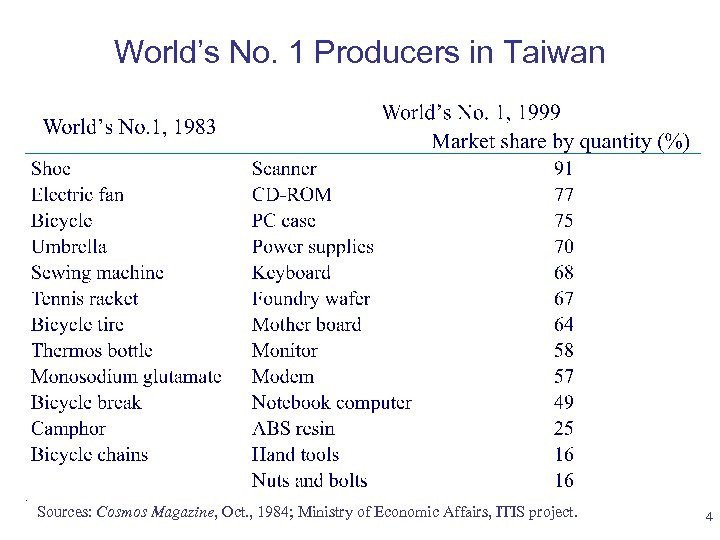 World’s No. 1 Producers in Taiwan Sources: Cosmos Magazine, Oct. , 1984; Ministry of Economic Affairs, ITIS project. 4
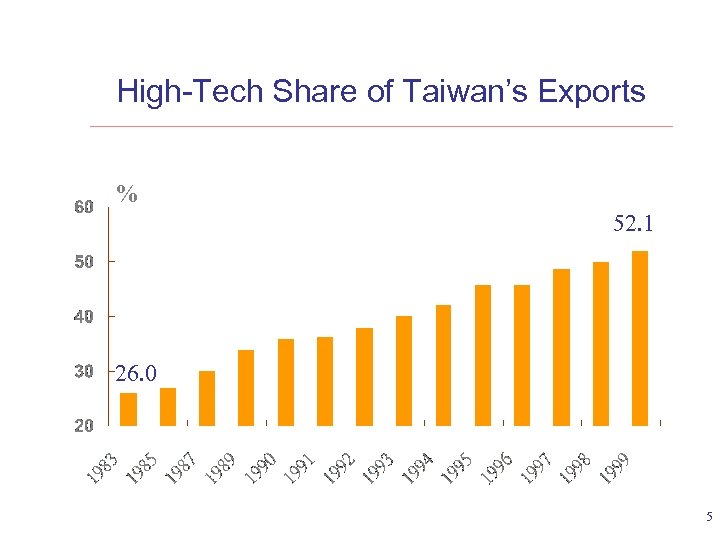 High-Tech Share of Taiwan’s Exports % 52. 1 26. 0 5
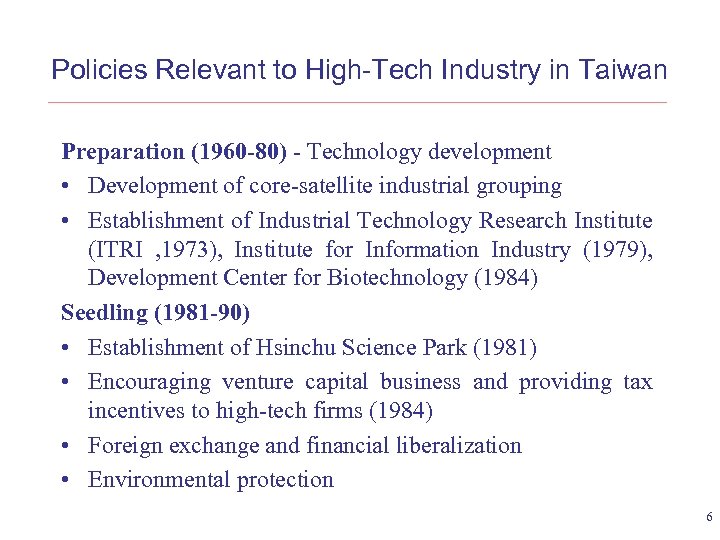 Policies Relevant to High-Tech Industry in Taiwan Preparation (1960 -80) - Technology development • Development of core-satellite industrial grouping • Establishment of Industrial Technology Research Institute (ITRI , 1973), Institute for Information Industry (1979), Development Center for Biotechnology (1984) Seedling (1981 -90) • Establishment of Hsinchu Science Park (1981) • Encouraging venture capital business and providing tax incentives to high-tech firms (1984) • Foreign exchange and financial liberalization • Environmental protection 6
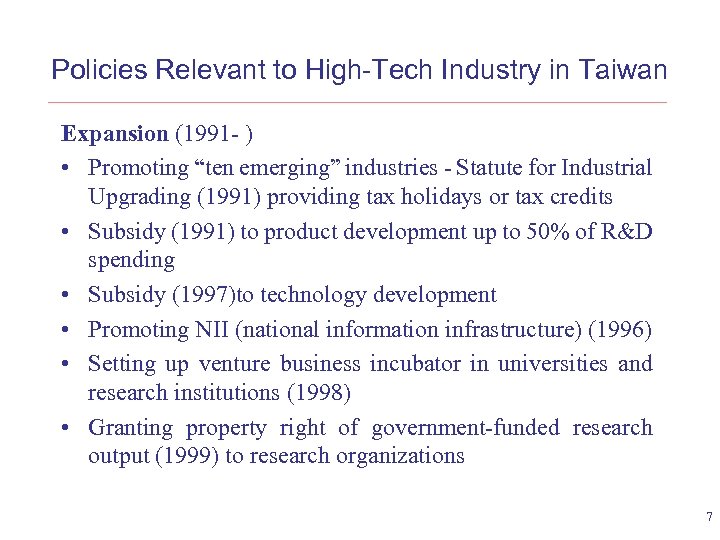 Policies Relevant to High-Tech Industry in Taiwan Expansion (1991 - ) • Promoting “ten emerging” industries - Statute for Industrial Upgrading (1991) providing tax holidays or tax credits • Subsidy (1991) to product development up to 50% of R&D spending • Subsidy (1997)to technology development • Promoting NII (national information infrastructure) (1996) • Setting up venture business incubator in universities and research institutions (1998) • Granting property right of government-funded research output (1999) to research organizations 7
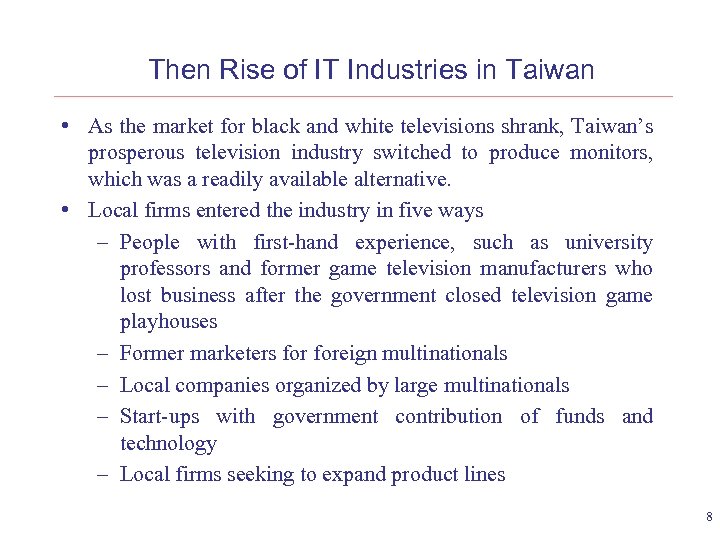 Then Rise of IT Industries in Taiwan • As the market for black and white televisions shrank, Taiwan’s prosperous television industry switched to produce monitors, which was a readily available alternative. • Local firms entered the industry in five ways – People with first-hand experience, such as university professors and former game television manufacturers who lost business after the government closed television game playhouses – Former marketers foreign multinationals – Local companies organized by large multinationals – Start-ups with government contribution of funds and technology – Local firms seeking to expand product lines 8
 Then Rise of Semiconductor Industries in Taiwan • Subsidiary established by General Instrument (1966), Texas Instrument, RCA, and Philips (1969 -71) – helped develop skilled labor and technicians and managers – introduced packaging and resting technology, and quality control system • Laboratories established within educational and research institutions • Electronics Research and Service Organization (ERSO) established 1974 developed a technology with good market potential and competitive cost • United Microelectronics Corporation (UMC) was jointly formed by the government, public bank and private enterprises. 9
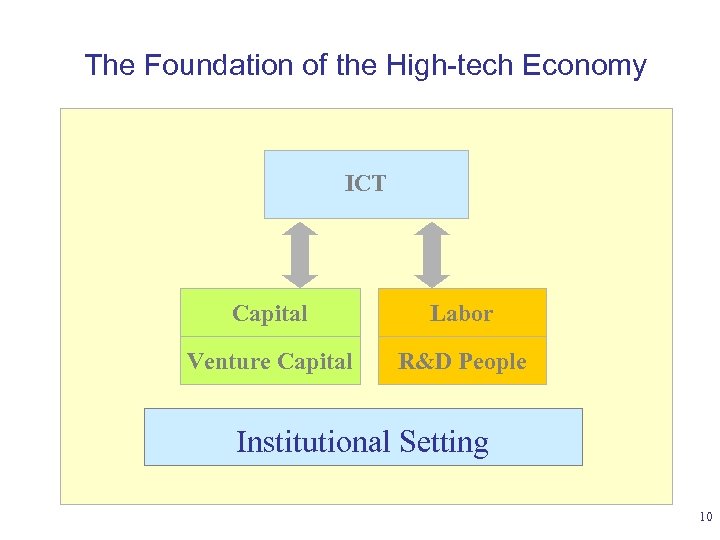 The Foundation of the High-tech Economy ICT Capital Labor Venture Capital R&D People Institutional Setting 10
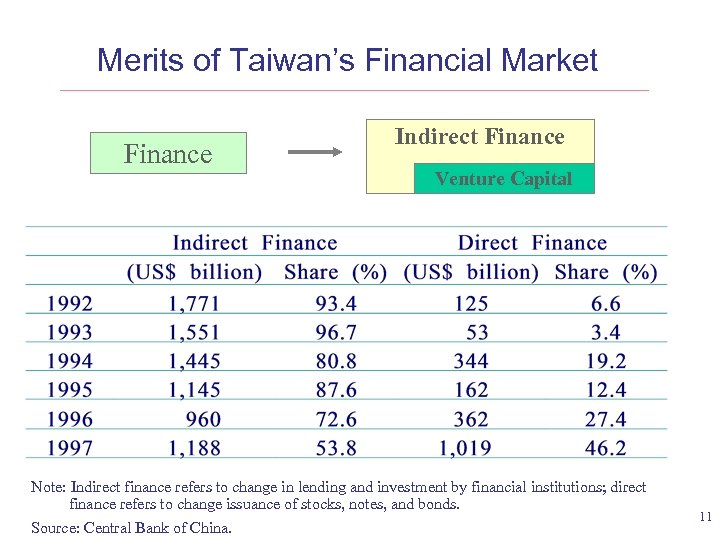 Merits of Taiwan’s Financial Market Finance Indirect Finance Venture Capital Note: Indirect finance refers to change in lending and investment by financial institutions; direct finance refers to change issuance of stocks, notes, and bonds. Source: Central Bank of China. 11
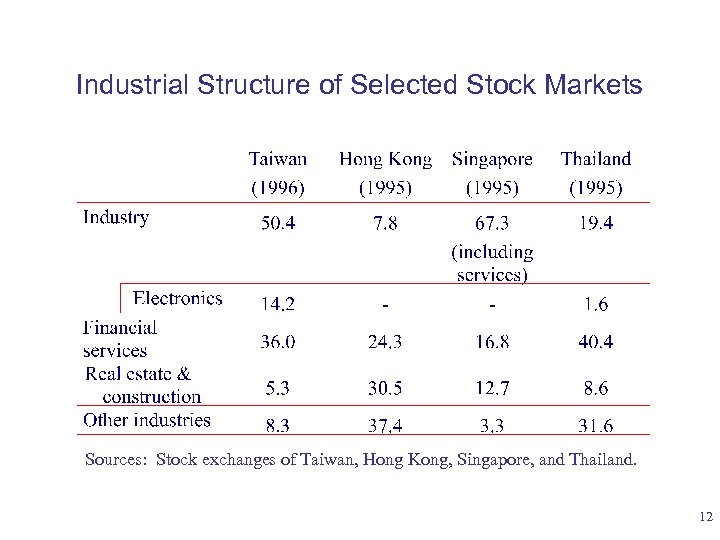 Industrial Structure of Selected Stock Markets Sources: Stock exchanges of Taiwan, Hong Kong, Singapore, and Thailand. 12
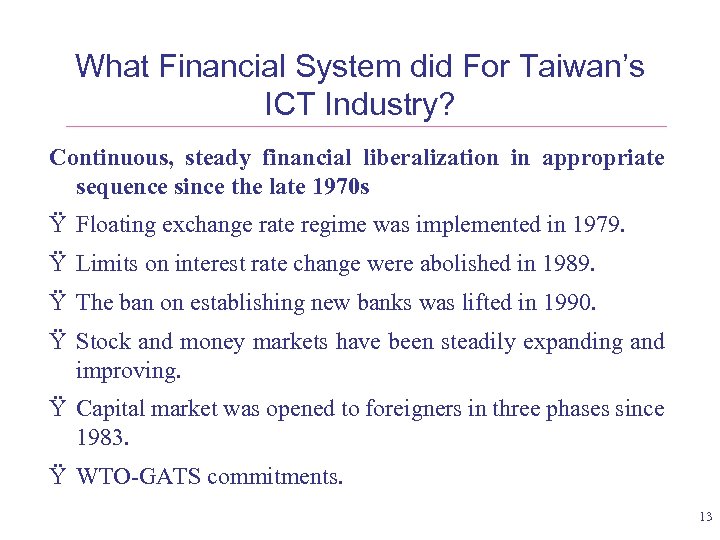 What Financial System did For Taiwan’s ICT Industry? Continuous, steady financial liberalization in appropriate sequence since the late 1970 s Ÿ Floating exchange rate regime was implemented in 1979. Ÿ Limits on interest rate change were abolished in 1989. Ÿ The ban on establishing new banks was lifted in 1990. Ÿ Stock and money markets have been steadily expanding and improving. Ÿ Capital market was opened to foreigners in three phases since 1983. Ÿ WTO-GATS commitments. 13
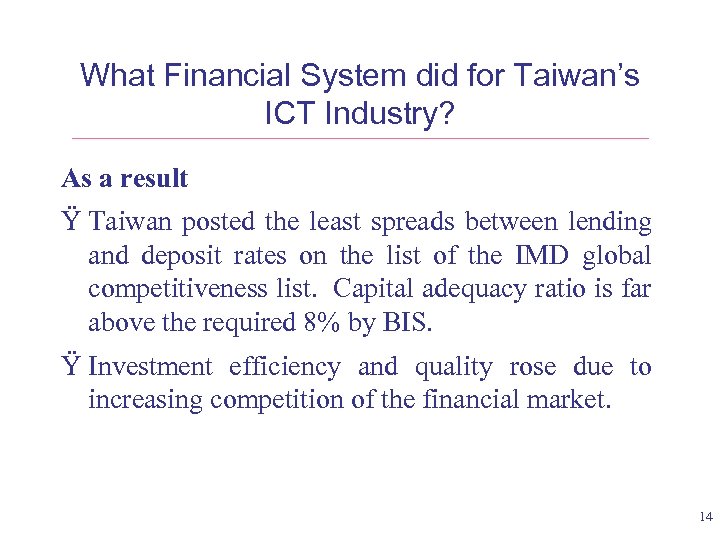 What Financial System did for Taiwan’s ICT Industry? As a result Ÿ Taiwan posted the least spreads between lending and deposit rates on the list of the IMD global competitiveness list. Capital adequacy ratio is far above the required 8% by BIS. Ÿ Investment efficiency and quality rose due to increasing competition of the financial market. 14
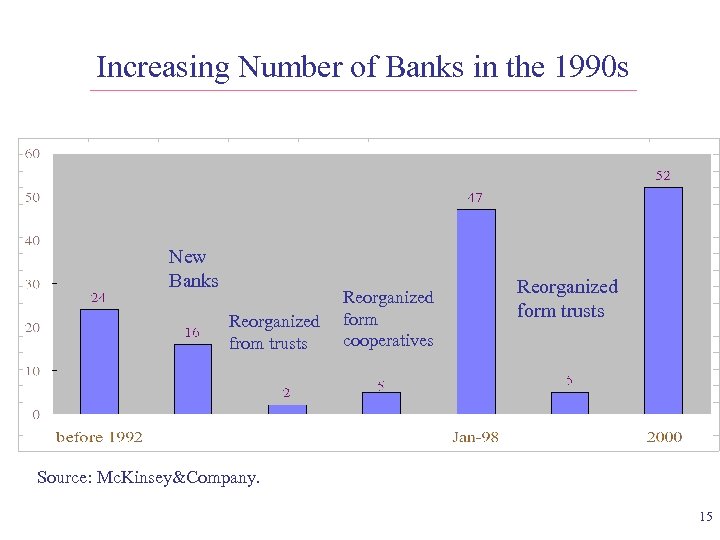 Increasing Number of Banks in the 1990 s New Banks Reorganized from trusts Reorganized form cooperatives Reorganized form trusts Source: Mc. Kinsey&Company. 15
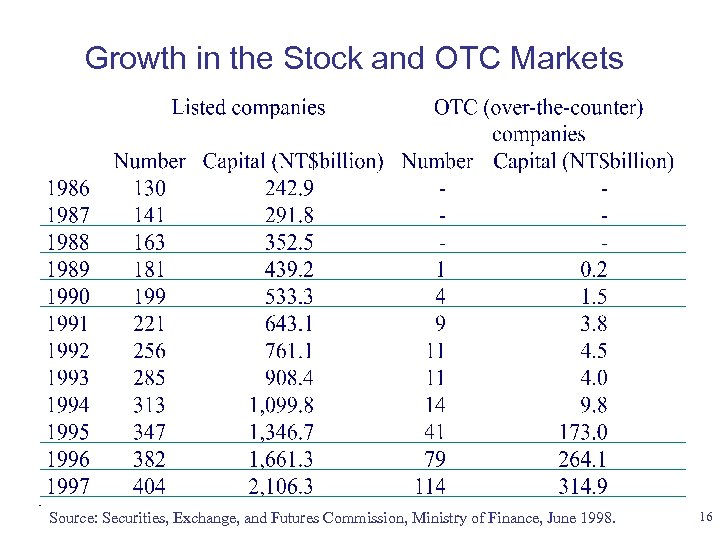 Growth in the Stock and OTC Markets Source: Securities, Exchange, and Futures Commission, Ministry of Finance, June 1998. 16
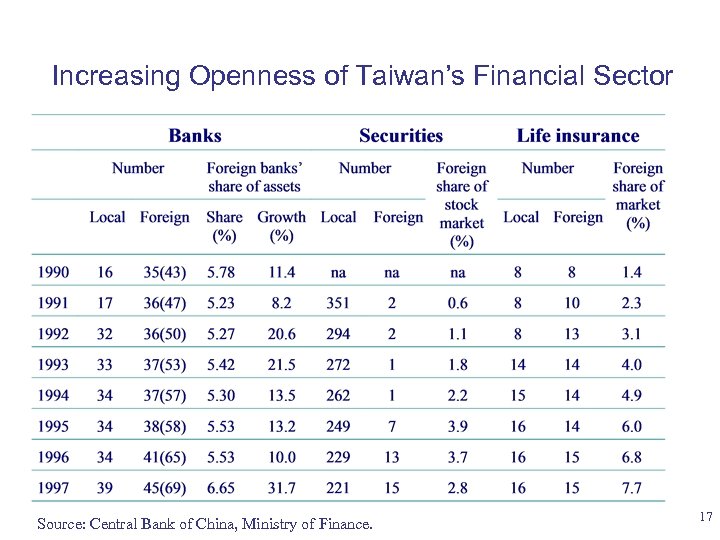 Increasing Openness of Taiwan’s Financial Sector Source: Central Bank of China, Ministry of Finance. 17
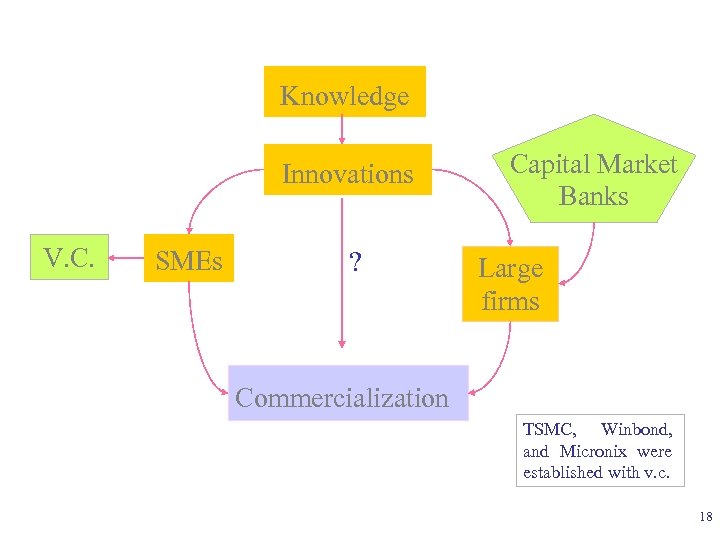 Knowledge Innovations V. C. SMEs ? Capital Market Banks Large firms Commercialization TSMC, Winbond, and Micronix were established with v. c. 18
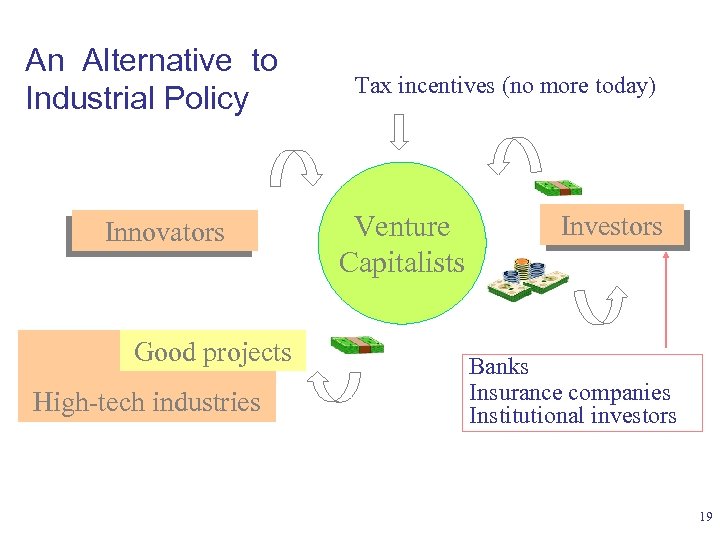 An Alternative to Industrial Policy Innovators Good projects High-tech industries Tax incentives (no more today) Venture Capitalists Investors Banks Insurance companies Institutional investors 19
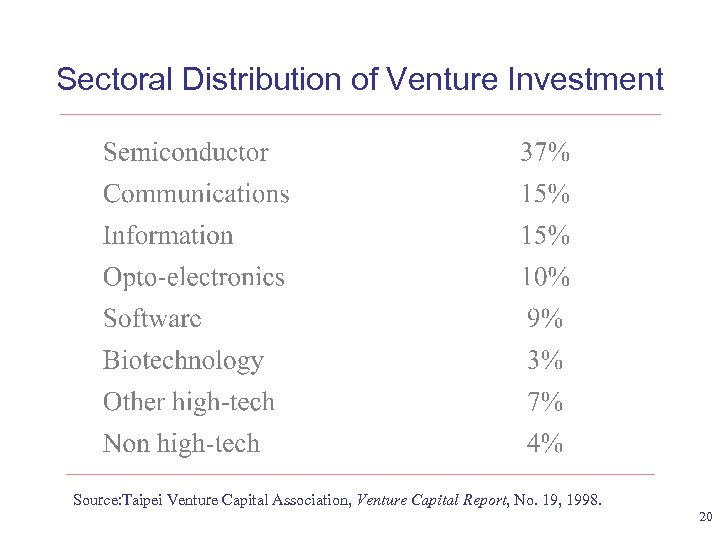 Sectoral Distribution of Venture Investment Source: Taipei Venture Capital Association, Venture Capital Report, No. 19, 1998. 20
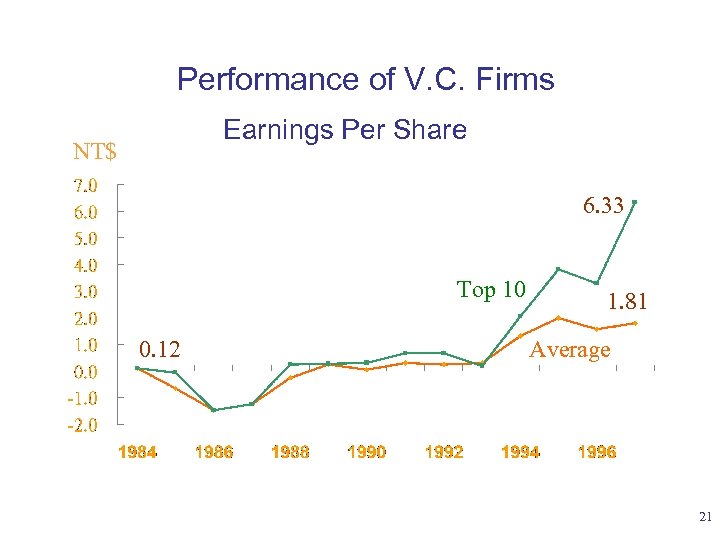 Performance of V. C. Firms Earnings Per Share NT$ 6. 33 Top 10 0. 12 1. 81 Average 21
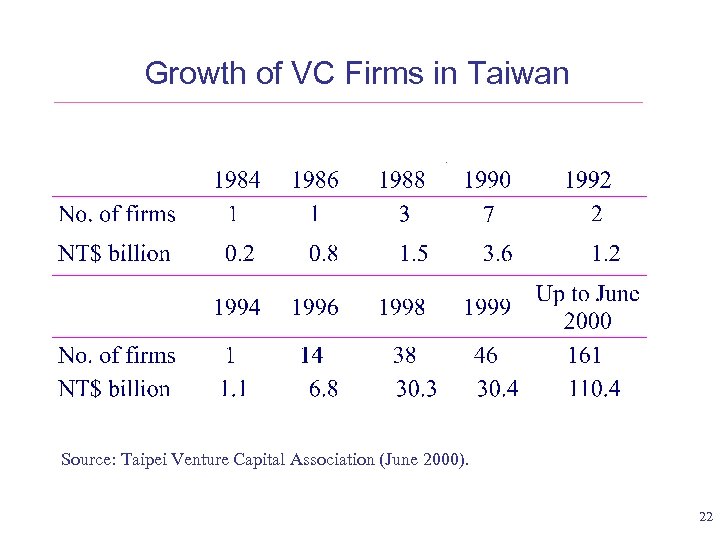 Growth of VC Firms in Taiwan Source: Taipei Venture Capital Association (June 2000). 22
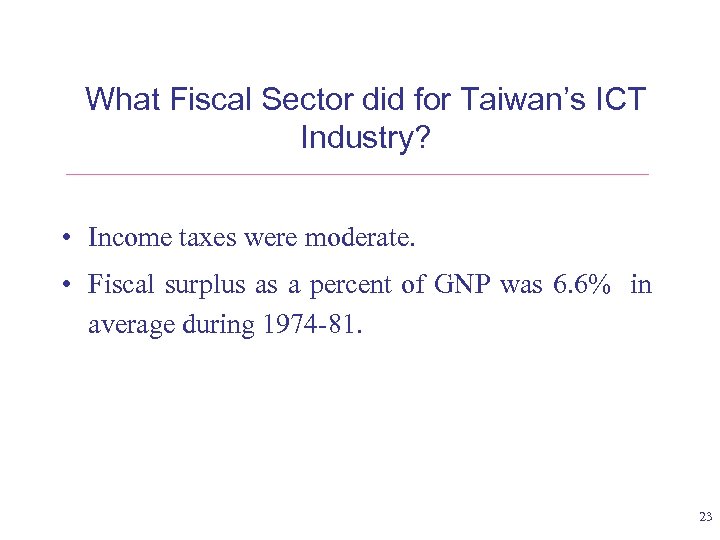 What Fiscal Sector did for Taiwan’s ICT Industry? • Income taxes were moderate. • Fiscal surplus as a percent of GNP was 6. 6% in average during 1974 -81. 23
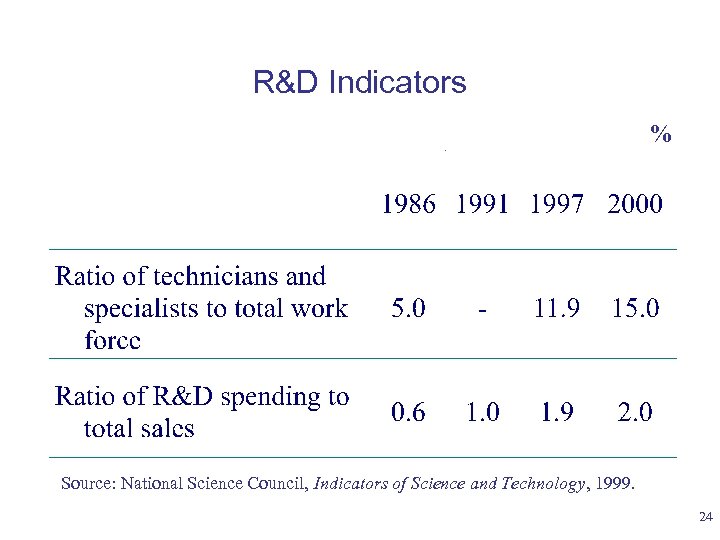 R&D Indicators % Source: National Science Council, Indicators of Science and Technology, 1999. 24
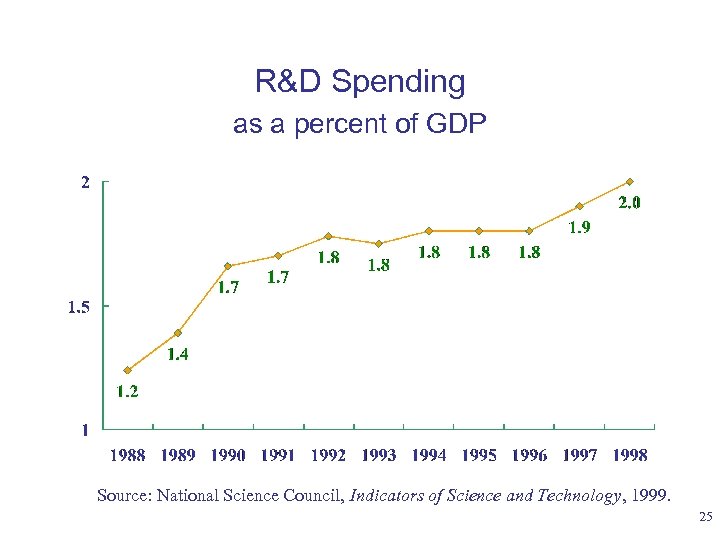 R&D Spending as a percent of GDP Source: National Science Council, Indicators of Science and Technology, 1999. 25
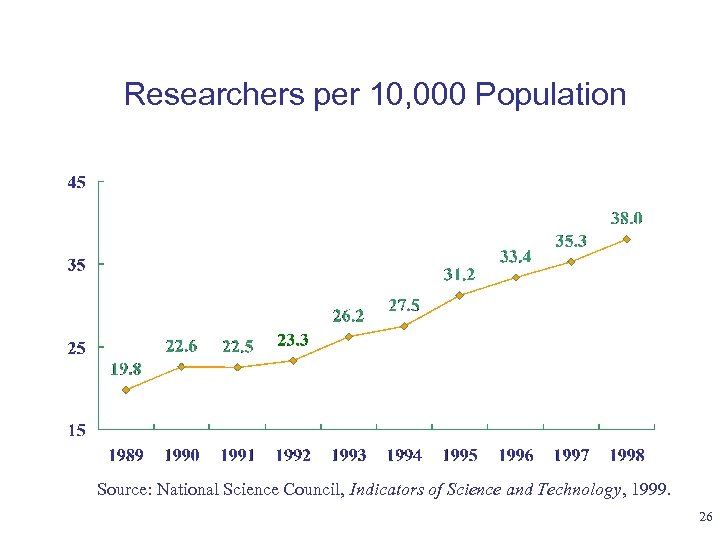 Researchers per 10, 000 Population Source: National Science Council, Indicators of Science and Technology, 1999. 26
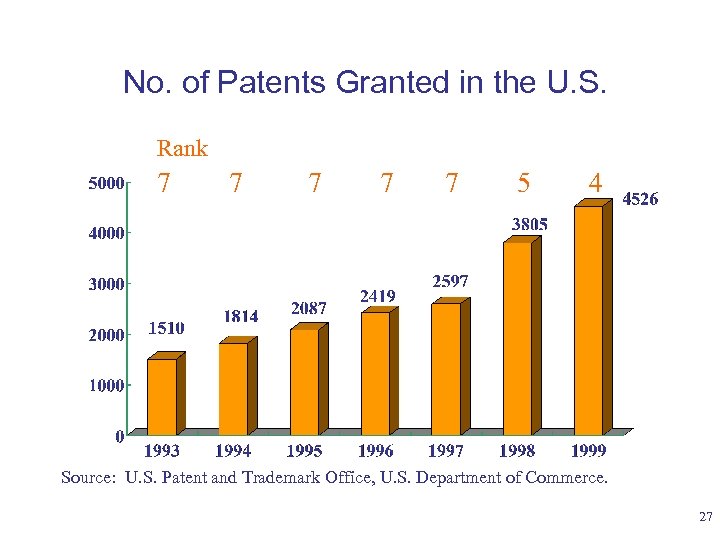 No. of Patents Granted in the U. S. Rank 7 7 7 5 4 Source: U. S. Patent and Trademark Office, U. S. Department of Commerce. 27
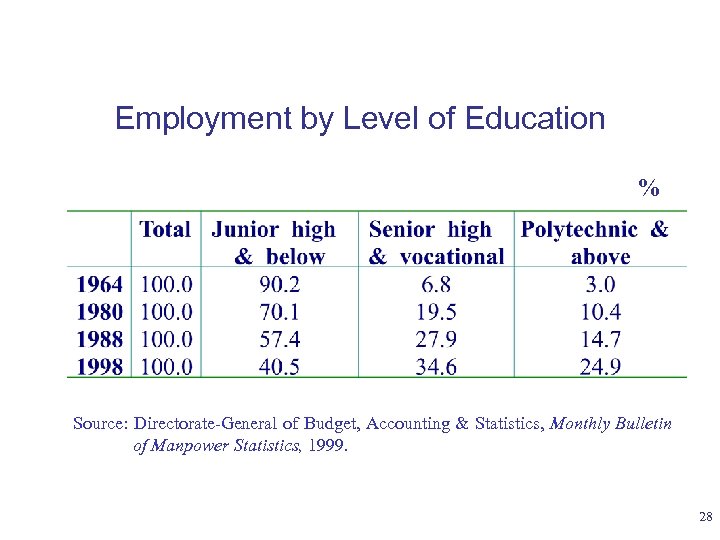 Employment by Level of Education % Source: Directorate-General of Budget, Accounting & Statistics, Monthly Bulletin of Manpower Statistics, 1999. 28
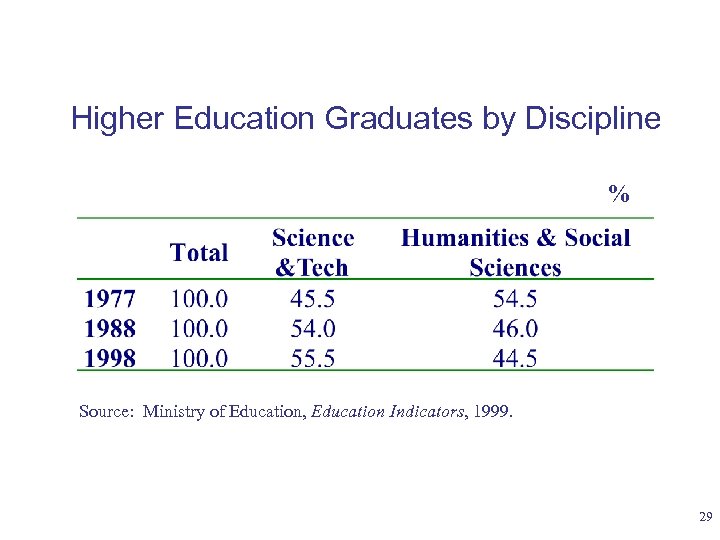 Higher Education Graduates by Discipline % Source: Ministry of Education, Education Indicators, 1999. 29
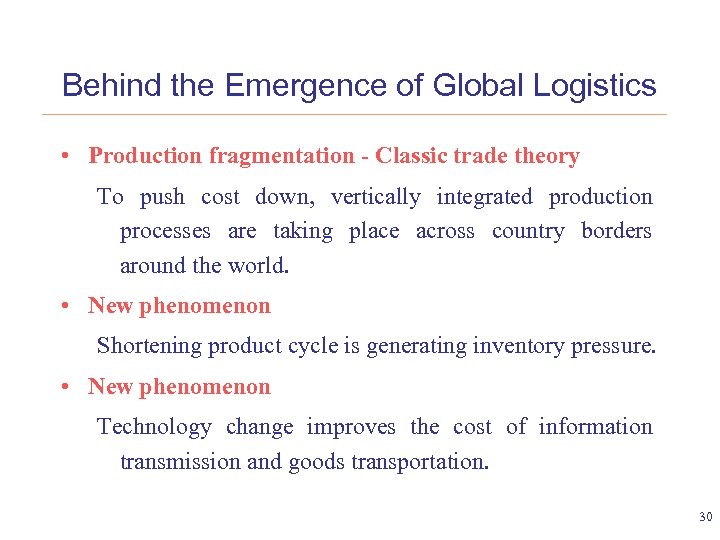 Behind the Emergence of Global Logistics • Production fragmentation - Classic trade theory To push cost down, vertically integrated production processes are taking place across country borders around the world. • New phenomenon Shortening product cycle is generating inventory pressure. • New phenomenon Technology change improves the cost of information transmission and goods transportation. 30
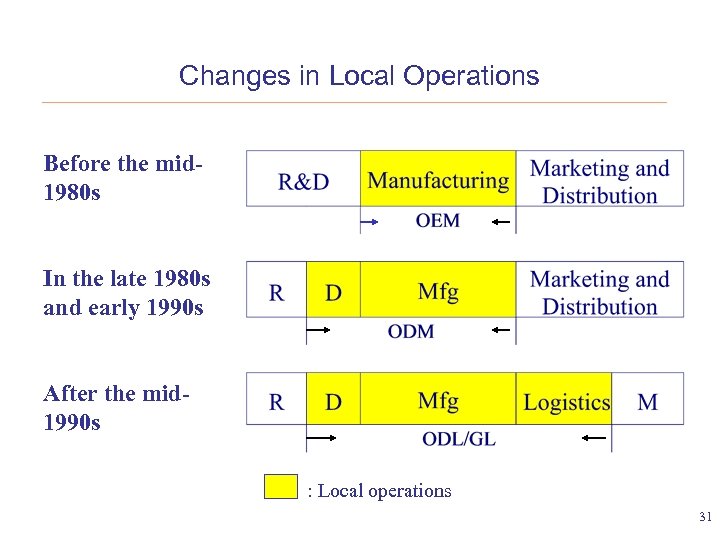 Changes in Local Operations Before the mid 1980 s In the late 1980 s and early 1990 s After the mid 1990 s : Local operations 31
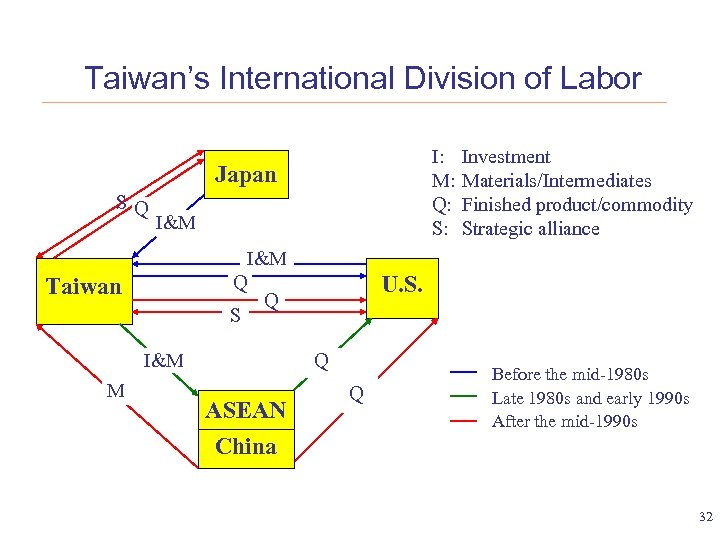 Taiwan’s International Division of Labor I: M: Q: S: Japan SQ I&M Q Q S Taiwan I&M M U. S. Q ASEAN Investment Materials/Intermediates Finished product/commodity Strategic alliance Q Before the mid-1980 s Late 1980 s and early 1990 s After the mid-1990 s China 32
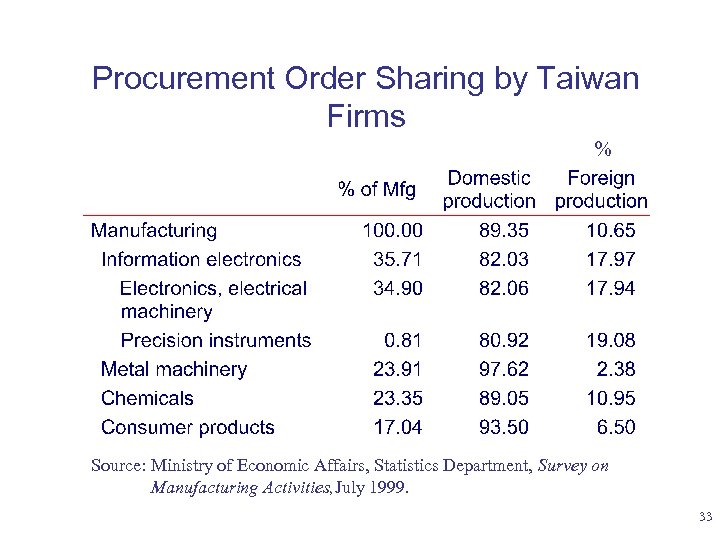 Procurement Order Sharing by Taiwan Firms % Source: Ministry of Economic Affairs, Statistics Department, Survey on Manufacturing Activities, July 1999. 33
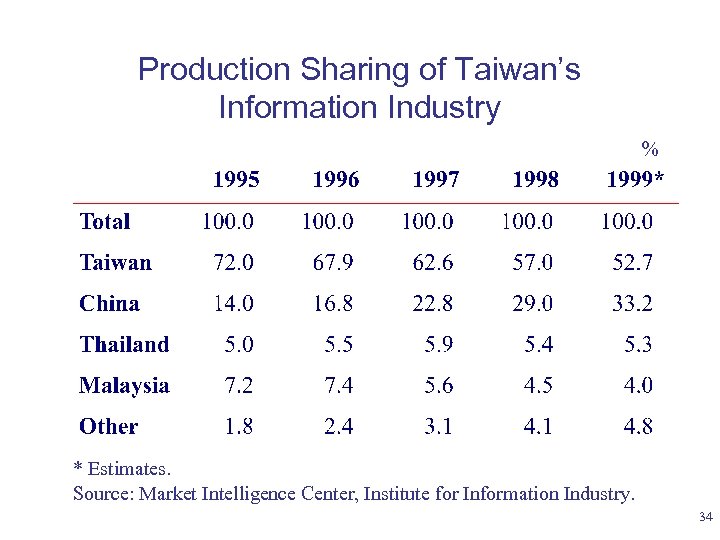 Production Sharing of Taiwan’s Information Industry % * Estimates. Source: Market Intelligence Center, Institute for Information Industry. 34
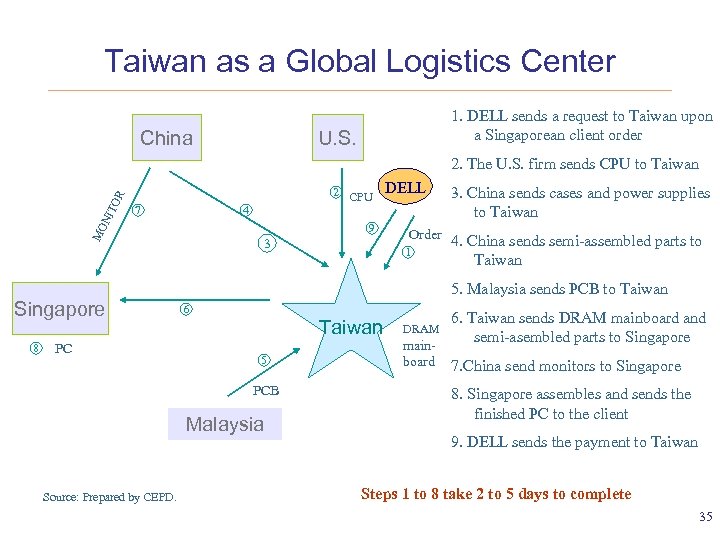 Taiwan as a Global Logistics Center China 1. DELL sends a request to Taiwan upon a Singaporean client order U. S. 2. The U. S. firm sends CPU to Taiwan 7 4 MO N ITO R 2 CPU 9 3 DELL 3. China sends cases and power supplies to Taiwan Order 4. China sends semi-assembled parts to 1 Taiwan 5. Malaysia sends PCB to Taiwan Singapore 8 PC 6 Taiwan 5 PCB Malaysia Source: Prepared by CEPD. 6. Taiwan sends DRAM mainboard and semi-asembled parts to Singapore mainboard 7. China send monitors to Singapore DRAM 8. Singapore assembles and sends the finished PC to the client 9. DELL sends the payment to Taiwan Steps 1 to 8 take 2 to 5 days to complete 35
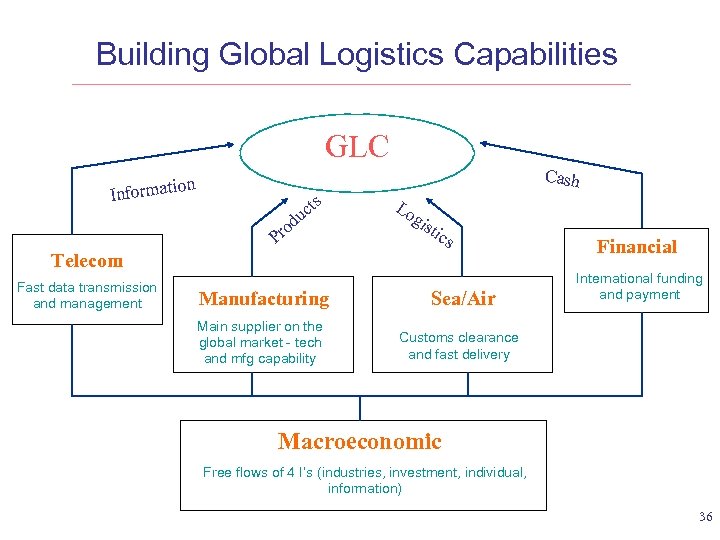 Building Global Logistics Capabilities GLC Cash on Informati cts u d ro P Lo gis tic s Telecom Fast data transmission and management Manufacturing Main supplier on the global market - tech and mfg capability Sea/Air Financial International funding and payment Customs clearance and fast delivery Macroeconomic Free flows of 4 I’s (industries, investment, individual, information) 36