


 Скачать презентацию Tailoring Systematic Reviews to Meet Critical Priorities in
22ec21c2fa8243587d45559d20d8e487.ppt
- Количество слайдов: 17
 Tailoring Systematic Reviews to Meet Critical Priorities in Maternal Health Presented by Meera Viswanathan, Ph. D. RTI International Presented at The 135 th Annual Meeting of the American Public Health Association Washington, DC, November 3– 7, 2007 3040 Cornwallis Road Phone 919 -316 -3930 ■ P. O. Box 12194 ■ Fax 919 -541 -7384 Research Triangle Park, NC 27709 e-mail viswanathan@rti. org RTI International is a trade name of Research Triangle Institute
 Current Practice for Selecting Topics for Systematic Reviews n AHRQ topics often generated by professional societies; Cochrane reviews by individual reviewers n Topic nominations can be motivated by l Search for evidence to review ongoing changes in clinical practice l Publication of unexpected trial or observational data n n 2 Incremental approach Requires clear specification of Patient, Intervention, Comparators, Outcomes, Timing, and Setting (PICOTS)
 Rethinking Systematic Review Resources on Maternal Health: why should we care? n Systematic reviews can have substantial impact on practice l physician guidelines l quality of care initiatives n n 3 Time- and resource-intensive efforts AHRQ reviews are funded by public dollars
 Reframing Maternal Health Priorities for Systematic Reviews n n Cross-cutting issues n Cost n 4 Morbidity and mortality Other?
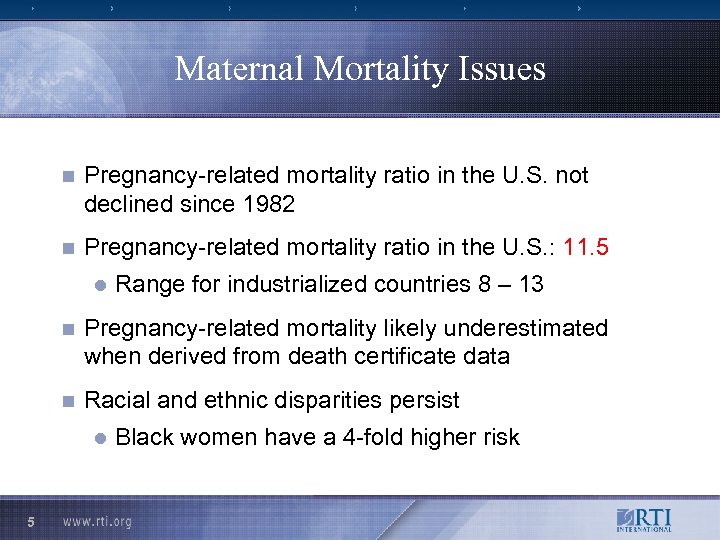 Maternal Mortality Issues n Pregnancy-related mortality ratio in the U. S. not declined since 1982 n Pregnancy-related mortality ratio in the U. S. : 11. 5 l Range for industrialized countries 8 – 13 n Pregnancy-related mortality likely underestimated when derived from death certificate data n Racial and ethnic disparities persist l 5 Black women have a 4 -fold higher risk
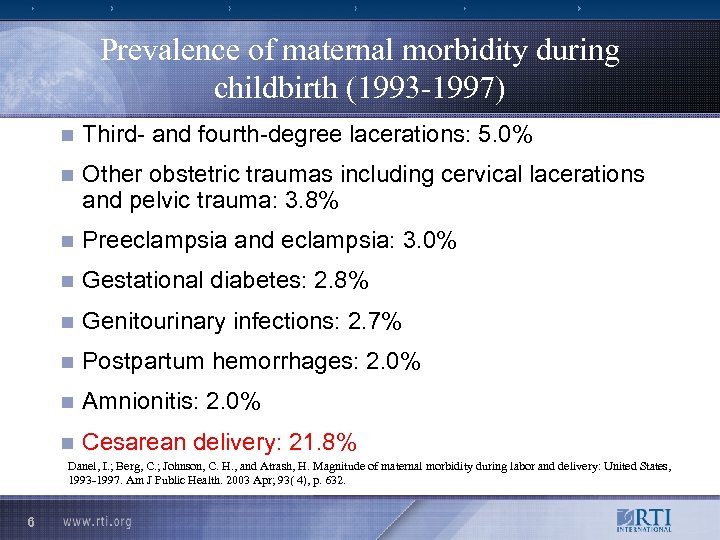 Prevalence of maternal morbidity during childbirth (1993 -1997) n Third- and fourth-degree lacerations: 5. 0% n Other obstetric traumas including cervical lacerations and pelvic trauma: 3. 8% n Preeclampsia and eclampsia: 3. 0% n Gestational diabetes: 2. 8% n Genitourinary infections: 2. 7% n Postpartum hemorrhages: 2. 0% n Amnionitis: 2. 0% n Cesarean delivery: 21. 8% Danel, I. ; Berg, C. ; Johnson, C. H. , and Atrash, H. Magnitude of maternal morbidity during labor and delivery: United States, 1993 -1997. Am J Public Health. 2003 Apr; 93( 4), p. 632. 6
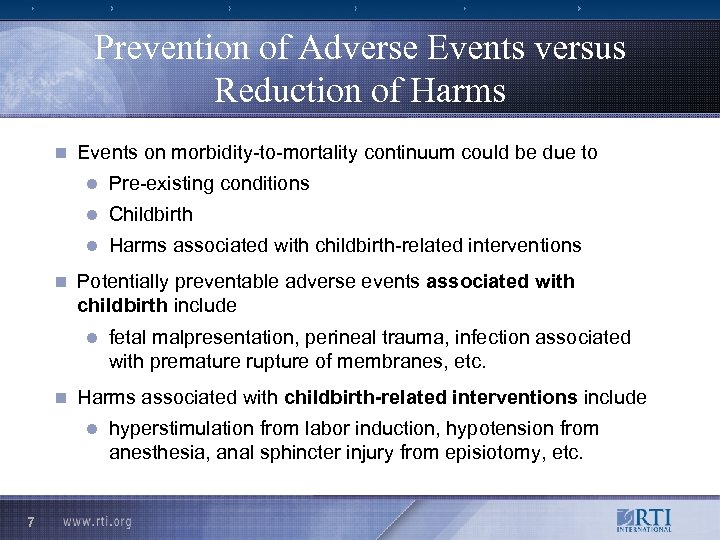 Prevention of Adverse Events versus Reduction of Harms n Events on morbidity-to-mortality continuum could be due to l l Childbirth l n Pre-existing conditions Harms associated with childbirth-related interventions Potentially preventable adverse events associated with childbirth include l n Harms associated with childbirth-related interventions include l 7 fetal malpresentation, perineal trauma, infection associated with premature rupture of membranes, etc. hyperstimulation from labor induction, hypotension from anesthesia, anal sphincter injury from episiotomy, etc.
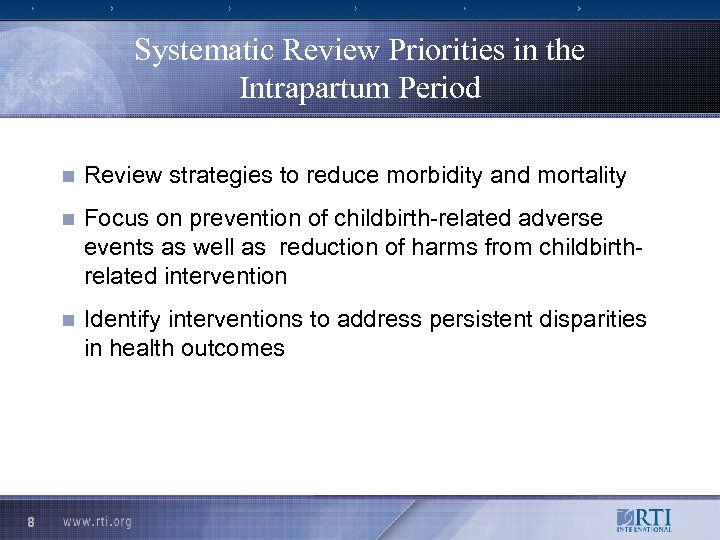 Systematic Review Priorities in the Intrapartum Period n n Focus on prevention of childbirth-related adverse events as well as reduction of harms from childbirthrelated intervention n 8 Review strategies to reduce morbidity and mortality Identify interventions to address persistent disparities in health outcomes
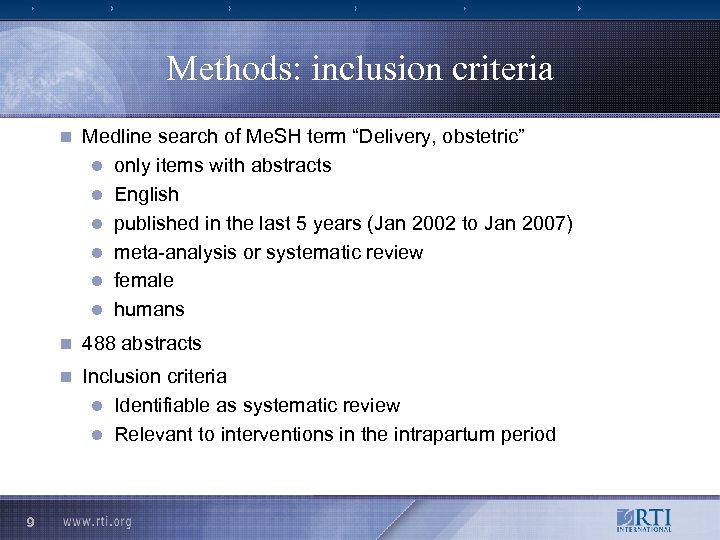 Methods: inclusion criteria n n 488 abstracts n 9 Medline search of Me. SH term “Delivery, obstetric” l only items with abstracts l English l published in the last 5 years (Jan 2002 to Jan 2007) l meta-analysis or systematic review l female l humans Inclusion criteria l Identifiable as systematic review l Relevant to interventions in the intrapartum period
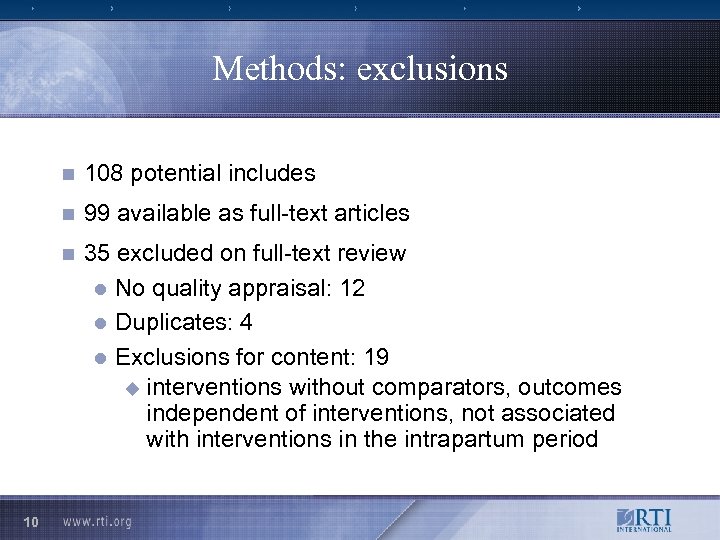 Methods: exclusions n n 99 available as full-text articles n 10 108 potential includes 35 excluded on full-text review l No quality appraisal: 12 l Duplicates: 4 l Exclusions for content: 19 u interventions without comparators, outcomes independent of interventions, not associated with interventions in the intrapartum period
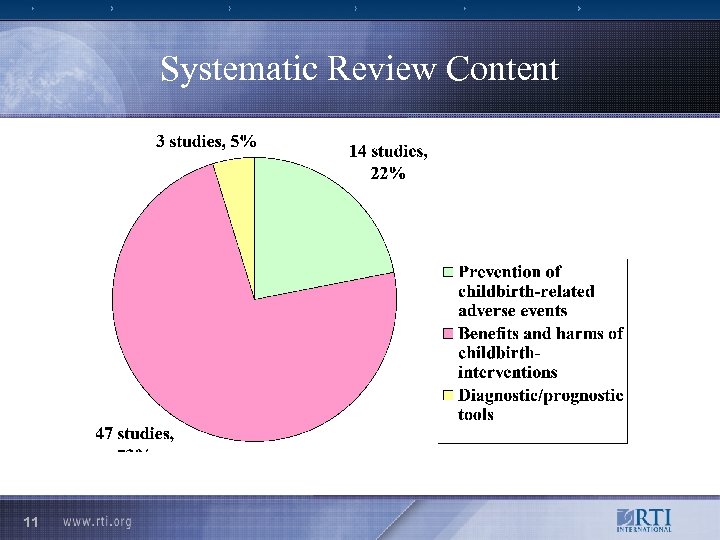 Systematic Review Content 11
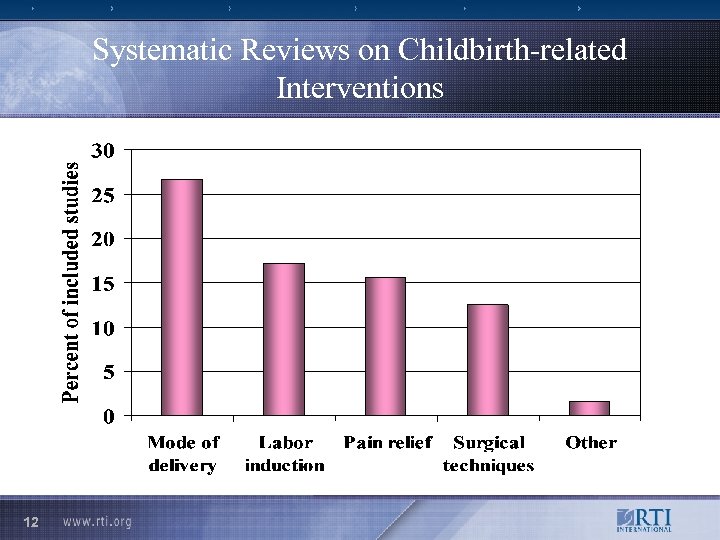 Systematic Reviews on Childbirth-related Interventions 12
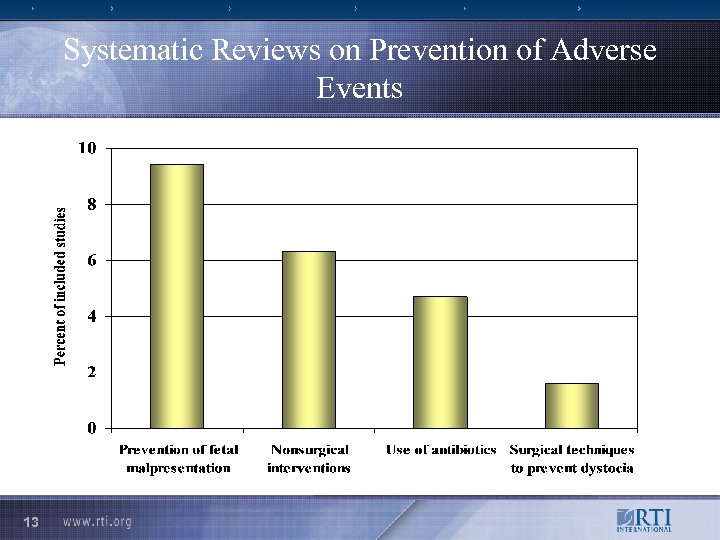 Systematic Reviews on Prevention of Adverse Events 13
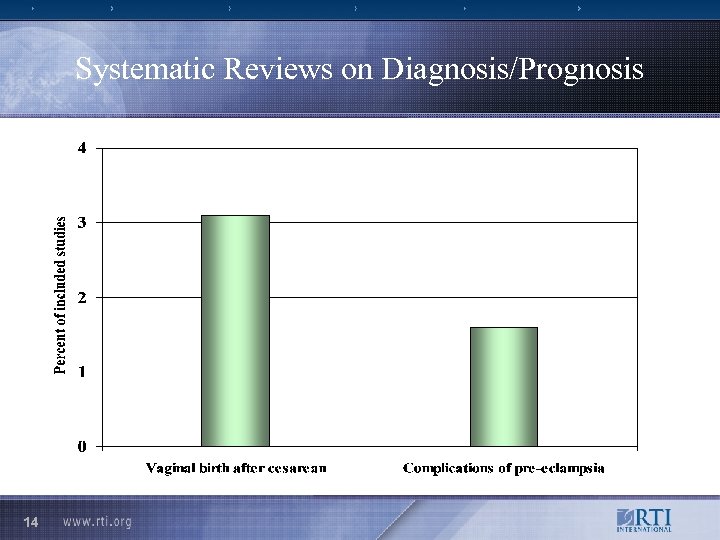 Systematic Reviews on Diagnosis/Prognosis 14
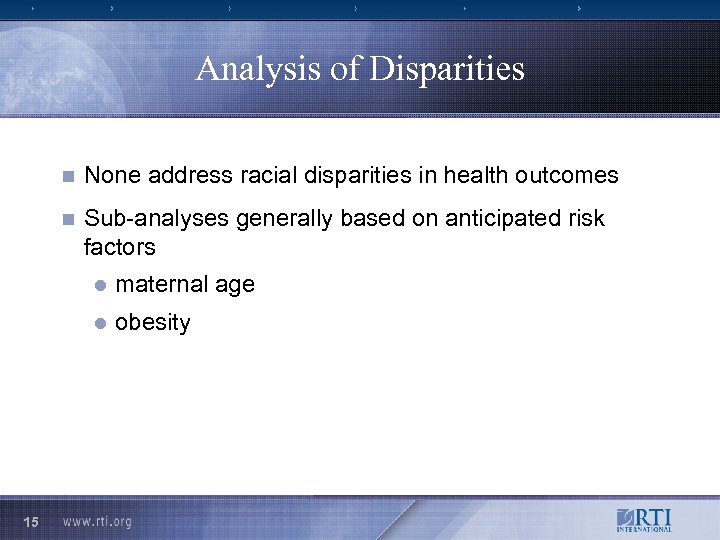 Analysis of Disparities n None address racial disparities in health outcomes n Sub-analyses generally based on anticipated risk factors l l 15 maternal age obesity
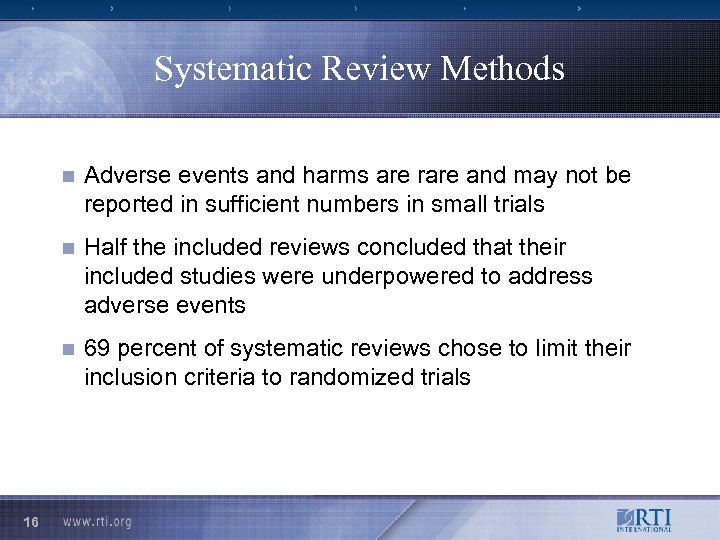 Systematic Review Methods n n Half the included reviews concluded that their included studies were underpowered to address adverse events n 16 Adverse events and harms are rare and may not be reported in sufficient numbers in small trials 69 percent of systematic reviews chose to limit their inclusion criteria to randomized trials
 Considerations for the Future n n Address issues of quality in observational studies n 17 Include large observational studies to address rare adverse events and harms Explicitly seek evidence on interventions addressing racial and ethnic disparities in maternal morbidity and mortality