Скачать презентацию TAIEX Technical assistance and Information Exchange instrument April
665610ed50be7cf8f2c0eef8e86c7ea4.ppt
- Количество слайдов: 42
 TAIEX Technical assistance and Information Exchange instrument April 2015 Damjan Režek
 Persons under obligation n n n banks; savings banks; payment institutions; post office; management companies of investment funds, founders and managers of mutual pension funds and pension companies; brokerage companies; insurance companies; electronic money; currency exchange offices; auditing firms and independent auditors; concessionaires organising special gaming in casinos or gaming halls; organisers regularly offering sport wagers; organisers and concessionaires offering games of chance via the Internet or other telecommunications means; pawnbroker shops;
 n legal entities and natural persons conducting business relating to: • granting credits or loans, factoring and financing of commercial transactions, including forfeiting; • financial leasing; • issuing and management of other payment instruments (for instance, bills and traveller’s cheques), ; • issuing of guarantees and other commitments; • portfolio management services to third parties and related advice; • safe custody services; • mediation in the conclusion of loan and credit transactions; • insurance agency services for the purpose of concluding life insurance contracts; • insurance intermediaries in concluding life insurance contracts; • accounting services; • tax advisory services; • trust and company services; trade in precious metals and precious stones and products made from these materials; • trade in works of art; • organisation or execution of auctions or • real property transactions
 DUTIES OF THE OBLIGED ENTITIES - - - All obliged entities should report to the Office on all transactions suspected to be connected with ML/TF Obliged entities from the Article 4 of APMLTF (financial institutions, accountants, casinos, traders with arts, real assets etc. ) should send a report to the Office on every cash transaction exceeding 30. 000 EUR (at once or within 3 working days after the transaction has been performed) Customer due diligence Customs authorities are obliged to report to the Office every import or export of cash exceeding 10. 000 EUR entering or leaving EU (within 3 days)
 - Appointment of authorised person and his/her deputy (organisations of fewer than four employees) - Education and professional training - Participation in drawing up the list of indicators
 Verification of the identity of a customer 1. 2. The customer’s identity shall also be determined and/or verified in the following cases: upon the customer’s entry into a casino or gaming hall; each time the customer accesses the safe.
 • personal name, permanent or temporary address, date and place of birth of the natural person entering the casino or gaming hall • the date and time of entering the casino or gaming hall
 ROLE OF FIU IN CASE OF THE SUSPICION ON ML/TF - - Requests for additional data, information, documentation from obliged entities that have to be sent in 15 days Request to a state authority or holder of public authority for the submission of the data - Reguest to a lawyer and notary for the submission of the data - Monitoring of a customer’s financial transactions - Suspending a transaction
 PROBLEMS - CHALLENGES - - - Involvement of the “professional money launderers” Physical transfers of cash Use of companies, which activities have been based on cash (casinos, lotteries, internet etc. ) Use of off-shore territories Involvement of transition countries Electronic banking
 SUPERVISION Supervision of implementing the provisions of FIU regulations shall be exercised within their competencies by: n n n n n a) the Office, b) Bank of Slovenia, c) Securities Market Agency of the Republic of Slovenia, d) Insurance Supervision Agency, e) Office of the Republic of Slovenia for Gaming Supervision, f) Tax Administration of the Republic of Slovenia, g) Market Inspectorate of the Republic of Slovenia, h) Slovenian Audit Institute, i) Bar Association of Slovenia, and j) Chamber of Notaries of Slovenia.
 The supervisory bodies shall have the right and duty to: 1. order measures to remedy the irregularities and deficiencies within the time limit asspecified by it; 2. carry out proceedings in accordance with the law regulating offences; 3. propose the adoption of appropriate measures to the competent authority; 4. order other measures and perform acts for which it is authorised by law or any other regulation
 Casse 1 Suspicious transactions report from casino Reasons for suspicion of money laundering: - - Slovenian citizen came in to the casino at 13: 14 and left at 04: 16 He played on slot machines that allow payment in cash in the amount of € 2, 500 He paid a minimum bet of € 5 EUR After a few games, he stopped playing and slot machine had issued him a certificate for payment
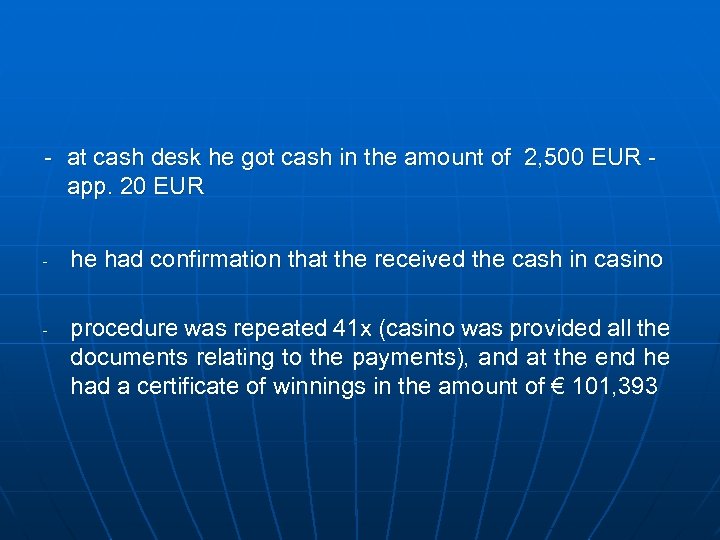 - at cash desk he got cash in the amount of 2, 500 EUR app. 20 EUR - - he had confirmation that the received the cash in casino procedure was repeated 41 x (casino was provided all the documents relating to the payments), and at the end he had a certificate of winnings in the amount of € 101, 393
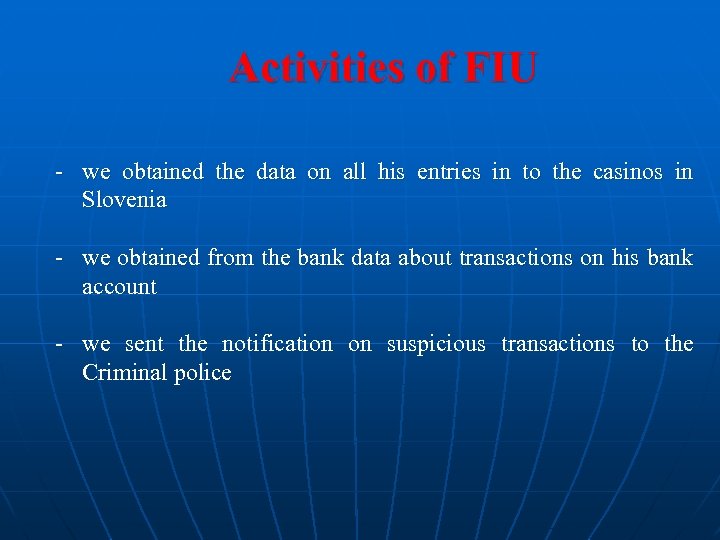 Activities of FIU - we obtained the data on all his entries in to the casinos in Slovenia - we obtained from the bank data about transactions on his bank account - we sent the notification on suspicious transactions to the Criminal police
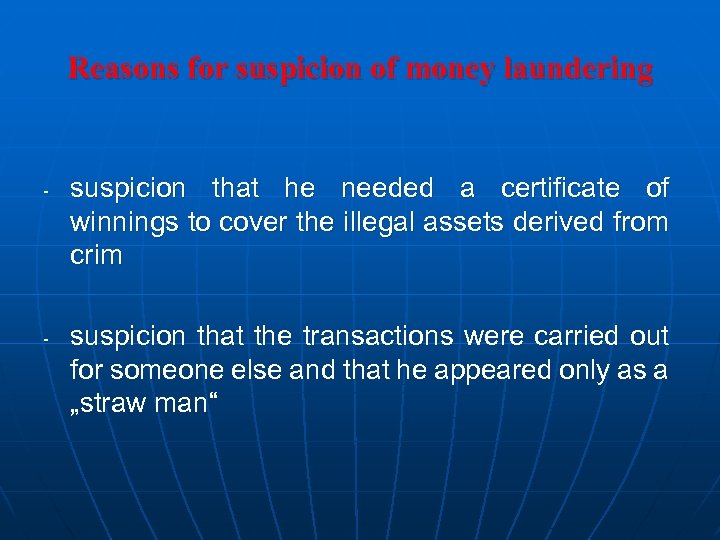 Reasons for suspicion of money laundering - - suspicion that he needed a certificate of winnings to cover the illegal assets derived from crim suspicion that the transactions were carried out for someone else and that he appeared only as a „straw man“
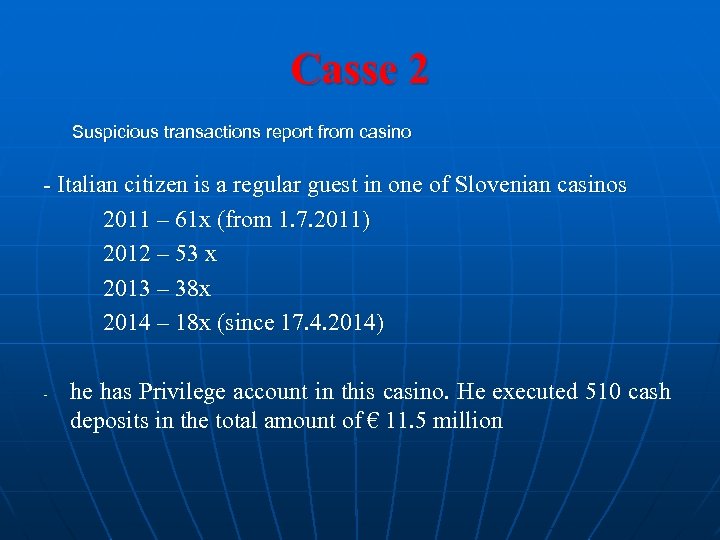 Casse 2 Suspicious transactions report from casino - Italian citizen is a regular guest in one of Slovenian casinos 2011 – 61 x (from 1. 7. 2011) 2012 – 53 x 2013 – 38 x 2014 – 18 x (since 17. 4. 2014) - he has Privilege account in this casino. He executed 510 cash deposits in the total amount of € 11. 5 million
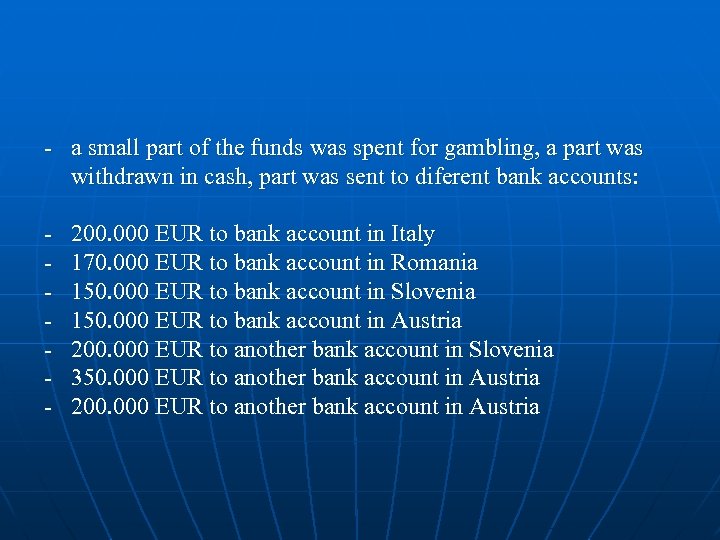 - a small part of the funds was spent for gambling, a part was withdrawn in cash, part was sent to diferent bank accounts: - 200. 000 EUR to bank account in Italy 170. 000 EUR to bank account in Romania 150. 000 EUR to bank account in Slovenia 150. 000 EUR to bank account in Austria 200. 000 EUR to another bank account in Slovenia 350. 000 EUR to another bank account in Austria 200. 000 EUR to another bank account in Austria
 - it is important that as the sender of funds has been stated casino and not the owner of the account
 Activities of the FIU - we obtained data about transactions on his bank accounts opened in Slovenian banks - he signed a long-term deposit contracts with the Bank - we checked the database of cash transactions and found that he executed 982 cash transactions
 Reasons for suspicion of money laundering - - - Italian citizen has brought large sums of cash that was not spent on gambling with deposits of cash on Privilege account he carried out the first stage of money laundering „placement“ an amount of € 1, 420, 000 was transferred to his bank accounts. He executed the second phase of money laundering „layering“. He tried to hide the real source of the money We informed on our findings Criminal police and SOVA
 Methods of Money Laundering through the Use of Casino Value Instruments: - - - Purchase of chips or credits with subsequent redemption of value by way of payment document Purchase of chips or winnings from “clean” players at a higher price Use of chips as currency in illegal transactions
 Indicators of Money Laundering Suspicions Related to the Use of Casino Value Instruments The following indicators may point out to the possible existence of money laundering schemes through the use of casino value instruments: n Purchases and cash outs of casino chips with little or no gaming activity; n Multiple exchanges of cash for chips and vice versa during the same day; n Similar or equal amount of purchased and cashed out chips; n Customer purchases chips and leaves casino shortly after; n Purchase of chips through third parties; n Detection of chips brought by customers into the casino; n Customer presents for payout chip purchase vouchers dated prior to date of redemption;
 • Customer requests to add cash to casino winnings, and then exchanges the combined amount for a single cheque or bank draft; • Customer purchases chips by depositing multiple cheques or bank drafts into individual account, or requests the winnings to be paid out in form of multiple cheques or bank drafts; • Customer inserts funds into gaming machines and claims those funds as credits on individual account with little or no gaming activity; • Customer claims gaming machine credit payouts with no jackpot;
 • Customer frequently inserts substantial amounts of cash in gaming machines that have high payout percentages and does not play "max bet" to limit chances of significant losses or wins, thereby accumulating gaming credits with minimal play; • Customer requests transfer of credits to individual account with another casino; • Abrupt changes in wagering or betting pattern; • Customer’s intention to win is absent or secondary.
 Methods of Money Laundering through the Structuring of Transactions Regular depositing of cash Use of third parties to undertake transactions Utilizing shift changes to conduct transactions Regularly switching the place of gaming Requesting division of winnings
 Indicators of Money Laundering Suspicions Related to the Structuring of Transactions Frequent purchases of value instruments and (or) frequent wagers in cash just below the identification and (or) reporting disclosure thresholds; Purchases of value instruments with cheques issued by different banks with face value just below the identification and (or) reporting disclosure thresholds; Purchases of value instruments with cheques issued on behalf of third parties
 A third party is present for all transactions of the customer, but does not participate in the actual transaction; Use of the customer’s individual account by third parties; Cash received from third party for purchasing chips; Cash handed to third party after exchanging chips; Transfer of funds from one individual account to multiple individual accounts; Transfer of funds from multiple individual accounts to one individual account;
 Customer waits for changes of casino personnel shift to purchase or exchange chips just below the identification and (or) reporting disclosure thresholds; Customer moves from table to table or room to room or leaves the casino every time before the amounts of transactions reach the identification and (or) reporting disclosure thresholds; Customer requests the winnings to be paid out in form of separate cash amounts, multiple cheques or bank drafts just below the identification and (or) reporting disclosure thresholds.
 Methods of Money Laundering through the Refining of Banknotes Refining at the cashier’s desk Refining through “note acceptors” gaming machines that accept cash or Use of individual casino accounts for refining
 Indicators of Money Laundering Suspicions Related to the Refining of Banknotes Customer in possession of large amounts of bills or coinage; Attempt to exchange low denomination notes for high denomination ones for various reasoning; Insert low denomination banknotes in “note acceptors” or gaming devices with little or no gaming activity before redeeming the credits for high denomination banknotes; Deposit amounts in low denomination banknotes on individual account with little or no play before redeeming the balance of account for high denomination banknotes.
 Methods of Money Laundering through the Use of Individual Accounts and Safe Deposit Boxes Deposits into casino account by various means of payment Deposits into casino accounts by wire transfer Use of foreign individual holding accounts Use of safety deposit boxes
 Indicators of Money Laundering Suspicions Related to the Use of Individual Accounts and Safe Deposit Boxes Deposits of cash, cheques, and wire transfers into individual account inconsistent with customer profile; Funds withdrawn from individual account shortly after being deposited; Significant movement of funds through the individual account with little or no gambling activity; Funds credited into an individual account from banks or other individual accounts in high-risk countries, from unknown sources;
 • Funds debited from an individual account to banks or other individual accounts in high-risk countries, to unknown beneficiaries; • Use of intermediaries (authorized representatives) to undertake transactions; • Funds transferred to customer’s individual account from a corporate accounts; • U-turn transactions occurring with funds being transferred (out of country) and then the same or similar amounts being returned; • Third parties regularly make use of the customer’s individual safe deposit box.
 Methods of Money Laundering through the Use of False Documents and Means of Payment Use of false identification data Use of forged means of payment
 Indicators of Money Laundering Suspicions Related to the Use of False Documents and Means of Payment Customers introducing themselves under a fictitious name or different names; Use of identification document with altered or missing entries; Inconsistent and contradictory identity information presented; Refusal to present any identification document and (or) personal data; Counterfeit banknotes or cheques used for purchasing value instruments or replenishing individual account; Forged non-cash means of payment (e. g. debit, credit or gift cards) used for purchasing value instruments or replenishing individual account.
 Methods of Money Laundering through Conspiracy for Fixed Game Fixed game with another customer Fixed game with a casino employee
 Indicators of Money Laundering Suspicions Related to Conspiracy for Fixed Game Even-money wagering when conducted by a pair of betters covering both sides of an even bet (e. g. , in roulette, baccarat/mini-baccarat); Two or more pairs of customers frequently playing at the same table; Two or more pairs of players frequently wagering against one another (the win of one player is “accompanied” by the loss of the other);
 Customer attempting to be friend with casino employees; Customer prefers to play at the table serviced by a certain dealer; Contacts or connections between customers and casino staff outside of the casino.
 Other Transactions inconsistent with customer profile; High volume of transactions within a short period; Abrupt increase in the volume of transactions; Customers pertaining to high-risk groups (e. g. PEPs); Negative information on costumer (e. g. criminal records).