


 Скачать презентацию Tag Learner A P 2 P Classifier Learning
cf664cb44633bed72812ac512b58127f.ppt
- Количество слайдов: 25
 Tag. Learner: A P 2 P Classifier Learning System from Collaboratively Tagged Text Documents Haimonti Dutta 1, Xianshu Zhu 2, Tushar Muhale 2, Hillol Kargupta 2, Kirk Borne 3, Codrina Lauth 4, Florian Holz 5, and Gerherd Heyer 5 1 Columbia University of Maryland, Baltimore County 3 George Mason University 4 Fraunhofer Institute for Intelligent Analysis and Information Systems 5 University of Leipzig 2 University
 Outline • • • Introduction and Motivation Related Work Tag. Learner Distributed Classifier-learning Algorithm Experiments Conclusion and Future Work
 Introduction • Large Online Document Repositories: – Online Newspapers, Digital Libraries, etc. – Growing in size • Text categorization on the repositories: – No automated text classification mechanism – Performed by authorities, such as librarians Impractical
 Introduction (cont. ) • Collaborative tagging – Del. icio. us, Flickr, Google image labeler – Recruit web users to add tags to a resource – Help to utilize power of people’s knowledge • Pros and cons – Improve web search result, help on classification – Not support by most online text repositories – Lack of control • Absence of standard keywords • Errors in tagging due to spelling errors • Harder to manage due to increased content diversity
 Motivation • Provide automated classification service – Utilize collaborative effort of users • Collaborative tagging in Peer-to-Peer network – Without repositories’ support P 2 P Classifier learning system
 Related Work • Collaborative tagging: – Recommendation System (Tso-Sutter et al. ) – Web search (Yahia et al. ) – Classification accuracy (Brooks et al. ) • Distributed Linear Programming: – Distributed Simplex Algorithm (Dutta et al. )
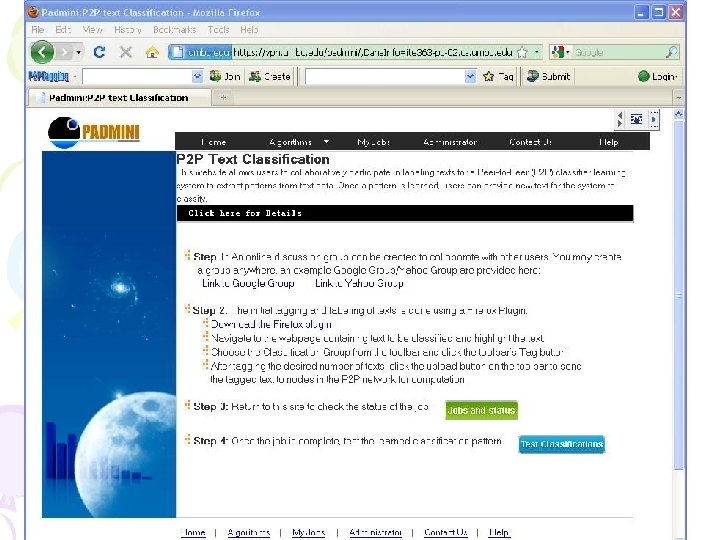
 Tag. Learner: A P 2 P Classifier Learning System
 Tag. Learner: A P 2 P Classifier Learning System
 Tag. Learner: A P 2 P Classifier Learning System
 Tag. Learner: A P 2 P Classifier Learning System
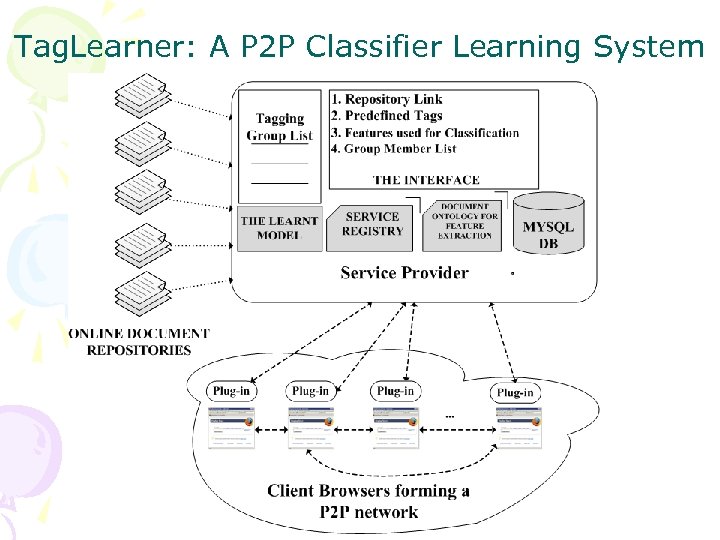
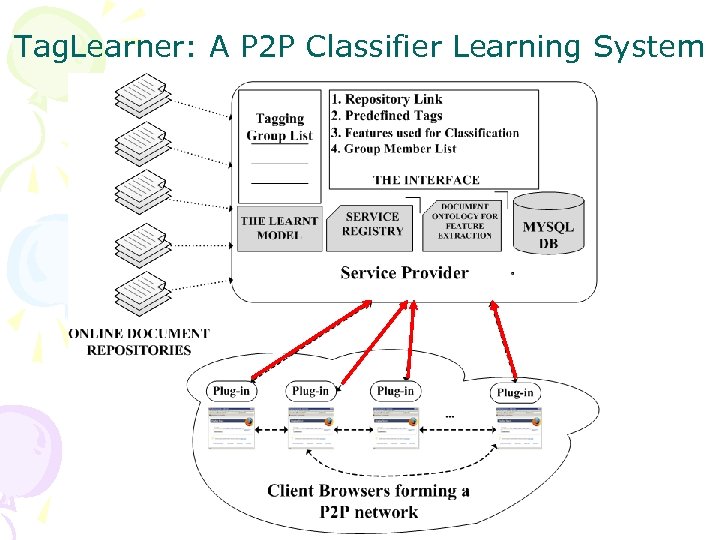
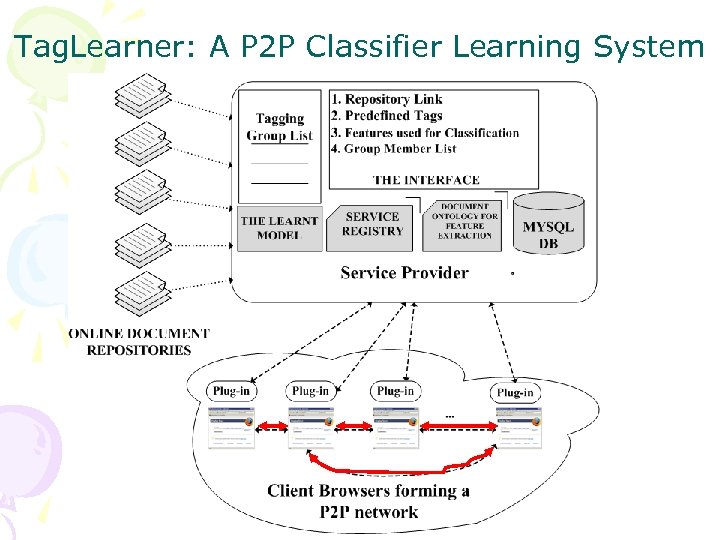
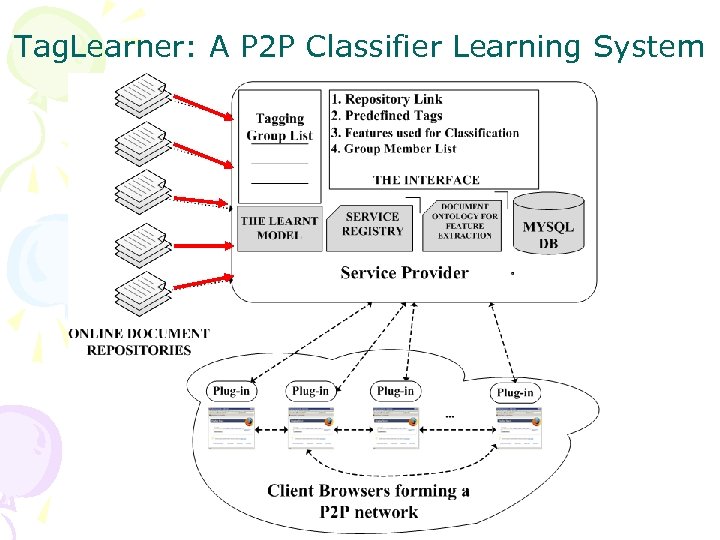
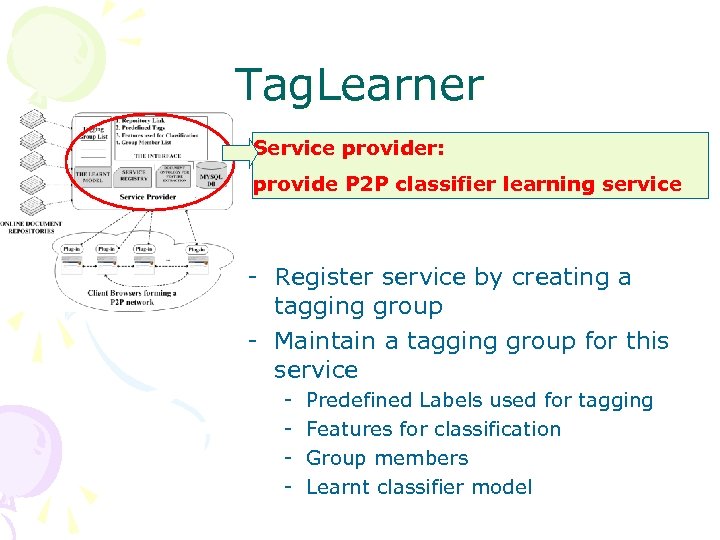 Tag. Learner Service provider: provide P 2 P classifier learning service - Register service by creating a tagging group - Maintain a tagging group for this service - Predefined Labels used for tagging Features for classification Group members Learnt classifier model
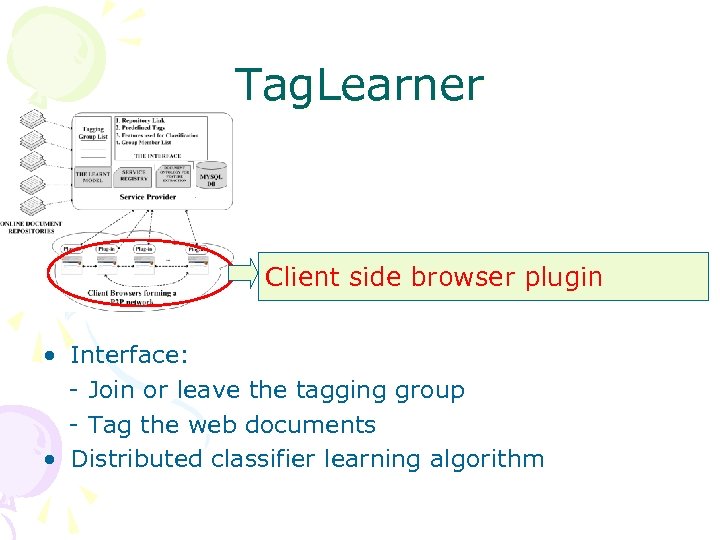 Tag. Learner Client side browser plugin • Interface: - Join or leave the tagging group - Tag the web documents • Distributed classifier learning algorithm
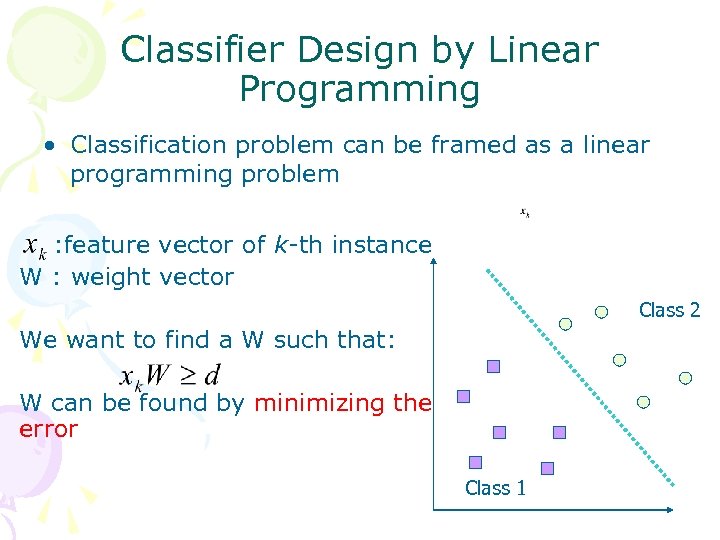 Classifier Design by Linear Programming • Classification problem can be framed as a linear programming problem : feature vector of k-th instance W : weight vector Class 2 We want to find a W such that: W can be found by minimizing the error Class 1
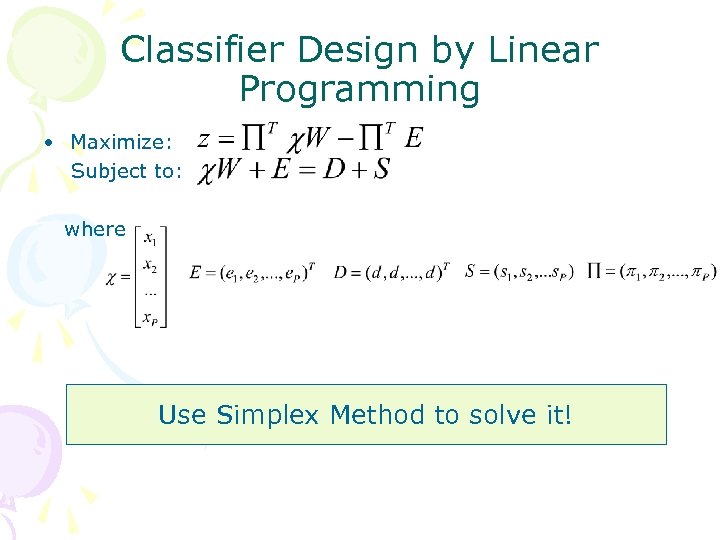 Classifier Design by Linear Programming • Maximize: Subject to: where Use Simplex Method to solve it!
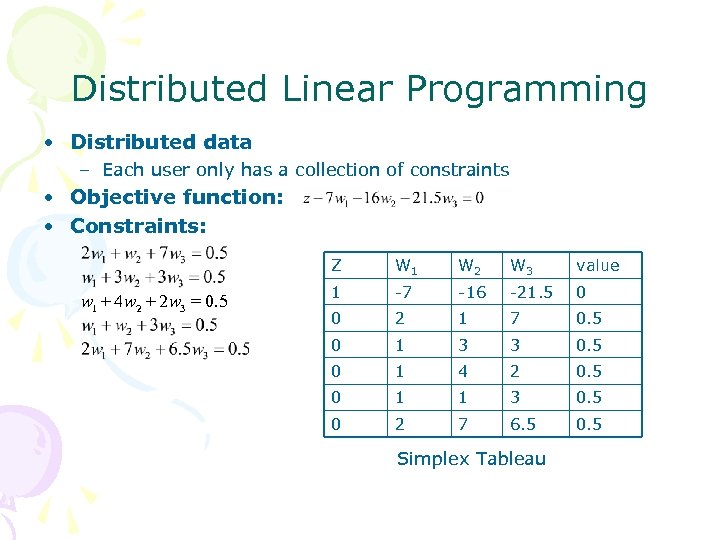 Distributed Linear Programming • Distributed data – Each user only has a collection of constraints • Objective function: • Constraints: Z w 1 + 4 w 2 + 2 w 3 = 0. 5 W 1 W 2 W 3 value 1 -7 -16 -21. 5 0 0 2 1 7 0. 5 0 1 3 3 0. 5 0 1 4 2 0. 5 0 1 1 3 0. 5 0 2 7 6. 5 0. 5 Simplex Tableau
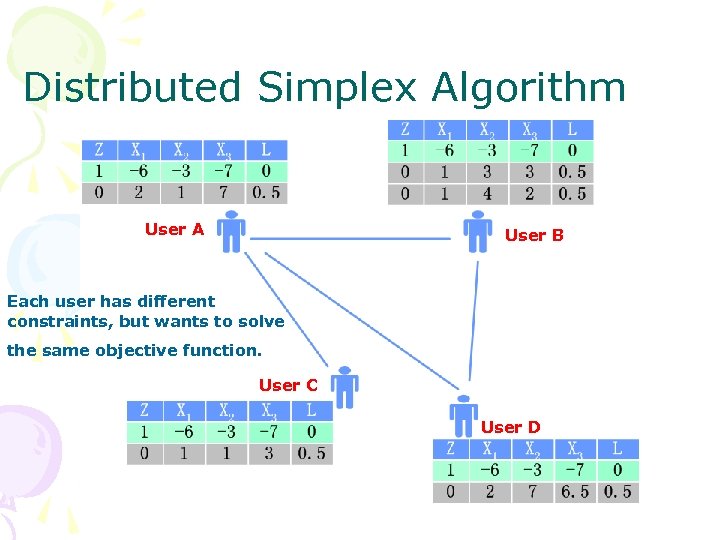 Distributed Simplex Algorithm User A User B Each user has different constraints, but wants to solve the same objective function. User C User D
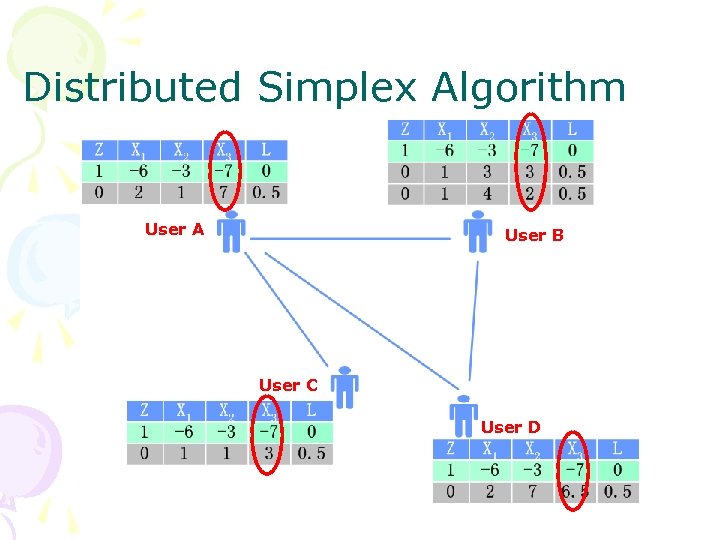 Distributed Simplex Algorithm User A User B User C User D
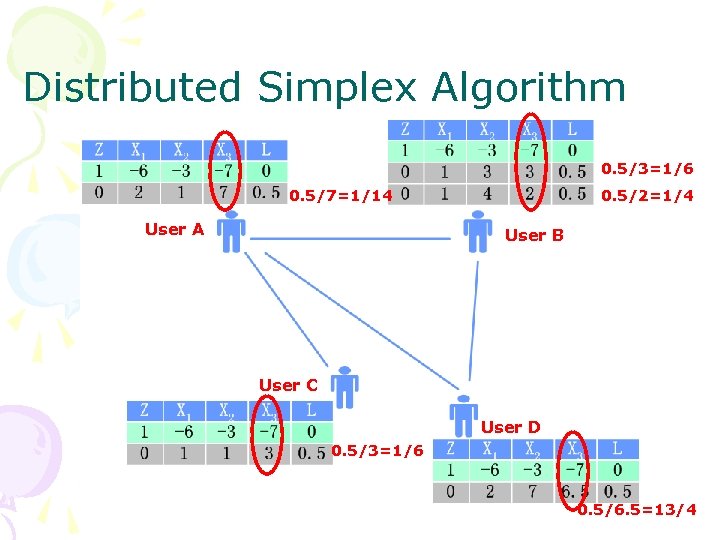 Distributed Simplex Algorithm 0. 5/3=1/6 0. 5/7=1/14 User A 0. 5/2=1/4 User B User C User D 0. 5/3=1/6 0. 5/6. 5=13/4
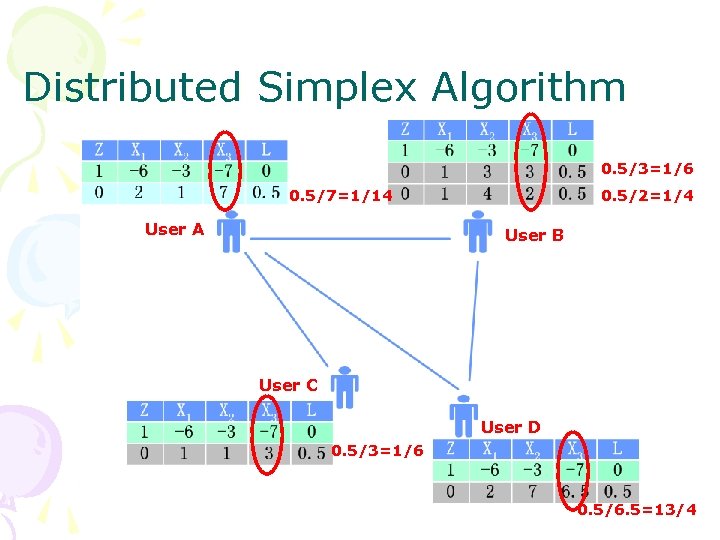 Distributed Simplex Algorithm 0. 5/3=1/6 0. 5/7=1/14 User A 0. 5/2=1/4 User B User C User D 0. 5/3=1/6 0. 5/6. 5=13/4
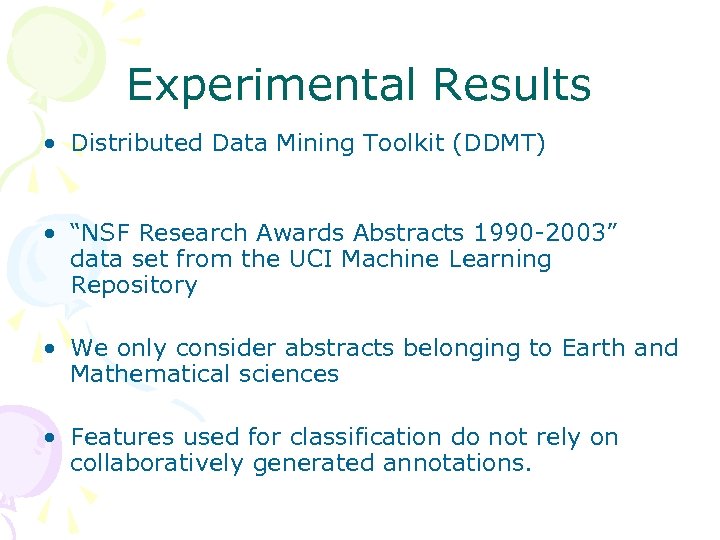 Experimental Results • Distributed Data Mining Toolkit (DDMT) • “NSF Research Awards Abstracts 1990 -2003” data set from the UCI Machine Learning Repository • We only consider abstracts belonging to Earth and Mathematical sciences • Features used for classification do not rely on collaboratively generated annotations.
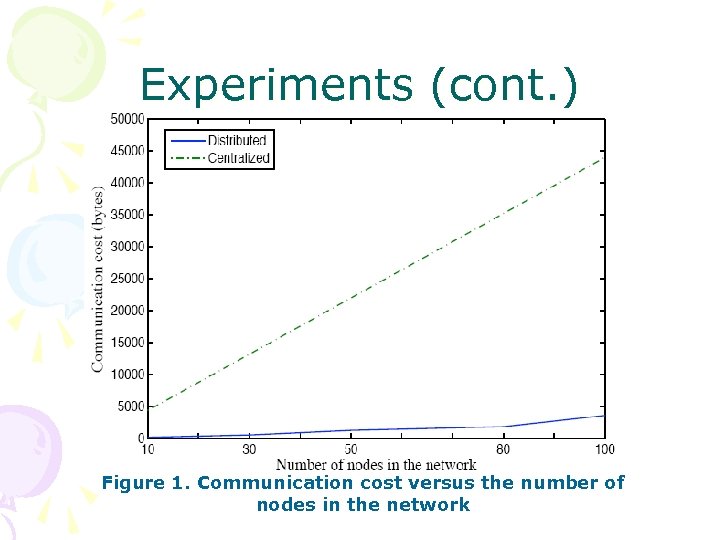 Experiments (cont. ) Figure 1. Communication cost versus the number of nodes in the network
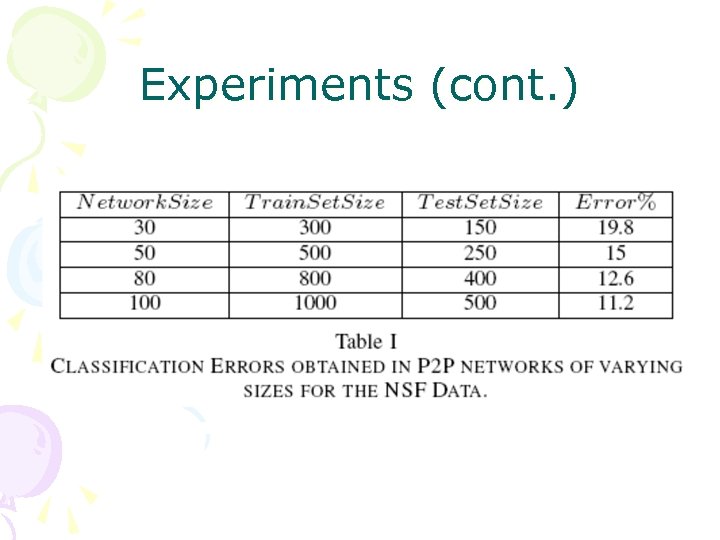 Experiments (cont. )
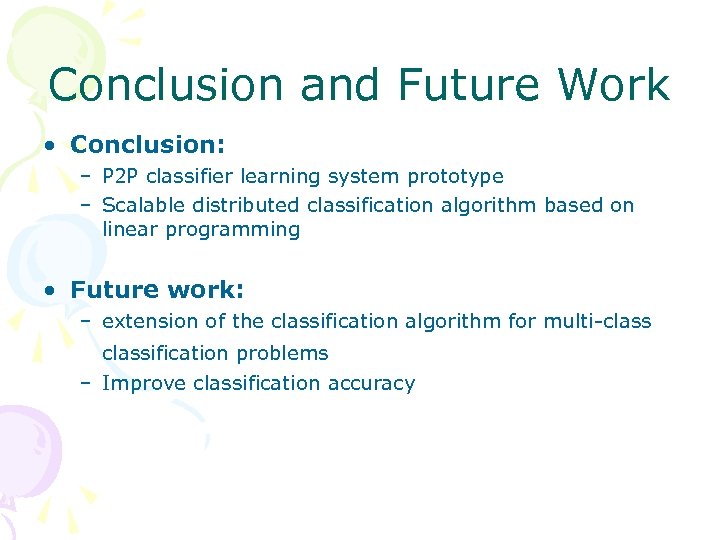 Conclusion and Future Work • Conclusion: – P 2 P classifier learning system prototype – Scalable distributed classification algorithm based on linear programming • Future work: – extension of the classification algorithm for multi-classification problems – Improve classification accuracy
 Thank you ! Questions ?