 Скачать презентацию Table of Contents n Introduction n The Mica
b4f2311124e937f7d6b1e20d3555dc79.ppt
- Количество слайдов: 105



Table of Contents n Introduction n The Mica Mote n Sensing and Communication n Design Issues Range Challenges n Energy Consumption n Clustering of Sensors p Regularly placed sensors p Heterogeneous WSNs p Mobile Sensors n Applications p Habitat Monitoring p A Remote Ecological Micro-Sensor Network p Environmental Monitoring p Drinking Water Quality p Disaster Relief Management p Soil Moisture Monitoring p Health Care Monitoring p Building, Bridge and Structural Monitoring p Smart Energy and Home/Office Applications p DARPA Efforts towards Wireless Sensor Networks p Body Area Network n Conclusions and Future Directions p Copyright © 2006, Dr. Carlos Cordeiro and Prof. Dharma P. Agrawal, All rights reserved. 1
Introduction § Wireless Sensor Networks can be considered as a special case of ad hoc networks with reduced or no mobility § WSNs enable reliable monitoring and analysis of unknown and untested environments § These networks are “data centric”, i. e. , unlike traditional ad hoc networks where data is requested from a specific node, data is requested based on certain attributes such as, “which area has temperature over 35ºC or 95ºF” § A sensor has many functional components as shown in Figure 8. 1 § A typical sensor consists of a transducer to sense a given physical quantity, an embedded processor, small memory and a wireless transceiver to transmit or receive data and an attached battery Copyright © 2006, Dr. Carlos Cordeiro and Prof. Dharma P. Agrawal, All rights reserved. 2
Introduction to WSN • What is a – – – Sensor? Sensor Node? Sensor Network? 4 May 2013 Copyright © 2006, Dr. Carlos Cordeiro and 2 -d Nat'l w/s on W/L Adhoc N/Ws Prof. Dharma P. Agrawal, All rights reserved. 3 3
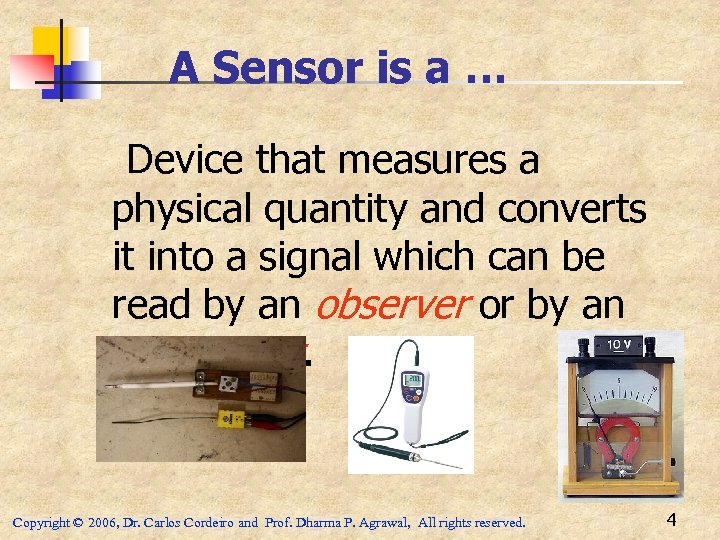
A Sensor is a … Device that measures a physical quantity and converts it into a signal which can be read by an observer or by an instrument. Copyright © 2006, Dr. Carlos Cordeiro and Prof. Dharma P. Agrawal, All rights reserved. 4
• Sensor Node (Mote) is a … Node that is capable of – – – Sensing Information Processing (on-board) Communicating to nodes in the network Copyright © 2006, Dr. Carlos Cordeiro and Prof. Dharma P. Agrawal, All rights reserved. 5
Typical SN contains several transducers Temperature, Pressure, Velocity, Acceleration, Stress and Strain, Fatigue, Tilt, Light Intensity, Sound, Humidity, Gas-Sensors, Biological, Pollution, Nuclear Radiation, Civil Structural Sensors, Blood Pressure, Sugar Level, White Cell Count, . . . § Any one could be selected under the program control at a given time Copyright © 2006, Dr. Carlos Cordeiro and Prof. Dharma P. Agrawal, All rights reserved. 6
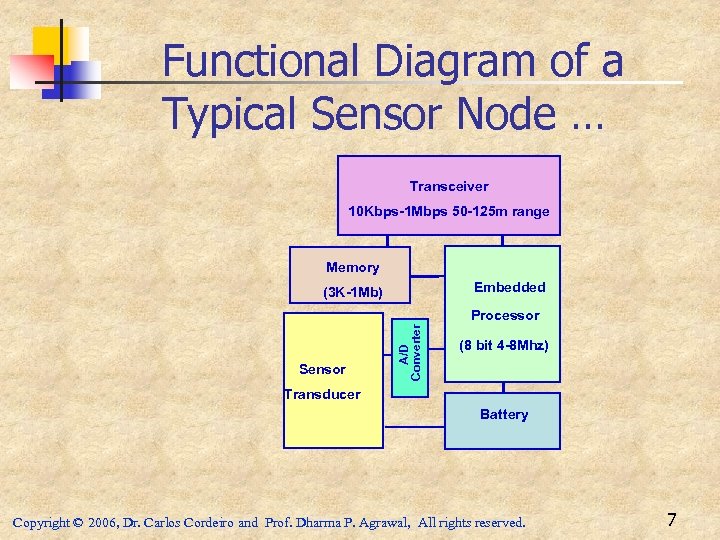
Functional Diagram of a Typical Sensor Node … Transceiver 10 Kbps-1 Mbps 50 -125 m range Memory Embedded (3 K-1 Mb) Sensor A/D Converter Processor (8 bit 4 -8 Mhz) Transducer Battery Copyright © 2006, Dr. Carlos Cordeiro and Prof. Dharma P. Agrawal, All rights reserved. 7
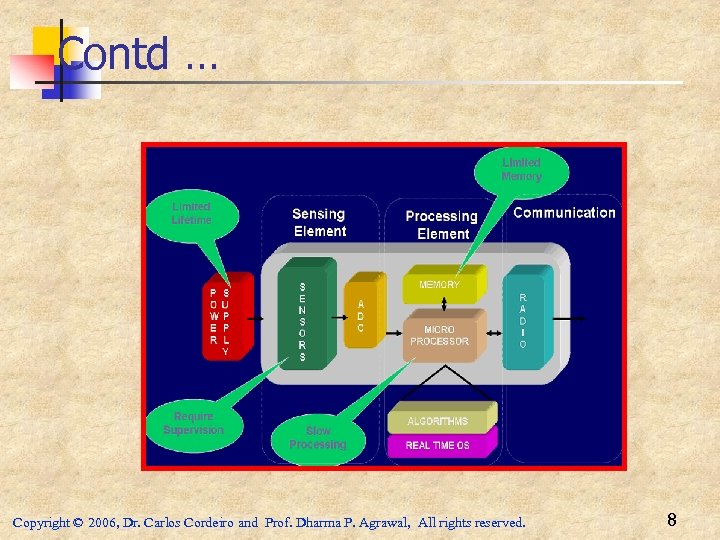
Contd … Copyright © 2006, Dr. Carlos Cordeiro and Prof. Dharma P. Agrawal, All rights reserved. 8
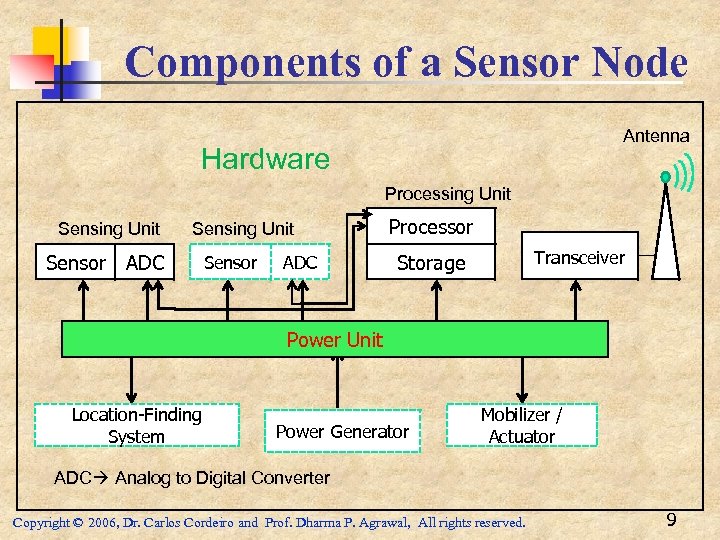
Components of a Sensor Node Antenna Hardware Processing Unit Sensing Unit #1 Sensor ADC Sensing Unit #2(OPT) Sensor ADC Processor Transceiver Storage Power Unit Location-Finding System Power Generator Mobilizer / Actuator ADC Analog to Digital Converter Copyright © 2006, Dr. Carlos Cordeiro and Prof. Dharma P. Agrawal, All rights reserved. 9
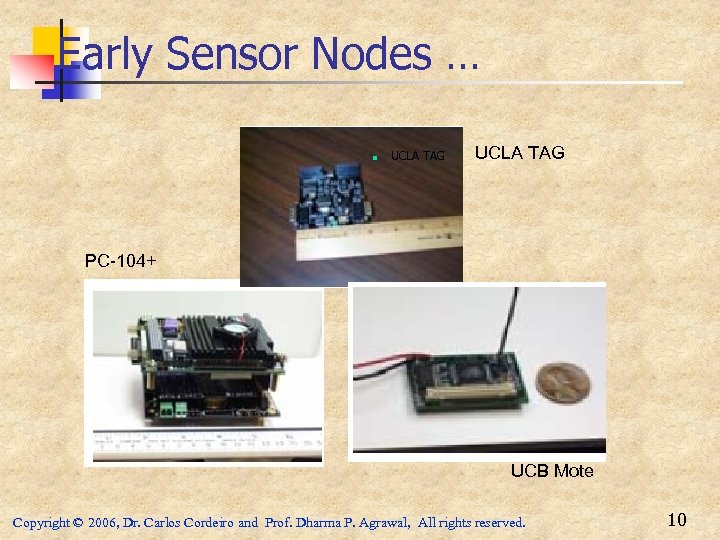
Early Sensor Nodes … n UCLA TAG PC-104+ UCB Mote Copyright © 2006, Dr. Carlos Cordeiro and Prof. Dharma P. Agrawal, All rights reserved. 10

UCB Mica Mote & Mica Board … • Mica Motes-2 Mica Board Copyright © 2006, Dr. Carlos Cordeiro and Prof. Dharma P. Agrawal, All rights reserved. 11
Introduction (Contd) WSN is composed of a large number of sensor nodes densely deployed – either inside the phenomenon or very close to it. Copyright © 2006, Dr. Carlos Cordeiro and Prof. Dharma P. Agrawal, All rights reserved. 12
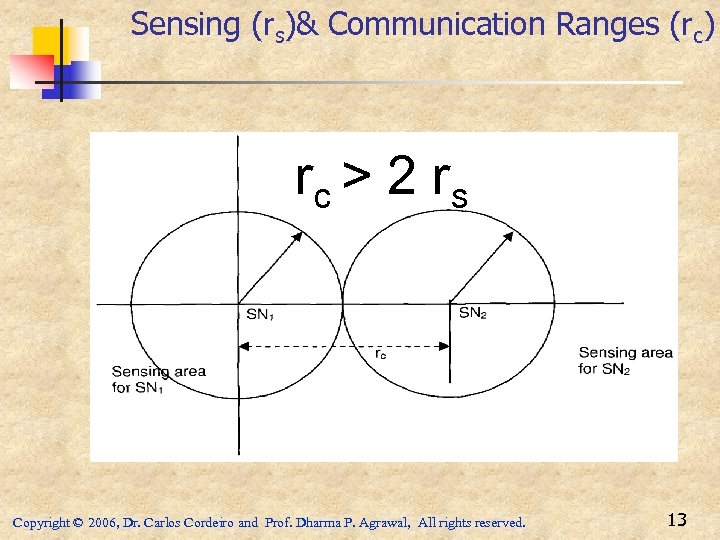
Sensing (rs)& Communication Ranges (rc) rc > 2 r s Copyright © 2006, Dr. Carlos Cordeiro and Prof. Dharma P. Agrawal, All rights reserved. 13
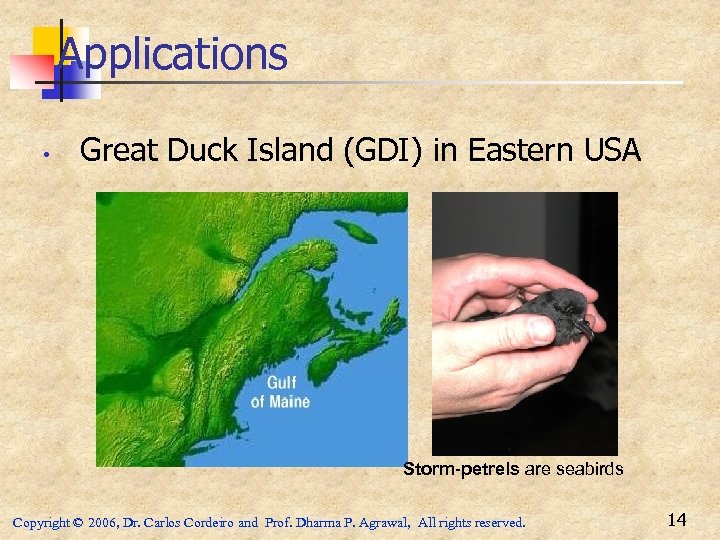
Applications • Great Duck Island (GDI) in Eastern USA Storm-petrels are seabirds Copyright © 2006, Dr. Carlos Cordeiro and Prof. Dharma P. Agrawal, All rights reserved. 14
Copyright © 2006, Dr. Carlos Cordeiro and Prof. Dharma P. Agrawal, All rights reserved. 15
Questions to Answer Usage pattern of nesting burrows over the 24 -72 hour cycle • Changes in the burrow and surface environmental parameters • Differences in the micro-environments with and without large numbers of nesting petrels u Copyright © 2006, Dr. Carlos Cordeiro and Prof. Dharma P. Agrawal, All rights reserved. 16
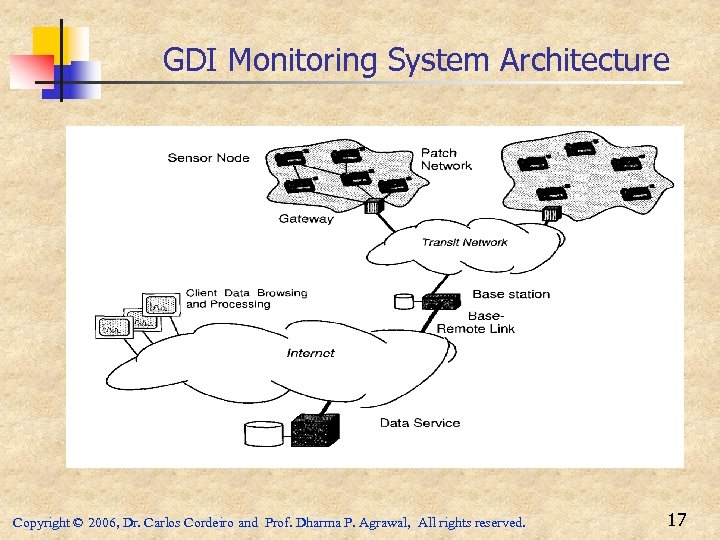
GDI Monitoring System Architecture Copyright © 2006, Dr. Carlos Cordeiro and Prof. Dharma P. Agrawal, All rights reserved. 17
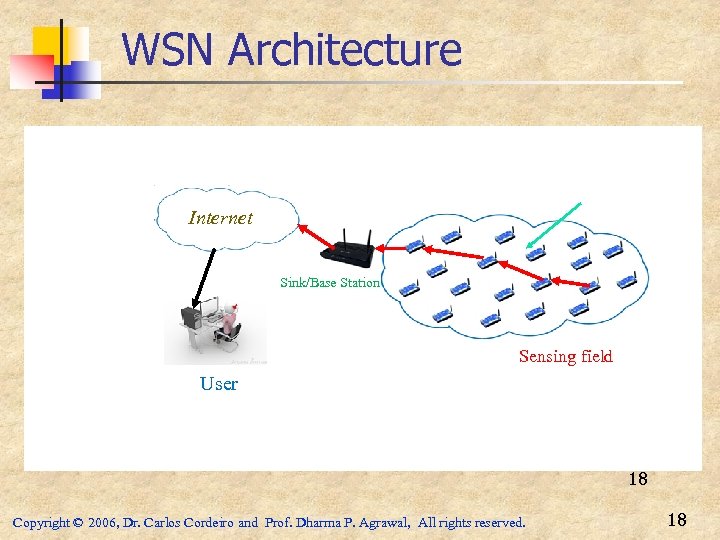
WSN Architecture Sensor node Internet Sink/Base Station Sensing field User 18 Copyright © 2006, Dr. Carlos Cordeiro and Prof. Dharma P. Agrawal, All rights reserved. 18
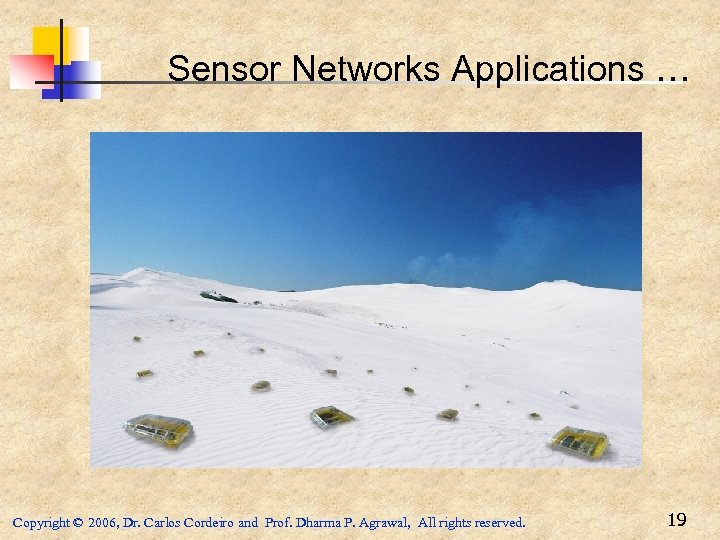
Sensor Networks Applications … Copyright © 2006, Dr. Carlos Cordeiro and Prof. Dharma P. Agrawal, All rights reserved. 19
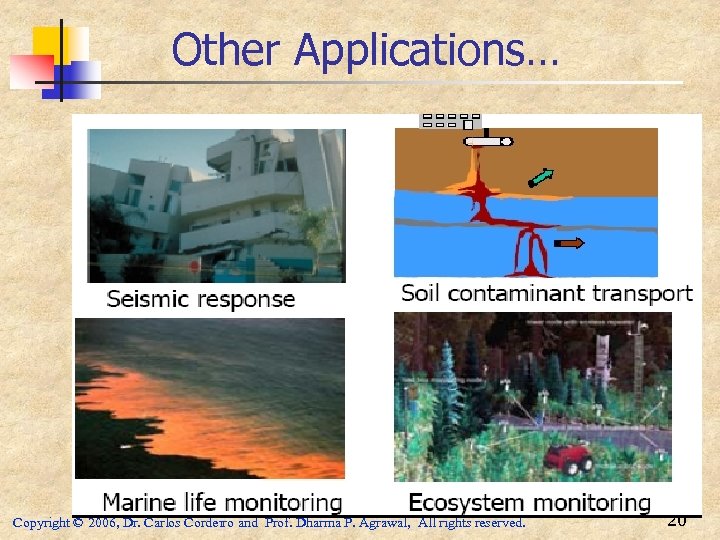
Other Applications… Copyright © 2006, Dr. Carlos Cordeiro and Prof. Dharma P. Agrawal, All rights reserved. 20
WSN Vs Manets • • The number of nodes in a sensor network can be several orders of magnitude higher than the nodes in an ad hoc network. Sensor nodes are densely deployed. Sensor nodes are limited in power, computational capacities and memory. Sensor nodes are prone to failures. The topology of a sensor network changes frequently. Sensor nodes mainly use broadcast, most ad hoc networks are based on p 2 p. Sensor nodes may not have global ID. Copyright © 2006, Dr. Carlos Cordeiro and Prof. Dharma P. Agrawal, All rights reserved. 21
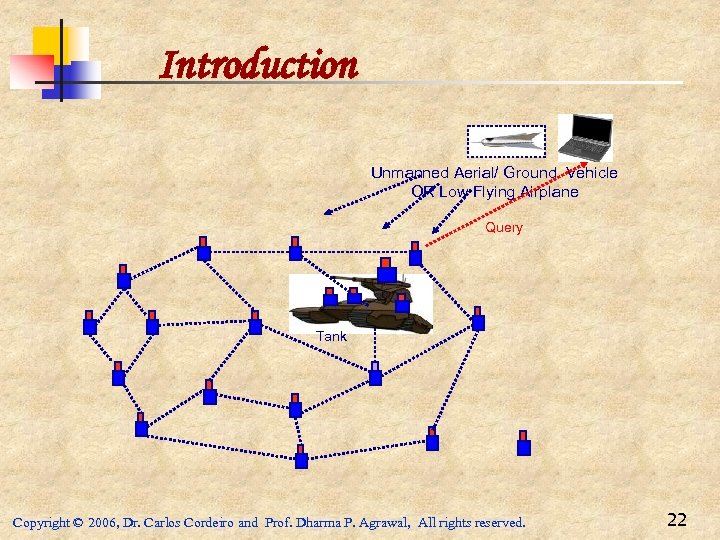
Introduction Unmanned Aerial/ Ground Vehicle OR Low Flying Airplane Query Tank Copyright © 2006, Dr. Carlos Cordeiro and Prof. Dharma P. Agrawal, All rights reserved. 22
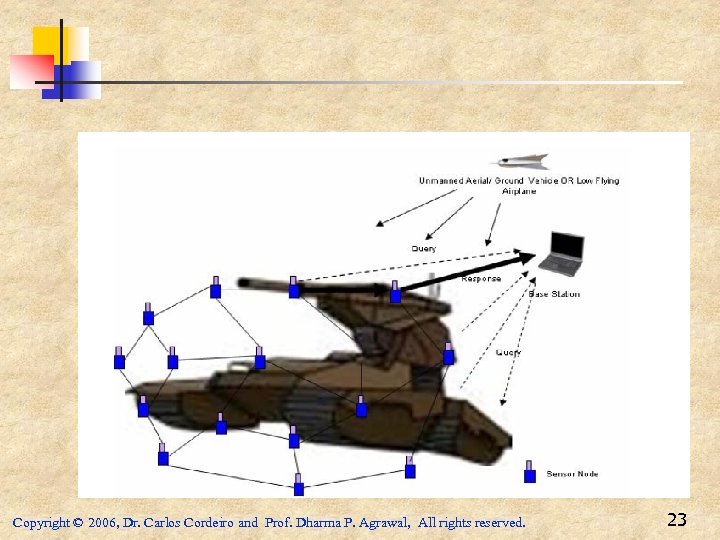
Copyright © 2006, Dr. Carlos Cordeiro and Prof. Dharma P. Agrawal, All rights reserved. 23
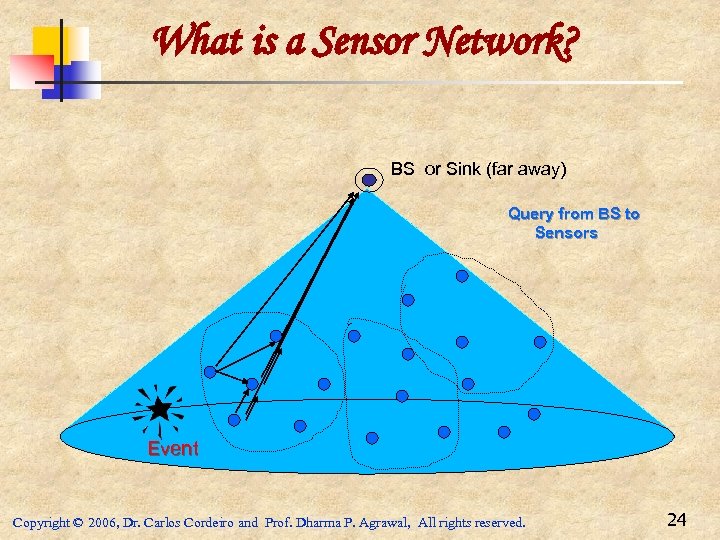
What is a Sensor Network? BS or Sink (far away) Query from BS to Sensors Event Copyright © 2006, Dr. Carlos Cordeiro and Prof. Dharma P. Agrawal, All rights reserved. 24
Classifications of WSNs § WSNs can be classified on the basis of their mode of operation or functionality, and the type of target applications p p p Proactive Networks – The nodes in this network periodically switch on their sensors and transmitters, sense the environment and transmit the data of interest and they provide a snapshot of the relevant parameters at regular intervals and are well suited for applications requiring periodic data monitoring Reactive Networks – In this scheme, the nodes react immediately to sudden and drastic changes in the value of a sensed attribute and as such, these are well suited for time critical applications Hybrid Networks – This is a combination of both proactive and reactive networks where sensor nodes not only send data periodically, but also respond to sudden changes in attribute values Copyright © 2006, Dr. Carlos Cordeiro and Prof. Dharma P. Agrawal, All rights reserved. 25
Network Architecture § WSN architecture need to cover a desired area both for sensing coverage and communication connectivity point of view § Therefore, density of the WSN network is critical for the effective use of the WSN § There is no well-defined measure of life-time of a WSN and some assume either the failure of a single sensor running out of battery power as life-time of the network § Perhaps a better definition is if certain percentage of sensors stops working, may define the life-time as the network continues to operate § The percentage failure may depend on the nature of application and as long as the area is adequately covered by the operating sensors, a WSN may be considered operational Copyright © 2006, Dr. Carlos Cordeiro and Prof. Dharma P. Agrawal, All rights reserved. 26
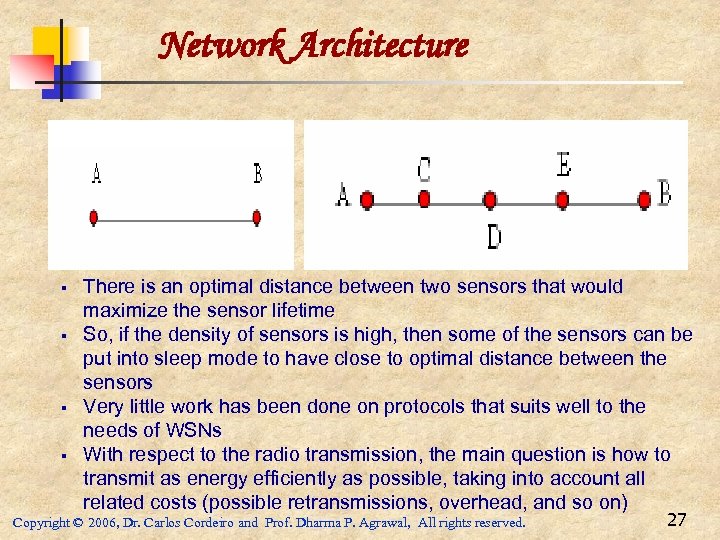
Network Architecture § § There is an optimal distance between two sensors that would maximize the sensor lifetime So, if the density of sensors is high, then some of the sensors can be put into sleep mode to have close to optimal distance between the sensors Very little work has been done on protocols that suits well to the needs of WSNs With respect to the radio transmission, the main question is how to transmit as energy efficiently as possible, taking into account all related costs (possible retransmissions, overhead, and so on) Copyright © 2006, Dr. Carlos Cordeiro and Prof. Dharma P. Agrawal, All rights reserved. 27
MAC Protocols § WSNs are designed to operate for long time § Nodes are in idle state for most time when no sensing occurs § Measurements have shown that a typical radio consumes the similar level of energy in idle mode as in receiving mode § Important to operate in low duty cycles The Sensor-MAC § Protocol explores design trade-offs for energy-conservation in the MAC layer § Reduces the radio energy consumption from the following sources: collision, control overhead, overhearing unnecessary traffic, and idle listening § The basic scheme is to put all SNs into a low-duty-cycle mode – listen and sleep periodically § When SNs are listening, they follow a contention rule similar to the IEEE 802. 11 DCF Copyright © 2006, Dr. Carlos Cordeiro and Prof. Dharma P. Agrawal, All rights reserved. 28
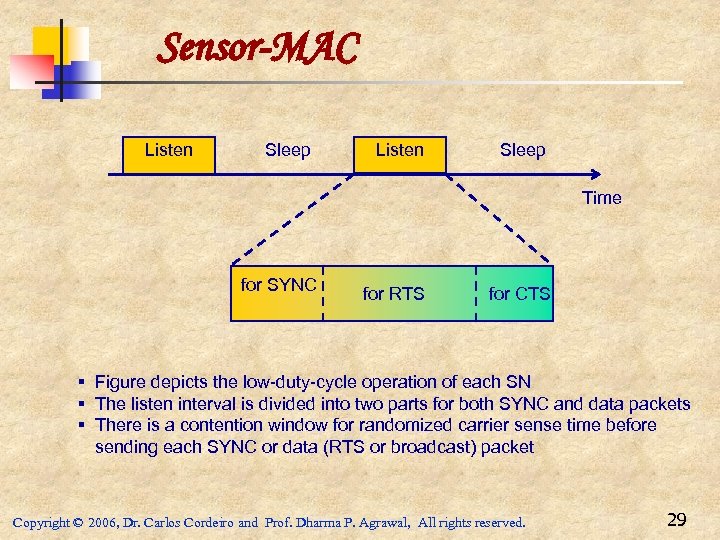
Sensor-MAC Listen Sleep Time for SYNC for RTS for CTS § Figure depicts the low-duty-cycle operation of each SN § The listen interval is divided into two parts for both SYNC and data packets § There is a contention window for randomized carrier sense time before sending each SYNC or data (RTS or broadcast) packet Copyright © 2006, Dr. Carlos Cordeiro and Prof. Dharma P. Agrawal, All rights reserved. 29
SMACS § The SMACS is an infrastructure-building protocol that forms a flat topology (as opposed to a cluster hierarchy) for sensor networks § SMACS is a distributed protocol which enables a collection of SNs to discover their neighbors and establish transmission/reception schedules for communicating with them without the need for any local or global master nodes § In order to achieve this ease of formation, SMACS combines the neighbor discovery and channel assignment phases Copyright © 2006, Dr. Carlos Cordeiro and Prof. Dharma P. Agrawal, All rights reserved. 30
SMACS (Contd. ) § § SMACS assigns a channel to a link immediately after the link’s existence is discovered This way, links begin to form concurrently throughout the network By the time all nodes hear all their neighbors, they would have formed a connected network In a connected network, there exists at least one multihop path between any two distinct nodes Copyright © 2006, Dr. Carlos Cordeiro and Prof. Dharma P. Agrawal, All rights reserved. 31
Network Topology 4 May 2013 Copyright © 2006, Dr. Carlos Cordeiro and 2 -d Nat'l w/s on W/L Adhoc N/Ws Prof. Dharma P. Agrawal, All rights reserved. 32 32
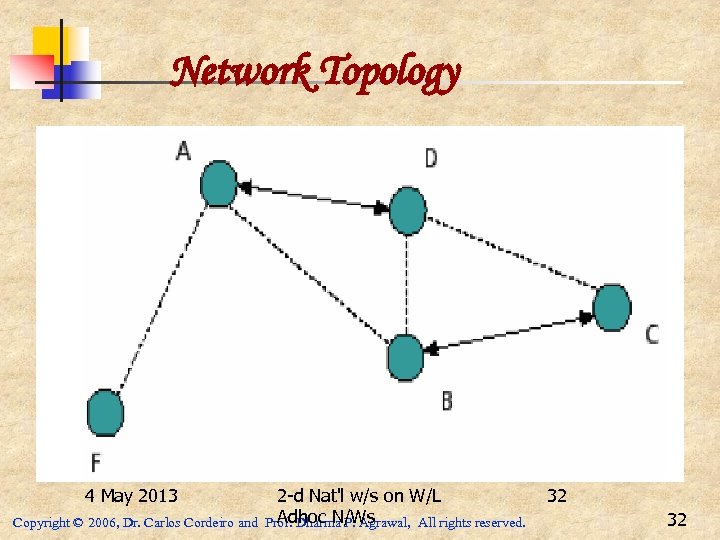
SMACS (Contd. ) § § Here, nodes A and D wake up at times Ta and Td After they find each other, they agree to transmit and receive during a pair of fixed time slots This transmission/reception pattern is repeated periodically every Tframe Nodes B and C, in turn, wake up later at times Tb and Tc, respectively 4 May 2013 Copyright © 2006, Dr. Carlos Cordeiro and 2 -d Nat'l w/s on W/L Adhoc N/Ws Prof. Dharma P. Agrawal, All rights reserved. 33 33
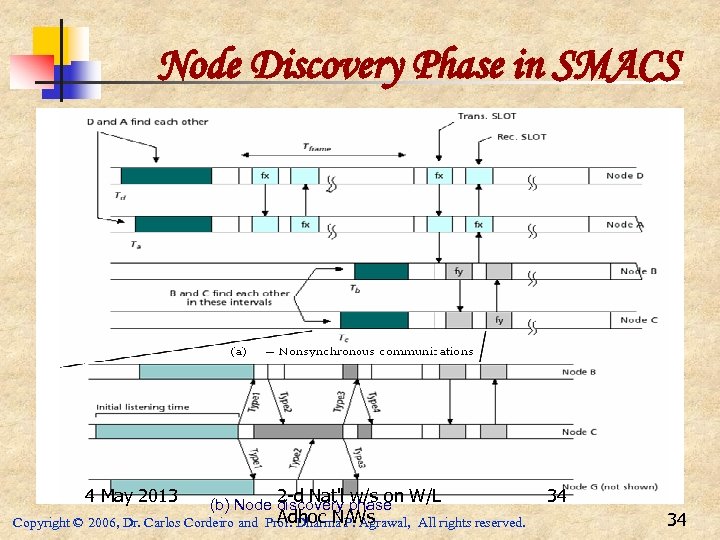
Node Discovery Phase in SMACS 4 May 2013 2 -d Nat'l w/s on W/L Adhoc N/Ws Prof. Dharma P. Agrawal, All rights reserved. (b) Node discovery phase Copyright © 2006, Dr. Carlos Cordeiro and 34 34
Routing Layer § Routing in sensor networks is usually multi-hop § The goal is to send the data from source node(s) to a known destination node § The destination node or the sink node is known and addressed by means of its location § A BS may be fixed or mobile, and is capable of connecting the sensor network to an existing infrastructure where the user can have access to the collected data 4 May 2013 Copyright © 2006, Dr. Carlos Cordeiro and 2 -d Nat'l w/s on W/L Adhoc N/Ws Prof. Dharma P. Agrawal, All rights reserved. 35 35
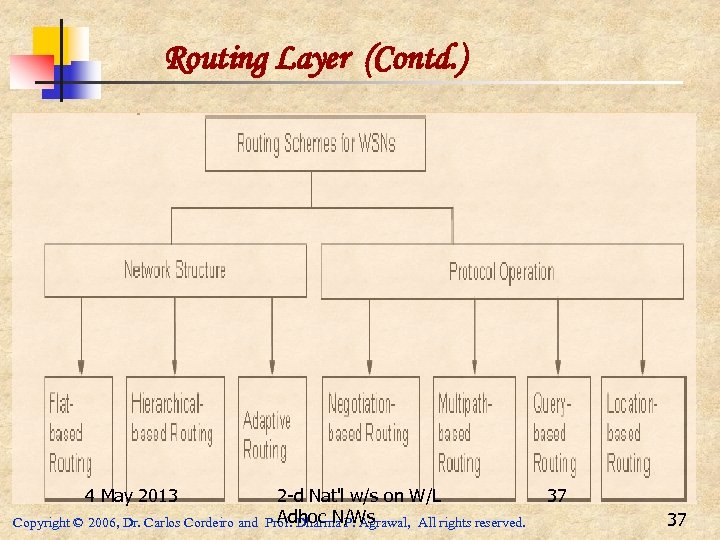
Routing Layer (Contd. ) § § In flat-based routing, all nodes are assigned equal role In hierarchical-based routing, however, nodes play different roles and certain nodes, called cluster heads (CHs), are given more responsibility In adaptive routing, certain system parameters are controlled in order to adapt to the current network conditions and available energy levels Furthermore, these protocols can be classified into multipath-based, query-based, negotiation-based, or location-based routing techniques 4 May 2013 Copyright © 2006, Dr. Carlos Cordeiro and 2 -d Nat'l w/s on W/L Adhoc N/Ws Prof. Dharma P. Agrawal, All rights reserved. 36 36
Routing Layer (Contd. ) 4 May 2013 Copyright © 2006, Dr. Carlos Cordeiro and 2 -d Nat'l w/s on W/L Adhoc N/Ws Prof. Dharma P. Agrawal, All rights reserved. 37 37
Network Structure Based §In this class of routing protocols, the network structure is one of the determinant factors §In addition, the network structure can be further subdivided into flat, hierarchical and adaptive depending upon its organization Flat Routing §In flat routing based protocols, all nodes play the same role and we present the most prominent protocols falling in this 4 May 2013 2 -d Nat'l w/s on W/L 38 category Adhoc N/Ws Copyright © 2006, Dr. Carlos Cordeiro and Prof. Dharma P. Agrawal, All rights reserved. 38
Directed Diffusion is a data aggregation and dissemination paradigm for sensor networks § It is a data-centric (DC) and application-aware approach in the sense that all data generated by sensor nodes is named by attribute-value pairs § Directed Diffusion is very useful for applications requiring dissemination and processing of queries § The main idea of the DC paradigm is to combine the data coming from different sources en-route (in-network aggregation) by eliminating redundancy, minimizing the number of transmissions; thus saving network energy and prolonging its lifetime § 4 May 2013 Copyright © 2006, Dr. Carlos Cordeiro and 2 -d Nat'l w/s on W/L Adhoc N/Ws Prof. Dharma P. Agrawal, All rights reserved. 39 39
Data Centric Routing and Directed Diffusion § Unlike traditional end-to-end routing, DC routing finds routes from multiple sources to a single destination (BS) that allows innetwork consolidation of redundant data § In Directed Diffusion, sensors measure events and create gradients of information in their respective neighborhoods § The BS requests data by broadcasting interests, which describes a task to be done by the network 4 May 2013 Copyright © 2006, Dr. Carlos Cordeiro and 2 -d Nat'l w/s on W/L Adhoc N/Ws Prof. Dharma P. Agrawal, All rights reserved. 40 40
Contd. Interest diffuses through the network hop-byhop, and is broadcast by each node to its neighbors § As the interest is propagated throughout the network, gradients are setup to draw data satisfying the query towards the requesting node § Each SN that receives the interest setup a gradient toward the SNs from which it receives the interest § This process continues until gradients are setup 4 May 2013 from. Dr. the Cordeiro and Prof. back. P. to on W/Lrights reserved. 41 sources 2 -d Nat'l w/s the BS Adhoc N/Ws 41 Copyright © 2006, Carlos Dharma Agrawal, All §
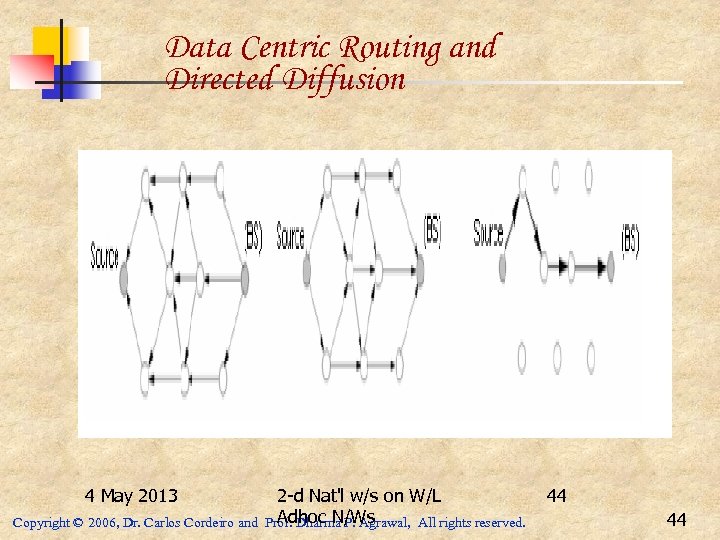
Data Centric Routing and Directed Diffusion § The strength of the gradient may be different towards different neighbors, resulting in variable amounts of information flow § At this point, loops are not checked, but are removed at a later stage § Figure 9. 9 depicts an example of the operation of directed diffusion § Figure 9. 9(a) presents the propagation of interests, Figure 9. 9(b) shows the gradients construction, and Figure 9. 9(c) depicts the data dissemination 4 May 2013 Copyright © 2006, Dr. Carlos Cordeiro and 2 -d Nat'l w/s on W/L Adhoc N/Ws Prof. Dharma P. Agrawal, All rights reserved. 42 42
Data Centric Routing and Directed Diffusion § § § When interests fit gradients, paths of information flow are formed from multiple paths, and the best paths are reinforced so as to prevent further flooding according to a local rule In order to reduce communication costs, data is aggregated on the way The BS periodically refreshes and re-sends the interest when it starts to receive data from the source(s) This retransmission of interests is needed because the medium is inherently unreliable 4 May 2013 Copyright © 2006, Dr. Carlos Cordeiro and 2 -d Nat'l w/s on W/L Adhoc N/Ws Prof. Dharma P. Agrawal, All rights reserved. 43 43
Data Centric Routing and Directed Diffusion 4 May 2013 Copyright © 2006, Dr. Carlos Cordeiro and 2 -d Nat'l w/s on W/L Adhoc N/Ws Prof. Dharma P. Agrawal, All rights reserved. 44 44
Data Centric Routing and Directed Diffusion § § § Sensor nodes in a directed diffusion-based network are application-aware, which enables diffusion to achieve energy savings by choosing empirically good paths and by caching and processing data in the network An application of directed diffusion is to spontaneously propagate an important event to regions of the sensor network Such type of information retrieval is well suited for persistent queries where requesting nodes expect data that satisfy a query for a period of time 4 May 2013 Copyright © 2006, Dr. Carlos Cordeiro and 2 -d Nat'l w/s on W/L Adhoc N/Ws Prof. Dharma P. Agrawal, All rights reserved. 45 45
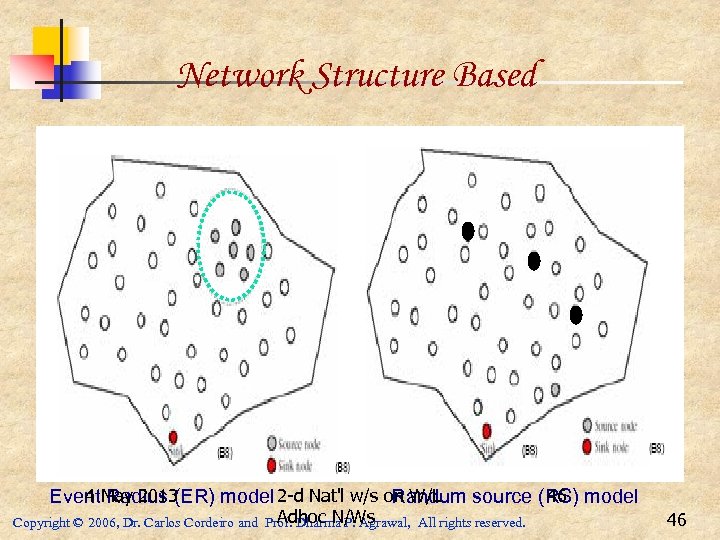
Network Structure Based 4 Radius (ER) model 2 -d Nat'l w/s on W/L 46 Event. May 2013 Randum source (RS) model Adhoc N/Ws Copyright © 2006, Dr. Carlos Cordeiro and Prof. Dharma P. Agrawal, All rights reserved. 46
Sequential Assignment Routing (SAR) § The routing scheme in SAR depends on three factors: energy resources, Qo. S on each path, and the priority level of each packet § To avoid single route failure, a multi-path approach coupled with a localized path restoration scheme is employed § To create multiple paths from a source node, a tree rooted at the source node to the destination nodes (i. e. , the set of BSs) is constructed § The paths of the tree are defined by avoiding 4 May 2013 2 -d Nat'l w/s on W/L 47 nodes with low energy or Qo. S guarantees 47 Adhoc N/Ws Copyright © 2006, Dr. Carlos Cordeiro and Prof. Dharma P. Agrawal, All rights reserved.
SAR Contd. At the end of this process, each sensor node is a part of multi-path tree § For each SN, two metrics are associated with each path: delay (which is an additive Qo. S metric); and energy usage for routing on that path § The energy is measured with respect to how many packets will traverse that path § SAR calculates a weighted Qo. S metric as the product of the additive Qo. S metric and a weight coefficient associated with the priority level of the packet § The goal of SAR is to minimize the average weighted Qo. S metric for the Nat'l w/s on W/L 4 May 2013 2 -d network 48 § Adhoc N/Ws Copyright © 2006, Dr. Carlos Cordeiro and Prof. Dharma P. Agrawal, All rights reserved. 48
Hierarchical Routing § Hierarchical, or cluster-based routing has its roots in wired networks, where the main goals are to achieve scalable and efficient communication § As such, the concept of hierarchical routing has also been employed in WSN to perform energyefficient routing § In a hierarchical architecture, higher energy nodes (usually called cluster heads) can be used to process and send the accumulated information while low energy nodes can be used to sense in the neighborhood of the target and pass on to the CH 4 May 2013 Copyright © 2006, Dr. Carlos Cordeiro and 2 -d Nat'l w/s on W/L Adhoc N/Ws Prof. Dharma P. Agrawal, All rights reserved. 49 49
Hierarchical Routing (Contd. ) § § § In these cluster-based architectures creation of clusters and appropriate assignment of special tasks to CHs can contribute to overall system scalability, lifetime, and energy efficiency An example of a general hierarchical clustering scheme is depicted in Figure 9. 11 As we can see from this figure, each cluster has a CH which collects data from its cluster members, aggregates it and sends it to the BS or an upper level CH 4 May 2013 Copyright © 2006, Dr. Carlos Cordeiro and 2 -d Nat'l w/s on W/L Adhoc N/Ws Prof. Dharma P. Agrawal, All rights reserved. 50 50
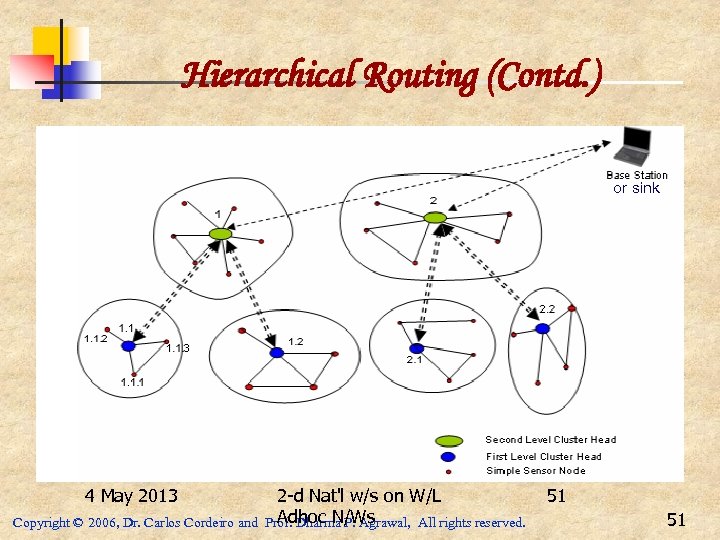
Hierarchical Routing (Contd. ) or sink 4 May 2013 Copyright © 2006, Dr. Carlos Cordeiro and 2 -d Nat'l w/s on W/L Adhoc N/Ws Prof. Dharma P. Agrawal, All rights reserved. 51 51
Cluster Based Routing Protocol § A simple cluster based routing protocol (CBRP) divides the network nodes into a number of overlapping or disjoint two-hop-diameter clusters in a distributed manner § The cluster members just send the data to the CH, and the CH is responsible for routing the data to the destination § The major drawback with CBRP is that it requires a lot of hello messages to form and maintain the clusters, and thus may not be suitable for WSN § Given that sensor nodes are stationary in most of the applications this is a considerable and unnecessary overhead Scalable Coordination § In hierarchical clustering method, the cluster formation appears to require considerable amount of energy as periodic advertisements are needed to form the hierarchy § Also, any changes in the network conditions or sensor energy level result in re-clustering which may be not quite acceptable as some 4 May 2013 2 -d Nat'l w/s on W/L 52 parameters tend to change dynamically Adhoc N/Ws Copyright © 2006, Dr. Carlos Cordeiro and Prof. Dharma P. Agrawal, All rights reserved. 52

Hybrid Protocol Features: p Combines both proactive and reactive policies p Offers a lot of flexibility by allowing the user to set the time interval and the threshold values for the attributes p Energy consumption can be controlled by changing periodic interval as well as the threshold values p Can emulate either a proactive network or a reactive network, based on the 4 May 2013 2 -d Nat'l w/s on W/L 53 application Adhoc N/Ws Copyright © 2006, Dr. Carlos Cordeiro and Prof. Dharma P. Agrawal, All rights reserved. § 53
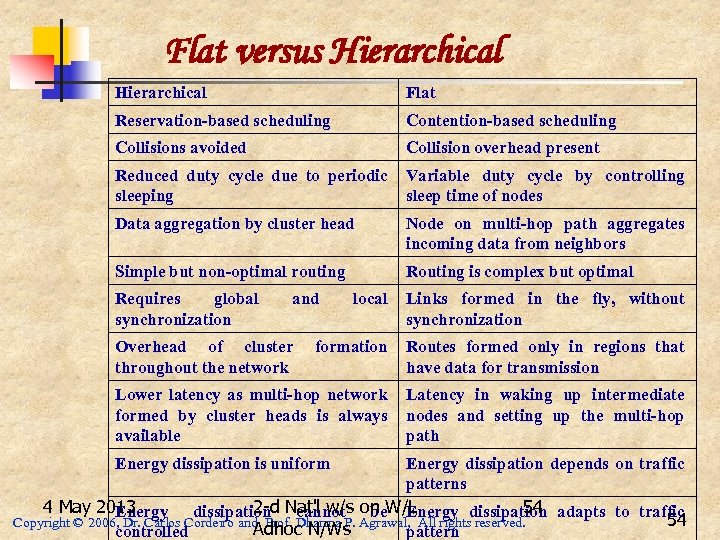
Flat versus Hierarchical Flat Reservation-based scheduling Contention-based scheduling Collisions avoided Collision overhead present Reduced duty cycle due to periodic sleeping Variable duty cycle by controlling sleep time of nodes Data aggregation by cluster head Node on multi-hop path aggregates incoming data from neighbors Simple but non-optimal routing Routing is complex but optimal Requires global synchronization and local Links formed in the fly, without synchronization formation Routes formed only in regions that have data for transmission Lower latency as multi-hop network formed by cluster heads is always available Latency in waking up intermediate nodes and setting up the multi-hop path Energy dissipation is uniform Energy dissipation depends on traffic patterns Overhead of cluster throughout the network 4 May 2013 Energy 2 -d cannot be Energy dissipation adapts to traffic 54 dissipation Nat'l w/s on W/L 54 Adhoc N/Ws controlled pattern Copyright © 2006, Dr. Carlos Cordeiro and Prof. Dharma P. Agrawal, All rights reserved.
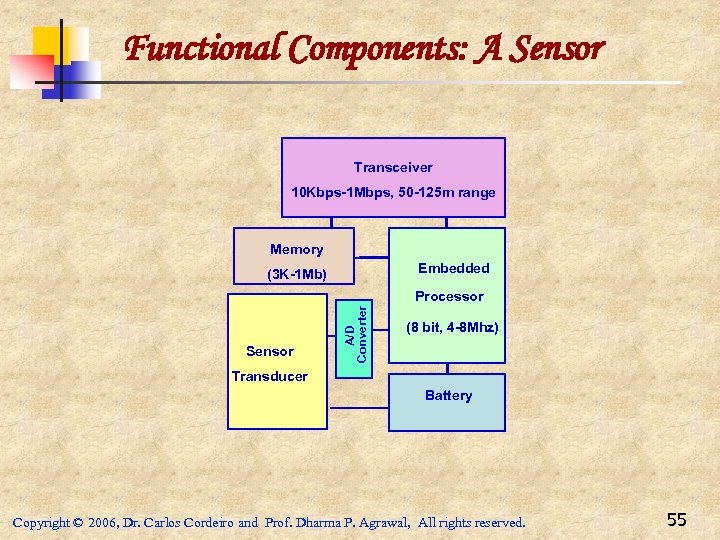
Functional Components: A Sensor Transceiver 10 Kbps-1 Mbps, 50 -125 m range Memory Embedded (3 K-1 Mb) Sensor A/D Converter Processor (8 bit, 4 -8 Mhz) Transducer Battery Copyright © 2006, Dr. Carlos Cordeiro and Prof. Dharma P. Agrawal, All rights reserved. 55
The Mica Mote § The Mica Mote is a comprehensive sensor node developed by University of California at Berkeley and marketed by Crossbow § It uses an Atmel Atmega 103 microcontroller running at 4 MHz, with a radio operating at the 916 MHz frequency band with bidirectional communication at 40 kbps when energized with a pair of AA batteries § Mica Board is stacked to the processor board via the 51 pin extension connector to provide temperature, photo resistor, barometer, humidity, and thermopile sensors § To conserve energy, later designs include an A/D Converter and an 8 x 8 power switch on the sensor board Copyright © 2006, Dr. Carlos Cordeiro and Prof. Dharma P. Agrawal, All rights reserved. 56

The Mica Motes-2 Mica Board Copyright © 2006, Dr. Carlos Cordeiro and Prof. Dharma P. Agrawal, All rights reserved. 57
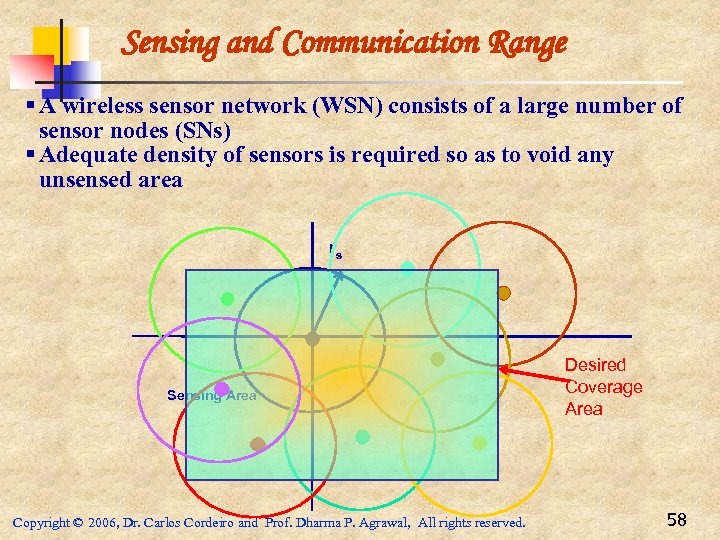
Sensing and Communication Range § A wireless sensor network (WSN) consists of a large number of sensor nodes (SNs) § Adequate density of sensors is required so as to void any unsensed area rs Sensing Area Copyright © 2006, Dr. Carlos Cordeiro and Prof. Dharma P. Agrawal, All rights reserved. Desired Coverage Area 58
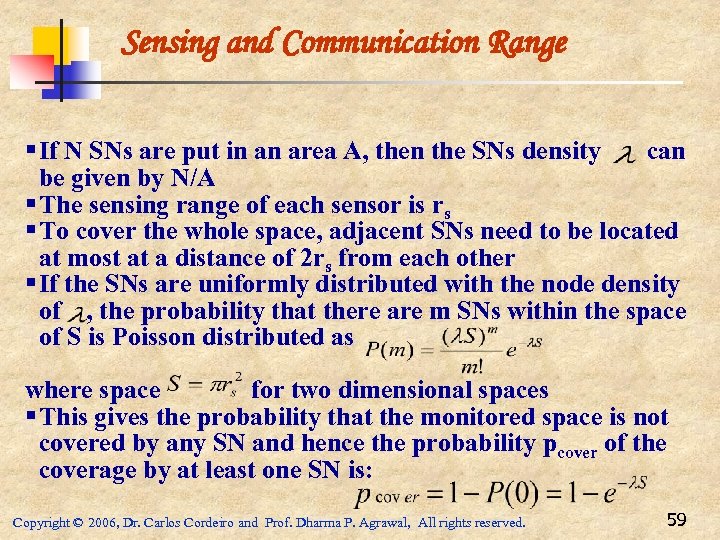
Sensing and Communication Range § If N SNs are put in an area A, then the SNs density can be given by N/A § The sensing range of each sensor is rs § To cover the whole space, adjacent SNs need to be located at most at a distance of 2 rs from each other § If the SNs are uniformly distributed with the node density of , the probability that there are m SNs within the space of S is Poisson distributed as where space for two dimensional spaces § This gives the probability that the monitored space is not covered by any SN and hence the probability pcover of the coverage by at least one SN is: Copyright © 2006, Dr. Carlos Cordeiro and Prof. Dharma P. Agrawal, All rights reserved. 59
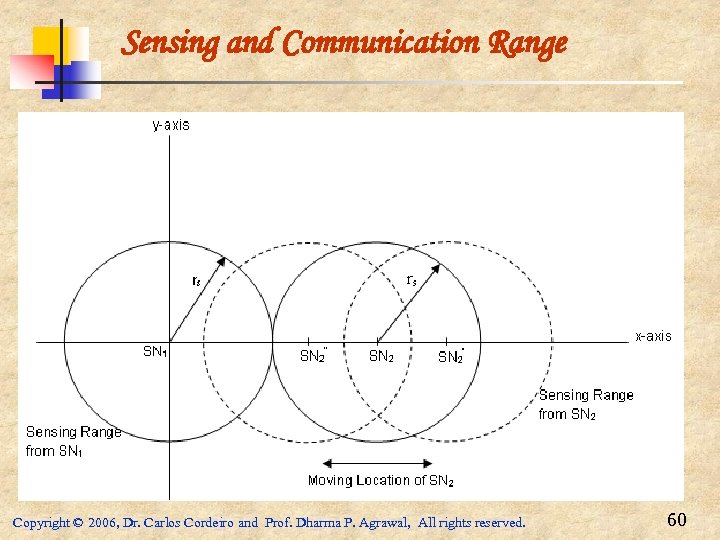
Sensing and Communication Range Copyright © 2006, Dr. Carlos Cordeiro and Prof. Dharma P. Agrawal, All rights reserved. 60
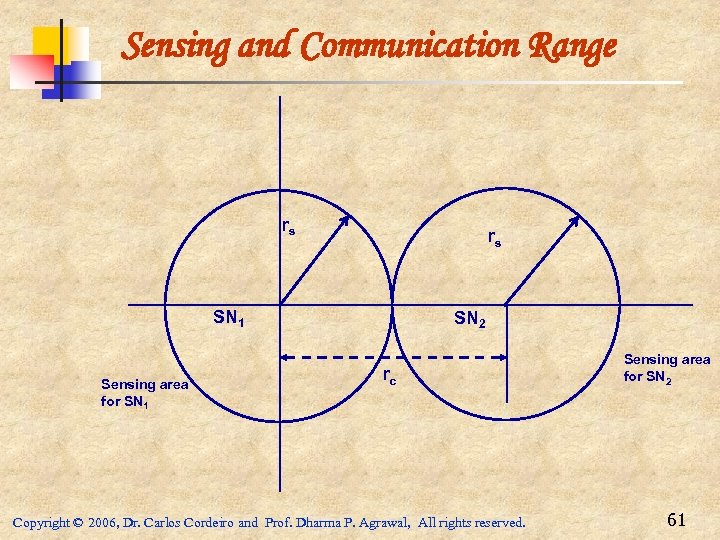
Sensing and Communication Range rs rs SN 1 Sensing area for SN 1 SN 2 rc Copyright © 2006, Dr. Carlos Cordeiro and Prof. Dharma P. Agrawal, All rights reserved. Sensing area for SN 2 61
Sensing and Communication Range § Transmission between adjacent SNs is feasible if there is at least one SN within the communication range of each SN § Not just the sensing coverage, but the communication connectivity is equally important § The wireless communication coverage of a sensor must be at least twice the sensing distance § Data from a single SN is not adequate to make any useful decision and need to be collected from a set of SNs Copyright © 2006, Dr. Carlos Cordeiro and Prof. Dharma P. Agrawal, All rights reserved. 62
Design Issues: Advantages of WSNs § Ease of deployment – Can be dropped from a plane or placed in a factory, without any prior organization, thus reducing the installation cost and time, and increasing the flexibility of deployment § Extended range – One huge wired sensor (macro-sensor) can be replaced by many smaller wireless sensors for the same cost § Fault tolerant – With wireless sensors, failure of one node does not affect the network operation § Mobility – Since these wireless sensors are equipped with battery, they can possess limited mobility (e. g. , if placed on robots) § Disadvantage: The wireless medium has a few inherent limitations such as low bandwidth, error prone transmissions, and potential collisions in channel access, etc. Copyright © 2006, Dr. Carlos Cordeiro and Prof. Dharma P. Agrawal, All rights reserved. 63
Design Issues Traditional routing protocols defined for MANETs are not well suited for wireless sensor networks due to the following reasons: p p Wireless sensor networks are “data centric”, where data is requested based on particular criteria such as “which area has temperature 35ºC” In traditional wired and wireless networks, each node is given a unique identification and cannot be effectively used in sensor networks Adjacent nodes may have similar data and rather than sending data separately from each sensor node, it is desirable to aggregate similar data before sending it The requirements of the network change with the application and hence, it is application-specific Copyright © 2006, Dr. Carlos Cordeiro and Prof. Dharma P. Agrawal, All rights reserved. 64
Desirable Features § Attribute-based addressing: This is typically employed in sensor networks where addresses are composed of a group of attribute-value pairs § Location awareness: Since most data collection is based on location, it is desirable that the nodes know their position § The sensors should react immediately to drastic changes in their environment § Query Handling: Users should be able to request data from the network through some base station (also known as a sink) or through any of the nodes, whichever is closer Copyright © 2006, Dr. Carlos Cordeiro and Prof. Dharma P. Agrawal, All rights reserved. 65
Design Issues : Challenges § Routing protocol design is heavily influenced by many challenging factors § These challenges can be summarized as follows: p p p Ad hoc deployment – Sensor nodes are randomly deployed so that they form connections between the nodes Computational capabilities – Sensor nodes have limited computing power and therefore may run simple versions of routing protocols Energy consumption without losing accuracy – Sensor nodes can use up their limited energy supply carrying out computations and transmitting information Copyright © 2006, Dr. Carlos Cordeiro and Prof. Dharma P. Agrawal, All rights reserved. 66
Design Issues : Challenges § Scalability – The number of sensor nodes deployed in the sensing area may be in the order of hundreds, thousands, or more and routing scheme must be scalable enough to respond to events § Communication range – The bandwidth of the wireless links connecting sensor nodes is often limited, hence constraining intersensor communication § Fault tolerance – Some sensor nodes may fail or be blocked due to lack of power, physical damage, or environmental interference § Connectivity – High node density in sensor networks precludes them from being completely isolated from each other Copyright © 2006, Dr. Carlos Cordeiro and Prof. Dharma P. Agrawal, All rights reserved. 67
Design Issues : Challenges § Transmission media –Communicating nodes are linked by a wireless medium and traditional problems associated with a wireless channel (e. g. , fading, high error rate) also affect the operation § Qo. S – In some applications (e. g. , some military applications), the data should be delivered within a certain period of time from the moment it is sensed § Control Overhead – When the number of retransmissions in wireless medium increases due to collisions, the latency and energy consumption also increases § Security –Besides physical security, both authentication and encryption should be feasible while complex algorithm needs to be avoided Copyright © 2006, Dr. Carlos Cordeiro and Prof. Dharma P. Agrawal, All rights reserved. 68
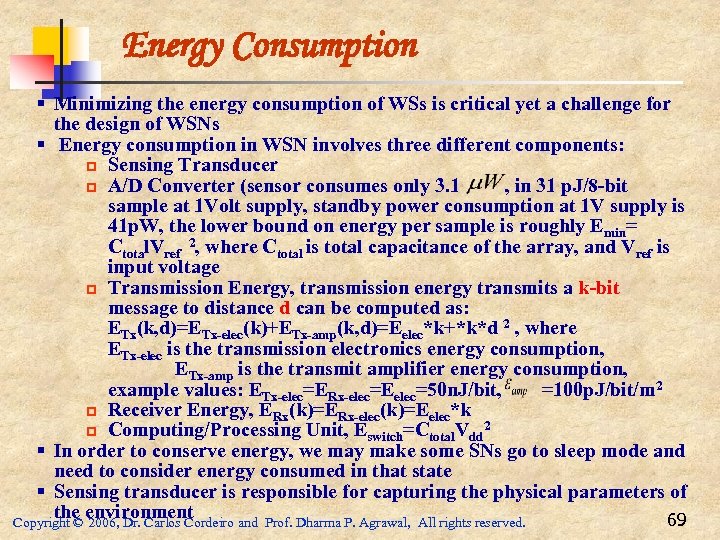
Energy Consumption § Minimizing the energy consumption of WSs is critical yet a challenge for the design of WSNs § Energy consumption in WSN involves three different components: p Sensing Transducer p A/D Converter (sensor consumes only 3. 1 , in 31 p. J/8 -bit sample at 1 Volt supply, standby power consumption at 1 V supply is 41 p. W, the lower bound on energy per sample is roughly Emin= Ctotal. Vref 2, where Ctotal is total capacitance of the array, and Vref is input voltage p Transmission Energy, transmission energy transmits a k-bit message to distance d can be computed as: ETx(k, d)=ETx-elec(k)+ETx-amp(k, d)=Eelec*k+*k*d 2 , where ETx-elec is the transmission electronics energy consumption, ETx-amp is the transmit amplifier energy consumption, example values: ETx-elec=ERx-elec=Eelec=50 n. J/bit, =100 p. J/bit/m 2 p Receiver Energy, ERx(k)=ERx-elec(k)=Eelec*k p Computing/Processing Unit, Eswitch=Ctotal. Vdd 2 § In order to conserve energy, we may make some SNs go to sleep mode and need to consider energy consumed in that state § Sensing transducer is responsible for capturing the physical parameters of the environment 69 Copyright © 2006, Dr. Carlos Cordeiro and Prof. Dharma P. Agrawal, All rights reserved.
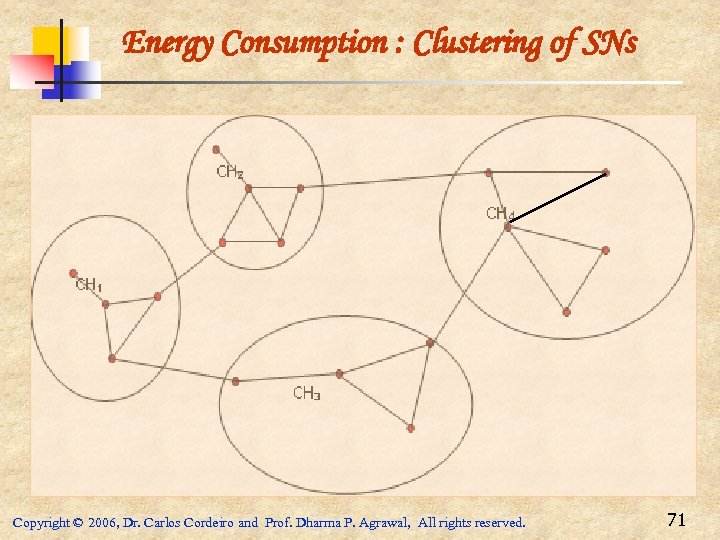
Energy Consumption : Clustering of SNs § Clustering of SNs not only allows aggregation of sensed data, but limits data transmission primarily within the cluster § The sequence starts with discovery of neighboring SNs by sending periodic Beacon Signals, determining close by SNs with some intermediate SNs, forming clusters and selecting cluster head (CH) for each cluster § So, the real question is how to group adjacent SNs, and how many groups should be there that could optimize some performance parameter § One approach is to partition the WSN into clusters such that all members of the clusters are directly connected to the CH § One such example for randomly deployed SNs § SNs in a WSN in a cluster, can transmit directly to the CH without any intermediate SN Copyright © 2006, Dr. Carlos Cordeiro and Prof. Dharma P. Agrawal, All rights reserved. 70
Energy Consumption : Clustering of SNs Copyright © 2006, Dr. Carlos Cordeiro and Prof. Dharma P. Agrawal, All rights reserved. 71
Clustering of Sensors § Data from SNs belonging to a single cluster can be combined together in an intelligent way (aggregation) using local transmissions § This can not only reduce the global data to be transferred and localize most traffic to within each individual cluster § A lot of research gone into testing coverage of areas by k-sensors clustering adjacent SNs and defining the size of the cluster so that the cluster heads (CHs) can communicate and get data from their own cluster members § If each cluster is covered by more than one subset of SNs all the time, then some of the SNs can be put into sleep mode so as to conserve energy while keeping full coverage § The use of a second smaller radio has been suggested for waking up the sleeping sensor, thereby conserving the power of main wireless transmitter Copyright © 2006, Dr. Carlos Cordeiro and Prof. Dharma P. Agrawal, All rights reserved. 72
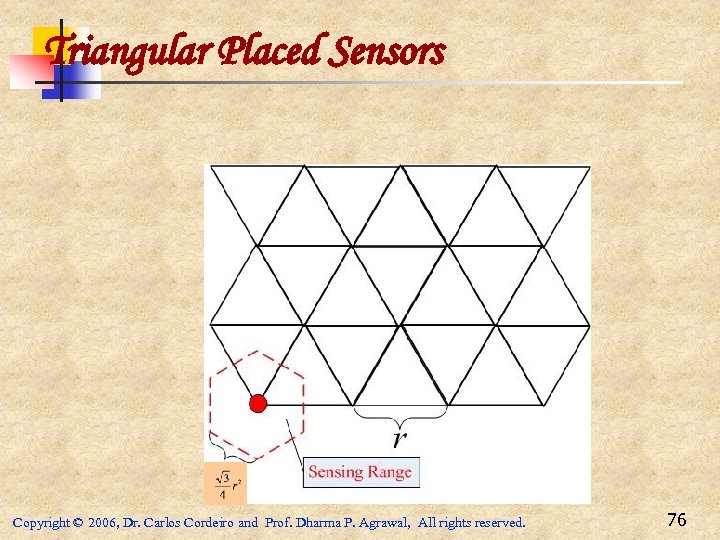
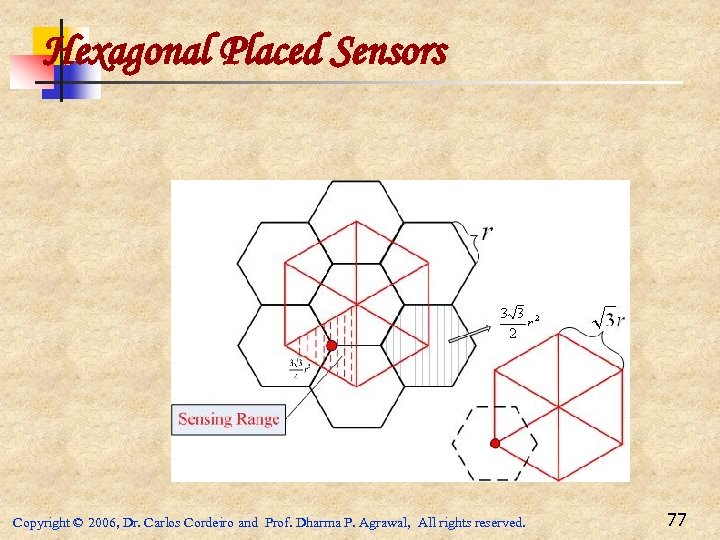
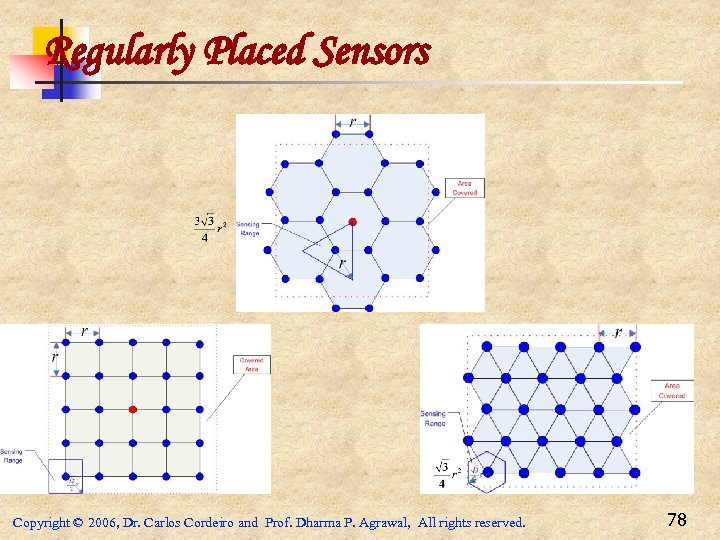
Clustering of Sensors: Predetermined Grid v/s Random Placement Regularly placed sensors § A simple strategy is to place the sensors in the form of twodimensional grid as such cross-point and such configuration may be very useful for uniform coverage § Such symmetric placement allows best possible regular coverage and easy clustering of the close-by SNs § Three such examples of SNs in rectangular, triangular and hexagonal tiles of clusters are shown Copyright © 2006, Dr. Carlos Cordeiro and Prof. Dharma P. Agrawal, All rights reserved. 73
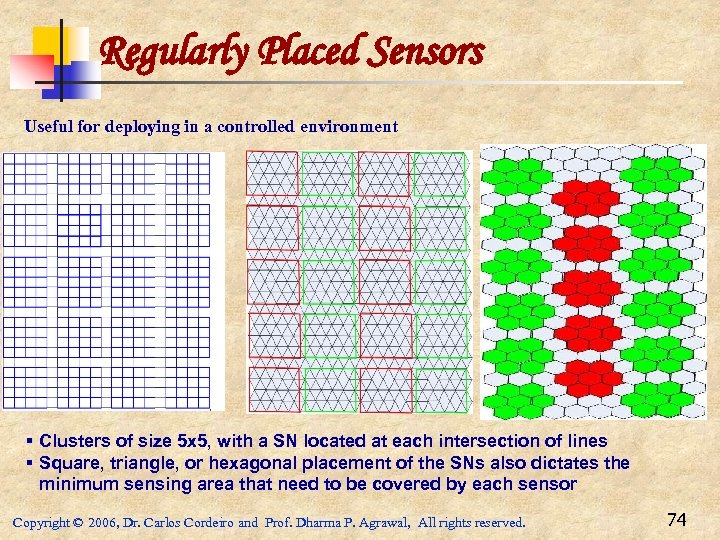
Regularly Placed Sensors Useful for deploying in a controlled environment § Clusters of size 5 x 5, with a SN located at each intersection of lines § Square, triangle, or hexagonal placement of the SNs also dictates the minimum sensing area that need to be covered by each sensor Copyright © 2006, Dr. Carlos Cordeiro and Prof. Dharma P. Agrawal, All rights reserved. 74
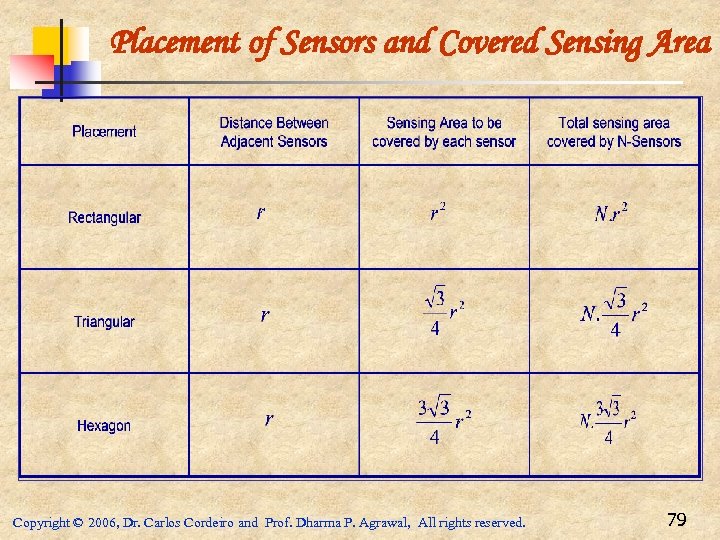
Regularly placed sensors § Detailed views of three different configurations, are shown in next three slides § For simplicity of calculation, the sensing area covered by rectangular placement is taken rectangular, while sensing are by the two configurations are assumed hexagonal and triangular respectively § The required number of SNs in each scheme, is given in Table 8. 2 § Radio transmission distance between adjacent SNs need to be such that the sensors can receive data from adjacent sensors using wireless radio § Clustering can be done for these configurations and the size of each cluster can be fixed as per application requirements § If the sensing and radio transmission ranges are set to the minimum value, then all the SNs need to be active all the time to cover the area and function properly § If these ranges are increased, then each sub-region can be covered by more than one sensor node and selected SNs can be allowed to go to sleep mode 75 Copyright © 2006, Dr. Carlos Cordeiro and Prof. Dharma P. Agrawal, All rights reserved.
Triangular Placed Sensors Copyright © 2006, Dr. Carlos Cordeiro and Prof. Dharma P. Agrawal, All rights reserved. 76
Hexagonal Placed Sensors Copyright © 2006, Dr. Carlos Cordeiro and Prof. Dharma P. Agrawal, All rights reserved. 77
Regularly Placed Sensors Copyright © 2006, Dr. Carlos Cordeiro and Prof. Dharma P. Agrawal, All rights reserved. 78
Placement of Sensors and Covered Sensing Area Copyright © 2006, Dr. Carlos Cordeiro and Prof. Dharma P. Agrawal, All rights reserved. 79
Randomly distributed sensors § The sensors could also be used in an unknown territory or inaccessible area by deploying them from a low flying airplane or unmanned ground/aerial vehicle § SNs have to find themselves who their communicating neighbors are and how many of them are present § The adjacency among SNs can be initially determined by sending bacon signals as is done in a typical ad hoc network (MANET) § The communication range of associated wireless radio should be such that the SNs could be connected together to form a WSN § Distribution of the SNs and their sensing range would also determine if the physical parameter in the complete deployed area can be sensed by at least one SN Copyright © 2006, Dr. Carlos Cordeiro and Prof. Dharma P. Agrawal, All rights reserved. 80
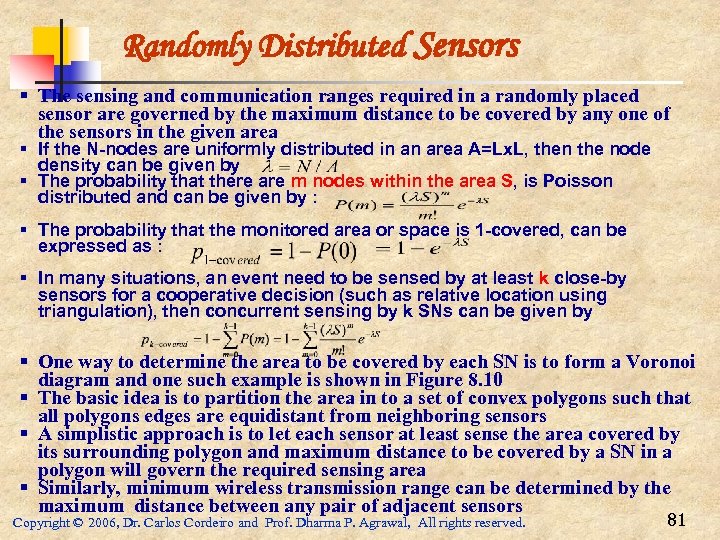
Randomly Distributed Sensors § The sensing and communication ranges required in a randomly placed sensor are governed by the maximum distance to be covered by any one of the sensors in the given area § If the N-nodes are uniformly distributed in an area A=Lx. L, then the node density can be given by § The probability that there are m nodes within the area S, is Poisson distributed and can be given by : § The probability that the monitored area or space is 1 -covered, can be expressed as : § In many situations, an event need to be sensed by at least k close-by sensors for a cooperative decision (such as relative location using triangulation), then concurrent sensing by k SNs can be given by § One way to determine the area to be covered by each SN is to form a Voronoi diagram and one such example is shown in Figure 8. 10 § The basic idea is to partition the area in to a set of convex polygons such that all polygons edges are equidistant from neighboring sensors § A simplistic approach is to let each sensor at least sense the area covered by its surrounding polygon and maximum distance to be covered by a SN in a polygon will govern the required sensing area § Similarly, minimum wireless transmission range can be determined by the maximum distance between any pair of adjacent sensors Copyright © 2006, Dr. Carlos Cordeiro and Prof. Dharma P. Agrawal, All rights reserved. 81
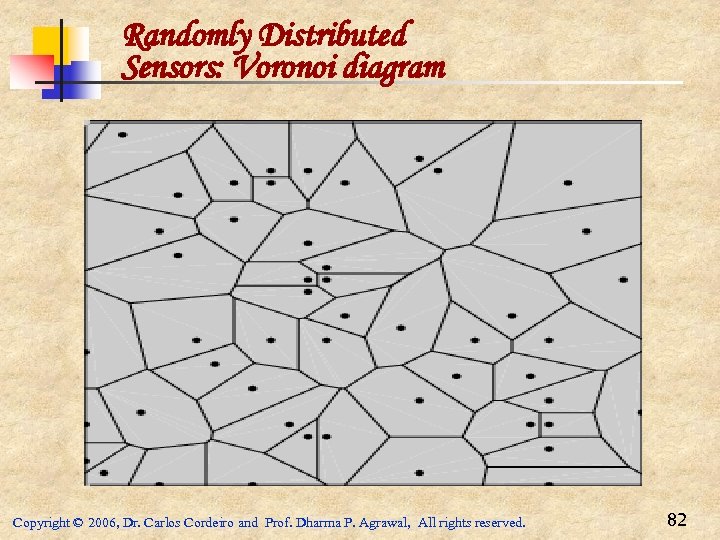
Randomly Distributed Sensors: Voronoi diagram Copyright © 2006, Dr. Carlos Cordeiro and Prof. Dharma P. Agrawal, All rights reserved. 82
Heterogeneous WSNs § With constant sensing and transmission range for all SNs, WSNs are also known as homogeneous WSNs § This makes the design simpler and easier to manage § In some situations, when a new version of SNs are deployed to cover additional area, or some of the existing SNs are replaced by new ones for extended life or precision, then sensing and/or communication range and/or computing power may also depend on the sensor type or version § Use of sensors with different sensing and/or communication and/or computation capabilities leads to a heterogeneous WSN which is helpful for performing additional functionalities or be given much more responsibilities § One such example is shown in Figure 8. 11 Copyright © 2006, Dr. Carlos Cordeiro and Prof. Dharma P. Agrawal, All rights reserved. 83
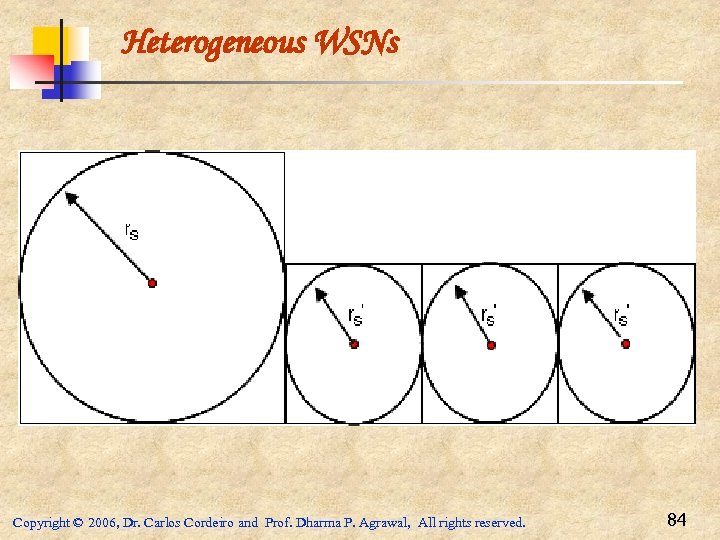
Heterogeneous WSNs Copyright © 2006, Dr. Carlos Cordeiro and Prof. Dharma P. Agrawal, All rights reserved. 84
Mobile Sensors § The enhancements in the field of robotics are paving the way for industrial robots to be applied to a wider range of tasks § However, harnessing their full efficiency also depends on how accurately they understand their environment § Thus, as sensor networks are the primary choice for environmental sensing, combining sensor networks with mobile robots is a natural and very promising application § Robots could play a major role of high-speed resource carriers in defense and military applications where human time and life is very precious § Other applications include fire fighting, autonomous waste disposal § Thus, we see that there a number of future applications where sensors and robots could work together through some form of cooperation Copyright © 2006, Dr. Carlos Cordeiro and Prof. Dharma P. Agrawal, All rights reserved. 85
Mobile Sensors § Sensors detect events autonomously and the mobile robots could take appropriate actions based on the nature of the event § Coordination between the mobile robots is obviously critical in achieving better resource distribution and information retrieval § Mobile sensor Networks have been suggested to cover the area not reachable by static sensors § Coordination between multiple robots for resource transportation has been explored for quite some time now § Transporting various types of resources for different applications like defense, manufacturing process, and so on, has been suggested § In these schemes, time taken to detect an event depends entirely on the trail followed by the robots § Though the path progressively gets better with the use of an ant-like type of algorithm, the whole process has to be started anew when the position of the event changes Copyright © 2006, Dr. Carlos Cordeiro and Prof. Dharma P. Agrawal, All rights reserved. 86
Mobile Sensors § In terrains where human ingress is difficult, mobile robots can be used to imitate the human’s chore § Typical resource-carrying robots are depicted in Figure 8. 12 which depicts a possible means of a robot transferring its resources to anothers § Once depleted of their resource, they may get themselves refilled from the sink § The resource in demand could be water or sand (to extinguish fire), oxygen supply, medicines, bullets, clothes or chemicals to neutralize hazardous wastes, and so on § The target region that is in need of these resources is sometimes called an event location § Whether it is a sensor or another robot within collision distance, it is considered an obstacle and the robot proceeds in a direction away from it Copyright © 2006, Dr. Carlos Cordeiro and Prof. Dharma P. Agrawal, All rights reserved. 87
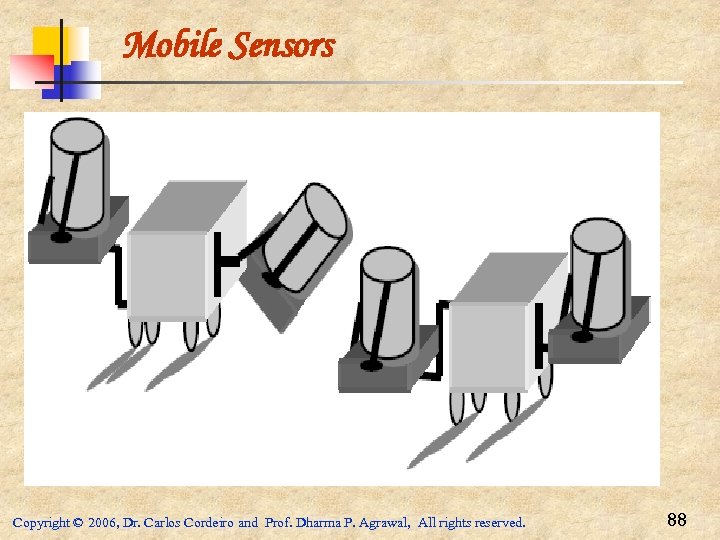
Mobile Sensors Copyright © 2006, Dr. Carlos Cordeiro and Prof. Dharma P. Agrawal, All rights reserved. 88
Applications § Thousands of sensors over strategic locations are used in a structure such as an automobile or an airplane, so that conditions can be constantly monitored both from the inside and the outside and a real-time warning can be issued whenever a major problem is forthcoming in the monitored entity § These wired sensors are large (and expensive) to cover as much area is desirable § Each of these need a continuous power supply and communicates their data to the end-user using a wired network § The organization of such a network should be pre-planned to find strategic position to place these nodes and then should be installed appropriately § The failure of a single node might bring down the whole network or leave that region completely un-monitored Copyright © 2006, Dr. Carlos Cordeiro and Prof. Dharma P. Agrawal, All rights reserved. 89
Applications § Unattendability and some degree of fault tolerance in these networks are desirable in those applications where the sensors may be embedded in the structure or places in an inhospitable terrain and could be inaccessible for any service § Undoubtedly, wireless sensor networks have been conceived with military applications in mind, including battlefield surveillance and tracking of enemy activities § However, civil applications considerably outnumber the military ones and are applicable to many practical situations § Judging by the interest shown by military, academia, and the media, innumerable applications do exist for sensor networks § Examples include weather monitoring, security and tactical surveillance, distributed computing, fault detection and diagnosis in machinery, large bridges and tall structures, detecting ambient conditions such as temperature, movement, sound, light, radiation, vibration, smoke, gases, or the presence of certain biological and chemical objects 90 Copyright © 2006, Dr. Carlos Cordeiro and Prof. Dharma P. Agrawal, All rights reserved.
Applications § Under the civil category, envisioned applications can be classified into environment observation and forecast system, habitat monitoring equipment and human health, large structures and other commercial applications Habitat Monitoring § A prototype test bed consisting of i. PAQs (i. e. , a type of handheld device) has been built to evaluate the performance of these target classification and localization methods § As expected, energy efficiency is one of the design goals at every level: hardware, local processing (compressing, filtering, etc. ), MAC and topology control, data aggregation, data-centric routing and storage § Preprocessing is proposed in for habitat monitoring applications, where it is argued that the tiered network in GDI is solely used for communication § The proposed 2 -tier network architecture consists of micro nodes and macro nodes, wherein the micro nodes perform local filtering and data to significantly reduce the amount of data transmitted to macro nodes 91 Copyright © 2006, Dr. Carlos Cordeiro and Prof. Dharma P. Agrawal, All rights reserved.
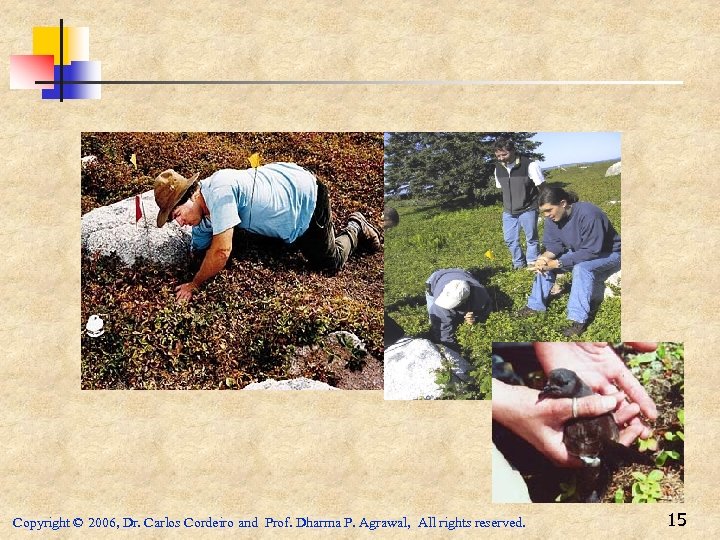
Applications The Grand Duck Island Monitoring Network § Researchers from the University of California at Berkeley (UCB) and Intel Research Laboratory deployed in August 2002 a mote-based tiered sensor network in Great Duck Island (GDI), Maine, aimed at monitoring the behavior of storm petrel § The overall system architecture is depicted in Figure 8. 13 § A total of 32 motes have been placed in the area to be sensed grouped into sensor patches to transmit sensed data to a gateway which is responsible forwarding the information from the sensor patch to a remote base station through a local transit network § The base station then provides data logging and replicates the data every 15 minutes to a database in Berkeley over a satellite link § Remote users can access the replica database server in Berkeley, while local users make use of a small PDA-size device to perform local interactions such as adjusting the sampling rates, power management parameters, etc. Copyright © 2006, Dr. Carlos Cordeiro and Prof. Dharma P. Agrawal, All rights reserved. 92
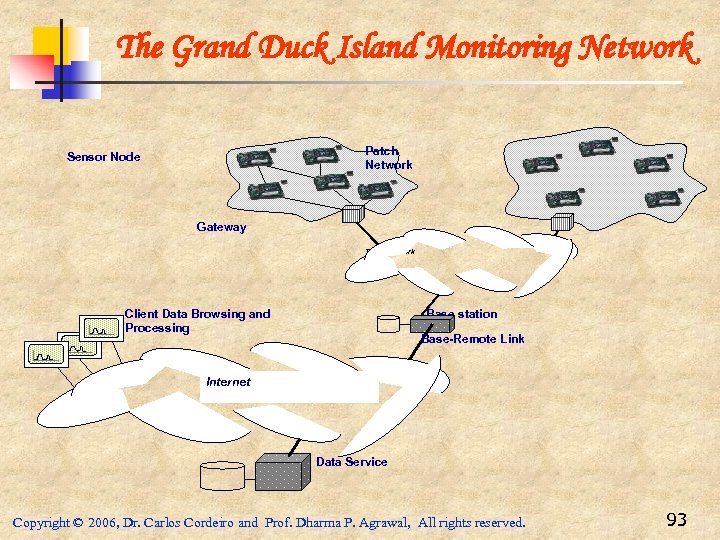
The Grand Duck Island Monitoring Network Patch Network Sensor Node Gateway Transit Network Client Data Browsing and Processing Base station Base-Remote Link Internet Data Service Copyright © 2006, Dr. Carlos Cordeiro and Prof. Dharma P. Agrawal, All rights reserved. 93
Applications: Remote Ecological Micro-Sensor Network § PODS is a research project undertaken at the University of Hawaii that has built a wireless network of environmental sensors to investigate why endangered species of plants will grow in one area but not in neighboring areas § They deployed camouflaged sensor nodes, (called PODS), in the Hawaii Volcanoes National Park § The PODS consist of a computer, radio transceiver and environmental sensors, sometimes including a high resolution digital camera, relaying sensed data via wireless link back to the Internet § Bluetooth and 802. 11 b are chosen as the MAC layer, while data packets are delivered through the IP § In PODS, energy efficiency is identified as one of the design goals and an ad hoc routing protocols called Multi-Path On-demand Routing (MOR) has been developed Copyright © 2006, Dr. Carlos Cordeiro and Prof. Dharma P. Agrawal, All rights reserved. 94
Applications: Remote Ecological Micro-Sensor Network § Weather data are collected every ten minutes and image data are collected once per hour § Users employ the Internet to access the data from a server in University of Hawaii at Manoa § The placement strategy for the sensor nodes is then investigated § Topologies of 1 -dimensional and 2 -dimensional regions such as triangle tile, square tile, hexagon tile, ring, star, and linear are discussed § The sensor placement strategy evaluation is based on three goals: resilience to single point of failure, the area of interest has to be covered by at lease one sensor, and minimum number of nodes § Finally, it is found that the choice of placement depends on d and r Copyright © 2006, Dr. Carlos Cordeiro and Prof. Dharma P. Agrawal, All rights reserved. 95

Environmental Monitoring Application § Sensors to monitor landfill and the air quality § Household solid waste and non-hazardous industrial waste such as construction debris and sewer sludge are being disposed off by using over 6000 landfills in USA and associated organic components undergo biological and chemical reaction such as fermentation, biodegradation and oxidation-reduction § This causes harmful gases like methane, carbon dioxide, nitrogen, sulfide compounds and ammonia to be produced and migration of gases in the landfill causes physical reactions which eventually lead to ozone gases, a primary air pollutant and an irritant to our respiratory systems § The current method of monitoring landfill employs periodic drilling of collection well, collecting gas samples in airtight bags and analyze off-site, making the process very time consuming Copyright © 2006, Dr. Carlos Cordeiro and Prof. Dharma P. Agrawal, All rights reserved. 96
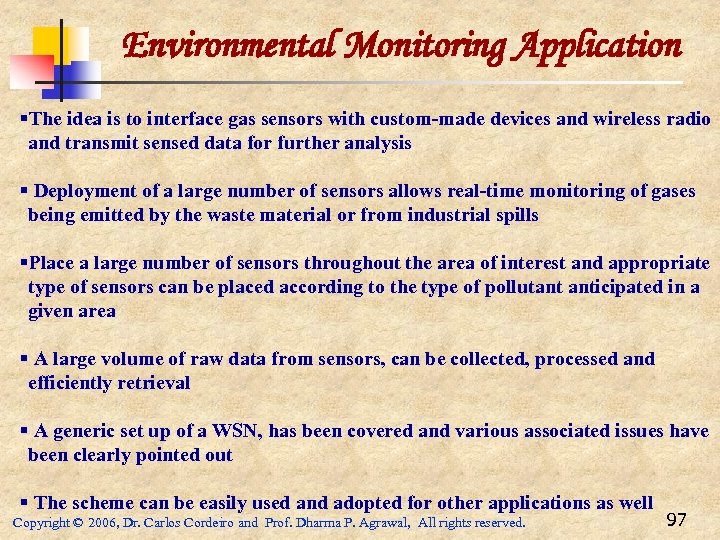
Environmental Monitoring Application §The idea is to interface gas sensors with custom-made devices and wireless radio and transmit sensed data for further analysis § Deployment of a large number of sensors allows real-time monitoring of gases being emitted by the waste material or from industrial spills §Place a large number of sensors throughout the area of interest and appropriate type of sensors can be placed according to the type of pollutant anticipated in a given area § A large volume of raw data from sensors, can be collected, processed and efficiently retrieval § A generic set up of a WSN, has been covered and various associated issues have been clearly pointed out § The scheme can be easily used and adopted for other applications as well Copyright © 2006, Dr. Carlos Cordeiro and Prof. Dharma P. Agrawal, All rights reserved. 97
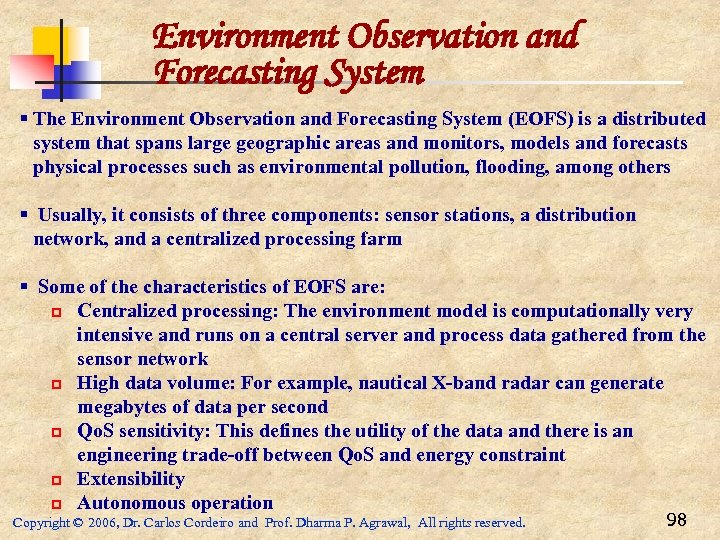
Environment Observation and Forecasting System § The Environment Observation and Forecasting System (EOFS) is a distributed system that spans large geographic areas and monitors, models and forecasts physical processes such as environmental pollution, flooding, among others § Usually, it consists of three components: sensor stations, a distribution network, and a centralized processing farm § Some of the characteristics of EOFS are: p Centralized processing: The environment model is computationally very intensive and runs on a central server and process data gathered from the sensor network p High data volume: For example, nautical X-band radar can generate megabytes of data per second p Qo. S sensitivity: This defines the utility of the data and there is an engineering trade-off between Qo. S and energy constraint p Extensibility p Autonomous operation Copyright © 2006, Dr. Carlos Cordeiro and Prof. Dharma P. Agrawal, All rights reserved. 98

Drinking Water Quality § A sensor based monitoring system with emphasis on placement and utilization of in situ sensing technologies and doing spatial-temporal data mining for water-quality monitoring and modeling § The main objective is to develop data-mining techniques to water-quality databases and use them for interpreting and using environmental data § This also helps in controlling addition of chlorine to the treated water before releasing to the distribution system § Detailed implementation of a bio-sensor for incoming wastewater treatment has been discussed § A pilot-scale and full scale system has also been described Copyright © 2006, Dr. Carlos Cordeiro and Prof. Dharma P. Agrawal, All rights reserved. 99
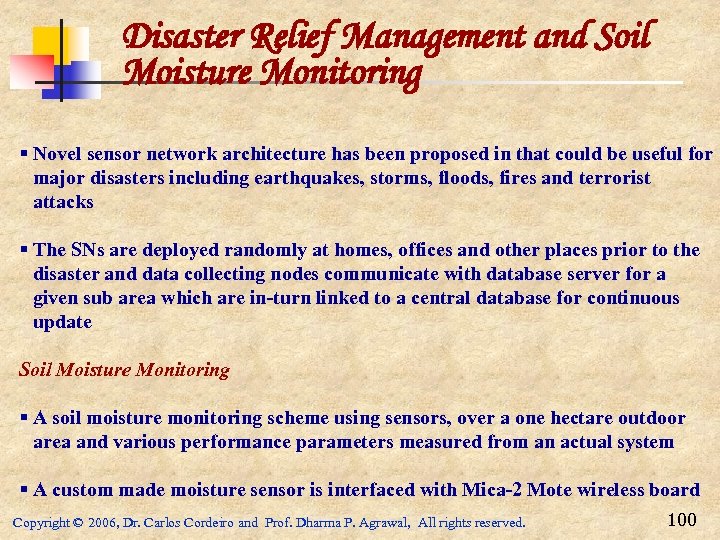
Disaster Relief Management and Soil Moisture Monitoring § Novel sensor network architecture has been proposed in that could be useful for major disasters including earthquakes, storms, floods, fires and terrorist attacks § The SNs are deployed randomly at homes, offices and other places prior to the disaster and data collecting nodes communicate with database server for a given sub area which are in-turn linked to a central database for continuous update Soil Moisture Monitoring § A soil moisture monitoring scheme using sensors, over a one hectare outdoor area and various performance parameters measured from an actual system § A custom made moisture sensor is interfaced with Mica-2 Mote wireless board Copyright © 2006, Dr. Carlos Cordeiro and Prof. Dharma P. Agrawal, All rights reserved. 100
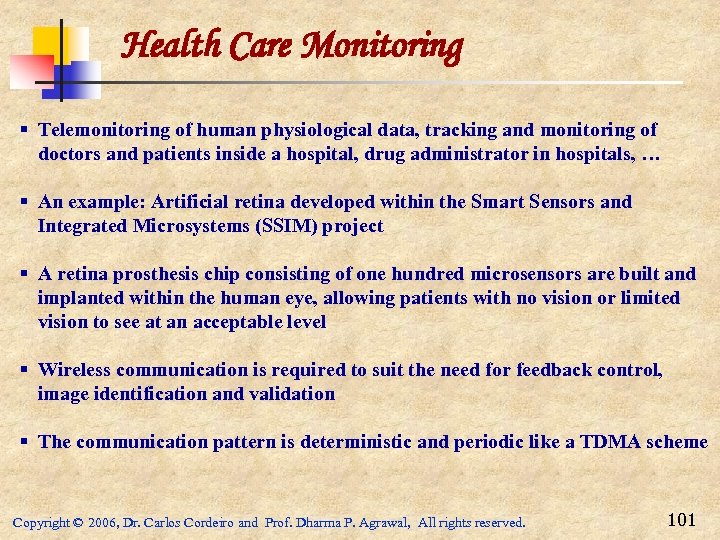
Health Care Monitoring § Telemonitoring of human physiological data, tracking and monitoring of doctors and patients inside a hospital, drug administrator in hospitals, … § An example: Artificial retina developed within the Smart Sensors and Integrated Microsystems (SSIM) project § A retina prosthesis chip consisting of one hundred microsensors are built and implanted within the human eye, allowing patients with no vision or limited vision to see at an acceptable level § Wireless communication is required to suit the need for feedback control, image identification and validation § The communication pattern is deterministic and periodic like a TDMA scheme Copyright © 2006, Dr. Carlos Cordeiro and Prof. Dharma P. Agrawal, All rights reserved. 101
Building, Bridge and Structural Monitoring § Projects have explored the use of sensors in monitoring the health of buildings, bridges and highways § A Bluetooth based scatternet has been proposed to monitor stress, vibration, temperature, humidity etc. in civil infrastructures § Simulation results are given to justify effectiveness of their solution by having a set of rectangular Bluetooth equipped sensor grids to model a portion of bridge span § Fiber optic based sensors have been proposed for monitoring crack openings in concrete bridge decks, of strain and corrosion of the reinforcement in concrete structures § Corrosion of steel bars is measured by using special super glue and angular strain sensors Copyright © 2006, Dr. Carlos Cordeiro and Prof. Dharma P. Agrawal, All rights reserved. 102
Smart Energy and Home/Office Applications § Societal-scale sensor networks can greatly improve the efficiency of energyprovision chain, which consists of three components: the energy-generation, distribution, and consumption infrastructure § It has been reported that 1% load reduction due to demand response can lead to a 10% reduction in wholesale prices, while a 5% load response can cut the wholesale price in half DARPA Efforts towards Wireless Sensor Networks § The DARPA has identified networked micro sensors technology as a key application for the future § On the battlefield of the future, a networked system of smart, inexpensive and plentiful microsensors, combining multiple sensor types, embedded processors, positioning ability and wireless communication, will pervade the environment and provide commanders and soldiers alike with heightened situation awareness Copyright © 2006, Dr. Carlos Cordeiro and Prof. Dharma P. Agrawal, All rights reserved. 103
Body Area Network § Specialized sensors and transducers are being developed to measure human body characterizing parameters § There has been increased interest in the biomedical area and numerous proposals have recently been introduced § Micro sensor array is used for artificial retina, glucose level monitoring, organ monitors, cancer detectors and general health monitoring § A wearable computing network has been suggested to remotely monitor the progress of a physical therapy done at home and an initial prototype has been developed using electroluminescent strips indicating the range of human body’s motion § An indoor/outdoor wearable navigation system has been suggested for blind and visually impaired people through vocal interfaces about surrounding environment and changing the mode from indoor to outdoor and vice-versa using simple vocal command Copyright © 2006, Dr. Carlos Cordeiro and Prof. Dharma P. Agrawal, All rights reserved. 104
Conclusions and Future Directions § Sensor networks are perhaps one of the fastest growing areas in the broad wireless ad hoc networking field § As we could see throughout this chapter, the research in sensor networks is flourishing at a rapid pace and still there are many challenges to be addressed such as: p Energy Conservation - Nodes are battery powered with limited resources while still having to perform basic functions such as sensing, transmission and routing p Sensing - Many new sensor transducers are being developed to convert physical quantity to equivalent electrical signal and many new development is anticipated p Communication - Sensor networks are very bandwidth-limited and how to optimize the use of the scarce resources and how can sensor nodes minimize the amount of communication p Computation - Here, there are many open issues in what regards signal processing algorithms and network protocols Copyright © 2006, Dr. Carlos Cordeiro and Prof. Dharma P. Agrawal, All rights reserved. 105
Скачать презентацию Table of Contents n Introduction n The Mica
b4f2311124e937f7d6b1e20d3555dc79.ppt