 Скачать презентацию T 30 Overview APAC FAE Training October 2004
c3d9881ea8da0e21c4669a62a76adb89.ppt
- Количество слайдов: 46



T. 30 Overview APAC FAE Training October 2004
Purpose of the training • This training is intend for help to debug T. 30 transmit problem over Mindspeed product. It is not for debug fax terminal application. Thus we care about external procedure, signal, timing, handshake. We do not care much about the fax internal theory, message contain, data compress and etc. • By understand the T. 30 procedure, help to debug Fax issue base on TDM trace and FPT signal wave from IP trace. 2 Mindspeed Technologies™ Preliminary Information/Proprietary and Confidential
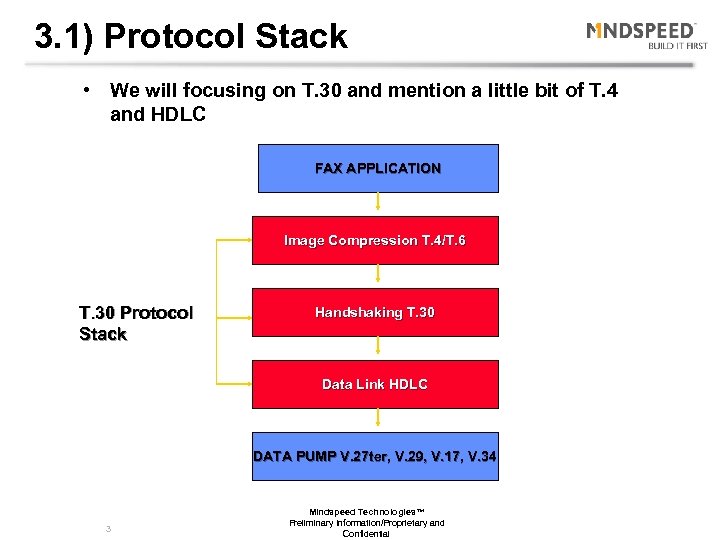
3. 1) Protocol Stack • We will focusing on T. 30 and mention a little bit of T. 4 and HDLC FAX APPLICATION Image Compression T. 4/T. 6 T. 30 Protocol Stack Handshaking T. 30 Data Link HDLC DATA PUMP V. 27 ter, V. 29, V. 17, V. 34 3 Mindspeed Technologies™ Preliminary Information/Proprietary and Confidential
3. 3) Terms of fax device: • Originate/Caller: start the call(Dialer) • Answer/Called/Callee: answer the call • Sender: device send fax page data (may be not the caller) • Receiver: device receive fax page 4 Mindspeed Technologies™ Preliminary Information/Proprietary and Confidential
3. 2) terms of fax signal: Spectra and frequency analyze: • Tone: CNG, CED. • Low speed for signaling: V. 21 (300 bps) • High speed for Data transmit V. 27 ter - up to 4800 bps V. 29 - up to 9600 bps V. 17 - up to 14400 bps 5 Mindspeed Technologies™ Preliminary Information/Proprietary and Confidential
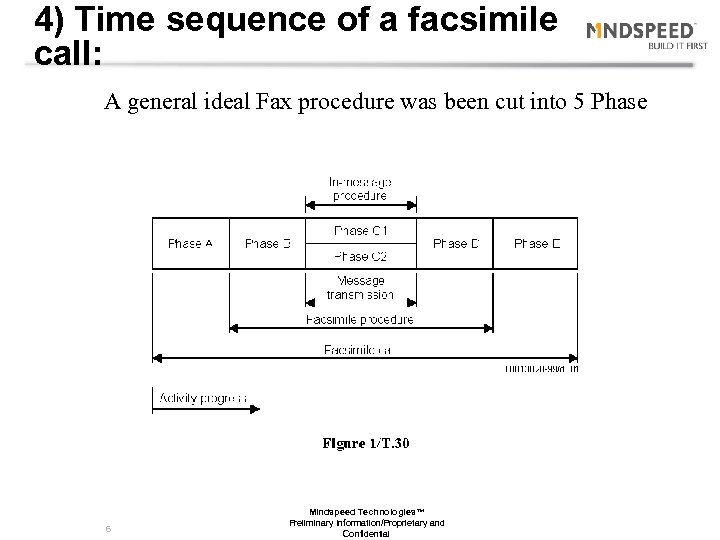
4) Time sequence of a facsimile call: A general ideal Fax procedure was been cut into 5 Phase 6 Mindspeed Technologies™ Preliminary Information/Proprietary and Confidential
5) Time sequence of a facsimile call(caller automatic operation) • . Off hook • . Dial Phase A • . Device identification Phase B • . Capability negotiation • . Channel probing Phase C • . Fax message exchange Phase D • . Post message handshaking Phase E • . Disconnect and • . On hook 7 Mindspeed Technologies™ Preliminary Information/Proprietary and Confidential
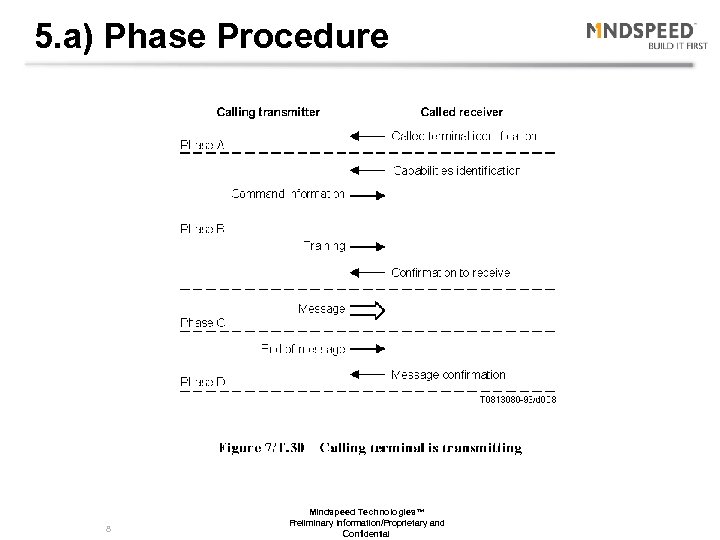
5. a) Phase Procedure 8 Mindspeed Technologies™ Preliminary Information/Proprietary and Confidential
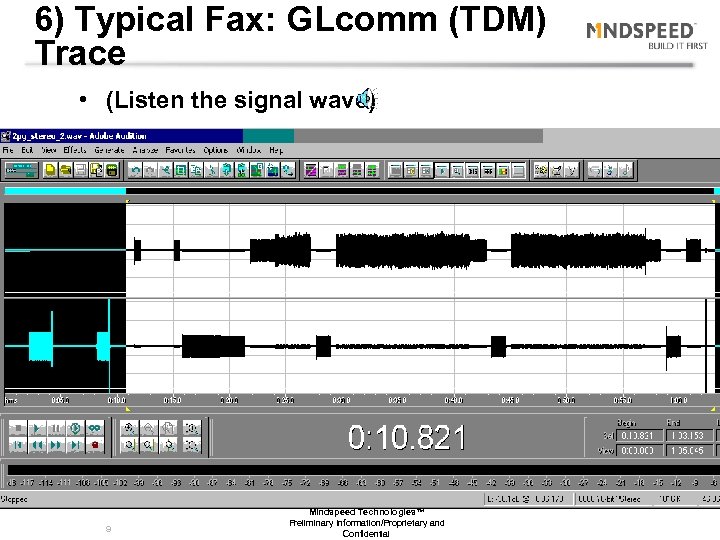
6) Typical Fax: GLcomm (TDM) Trace • (Listen the signal wave) 9 Mindspeed Technologies™ Preliminary Information/Proprietary and Confidential
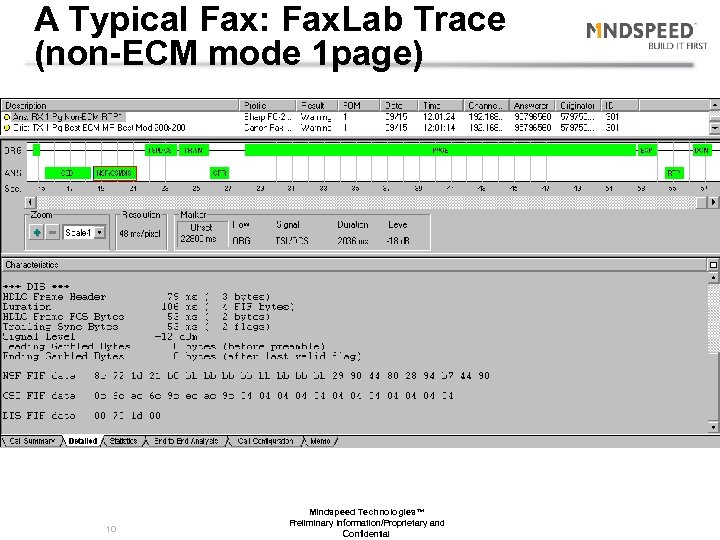
A Typical Fax: Fax. Lab Trace (non-ECM mode 1 page) 10 Mindspeed Technologies™ Preliminary Information/Proprietary and Confidential
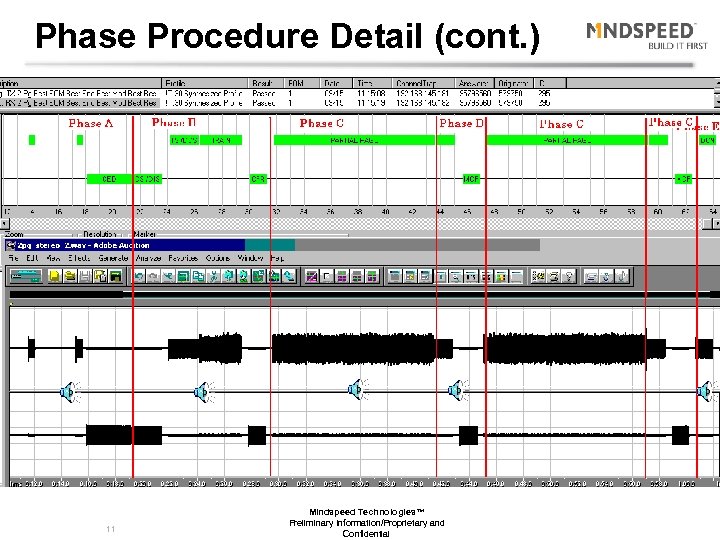
Phase Procedure Detail (cont. ) 11 Mindspeed Technologies™ Preliminary Information/Proprietary and Confidential
Phase A Call establishment • Call establishment can be realized manually and/or automatically. • (It is very few people in North America are using Manual fax. Automatic fax are more popular) • Caller fax send CND • Called fax send CED (it is optional on manual mode) 12 Mindspeed Technologies™ Preliminary Information/Proprietary and Confidential
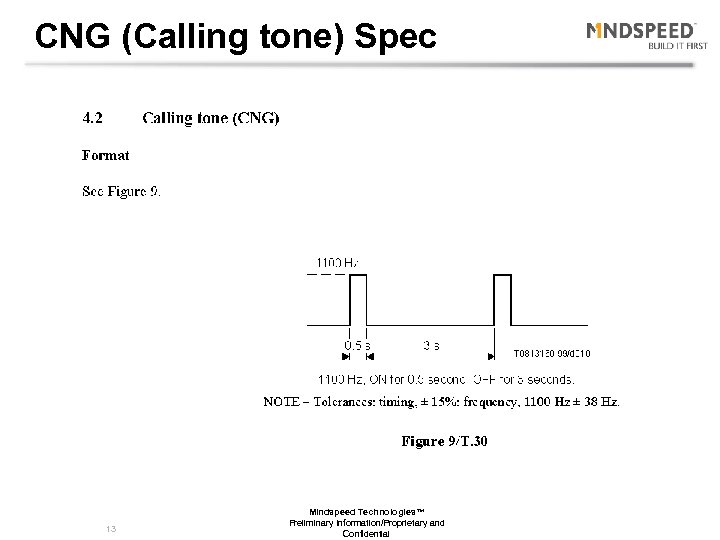
CNG (Calling tone) Spec 13 Mindspeed Technologies™ Preliminary Information/Proprietary and Confidential
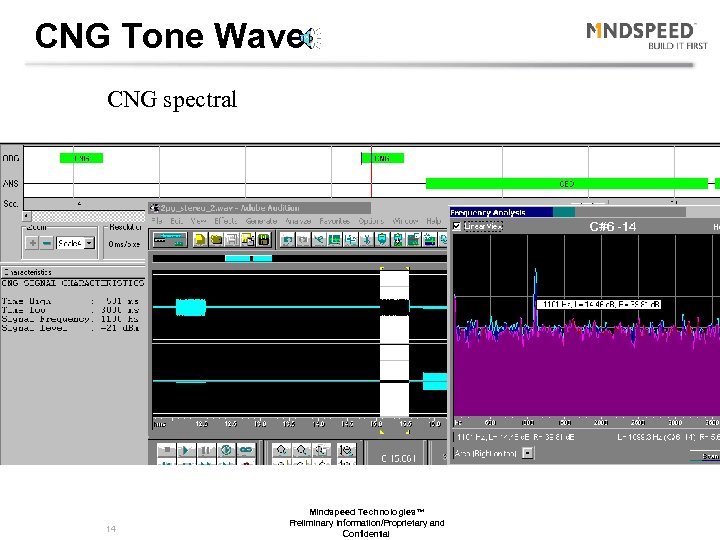
CNG Tone Wave CNG spectral 14 Mindspeed Technologies™ Preliminary Information/Proprietary and Confidential
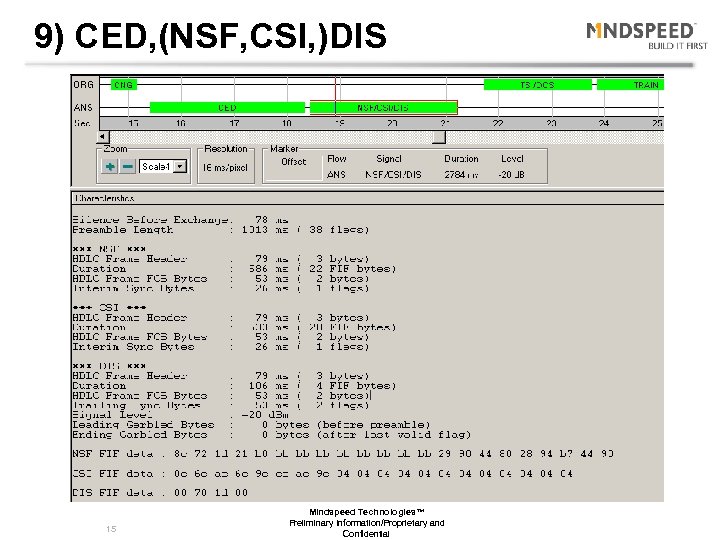
9) CED, (NSF, CSI, )DIS 15 Mindspeed Technologies™ Preliminary Information/Proprietary and Confidential
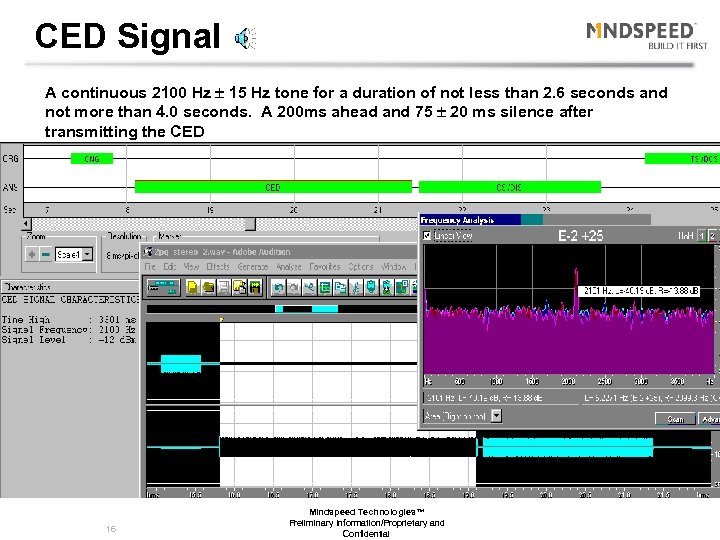
CED Signal A continuous 2100 Hz ± 15 Hz tone for a duration of not less than 2. 6 seconds and not more than 4. 0 seconds. A 200 ms ahead and 75 ± 20 ms silence after transmitting the CED 16 Mindspeed Technologies™ Preliminary Information/Proprietary and Confidential
Phase B – Pre-message Procedure • The pre-message procedure consists of the identification of capabilities and the commanding of the chosen conditions as well as the confirmation of acceptable conditions. • i. e. Exchange ID; Negotiate transmit protocol and speed; Training(channel probing) • DIS-digital identification signal(capabilities identification) • DCS-digital command signal(the response of DIS, indicate what capability will been used in the transmit) • CFR-confirmation to receive(the training is successful) • FTT-failure to train(the training is failed) • (CSI)-called subscriber identification • (NSF)-non-standard facilities 17 Mindspeed Technologies™ Preliminary Information/Proprietary and Confidential
11) preamble + (NSF)+(CSI) + DIS • Low speed data. Binary @ HDLC frame structure @ V. 21: 300 bps(FSK). • Preamble The preamble shall precede all binary coded signalling whenever a new transmission of information begins in any direction (i. e. for each line turnaround). This preamble assures that all elements of the communication channel (e. g. echo suppressors) are properly conditioned so that the subsequent data may be passed unimpaired. This preamble shall be a series of flag sequences for 1 s +/- 15%. Flag sequence Format: 0111 1110 (in short: 1 sec 0 x 7 E) 18 Mindspeed Technologies™ Preliminary Information/Proprietary and Confidential
11) preamble + (NSF)+(CSI) + DIS • (CSI) - Called Subscriber Identification Optional frame (non-terminal) that provides the specific identity of the called subscriber by its international phone number. FCF(Facsimile Control Field) format - 0000 0010. FIF(Facsimile Information Field) length - 20 bytes • (NSF) -Non-Standard Facilities Optional frame (non-terminal) that may be used to identify specific user requirements which are not covered by T. 30 number. FCF format - 0000 0100. FIF length - min 3 bytes (the only standard portion of NSF) • DIS - Digital Identification Signal Mandatory frame (terminal frame) that characterizes the capabilities of the called terminal. FCF format: 0000 0001. FIF length - min 3 bytes (basic capabilities), 10 bytes defined as of 1996 (optional enhancements) Each bit or bit combination in the FIF maps over a Mindspeed Technologies™ Preliminary Information/Proprietary and capability 19 Confidential
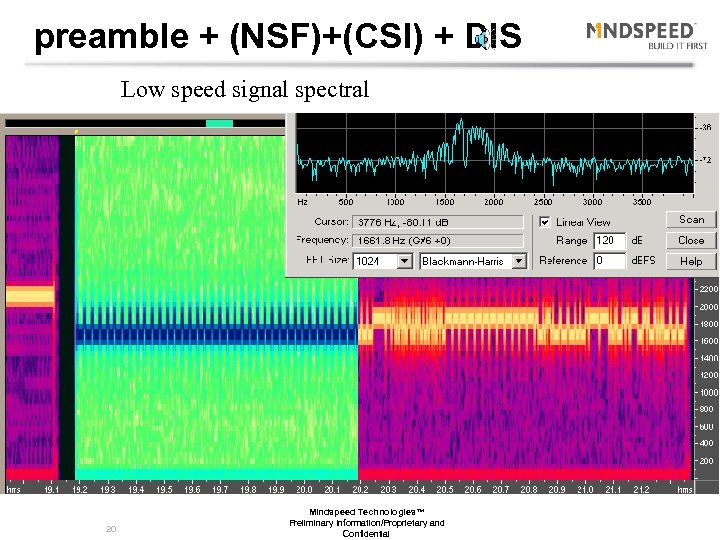
preamble + (NSF)+(CSI) + DIS Low speed signal spectral 20 Mindspeed Technologies™ Preliminary Information/Proprietary and Confidential
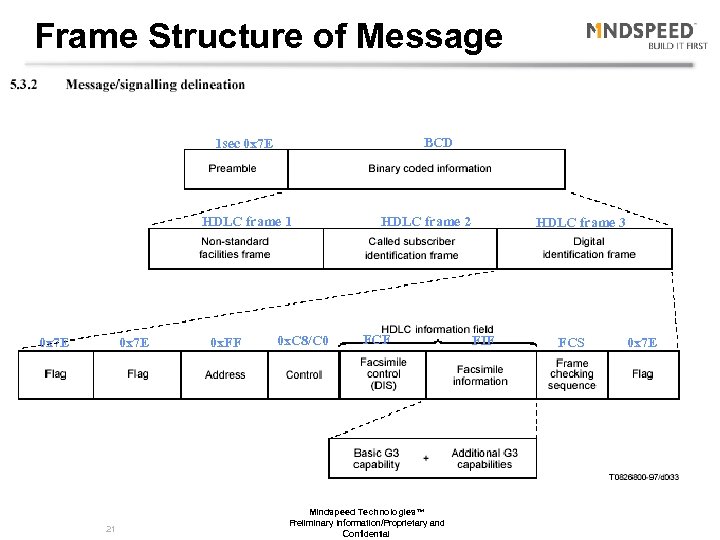
Frame Structure of Message BCD 1 sec 0 x 7 E HDLC frame 1 0 x 7 E 21 0 x. FF 0 x. C 8/C 0 HDLC frame 2 FCF Mindspeed Technologies™ Preliminary Information/Proprietary and Confidential HDLC frame 3 FIF FCS 0 x 7 E
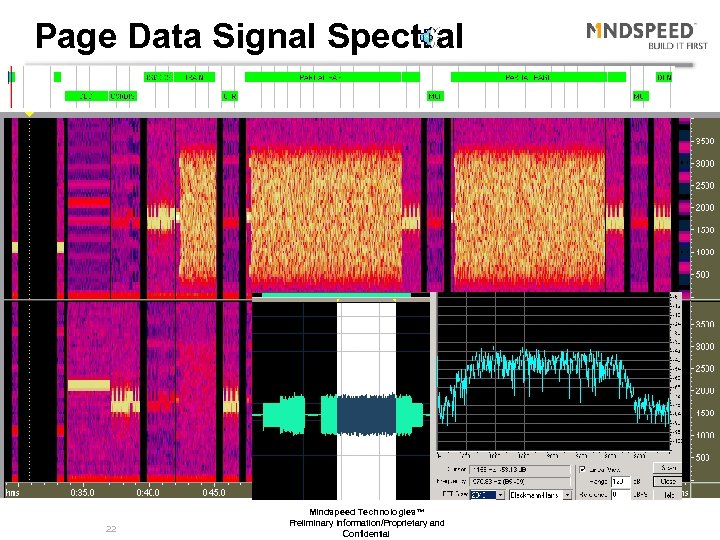
Page Data Signal Spectral 22 Mindspeed Technologies™ Preliminary Information/Proprietary and Confidential
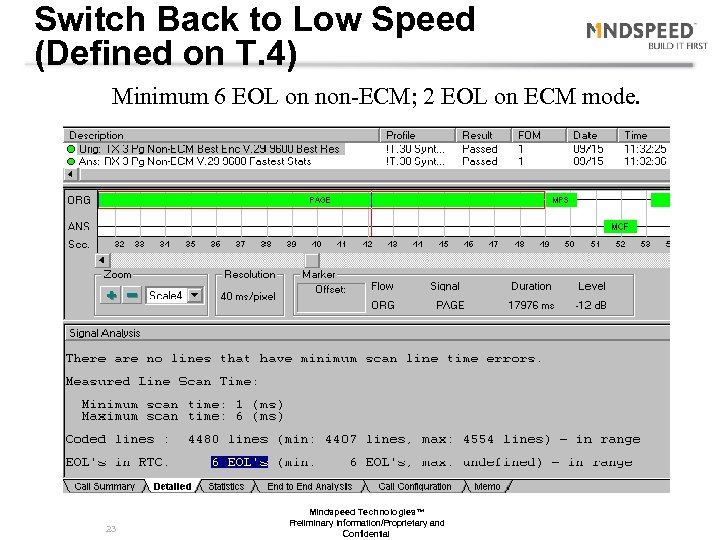
Switch Back to Low Speed (Defined on T. 4) Minimum 6 EOL on non-ECM; 2 EOL on ECM mode. 23 Mindspeed Technologies™ Preliminary Information/Proprietary and Confidential
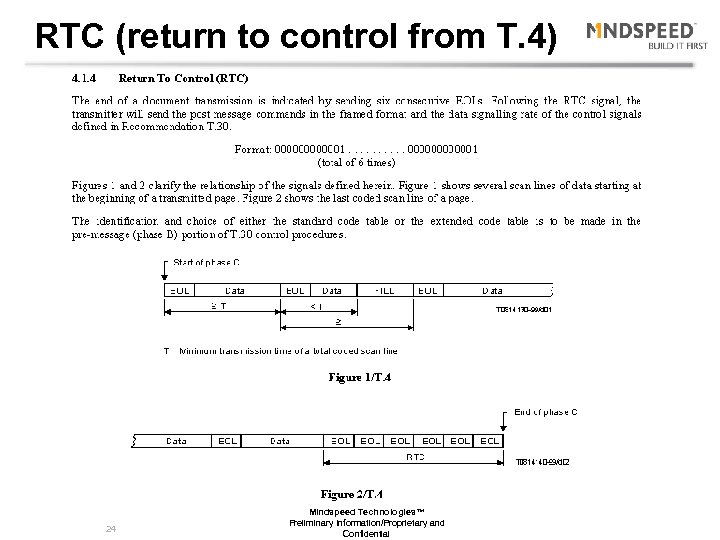
RTC (return to control from T. 4) 24 Mindspeed Technologies™ Preliminary Information/Proprietary and Confidential
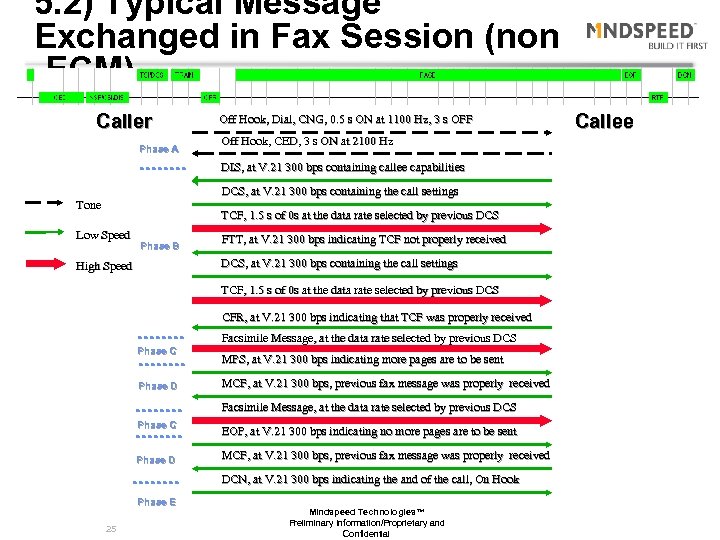
5. 2) Typical Message Exchanged in Fax Session (non -ECM) Caller Phase A Off Hook, Dial, CNG, 0. 5 s ON at 1100 Hz, 3 s OFF Off Hook, CED, 3 s ON at 2100 Hz DIS, at V. 21 300 bps containing callee capabilities DCS, at V. 21 300 bps containing the call settings Tone TCF, 1. 5 s of 0 s at the data rate selected by previous DCS Low Speed Phase B FTT, at V. 21 300 bps indicating TCF not properly received DCS, at V. 21 300 bps containing the call settings High Speed TCF, 1. 5 s of 0 s at the data rate selected by previous DCS CFR, at V. 21 300 bps indicating that TCF was properly received Facsimile Message, at the data rate selected by previous DCS Phase C Phase D MPS, at V. 21 300 bps indicating more pages are to be sent MCF, at V. 21 300 bps, previous fax message was properly received Facsimile Message, at the data rate selected by previous DCS Phase C Phase D EOP, at V. 21 300 bps indicating no more pages are to be sent MCF, at V. 21 300 bps, previous fax message was properly received DCN, at V. 21 300 bps indicating the and of the call, On Hook Phase E 25 Mindspeed Technologies™ Preliminary Information/Proprietary and Confidential Callee
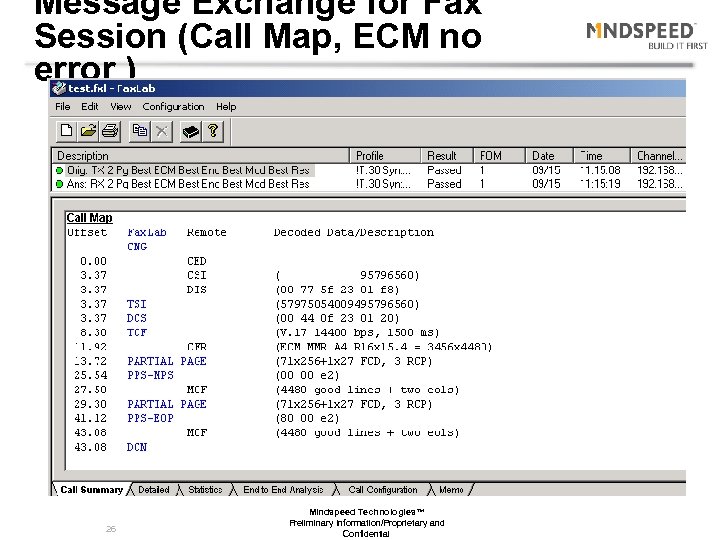
Message Exchange for Fax Session (Call Map, ECM no error ) 26 Mindspeed Technologies™ Preliminary Information/Proprietary and Confidential
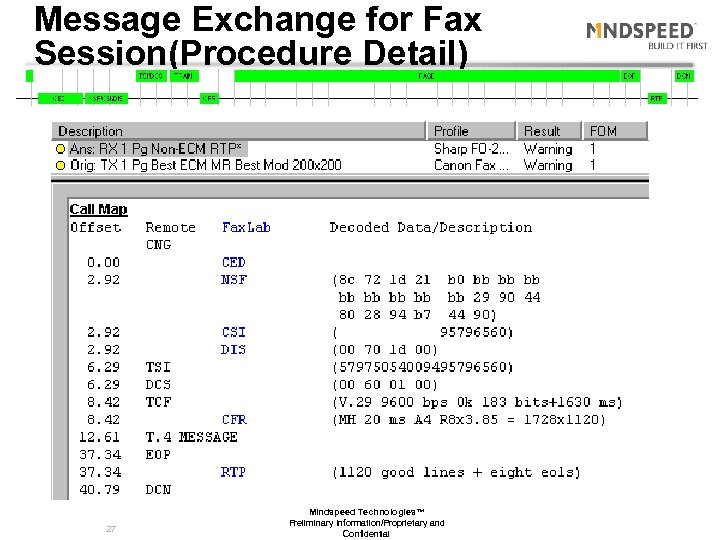
Message Exchange for Fax Session(Procedure Detail) 27 Mindspeed Technologies™ Preliminary Information/Proprietary and Confidential
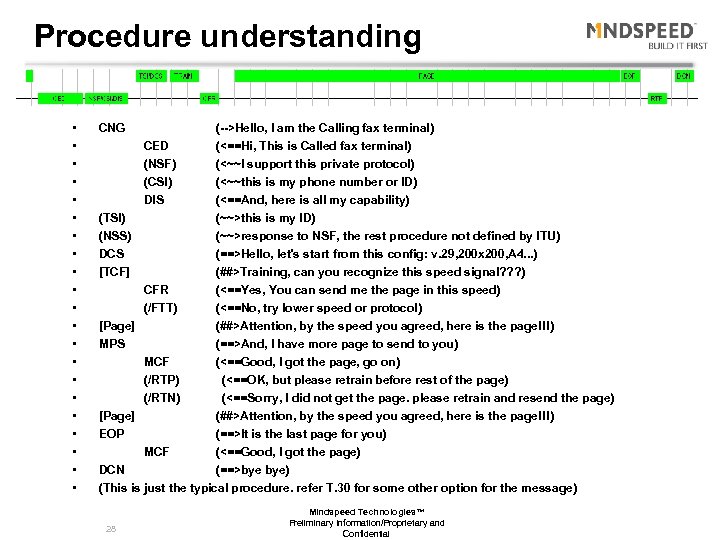
Procedure understanding • • • • • • CNG CED (NSF) (CSI) DIS (-->Hello, I am the Calling fax terminal) (<==Hi, This is Called fax terminal) (TSI) (NSS) (<~~I support this private protocol) (<~~this is my phone number or ID) (<==And, here is all my capability) (~~>this is my ID) (~~>response to NSF, the rest procedure not defined by ITU) DCS (==>Hello, let's start from this config: v. 29, 200 x 200, A 4. . . ) [TCF] (##>Training, can you recognize this speed signal? ? ? ) CFR (<==Yes, You can send me the page in this speed) (/FTT) (<==No, try lower speed or protocol) [Page] (##>Attention, by the speed you agreed, here is the page!!!) MPS (==>And, I have more page to send to you) MCF (<==Good, I got the page, go on) (/RTP) (/RTN) (<==OK, but please retrain before rest of the page) (<==Sorry, I did not get the page. please retrain and resend the page) [Page] (##>Attention, by the speed you agreed, here is the page!!!) EOP (==>It is the last page for you) MCF (<==Good, I got the page) DCN (==>bye bye) (This is just the typical procedure. refer T. 30 for some other option for the message) 28 Mindspeed Technologies™ Preliminary Information/Proprietary and Confidential
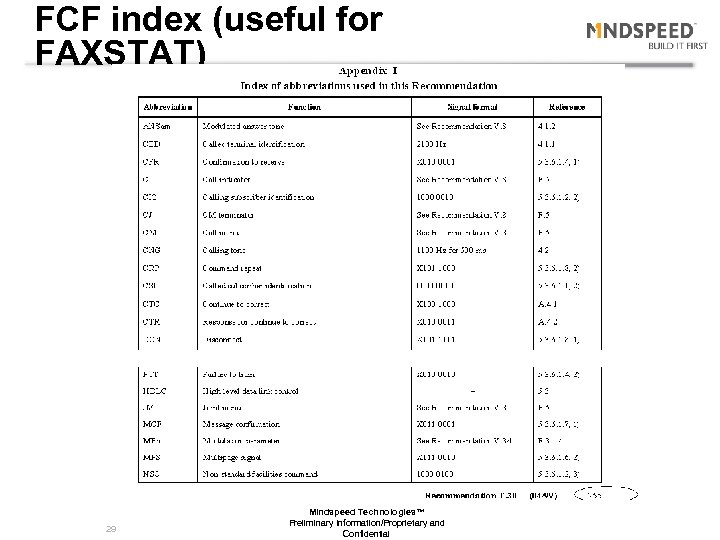
FCF index (useful for FAXSTAT) 29 Mindspeed Technologies™ Preliminary Information/Proprietary and Confidential
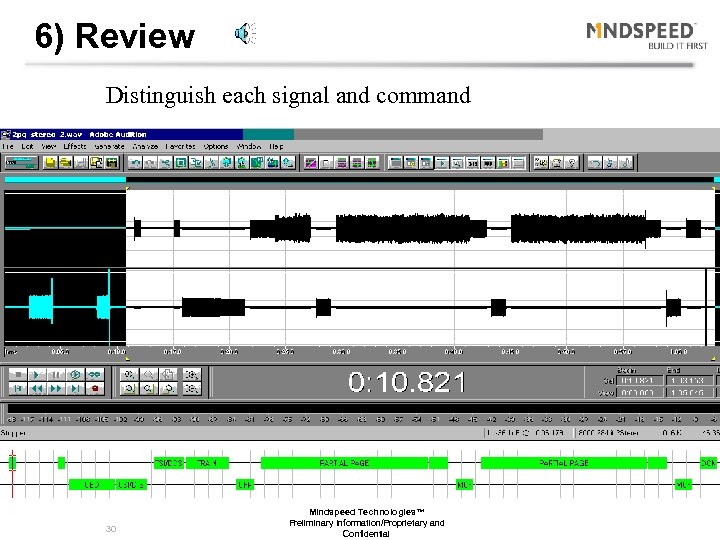
6) Review Distinguish each signal and command 30 Mindspeed Technologies™ Preliminary Information/Proprietary and Confidential
Automatic operation and manual operation • Call establishment can be realized manually and/or automatically. • (It is very few people in North America are using Manual fax. Automatic fax are more popular) • T. 30 Call establishment operateing method 1: Manual mode on both end • T. 30 Call establishment operateing method 2: Calling manual mode, Called auto mode • T. 30 Call establishment operateing method 3: Calling auto mode, Called manual mode • T. 30 Call establishment operateing method 4: Auto modemon both end • T. 30 Call establishment operateing method 4 bis a&b: V. 34 fax 31 Mindspeed Technologies™ Preliminary Information/Proprietary and Confidential
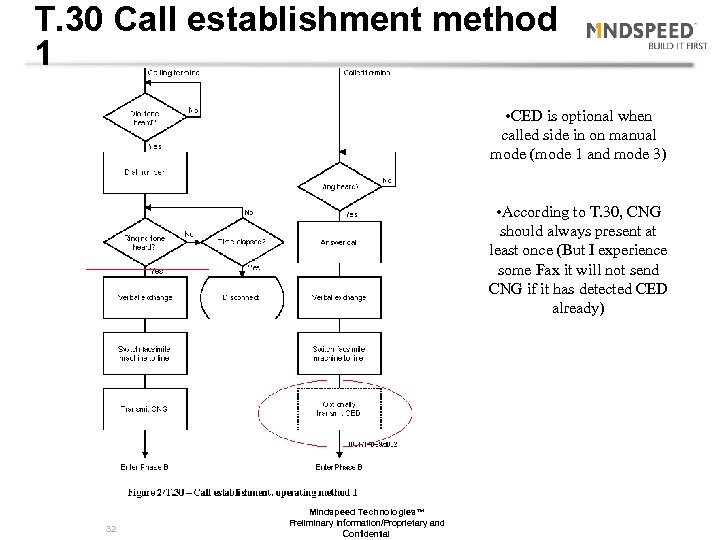
T. 30 Call establishment method 1 • CED is optional when called side in on manual mode (mode 1 and mode 3) • According to T. 30, CNG should always present at least once (But I experience some Fax it will not send CNG if it has detected CED already) 32 Mindspeed Technologies™ Preliminary Information/Proprietary and Confidential
Timer • • • T 2: (6 s +/- 5 s) Time-out T 2 makes use of the tight control between commands and responses to detect the loss of command/response synchronization. T 2 is 6 +/- 1 seconds and begins when initiating a command search (e. g. the first entrance into the "command received" subroutine, reference flow diagram in 5. 2). T 2 is reset when an HDLC flag is received or when T 2 times out. (6 s. The time the receiver fax wait for next command after previous command was received. Will disconnect if time out) T 3: (10 s +/- 5 s) Time-out T 3 defines the amount of time a terminal will attempt to alert the local operator in response to a procedural interrupt. Failing to achieve operator intervention, the terminal will discontinue this attempt and shall issue other commands or responses. T 3 is 10 +/- 5 seconds, begins on the first detection of a procedural interrupt command/response signal (i. e. PIN/PIP or PRI-Q) and is reset when T 3 times out or when the operator initiates a line request. (10 s. The time wait for the operator to press a bottom or insert a paper or pick up handset) T 4 (3 s +/- 15%) Defines how long the receiver waits for HDLC command flags. 3 s +/- 15% for automatic units and 4. 5 s +/- 15% for manual units. Begins when first entering in the Response Received routine Reset when an HDLC Flag is received or when it times out. Mindspeed Technologies™ (3 s. The time the sender fax wait for the command response after it resent the Preliminary Information/Proprietary and 33 command) Confidential
T 2, T 4 Example • Receiver Fax will start T 2 (6 s) timer when receive a command (and responds the command). Will time out after 6 sec if the command doesn’t come. It will disconnect the line. Receiver Fax will start T 4 (3 s) timer after send DIS to sender. Will time out and resend this message 3 times if time out. • Sender Fax will start T 4 timer after send command to receiver Fax. Will time out after 3 sec if a response doesn’t come. It will retry 3 times (except DIS) and send DCN to disconnect the line. • T. 30 assume the telephone line should at least support low speed signal transmit and not generate any error. Otherwise the line is not good enough for Mindspeed Technologies™ a fax transaction. Preliminary Information/Proprietary and 34 Confidential
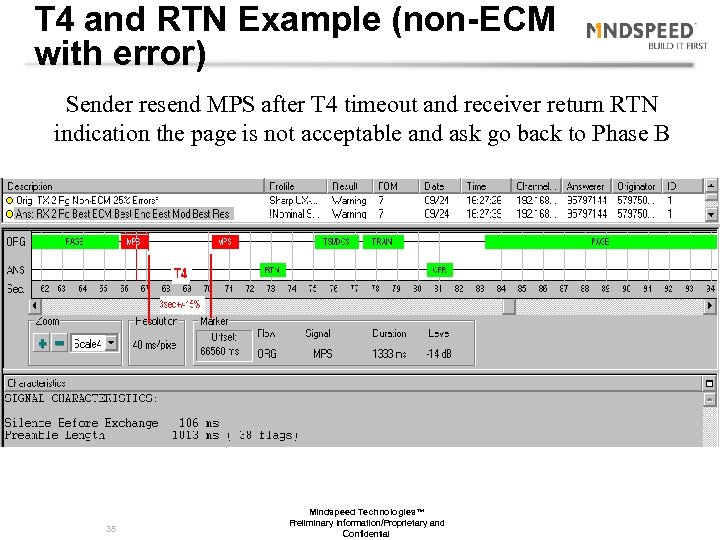
T 4 and RTN Example (non-ECM with error) Sender resend MPS after T 4 timeout and receiver return RTN indication the page is not acceptable and ask go back to Phase B 35 Mindspeed Technologies™ Preliminary Information/Proprietary and Confidential
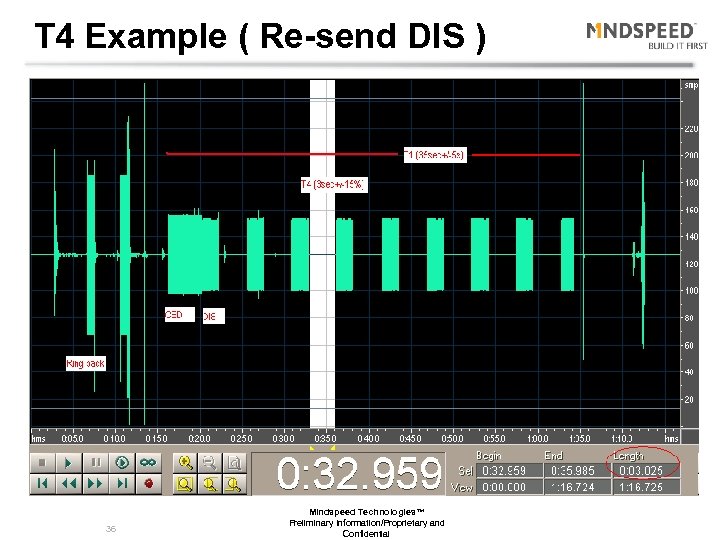
T 4 Example ( Re-send DIS ) 36 Mindspeed Technologies™ Preliminary Information/Proprietary and Confidential
ECM Error Correction Mode • ECM is a transmission mode for fax (receiver) to automaticly inform and (for sender)resend the corrupted page data. • Sender set bit 27 in DIS/DTC command to indicate ECM capability. Receiver set bit 27 in DCS command to confirm ECM mode. • The method of ECM is to divide the page data to 64 or 256 bytes a frame; packed as HDLC frame format(with sequence number and FCS); combine 256 frame to a Block. • Sender send one block every time. Receiver receive and check the contain for the transmit error. And send back information to sender to inform any error frame. Sender resend error frame and receiver to check again. Repeat this procedure up 37 Mindspeed Technologies™ Preliminary Information/Proprietary and Confidential
New Command for ECM • By implementing this, some new message for ECM was been added upon non-ECM mode: PPS: Partial Page Signal. End of Partial Page. EOP, MPS, EOM have been replaced with PPS_EOP, PPS_MPS, PPS_EOM PPS_NULL indicate next Partial Page contains a block for the same page image PPR: Partial Page Request to resend some error. CTC: Continue To Correct. Request to repeat error correction over 4 times. RNR/RR: to buy time for the low end receivers to rebuild the image buffer, decompress and print the image EOR/ERR signals to decide to drop the transmission of the current block and move to the next one Mindspeed Technologies™ Preliminary Information/Proprietary and 38 …. Confidential
ECM Challenges – Low end machines used to print as the image arrives • Low memory was needed • Lines were decompressed as they arrived – ECM, a whole block needs to be received before the device can start printing • Higher memory requirements • Faster processing and printing unit – Due to the error correction mechanism, on noisy lines the call can take much longer due to retransmissions 39 Mindspeed Technologies™ Preliminary Information/Proprietary and Confidential
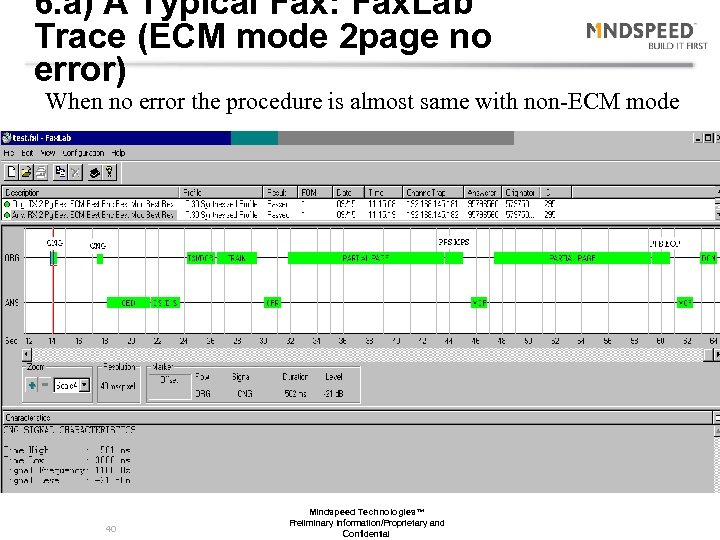
6. a) A Typical Fax: Fax. Lab Trace (ECM mode 2 page no error) When no error the procedure is almost same with non-ECM mode 40 Mindspeed Technologies™ Preliminary Information/Proprietary and Confidential
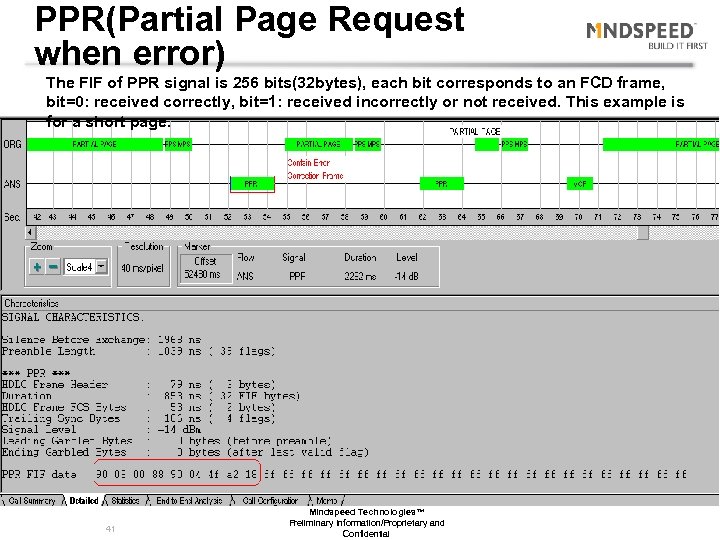
PPR(Partial Page Request when error) The FIF of PPR signal is 256 bits(32 bytes), each bit corresponds to an FCD frame, bit=0: received correctly, bit=1: received incorrectly or not received. This example is for a short page. 41 Mindspeed Technologies™ Preliminary Information/Proprietary and Confidential
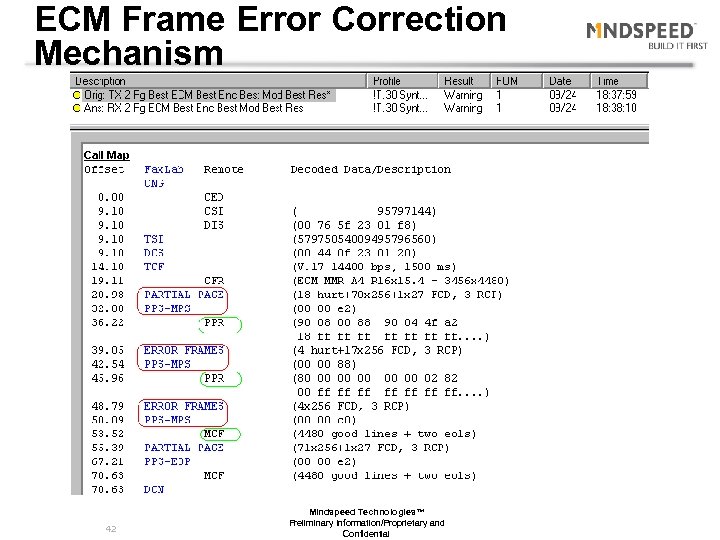
ECM Frame Error Correction Mechanism 42 Mindspeed Technologies™ Preliminary Information/Proprietary and Confidential
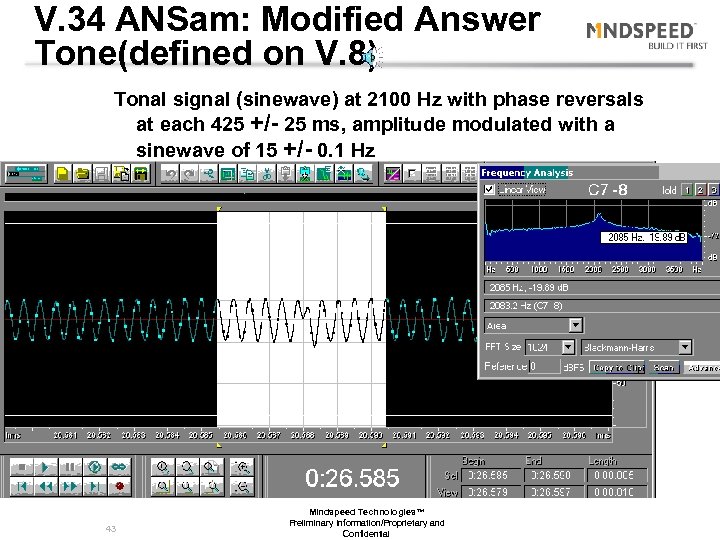
V. 34 ANSam: Modified Answer Tone(defined on V. 8) Tonal signal (sinewave) at 2100 Hz with phase reversals at each 425 +/- 25 ms, amplitude modulated with a sinewave of 15 +/- 0. 1 Hz 43 Mindspeed Technologies™ Preliminary Information/Proprietary and Confidential
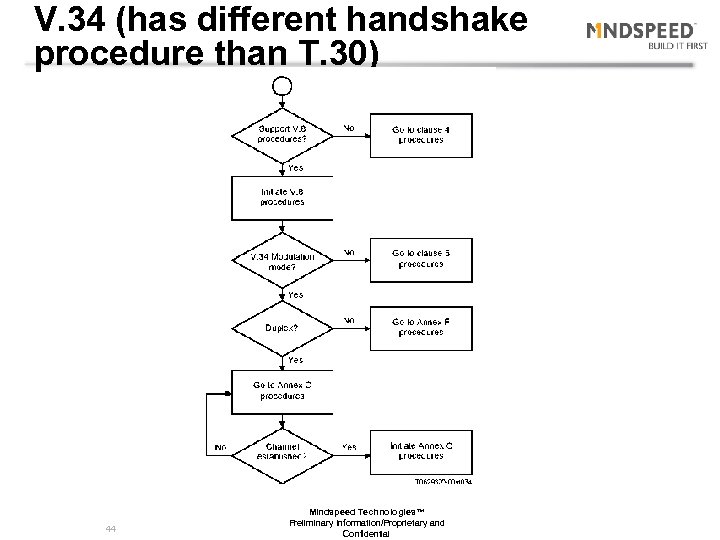
V. 34 (has different handshake procedure than T. 30) 44 Mindspeed Technologies™ Preliminary Information/Proprietary and Confidential
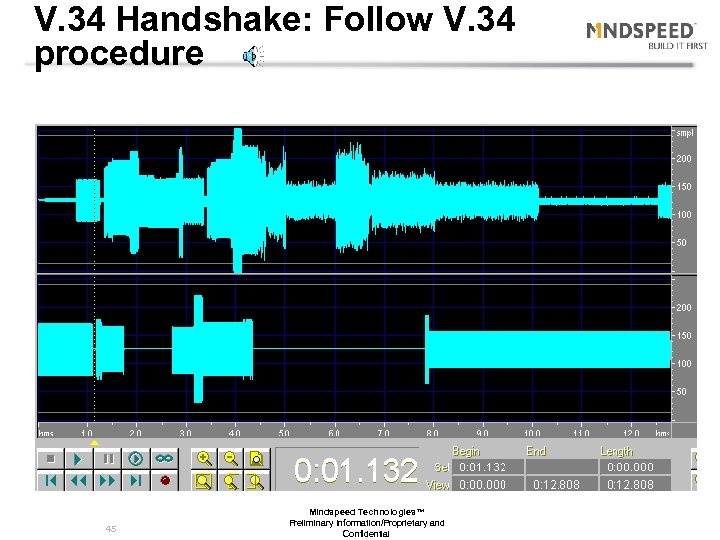
V. 34 Handshake: Follow V. 34 procedure 45 Mindspeed Technologies™ Preliminary Information/Proprietary and Confidential
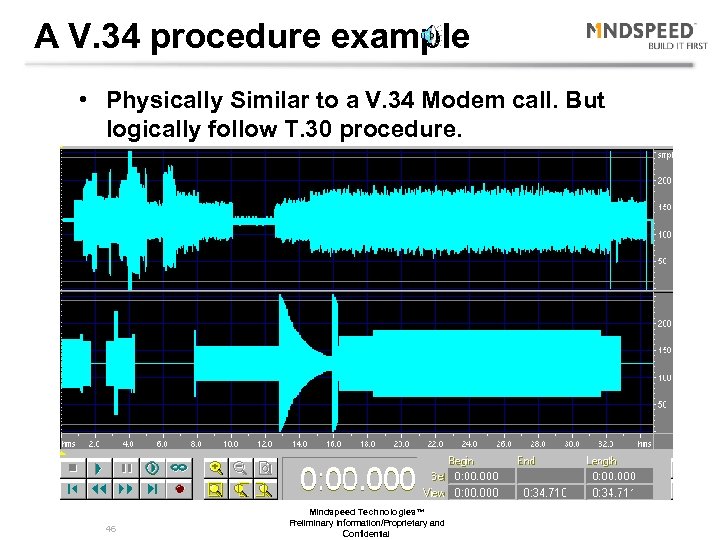
A V. 34 procedure example • Physically Similar to a V. 34 Modem call. But logically follow T. 30 procedure. 46 Mindspeed Technologies™ Preliminary Information/Proprietary and Confidential
Скачать презентацию T 30 Overview APAC FAE Training October 2004
c3d9881ea8da0e21c4669a62a76adb89.ppt