


 Скачать презентацию T 25 1 Chapter Outline Chapter 25 Options
b2d99ce495d3a22cbdacc2c79b1f35d5.ppt
- Количество слайдов: 21
 T 25. 1 Chapter Outline Chapter 25 Options and Corporate Securities Chapter Organization n 25. 1 Options: The Basics n 25. 2 Fundamentals of Option Valuation n 25. 3 Valuing a Call Option n 25. 4 Equity as a Call Option on the Firm’s Assets n 25. 5 Warrants n 25. 6 Convertible Bonds n 25. 7 Reasons for Issuing Warrants and Convertibles n 25. 8 Other Options n 25. 9 Summary and Conclusions n 25 A The Black-Scholes Option Pricing Model CLICK MOUSE OR HIT SPACEBAR TO ADVANCE Irwin/Mc. Graw-Hill copyright © 2002 Mc. Graw-Hill Ryerson, Ltd.
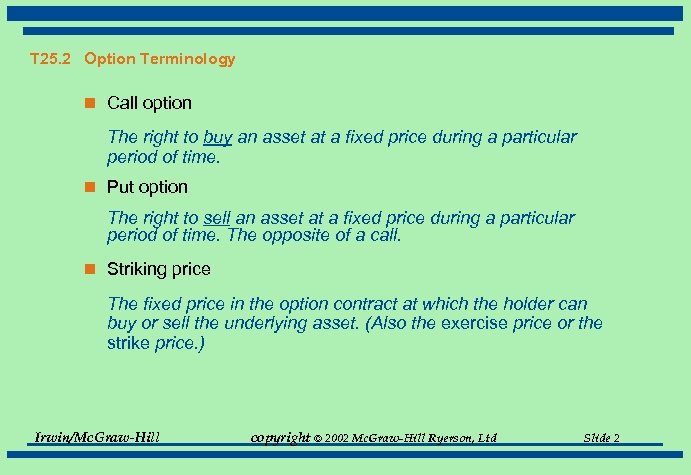 T 25. 2 Option Terminology n Call option The right to buy an asset at a fixed price during a particular period of time. n Put option The right to sell an asset at a fixed price during a particular period of time. The opposite of a call. n Striking price The fixed price in the option contract at which the holder can buy or sell the underlying asset. (Also the exercise price or the strike price. ) Irwin/Mc. Graw-Hill copyright © 2002 Mc. Graw-Hill Ryerson, Ltd Slide 2
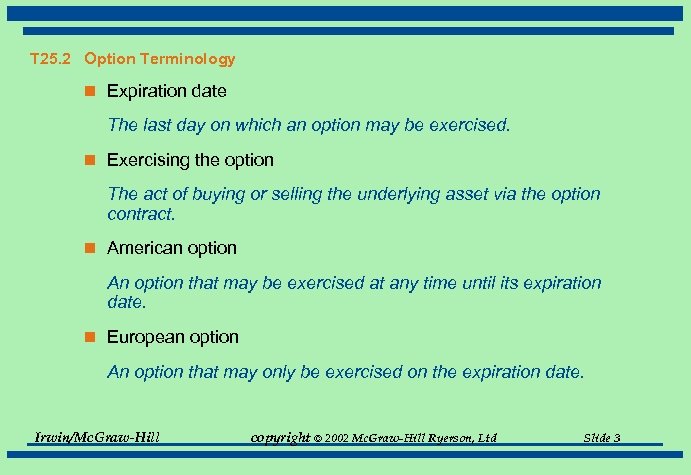 T 25. 2 Option Terminology n Expiration date The last day on which an option may be exercised. n Exercising the option The act of buying or selling the underlying asset via the option contract. n American option An option that may be exercised at any time until its expiration date. n European option An option that may only be exercised on the expiration date. Irwin/Mc. Graw-Hill copyright © 2002 Mc. Graw-Hill Ryerson, Ltd Slide 3
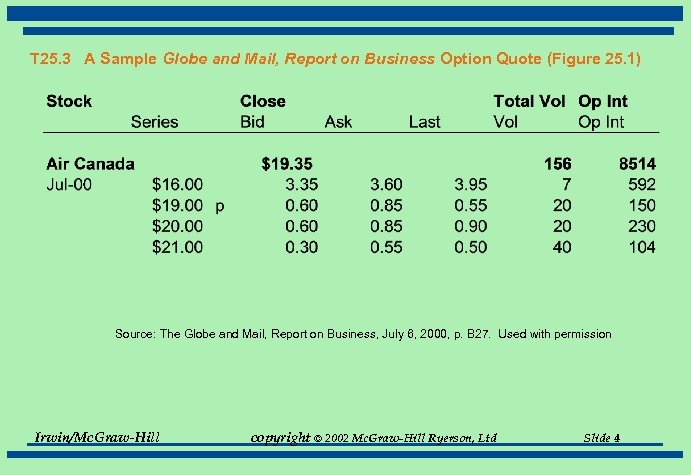 T 25. 3 A Sample Globe and Mail, Report on Business Option Quote (Figure 25. 1) Source: The Globe and Mail, Report on Business, July 6, 2000, p. B 27. Used with permission Irwin/Mc. Graw-Hill copyright © 2002 Mc. Graw-Hill Ryerson, Ltd Slide 4
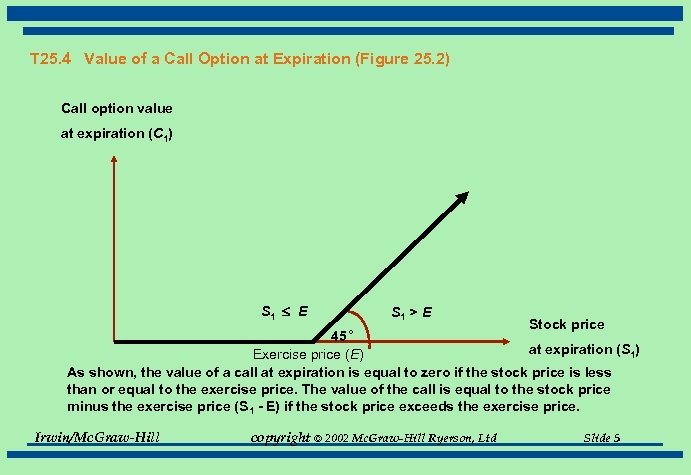 T 25. 4 Value of a Call Option at Expiration (Figure 25. 2) Call option value at expiration (C 1) S 1 E S 1 > E Stock price 45 ° at expiration (S 1) Exercise price (E) As shown, the value of a call at expiration is equal to zero if the stock price is less than or equal to the exercise price. The value of the call is equal to the stock price minus the exercise price (S 1 - E) if the stock price exceeds the exercise price. Irwin/Mc. Graw-Hill copyright © 2002 Mc. Graw-Hill Ryerson, Ltd Slide 5
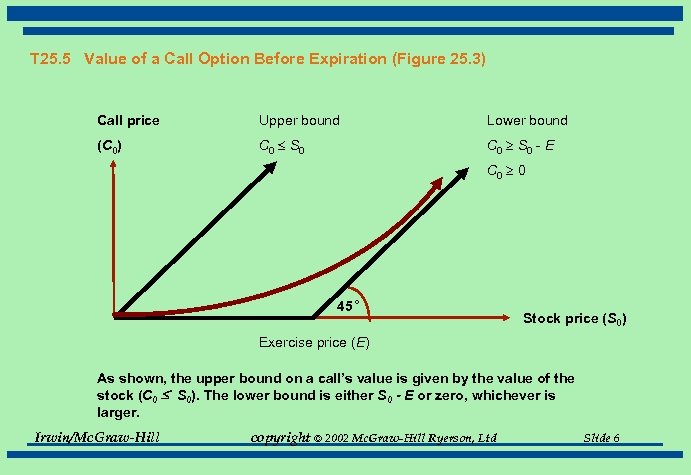 T 25. 5 Value of a Call Option Before Expiration (Figure 25. 3) Call price Upper bound Lower bound (C 0) C 0 S 0 - E C 0 0 45 ° Stock price (S 0) Exercise price (E) As shown, the upper bound on a call’s value is given by the value of the stock (C 0 S 0). The lower bound is either S 0 - E or zero, whichever is larger. Irwin/Mc. Graw-Hill copyright © 2002 Mc. Graw-Hill Ryerson, Ltd Slide 6
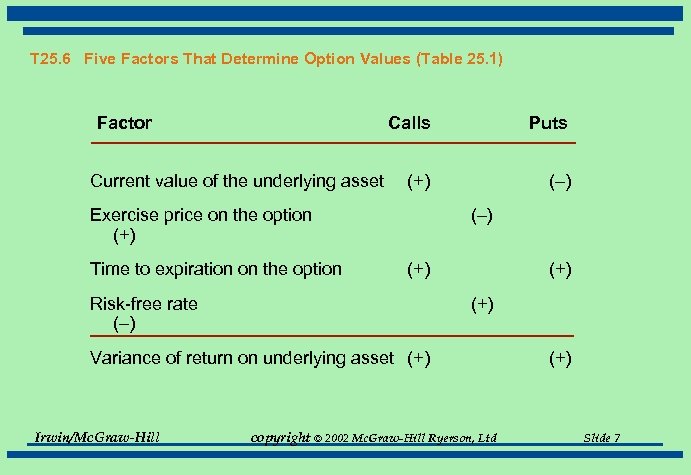 T 25. 6 Five Factors That Determine Option Values (Table 25. 1) Factor Calls Current value of the underlying asset Puts (+) ( ) Exercise price on the option (+) Time to expiration on the option ( ) (+) Risk-free rate ( ) (+) Variance of return on underlying asset (+) Irwin/Mc. Graw-Hill copyright © 2002 Mc. Graw-Hill Ryerson, Ltd (+) Slide 7
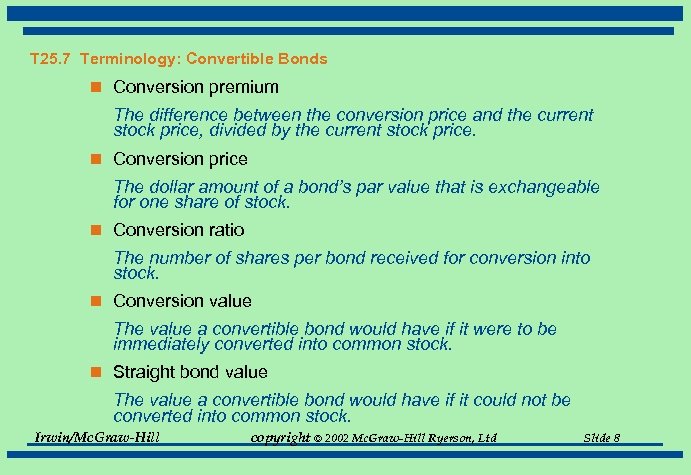 T 25. 7 Terminology: Convertible Bonds n Conversion premium The difference between the conversion price and the current stock price, divided by the current stock price. n Conversion price The dollar amount of a bond’s par value that is exchangeable for one share of stock. n Conversion ratio The number of shares per bond received for conversion into stock. n Conversion value The value a convertible bond would have if it were to be immediately converted into common stock. n Straight bond value The value a convertible bond would have if it could not be converted into common stock. Irwin/Mc. Graw-Hill copyright © 2002 Mc. Graw-Hill Ryerson, Ltd Slide 8
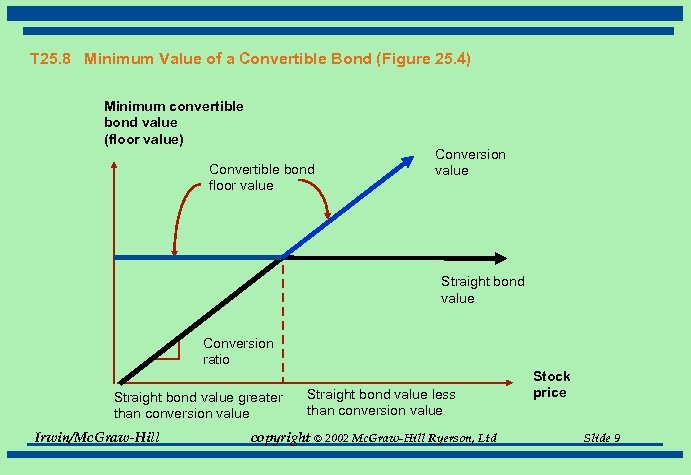 T 25. 8 Minimum Value of a Convertible Bond (Figure 25. 4) Minimum convertible bond value (floor value) Convertible bond floor value Conversion value Straight bond value Conversion ratio Straight bond value greater than conversion value Irwin/Mc. Graw-Hill Straight bond value less than conversion value copyright © 2002 Mc. Graw-Hill Ryerson, Ltd Stock price Slide 9
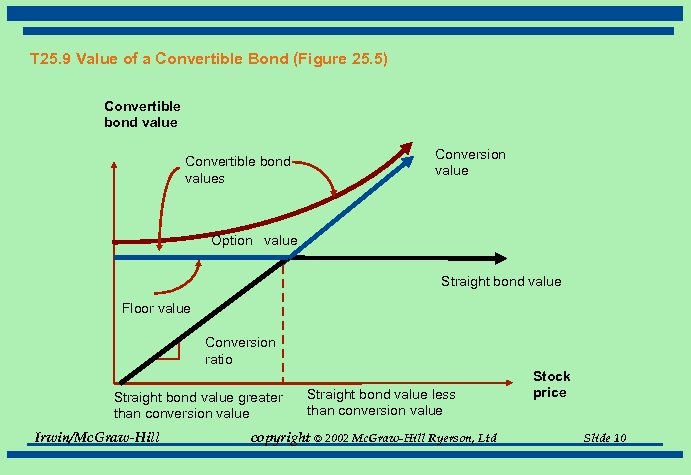 T 25. 9 Value of a Convertible Bond (Figure 25. 5) Convertible bond values Conversion value Option value Straight bond value Floor value Conversion ratio Straight bond value greater than conversion value Irwin/Mc. Graw-Hill Straight bond value less than conversion value copyright © 2002 Mc. Graw-Hill Ryerson, Ltd Stock price Slide 10
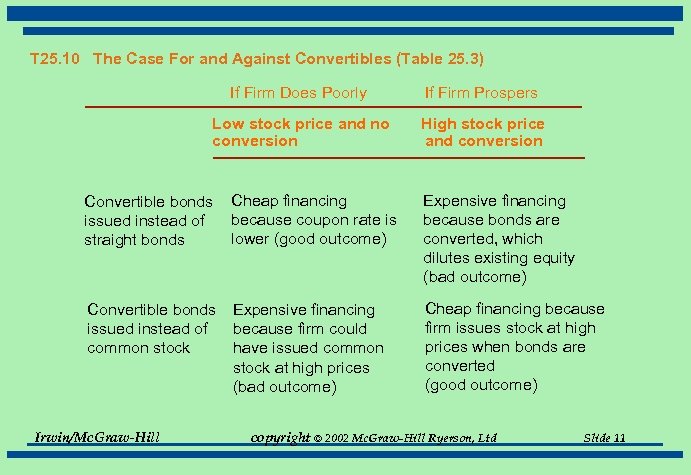 T 25. 10 The Case For and Against Convertibles (Table 25. 3) If Firm Does Poorly If Firm Prospers Low stock price and no conversion High stock price and conversion Convertible bonds issued instead of straight bonds Cheap financing because coupon rate is lower (good outcome) Expensive financing because bonds are converted, which dilutes existing equity (bad outcome) Convertible bonds issued instead of common stock Expensive financing because firm could have issued common stock at high prices (bad outcome) Cheap financing because firm issues stock at high prices when bonds are converted (good outcome) Irwin/Mc. Graw-Hill copyright © 2002 Mc. Graw-Hill Ryerson, Ltd Slide 11
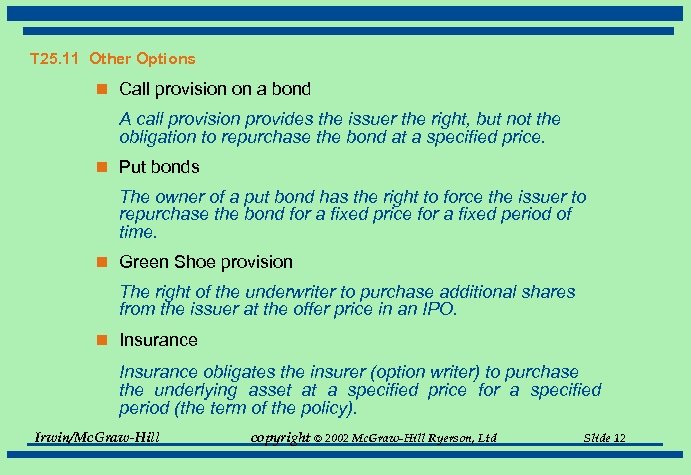 T 25. 11 Other Options n Call provision on a bond A call provision provides the issuer the right, but not the obligation to repurchase the bond at a specified price. n Put bonds The owner of a put bond has the right to force the issuer to repurchase the bond for a fixed price for a fixed period of time. n Green Shoe provision The right of the underwriter to purchase additional shares from the issuer at the offer price in an IPO. n Insurance obligates the insurer (option writer) to purchase the underlying asset at a specified price for a specified period (the term of the policy). Irwin/Mc. Graw-Hill copyright © 2002 Mc. Graw-Hill Ryerson, Ltd Slide 12
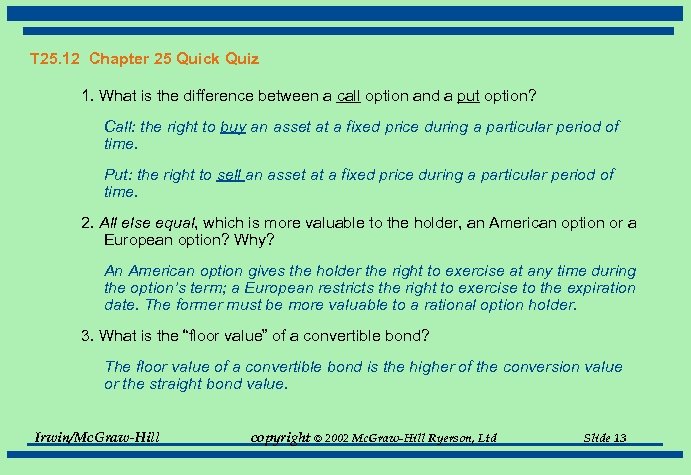 T 25. 12 Chapter 25 Quick Quiz 1. What is the difference between a call option and a put option? Call: the right to buy an asset at a fixed price during a particular period of time. Put: the right to sell an asset at a fixed price during a particular period of time. 2. All else equal, which is more valuable to the holder, an American option or a European option? Why? An American option gives the holder the right to exercise at any time during the option’s term; a European restricts the right to exercise to the expiration date. The former must be more valuable to a rational option holder. 3. What is the “floor value” of a convertible bond? The floor value of a convertible bond is the higher of the conversion value or the straight bond value. Irwin/Mc. Graw-Hill copyright © 2002 Mc. Graw-Hill Ryerson, Ltd Slide 13
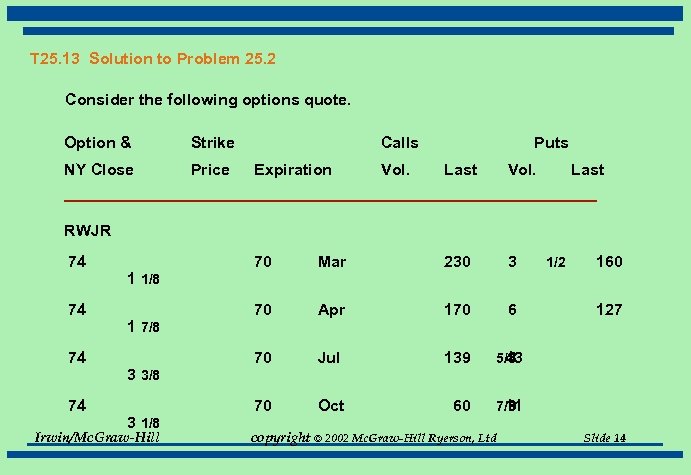 T 25. 13 Solution to Problem 25. 2 Consider the following options quote. Option & Strike NY Close Price Calls Expiration Vol. Puts Last Vol. Last RWJR 74 74 1 1/8 1 7/8 3 3/8 3 1/8 Irwin/Mc. Graw-Hill 70 Mar 230 3 70 Apr 170 6 70 Jul 139 5/8 43 8 70 Oct 60 7/8 11 9 copyright © 2002 Mc. Graw-Hill Ryerson, Ltd 1/2 160 127 Slide 14
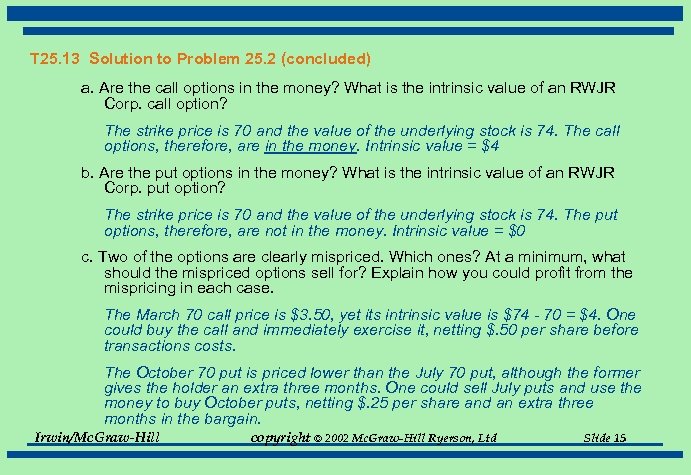 T 25. 13 Solution to Problem 25. 2 (concluded) a. Are the call options in the money? What is the intrinsic value of an RWJR Corp. call option? The strike price is 70 and the value of the underlying stock is 74. The call options, therefore, are in the money. Intrinsic value = $4 b. Are the put options in the money? What is the intrinsic value of an RWJR Corp. put option? The strike price is 70 and the value of the underlying stock is 74. The put options, therefore, are not in the money. Intrinsic value = $0 c. Two of the options are clearly mispriced. Which ones? At a minimum, what should the mispriced options sell for? Explain how you could profit from the mispricing in each case. The March 70 call price is $3. 50, yet its intrinsic value is $74 - 70 = $4. One could buy the call and immediately exercise it, netting $. 50 per share before transactions costs. The October 70 put is priced lower than the July 70 put, although the former gives the holder an extra three months. One could sell July puts and use the money to buy October puts, netting $. 25 per share and an extra three months in the bargain. Irwin/Mc. Graw-Hill copyright © 2002 Mc. Graw-Hill Ryerson, Ltd Slide 15
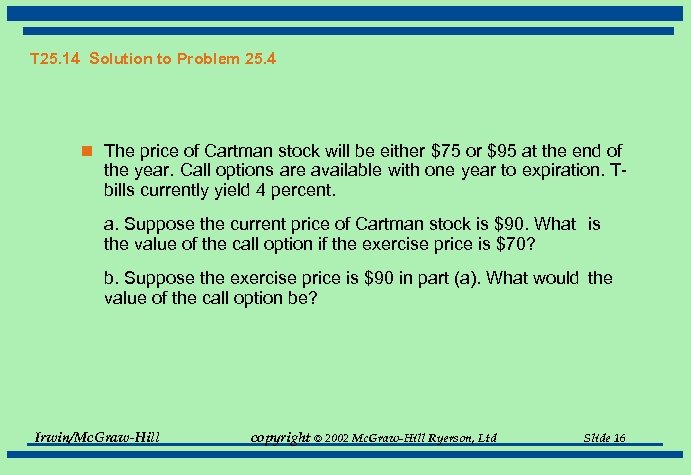 T 25. 14 Solution to Problem 25. 4 n The price of Cartman stock will be either $75 or $95 at the end of the year. Call options are available with one year to expiration. Tbills currently yield 4 percent. a. Suppose the current price of Cartman stock is $90. What is the value of the call option if the exercise price is $70? b. Suppose the exercise price is $90 in part (a). What would the value of the call option be? Irwin/Mc. Graw-Hill copyright © 2002 Mc. Graw-Hill Ryerson, Ltd Slide 16
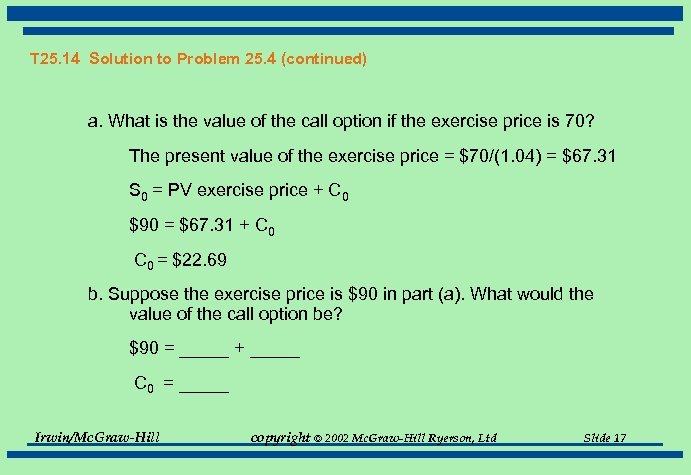 T 25. 14 Solution to Problem 25. 4 (continued) a. What is the value of the call option if the exercise price is 70? The present value of the exercise price = $70/(1. 04) = $67. 31 S 0 = PV exercise price + C 0 $90 = $67. 31 + C 0 = $22. 69 b. Suppose the exercise price is $90 in part (a). What would the value of the call option be? $90 = _____ + _____ C 0 = _____ Irwin/Mc. Graw-Hill copyright © 2002 Mc. Graw-Hill Ryerson, Ltd Slide 17
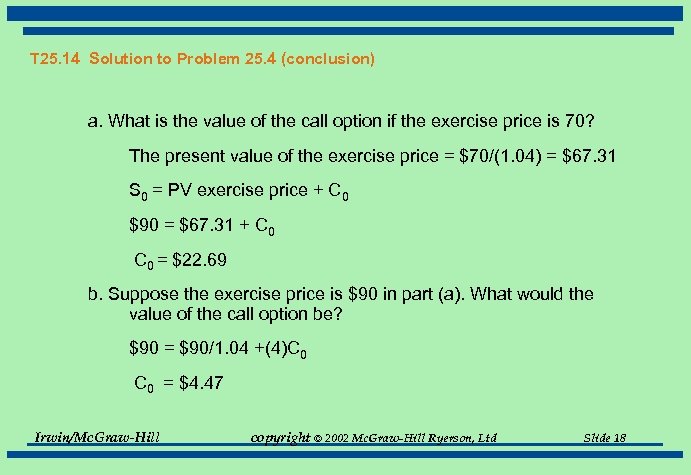 T 25. 14 Solution to Problem 25. 4 (conclusion) a. What is the value of the call option if the exercise price is 70? The present value of the exercise price = $70/(1. 04) = $67. 31 S 0 = PV exercise price + C 0 $90 = $67. 31 + C 0 = $22. 69 b. Suppose the exercise price is $90 in part (a). What would the value of the call option be? $90 = $90/1. 04 +(4)C 0 = $4. 47 Irwin/Mc. Graw-Hill copyright © 2002 Mc. Graw-Hill Ryerson, Ltd Slide 18
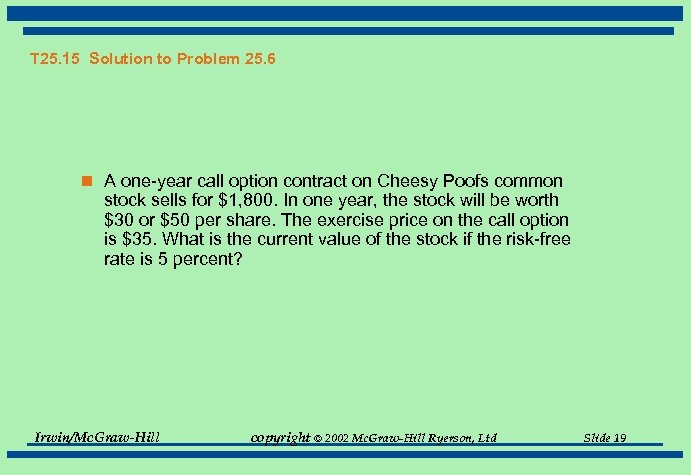 T 25. 15 Solution to Problem 25. 6 n A one-year call option contract on Cheesy Poofs common stock sells for $1, 800. In one year, the stock will be worth $30 or $50 per share. The exercise price on the call option is $35. What is the current value of the stock if the risk-free rate is 5 percent? Irwin/Mc. Graw-Hill copyright © 2002 Mc. Graw-Hill Ryerson, Ltd Slide 19
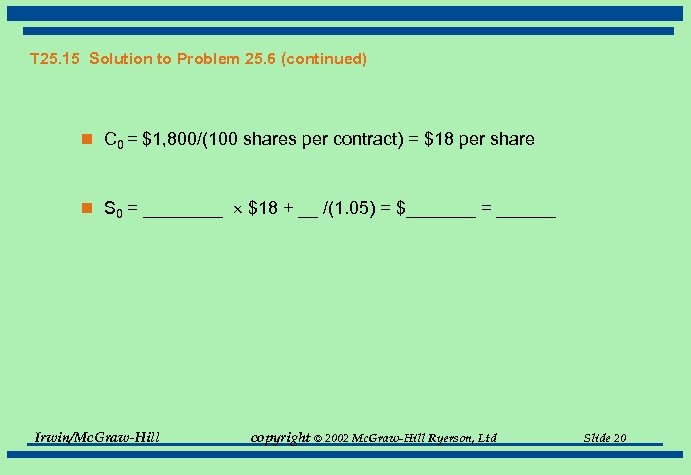 T 25. 15 Solution to Problem 25. 6 (continued) n C 0 = $1, 800/(100 shares per contract) = $18 per share n S 0 = ____ $18 + __ /(1. 05) = $_______ = ______ Irwin/Mc. Graw-Hill copyright © 2002 Mc. Graw-Hill Ryerson, Ltd Slide 20
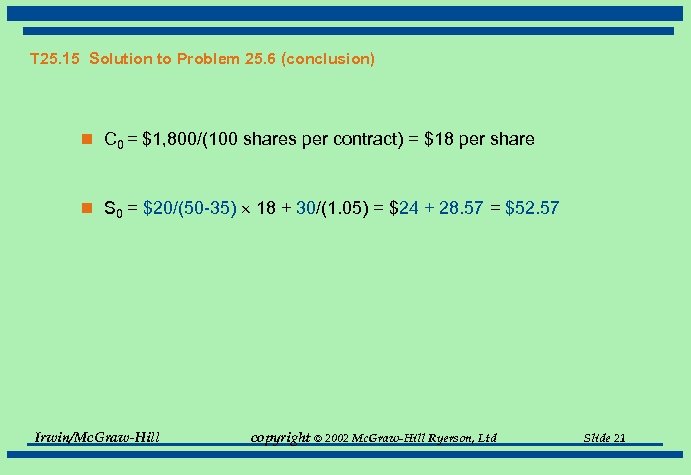 T 25. 15 Solution to Problem 25. 6 (conclusion) n C 0 = $1, 800/(100 shares per contract) = $18 per share n S 0 = $20/(50 -35) 18 + 30/(1. 05) = $24 + 28. 57 = $52. 57 Irwin/Mc. Graw-Hill copyright © 2002 Mc. Graw-Hill Ryerson, Ltd Slide 21