


 Скачать презентацию T 21 1 Chapter Outline Chapter 21 International
c5abccae76bb3e6a3c5fd196ae84a60a.ppt
- Количество слайдов: 26
 T 21. 1 Chapter Outline Chapter 21 International Corporate Finance Chapter Organization n 21. 1 Terminology n 21. 2 Foreign Exchange Markets and Exchange Rates n 21. 3 Purchasing Power Parity n 21. 4 Interest Rate Parity, Unbiased Forward Rates, and the International Fisher Effect n 21. 5 International Capital Budgeting n 21. 6 Financing International Projects n 21. 7 Exchange Rate Risk n 21. 8 Political Risk n 21. 9 Summary and Conclusions Irwin/Mc. Graw-Hill CLICK MOUSE OR HIT SPACEBAR TO ADVANCE copyright © 2002 Mc. Graw-Hill Ryerson, Ltd.
 T 21. 2 Domestic Financial Management and International Financial Management n Domestic financial management and international financial management differ in several important ways: u Whenever transactions involve more than one currency, one must be concerned with the levels of, and possible changes in, exchange rates. u Another risk that must be considered is the risk of loss associated with actions taken by foreign governments. This political risk can be difficult to assess, and difficult to hedge against; u Financing opportunities encompass international capital markets and instruments, which can reduce the firm’s cost of capital. Irwin/Mc. Graw-Hill copyright © 2002 Mc. Graw-Hill Ryerson, Ltd Slide 2
 T 21. 3 International Finance Terminology n Belgian dentist: Stereotypical investor in Eurobonds interested in bonds denominated in foreign currencies that are unregistered (untraceable) and thus essentially tax-free. n Cross-Rate: The implicit exchange rate between two currencies (usually non-U. S. ) quoted in some third currency (usually the U. S. dollar). n Eurobonds: International bonds issued in multiple countries but denominated in a single currency (usually the issuer’s currency). n Eurocurrency: Money deposited in a financial center outside of the country whose currency is involved. Irwin/Mc. Graw-Hill copyright © 2002 Mc. Graw-Hill Ryerson, Ltd Slide 3
 T 21. 3 International Finance Terminology (concluded) n Foreign Bonds: International bonds issued in a single country, usually denominated in that country’s currency. n Foreign Exchange Market: The market in which one country’s currency is traded for another. n Gilts: British and Irish government securities. n London Interbank Offer Rate (LIBOR): The rate most international banks charge one another for overnight Eurodollar loans. n Swaps: Agreements to exchange two securities or similar currencies. n Export Development Corporation (EDC): a federal Crown corporation with a mandate to promote Canadian exports. It does this in several ways, some examples of which are: u providing financing foreign companies that purchase Canadian exports, u insuring exporter receivables and u providing coverage against loss of assets due to political risks abroad. Irwin/Mc. Graw-Hill copyright © 2002 Mc. Graw-Hill Ryerson, Ltd Slide 4
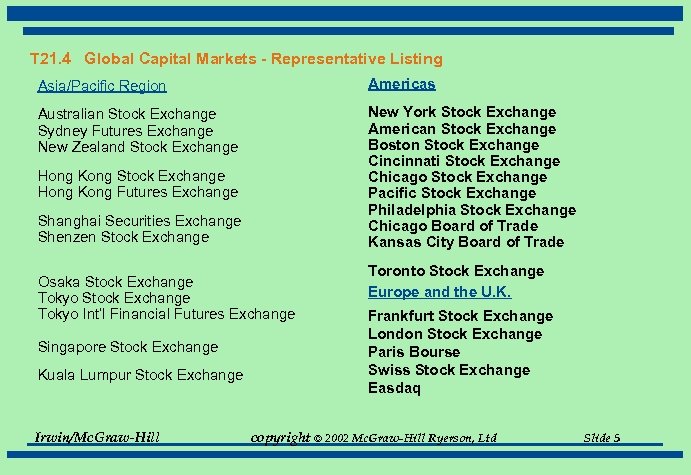 T 21. 4 Global Capital Markets - Representative Listing Asia/Pacific Region Americas Australian Stock Exchange Sydney Futures Exchange New Zealand Stock Exchange New York Stock Exchange American Stock Exchange Boston Stock Exchange Cincinnati Stock Exchange Chicago Stock Exchange Pacific Stock Exchange Philadelphia Stock Exchange Chicago Board of Trade Kansas City Board of Trade Hong Kong Stock Exchange Hong Kong Futures Exchange Shanghai Securities Exchange Shenzen Stock Exchange Osaka Stock Exchange Tokyo Int’l Financial Futures Exchange Singapore Stock Exchange Kuala Lumpur Stock Exchange Irwin/Mc. Graw-Hill Toronto Stock Exchange Europe and the U. K. Frankfurt Stock Exchange London Stock Exchange Paris Bourse Swiss Stock Exchange Easdaq copyright © 2002 Mc. Graw-Hill Ryerson, Ltd Slide 5
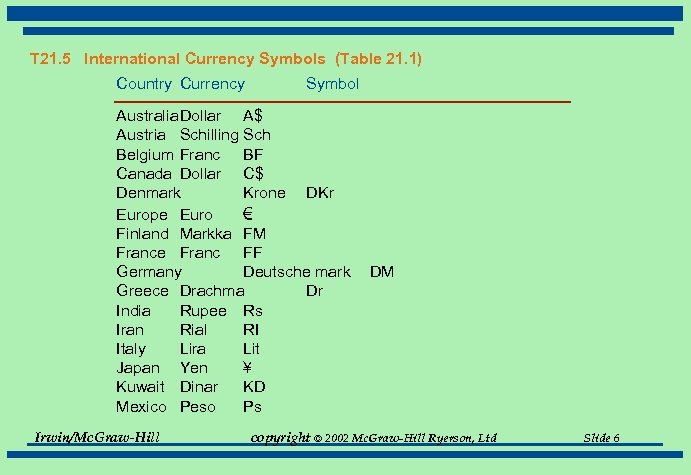 T 21. 5 International Currency Symbols (Table 21. 1) Country Currency Symbol Australia. Dollar A$ Austria Schilling Sch Belgium Franc BF Canada Dollar C$ Denmark Krone DKr Europe Euro € Finland Markka FM France Franc FF Germany Deutsche mark Greece Drachma Dr India Rupee Rs Iran Rial RI Italy Lira Lit Japan Yen ¥ Kuwait Dinar KD Mexico Peso Ps Irwin/Mc. Graw-Hill DM copyright © 2002 Mc. Graw-Hill Ryerson, Ltd Slide 6
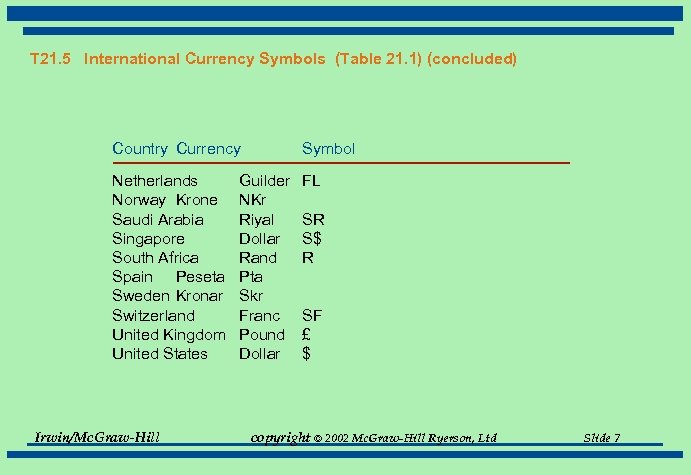 T 21. 5 International Currency Symbols (Table 21. 1) (concluded) Country Currency Symbol Netherlands Norway Krone Saudi Arabia Singapore South Africa Spain Peseta Sweden Kronar Switzerland United Kingdom United States FL Irwin/Mc. Graw-Hill Guilder NKr Riyal Dollar Rand Pta Skr Franc Pound Dollar SR S$ R SF £ $ copyright © 2002 Mc. Graw-Hill Ryerson, Ltd Slide 7
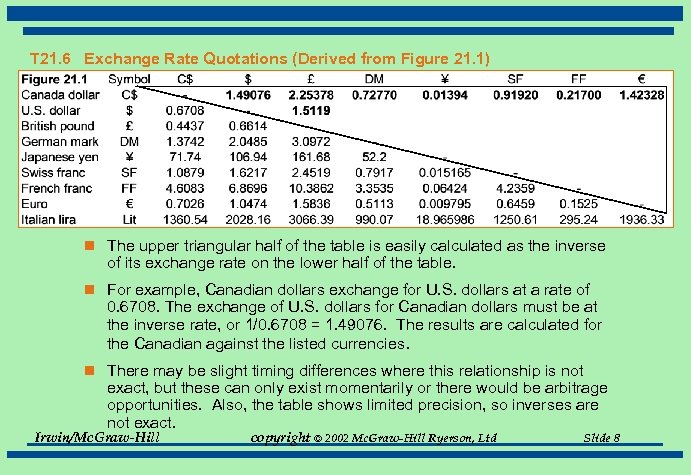 T 21. 6 Exchange Rate Quotations (Derived from Figure 21. 1) n The upper triangular half of the table is easily calculated as the inverse of its exchange rate on the lower half of the table. n For example, Canadian dollars exchange for U. S. dollars at a rate of 0. 6708. The exchange of U. S. dollars for Canadian dollars must be at the inverse rate, or 1/0. 6708 = 1. 49076. The results are calculated for the Canadian against the listed currencies. n There may be slight timing differences where this relationship is not exact, but these can only exist momentarily or there would be arbitrage opportunities. Also, the table shows limited precision, so inverses are not exact. Irwin/Mc. Graw-Hill copyright © 2002 Mc. Graw-Hill Ryerson, Ltd Slide 8
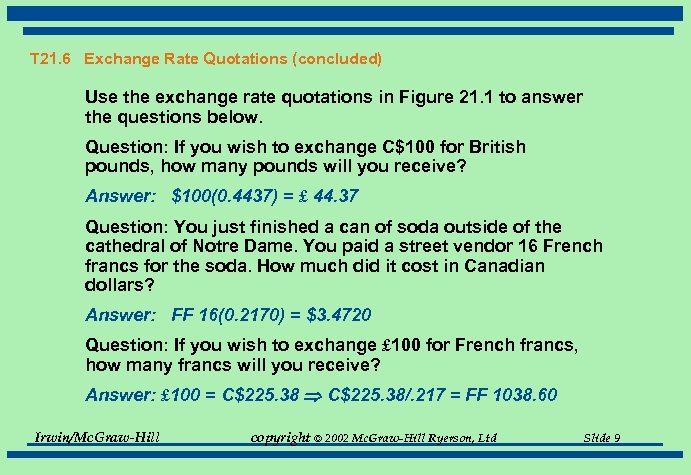 T 21. 6 Exchange Rate Quotations (concluded) Use the exchange rate quotations in Figure 21. 1 to answer the questions below. Question: If you wish to exchange C$100 for British pounds, how many pounds will you receive? Answer: $100(0. 4437) = £ 44. 37 Question: You just finished a can of soda outside of the cathedral of Notre Dame. You paid a street vendor 16 French francs for the soda. How much did it cost in Canadian dollars? Answer: FF 16(0. 2170) = $3. 4720 Question: If you wish to exchange £ 100 for French francs, how many francs will you receive? Answer: £ 100 = C$225. 38/. 217 = FF 1038. 60 Irwin/Mc. Graw-Hill copyright © 2002 Mc. Graw-Hill Ryerson, Ltd Slide 9
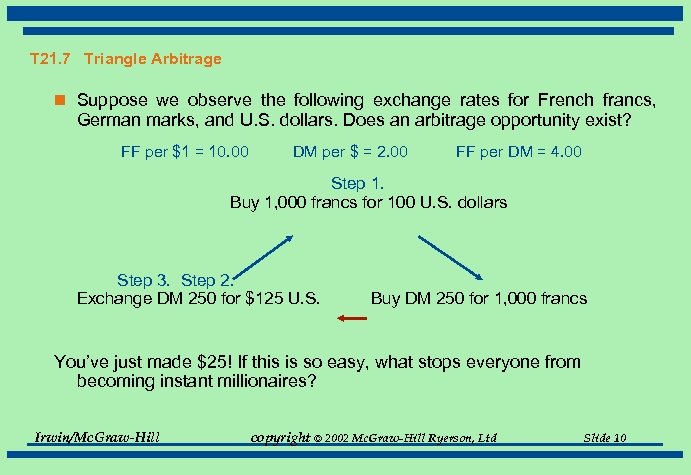 T 21. 7 Triangle Arbitrage n Suppose we observe the following exchange rates for French francs, German marks, and U. S. dollars. Does an arbitrage opportunity exist? FF per $1 = 10. 00 DM per $ = 2. 00 FF per DM = 4. 00 Step 1. Buy 1, 000 francs for 100 U. S. dollars Step 3. Step 2. Exchange DM 250 for $125 U. S. Buy DM 250 for 1, 000 francs You’ve just made $25! If this is so easy, what stops everyone from becoming instant millionaires? Irwin/Mc. Graw-Hill copyright © 2002 Mc. Graw-Hill Ryerson, Ltd Slide 10
 T 21. 8 Types of Transactions n Spot trade An agreement to trade currencies based on the exchange rate today for settlement within two business days n Spot exchange rate The exchange rate on a spot trade n Forward trade An agreement to exchange currency at some time in the future n Forward exchange rate The agreed-upon exchange rate to be used in a forward trade Irwin/Mc. Graw-Hill copyright © 2002 Mc. Graw-Hill Ryerson, Ltd Slide 11
 T 21. 9 Purchasing Power Parity n Purchasing power parity (PPP) The idea that the exchange rate adjusts to keep purchasing power constant among currencies. n Absolute PPP Under absolute PPP, a commodity costs the same regardless of what currency is used to purchase it or where it is selling. For example. , under absolute PPP, a beer will cost you the same price regardless of what country it is purchased in. n For absolute PPP to hold Transactions costs must be zero No barriers to trade (tariffs, taxes, duties, etc. ) Item purchased must be identical in all locations Irwin/Mc. Graw-Hill copyright © 2002 Mc. Graw-Hill Ryerson, Ltd Slide 12
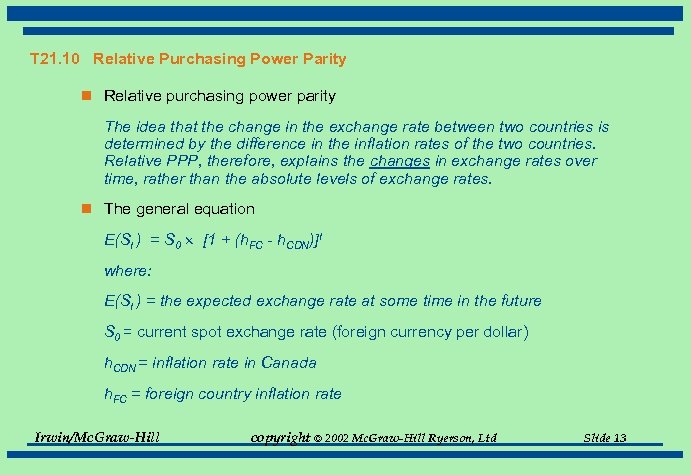 T 21. 10 Relative Purchasing Power Parity n Relative purchasing power parity The idea that the change in the exchange rate between two countries is determined by the difference in the inflation rates of the two countries. Relative PPP, therefore, explains the changes in exchange rates over time, rather than the absolute levels of exchange rates. n The general equation E(St ) = S 0 [1 + (h. FC - h. CDN)]t where: E(St ) = the expected exchange rate at some time in the future S 0 = current spot exchange rate (foreign currency per dollar) h. CDN = inflation rate in Canada h. FC = foreign country inflation rate Irwin/Mc. Graw-Hill copyright © 2002 Mc. Graw-Hill Ryerson, Ltd Slide 13
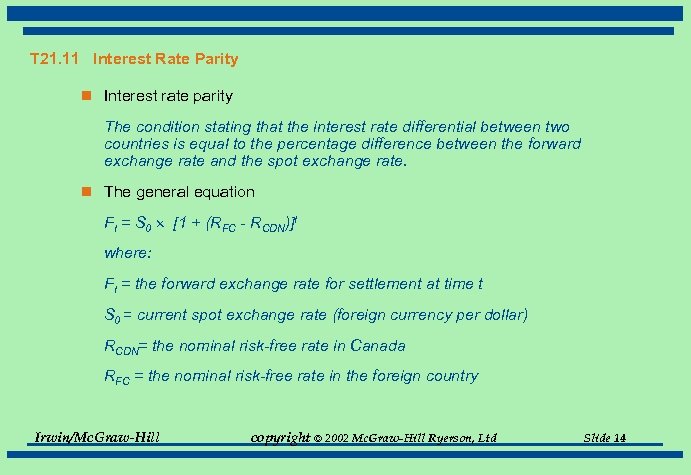 T 21. 11 Interest Rate Parity n Interest rate parity The condition stating that the interest rate differential between two countries is equal to the percentage difference between the forward exchange rate and the spot exchange rate. n The general equation Ft = S 0 [1 + (RFC - RCDN)]t where: Ft = the forward exchange rate for settlement at time t S 0 = current spot exchange rate (foreign currency per dollar) RCDN= the nominal risk-free rate in Canada RFC = the nominal risk-free rate in the foreign country Irwin/Mc. Graw-Hill copyright © 2002 Mc. Graw-Hill Ryerson, Ltd Slide 14
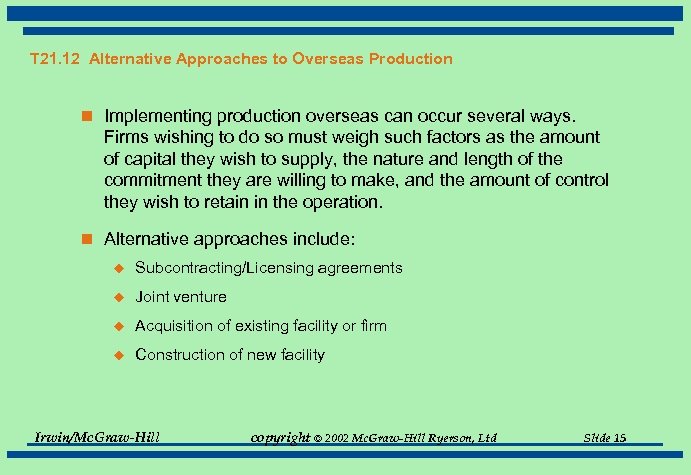 T 21. 12 Alternative Approaches to Overseas Production n Implementing production overseas can occur several ways. Firms wishing to do so must weigh such factors as the amount of capital they wish to supply, the nature and length of the commitment they are willing to make, and the amount of control they wish to retain in the operation. n Alternative approaches include: u Subcontracting/Licensing agreements u Joint venture u Acquisition of existing facility or firm u Construction of new facility Irwin/Mc. Graw-Hill copyright © 2002 Mc. Graw-Hill Ryerson, Ltd Slide 15
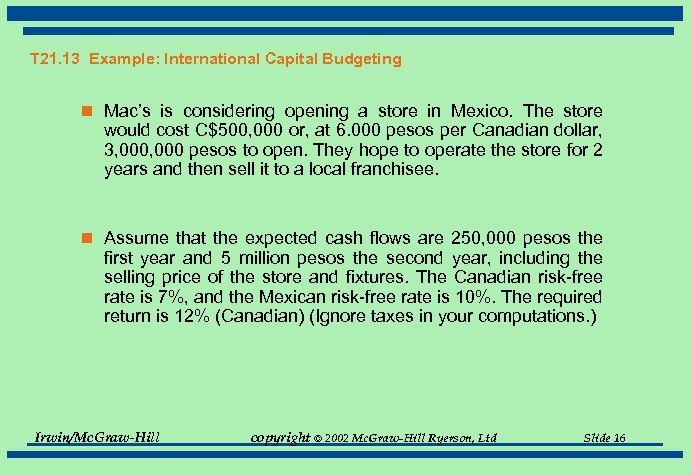 T 21. 13 Example: International Capital Budgeting n Mac’s is considering opening a store in Mexico. The store would cost C$500, 000 or, at 6. 000 pesos per Canadian dollar, 3, 000 pesos to open. They hope to operate the store for 2 years and then sell it to a local franchisee. n Assume that the expected cash flows are 250, 000 pesos the first year and 5 million pesos the second year, including the selling price of the store and fixtures. The Canadian risk-free rate is 7%, and the Mexican risk-free rate is 10%. The required return is 12% (Canadian) (Ignore taxes in your computations. ) Irwin/Mc. Graw-Hill copyright © 2002 Mc. Graw-Hill Ryerson, Ltd Slide 16
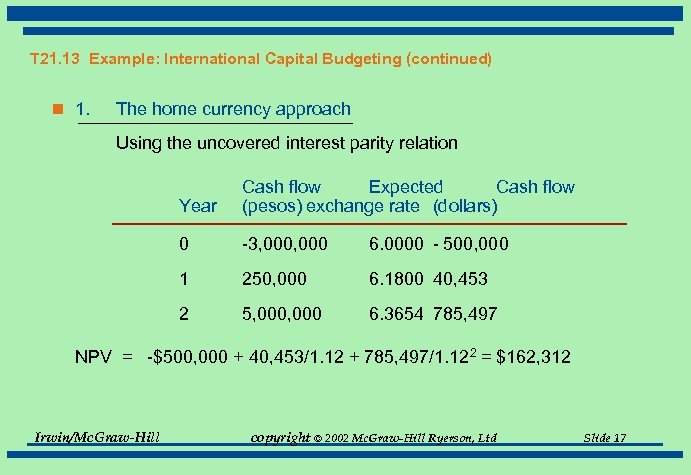 T 21. 13 Example: International Capital Budgeting (continued) n 1. The home currency approach Using the uncovered interest parity relation Year Cash flow Expected Cash flow (pesos) exchange rate (dollars) 0 -3, 000 6. 0000 - 500, 000 1 250, 000 6. 1800 40, 453 2 5, 000 6. 3654 785, 497 NPV = -$500, 000 + 40, 453/1. 12 + 785, 497/1. 122 = $162, 312 Irwin/Mc. Graw-Hill copyright © 2002 Mc. Graw-Hill Ryerson, Ltd Slide 17
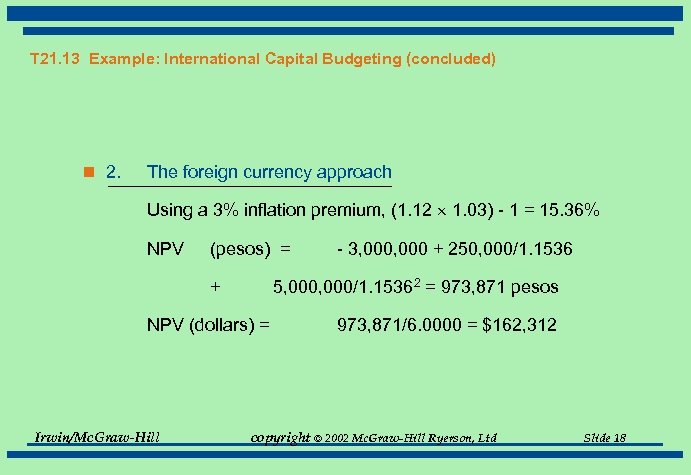 T 21. 13 Example: International Capital Budgeting (concluded) n 2. The foreign currency approach Using a 3% inflation premium, (1. 12 1. 03) - 1 = 15. 36% NPV (pesos) = 5, 000/1. 15362 = 973, 871 pesos + NPV (dollars) = Irwin/Mc. Graw-Hill - 3, 000 + 250, 000/1. 1536 973, 871/6. 0000 = $162, 312 copyright © 2002 Mc. Graw-Hill Ryerson, Ltd Slide 18
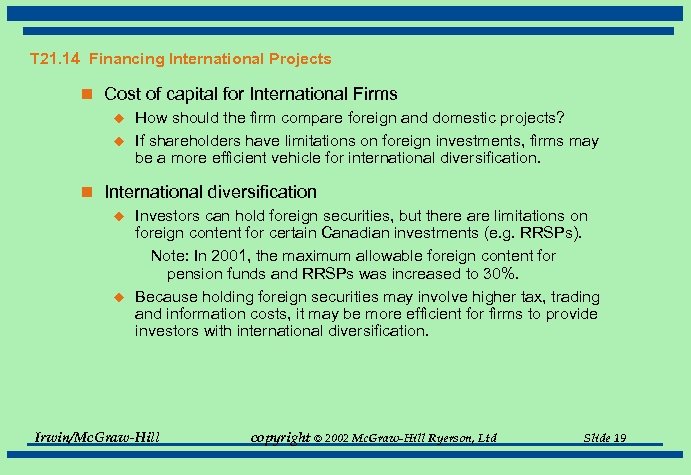 T 21. 14 Financing International Projects n Cost of capital for International Firms u How should the firm compare foreign and domestic projects? u If shareholders have limitations on foreign investments, firms may be a more efficient vehicle for international diversification. n International diversification u Investors can hold foreign securities, but there are limitations on foreign content for certain Canadian investments (e. g. RRSPs). Note: In 2001, the maximum allowable foreign content for pension funds and RRSPs was increased to 30%. u Because holding foreign securities may involve higher tax, trading and information costs, it may be more efficient for firms to provide investors with international diversification. Irwin/Mc. Graw-Hill copyright © 2002 Mc. Graw-Hill Ryerson, Ltd Slide 19
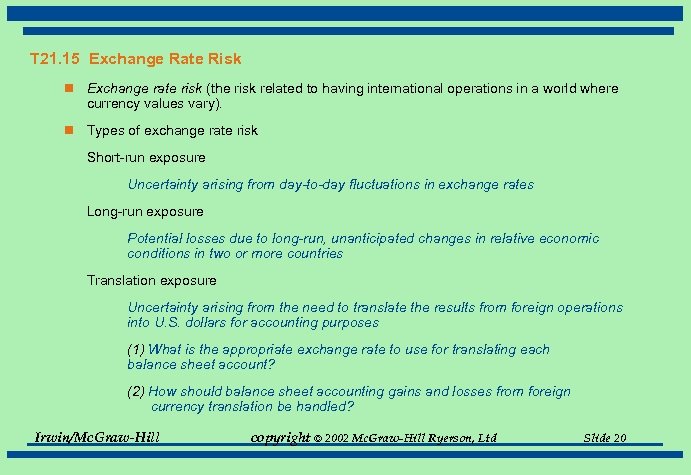 T 21. 15 Exchange Rate Risk n Exchange rate risk (the risk related to having international operations in a world where currency values vary). n Types of exchange rate risk Short-run exposure Uncertainty arising from day-to-day fluctuations in exchange rates Long-run exposure Potential losses due to long-run, unanticipated changes in relative economic conditions in two or more countries Translation exposure Uncertainty arising from the need to translate the results from foreign operations into U. S. dollars for accounting purposes (1) What is the appropriate exchange rate to use for translating each balance sheet account? (2) How should balance sheet accounting gains and losses from foreign currency translation be handled? Irwin/Mc. Graw-Hill copyright © 2002 Mc. Graw-Hill Ryerson, Ltd Slide 20
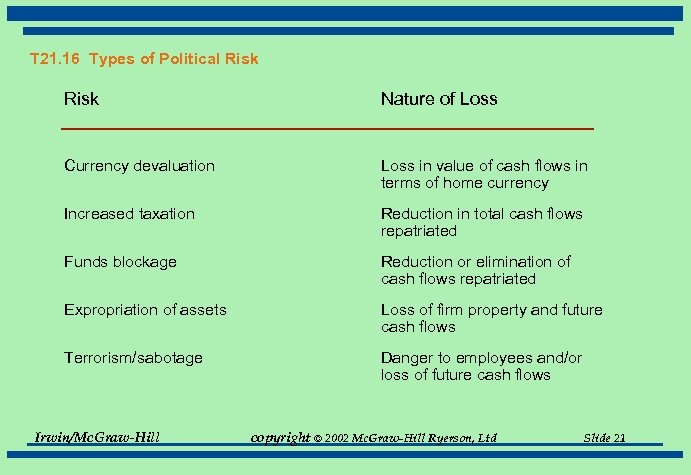 T 21. 16 Types of Political Risk Nature of Loss Currency devaluation Loss in value of cash flows in terms of home currency Increased taxation Reduction in total cash flows repatriated Funds blockage Reduction or elimination of cash flows repatriated Expropriation of assets Loss of firm property and future cash flows Terrorism/sabotage Danger to employees and/or loss of future cash flows Irwin/Mc. Graw-Hill copyright © 2002 Mc. Graw-Hill Ryerson, Ltd Slide 21
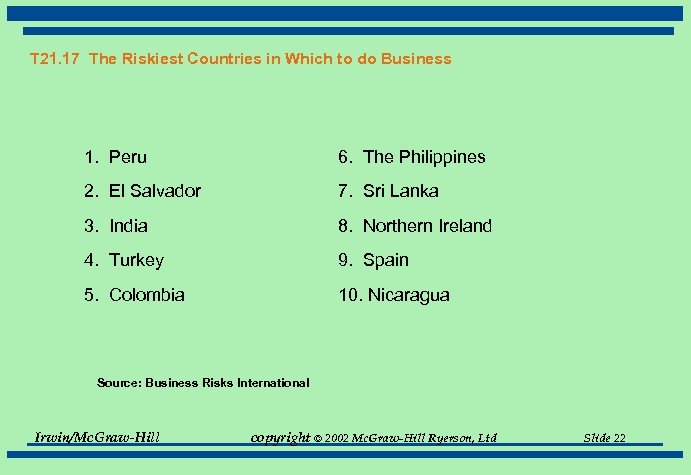 T 21. 17 The Riskiest Countries in Which to do Business 1. Peru 6. The Philippines 2. El Salvador 7. Sri Lanka 3. India 8. Northern Ireland 4. Turkey 9. Spain 5. Colombia 10. Nicaragua Source: Business Risks International Irwin/Mc. Graw-Hill copyright © 2002 Mc. Graw-Hill Ryerson, Ltd Slide 22
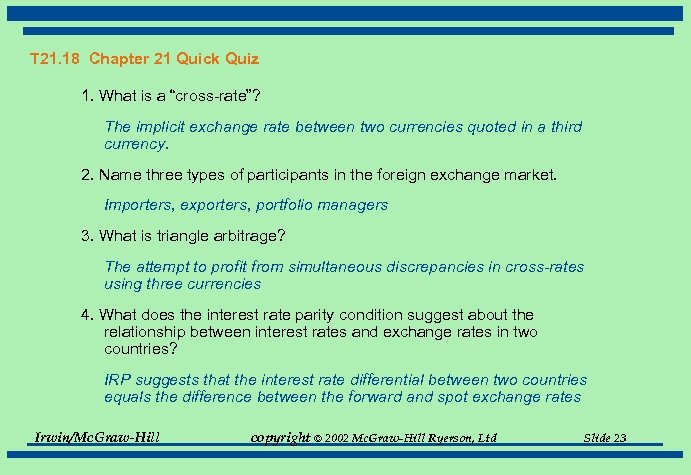 T 21. 18 Chapter 21 Quick Quiz 1. What is a “cross-rate”? The implicit exchange rate between two currencies quoted in a third currency. 2. Name three types of participants in the foreign exchange market. Importers, exporters, portfolio managers 3. What is triangle arbitrage? The attempt to profit from simultaneous discrepancies in cross-rates using three currencies 4. What does the interest rate parity condition suggest about the relationship between interest rates and exchange rates in two countries? IRP suggests that the interest rate differential between two countries equals the difference between the forward and spot exchange rates Irwin/Mc. Graw-Hill copyright © 2002 Mc. Graw-Hill Ryerson, Ltd Slide 23
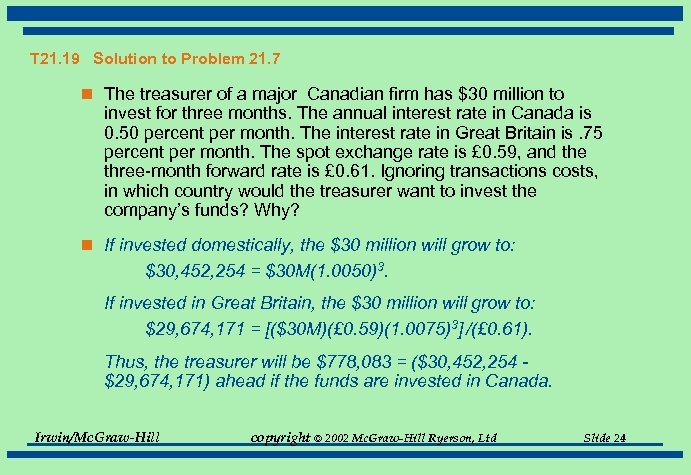 T 21. 19 Solution to Problem 21. 7 n The treasurer of a major Canadian firm has $30 million to invest for three months. The annual interest rate in Canada is 0. 50 percent per month. The interest rate in Great Britain is. 75 percent per month. The spot exchange rate is £ 0. 59, and the three-month forward rate is £ 0. 61. Ignoring transactions costs, in which country would the treasurer want to invest the company’s funds? Why? n If invested domestically, the $30 million will grow to: $30, 452, 254 = $30 M(1. 0050)3. If invested in Great Britain, the $30 million will grow to: $29, 674, 171 = [($30 M)(£ 0. 59)(1. 0075)3] /(£ 0. 61). Thus, the treasurer will be $778, 083 = ($30, 452, 254 $29, 674, 171) ahead if the funds are invested in Canada. Irwin/Mc. Graw-Hill copyright © 2002 Mc. Graw-Hill Ryerson, Ltd Slide 24
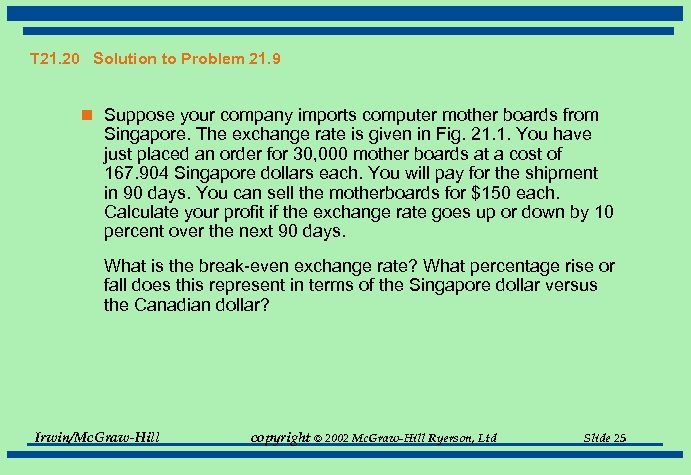 T 21. 20 Solution to Problem 21. 9 n Suppose your company imports computer mother boards from Singapore. The exchange rate is given in Fig. 21. 1. You have just placed an order for 30, 000 mother boards at a cost of 167. 904 Singapore dollars each. You will pay for the shipment in 90 days. You can sell the motherboards for $150 each. Calculate your profit if the exchange rate goes up or down by 10 percent over the next 90 days. What is the break-even exchange rate? What percentage rise or fall does this represent in terms of the Singapore dollar versus the Canadian dollar? Irwin/Mc. Graw-Hill copyright © 2002 Mc. Graw-Hill Ryerson, Ltd Slide 25
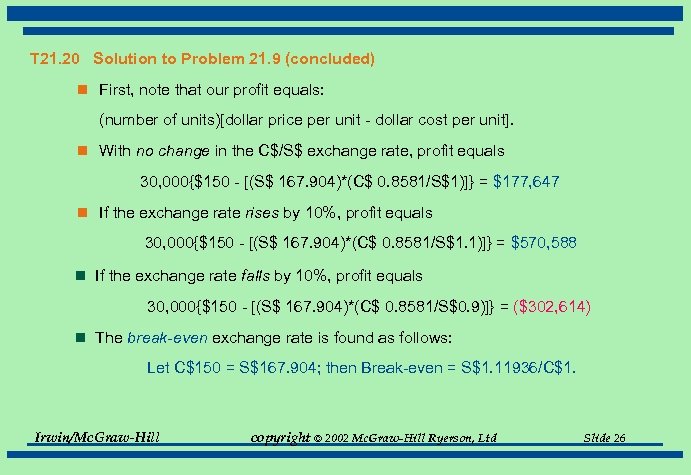 T 21. 20 Solution to Problem 21. 9 (concluded) n First, note that our profit equals: (number of units)[dollar price per unit - dollar cost per unit]. n With no change in the C$/S$ exchange rate, profit equals 30, 000{$150 - [(S$ 167. 904)*(C$ 0. 8581/S$1)]} = $177, 647 n If the exchange rate rises by 10%, profit equals 30, 000{$150 - [(S$ 167. 904)*(C$ 0. 8581/S$1. 1)]} = $570, 588 n If the exchange rate falls by 10%, profit equals 30, 000{$150 - [(S$ 167. 904)*(C$ 0. 8581/S$0. 9)]} = ($302, 614) n The break-even exchange rate is found as follows: Let C$150 = S$167. 904; then Break-even = S$1. 11936/C$1. Irwin/Mc. Graw-Hill copyright © 2002 Mc. Graw-Hill Ryerson, Ltd Slide 26