 Скачать презентацию Systems with Assurance Evaluation Auditing Lecture 10 November
31a047f3414bce6b1d43994708523d3c.ppt
- Количество слайдов: 86



Systems with Assurance Evaluation Auditing Lecture 10 November 6, 2003 Courtesy of Professors Chris Clifton & Matt Bishop INFSCI 2935: Introduction of Computer Security 1
Threats and Vulnerabilities l Threat ¡ A potential occurrence that can have an undesirable effect on the system assets of resources l l Results in breaches in confidentiality, integrity, or a denial of service Example: outsider penetrating a system is an outsider threat (insider threat? ) Need to identify all possible threats and address them to generate security objectives Vulnerability l A weakness that makes it possible for a threat to occur INFSCI 2935: Introduction to Computer Security 2
Architectural considerations l Determine the focus of control of security enforcement mechanism ¡ Operating system: focus is on data ¡ Applications: more on operations/transactions l Centralized or Distributed ¡ Distribute them among systems/components ¡ Tradeoffs? ¡ Generally easier to “assure” centralized system l Security mechanism may exist in any layer INFSCI 2935: Introduction to Computer Security 3
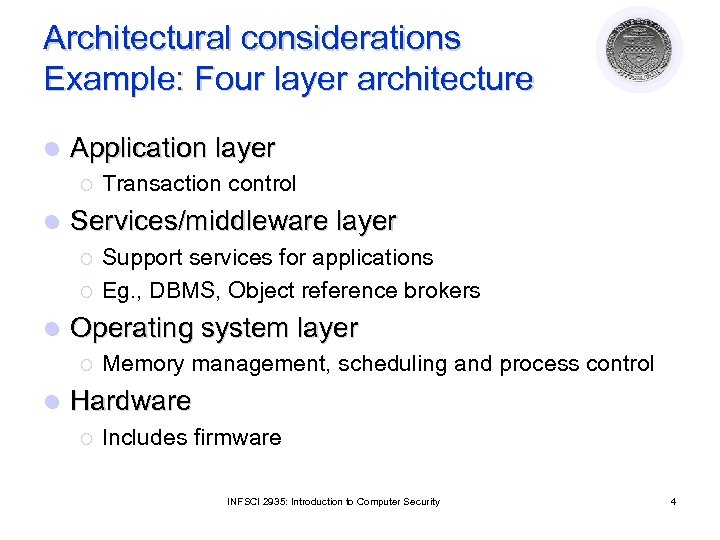
Architectural considerations Example: Four layer architecture l Application layer ¡ l Services/middleware layer ¡ ¡ l Support services for applications Eg. , DBMS, Object reference brokers Operating system layer ¡ l Transaction control Memory management, scheduling and process control Hardware ¡ Includes firmware INFSCI 2935: Introduction to Computer Security 4
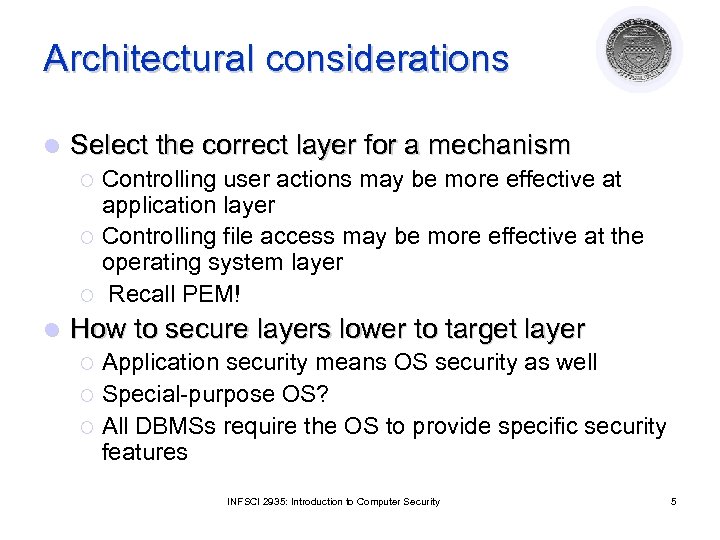
Architectural considerations l Select the correct layer for a mechanism Controlling user actions may be more effective at application layer ¡ Controlling file access may be more effective at the operating system layer ¡ Recall PEM! ¡ l How to secure layers lower to target layer Application security means OS security as well ¡ Special-purpose OS? ¡ All DBMSs require the OS to provide specific security features ¡ INFSCI 2935: Introduction to Computer Security 5
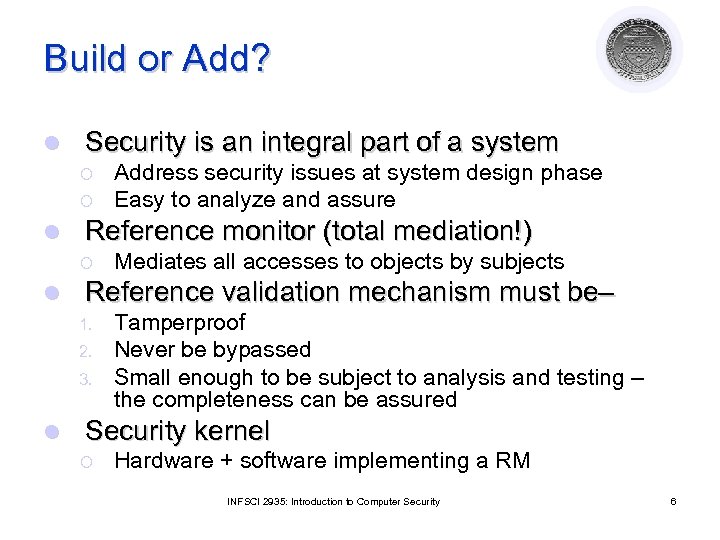
Build or Add? l Security is an integral part of a system ¡ ¡ l Reference monitor (total mediation!) ¡ l Mediates all accesses to objects by subjects Reference validation mechanism must be– 1. 2. 3. l Address security issues at system design phase Easy to analyze and assure Tamperproof Never be bypassed Small enough to be subject to analysis and testing – the completeness can be assured Security kernel ¡ Hardware + software implementing a RM INFSCI 2935: Introduction to Computer Security 6
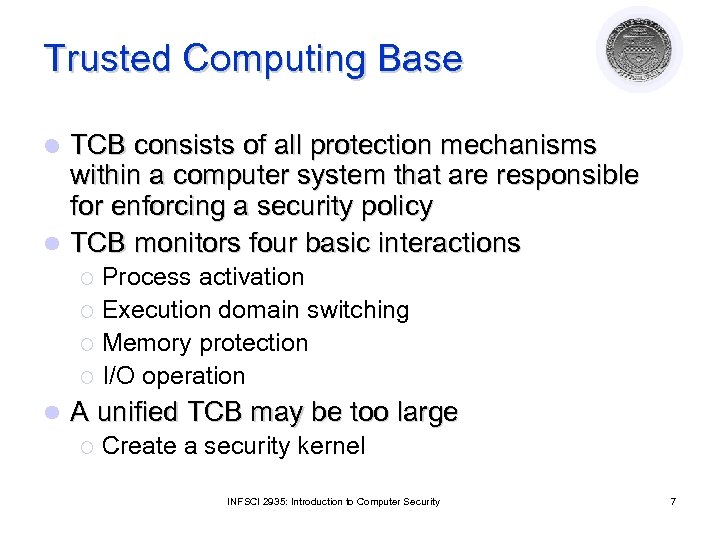
Trusted Computing Base TCB consists of all protection mechanisms within a computer system that are responsible for enforcing a security policy l TCB monitors four basic interactions l Process activation ¡ Execution domain switching ¡ Memory protection ¡ I/O operation ¡ l A unified TCB may be too large ¡ Create a security kernel INFSCI 2935: Introduction to Computer Security 7
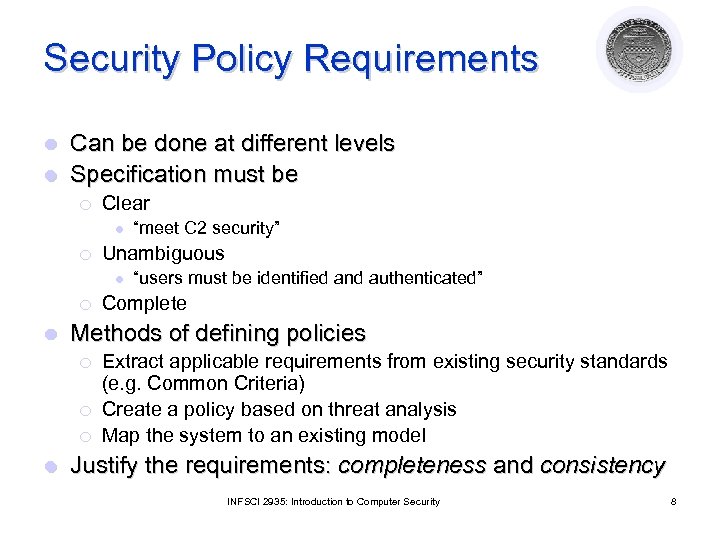
Security Policy Requirements Can be done at different levels l Specification must be l ¡ Clear l ¡ Unambiguous l ¡ l “users must be identified and authenticated” Complete Methods of defining policies ¡ ¡ ¡ l “meet C 2 security” Extract applicable requirements from existing security standards (e. g. Common Criteria) Create a policy based on threat analysis Map the system to an existing model Justify the requirements: completeness and consistency INFSCI 2935: Introduction to Computer Security 8
Design assurance l Identify design flaws ¡ Enhances trustworthiness ¡ Supports implementation and operational assurance l Design assurance technique employs ¡ Specification of requirements ¡ Specification of the system design ¡ Process to examine how well the design meets the requirement INFSCI 2935: Introduction to Computer Security 9
Techniques for Design Assurance l Modularity & Layering ¡ ¡ l Different layers to capture different levels of abstraction ¡ ¡ ¡ l Well defined independent modules Simplifies and makes system more understandable Data hiding Easy to understand analyze Subsystem (memory management, I/O subsystem, creditcard processing function) Subcomponent (I/O management, I/O drivers) Module: set of related functions and data structure Use principles of secure design INFSCI 2935: Introduction to Computer Security 10
Design Documents Design documentation is an important component in life cycle models l Documentation must specify l ¡ Security functions and approach l l l ¡ External interfaces used by users l l ¡ Describe each security function Overview of a set of security functions Map to requirements (tabular) Parameters, syntax, security constraints and error conditions Component overview, data descriptions, interface description Internal design with low-level details l l l Overview of the component Detailed description of the component Security relevance of the component INFSCI 2935: Introduction to Computer Security 11
Design meets requirements? l Techniques needed ¡ l Requirements tracing ¡ l To prevent requirements and functionality from being discarded, forgotten, or ignored at lower levels of design Process of identifying specific security requirements that are met by parts of a description Informal Correspondence ¡ Process of showing that a specification is consistent with an adjacent level of specification INFSCI 2935: Introduction to Computer Security 12
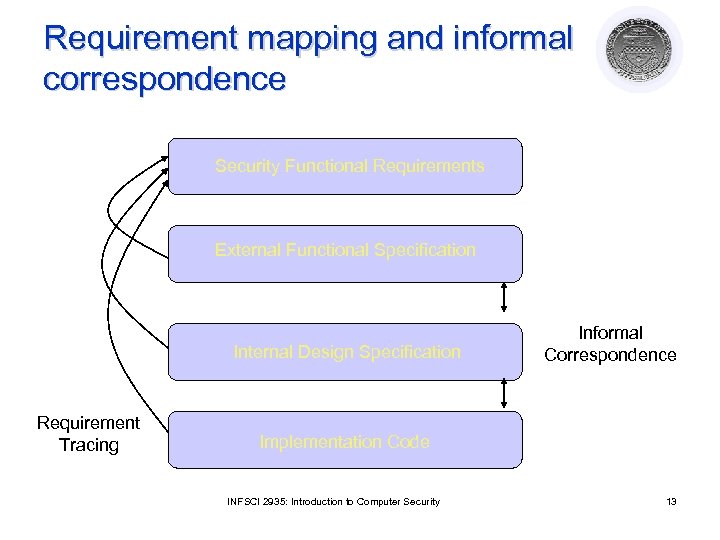
Requirement mapping and informal correspondence Security Functional Requirements External Functional Specification Internal Design Specification Requirement Tracing Informal Correspondence Implementation Code INFSCI 2935: Introduction to Computer Security 13
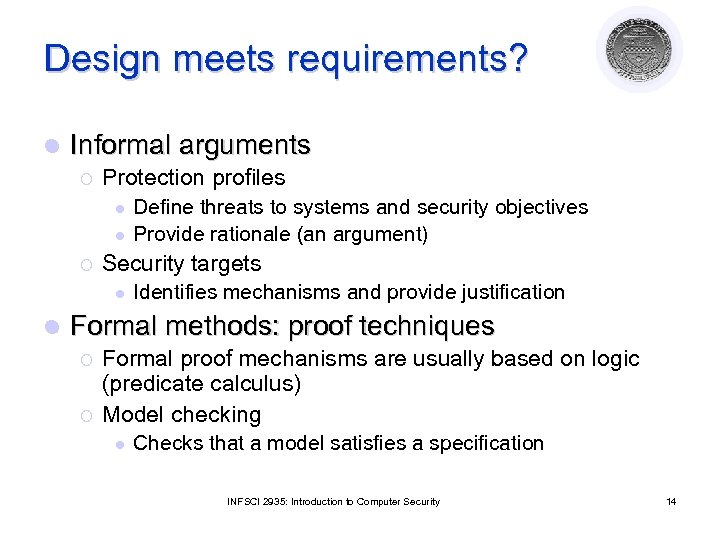
Design meets requirements? l Informal arguments ¡ Protection profiles l l ¡ Security targets l l Define threats to systems and security objectives Provide rationale (an argument) Identifies mechanisms and provide justification Formal methods: proof techniques ¡ ¡ Formal proof mechanisms are usually based on logic (predicate calculus) Model checking l Checks that a model satisfies a specification INFSCI 2935: Introduction to Computer Security 14
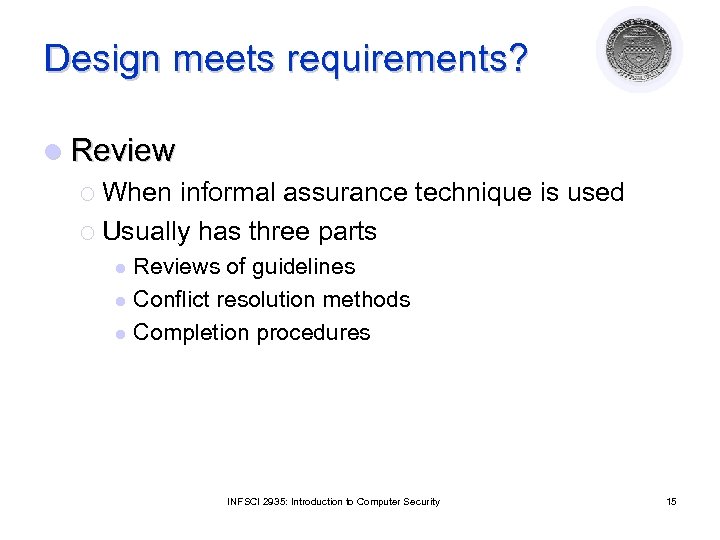
Design meets requirements? l Review ¡ When informal assurance technique is used ¡ Usually has three parts Reviews of guidelines l Conflict resolution methods l Completion procedures l INFSCI 2935: Introduction to Computer Security 15
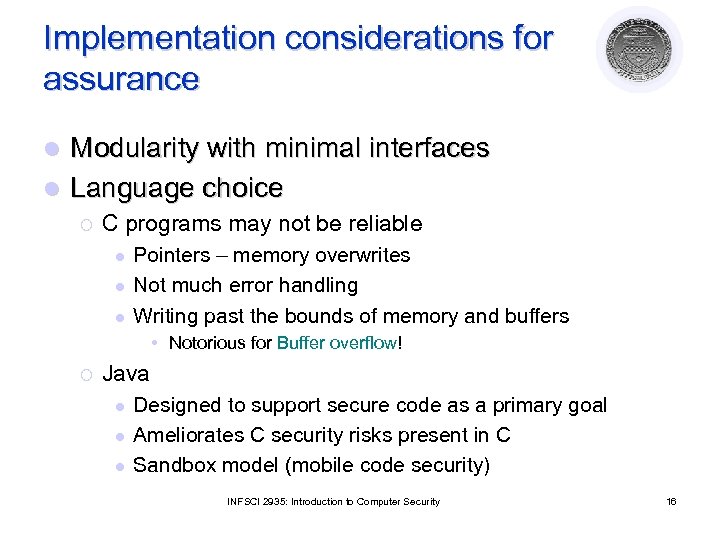
Implementation considerations for assurance Modularity with minimal interfaces l Language choice l ¡ C programs may not be reliable l l l Pointers – memory overwrites Not much error handling Writing past the bounds of memory and buffers • Notorious for Buffer overflow! ¡ Java l l l Designed to support secure code as a primary goal Ameliorates C security risks present in C Sandbox model (mobile code security) INFSCI 2935: Introduction to Computer Security 16
Assurance through Implementation management l Configuration management tools ¡ Control of the refinement and modification of configuration items such as source code, documentation etc. ¡ CM system functions Version control and tracking l Change authorization l Integration procedures l Tools for product generation l CVS? INFSCI 2935: Introduction to Computer Security 17
Implementation meets Design? l Security testing ¡ Functional testing (FT) (black box testing) l ¡ Structural testing (ST) (white box testing) l l Testing of an entity to determine how well it meets its specification Testing based on an analysis of the code to develop test cases Testing occurs at different times ¡ ¡ ¡ Unit testing (usually ST): testing a code module before integration System testing (FT): on integrated modules Security testing: product security l l l Security functional testing (against security issues) Security structural testing (security implementation) Security requirements testing INFSCI 2935: Introduction to Computer Security 18
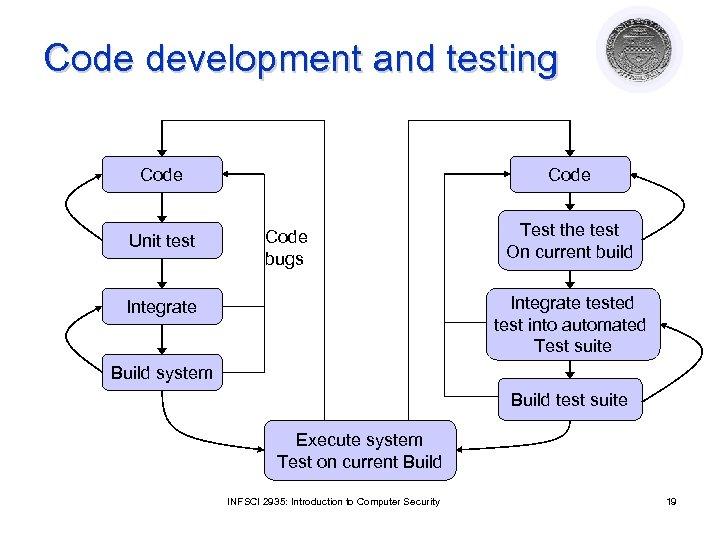
Code development and testing Code Unit test Code bugs Test the test On current build Integrate tested test into automated Test suite Integrate Build system Build test suite Execute system Test on current Build INFSCI 2935: Introduction to Computer Security 19
Operation and maintenance assurance l Bugs in operational phase need fixing l Hot fix ¡ Immediate fix ¡ Bugs are serous and critical l Regular fix ¡ Less serious bugs ¡ Long term solution after a hot fix INFSCI 2935: Introduction to Computer Security 20

Evaluation Courtesy of Professors Chris Clifton & Matt Bishop INFSCI 2935: Introduction of Computer Security 21
What is Formal Evaluation? l Method to achieve Trust ¡ l Evaluation methodology includes: ¡ ¡ l Not a guarantee of security Security requirements Assurance requirements showing how to establish security requirements met Procedures to demonstrate system meets requirements Metrics for results (level of trust) Examples: TCSEC (Orange Book), ITSEC, CC INFSCI 2935: Introduction to Computer Security 22
Formal Evaluation: Why? l Organizations require assurance ¡ ¡ ¡ Defense Telephone / Utilities “Mission Critical” systems Formal verification of entire systems not feasible l Instead, organizations develop formal evaluation methodologies l ¡ ¡ Products passing evaluation are trusted Required to do business with the organization INFSCI 2935: Introduction to Computer Security 23
TCSEC: The Original l Trusted Computer System Evaluation Criteria ¡ ¡ l l Policy model based on Bell-La. Padula Enforcement: Reference Validation Mechanism ¡ l l U. S. Government security evaluation criteria Used for evaluating commercial products Every reference checked by compact, analyzable body of code Emphasis on Confidentiality Metric: Seven trust levels: ¡ ¡ D, C 1, C 2, B 1, B 2, B 3, A 1 D is “tried but failed” INFSCI 2935: Introduction to Computer Security 24
TCSEC Class Assurances l C 1: Discretionary Protection ¡ ¡ ¡ l C 2: Controlled Access Protection ¡ l Identification Authentication Discretionary access control Object reuse and auditing B 1: Labeled security protection ¡ ¡ Mandatory access control on limited set of objects Informal model of the security policy INFSCI 2935: Introduction to Computer Security 25
TCSEC Class Assurances (continued) l B 2: Structured Protections ¡ ¡ ¡ l B 3: Security Domains ¡ ¡ ¡ l Trusted path for login Principle of Least Privilege Formal model of Security Policy Covert channel analysis Configuration management Full reference validation mechanism Constraints on code development process Documentation, testing requirements A 1: Verified Protection ¡ ¡ Formal methods for analysis, verification Trusted distribution INFSCI 2935: Introduction to Computer Security 26
How is Evaluation Done? l Government-sponsored independent evaluators ¡ Application: Determine if government cares ¡ Preliminary Technical Review Discussion of process, schedules l Development Process l Technical Content, Requirements l ¡ Evaluation Phase INFSCI 2935: Introduction to Computer Security 27
TCSEC: Evaluation Phase l Three phases ¡ Design analysis l ¡ ¡ l Test analysis Final Review Trained independent evaluation ¡ ¡ l Review of design based on documentation Results presented to Technical Review Board Must approve before next phase starts Ratings Maintenance Program ¡ Determines when updates trigger new evaluation INFSCI 2935: Introduction to Computer Security 28
TCSEC: Problems l Based heavily on confidentiality ¡ Did not address integrity, availability l Tied security and functionality l Base TCSEC geared to operating systems ¡ TNI: Trusted Network Interpretation ¡ TDI: Trusted Database management System Interpretation INFSCI 2935: Introduction to Computer Security 29
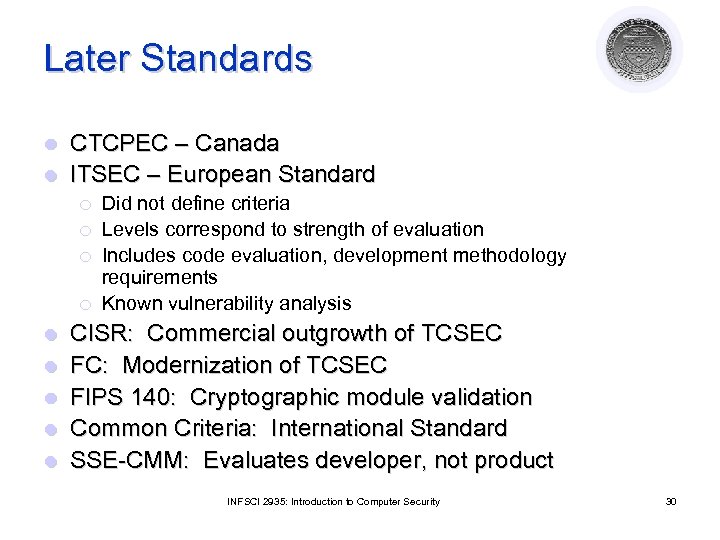
Later Standards CTCPEC – Canada l ITSEC – European Standard l ¡ ¡ l l l Did not define criteria Levels correspond to strength of evaluation Includes code evaluation, development methodology requirements Known vulnerability analysis CISR: Commercial outgrowth of TCSEC FC: Modernization of TCSEC FIPS 140: Cryptographic module validation Common Criteria: International Standard SSE-CMM: Evaluates developer, not product INFSCI 2935: Introduction to Computer Security 30
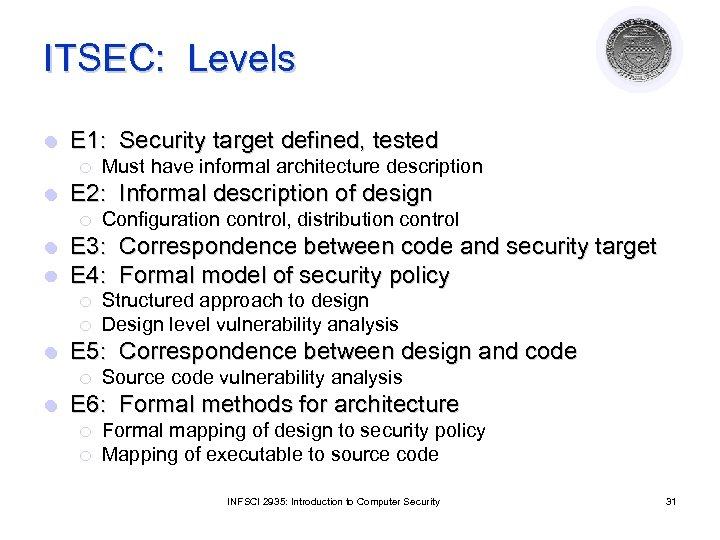
ITSEC: Levels l E 1: Security target defined, tested ¡ l E 2: Informal description of design ¡ l l ¡ Structured approach to design Design level vulnerability analysis E 5: Correspondence between design and code ¡ l Configuration control, distribution control E 3: Correspondence between code and security target E 4: Formal model of security policy ¡ l Must have informal architecture description Source code vulnerability analysis E 6: Formal methods for architecture ¡ ¡ Formal mapping of design to security policy Mapping of executable to source code INFSCI 2935: Introduction to Computer Security 31
ITSEC Problems: l No validation that security requirements made sense ¡ Product meets goals ¡ But does this meet user expectations? l Inconsistency in evaluations ¡ Not as formally defined as TCSEC INFSCI 2935: Introduction to Computer Security 32
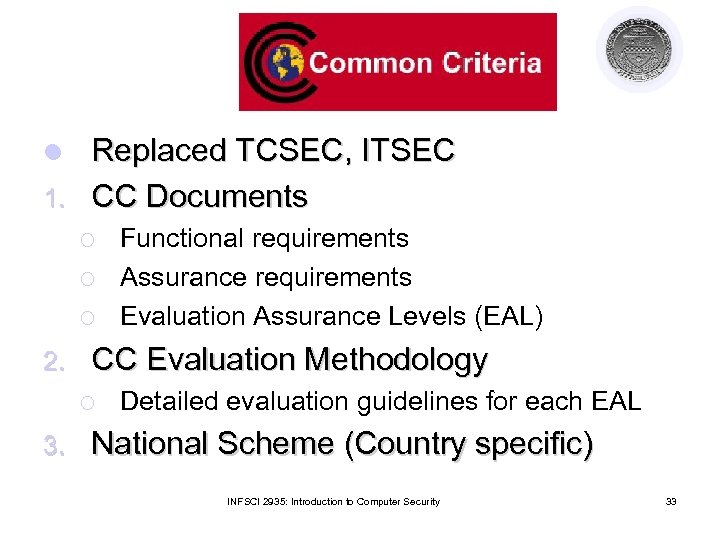
Replaced TCSEC, ITSEC 1. CC Documents l ¡ ¡ ¡ 2. CC Evaluation Methodology ¡ 3. Functional requirements Assurance requirements Evaluation Assurance Levels (EAL) Detailed evaluation guidelines for each EAL National Scheme (Country specific) INFSCI 2935: Introduction to Computer Security 33
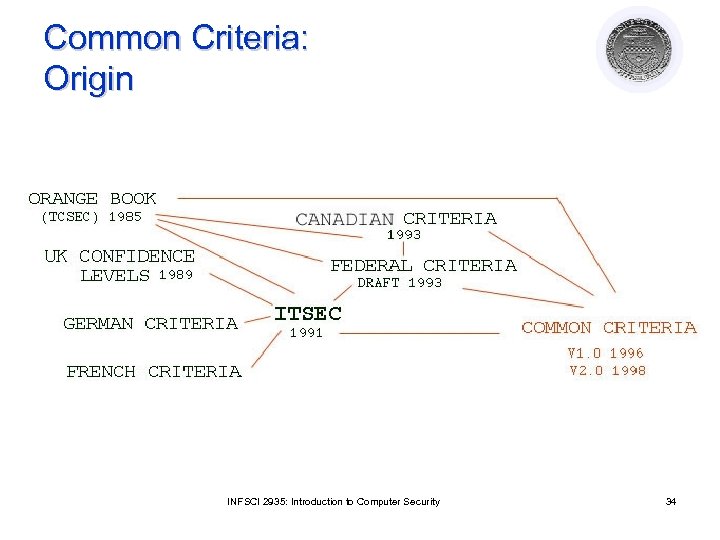
Common Criteria: Origin INFSCI 2935: Introduction to Computer Security 34
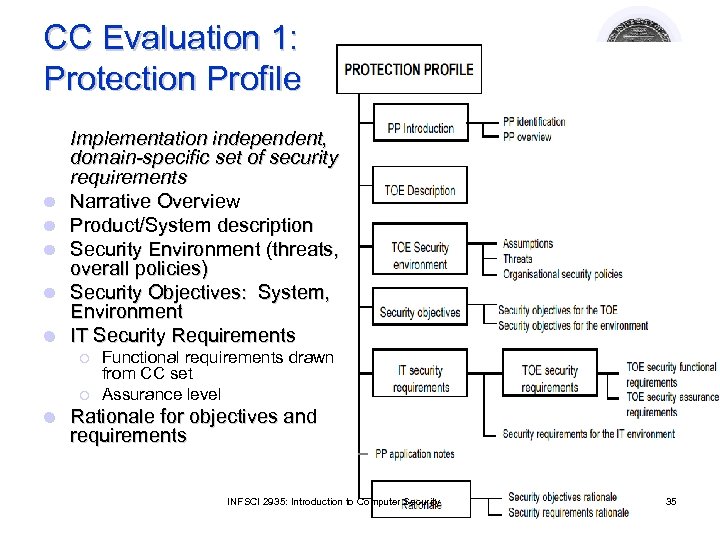
CC Evaluation 1: Protection Profile l l l Implementation independent, domain-specific set of security requirements Narrative Overview Product/System description Security Environment (threats, overall policies) Security Objectives: System, Environment IT Security Requirements ¡ ¡ l Functional requirements drawn from CC set Assurance level Rationale for objectives and requirements INFSCI 2935: Introduction to Computer Security 35
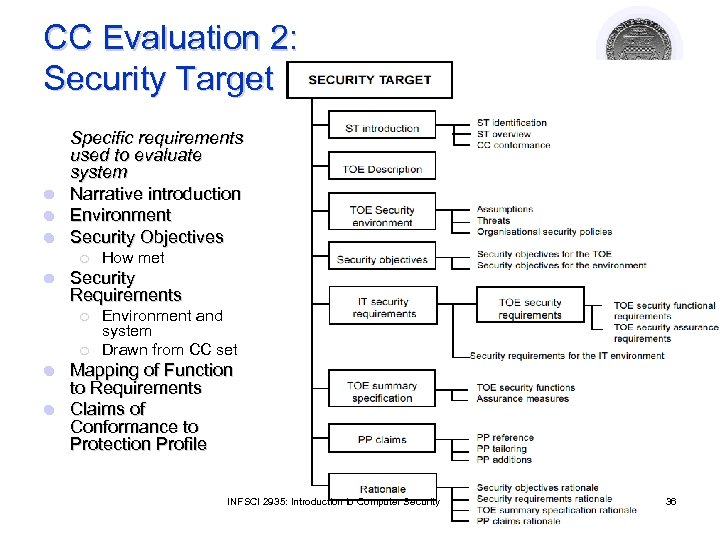
CC Evaluation 2: Security Target l l l Specific requirements used to evaluate system Narrative introduction Environment Security Objectives ¡ l How met Security Requirements ¡ ¡ Environment and system Drawn from CC set Mapping of Function to Requirements l Claims of Conformance to Protection Profile l INFSCI 2935: Introduction to Computer Security 36
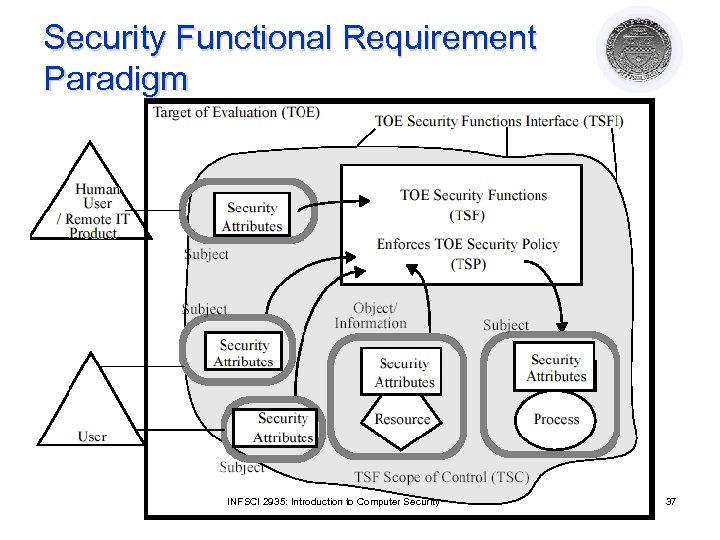
Security Functional Requirement Paradigm INFSCI 2935: Introduction to Computer Security 37
Common Criteria: Functional Requirements l 362 page document l 11 Classes ¡ Security Audit, Communication, Cryptography, User data protection, ID/authentication, Security Management, Privacy, Protection of Security Functions, Resource Utilization, Access, Trusted paths l Several families per class l Lattice of components in a family INFSCI 2935: Introduction to Computer Security 38
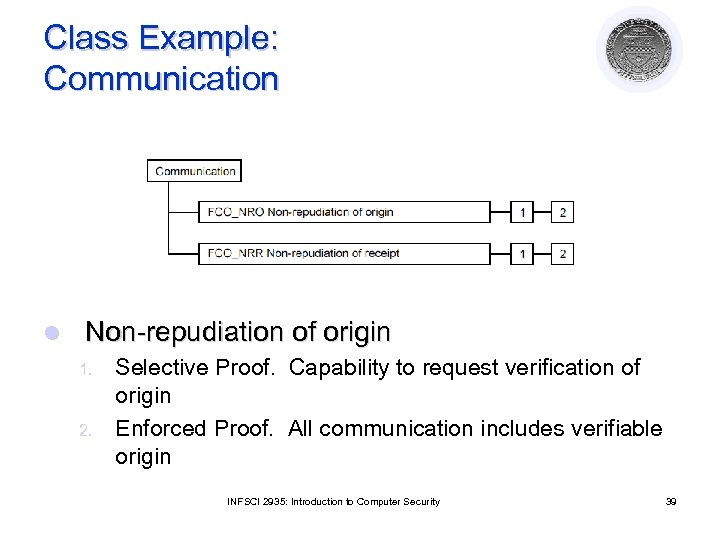
Class Example: Communication l Non-repudiation of origin 1. 2. Selective Proof. Capability to request verification of origin Enforced Proof. All communication includes verifiable origin INFSCI 2935: Introduction to Computer Security 39
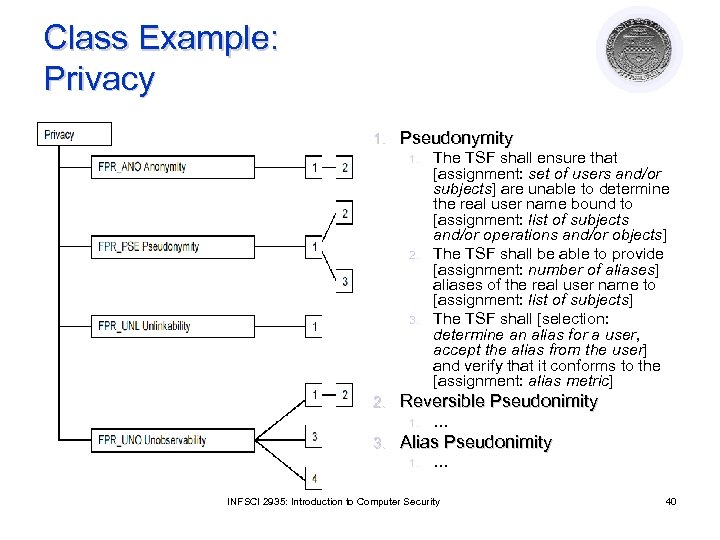
Class Example: Privacy 1. Pseudonymity 1. 2. 3. 2. Reversible Pseudonimity 1. 3. The TSF shall ensure that [assignment: set of users and/or subjects] are unable to determine the real user name bound to [assignment: list of subjects and/or operations and/or objects] The TSF shall be able to provide [assignment: number of aliases] aliases of the real user name to [assignment: list of subjects] The TSF shall [selection: determine an alias for a user, accept the alias from the user] and verify that it conforms to the [assignment: alias metric] … Alias Pseudonimity 1. … INFSCI 2935: Introduction to Computer Security 40
Common Criteria: Assurance Requirements 216 page document l 10 Classes l ¡ ¡ ¡ Protection Profile Evaluation, Security Target Evaluation Configuration management, Delivery and operation, Development, Guidance, Life cycle, Tests, Vulnerability assessment Maintenance Several families per class l Lattice of components in family l INFSCI 2935: Introduction to Computer Security 41
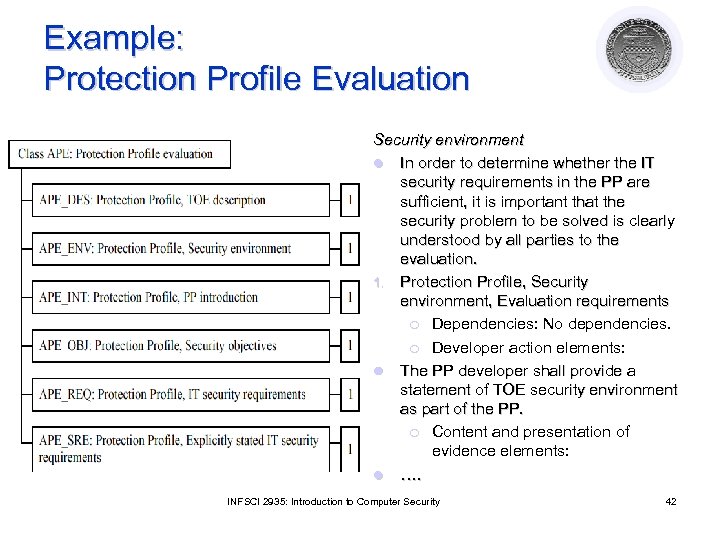
Example: Protection Profile Evaluation Security environment l In order to determine whether the IT security requirements in the PP are sufficient, it is important that the security problem to be solved is clearly understood by all parties to the evaluation. 1. Protection Profile, Security environment, Evaluation requirements ¡ Dependencies: No dependencies. ¡ Developer action elements: l The PP developer shall provide a statement of TOE security environment as part of the PP. ¡ Content and presentation of evidence elements: l …. INFSCI 2935: Introduction to Computer Security 42
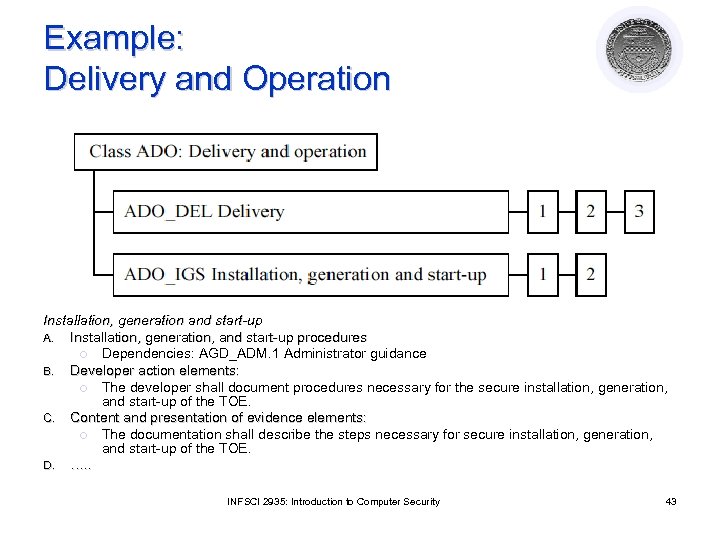
Example: Delivery and Operation Installation, generation and start-up A. Installation, generation, and start-up procedures ¡ Dependencies: AGD_ADM. 1 Administrator guidance B. Developer action elements: ¡ The developer shall document procedures necessary for the secure installation, generation, and start-up of the TOE. C. Content and presentation of evidence elements: ¡ The documentation shall describe the steps necessary for secure installation, generation, and start-up of the TOE. D. …. . INFSCI 2935: Introduction to Computer Security 43
Common Criteria: Evaluation Assurance Levels 1. 2. 3. 4. 5. 6. 7. Functionally tested Structurally tested Methodically tested and checked Methodically designed, tested, and reviewed Semi-formally designed and tested Semi-formally verified design and tested Formally verified design and tested INFSCI 2935: Introduction to Computer Security 44
Common Criteria: Evaluation Process l National Authority authorizes evaluators ¡ U. S. : NIST accredits commercial organizations ¡ Fee charged for evaluation l Team of four to six evaluators ¡ Develop work plan and clear with NIST ¡ Evaluate Protection Profile first ¡ If successful, can evaluate Security Target INFSCI 2935: Introduction to Computer Security 45
Common Criteria: Status l About 80 registered products ¡ Only one at level 5 (Java Smart Card) ¡ Several OS at 4 ¡ Likely many more not registered l New versions appearing on regular basis INFSCI 2935: Introduction to Computer Security 46
Auditing Courtesy of Professors Chris Clifton & Matt Bishop INFSCI 2935: Introduction of Computer Security 47
What is Auditing? l Logging ¡ Recording events or statistics to provide information about system use and performance l Auditing ¡ Analysis of log records to present information about the system in a clear, understandable manner INFSCI 2935: Introduction to Computer Security 48
Auditing goals/uses l l User accountability Damage assessment Determine causes of security violations Describe security state for monitoring critical problems ¡ l Determine if system enters unauthorized state Evaluate effectiveness of protection mechanisms ¡ ¡ Determine which mechanisms are appropriate and working Deter attacks because of presence of record INFSCI 2935: Introduction to Computer Security 49
Problems l What to log? ¡ looking for violations of a policy, so record at least what will show such violations ¡ Use of privileges l What do you audit? ¡ Need not audit everything ¡ Key: what is the policy involved? INFSCI 2935: Introduction to Computer Security 50
Audit System Structure l Logger ¡ Records information, usually controlled by parameters l Analyzer ¡ Analyzes logged information looking for something l Notifier ¡ Reports results of analysis INFSCI 2935: Introduction to Computer Security 51
Logger l Type, quantity of information recorded controlled by system or program configuration parameters l May be human readable or not ¡ If not, usually viewing tools supplied ¡ Space available, portability influence storage format INFSCI 2935: Introduction to Computer Security 52
Example: RACF l Security enhancement package for IBM’s MVS/VM l Logs failed access attempts, use of privilege to change security levels, and (if desired) RACF interactions l View events with LISTUSERS commands INFSCI 2935: Introduction to Computer Security 53
Example: Windows NT l Different logs for different types of events ¡ ¡ ¡ System event logs record system crashes, component failures, and other system events Application event logs record events that applications request be recorded Security event log records security-critical events such as logging in and out, system file accesses, and other events Logs are binary; use event viewer to see them l If log full, can have system shut down, logging disabled, or logs overwritten l INFSCI 2935: Introduction to Computer Security 54
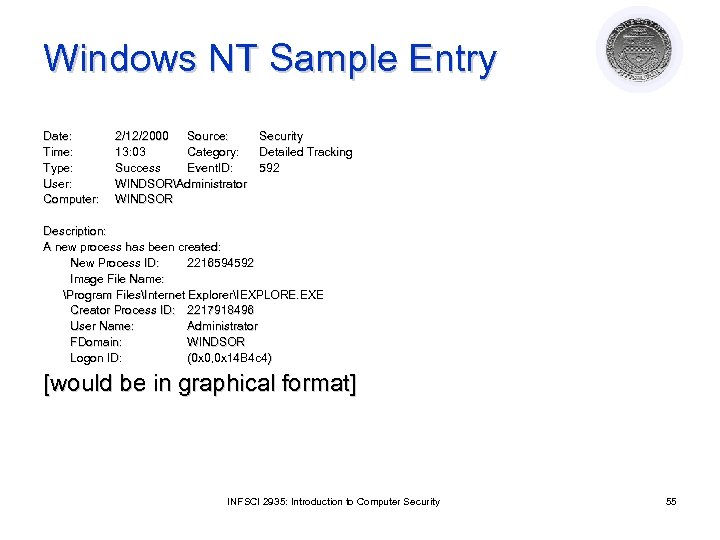
Windows NT Sample Entry Date: Time: Type: User: Computer: 2/12/2000 Source: Security 13: 03 Category: Detailed Tracking Success Event. ID: 592 Event. ID: WINDSORAdministrator WINDSOR Description: A new process has been created: New Process ID: 2216594592 Image File Name: Program FilesInternet ExplorerIEXPLORE. EXE Creator Process ID: 2217918496 User Name: Administrator FDomain: WINDSOR FDomain: Logon ID: (0 x 0, 0 x 14 B 4 c 4) [would be in graphical format] INFSCI 2935: Introduction to Computer Security 55
Analyzer l Analyzes one or more logs ¡ Logs may come from multiple systems, or a single system May lead to changes in logging May lead to a report of an event ¡ Using swatch to find instances of telnet from tcpd logs: ¡ ¡ /telnet/&!/localhost/&!/*. site. com/ ¡ Query set overlap control in databases l ¡ If too much overlap between current query and past queries, do not answer Intrusion detection analysis engine (director) l Takes data from sensors and determines if an intrusion is occurring INFSCI 2935: Introduction to Computer Security 56
Notifier l Informs analyst, other entities of results of analysis l May reconfigure logging and/or analysis on basis of results l May take some action INFSCI 2935: Introduction to Computer Security 57
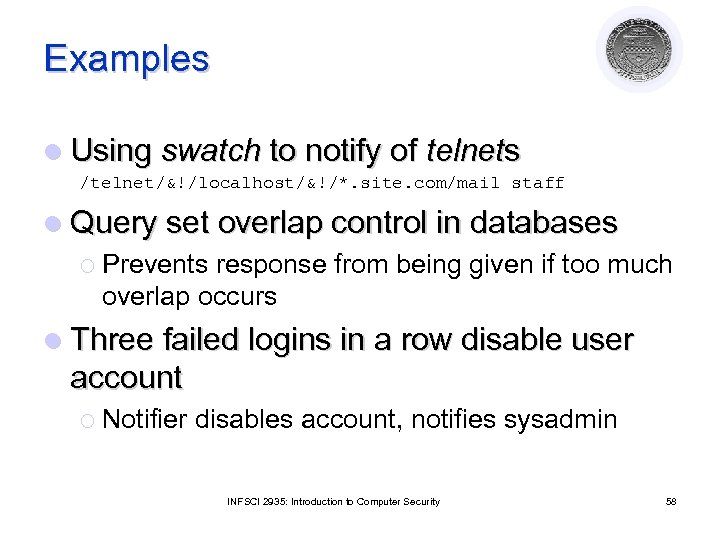
Examples l Using swatch to notify of telnets /telnet/&!/localhost/&!/*. site. com/mail staff l Query set overlap control in databases ¡ Prevents response from being given if too much overlap occurs l Three failed logins in a row disable user account ¡ Notifier disables account, notifies sysadmin INFSCI 2935: Introduction to Computer Security 58
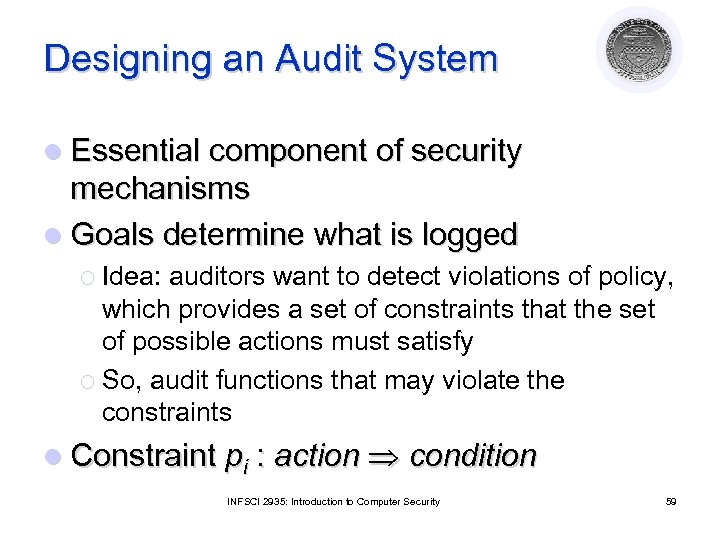
Designing an Audit System l Essential component of security mechanisms l Goals determine what is logged ¡ Idea: auditors want to detect violations of policy, which provides a set of constraints that the set of possible actions must satisfy ¡ So, audit functions that may violate the constraints l Constraint pi : action condition INFSCI 2935: Introduction to Computer Security 59
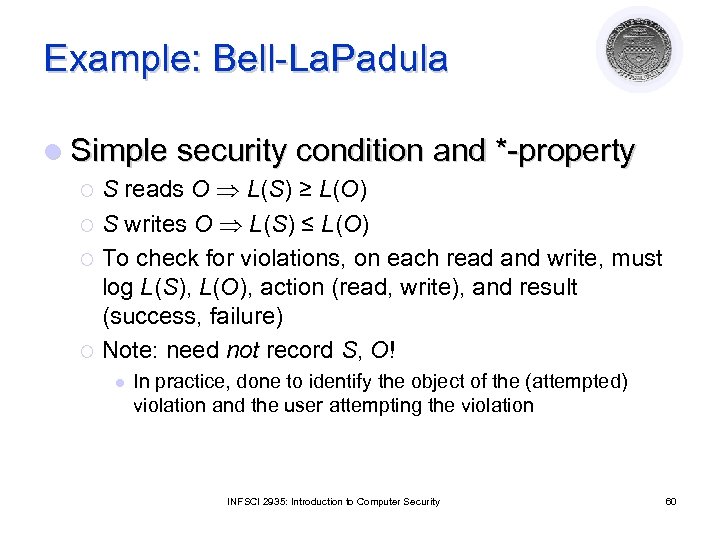
Example: Bell-La. Padula l Simple security condition and *-property S reads O L(S) ≥ L(O) ¡ S writes O L(S) ≤ L(O) ¡ To check for violations, on each read and write, must log L(S), L(O), action (read, write), and result (success, failure) ¡ Note: need not record S, O! ¡ l In practice, done to identify the object of the (attempted) violation and the user attempting the violation INFSCI 2935: Introduction to Computer Security 60
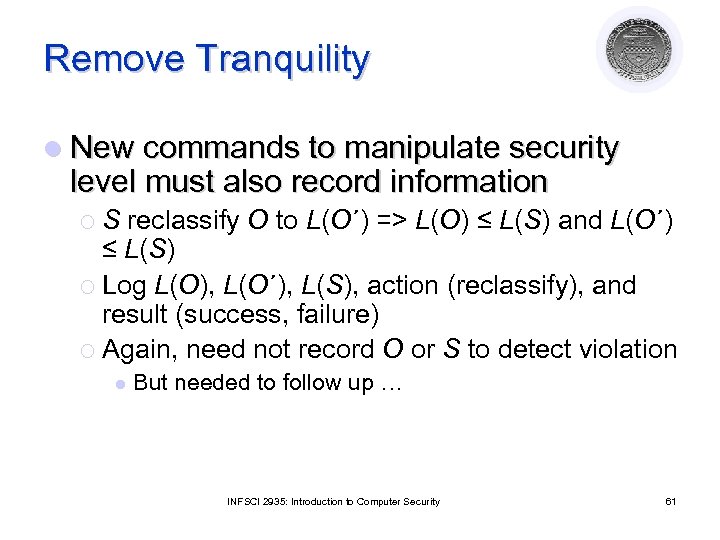
Remove Tranquility l New commands to manipulate security level must also record information ¡S reclassify O to L(O´) => L(O) ≤ L(S) and L(O´) ≤ L(S) ¡ Log L(O), L(O´), L(S), action (reclassify), and result (success, failure) ¡ Again, need not record O or S to detect violation l But needed to follow up … INFSCI 2935: Introduction to Computer Security 61
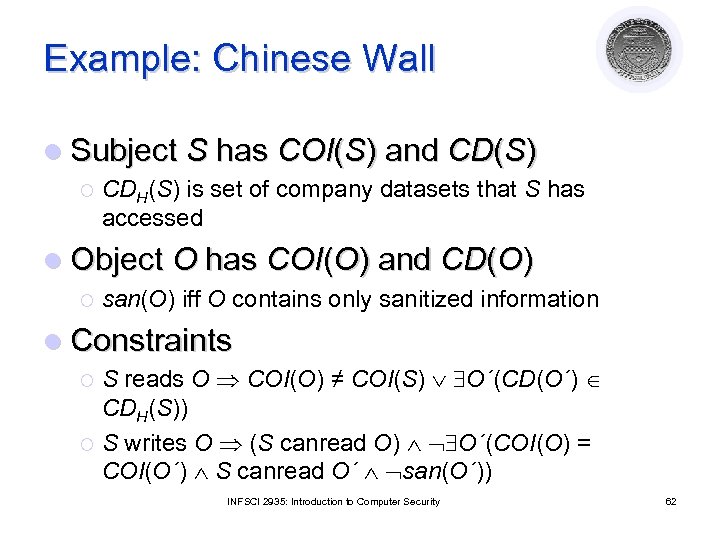
Example: Chinese Wall l Subject S has COI(S) and CD(S) ¡ CDH(S) is set of company datasets that S has accessed l Object O has COI(O) and CD(O) ¡ san(O) iff O contains only sanitized information l Constraints S reads O COI(O) ≠ COI(S) O´(CD(O´) CDH(S)) ¡ S writes O (S canread O) O´(COI(O) = COI(O´) S canread O´ san(O´)) ¡ INFSCI 2935: Introduction to Computer Security 62
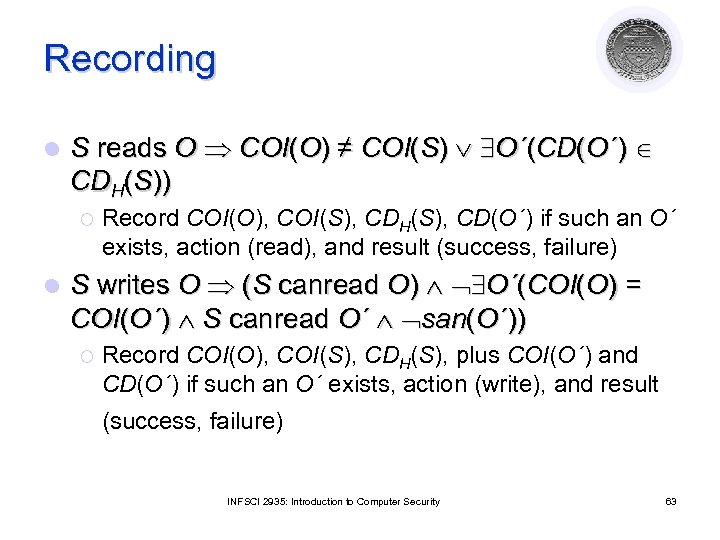
Recording l S reads O COI(O) ≠ COI(S) O´(CD(O´) CDH(S)) ¡ l Record COI(O), COI(S), CDH(S), CD(O´) if such an O´ exists, action (read), and result (success, failure) S writes O (S canread O) O´(COI(O) = COI(O´) S canread O´ san(O´)) ¡ Record COI(O), COI(S), CDH(S), plus COI(O´) and CD(O´) if such an O´ exists, action (write), and result (success, failure) INFSCI 2935: Introduction to Computer Security 63
Implementation Issues l Show non-security or find violations? ¡ Former requires logging initial state as well as changes l Defining violations ¡ Does “write” include “append” and “create directory”? l Multiple names for one object Logging goes by object and not name ¡ Representations can affect this (if you read raw disks, you’re reading files; can your auditing system determine which file? ) ¡ INFSCI 2935: Introduction to Computer Security 64
Syntactic Issues l Data that is logged may be ambiguous ¡ BSM: two optional text fields followed by two mandatory text fields ¡ If three fields, which of the optional fields is omitted? l Solution: use grammar to ensure well- defined syntax of log files INFSCI 2935: Introduction to Computer Security 65
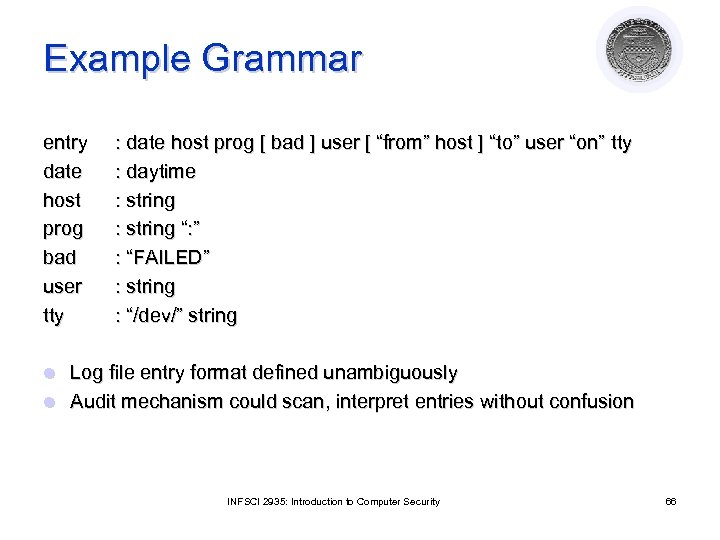
Example Grammar entry date host prog bad user tty : date host prog [ bad ] user [ “from” host ] “to” user “on” tty : daytime : string “: ” : “FAILED” : string : “/dev/” string Log file entry format defined unambiguously l Audit mechanism could scan, interpret entries without confusion l INFSCI 2935: Introduction to Computer Security 66
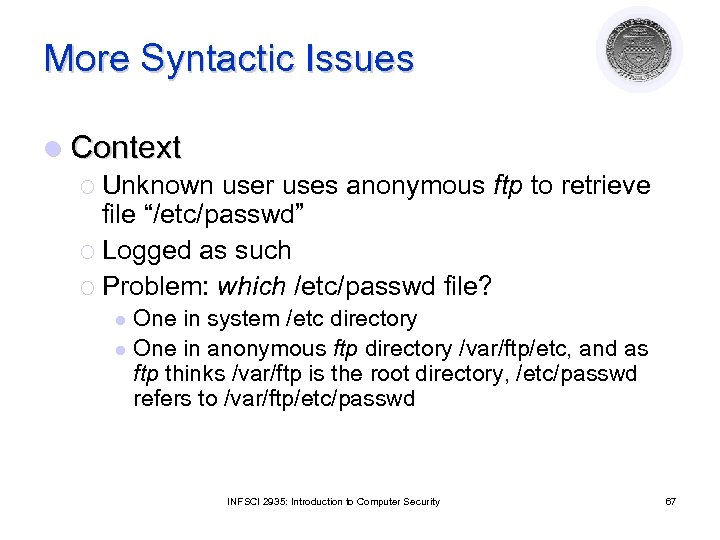
More Syntactic Issues l Context ¡ Unknown user uses anonymous ftp to retrieve file “/etc/passwd” ¡ Logged as such ¡ Problem: which /etc/passwd file? One in system /etc directory l One in anonymous ftp directory /var/ftp/etc, and as ftp thinks /var/ftp is the root directory, /etc/passwd refers to /var/ftp/etc/passwd l INFSCI 2935: Introduction to Computer Security 67
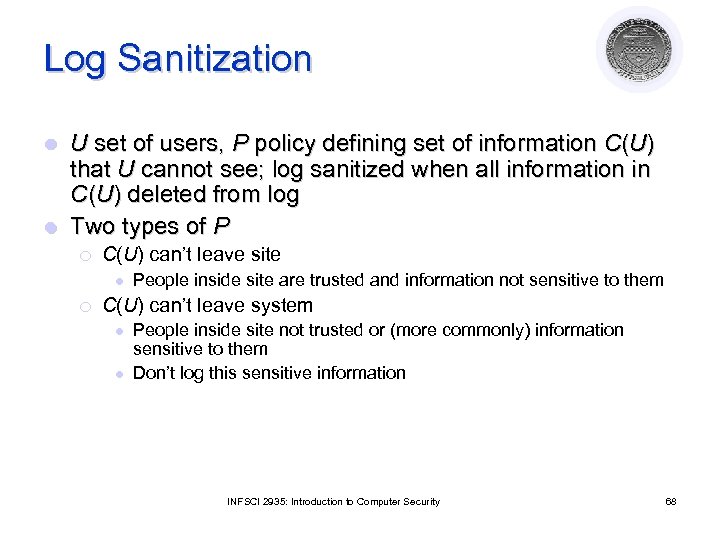
Log Sanitization U set of users, P policy defining set of information C(U) that U cannot see; log sanitized when all information in C(U) deleted from log l Two types of P l ¡ C(U) can’t leave site l ¡ People inside site are trusted and information not sensitive to them C(U) can’t leave system l l People inside site not trusted or (more commonly) information sensitive to them Don’t log this sensitive information INFSCI 2935: Introduction to Computer Security 68
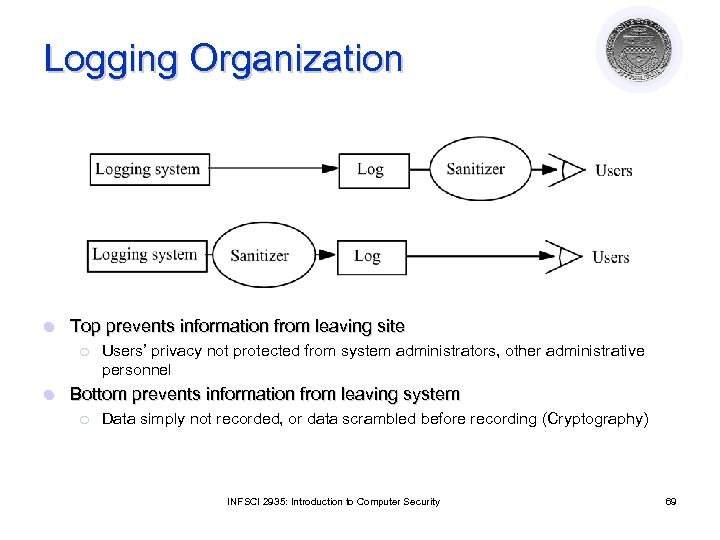
Logging Organization l Top prevents information from leaving site ¡ l Users’ privacy not protected from system administrators, other administrative personnel Bottom prevents information from leaving system ¡ Data simply not recorded, or data scrambled before recording (Cryptography) INFSCI 2935: Introduction to Computer Security 69
Reconstruction l Anonymizing sanitizer cannot be undone ¡ No way to recover data from this l Pseudonymizing sanitizer can be undone ¡ Original log can be reconstructed l Importance ¡ Suppose security analysis requires access to information that was sanitized? INFSCI 2935: Introduction to Computer Security 70
Issue l Key: sanitization must preserve properties needed for security analysis l If new properties added (because analysis changes), may have to resanitize information ¡ This requires pseudonymous sanitization or the original log INFSCI 2935: Introduction to Computer Security 71
Example l Company wants to keep its IP addresses secret, but wants a consultant to analyze logs for an address scanning attack Connections to port 25 on IP addresses 10. 163. 5. 10, 10. 163. 5. 11, 10. 163. 5. 12, 10. 163. 5. 13, 10. 163. 5. 14, ¡ Sanitize with random IP addresses l Cannot see sweep through consecutive IP addresses ¡ Sanitize with sequential IP addresses l Can see sweep through consecutive IP addresses ¡ INFSCI 2935: Introduction to Computer Security 72
Generation of Pseudonyms 1. Devise set of pseudonyms to replace sensitive information • • 2. Replace data with pseudonyms that preserve relationship Maintain table mapping pseudonyms to data Use random key to encipher sensitive datum and use secret sharing scheme to share key • • Used when insiders cannot see unsanitized data, but outsiders (law enforcement) need to (t, n) –threshold scheme: requires t out of n people to read data INFSCI 2935: Introduction to Computer Security 73
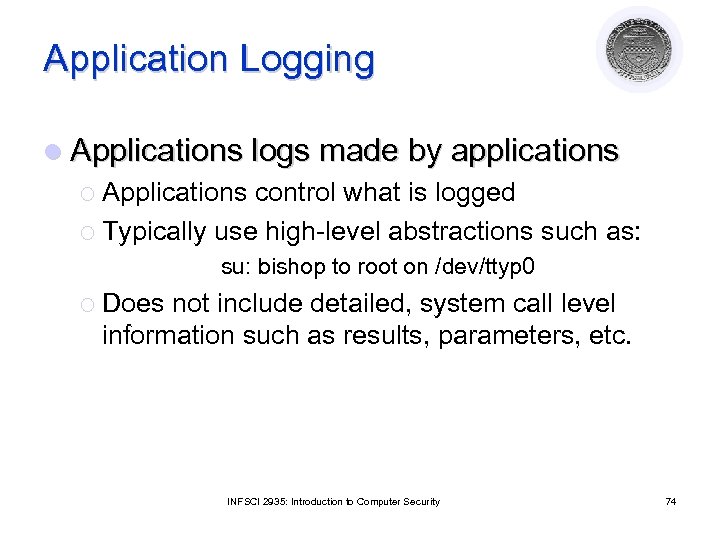
Application Logging l Applications logs made by applications ¡ Applications control what is logged ¡ Typically use high-level abstractions such as: su: bishop to root on /dev/ttyp 0 ¡ Does not include detailed, system call level information such as results, parameters, etc. INFSCI 2935: Introduction to Computer Security 74
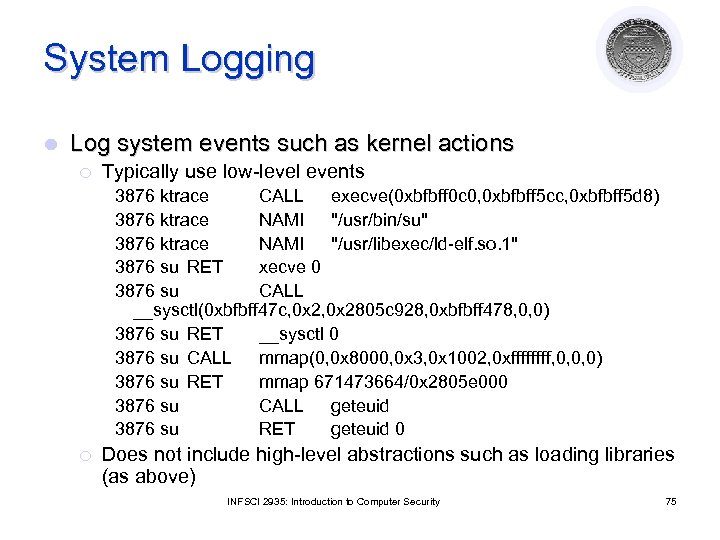
System Logging l Log system events such as kernel actions ¡ Typically use low-level events 3876 ktrace CALL execve(0 xbfbff 0 c 0, 0 xbfbff 5 cc, 0 xbfbff 5 d 8) 3876 ktrace NAMI "/usr/bin/su" 3876 ktrace NAMI "/usr/libexec/ld-elf. so. 1" 3876 su RET xecve 0 3876 su CALL __sysctl(0 xbfbff 47 c, 0 x 2805 c 928, 0 xbfbff 478, 0, 0) 3876 su RET __sysctl 0 3876 su CALL mmap(0, 0 x 8000, 0 x 3, 0 x 1002, 0 xffff, 0, 0, 0) 3876 su RET mmap 671473664/0 x 2805 e 000 3876 su CALL geteuid 3876 su RET geteuid 0 ¡ Does not include high-level abstractions such as loading libraries (as above) INFSCI 2935: Introduction to Computer Security 75
Contrast l Differ in focus Application logging focuses on application events, like failure to supply proper password, and the broad operation (what was the reason for the access attempt? ) ¡ System logging focuses on system events, like memory mapping or file accesses, and the underlying causes (why did access fail? ) ¡ System logs usually much bigger than application logs l Can do both, try to correlate them l INFSCI 2935: Introduction to Computer Security 76
Design l A posteriori design ¡ l Need to design auditing mechanism for system not built with security in mind Goal of auditing ¡ Detect any violation of a stated policy l ¡ Focus is on policy and actions designed to violate policy; specific actions may not be known Detect actions known to be part of an attempt to breach security l Focus on specific actions that have been determined to indicate attacks INFSCI 2935: Introduction to Computer Security 77
Detect Violations of Known Policy l Goal: does system enter a disallowed state? l Two forms ¡ State-based l auditing Look at current state of system ¡ Transition-based l auditing Look at actions that transition system from one state to another INFSCI 2935: Introduction to Computer Security 78
State-Based Auditing l Log information about state and determine if state is allowed ¡ Assumption: you can get a snapshot of system state ¡ Snapshot needs to be consistent ¡ Non-distributed system needs to be quiescent INFSCI 2935: Introduction to Computer Security 79
Example l File system auditing tools (e. g. tripwire) ¡ Thought of as analyzing single state (snapshot) ¡ In reality, analyze many slices of different state unless file system quiescent ¡ Potential problem: if test at end depends on result of test at beginning, relevant parts of system state may have changed between the first test and the last l Classic TOCTTOU flaw (time to check to time of use) INFSCI 2935: Introduction to Computer Security 80
Transition-Based Auditing l Log information about action, and examine current state and proposed transition to determine if new state would be disallowed ¡ Note: just analyzing the transition may not be enough; you may need the initial state ¡ Tend to use this when specific transitions always require analysis (for example, change of privilege) INFSCI 2935: Introduction to Computer Security 81
Example l TCP access control mechanism intercepts TCP connections and checks against a list of connections to be blocked ¡ Obtains IP address of source of connection ¡ Logs IP address, port, and result (allowed/blocked) in log file ¡ Purely transition-based (current state not analyzed at all) INFSCI 2935: Introduction to Computer Security 82
Detect Known Violations of Policy l Goal: does a specific action and/or state that is known to violate security policy occur? ¡ Assume that action automatically violates policy ¡ Policy may be implicit, not explicit ¡ Used to look for known attacks INFSCI 2935: Introduction to Computer Security 83
Example l Land attack ¡ ¡ ¡ Consider 3 -way handshake to initiate TCP connection (next slide) What happens if source, destination ports and addresses the same? Host expects ACK(t+1), but gets ACK(s+1). RFC ambiguous: l l p. 36 of RFC: send RST to terminate connection p. 69 of RFC: reply with empty packet having current sequence number t+1 and ACK number s+1—but it receives packet and ACK number is incorrect. So it repeats this … system hangs or runs very slowly, depending on whether interrupts are disabled INFSCI 2935: Introduction to Computer Security 84
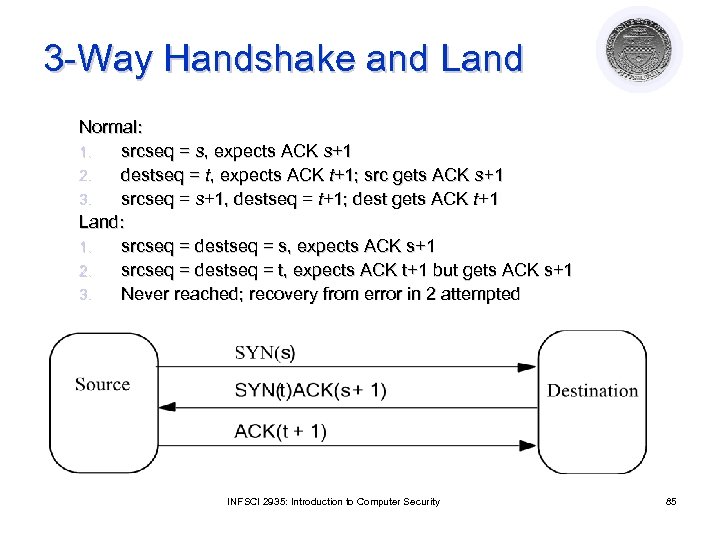
3 -Way Handshake and Land Normal: 1. srcseq = s, expects ACK s+1 2. destseq = t, expects ACK t+1; src gets ACK s+1 3. srcseq = s+1, destseq = t+1; dest gets ACK t+1 Land: 1. srcseq = destseq = s, expects ACK s+1 2. srcseq = destseq = t, expects ACK t+1 but gets ACK s+1 3. Never reached; recovery from error in 2 attempted INFSCI 2935: Introduction to Computer Security 85
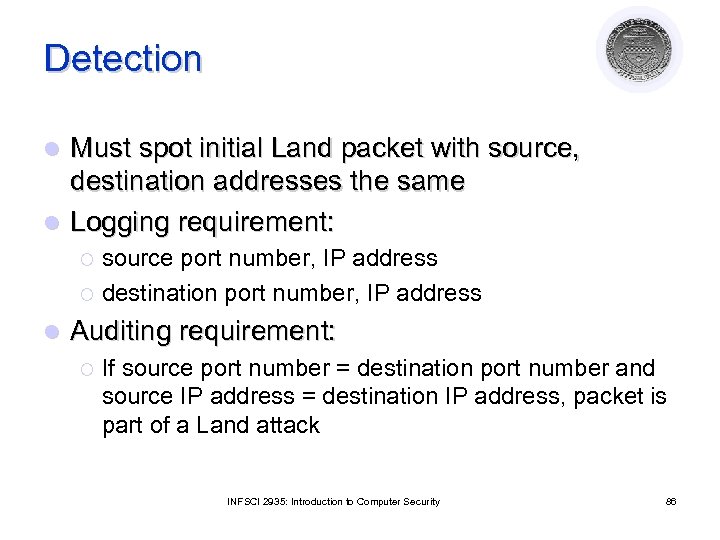
Detection Must spot initial Land packet with source, destination addresses the same l Logging requirement: l source port number, IP address ¡ destination port number, IP address ¡ l Auditing requirement: ¡ If source port number = destination port number and source IP address = destination IP address, packet is part of a Land attack INFSCI 2935: Introduction to Computer Security 86
Скачать презентацию Systems with Assurance Evaluation Auditing Lecture 10 November
31a047f3414bce6b1d43994708523d3c.ppt