


 Скачать презентацию SYSTEMS THEORY Whitchurch G G Constantine
6c2d1346f11b688f2f383aa9762c50be.ppt
- Количество слайдов: 13
 SYSTEMS THEORY Whitchurch, G. G. , & Constantine, L. L. (1993). Systems theory. In P. G. Boss, W. J. Doherty, R. La. Rossa, W. R. Schumm, & S. K. Steinmetz (Eds. ), Sourcebook of family theories and methods: A contextual approach (pp. 325 -352). New York: Plenum Press.
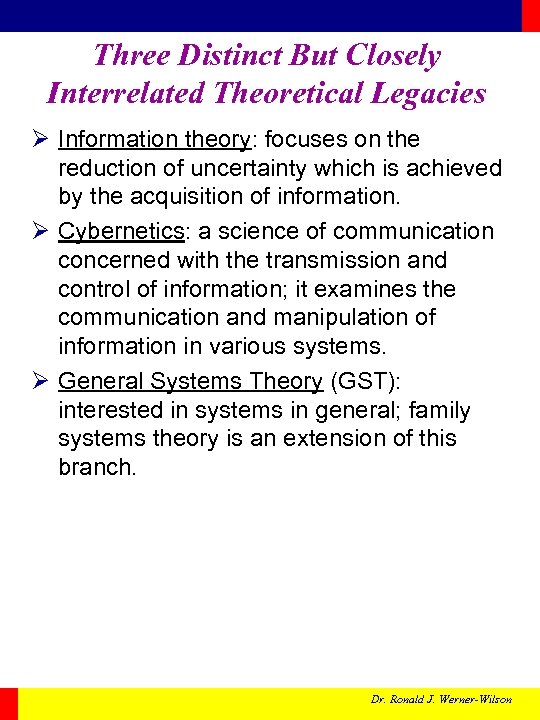 Three Distinct But Closely Interrelated Theoretical Legacies Ø Information theory: focuses on the reduction of uncertainty which is achieved by the acquisition of information. Ø Cybernetics: a science of communication concerned with the transmission and control of information; it examines the communication and manipulation of information in various systems. Ø General Systems Theory (GST): interested in systems in general; family systems theory is an extension of this branch. Dr. Ronald J. Werner-Wilson
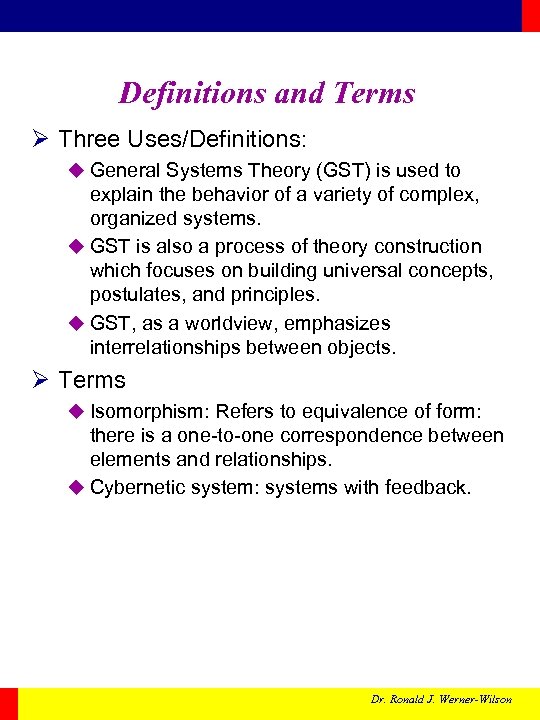 Definitions and Terms Ø Three Uses/Definitions: u General Systems Theory (GST) is used to explain the behavior of a variety of complex, organized systems. u GST is also a process of theory construction which focuses on building universal concepts, postulates, and principles. u GST, as a worldview, emphasizes interrelationships between objects. Ø Terms u Isomorphism: Refers to equivalence of form: there is a one-to-one correspondence between elements and relationships. u Cybernetic system: systems with feedback. Dr. Ronald J. Werner-Wilson
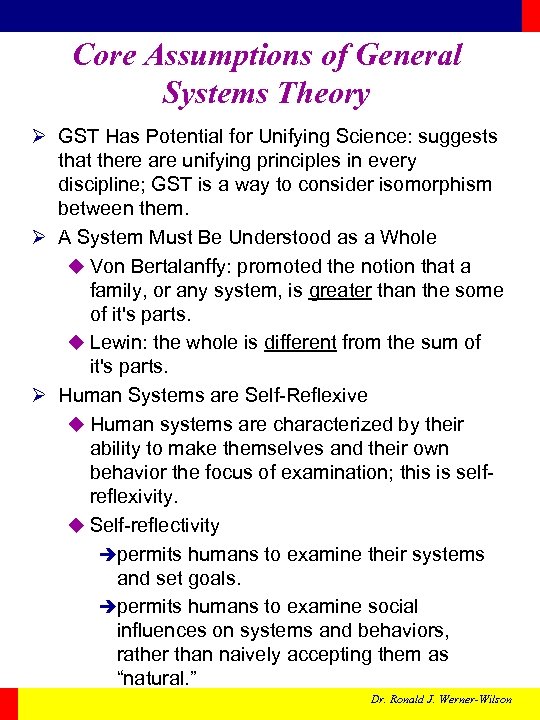 Core Assumptions of General Systems Theory Ø GST Has Potential for Unifying Science: suggests that there are unifying principles in every discipline; GST is a way to consider isomorphism between them. Ø A System Must Be Understood as a Whole u Von Bertalanffy: promoted the notion that a family, or any system, is greater than the some of it's parts. u Lewin: the whole is different from the sum of it's parts. Ø Human Systems are Self-Reflexive u Human systems are characterized by their ability to make themselves and their own behavior the focus of examination; this is selfreflexivity. u Self-reflectivity èpermits humans to examine their systems and set goals. èpermits humans to examine social influences on systems and behaviors, rather than naively accepting them as “natural. ” Dr. Ronald J. Werner-Wilson
 Research and Theory Foci Ø Ongoing Family Processes: u Transactional patterns (e. g. , predictable behavior sequences). u Shift focus from individual to the family. u Topics: èfamily functioning, èfamily communication, èfamily conflict, èseparateness and connecetedness, ècohesion, èadaptation to change. Ø Example of research questions (from Montgomery & Fewer, 1988): u What elements of a social system are influenced by other parts of the system; how does one element of a system recursively influence the whole system? u How does the behavior of different components fit together? u How does the fit between systems affect functioning? Ø What is the Relationship of Family Systems to Other Systems Dr. Ronald J. Werner-Wilson
 Major Contemporary Concepts of General Systems Theory Ø Interdependence/Mutual Influence Ø Equifinality: u Definition: the ability of a system to achieve the same goals through different routes (e. g. , we may take different roads to campus but we all arrive at the same place). u Communication patterns are organized into feedback loops which affect goal-setting behavior in systems. Ø Hierarchy: u The “layering” of systems of increasing complexity, including èSubsystems: smaller parts of the same system. èSystems èSuprasystems: larger systems (e. g. , economic and political system). u Controversy: disagreement about definition of sub- and supra-systems as well as identification of components. Dr. Ronald J. Werner-Wilson
 Major Contemporary Concepts of General Systems Theory (cont. ) Ø Boundaries and Open/Closed Systems u Boundaries define membership in a system. u Boundaries also represent the point of contact between the system and other systems. u Boundaries vary in degree of permeability, the degree to which they control the flow between systems. u Customary approaches to operationalizing boundaries: èAssessment of permeability and cohesion. èEmotional connectedness between family members. Dr. Ronald J. Werner-Wilson
 Contemporary Concepts (cont. ) Ø Feedback and Control u Feedback loop èPath of communication in a system. èFeedback is considered either positive or negative based on the effect it has on the system, not on it’s content. u Types of feedback loops: èNegative: l feedback is used to maintain homeostasis. This type of feedback has also been called constancy loops and deviation-attenuating loops. l Morphostatic feedback: refers to feedback which promotes maintenance of existing structure. èPositive: feedback used to promote change. l These types of feedback are also referred to as deviation-amplifying loops or variety loops. l Morphogenic feedback: refers to feedback which produces change in the system. Dr. Ronald J. Werner-Wilson
 Examples of Research Emerging from General Systems Theory Ø Marital and Family Interaction u Hess and Handel (1959): integrated GST and symbolic interactionism to examine the family as a system that socially constructs it’s reality. They suggested that there are five essential processes of family interaction. u Comparison of family interaction patterns between “normal” and “schizophrenic” families (Mishler & Waxler, 1968). Ø Family Dysfunction: individual patterns of dysfunction are attributed to family interaction patterns. u Alcoholism: Steinglass and Wolin have integrated a family development and systems approach, suggesting that alcoholism influences families in stages which accounts for patterns of alcoholism in families. u Family violence: systemic explanations are controversial. This research suggests that the failure to leave an abusive situation is a form of positive feedback. Dr. Ronald J. Werner-Wilson
 Examples of Research (cont. ) Ø Marital and Family Taxonomies u Olson’s Circumplex model èThree dimensions create sixteen relationship types; the three dimensions are l Cohesion l Adaptability l Communication èThree general types of relationships: l Balanced l Mid-range l Extreme èIn general, research has revealed that balanced families will function more adequately than the other types of families. èIt has been criticized for not including a dimension for competence. Dr. Ronald J. Werner-Wilson
 Examples of Research (cont. ) Ø Marital and Family Taxonomies (cont. ) u The Beavers systems model examines family competence (e. g. , healthy, mid-range, and severely dysfunctional). u Typologies melding systems with symbolic interactionism: develop, for example, a typology based on the effect of family members shared perceptions about their social environment (symbolic interactionism) on the social environment (a systems construct) (Reiss, 1981; see also Constantine, 1986; Constantine & Israel, 1985; Fitzpatrick, 1976, 1988). Dr. Ronald J. Werner-Wilson
 Limitations of General Systems Theory Ø General Criticisms: focus on application of systems theory. u GST is too vague and general, making it difficult to operationalize and evaluate empirically. u Criticized for poor explanatory power because, although it provides conceptualization, it is difficult to clearly identify and measure constructs. u Criticism of subtle assumption that all parts of a system have equal power. Dr. Ronald J. Werner-Wilson
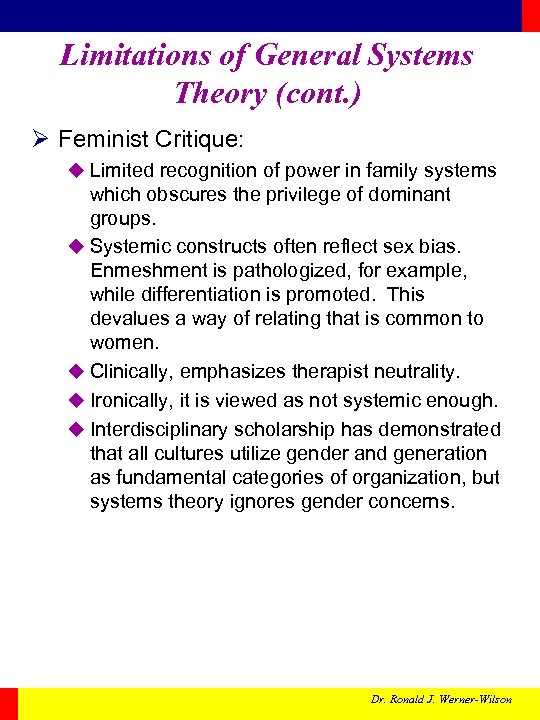 Limitations of General Systems Theory (cont. ) Ø Feminist Critique: u Limited recognition of power in family systems which obscures the privilege of dominant groups. u Systemic constructs often reflect sex bias. Enmeshment is pathologized, for example, while differentiation is promoted. This devalues a way of relating that is common to women. u Clinically, emphasizes therapist neutrality. u Ironically, it is viewed as not systemic enough. u Interdisciplinary scholarship has demonstrated that all cultures utilize gender and generation as fundamental categories of organization, but systems theory ignores gender concerns. Dr. Ronald J. Werner-Wilson