 Скачать презентацию Systems Engineering Research at Texas A M University Abhijit
1cca5b20d588ac64998ffacf88a67916.ppt
- Количество слайдов: 21



Systems Engineering Research at Texas A&M University Abhijit Deshmukh Lead SERC Researcher @ TAMU Amarnath Banerjee, Yu Ding, Andrew Johnson, Sara Mc. Comb, Lewis Ntaimo, Brett Peters, Donald Phillips, James Wall, Martin Wortman, Justin Yates Senior SERC Researchers @ TAMU 1
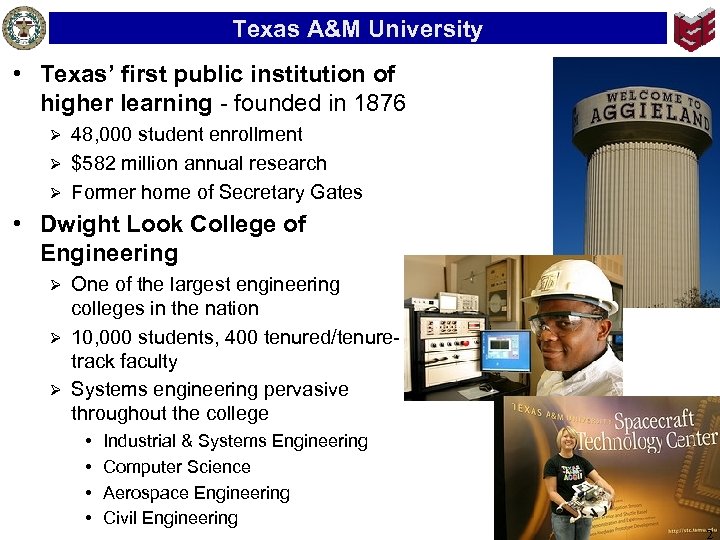
Texas A&M University • Texas’ first public institution of higher learning - founded in 1876 48, 000 student enrollment Ø $582 million annual research Ø Former home of Secretary Gates Ø • Dwight Look College of Engineering One of the largest engineering colleges in the nation Ø 10, 000 students, 400 tenured/tenuretrack faculty Ø Systems engineering pervasive throughout the college Ø • • Industrial & Systems Engineering Computer Science Aerospace Engineering Civil Engineering 2
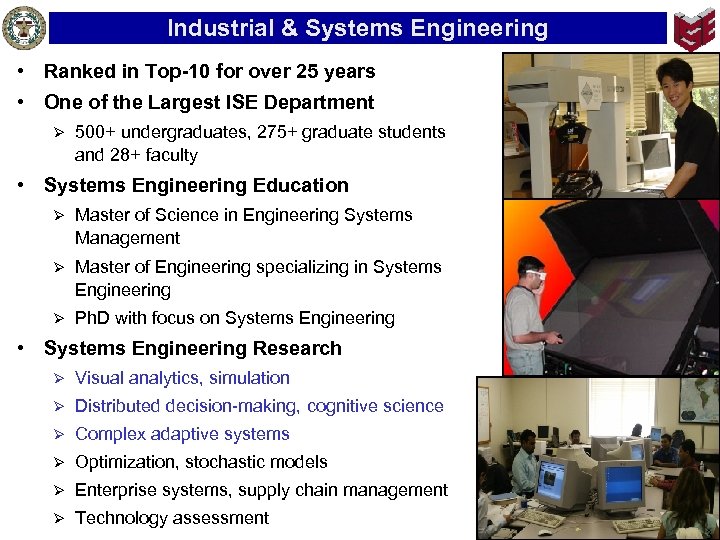
Industrial & Systems Engineering • Ranked in Top-10 for over 25 years • One of the Largest ISE Department Ø 500+ undergraduates, 275+ graduate students and 28+ faculty • Systems Engineering Education Ø Master of Science in Engineering Systems Management Ø Master of Engineering specializing in Systems Engineering Ø Ph. D with focus on Systems Engineering • Systems Engineering Research Ø Visual analytics, simulation Ø Distributed decision-making, cognitive science Ø Complex adaptive systems Ø Optimization, stochastic models Ø Enterprise systems, supply chain management Ø Technology assessment 3
Visual Analytics and Simulation 4
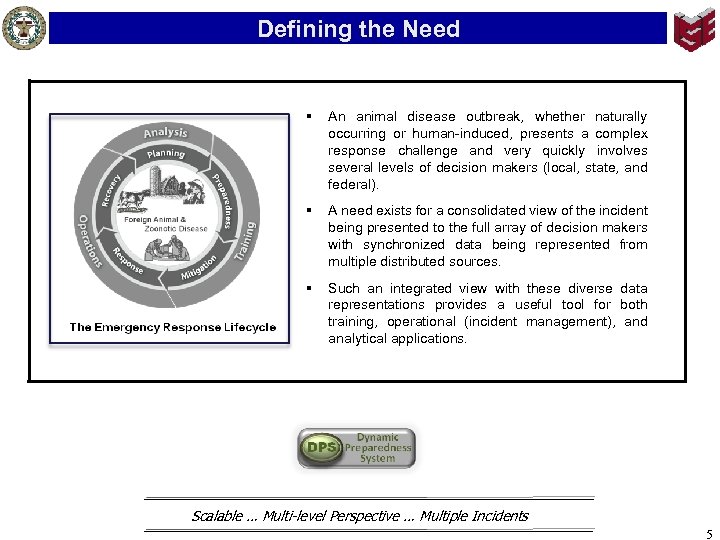
Defining the Need § An animal disease outbreak, whether naturally occurring or human-induced, presents a complex response challenge and very quickly involves several levels of decision makers (local, state, and federal). § A need exists for a consolidated view of the incident being presented to the full array of decision makers with synchronized data being represented from multiple distributed sources. § Such an integrated view with these diverse data representations provides a useful tool for both training, operational (incident management), and analytical applications. Scalable … Multi-level Perspective … Multiple Incidents 5
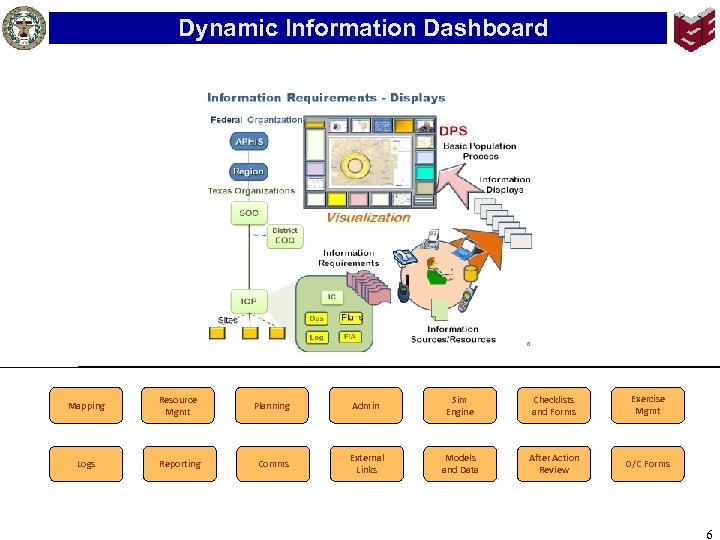
Dynamic Information Dashboard Mapping Resource Mgmt Planning Admin Sim Engine Checklists and Forms Exercise Mgmt Logs Reporting Comms External Links Models and Data After Action Review O/C Forms 6
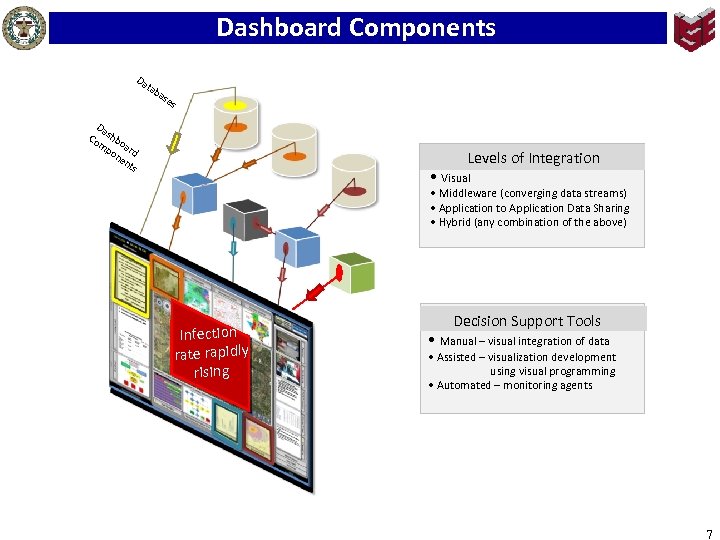
Dashboard Components Da tab ase s Da Co shbo mp ar on d en ts Levels of Integration • Visual • Middleware (converging data streams) • Application to Application Data Sharing • Hybrid (any combination of the above) Infection rate rapidly rising Decision Support Tools • Manual – visual integration of data • Assisted – visualization development using visual programming • Automated – monitoring agents 7
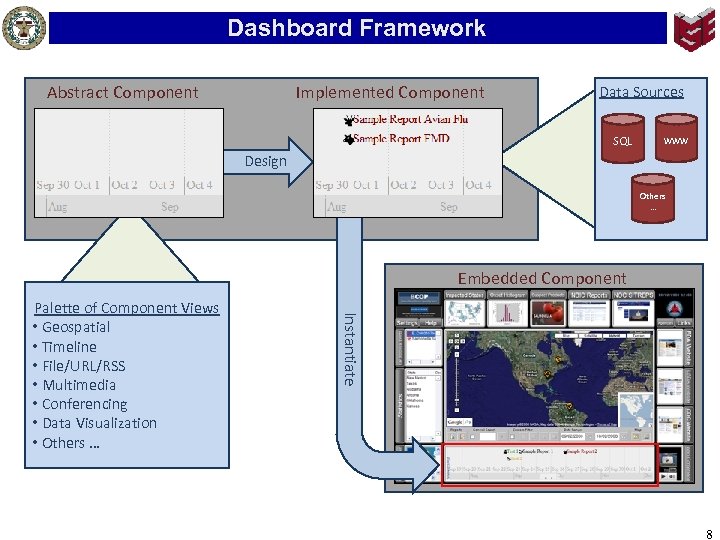
Dashboard Framework Abstract Component Implemented Component Data Sources SQL WWW Design Others … Embedded Component Instantiate Palette of Component Views • Geospatial • Timeline • File/URL/RSS • Multimedia • Conferencing • Data Visualization • Others … 8
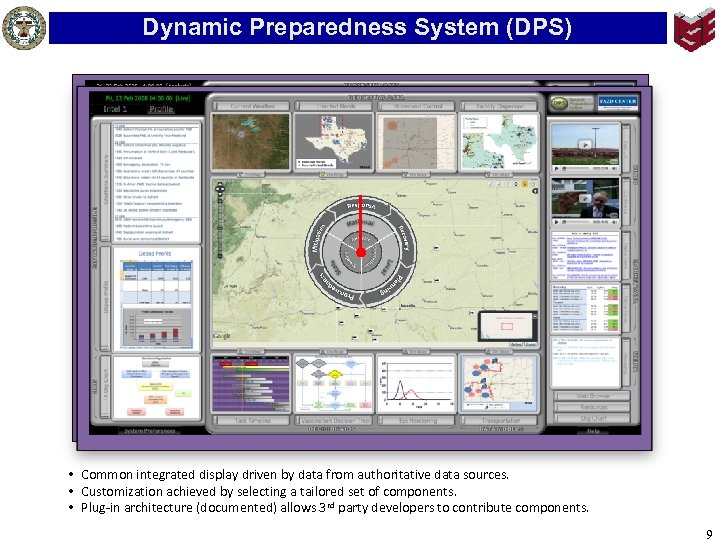
Dynamic Preparedness System (DPS) • Common integrated display driven by data from authoritative data sources. • Customization achieved by selecting a tailored set of components. • Plug-in architecture (documented) allows 3 rd party developers to contribute components. 9
Distributed Decision-Making 10
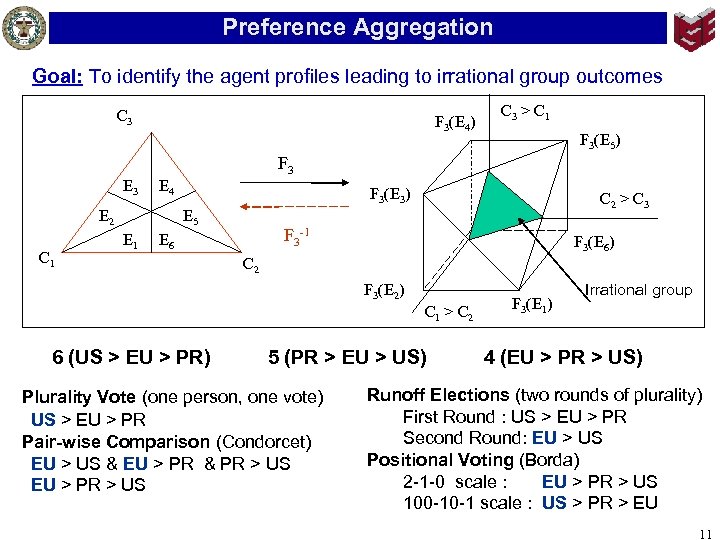
Preference Aggregation Goal: To identify the agent profiles leading to irrational group outcomes C 3 F 3(E 4) C 3 > C 1 F 3(E 5) F 3 E 4 E 2 C 1 F 3(E 3) E 5 E 1 C 2 > C 3 F 3 -1 E 6 F 3(E 6) C 2 F 3(E 2) C 1 > C 2 6 (US > EU > PR) 5 (PR > EU > US) Plurality Vote (one person, one vote) US > EU > PR Pair-wise Comparison (Condorcet) EU > US & EU > PR & PR > US EU > PR > US F 3(E 1) Irrational group 4 (EU > PR > US) Runoff Elections (two rounds of plurality) First Round : US > EU > PR Second Round: EU > US Positional Voting (Borda) 2 -1 -0 scale : EU > PR > US 100 -10 -1 scale : US > PR > EU 11
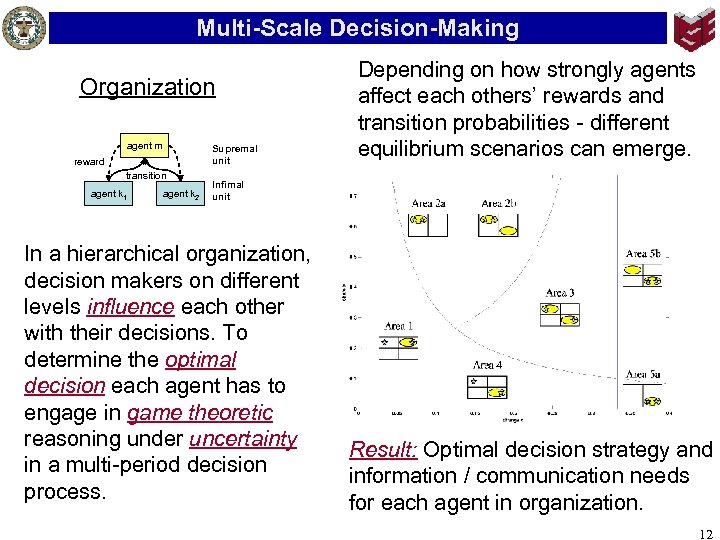
Multi-Scale Decision-Making Organization agent m reward transition agent k 1 agent k 2 Supremal unit Depending on how strongly agents affect each others’ rewards and transition probabilities - different equilibrium scenarios can emerge. Infimal unit In a hierarchical organization, decision makers on different levels influence each other with their decisions. To determine the optimal decision each agent has to engage in game theoretic reasoning under uncertainty in a multi-period decision process. Result: Optimal decision strategy and information / communication needs for each agent in organization. 12
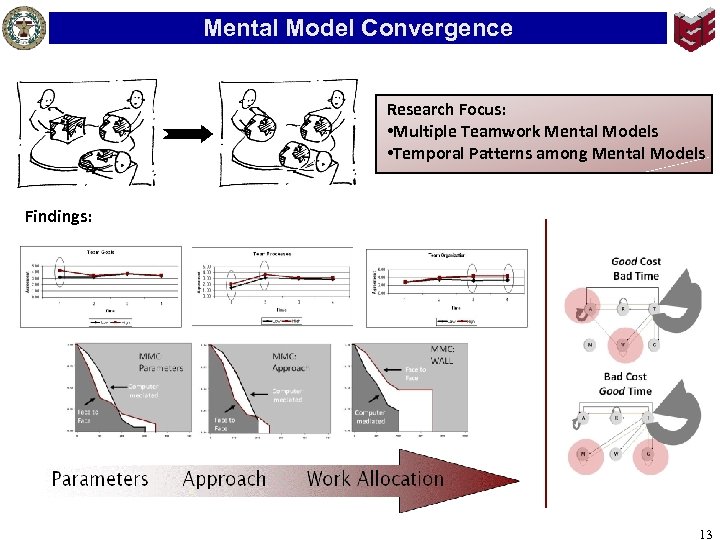
Mental Model Convergence Research Focus: • Multiple Teamwork Mental Models • Temporal Patterns among Mental Models Findings: 13
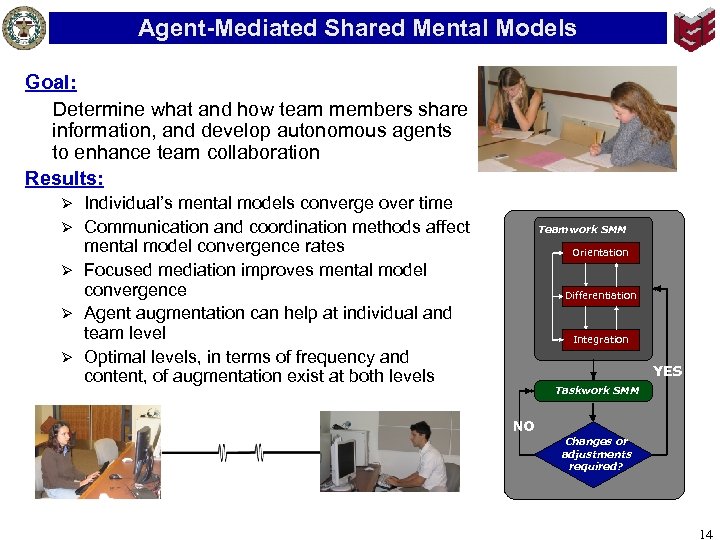
Agent-Mediated Shared Mental Models Goal: Determine what and how team members share information, and develop autonomous agents to enhance team collaboration Results: Ø Ø Ø Individual’s mental models converge over time Communication and coordination methods affect mental model convergence rates Focused mediation improves mental model convergence Agent augmentation can help at individual and team level Optimal levels, in terms of frequency and content, of augmentation exist at both levels Teamwork SMM Orientation Differentiation Integration YES Taskwork SMM NO Changes or adjustments required? 14
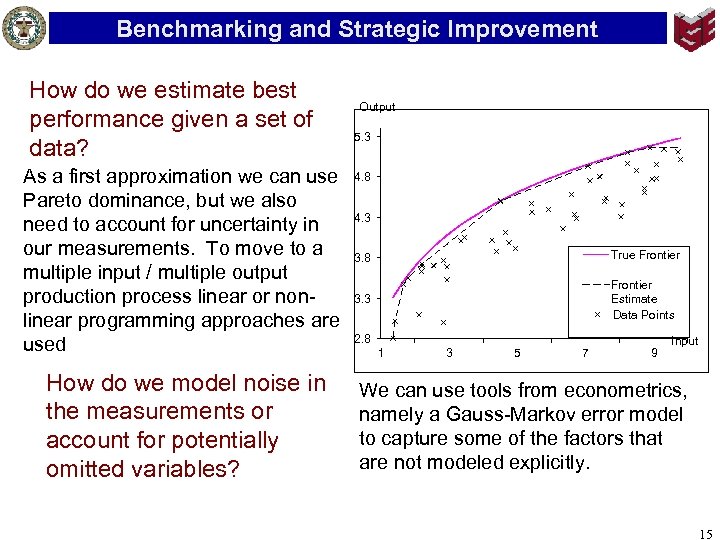
Benchmarking and Strategic Improvement How do we estimate best performance given a set of data? As a first approximation we can use Pareto dominance, but we also need to account for uncertainty in our measurements. To move to a multiple input / multiple output production process linear or nonlinear programming approaches are used How do we model noise in the measurements or account for potentially omitted variables? Output 5. 3 4. 8 4. 3 3. 8 True Frontier 3. 3 Frontier Estimate Data Points 2. 8 1 3 5 7 9 Input We can use tools from econometrics, namely a Gauss-Markov error model to capture some of the factors that are not modeled explicitly. 15
Complex Adaptive Systems 16
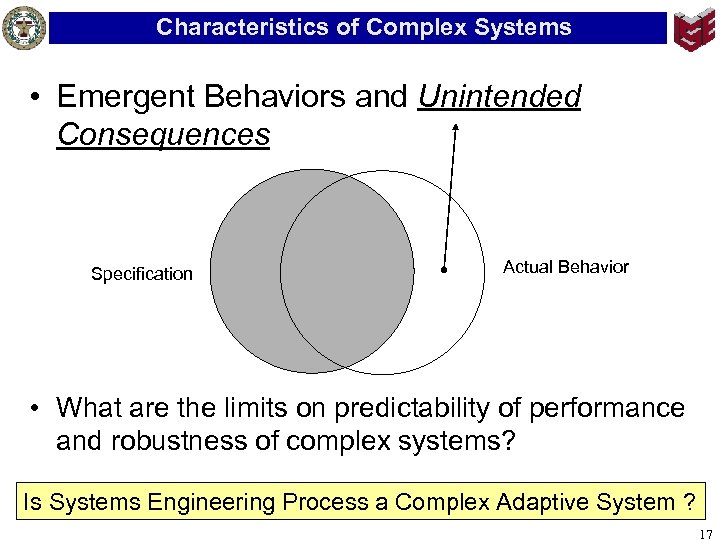
Characteristics of Complex Systems • Emergent Behaviors and Unintended Consequences Specification Actual Behavior • What are the limits on predictability of performance and robustness of complex systems? Is Systems Engineering Process a Complex Adaptive System ? 17
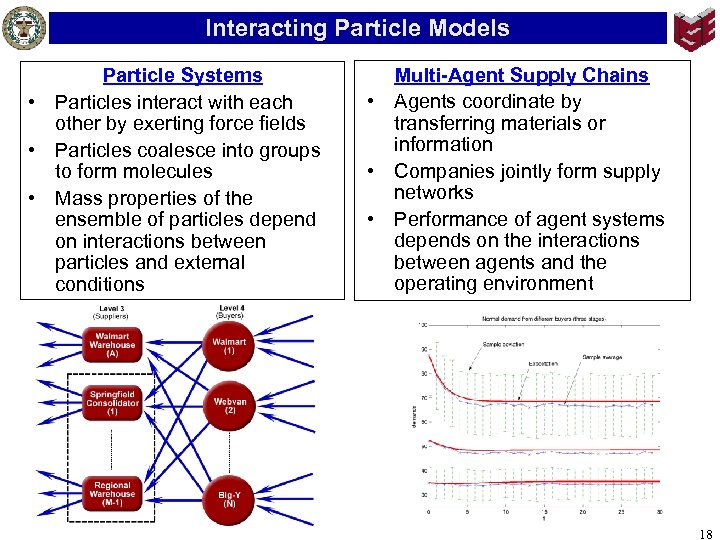
Interacting Particle Models Particle Systems • Particles interact with each other by exerting force fields • Particles coalesce into groups to form molecules • Mass properties of the ensemble of particles depend on interactions between particles and external conditions Multi-Agent Supply Chains • Agents coordinate by transferring materials or information • Companies jointly form supply networks • Performance of agent systems depends on the interactions between agents and the operating environment 18
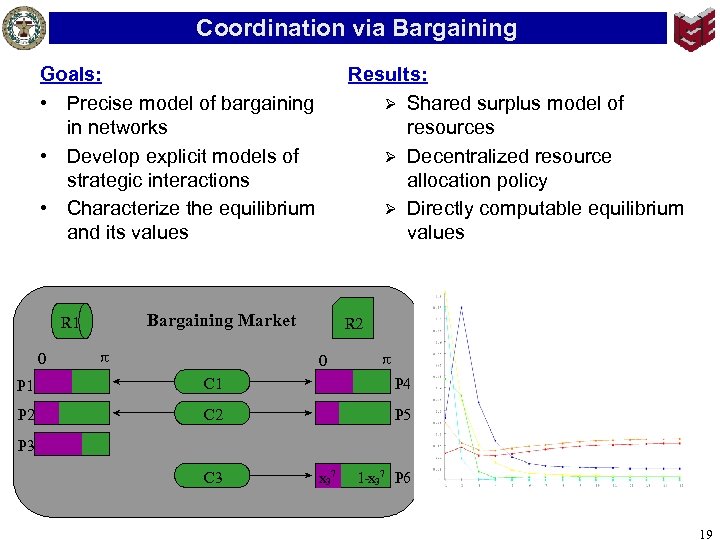
Coordination via Bargaining Goals: • Precise model of bargaining in networks • Develop explicit models of strategic interactions • Characterize the equilibrium and its values Bargaining Market R 1 0 Results: Ø Shared surplus model of resources Ø Decentralized resource allocation policy Ø Directly computable equilibrium values p R 2 0 p P 1 C 1 P 4 P 2 C 2 P 5 P 3 C 3 x 37 1 -x 37 P 6 19
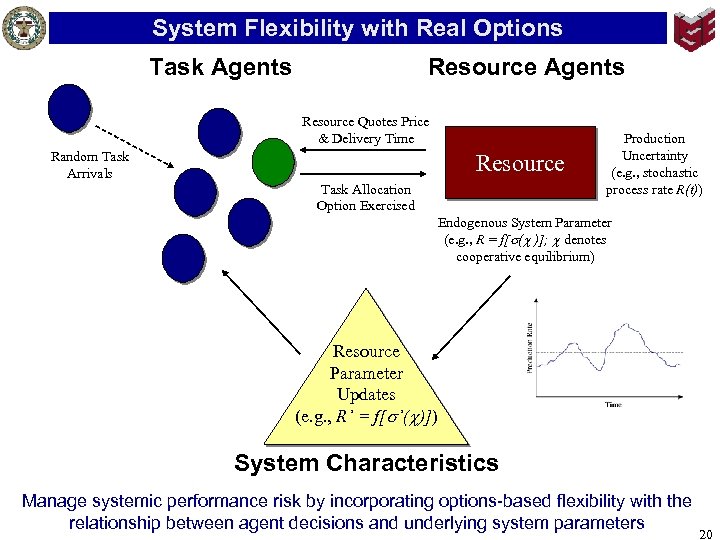
System Flexibility with Real Options Task Agents Resource Quotes Price & Delivery Time Random Task Arrivals Resource Task Allocation Option Exercised Production Uncertainty (e. g. , stochastic process rate R(t)) Endogenous System Parameter (e. g. , R = f[ ( )]; denotes cooperative equilibrium) Resource Parameter Updates (e. g. , R’ = f[ ’( )]) System Characteristics Manage systemic performance risk by incorporating options-based flexibility with the relationship between agent decisions and underlying system parameters 20
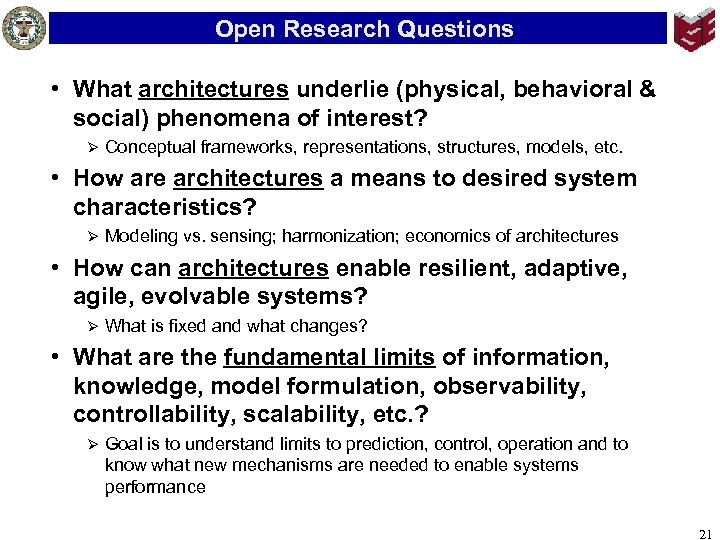
Open Research Questions • What architectures underlie (physical, behavioral & social) phenomena of interest? Ø Conceptual frameworks, representations, structures, models, etc. • How are architectures a means to desired system characteristics? Ø Modeling vs. sensing; harmonization; economics of architectures • How can architectures enable resilient, adaptive, agile, evolvable systems? Ø What is fixed and what changes? • What are the fundamental limits of information, knowledge, model formulation, observability, controllability, scalability, etc. ? Ø Goal is to understand limits to prediction, control, operation and to know what new mechanisms are needed to enable systems performance 21
Скачать презентацию Systems Engineering Research at Texas A M University Abhijit
1cca5b20d588ac64998ffacf88a67916.ppt