


 Скачать презентацию Systems Engineering 6 April 2004 SJ KAPURCH
0cd8944cc6e90b8f1ed867b065cf50cf.ppt
- Количество слайдов: 93
 Systems Engineering 6 April 2004 SJ KAPURCH PEO SYSTEMS ENGINEERING CODE D OCE HQ
 Purpose n Provide snapshot of state of Systems Engineering u NASA u DOD u Industry
 Outline n n n Background Overview SE NIAT SE Framework SE trends u u n Do. D Industry Summary
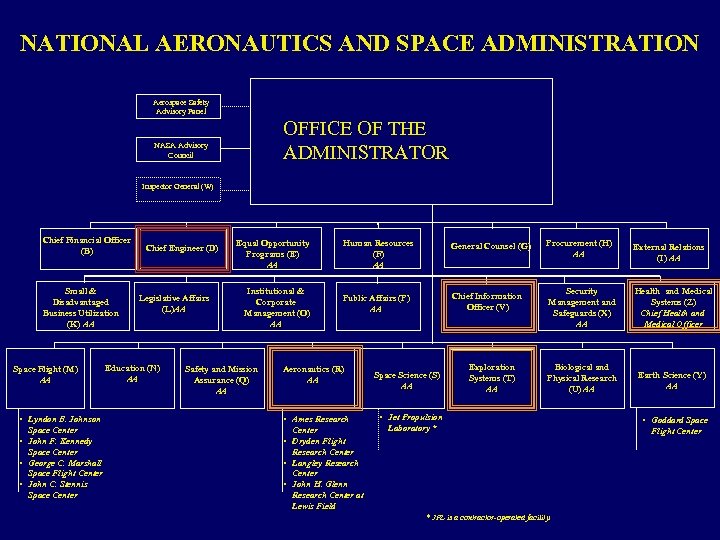 NATIONAL AERONAUTICS AND SPACE ADMINISTRATION Aerospace Safety Advisory Panel OFFICE OF THE ADMINISTRATOR NASA Advisory Council Inspector General (W) Chief Financial Officer (B) Small & Disadvantaged Business Utilization (K) AA Space Flight (M) AA Chief Engineer (D) Legislative Affairs (L)AA Education (N) AA Equal Opportunity Programs (E) AA Institutional & Corporate Management (O) AA Safety and Mission Assurance (Q) AA Human Resources (F) AA General Counsel (G) Public Affairs (P) AA Chief Information Officer (V) Aeronautics (R) AA • Lyndon B. Johnson • Ames Research Space Center • John F. Kennedy Space Center • George C. Marshall Space Flight Center • John C. Stennis Space Center • Dryden Flight Research Center • Langley Research Center • John H. Glenn Research Center at Lewis Field Space Science (S) AA Exploration Systems (T) AA Procurement (H) AA External Relations (I) AA Security Management and Safeguards (X) AA Health and Medical Systems (Z) Chief Health and Medical Officer Biological and Physical Research (U) AA Earth Science (Y) AA • Jet Propulsion Laboratory * * JPL is a contractor-operated facility. • Goddard Space Flight Center
 Outline n Background u n n NASA SE Framework SE trends u u n NIAT Do. D Industry Summary
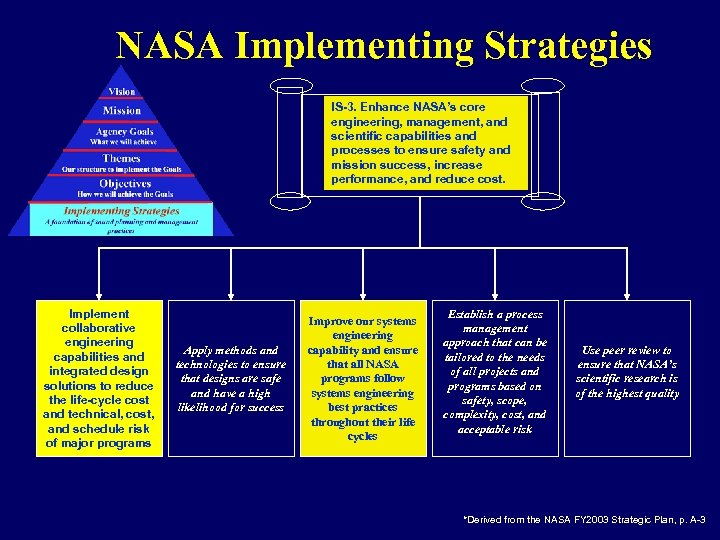 NASA Implementing Strategies IS-3. Enhance NASA’s core engineering, management, and scientific capabilities and processes to ensure safety and mission success, increase performance, and reduce cost. Implement collaborative engineering capabilities and integrated design solutions to reduce the life-cycle cost and technical, cost, and schedule risk of major programs Apply methods and technologies to ensure that designs are safe and have a high likelihood for success Improve our systems engineering capability and ensure that all NASA programs follow systems engineering best practices throughout their life cycles Establish a process management approach that can be tailored to the needs of all projects and programs based on safety, scope, complexity, cost, and acceptable risk Use peer review to ensure that NASA’s scientific research is of the highest quality *Derived from the NASA FY 2003 Strategic Plan, p. A-3
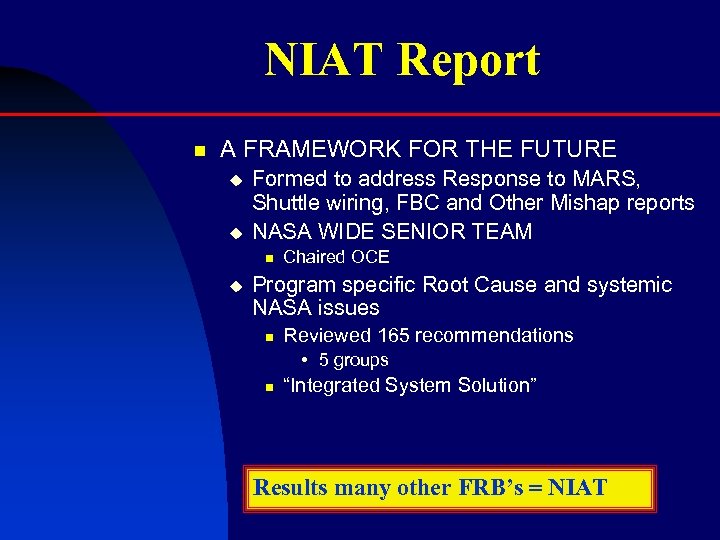 NIAT Report n A FRAMEWORK FOR THE FUTURE u u Formed to address Response to MARS, Shuttle wiring, FBC and Other Mishap reports NASA WIDE SENIOR TEAM n u Chaired OCE Program specific Root Cause and systemic NASA issues n Reviewed 165 recommendations • 5 groups n “Integrated System Solution” Results many other FRB’s = NIAT
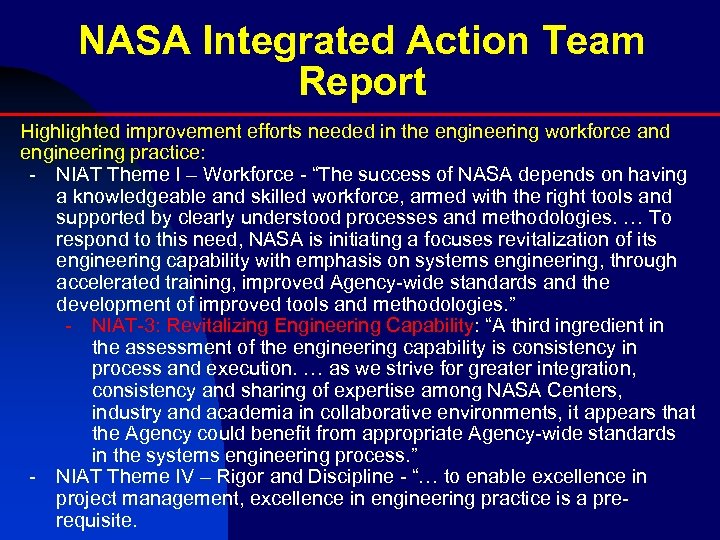 NASA Integrated Action Team Report Highlighted improvement efforts needed in the engineering workforce and engineering practice: - NIAT Theme I – Workforce - “The success of NASA depends on having a knowledgeable and skilled workforce, armed with the right tools and supported by clearly understood processes and methodologies. … To respond to this need, NASA is initiating a focuses revitalization of its engineering capability with emphasis on systems engineering, through accelerated training, improved Agency-wide standards and the development of improved tools and methodologies. ” - NIAT-3: Revitalizing Engineering Capability: “A third ingredient in the assessment of the engineering capability is consistency in process and execution. … as we strive for greater integration, consistency and sharing of expertise among NASA Centers, industry and academia in collaborative environments, it appears that the Agency could benefit from appropriate Agency-wide standards in the systems engineering process. ” - NIAT Theme IV – Rigor and Discipline - “… to enable excellence in project management, excellence in engineering practice is a prerequisite.
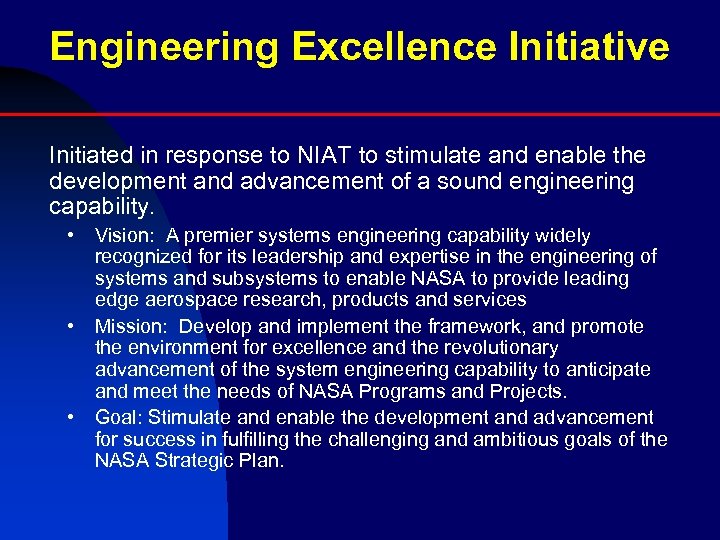 Engineering Excellence Initiative Initiated in response to NIAT to stimulate and enable the development and advancement of a sound engineering capability. • Vision: A premier systems engineering capability widely recognized for its leadership and expertise in the engineering of systems and subsystems to enable NASA to provide leading edge aerospace research, products and services • Mission: Develop and implement the framework, and promote the environment for excellence and the revolutionary advancement of the system engineering capability to anticipate and meet the needs of NASA Programs and Projects. • Goal: Stimulate and enable the development and advancement for success in fulfilling the challenging and ambitious goals of the NASA Strategic Plan.
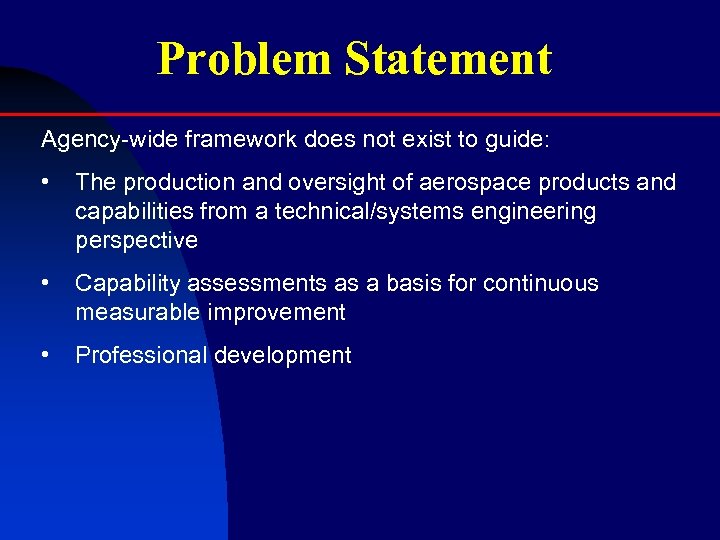 Problem Statement Agency-wide framework does not exist to guide: • The production and oversight of aerospace products and capabilities from a technical/systems engineering perspective • Capability assessments as a basis for continuous measurable improvement • Professional development
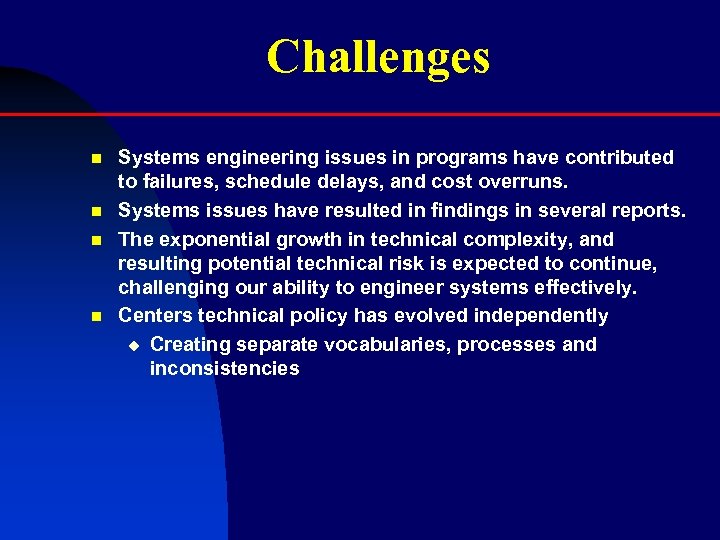 Challenges n n Systems engineering issues in programs have contributed to failures, schedule delays, and cost overruns. Systems issues have resulted in findings in several reports. The exponential growth in technical complexity, and resulting potential technical risk is expected to continue, challenging our ability to engineer systems effectively. Centers technical policy has evolved independently u Creating separate vocabularies, processes and inconsistencies
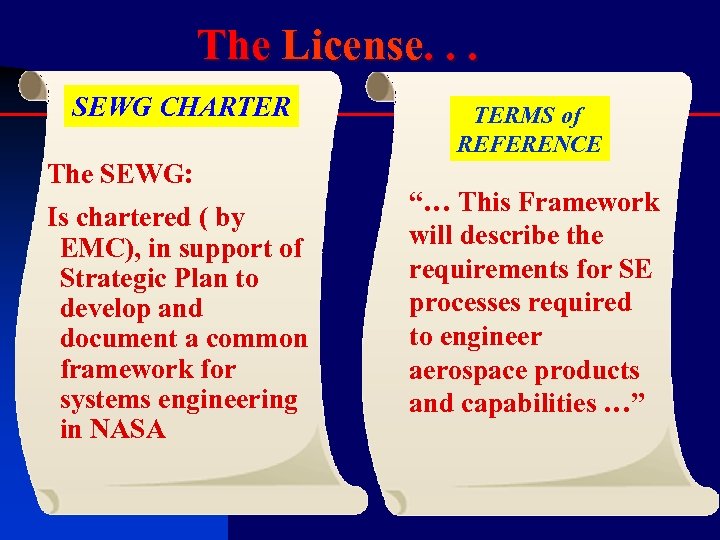 The License. . . SEWG CHARTER The SEWG: Is chartered ( by EMC), in support of Strategic Plan to develop and document a common framework for systems engineering in NASA TERMS of REFERENCE “… This Framework will describe the requirements for SE processes required to engineer aerospace products and capabilities …”
 Specific Needs Need: Consistency in basic approach to systems engineering Need: Common framework of recognized best practices that guides the systems engineering of aerospace program and project products and capabilities. Need: Common systems engineering terminology and definitions to enhance communication and collaboration among engineering teams across the Agency and with external partners and customers. Need: Basis for assessing and continuously improving systems engineering capabilities.
 Expectations n n n The NASA SEWG represents the interests of the Agency, and not the parochial interests of a particular Center Commitment to a product that we can be proud of Openness and honesty Willingness to take an introspective look at the present state and dare to push the envelope for what it could be Leadership within the SEWG and at the Centers for the vision to become reality No attribution or retribution for the sharing of ideas
 Expected Benefits n Enable and foster excellence in systems engineering capabilities to: u u n n Formulate feasible program and project concepts. Deliver required products and services to NASA customers. Make timely acquisition of enabling products and critical technologies. Reduce risk in system development and deployment. Enable more effective communications and collaboration within NASA and with external partners and customers. Conduct effective assessment and improvement of systems engineering capabilities. Develop strategic focus for advanced engineering environments. Change the culture to represent the needs of one NASA, and not the unique needs of a particular Center.
 Outline n Background u n n NASA SE Framework SE trends u u n NIAT Do. D Industry Summary
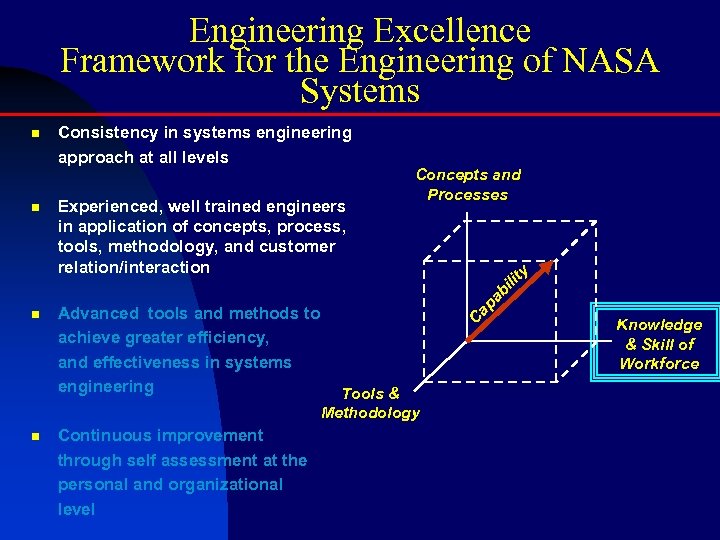
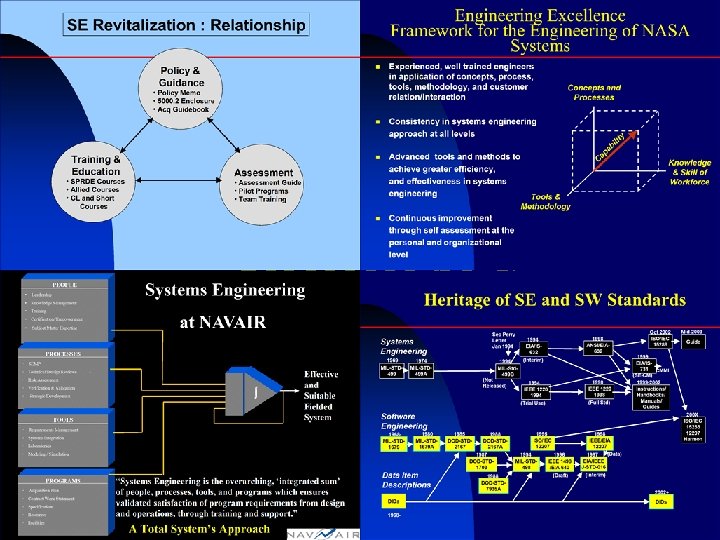
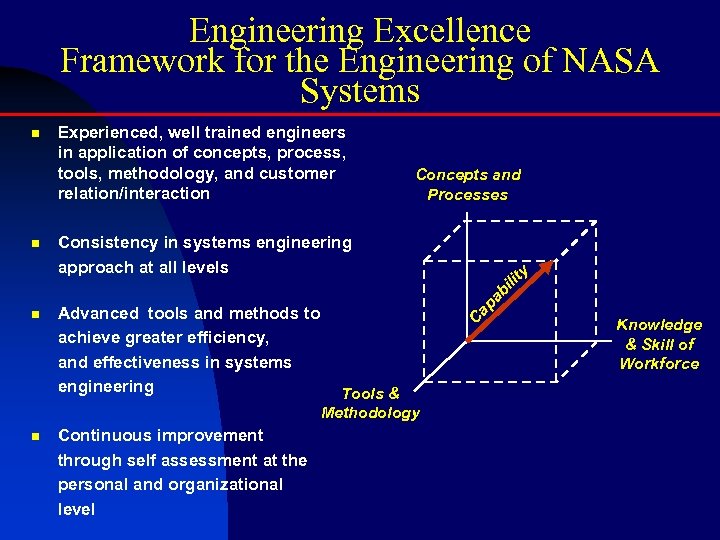 Engineering Excellence Framework for the Engineering of NASA Systems Experienced, well trained engineers in application of concepts, process, tools, methodology, and customer relation/interaction n Consistency in systems engineering approach at all levels n Concepts and Processes Advanced tools and methods to achieve greater efficiency, and effectiveness in systems engineering Tools & Methodology n Continuous improvement through self assessment at the personal and organizational level Ca pa bi lit y n Knowledge & Skill of Workforce
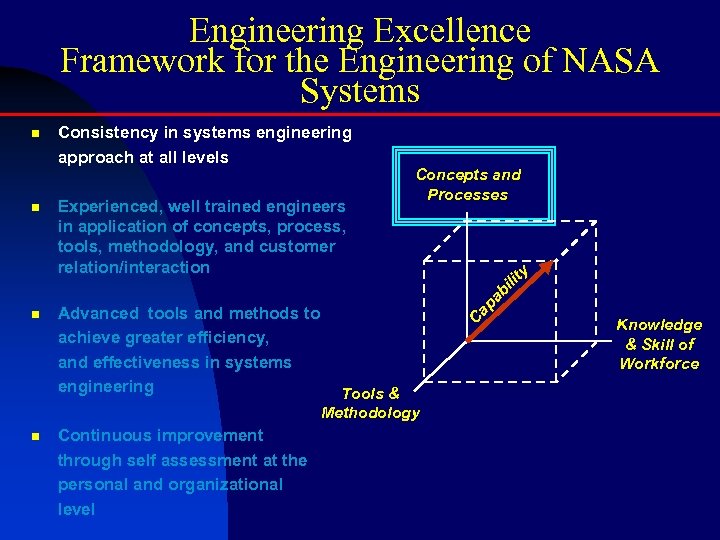 Engineering Excellence Framework for the Engineering of NASA Systems Consistency in systems engineering approach at all levels n Experienced, well trained engineers in application of concepts, process, tools, methodology, and customer relation/interaction n Concepts and Processes Advanced tools and methods to achieve greater efficiency, and effectiveness in systems engineering Tools & Methodology n Continuous improvement through self assessment at the personal and organizational level Ca pa bi lit y n Knowledge & Skill of Workforce
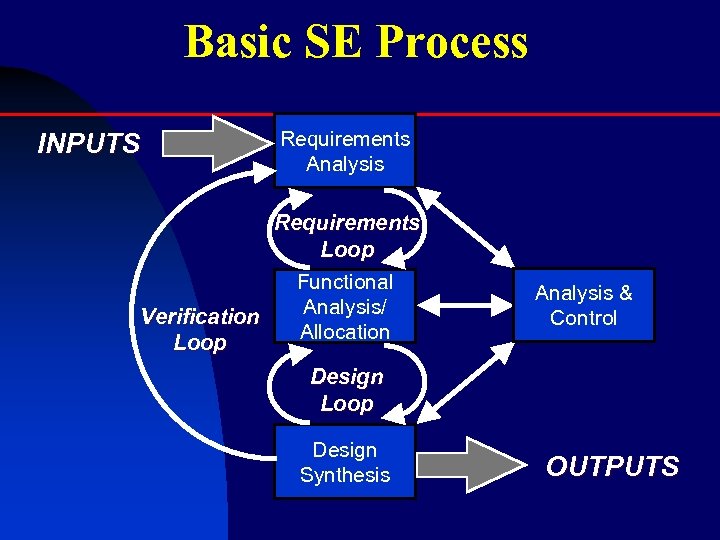 Basic SE Process INPUTS Requirements Analysis Requirements Loop Functional Analysis/ Verification Allocation Loop Design Synthesis Analysis & Control OUTPUTS
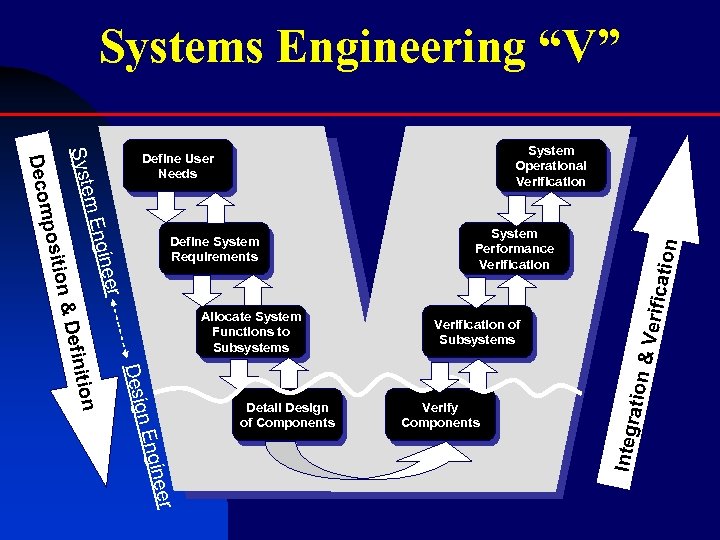 Systems Engineering “V” ginee System Performance Verification n m En Define System Requirements Verify Components ation n E ng Detail Design of Components Verification of Subsystems ineer Integr D e si g ition Defin Allocate System Functions to Subsystems & Ver if r icatio Syste ition & mpos Deco System Operational Verification Define User Needs
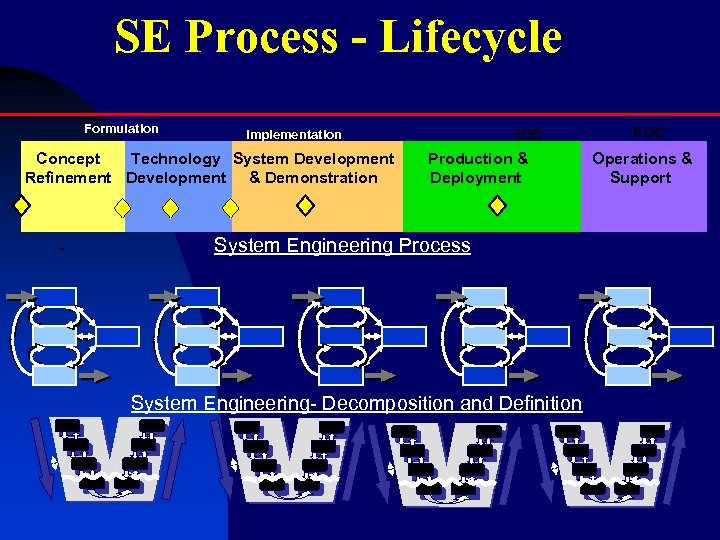 SE Process - Lifecycle Formulation Concept Technology System Development Refinement Development & Demonstration Concept Decision - IOC Initiation) Implementation Design Readiness Review Production & Deployment LRIP/IOT&E FRP Decision Review System Engineering Process System Engineering- Decomposition and Definition FOC Operations & Support
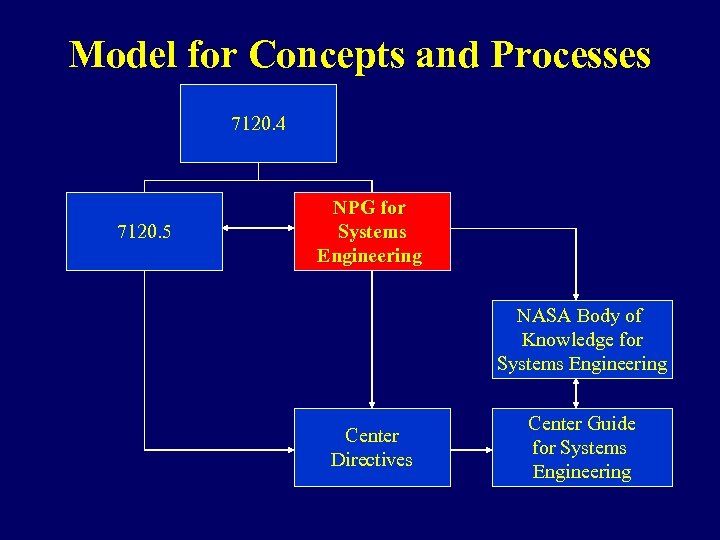 Model for Concepts and Processes 7120. 4 7120. 5 NPG for Systems Engineering NASA Body of Knowledge for Systems Engineering Center Directives Center Guide for Systems Engineering
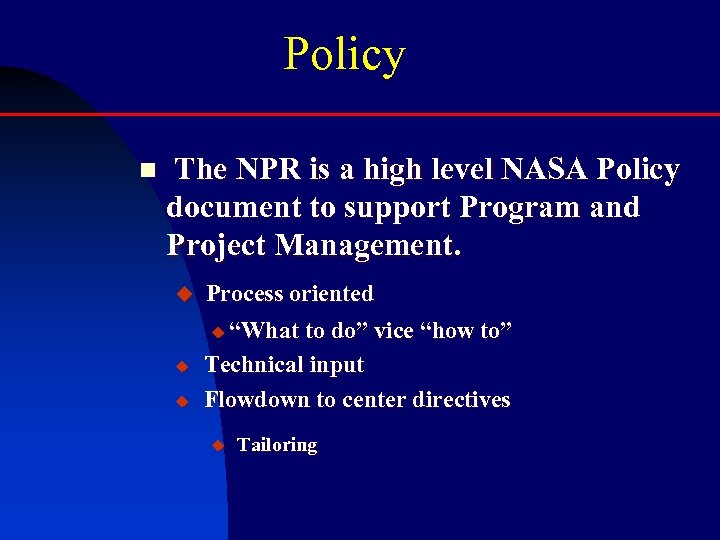 Policy n The NPR is a high level NASA Policy document to support Program and Project Management. u Process oriented “What to do” vice “how to” Technical input Flowdown to center directives u u Tailoring
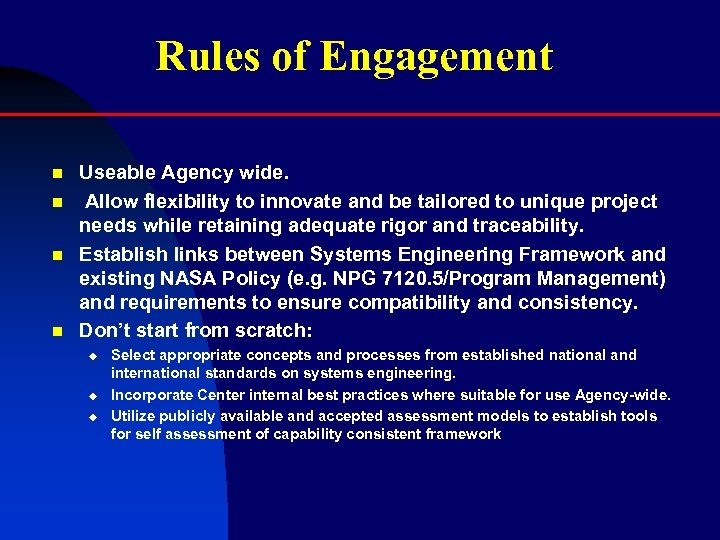 Rules of Engagement n n Useable Agency wide. Allow flexibility to innovate and be tailored to unique project needs while retaining adequate rigor and traceability. Establish links between Systems Engineering Framework and existing NASA Policy (e. g. NPG 7120. 5/Program Management) and requirements to ensure compatibility and consistency. Don’t start from scratch: u u u Select appropriate concepts and processes from established national and international standards on systems engineering. Incorporate Center internal best practices where suitable for use Agency-wide. Utilize publicly available and accepted assessment models to establish tools for self assessment of capability consistent framework
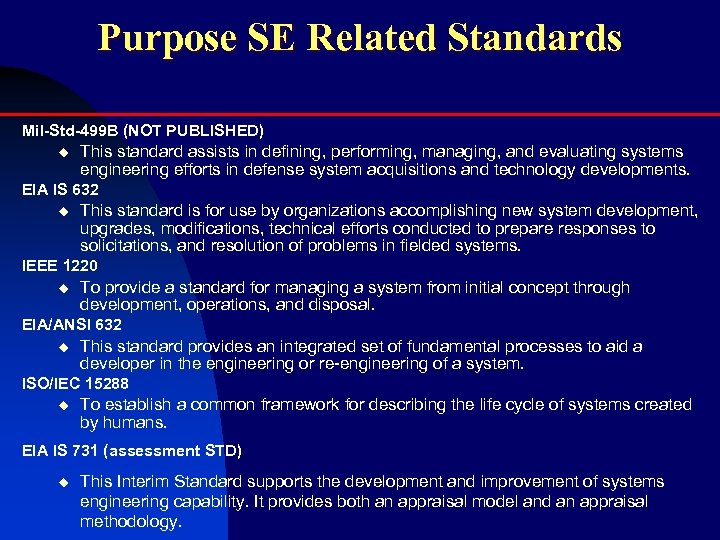 Purpose SE Related Standards Mil-Std-499 B (NOT PUBLISHED) u This standard assists in defining, performing, managing, and evaluating systems engineering efforts in defense system acquisitions and technology developments. EIA IS 632 u This standard is for use by organizations accomplishing new system development, upgrades, modifications, technical efforts conducted to prepare responses to solicitations, and resolution of problems in fielded systems. IEEE 1220 u To provide a standard for managing a system from initial concept through development, operations, and disposal. EIA/ANSI 632 u This standard provides an integrated set of fundamental processes to aid a developer in the engineering or re-engineering of a system. ISO/IEC 15288 u To establish a common framework for describing the life cycle of systems created by humans. EIA IS 731 (assessment STD) u This Interim Standard supports the development and improvement of systems engineering capability. It provides both an appraisal model and an appraisal methodology.
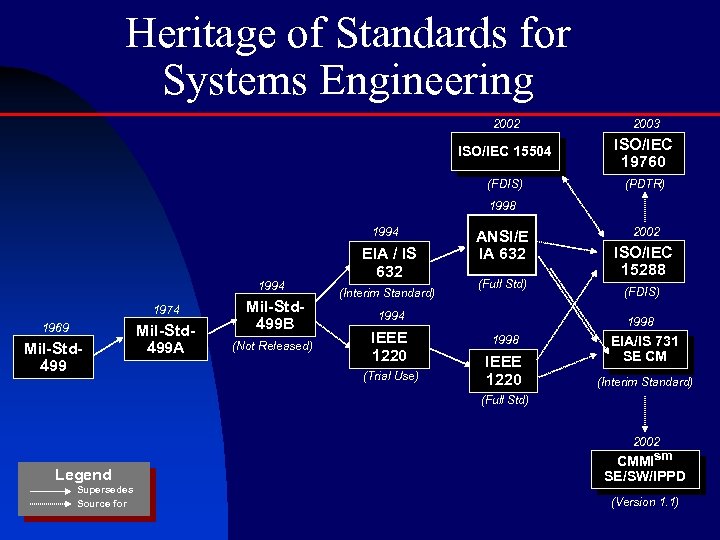 Heritage of Standards for Systems Engineering 2002 2003 ISO/IEC 15504 ISO/IEC 19760 (FDIS) (PDTR) 1998 1994 1974 1969 Mil-Std 499 A Mil-Std 499 B (Not Released) EIA / IS 632 (Interim Standard) ANSI/E IA 632 (Full Std) 1994 IEEE 1220 (Trial Use) 2002 ISO/IEC 15288 (FDIS) 1998 IEEE 1220 EIA/IS 731 SE CM (Interim Standard) (Full Std) 2002 Legend Supersedes Source for CMMIsm SE/SW/IPPD (Version 1. 1)
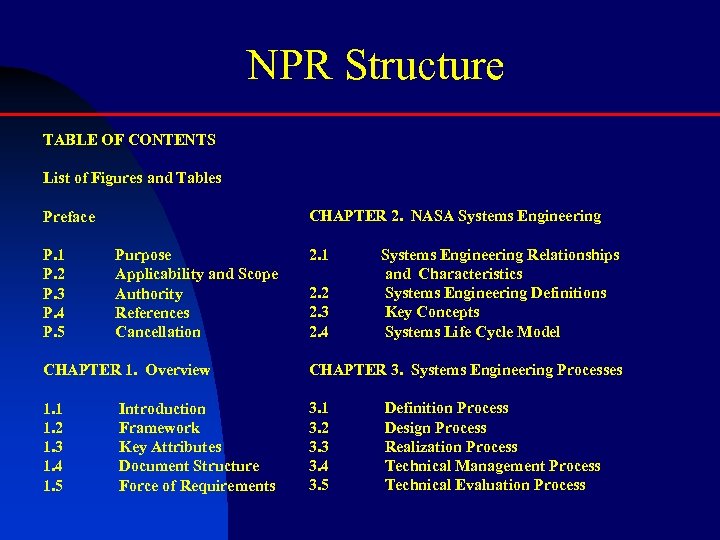 NPR Structure TABLE OF CONTENTS List of Figures and Tables Preface P. 1 Purpose P. 2 Applicability and Scope P. 3 Authority P. 4 References P. 5 Cancellation CHAPTER 1. Overview 1. 1 Introduction 1. 2 Framework 1. 3 Key Attributes 1. 4 Document Structure 1. 5 Force of Requirements CHAPTER 2. NASA Systems Engineering 2. 1 Systems Engineering Relationships and Characteristics 2. 2 Systems Engineering Definitions 2. 3 Key Concepts 2. 4 Systems Life Cycle Model CHAPTER 3. Systems Engineering Processes 3. 1 Definition Process 3. 2 Design Process 3. 3 Realization Process 3. 4 Technical Management Process 3. 5 Technical Evaluation Process
 Engineering Excellence Framework for the Engineering of NASA Systems Consistency in systems engineering approach at all levels n Experienced, well trained engineers in application of concepts, process, tools, methodology, and customer relation/interaction n Concepts and Processes Advanced tools and methods to achieve greater efficiency, and effectiveness in systems engineering Tools & Methodology n Continuous improvement through self assessment at the personal and organizational level Ca pa bi lit y n Knowledge & Skill of Workforce
 Workforce n Key is well trained workforce u n NET u n Multi-tier approach Crossman study Emphasis is on Systems Approach u Vice all Systems Engineers
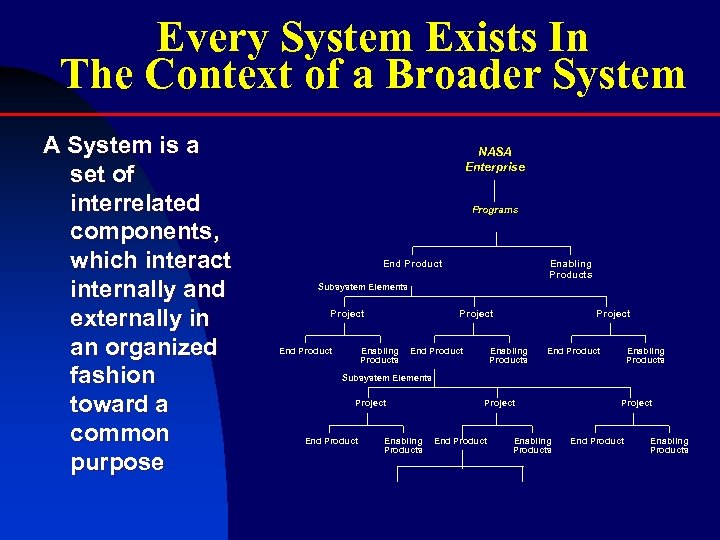 Every System Exists In The Context of a Broader System A System is a set of interrelated components, which interact internally and externally in an organized fashion toward a common purpose NASA Enterprise Programs End Product Enabling Products Subsystem Elements Project End Product Project Enabling Products End Product Enabling Products Subsystem Elements Project End Product Enabling Products
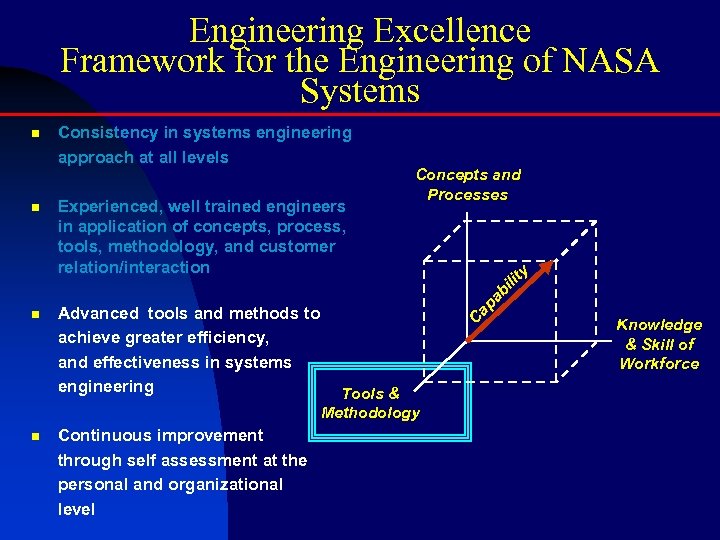 Engineering Excellence Framework for the Engineering of NASA Systems Consistency in systems engineering approach at all levels n Experienced, well trained engineers in application of concepts, process, tools, methodology, and customer relation/interaction n Concepts and Processes Advanced tools and methods to achieve greater efficiency, and effectiveness in systems engineering Tools & Methodology n Continuous improvement through self assessment at the personal and organizational level Ca pa bi lit y n Knowledge & Skill of Workforce
 Pre-Assessment Plan for Systems Engineering
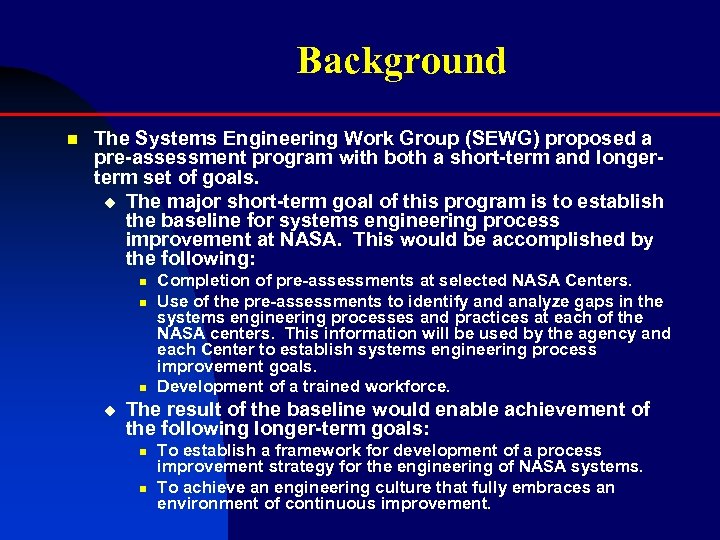 Background n The Systems Engineering Work Group (SEWG) proposed a pre-assessment program with both a short-term and longerterm set of goals. u The major short-term goal of this program is to establish the baseline for systems engineering process improvement at NASA. This would be accomplished by the following: n n n u Completion of pre-assessments at selected NASA Centers. Use of the pre-assessments to identify and analyze gaps in the systems engineering processes and practices at each of the NASA centers. This information will be used by the agency and each Center to establish systems engineering process improvement goals. Development of a trained workforce. The result of the baseline would enable achievement of the following longer-term goals: n n To establish a framework for development of a process improvement strategy for the engineering of NASA systems. To achieve an engineering culture that fully embraces an environment of continuous improvement.
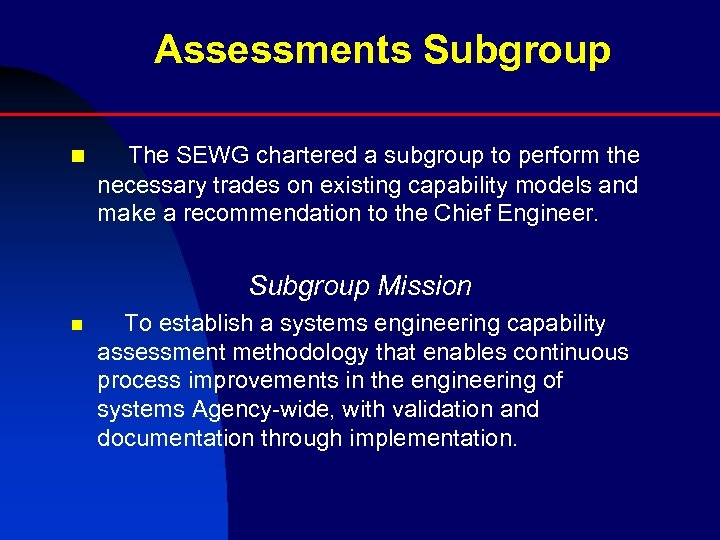 Assessments Subgroup n The SEWG chartered a subgroup to perform the necessary trades on existing capability models and make a recommendation to the Chief Engineer. Subgroup Mission n To establish a systems engineering capability assessment methodology that enables continuous process improvements in the engineering of systems Agency-wide, with validation and documentation through implementation.
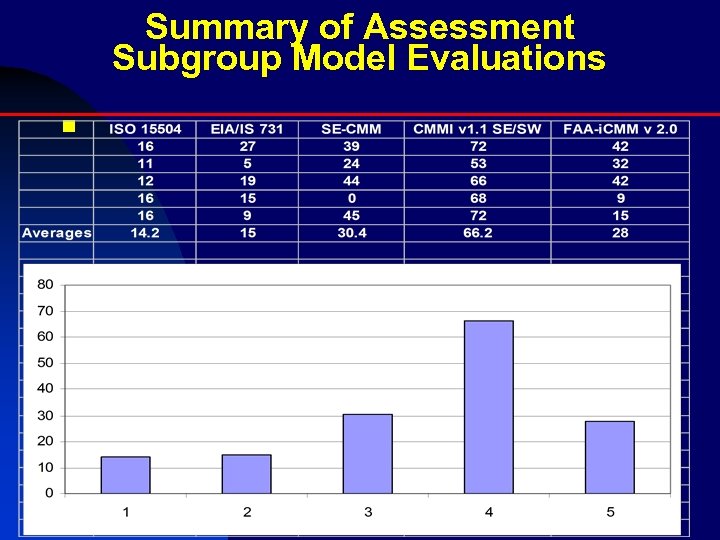
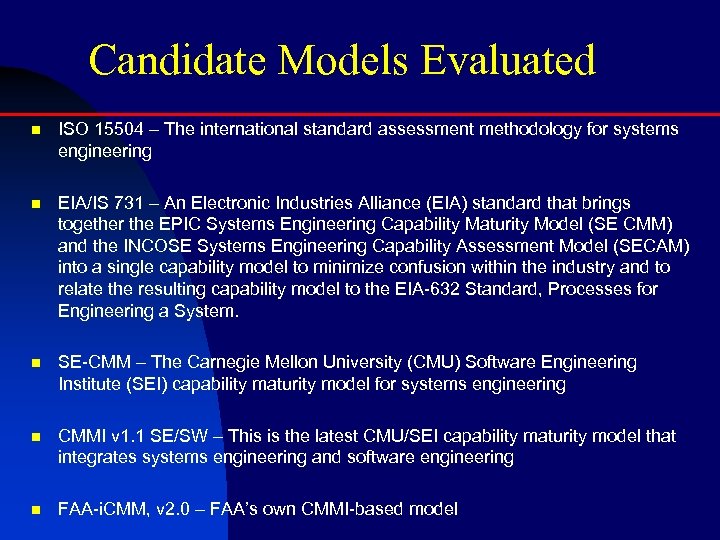 Candidate Models Evaluated n ISO 15504 – The international standard assessment methodology for systems engineering n EIA/IS 731 – An Electronic Industries Alliance (EIA) standard that brings together the EPIC Systems Engineering Capability Maturity Model (SE CMM) and the INCOSE Systems Engineering Capability Assessment Model (SECAM) into a single capability model to minimize confusion within the industry and to relate the resulting capability model to the EIA-632 Standard, Processes for Engineering a System. n SE-CMM – The Carnegie Mellon University (CMU) Software Engineering Institute (SEI) capability maturity model for systems engineering n CMMI v 1. 1 SE/SW – This is the latest CMU/SEI capability maturity model that integrates systems engineering and software engineering n FAA-i. CMM, v 2. 0 – FAA’s own CMMI-based model
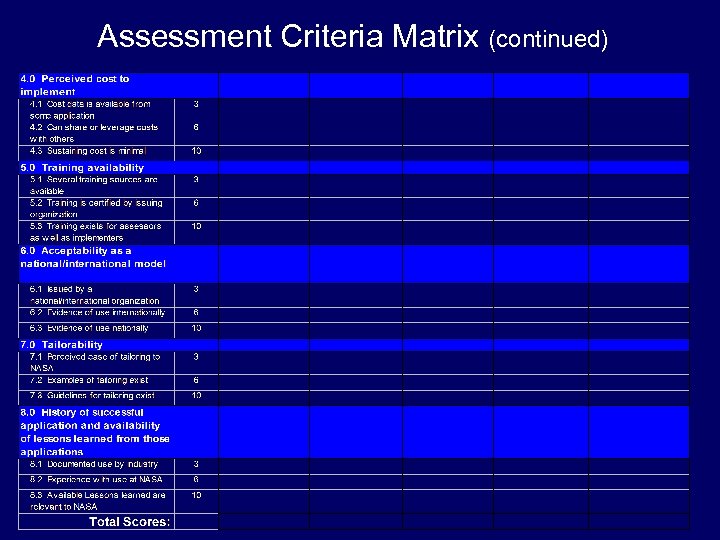
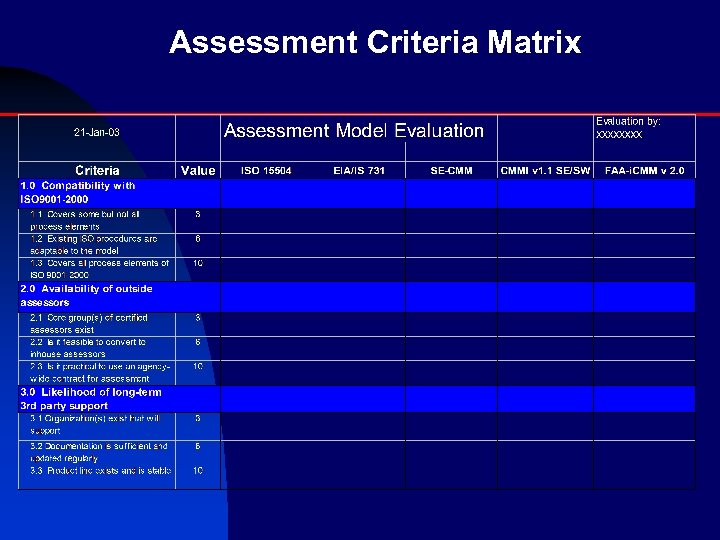 Assessment Criteria Matrix
 Assessment Criteria Matrix (continued)
 Summary of Assessment Subgroup Model Evaluations n
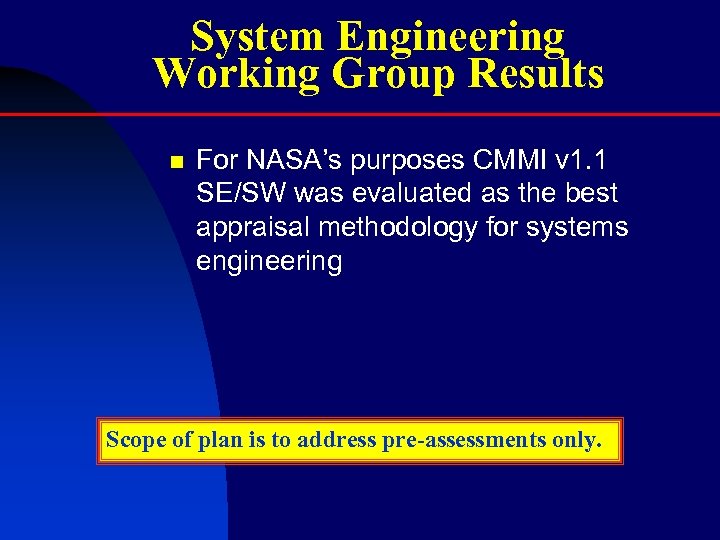 System Engineering Working Group Results n For NASA’s purposes CMMI v 1. 1 SE/SW was evaluated as the best appraisal methodology for systems engineering Scope of plan is to address pre-assessments only.
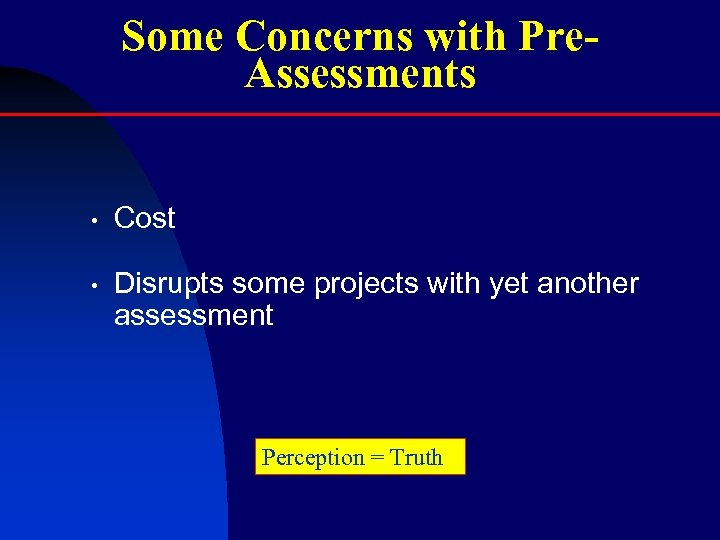 Some Concerns with Pre. Assessments • Cost • Disrupts some projects with yet another assessment Perception = Truth
 Advantages of Pre-Assessments • • Provides information in response to EMB action item, “What problem are we trying to solve? ” Multiple reports have indicated SE problems. Enables establishment of a current NASA-wide baseline for systems engineering processes Enables identification of gaps that exist in NASA-wide systems engineering terminologies, definitions, concepts and processes Identifies training deficiencies Enables justification of the NASA-wide standardization of processes Enables content improvement and identifies emphasis areas for the SE NPR
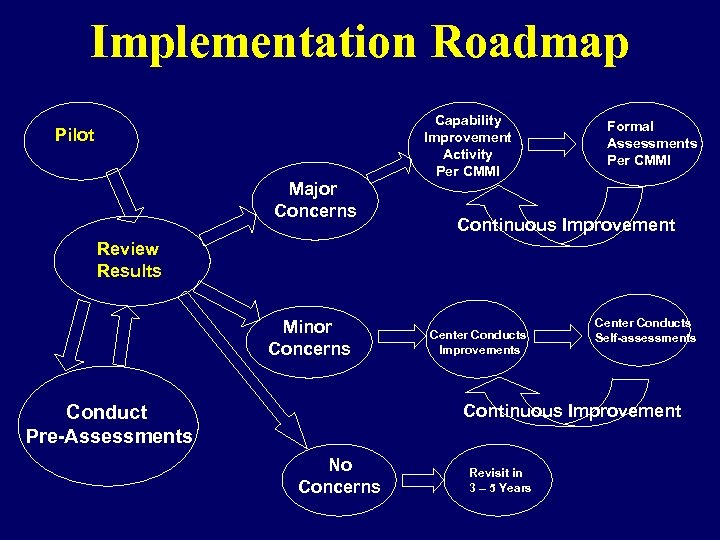 Implementation Roadmap Capability Improvement Activity Per CMMI Pilot Major Concerns Formal Assessments Per CMMI Continuous Improvement Review Results Minor Concerns Center Conducts Improvements Center Conducts Self-assessments Continuous Improvement Conduct Pre-Assessments No Concerns Revisit in 3 – 5 Years
 Proposed Approach • • • One pre-assessment per center. Two to three projects assessed per center. Four day period for each pre-assessment. Three external assessors and two NASA assessors. Same five assessors conduct each pre-assessment. One center representative participates in their center’s preassessment and provides liaison support. • Code AE contractor to monitor consistency, provide progress reports and complete the integrated final report. • Use a tailored CMMI-SE as the assessment tool. Results from a quick-look systems engineering assessment conducted at GSFC during 2002 indicate the value and feasibility of using a tailored CMMI-SE approach
 Pilot Objective n Specifically answers to the following questions were sought: u Will a CMMI based pre-assessment provide the desired baseline information? u How much effort is required for PIID preparation? u What were the major issues encountered? u How were the encountered issues resolved? u Was the initial PIID training received sufficient? u What is the impact on the projects that participated in discovery activities? u Was the level of CMMI practices selected (level 3) appropriate? u Are the CMMI model and the approaches used by pilot recommended for the conduct of pre-assessments at other selected NASA Centers?
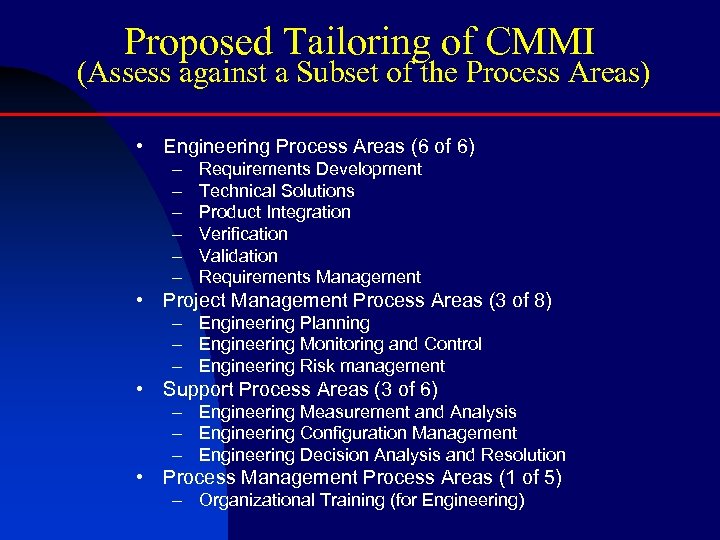 Proposed Tailoring of CMMI (Assess against a Subset of the Process Areas) • Engineering Process Areas (6 of 6) – – – Requirements Development Technical Solutions Product Integration Verification Validation Requirements Management • Project Management Process Areas (3 of 8) – Engineering Planning – Engineering Monitoring and Control – Engineering Risk management • Support Process Areas (3 of 6) – Engineering Measurement and Analysis – Engineering Configuration Management – Engineering Decision Analysis and Resolution • Process Management Process Areas (1 of 5) – Organizational Training (for Engineering)
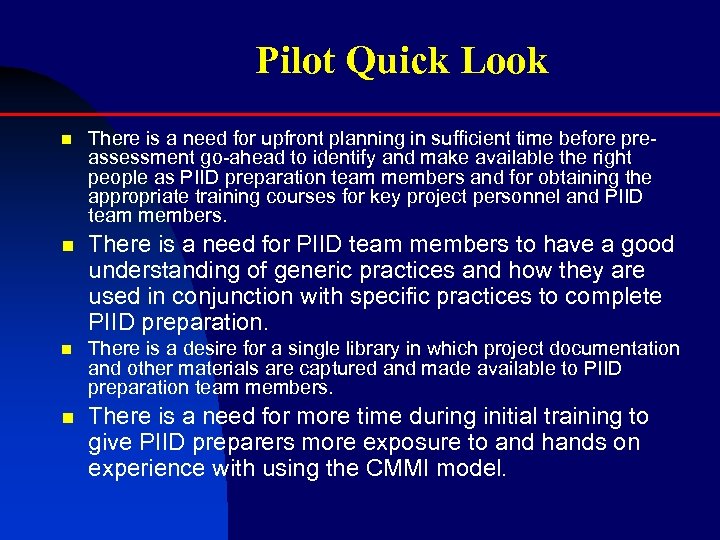 Pilot Quick Look n There is a need for upfront planning in sufficient time before preassessment go-ahead to identify and make available the right people as PIID preparation team members and for obtaining the appropriate training courses for key project personnel and PIID team members. n There is a need for PIID team members to have a good understanding of generic practices and how they are used in conjunction with specific practices to complete PIID preparation. n There is a desire for a single library in which project documentation and other materials are captured and made available to PIID preparation team members. n There is a need for more time during initial training to give PIID preparers more exposure to and hands on experience with using the CMMI model.
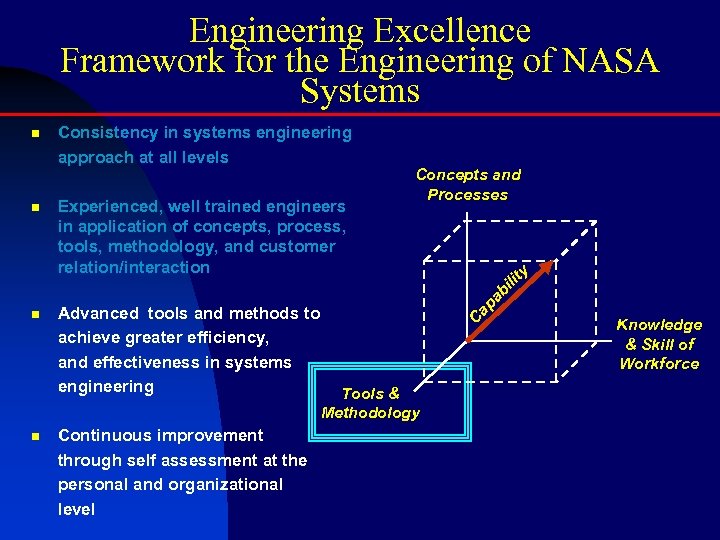 Engineering Excellence Framework for the Engineering of NASA Systems Consistency in systems engineering approach at all levels n Experienced, well trained engineers in application of concepts, process, tools, methodology, and customer relation/interaction n Concepts and Processes Advanced tools and methods to achieve greater efficiency, and effectiveness in systems engineering Tools & Methodology n Continuous improvement through self assessment at the personal and organizational level Ca pa bi lit y n Knowledge & Skill of Workforce
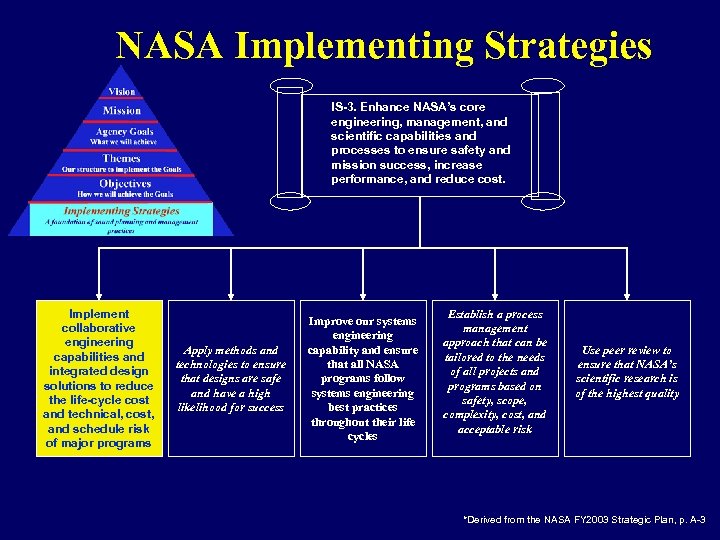 NASA Implementing Strategies IS-3. Enhance NASA’s core engineering, management, and scientific capabilities and processes to ensure safety and mission success, increase performance, and reduce cost. Implement collaborative engineering capabilities and integrated design solutions to reduce the life-cycle cost and technical, cost, and schedule risk of major programs Apply methods and technologies to ensure that designs are safe and have a high likelihood for success Improve our systems engineering capability and ensure that all NASA programs follow systems engineering best practices throughout their life cycles Establish a process management approach that can be tailored to the needs of all projects and programs based on safety, scope, complexity, cost, and acceptable risk Use peer review to ensure that NASA’s scientific research is of the highest quality *Derived from the NASA FY 2003 Strategic Plan, p. A-3
 Advanced Engineering Environments
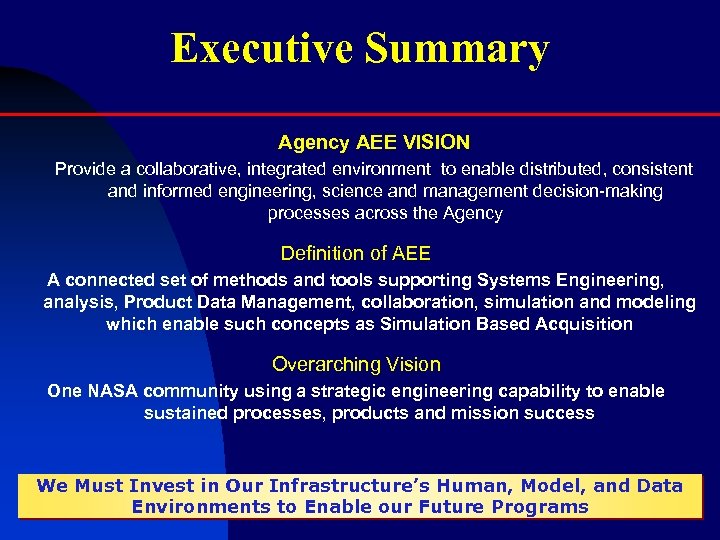 Executive Summary Agency AEE VISION Provide a collaborative, integrated environment to enable distributed, consistent and informed engineering, science and management decision-making processes across the Agency Definition of AEE A connected set of methods and tools supporting Systems Engineering, analysis, Product Data Management, collaboration, simulation and modeling which enable such concepts as Simulation Based Acquisition Overarching Vision One NASA community using a strategic engineering capability to enable sustained processes, products and mission success We Must Invest in Our Infrastructure’s Human, Model, and Data Environments to Enable our Future Programs
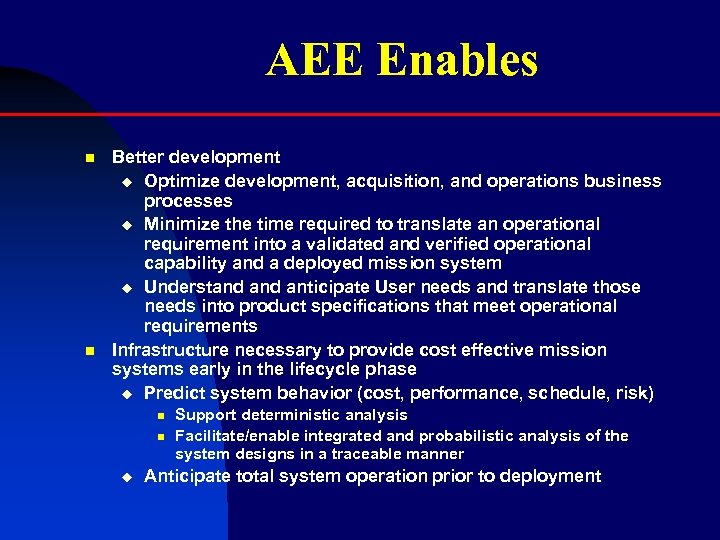 AEE Enables n n Better development u Optimize development, acquisition, and operations business processes u Minimize the time required to translate an operational requirement into a validated and verified operational capability and a deployed mission system u Understand anticipate User needs and translate those needs into product specifications that meet operational requirements Infrastructure necessary to provide cost effective mission systems early in the lifecycle phase u Predict system behavior (cost, performance, schedule, risk) n n u Support deterministic analysis Facilitate/enable integrated and probabilistic analysis of the system designs in a traceable manner Anticipate total system operation prior to deployment
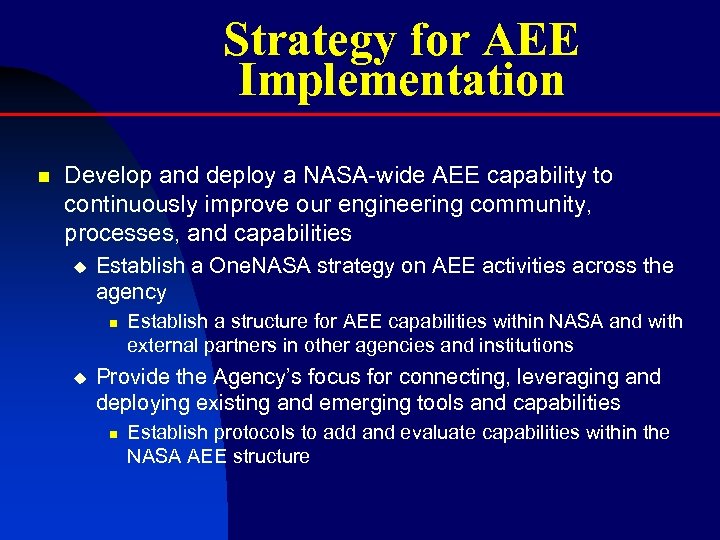 Strategy for AEE Implementation n Develop and deploy a NASA-wide AEE capability to continuously improve our engineering community, processes, and capabilities u Establish a One. NASA strategy on AEE activities across the agency n u Establish a structure for AEE capabilities within NASA and with external partners in other agencies and institutions Provide the Agency’s focus for connecting, leveraging and deploying existing and emerging tools and capabilities n Establish protocols to add and evaluate capabilities within the NASA AEE structure
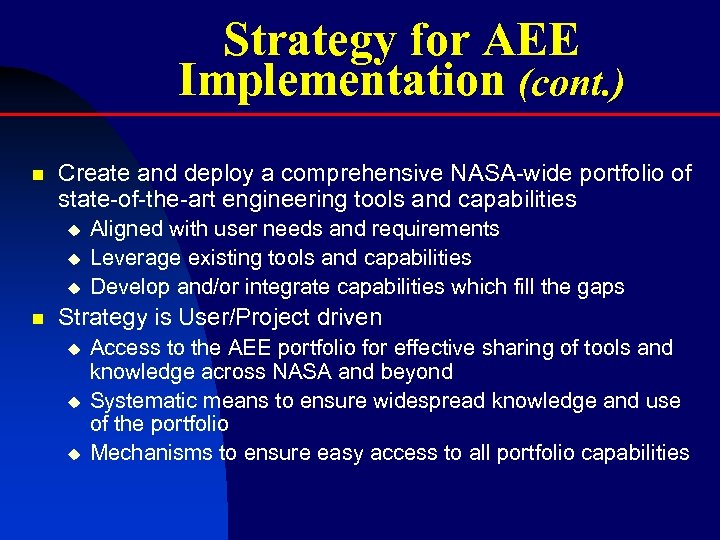 Strategy for AEE Implementation (cont. ) n Create and deploy a comprehensive NASA-wide portfolio of state-of-the-art engineering tools and capabilities u u u n Aligned with user needs and requirements Leverage existing tools and capabilities Develop and/or integrate capabilities which fill the gaps Strategy is User/Project driven u u u Access to the AEE portfolio for effective sharing of tools and knowledge across NASA and beyond Systematic means to ensure widespread knowledge and use of the portfolio Mechanisms to ensure easy access to all portfolio capabilities
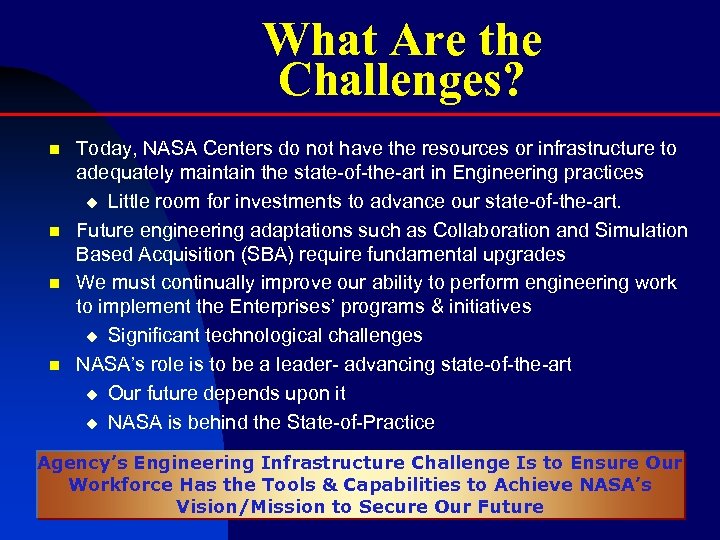 What Are the Challenges? n n Today, NASA Centers do not have the resources or infrastructure to adequately maintain the state-of-the-art in Engineering practices u Little room for investments to advance our state-of-the-art. Future engineering adaptations such as Collaboration and Simulation Based Acquisition (SBA) require fundamental upgrades We must continually improve our ability to perform engineering work to implement the Enterprises’ programs & initiatives u Significant technological challenges NASA’s role is to be a leader- advancing state-of-the-art u Our future depends upon it u NASA is behind the State-of-Practice Agency’s Engineering Infrastructure Challenge Is to Ensure Our Workforce Has the Tools & Capabilities to Achieve NASA’s Vision/Mission to Secure Our Future
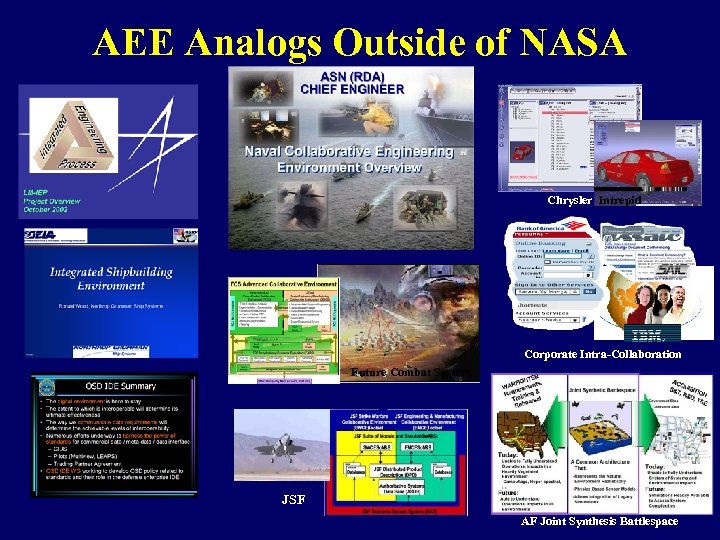 AEE Analogs Outside of NASA Chrysler Intrepid Corporate Intra-Collaboration Future Combat System JSF AF Joint Synthesis Battlespace
 Outline n Background u n n NASA SE Framework SE trends u u n NIAT Do. D Industry Summary
 DOD Systems Engineering Revitalization
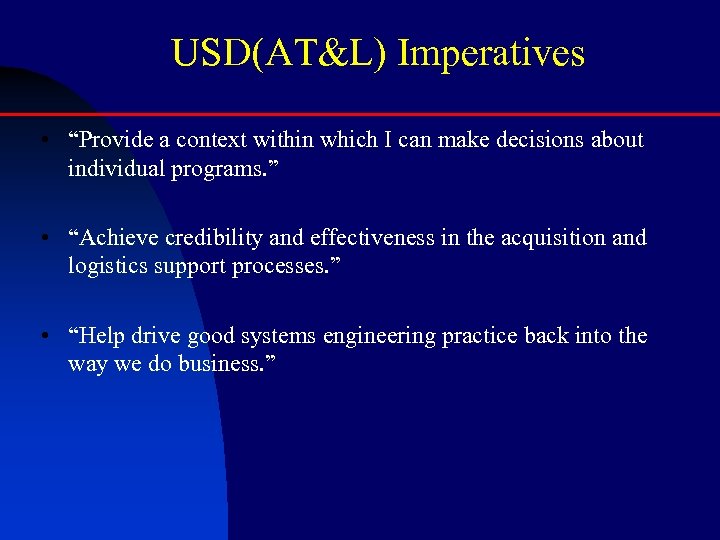 USD(AT&L) Imperatives • “Provide a context within which I can make decisions about individual programs. ” • “Achieve credibility and effectiveness in the acquisition and logistics support processes. ” • “Help drive good systems engineering practice back into the way we do business. ”
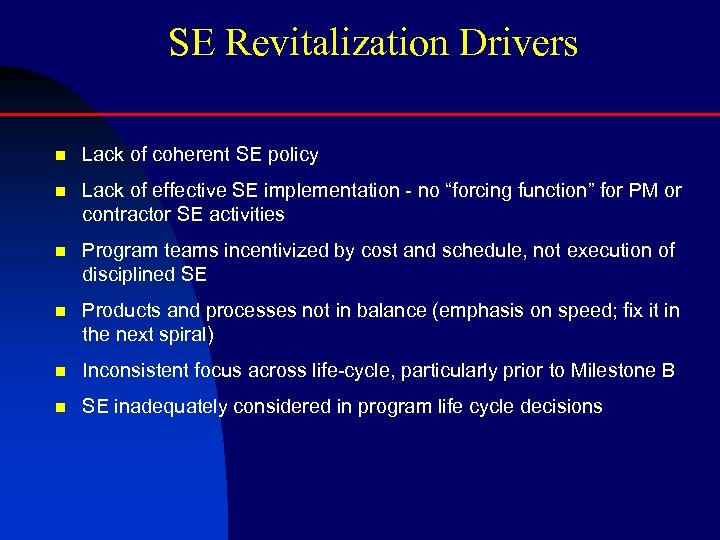 SE Revitalization Drivers n Lack of coherent SE policy n Lack of effective SE implementation - no “forcing function” for PM or contractor SE activities n Program teams incentivized by cost and schedule, not execution of disciplined SE n Products and processes not in balance (emphasis on speed; fix it in the next spiral) n Inconsistent focus across life-cycle, particularly prior to Milestone B n SE inadequately considered in program life cycle decisions
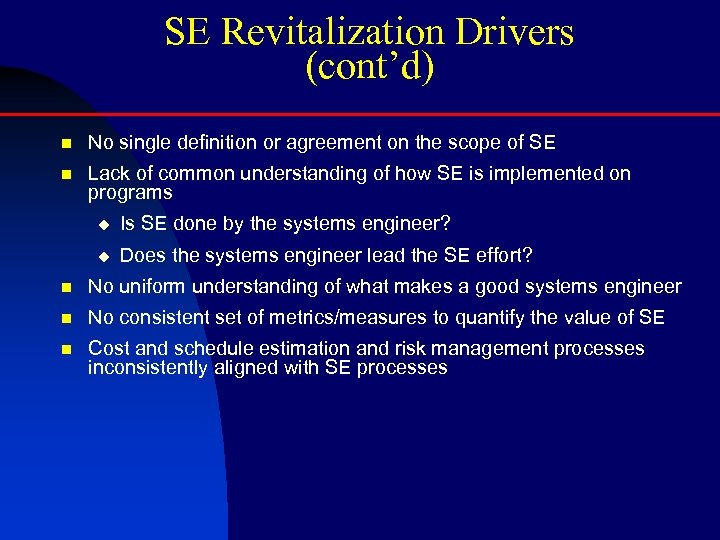 SE Revitalization Drivers (cont’d) n No single definition or agreement on the scope of SE n Lack of common understanding of how SE is implemented on programs u Is SE done by the systems engineer? u Does the systems engineer lead the SE effort? n No uniform understanding of what makes a good systems engineer n No consistent set of metrics/measures to quantify the value of SE n Cost and schedule estimation and risk management processes inconsistently aligned with SE processes
 System Complexity – A Major SE Challenge n n System complexity is ever increasing – Family of Systems/System of Systems interdependencies Integrated systems vice platforms Network centric, spiral development, extension of system applications are driving higher levels of integration Task is made more difficult because multiple practitioner communities not aligned u Hardware, Software, Information Systems
 Validation n n SE Education and Training Summit Industry feedback u n n NDIA, GEIA, AIA Component initiatives Assessment results Do. D u Service u GAO u
 Do. D Acquisition Policy Do. DD 5000. 1: “Acquisition programs shall be managed through the application of a systems engineering approach that optimizes total system performance and minimizes total ownership costs. A modular, opensystems approach shall be employed. ”
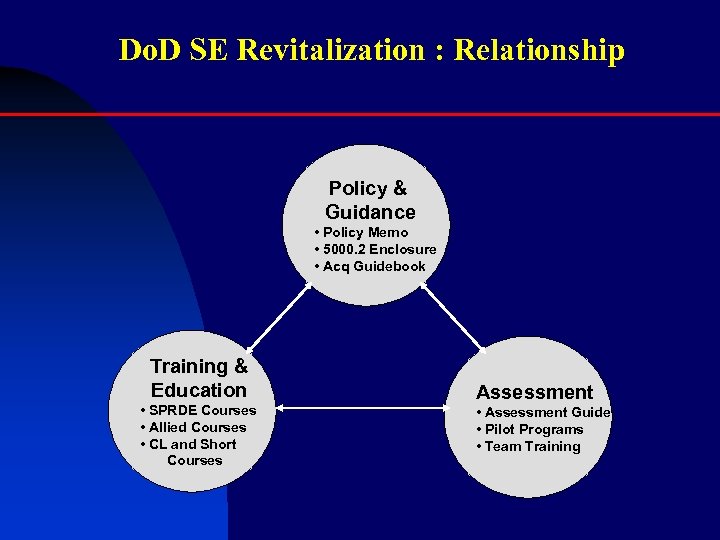 Do. D SE Revitalization : Relationship Policy & Guidance • Policy Memo • 5000. 2 Enclosure • Acq Guidebook Training & Education • SPRDE Courses • Allied Courses • CL and Short Courses Assessment • Assessment Guide • Pilot Programs • Team Training
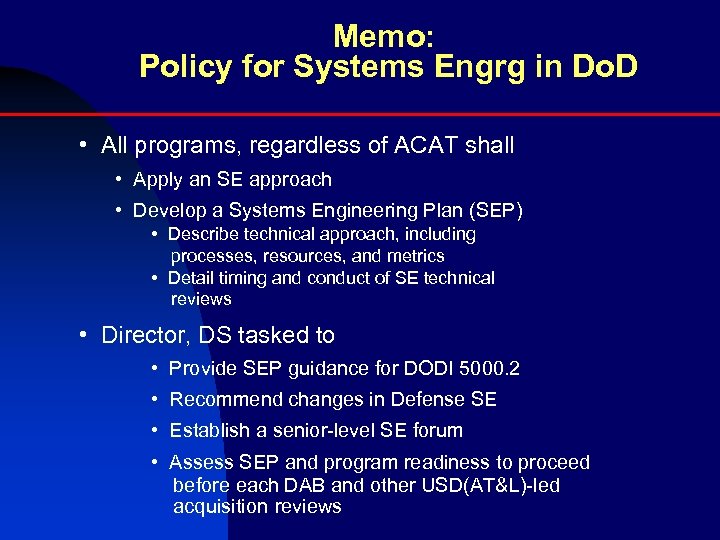 Memo: Policy for Systems Engrg in Do. D • All programs, regardless of ACAT shall • Apply an SE approach • Develop a Systems Engineering Plan (SEP) • Describe technical approach, including processes, resources, and metrics • Detail timing and conduct of SE technical reviews • Director, DS tasked to • Provide SEP guidance for DODI 5000. 2 • Recommend changes in Defense SE • Establish a senior-level SE forum • Assess SEP and program readiness to proceed before each DAB and other USD(AT&L)-led acquisition reviews
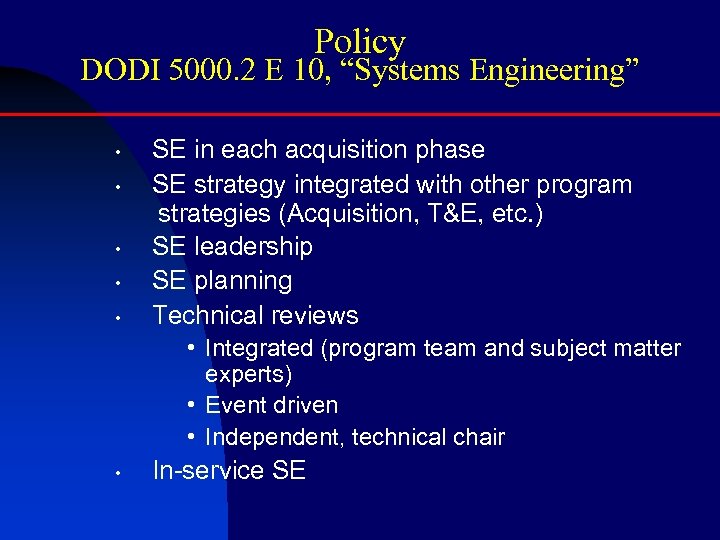 Policy DODI 5000. 2 E 10, “Systems Engineering” • • • SE in each acquisition phase SE strategy integrated with other program strategies (Acquisition, T&E, etc. ) SE leadership SE planning Technical reviews • Integrated (program team and subject matter experts) • Event driven • Independent, technical chair • In-service SE
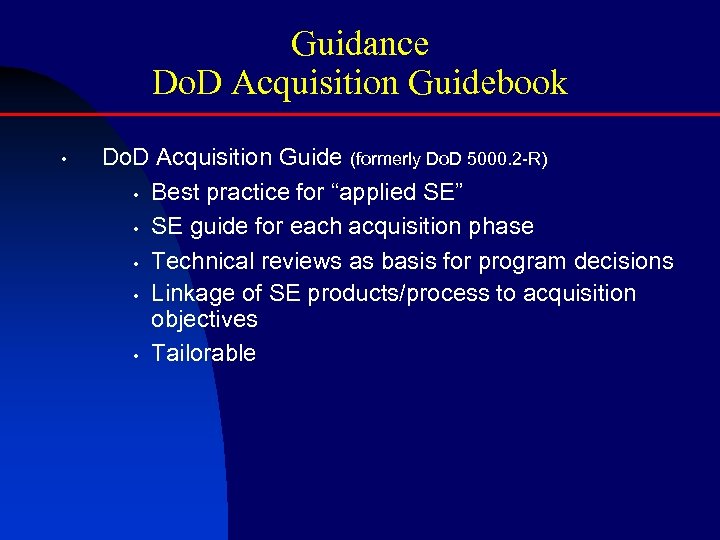 Guidance Do. D Acquisition Guidebook • Do. D Acquisition Guide (formerly Do. D 5000. 2 -R) • Best practice for “applied SE” • SE guide for each acquisition phase • Technical reviews as basis for program decisions • Linkage of SE products/process to acquisition objectives • Tailorable
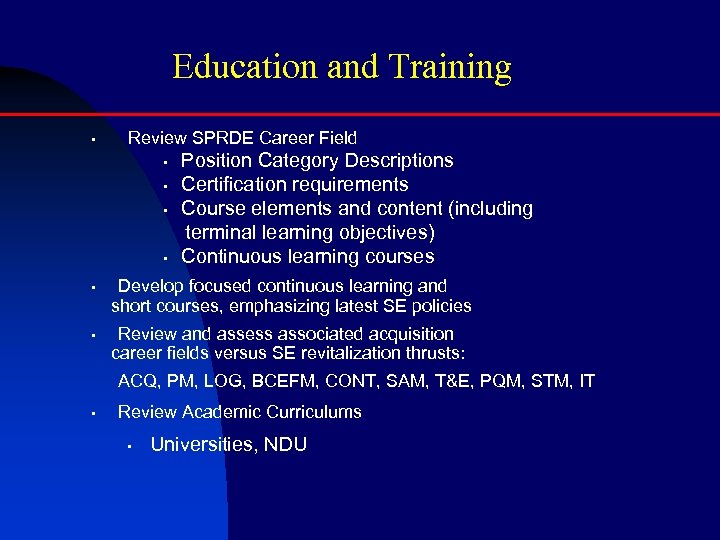 Education and Training • Review SPRDE Career Field • • Position Category Descriptions Certification requirements Course elements and content (including terminal learning objectives) Continuous learning courses • Develop focused continuous learning and short courses, emphasizing latest SE policies • Review and assess associated acquisition career fields versus SE revitalization thrusts: ACQ, PM, LOG, BCEFM, CONT, SAM, T&E, PQM, STM, IT • Review Academic Curriculums • Universities, NDU
 Assessments and Support • • • Develop comprehensive, phased assessment methodology Provide in-depth training to assessment teams Apply methodology to pilot programs and recoup lessons learned
 ARMY Presented By: Jeff Dyer US Army RDECOM ARDEC System Engineering, Integration and Analysis Director
 ARDEC SE Initiative n ARDEC Re-organization: A main pillar - “built around ensuring System Engineering principles are embedded in the conduct of all ARDEC programs” – ARDEC TD u Process Oriented n SEIA Organization: u u Mission: The Systems Engineering, Integration and Analysis Competency Directorate will develop and continuously improve the Systems Engineering, System Integration and System Analysis competency areas for ARDEC and will execute these tasks for all ARDEC programs. Vision: Develop and implement a systematic and disciplined system engineering process, with emphasis on Simulation and Modeling for Acquisition, Requirements and Training (SMART) principals, for the development of ARDEC personnel and products.
 USAF Systems Engineering Update Mr. Mike Ucchino Technical Director AF Center for Systems Engineering 22 March 04
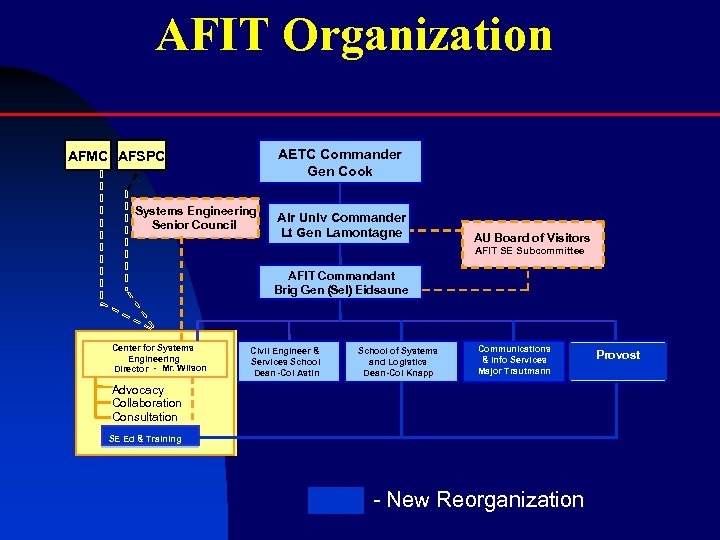 AFIT Organization AETC Commander Gen Cook AFMC AFSPC Systems Engineering Senior Council Air Univ Commander Lt Gen Lamontagne AU Board of Visitors AFIT SE Subcommittee AFIT Commandant Brig Gen (Sel) Eidsaune Center for Systems Engineering Director - -Mr. Wilson Interim Director. Mr. Wilson Civil Engineer & Services School Dean-Col Astin - School of Systems and Logistics Dean-Col Knapp Communications & Info Services Major Trautmann Provost Acting - Dr Calico Advocacy Collaboration Consultation SE Ed & Training - New Reorganization
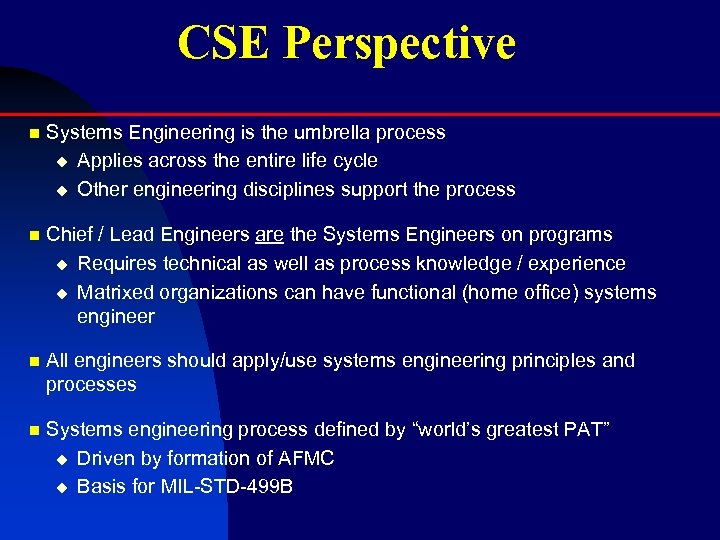 CSE Perspective n Systems Engineering is the umbrella process u Applies across the entire life cycle u Other engineering disciplines support the process n Chief / Lead Engineers are the Systems Engineers on programs u Requires technical as well as process knowledge / experience u Matrixed organizations can have functional (home office) systems engineer n All engineers should apply/use systems engineering principles and processes n Systems engineering process defined by “world’s greatest PAT” u Driven by formation of AFMC u Basis for MIL-STD-499 B
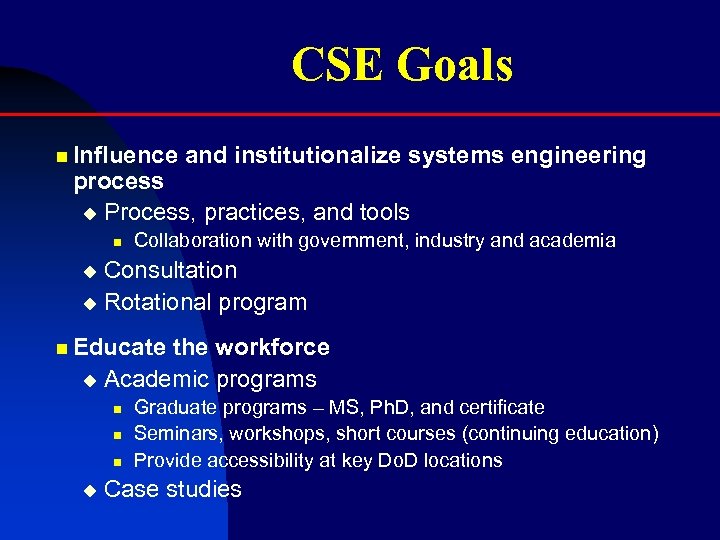 CSE Goals n Influence and institutionalize systems engineering process u Process, practices, and tools n Collaboration with government, industry and academia Consultation u Rotational program u n Educate the workforce u Academic programs n n n u Graduate programs – MS, Ph. D, and certificate Seminars, workshops, short courses (continuing education) Provide accessibility at key Do. D locations Case studies
 SYSTEMS ENGINEERING AT NAVAL AIR SYSTEMS COMMAND GEIA 09 SEPTEMBER 2003
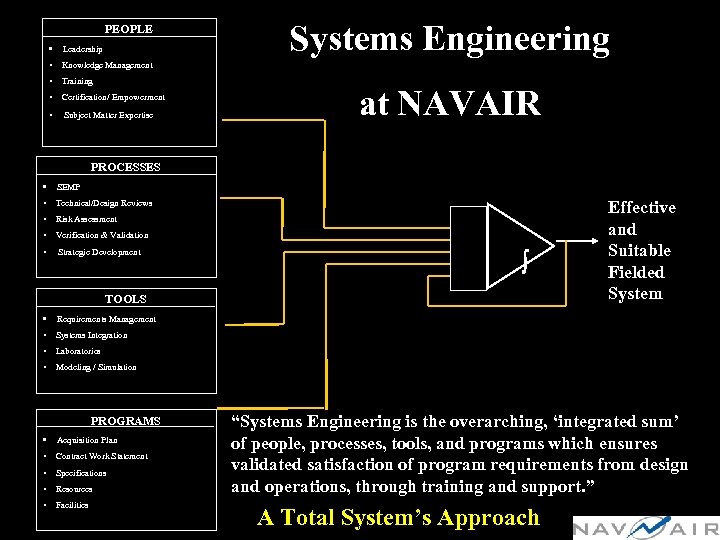 PEOPLE • Leadership Systems Engineering • Knowledge Management • Training • Certification/ Empowerment • Subject Matter Expertise at NAVAIR PROCESSES • SEMP • Technical/Design Reviews • Risk Assessment • Verification & Validation • Strategic Development ò TOOLS Effective and Suitable Fielded System • Requirements Management • Systems Integration • Laboratories • Modeling / Simulation PROGRAMS • Acquisition Plan • Contract Work Statement • Specifications • Resources • Facilities “Systems Engineering is the overarching, ‘integrated sum’ of people, processes, tools, and programs which ensures validated satisfaction of program requirements from design and operations, through training and support. ” A Total System’s Approach
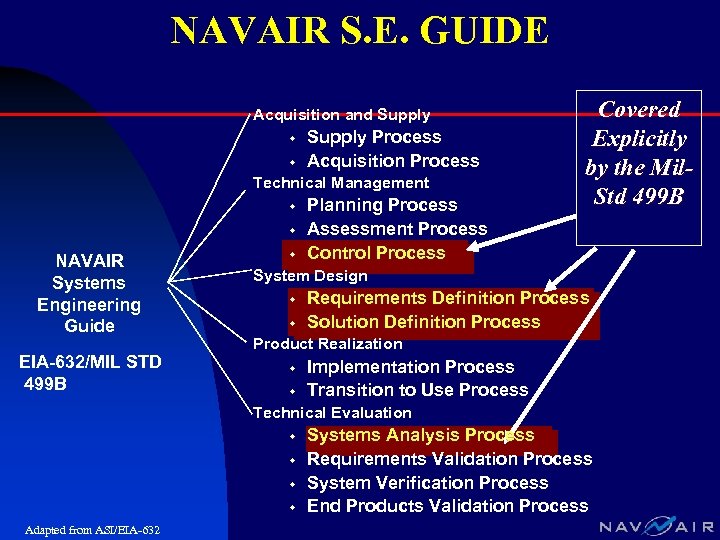 NAVAIR S. E. GUIDE Acquisition and Supply w w Supply Process Acquisition Process Technical Management w w NAVAIR Systems Engineering Guide EIA-632/MIL STD 499 B w Planning Process Assessment Process Control Process Covered Explicitly by the Mil. Std 499 B System Design w w Requirements Definition Process Solution Definition Process Product Realization w w Implementation Process Transition to Use Process Technical Evaluation w w Adapted from ASI/EIA-632 Systems Analysis Process Requirements Validation Process System Verification Process End Products Validation Process
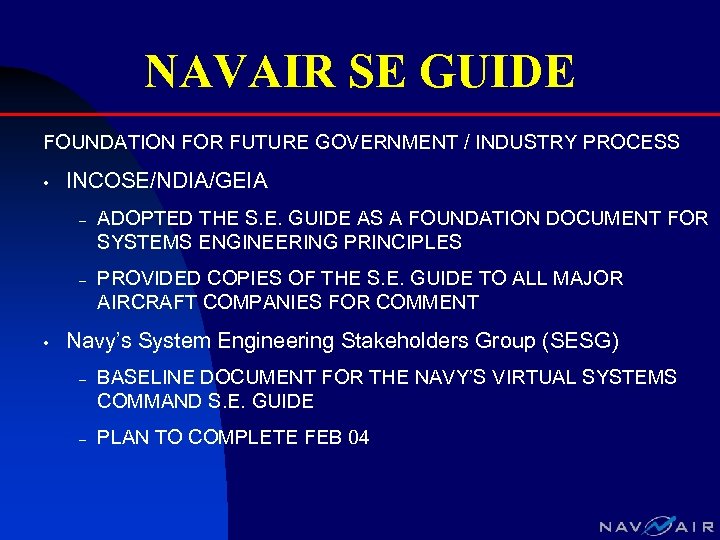 NAVAIR SE GUIDE FOUNDATION FOR FUTURE GOVERNMENT / INDUSTRY PROCESS • INCOSE/NDIA/GEIA – – • ADOPTED THE S. E. GUIDE AS A FOUNDATION DOCUMENT FOR SYSTEMS ENGINEERING PRINCIPLES PROVIDED COPIES OF THE S. E. GUIDE TO ALL MAJOR AIRCRAFT COMPANIES FOR COMMENT Navy’s System Engineering Stakeholders Group (SESG) – – BASELINE DOCUMENT FOR THE NAVY’S VIRTUAL SYSTEMS COMMAND S. E. GUIDE PLAN TO COMPLETE FEB 04
 Outline n Background u n n NASA SE Framework SE trends u u n NIAT Do. D Industry Summary
 Boeing System of Systems Engineering (So. SE) Process Copyright © 2003 The Boeing Company
 4+1 Views for each System Design Level are Populated with So. SE Process Products 4+1 Views are incrementally developed across the So. SE Activities So. S Process Derived System Element Needs Stakeholder Needs System Element Needs Requirements Analysis Process Products Functional Analysis Requirements Definition Use Case View, Logical View, Process View Process Products Functional Architecture Use Case View, Logical View, Process View Physical Architecture Synthesis Process Products Use Case View, Logical View, Physical View Derived Item Requirements for the Next Level of Decomposition Architecture Models and Specifications for each Design Level
 LM-IEP A Progress Report 9 September 2003
 LM-IEP A Product Suite Approach LM-IEP Standard Common Methods and Work Products Assessment Method (CAM) Training LM Process Asset Library (LM-PAL) ARIS Process Model Integrated Measurement & Risk Management
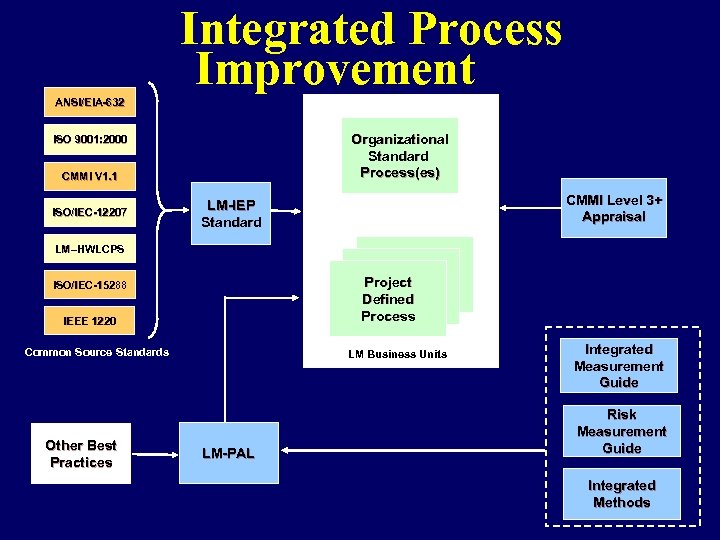 Integrated Process Improvement ANSI/EIA-632 Organizational Standard Process(es) ISO 9001: 2000 CMMI V 1. 1 ISO/IEC-12207 LM–HWLCPS Project Defined Process ISO/IEC-15288 IEEE 1220 Common Source Standards Other Best Practices CMMI Level 3+ Appraisal LM-IEP Standard LM Business Units LM-PAL Integrated Measurement Guide Risk Measurement Guide Integrated Methods
 Industry Associations
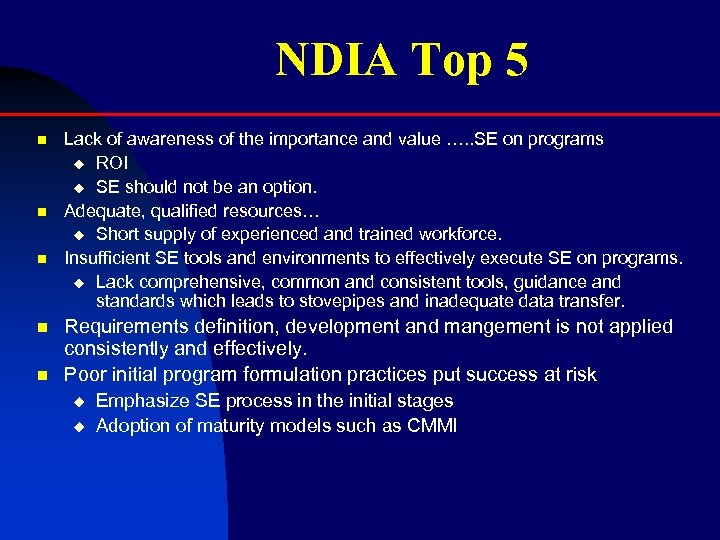 NDIA Top 5 n n n Lack of awareness of the importance and value …. . SE on programs u ROI u SE should not be an option. Adequate, qualified resources… u Short supply of experienced and trained workforce. Insufficient SE tools and environments to effectively execute SE on programs. u Lack comprehensive, common and consistent tools, guidance and standards which leads to stovepipes and inadequate data transfer. Requirements definition, development and mangement is not applied consistently and effectively. Poor initial program formulation practices put success at risk u u Emphasize SE process in the initial stages Adoption of maturity models such as CMMI
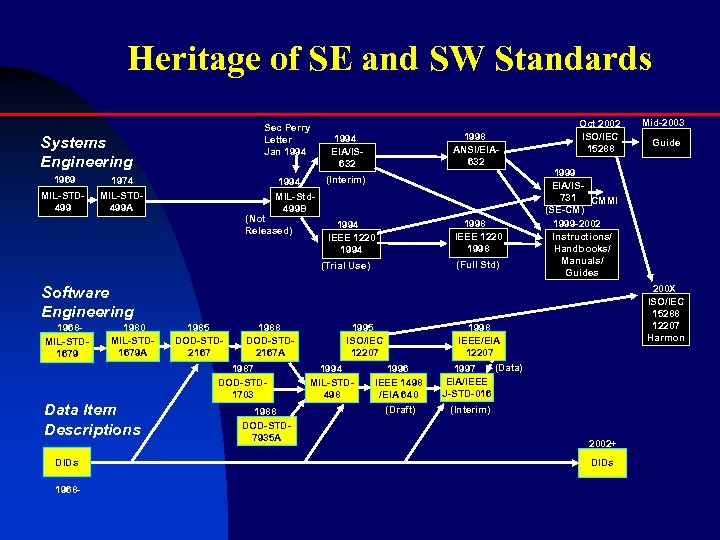 Heritage of SE and SW Standards Sec Perry Letter Jan 1994 Systems Engineering 1969 MIL-STD 499 1974 MIL-STD 499 A 1994 MIL-Std 499 B (Not Released) 1998 ANSI/EIA 632 1994 EIA/IS 632 (Interim) 1998 IEEE 1220 1998 1994 IEEE 1220 1994 (Full Std) (Trial Use) Oct 2002 ISO/IEC 15288 1980 MIL-STD 1679 A 1985 DOD-STD 2167 1988 DOD-STD 2167 A 1987 DOD-STD 1703 Data Item Descriptions DIDs 1968 - 1988 DOD-STD 7935 A 1995 ISO/IEC 12207 1994 MIL-STD 498 1996 IEEE 1498 /EIA 640 (Draft) Guide 1999 EIA/IS 731 CMMI (SE-CM) 1999 -2002 Instructions/ Handbooks/ Manuals/ Guides 200 X ISO/IEC 15288 12207 Harmon Software Engineering 1968 - MIL-STD 1679 Mid-2003 1998 IEEE/EIA 12207 (Data) 1997 EIA/IEEE J-STD-016 (Interim) 2002+ DIDs
 Summary
 Questions?
 BACKUP
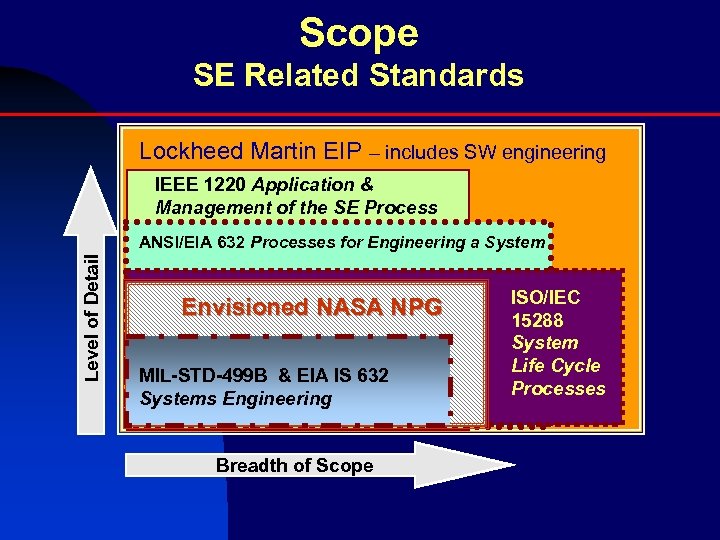 Scope SE Related Standards Lockheed Martin EIP – includes SW engineering IEEE 1220 Application & Management of the SE Process Level of Detail ANSI/EIA 632 Processes for Engineering a System Envisioned NASA NPG MIL-STD-499 B & EIA IS 632 Systems Engineering Breadth of Scope ISO/IEC 15288 System Life Cycle Processes
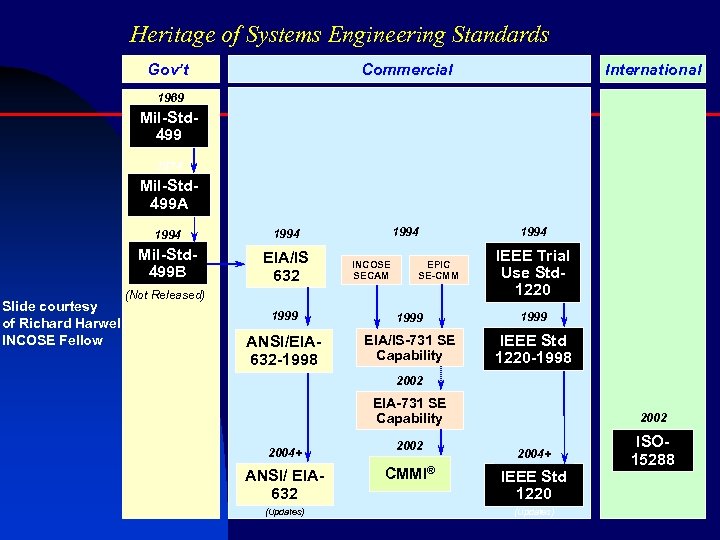 Heritage of Systems Engineering Standards Gov’t Commercial International 1969 Mil-Std 499 1974 Mil-Std 499 A 1994 Mil-Std 499 B Slide courtesy of Richard Harwell INCOSE Fellow 1994 EIA/IS 632 1994 INCOSE SECAM EPIC SE-CMM (Not Released) 1994 IEEE Trial Use Std 1220 1999 ANSI/EIA 632 -1998 EIA/IS-731 SE Capability IEEE Std 1220 -1998 2002 EIA-731 SE Capability 2004+ ANSI/ EIA- 632 (Updates) 2002 CMMI® 2002 2004+ IEEE Std 1220 (Updates) ISO- 15288