 Скачать презентацию Systems development using M S based on the DEVS
a2349b085912a881c08666d1600ffac2.ppt
- Количество слайдов: 20



Systems development using M&S based on the DEVS formalism Gabriel A. Wainer Department of Systems and Computer Engineering. Carleton University. Ottawa, ON. Canada. gwainer@sce. carleton. ca
Simulation-based problem solving n Analysis of natural/artificial real systems. n Goal: learning through experimentation (developing, studying, training, analyzing, improving, enhancing, creating, defining). n Analytical solutions (natural systems). Artificial systems complexity: general solutions cannot be provided. n Simulation: particular solution to a given problem using certain experimental conditions.
Current practices n Evolution: based on technological advances (computing power, networks, graphical interfaces, standards). n Current practices: ad-hoc techniques, ignorance of previous recommendations for software engineering. n Tendency to encapsulate models, simulators and experiments into tightly coupled packages (written in programming languages such as Fortran, C, C++, Java). n Difficulties: testing, maintainability of the applications, integration, software reuse. n Relatively few examples of storing previously developed models to be adapted for interoperability and reuse
DEVS M&S methodology n Research in the last 15 -20 years showed how DEVS can solve these issues: ¨ ¨ ¨ Interoperability and reuse Hybrid systems definition Software engineering-based approach (different for different types kinds of life cycles) Facilities for automated tasks High performance/distributed simulation
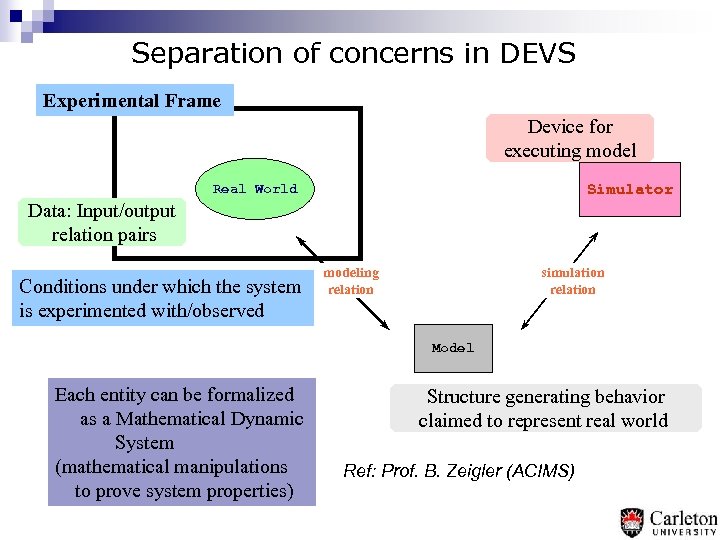
Separation of concerns in DEVS Experimental Frame Device for executing model Simulator Real World Data: Input/output relation pairs Conditions under which the system is experimented with/observed modeling relation simulation relation Model Each entity can be formalized as a Mathematical Dynamic System (mathematical manipulations to prove system properties) Structure generating behavior claimed to represent real world Ref: Prof. B. Zeigler (ACIMS)
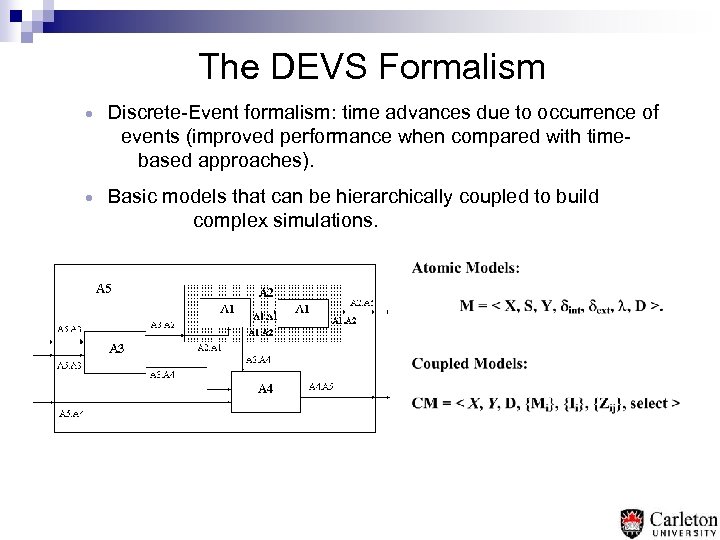
The DEVS Formalism · Discrete-Event formalism: time advances due to occurrence of events (improved performance when compared with timebased approaches). · Basic models that can be hierarchically coupled to build complex simulations.
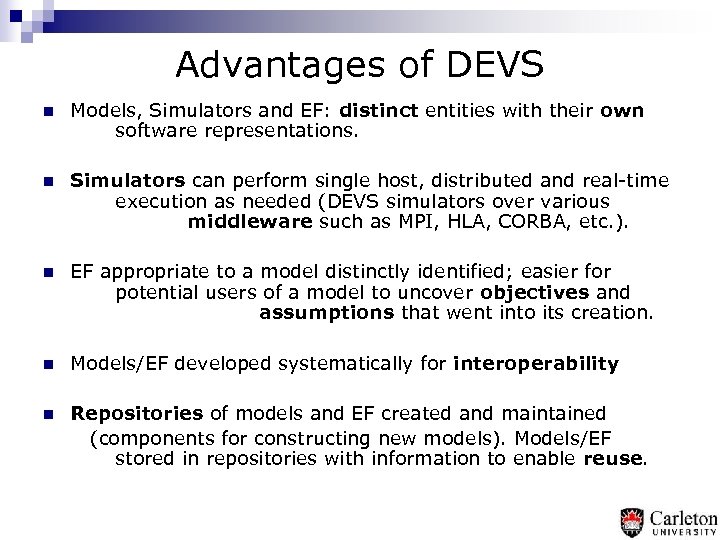
Advantages of DEVS n Models, Simulators and EF: distinct entities with their own software representations. n Simulators can perform single host, distributed and real-time execution as needed (DEVS simulators over various middleware such as MPI, HLA, CORBA, etc. ). n EF appropriate to a model distinctly identified; easier for potential users of a model to uncover objectives and assumptions that went into its creation. n Models/EF developed systematically for interoperability n Repositories of models and EF created and maintained (components for constructing new models). Models/EF stored in repositories with information to enable reuse.
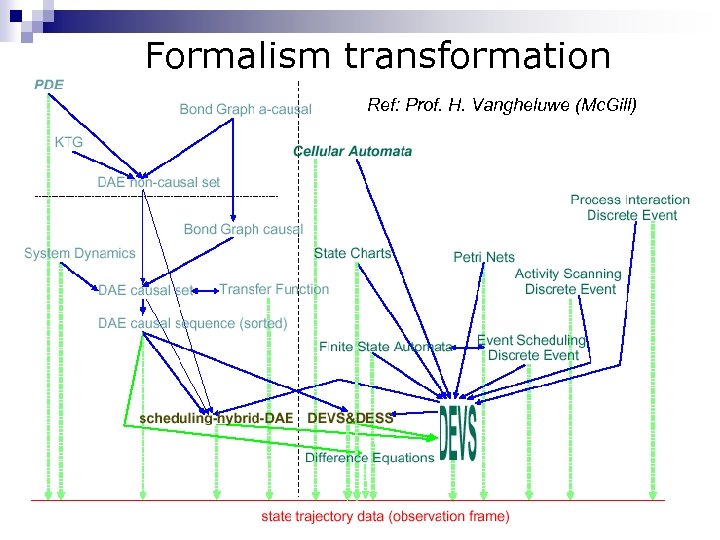
Formalism transformation Ref: Prof. H. Vangheluwe (Mc. Gill)
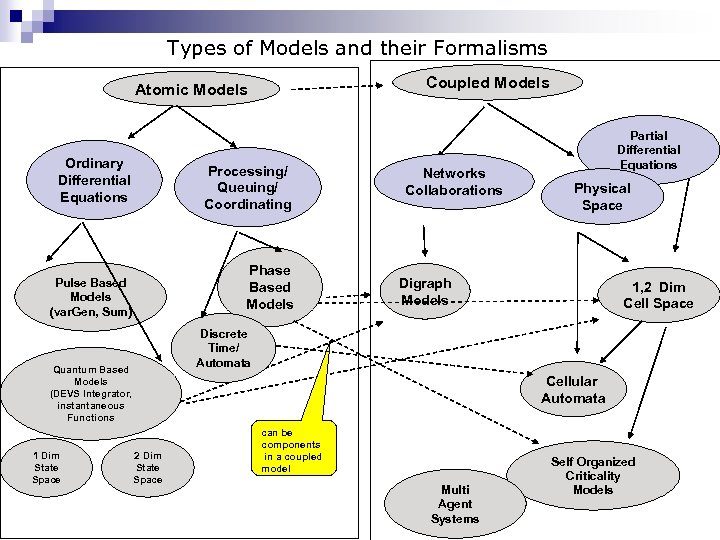
Types of Models and their Formalisms Coupled Models Atomic Models Ordinary Differential Equations Processing/ Queuing/ Coordinating Phase Based Models Pulse Based Models (var. Gen, Sum) Physical Space Digraph Models 1, 2 Dim Cell Space Discrete Time/ Automata Quantum Based Models (DEVS Integrator, instantaneous Functions 1 Dim State Space Networks Collaborations Partial Differential Equations Cellular Automata 2 Dim State Space can be components in a coupled model Multi Agent Systems Self Organized Criticality Models
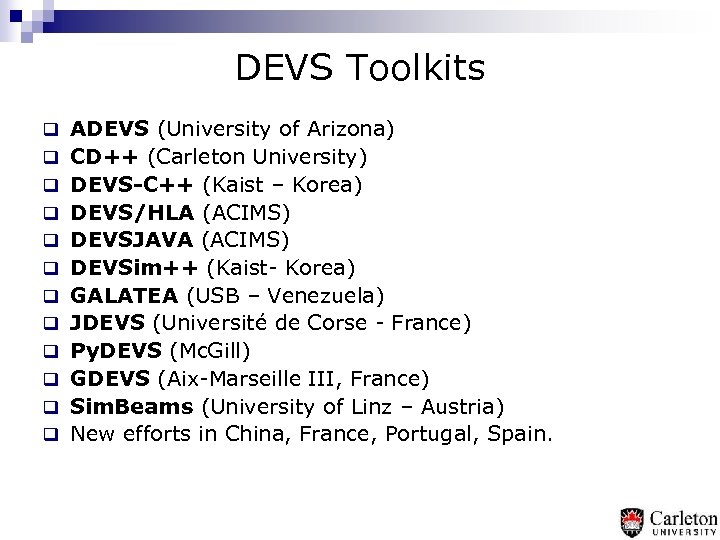
DEVS Toolkits q ADEVS (University of Arizona) q CD++ (Carleton University) q DEVS-C++ (Kaist – Korea) q DEVS/HLA (ACIMS) q DEVSJAVA (ACIMS) q DEVSim++ (Kaist- Korea) q GALATEA (USB – Venezuela) q JDEVS (Université de Corse - France) q Py. DEVS (Mc. Gill) q GDEVS (Aix-Marseille III, France) q Sim. Beams (University of Linz – Austria) q New efforts in China, France, Portugal, Spain.
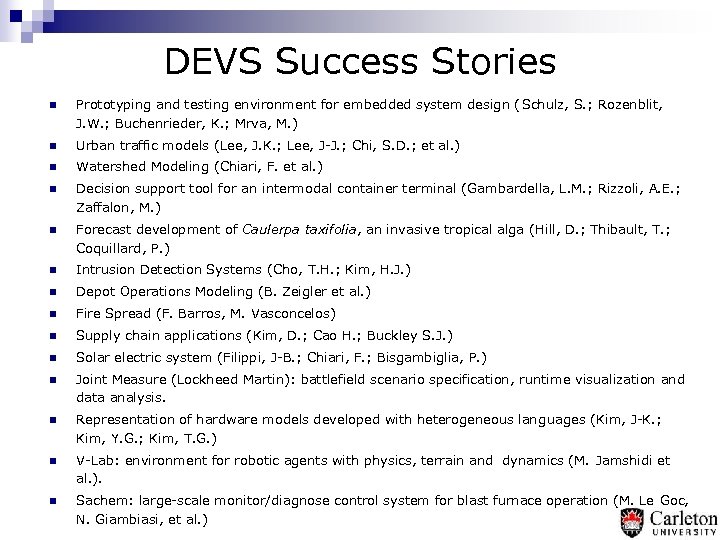
DEVS Success Stories n Prototyping and testing environment for embedded system design ( Schulz, S. ; Rozenblit, J. W. ; Buchenrieder, K. ; Mrva, M. ) n Urban traffic models (Lee, J. K. ; Lee, J-J. ; Chi, S. D. ; et al. ) n Watershed Modeling (Chiari, F. et al. ) n Decision support tool for an intermodal container terminal (Gambardella, L. M. ; Rizzoli, A. E. ; Zaffalon, M. ) n Forecast development of Caulerpa taxifolia, an invasive tropical alga (Hill, D. ; Thibault, T. ; Coquillard, P. ) n Intrusion Detection Systems (Cho, T. H. ; Kim, H. J. ) n Depot Operations Modeling (B. Zeigler et al. ) n Fire Spread (F. Barros, M. Vasconcelos) n Supply chain applications (Kim, D. ; Cao H. ; Buckley S. J. ) n Solar electric system (Filippi, J-B. ; Chiari, F. ; Bisgambiglia, P. ) n Joint Measure (Lockheed Martin): battlefield scenario specification, runtime visualization and data analysis. n Representation of hardware models developed with heterogeneous languages (Kim, J-K. ; Kim, Y. G. ; Kim, T. G. ) n V-Lab: environment for robotic agents with physics, terrain and dynamics (M. Jamshidi et al. ). n Sachem: large-scale monitor/diagnose control system for blast furnace operation (M. Le Goc, N. Giambiasi, et al. )
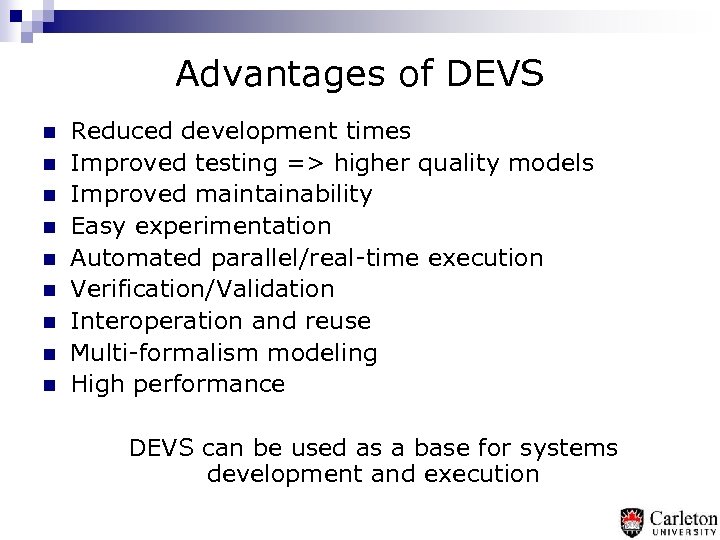
Advantages of DEVS n n n n n Reduced development times Improved testing => higher quality models Improved maintainability Easy experimentation Automated parallel/real-time execution Verification/Validation Interoperation and reuse Multi-formalism modeling High performance DEVS can be used as a base for systems development and execution
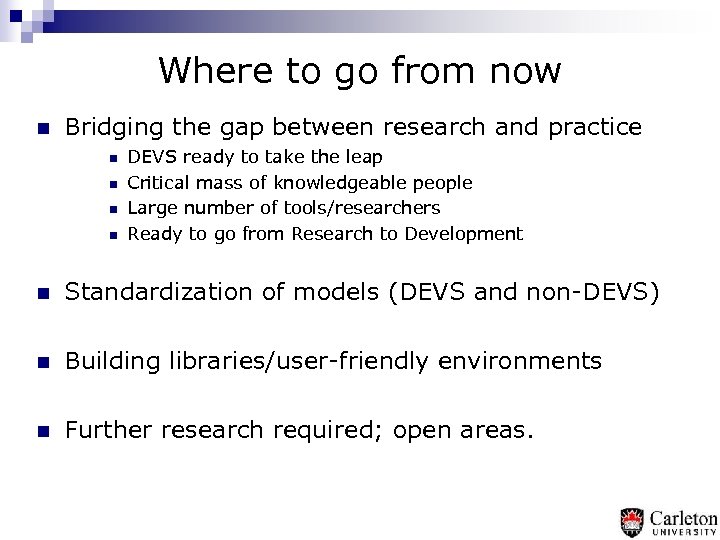
Where to go from now n Bridging the gap between research and practice n n DEVS ready to take the leap Critical mass of knowledgeable people Large number of tools/researchers Ready to go from Research to Development n Standardization of models (DEVS and non-DEVS) n Building libraries/user-friendly environments n Further research required; open areas.
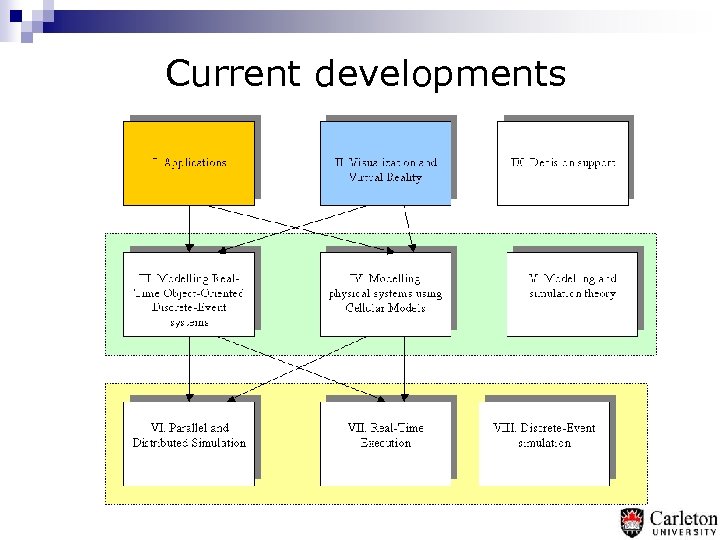
Current developments
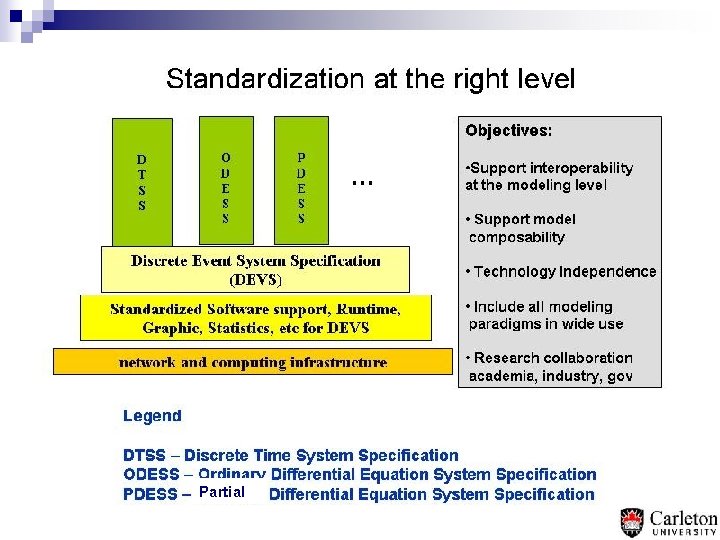
The DEVS Standardization Study group
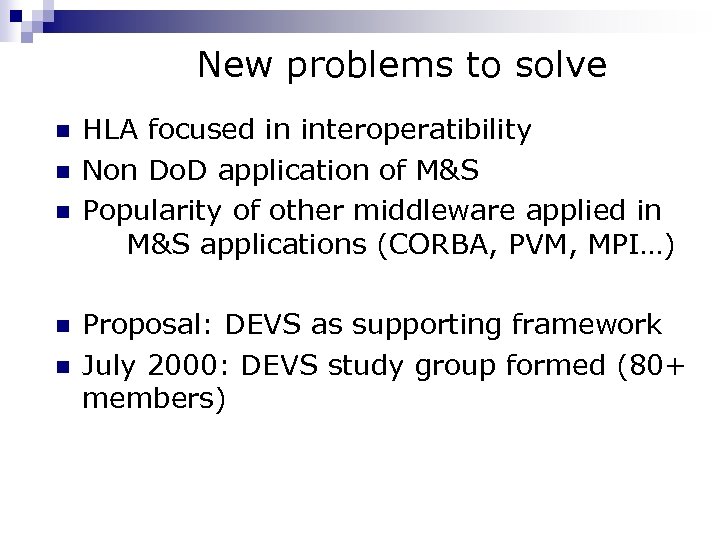
New problems to solve n n n HLA focused in interoperatibility Non Do. D application of M&S Popularity of other middleware applied in M&S applications (CORBA, PVM, MPI…) Proposal: DEVS as supporting framework July 2000: DEVS study group formed (80+ members)
Partial
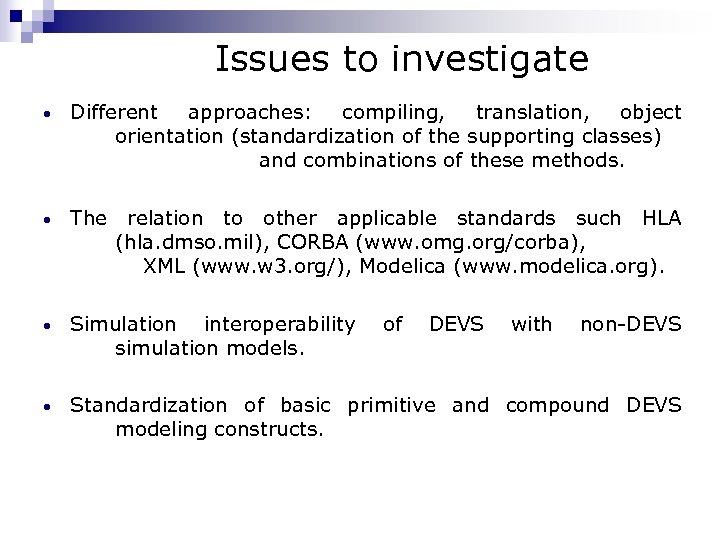
Issues to investigate · Different approaches: compiling, translation, object orientation (standardization of the supporting classes) and combinations of these methods. · The · Simulation interoperability simulation models. · Standardization of basic primitive and compound DEVS modeling constructs. relation to other applicable standards such HLA (hla. dmso. mil), CORBA (www. omg. org/corba), XML (www. w 3. org/), Modelica (www. modelica. org). of DEVS with non-DEVS
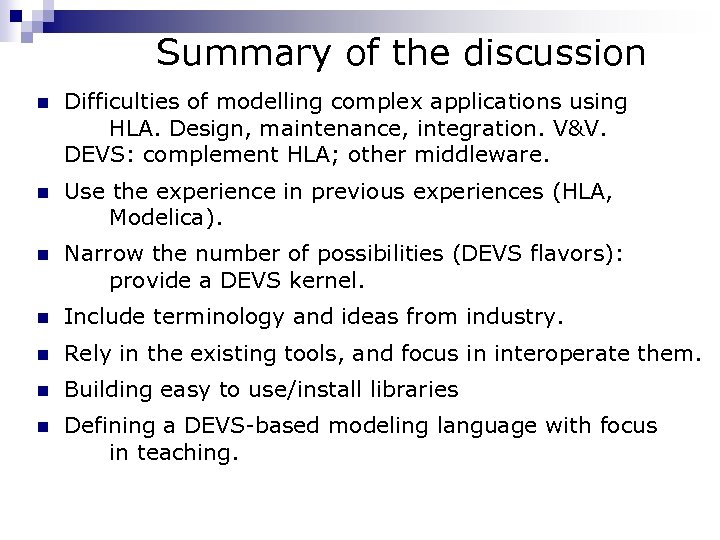
Summary of the discussion n Difficulties of modelling complex applications using HLA. Design, maintenance, integration. V&V. DEVS: complement HLA; other middleware. n Use the experience in previous experiences (HLA, Modelica). n Narrow the number of possibilities (DEVS flavors): provide a DEVS kernel. n Include terminology and ideas from industry. n Rely in the existing tools, and focus in interoperate them. n Building easy to use/install libraries n Defining a DEVS-based modeling language with focus in teaching.
Resources
Скачать презентацию Systems development using M S based on the DEVS
a2349b085912a881c08666d1600ffac2.ppt