 Скачать презентацию Systems Change Commons December 11 2008 How Evidence
38a611face32a823a43bbe1ca0d5e3ce.ppt
- Количество слайдов: 30




Systems Change Commons December 11 2008 How Evidence about Nurse-led Innovation Informs Decision-Making about Health System Improvement

Acknowledgements
Agenda • Welcome Sandra Mac. Donald-Rencz, • Chief Nursing Officer, Nursing Policy, Health Canada • About Systems Change Commons • Introduction of today’s Presenters • Discussions and Final Remarks • Closure
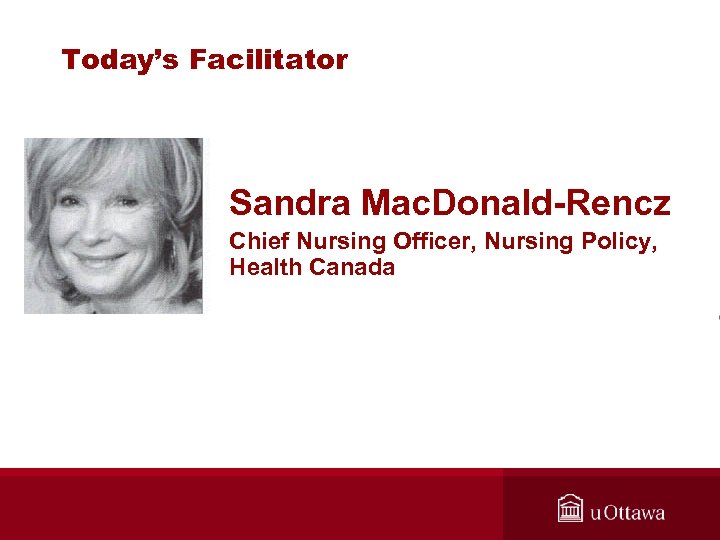
Today’s Facilitator Sandra Mac. Donald-Rencz Chief Nursing Officer, Nursing Policy, Health Canada
Systems Change Commons… • Systems Commons provides an opportunity for senior decision makers and researchers to discuss critical health systems issues. • Through these forums to engage senior policy-makers and other decision-makers, and researchers in conversations about exemplary initiatives with a focus on nursing and evidence-informed nursing service delivery models.

Today’s Presenters Mr. Tom Mill Assistant Deputy Minister Health System Development Alberta Health and Wellness Ms. Vanessa Burkoski Provincial Chief Nursing Officer Nursing Secretariat Ontario Ministry of Health and Long-Term Care Lise Guerrette-Daigle Executive VP Acute Care Establishments Regional Health Authority A, NB

TOR-OMH 029 -20080909 -Exhibit Vision 2020 The Future of Health Care in Alberta for discussion at Systems Change Commons December 11, 2008 Mr Tom Mill Assistant Deputy Minister Health System Development
Challenges our system is facing… • Excessive facility based care • High occupancy rates of many acute and LTC facilities • Distribution of health services – metro, urban, rural and remote • Proximity and occupancy of small hospitals • Health provider shortages • Little inter-regional, inter-facility and inter-provider co-ordination • Integration of health promotion and disease and injury prevention with health services and other sectors • High cost of services in high acuity facilities
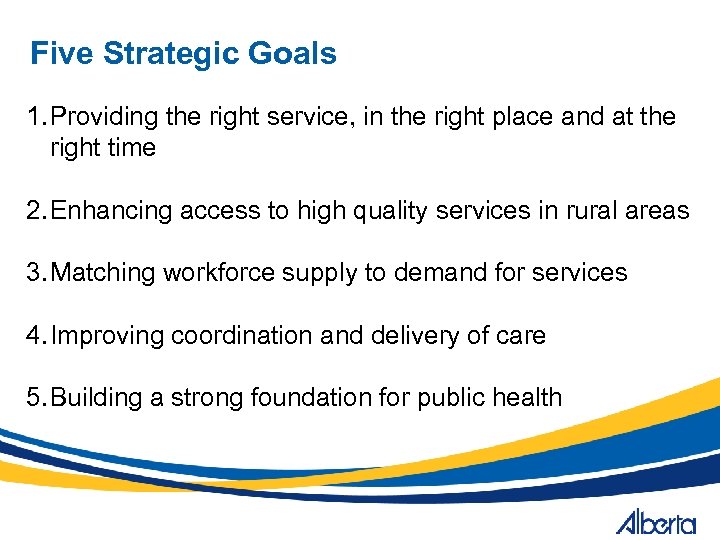
Five Strategic Goals 1. Providing the right service, in the right place and at the right time 2. Enhancing access to high quality services in rural areas 3. Matching workforce supply to demand for services 4. Improving coordination and delivery of care 5. Building a strong foundation for public health
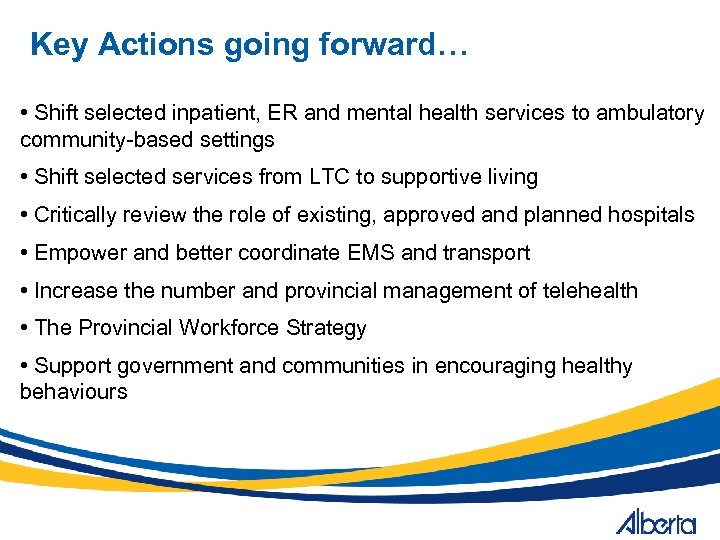
Key Actions going forward… • Shift selected inpatient, ER and mental health services to ambulatory community-based settings • Shift selected services from LTC to supportive living • Critically review the role of existing, approved and planned hospitals • Empower and better coordinate EMS and transport • Increase the number and provincial management of telehealth • The Provincial Workforce Strategy • Support government and communities in encouraging healthy behaviours

Evidence-based Initiatives: Informing Decision-Making Lise Guerrette-Daigle Executive VP Acute Care Establishments Regional Health Authority A, NB December 11, 2008
Improving Care Delivery Models: Responding to needs n Community-based initiative n n Project evaluation Hospital-based n n Clinical programs Organizational changes in Nursing
Community-based Initiative: Project Evaluation n Community-driven Project: n Goal Helping new immigrants better understand how to access health services n Informing care providers of cultural diversity in health and illness n n n Partnerships (Nursing leadership) Consultative process: literature, focus groups Outcome: 2 booklets Dissemination
Impact n n n Media interest Community immigration-related organizations Government agencies (federal, provincial, and municipal) Academic community (school of nursing, Med school) Hospital administrators (local, regional, national)

Hospital-based Nursing Initiatives: Clinical Programs n n n Smoking Cessation Decentralization of Antineoplastic Therapy Wound Management: prevalence & incidence evaluation
Impact n n All of these pilot projects have demonstrated positive outcomes & have become standard programs of care Building expertise Exporting knowledge Sharing tools
Hospital-based Initiative: 2005 Nursing Reorganization n Nursing Care-delivery model n n n Team nursing Full scope of practice Evaluation n Process & outcome indicators Focus groups Pre & post intervention questionnaire (satisfaction, autonomy, role clarity) n 418 respondents n
Creating a Culture of Program Evaluation and Research in Health Care Settings n Challenges n Limited resources n Knowledge & skills n Building capacity; academic support Information systems n Funding n Polarizing priorities n
Commons December 11, 2008 Vanessa Burkoski Provincial Chief Nursing Officer Ministry of Health and Long Term Care vanessa. burkoski@ontario. ca
Evidence Based Decision Making in Nursing • Evidence based decision making is an important element of quality care spanning all domains of nursing practice. • It is critical to optimize outcomes for patients, enhance clinical practice, achieve costeffective nursing care and ensure accountability and transparency in decision making. (CNA, 2002)
Ontario’s Investment in Health Research The Ontario government invests ~$235 M* annually in health research resulting in a track record of success that impacts: The System – – – Healthier Ontario with a better quality of life for Ontarians. A strengthened, responsive and more productive health care system. Ability to address current and emerging challenges. Build upon the existing health research infrastructure. Harness research to improve the health of vulnerable populations. Productivity – – – Health innovations that contribute to a more productive health system and prosperous economy. Fuels the cycle of innovation and commercialization by supporting discovery research. Rewarding work to keep key researchers, mentors and educators in Ontario. Quality – – – Advancing excellence in health care. Branding of Ontario as an international leader in health and health research. Rapid adoption of sound research into evidence-based practice, programs and policies. *approximately $154 M is allocated for clinical and biomedical research through MRI and another ~$81 M from MOHLTC for health system and services research
Nursing Secretariat Mandate and the Role of Research • Nursing Secretariat provides strategic advice, from a nursing perspective, within the Ministry and to the Minister of Health & Long. Term Care. • Through its participation in various forms, the Secretariat collaborates with other Ontario Ministries, other provinces & territories, and the federal government. • Research has a significant role and profile in the Secretariat’s mandate and operations. • Research focusing on the management, organization and effectiveness of nursing human resources is used to support the implementation of Ministry priorities and
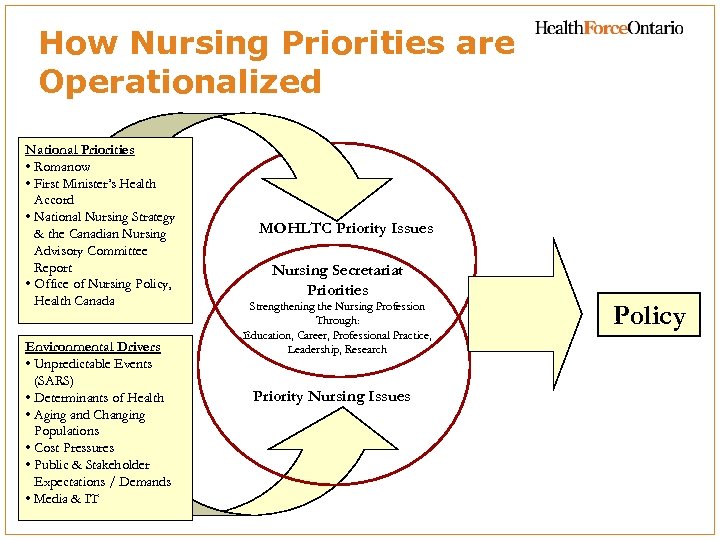
How Nursing Priorities are Operationalized National Priorities • Romanow • First Minister’s Health Accord • National Nursing Strategy & the Canadian Nursing Advisory Committee Report • Office of Nursing Policy, Health Canada Environmental Drivers • Unpredictable Events (SARS) • Determinants of Health • Aging and Changing Populations • Cost Pressures • Public & Stakeholder Expectations / Demands • Media & IT MOHLTC Priority Issues Nursing Secretariat Priorities Strengthening the Nursing Profession Through: Education, Career, Professional Practice, Leadership, Research Priority Nursing Issues Policy
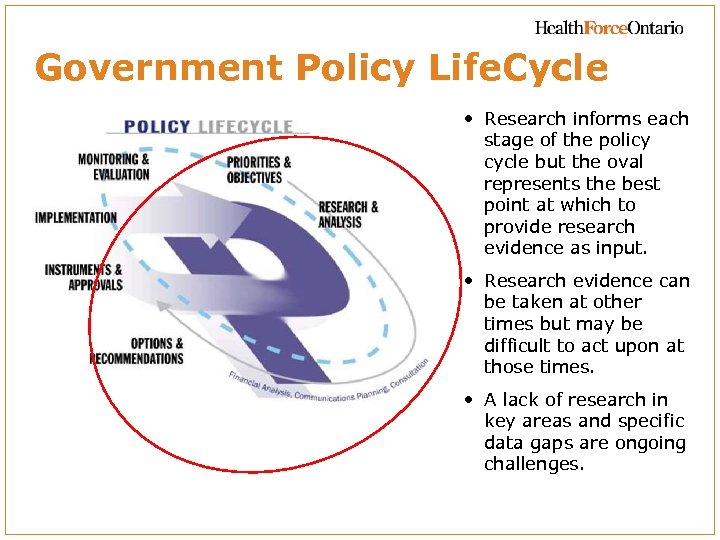
Government Policy Life. Cycle • Research informs each stage of the policy cycle but the oval represents the best point at which to provide research evidence as input. • Research evidence can be taken at other times but may be difficult to act upon at those times. • A lack of research in key areas and specific data gaps are ongoing challenges.
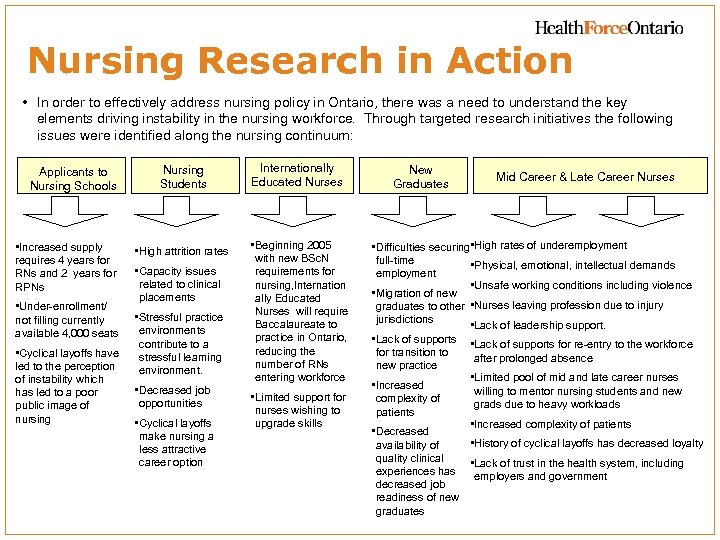
Nursing Research in Action • In order to effectively address nursing policy in Ontario, there was a need to understand the key elements driving instability in the nursing workforce. Through targeted research initiatives the following issues were identified along the nursing continuum: Applicants to Nursing Schools • Increased supply requires 4 years for RNs and 2 years for RPNs • Under-enrollment/ not filling currently available 4, 000 seats • Cyclical layoffs have led to the perception of instability which has led to a poor public image of nursing Nursing Students • High attrition rates • Capacity issues related to clinical placements • Stressful practice environments contribute to a stressful learning environment. • Decreased job opportunities • Cyclical layoffs make nursing a less attractive career option Internationally Educated Nurses • Beginning 2005 with new BSc. N requirements for nursing, Internation ally Educated Nurses will require Baccalaureate to practice in Ontario, reducing the number of RNs entering workforce • Limited support for nurses wishing to upgrade skills New Graduates Mid Career & Late Career Nurses • • Difficulties securing High rates of underemployment full-time • Physical, emotional, intellectual demands employment • Unsafe working conditions including violence • Migration of new graduates to other • Nurses leaving profession due to injury jurisdictions • Lack of leadership support. • Lack of supports for re-entry to the workforce for transition to after prolonged absence new practice • Limited pool of mid and late career nurses • Increased willing to mentor nursing students and new complexity of grads due to heavy workloads patients • Increased complexity of patients • Decreased • History of cyclical layoffs has decreased loyalty availability of quality clinical • Lack of trust in the health system, including experiences has employers and government decreased job readiness of new graduates
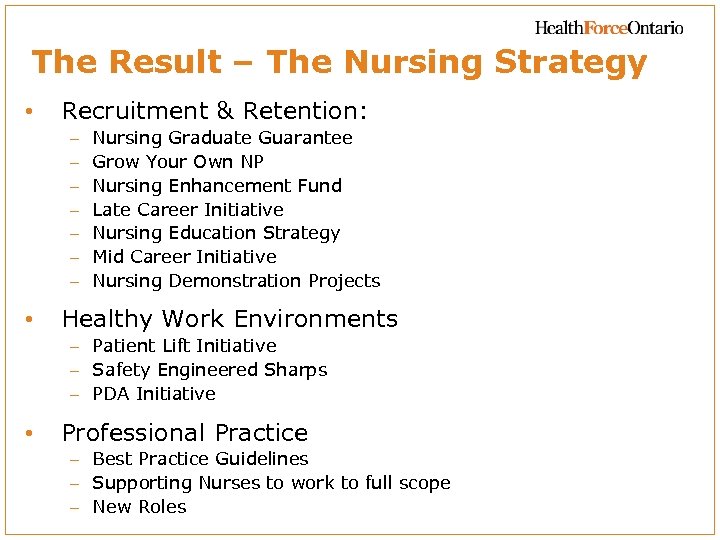
The Result – The Nursing Strategy • Recruitment & Retention: – – – – • Nursing Graduate Guarantee Grow Your Own NP Nursing Enhancement Fund Late Career Initiative Nursing Education Strategy Mid Career Initiative Nursing Demonstration Projects Healthy Work Environments – Patient Lift Initiative – Safety Engineered Sharps – PDA Initiative • Professional Practice – Best Practice Guidelines – Supporting Nurses to work to full scope – New Roles
Closure: Sandra Mac. Donald-Rencz Chief Nursing Officer, Nursing Policy, Health Canada

Discussions…. . • Comments from participants and presenters…

Systems Change Commons December 11 2008 Thanks for joining in… Next Systems Change Commons Spring 2009 For more information: Animateur@chnet-works. ca

• Nursing Best Practice Research Unit / Unité de recherche sur les pratiques exemplaires en soins infirmiers • http: //www. nbpru. ca • Registered Nurses Association of Ontario / L'Association des infirmieres et infirmiers autorisés de l'Ontario • http: //www. rnao. org • Community Health Research Unit, University of Ottawa / Centre de recherche sur la santé communautaire, l’université d’Ottawa • http: //aix 1. uottawa. ca/~nedwards/chru/
Скачать презентацию Systems Change Commons December 11 2008 How Evidence
38a611face32a823a43bbe1ca0d5e3ce.ppt