


 Скачать презентацию Systems Analysis and Design in a Changing World
09f6733581254f3bed7ef5674d7cbfd7.ppt
- Количество слайдов: 35
 Systems Analysis and Design in a Changing World, Fourth Edition Systems Analysis and Design in a Changing World, 4 th Edition 10
 Learning Objectives 10 u Describe the steps involved in the traditional approach to designing the application architecture u Develop a system flowchart u Develop a structure chart using transaction analysis and transform analysis u Write pseudocode for structured modules u Explain how to use three-layer design with the traditional approach Systems Analysis and Design in a Changing World, 4 th Edition 2
 10 Overview u Traditional approach to designing software l Overview of structured models, model development process, related terminology l How data flow diagrams are annotated with automation boundary information l How analysis phase models are transformed into design models using system flowcharts, structure charts, and module pseudocode l Integration into other design phase activities l Applying approach to a three-layer architecture Systems Analysis and Design in a Changing World, 4 th Edition 3
 The Structured Approach to Designing the Application Architecture u Application 10 software programs l Designed in conjunction with database and user interface l Hierarchy of modules u Design internal logic of individual modules u Top-down approach l DFDs with automation boundaries l System flowcharts, structure charts, pseudocode Systems Analysis and Design in a Changing World, 4 th Edition 4
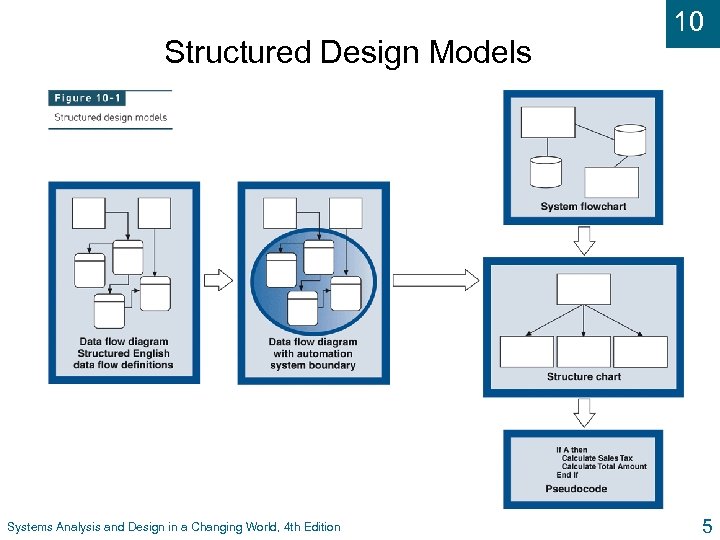 Structured Design Models Systems Analysis and Design in a Changing World, 4 th Edition 10 5
 10 The Automation System Boundary u Partitions data flow diagram processes into manual processes and automated systems u Processes u Data can be inside or outside boundary flows can be inside and outside of boundary l Data flows that cross system boundary represent inputs and outputs of system l Data flows that cross boundaries between programs represent program-to-program communication Systems Analysis and Design in a Changing World, 4 th Edition 6
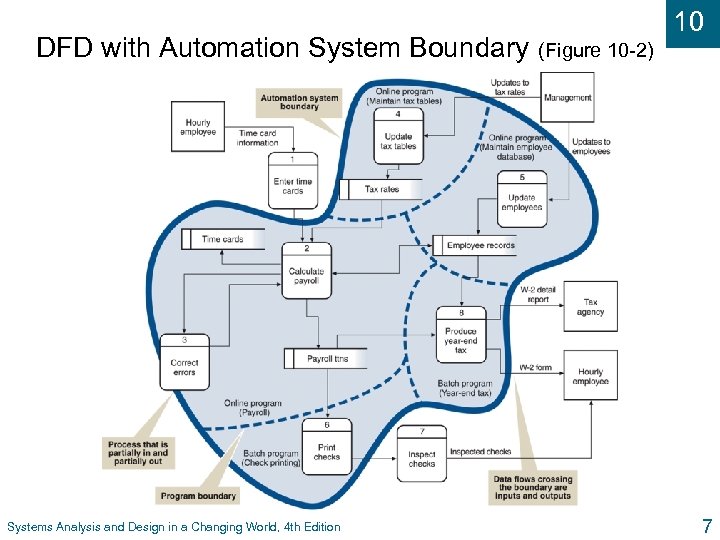 DFD with Automation System Boundary Systems Analysis and Design in a Changing World, 4 th Edition 10 (Figure 10 -2) 7
 10 The System Flowchart u Representation of various computer programs, files, databases, and associated manual processes that make up complete system u Frequently constructed during analysis activities u Graphically describes organization of subsystems into automated and manual components u Can show type of transaction processing system l Batch l Real-time Systems Analysis and Design in a Changing World, 4 th Edition 8
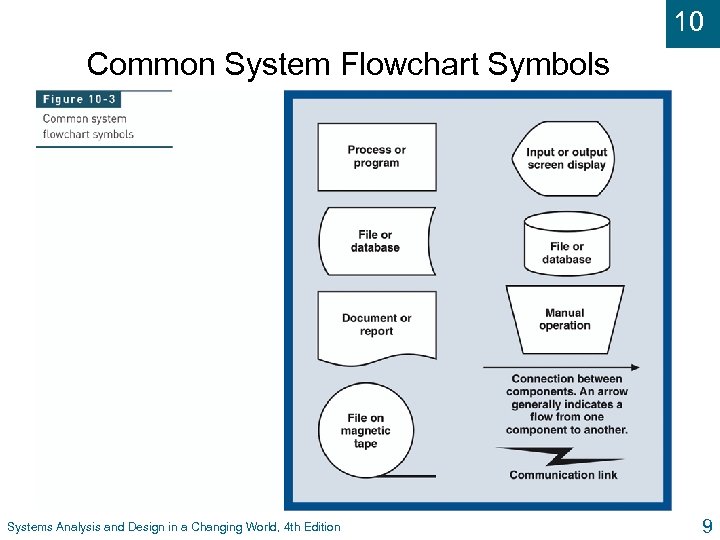 10 Common System Flowchart Symbols Systems Analysis and Design in a Changing World, 4 th Edition 9
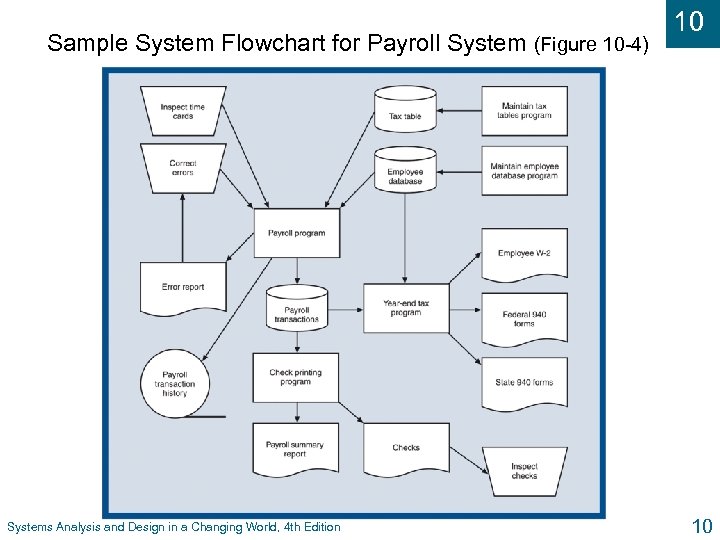 Sample System Flowchart for Payroll System (Figure 10 -4) Systems Analysis and Design in a Changing World, 4 th Edition 10 10
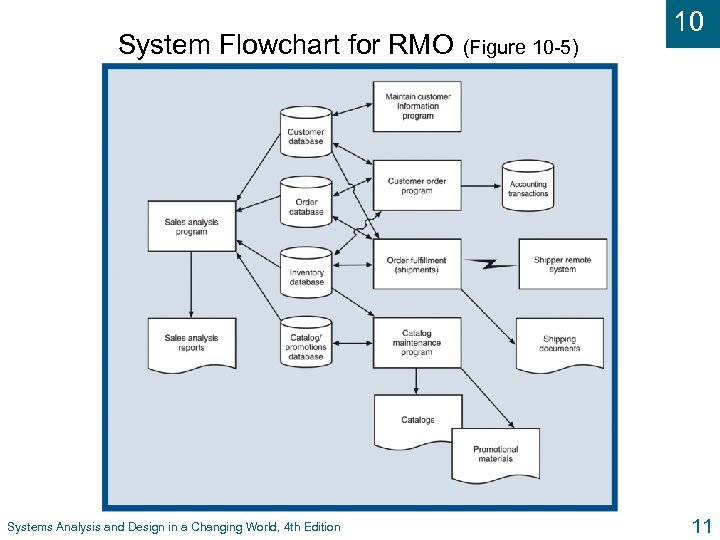 System Flowchart for RMO Systems Analysis and Design in a Changing World, 4 th Edition (Figure 10 -5) 10 11
 10 The Structure Chart u Describes functions and subfunctions of each part of system u Shows relationships between modules of a computer program u Simple and direct organization l Each module performs a specific function l Each layer in a program performs specific activities u Chart is tree-like with root module and branches Systems Analysis and Design in a Changing World, 4 th Edition 12
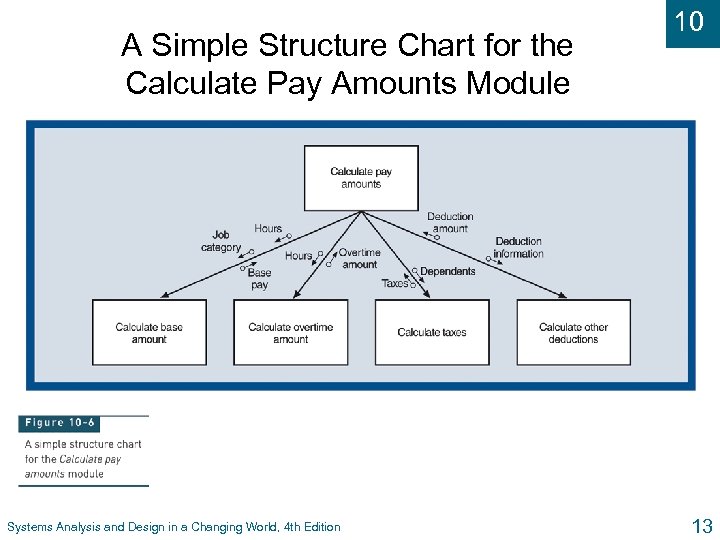 A Simple Structure Chart for the Calculate Pay Amounts Module Systems Analysis and Design in a Changing World, 4 th Edition 10 13
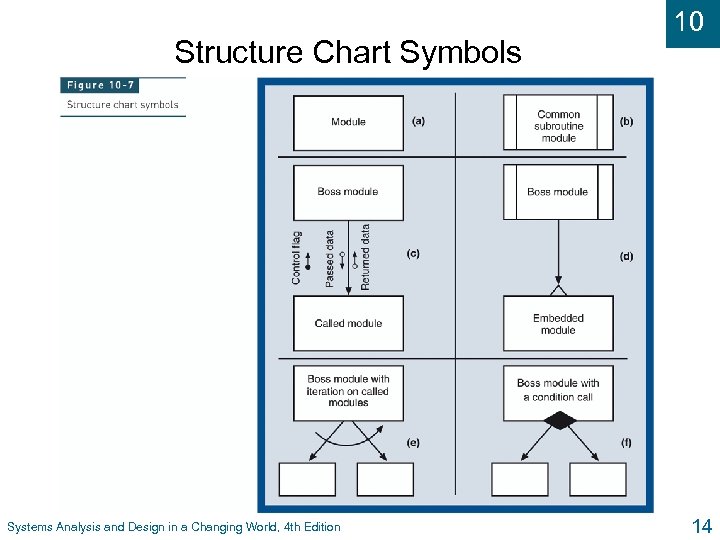 Structure Chart Symbols Systems Analysis and Design in a Changing World, 4 th Edition 10 14
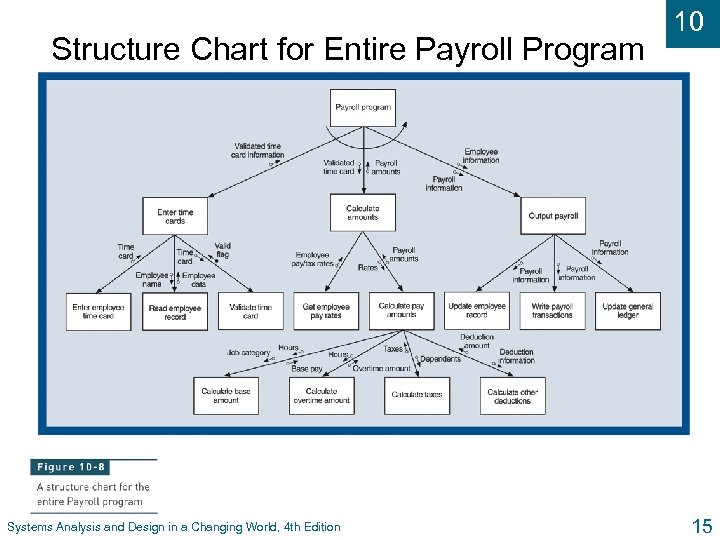 Structure Chart for Entire Payroll Program Systems Analysis and Design in a Changing World, 4 th Edition 10 15
 10 Developing a Structure Chart u Transaction analysis l Uses system flow chart and event table inputs l Upper-level modules developed first l Identifies each transaction supported by program u Transform analysis l Uses DFD fragments for inputs l Computer program “transforms” inputs into outputs l Charts have input, calculate, and output subtrees Systems Analysis and Design in a Changing World, 4 th Edition 16
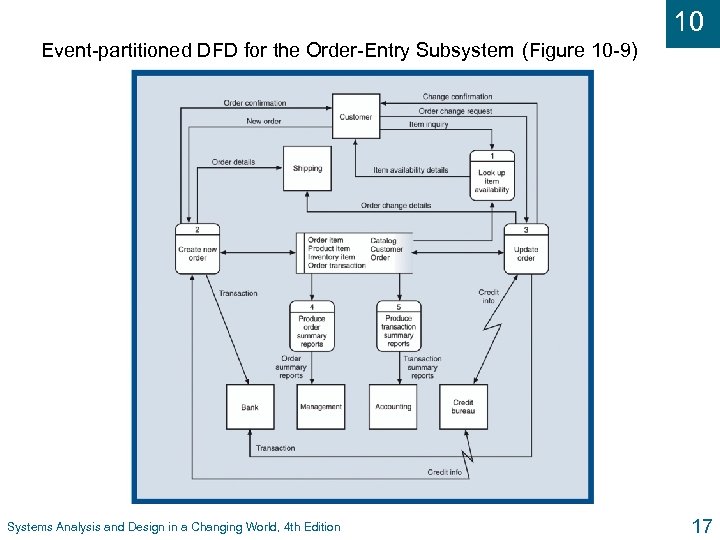 10 Event-partitioned DFD for the Order-Entry Subsystem (Figure 10 -9) Systems Analysis and Design in a Changing World, 4 th Edition 17
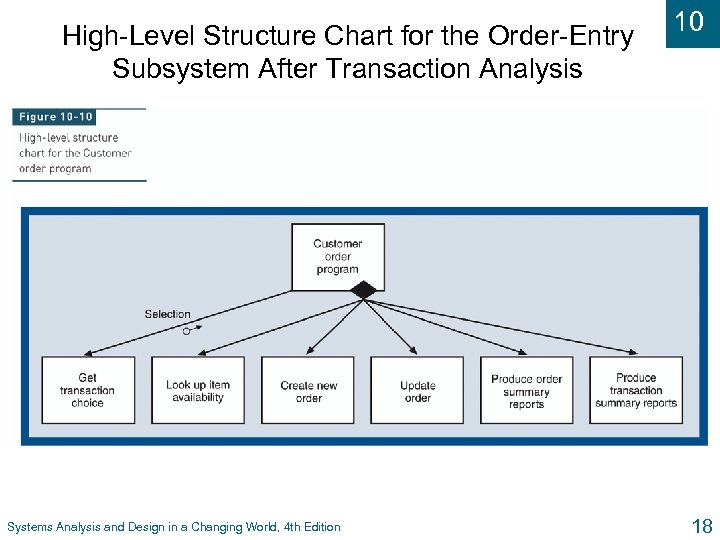 High-Level Structure Chart for the Order-Entry Subsystem After Transaction Analysis Systems Analysis and Design in a Changing World, 4 th Edition 10 18
 Steps to Create a Structure Chart from a DFD Fragment u Determine l 10 primary information flow Main stream of data transformed from some input form to output form u Find process that represents most fundamental change from input to output u Redraw DFD with inputs to left and outputs to right – central transform process goes in middle u Generate first draft of structure chart based on redrawn data flow Systems Analysis and Design in a Changing World, 4 th Edition 19
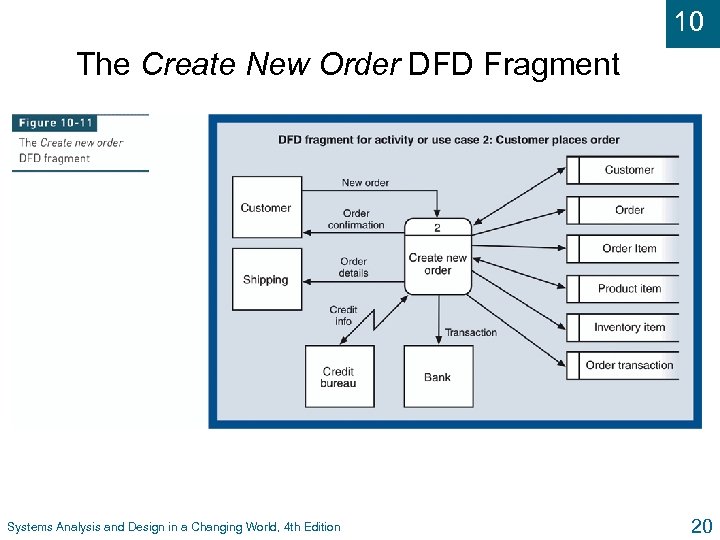 10 The Create New Order DFD Fragment Systems Analysis and Design in a Changing World, 4 th Edition 20
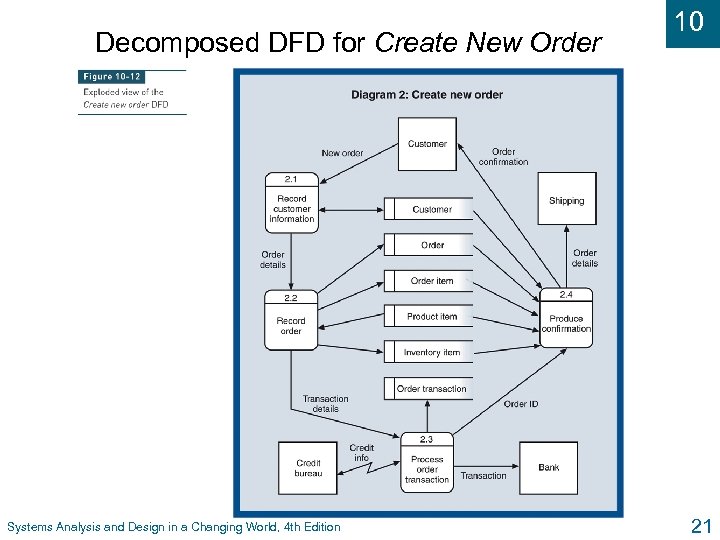 Decomposed DFD for Create New Order Systems Analysis and Design in a Changing World, 4 th Edition 10 21
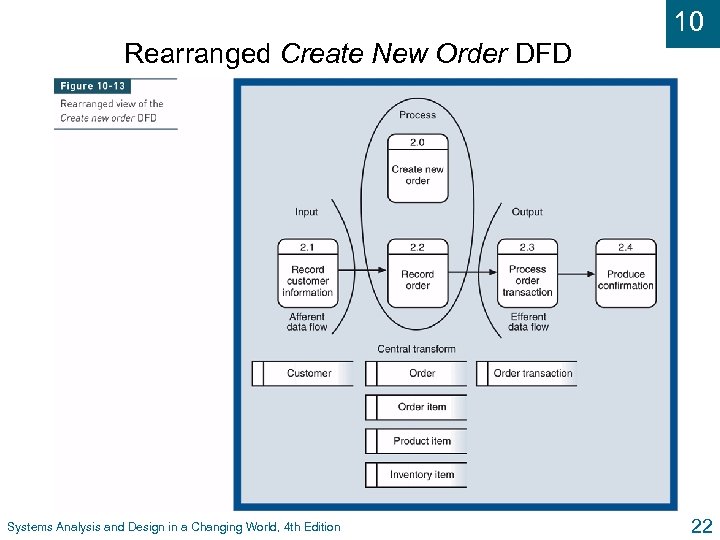 10 Rearranged Create New Order DFD Systems Analysis and Design in a Changing World, 4 th Edition 22
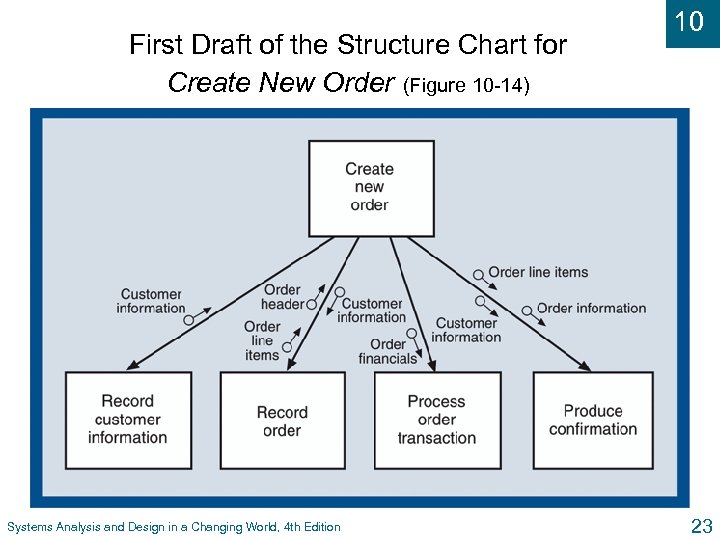 First Draft of the Structure Chart for Create New Order (Figure 10 -14) Systems Analysis and Design in a Changing World, 4 th Edition 10 23
 Steps to Create a Structure Chart from a DFD Fragment (continued) u Add 10 other modules l Get input data via user-interface screens l Read from and write to data storage l Write output data or reports u Add logic from structured English or decision tables u Make final refinements to structure chart based on quality control concepts Systems Analysis and Design in a Changing World, 4 th Edition 24
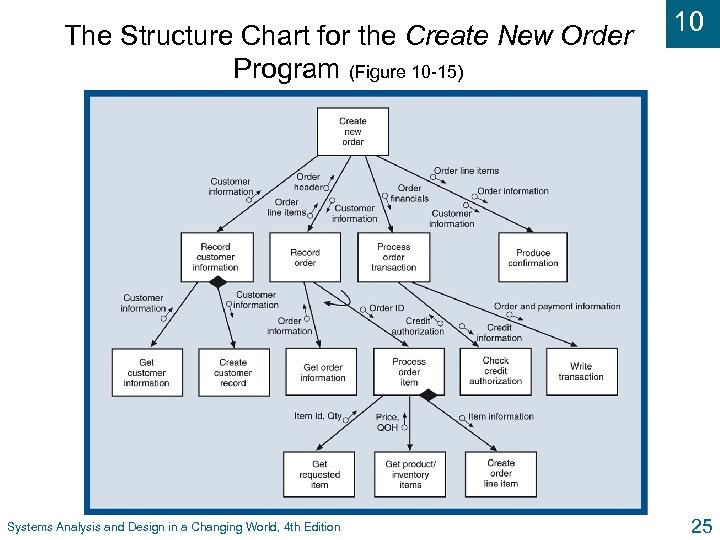 The Structure Chart for the Create New Order Program (Figure 10 -15) Systems Analysis and Design in a Changing World, 4 th Edition 10 25
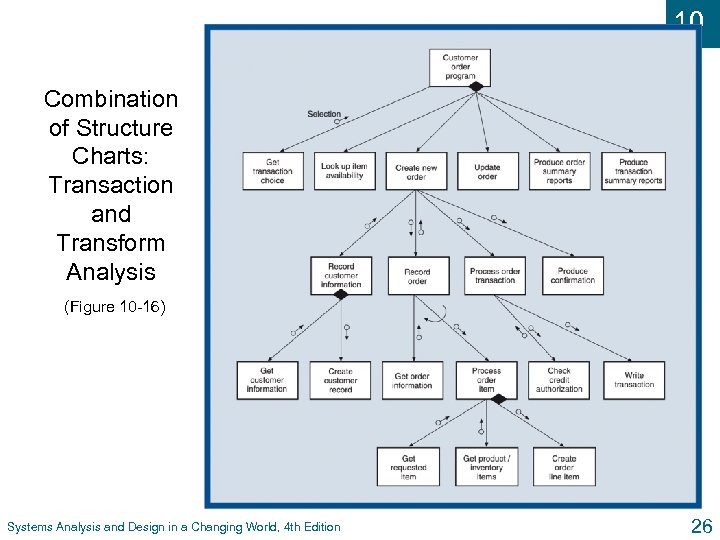 10 Combination of Structure Charts: Transaction and Transform Analysis (Figure 10 -16) Systems Analysis and Design in a Changing World, 4 th Edition 26
 10 Evaluating the Quality of a Structure Chart u Module coupling l Measure of how module is connected to other modules in program l Goal is to be loosely coupled u Module cohesion l Measure of internal strength of module l Module performs one defined task l Goal is to be highly cohesive Systems Analysis and Design in a Changing World, 4 th Edition 27
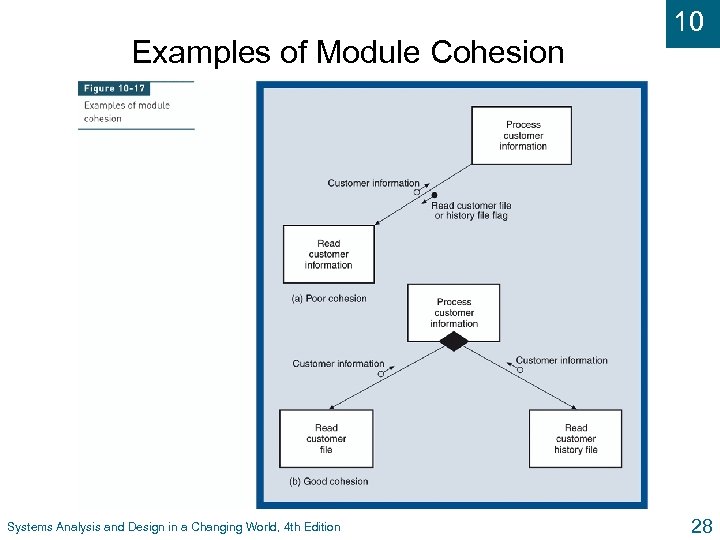 Examples of Module Cohesion Systems Analysis and Design in a Changing World, 4 th Edition 10 28
 10 Module Algorithm Design—Pseudocode u Describes internal logic of software modules u Variation of structured English that is closer to programming code u Syntax should mirror development language u Three types of control statements used in structured programming l Sequence – sequence of executable statements l Decision – if-then-else logic l Iteration – do-until or do-while Systems Analysis and Design in a Changing World, 4 th Edition 29
 Integrating Structured Application Design with Other Design Tasks 10 u Structure chart must be modified or enhanced to integrate design of user interface and database l Are additional modules needed? l Does pseudocode in modules need modification? l Are additional data couples needed to pass data? u Structure charts and system flowcharts must correspond to planned network architecture l Required protocols, capacity, and security Systems Analysis and Design in a Changing World, 4 th Edition 30
 10 Three-Layer Design u Three-layer l architecture View layer, business logic layer, and data layer u Structure charts and system flowcharts describe design decisions and software structuring u Employs multiple programs for user interface, business logic, and data access modules u Modules in different layers communicate over real -time links using well-defined protocols Systems Analysis and Design in a Changing World, 4 th Edition 31
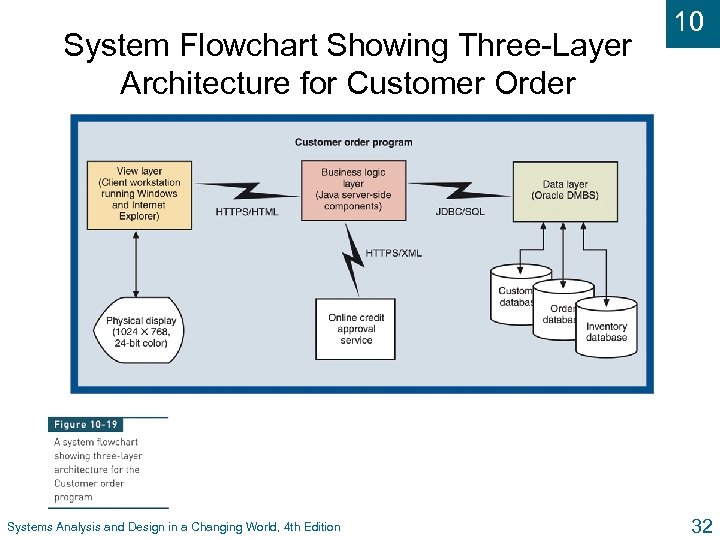 System Flowchart Showing Three-Layer Architecture for Customer Order Systems Analysis and Design in a Changing World, 4 th Edition 10 32
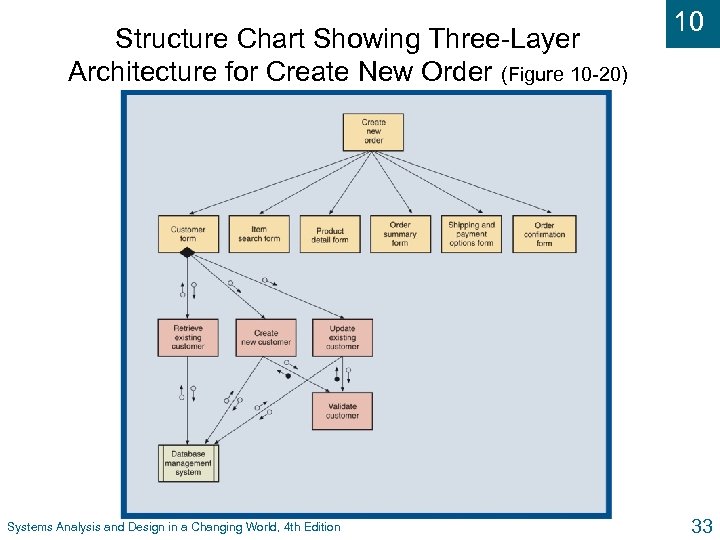 Structure Chart Showing Three-Layer Architecture for Create New Order (Figure 10 -20) Systems Analysis and Design in a Changing World, 4 th Edition 10 33
 10 Summary u For traditional structured approach to systems design, primary input is data flow diagram l DFD is enhanced by adding system boundary l Designer describes processes within each DFD boundary using one or more structure charts u Structure charts developed using l Transaction analysis – multiple transaction types l Transform analysis – single transaction from input to output Systems Analysis and Design in a Changing World, 4 th Edition 34
 10 Summary (continued) u Structure charts may be based on three-layer architecture l Modules will be clearly identified by layer l Structure chart may be decomposed if layers execute on multiple systems u Structured design may also include l System flowcharts to show data movement l Module pseudocode to describe internal logic of structure chart module Systems Analysis and Design in a Changing World, 4 th Edition 35