


 Скачать презентацию Systems Analysis and Design in a Changing World
8f8a888908cc22e976cb588195da4498.ppt
- Количество слайдов: 29
 Systems Analysis and Design in a Changing World, 3 rd Edition
 Chapter 8: Evaluating Alternatives for Requirements, Environment, and Implementation Systems Analysis and Design in a Changing World, 3 rd Edition
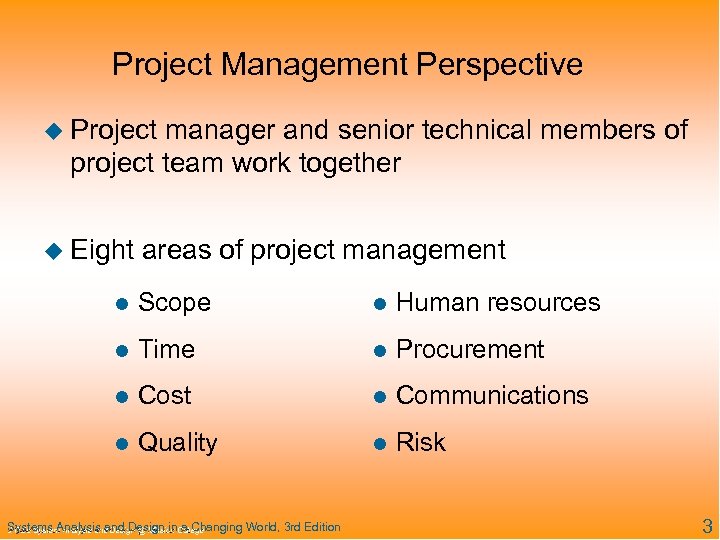 Project Management Perspective u Project manager and senior technical members of project team work together u Eight areas of project management l Scope l Human resources l Time l Procurement l Cost l Communications l Quality l Risk Systems Analysis and Design in a Changing World, 3 rd Edition 3
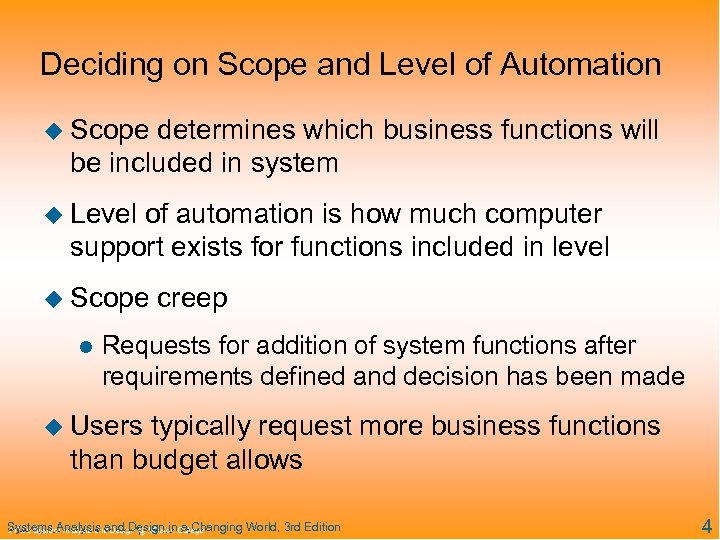 Deciding on Scope and Level of Automation u Scope determines which business functions will be included in system u Level of automation is how much computer support exists for functions included in level u Scope l creep Requests for addition of system functions after requirements defined and decision has been made u Users typically request more business functions than budget allows Systems Analysis and Design in a Changing World, 3 rd Edition 4
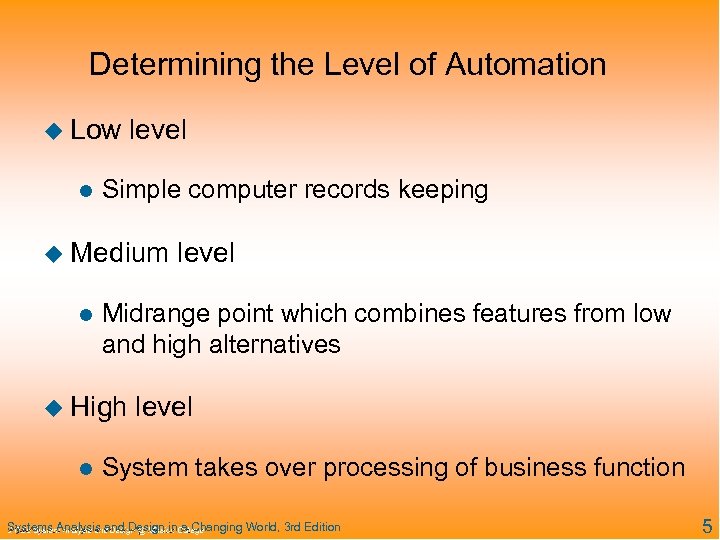 Determining the Level of Automation u Low l level Simple computer records keeping u Medium l Midrange point which combines features from low and high alternatives u High l level System takes over processing of business function Systems Analysis and Design in a Changing World, 3 rd Edition 5
 Selecting Alternatives u Entire group of alternatives is evaluated together to provide “big picture” view of proposed system u Key criteria that are used: l Strategic plan l Economic feasibility l Schedule and resource feasibility l Technological feasibility l Operational, organizational, and cultural feasibility Systems Analysis and Design in a Changing World, 3 rd Edition 6
 Defining the Application Deployment Environment u Configuration of: l Computer hardware l System software l Networks l Development Tools u Existing environment generally considered and compared with proposed environment Systems Analysis and Design in a Changing World, 3 rd Edition 7
 Hardware, System Software, and Networks u Older batch-mode applications on centralized mainframe u Stand-alone applications on mini- and personal computers u On-line interactive applications u Distributed applications u Web-based applications Systems Analysis and Design in a Changing World, 3 rd Edition 8
 Deployment Environment Characteristics u Compatibility with system requirements u Compatibility among hardware and system software u Required interfaces to external systems u Conformity with IT strategic plan and architecture plans u Cost and schedule Systems Analysis and Design in a Changing World, 3 rd Edition 9
 Development Tools u Programming languages, CASE tools, software used to develop application software u Java and Visual Studio. NET are examples u Application deployment environment decisions limit development tool choices l Operating system environment l Database management system (DBMS) l Distributed software standard Systems Analysis and Design in a Changing World, 3 rd Edition 10
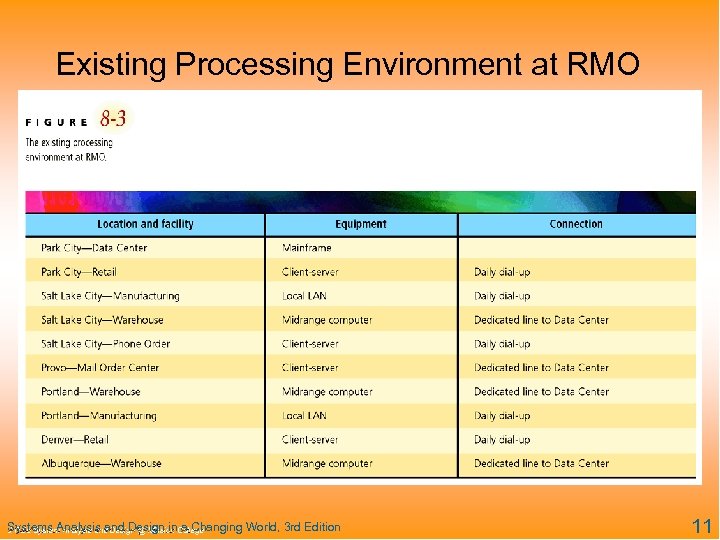 Existing Processing Environment at RMO Systems Analysis and Design in a Changing World, 3 rd Edition 11
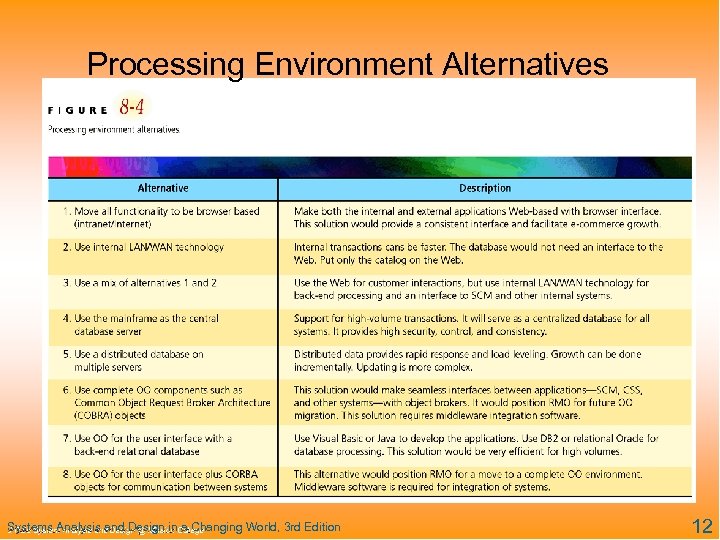 Processing Environment Alternatives Systems Analysis and Design in a Changing World, 3 rd Edition 12
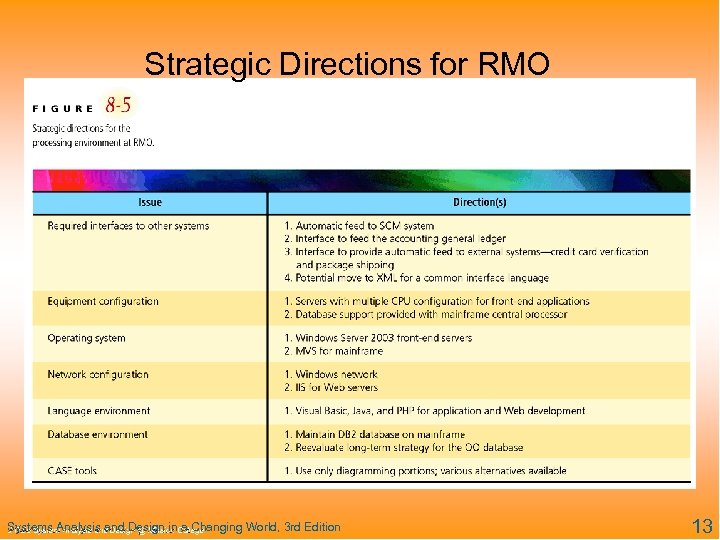 Strategic Directions for RMO Systems Analysis and Design in a Changing World, 3 rd Edition 13
 Choosing Implementation Alternatives u Variations on obtaining system l Facilities management outsource all IS support l Packaged software, Turnkey system, ERP system l Custom-built software systems l In-house development u Selection dimensions l Buy vs. build l In-house vs. outsource Systems Analysis and Design in a Changing World, 3 rd Edition 14
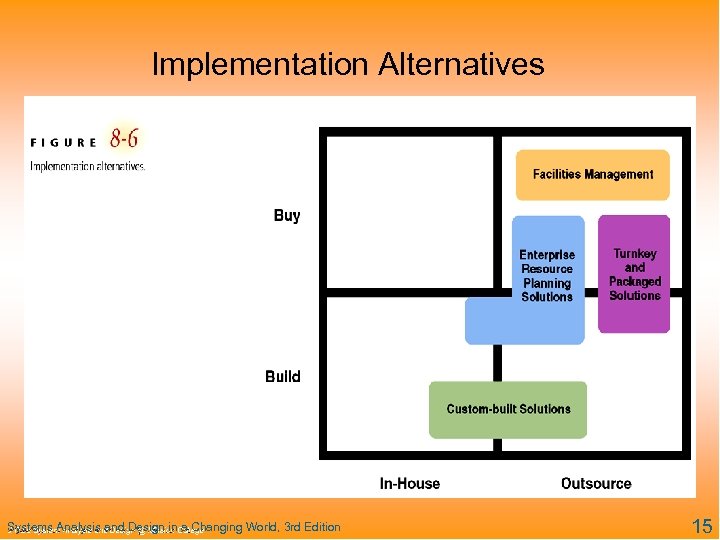 Implementation Alternatives Systems Analysis and Design in a Changing World, 3 rd Edition 15
 Selecting an Implementation Alternative u Identifying Criteria for Selection l Comparisons can be difficult l Different proposed systems have strengths in different areas u Three major areas to consider l General requirements l Technical requirements l Functional requirements Systems Analysis and Design in a Changing World, 3 rd Edition 16
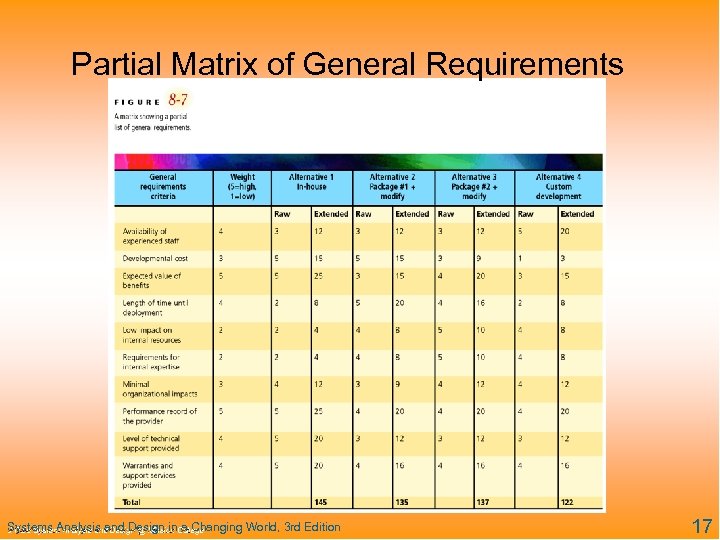 Partial Matrix of General Requirements Systems Analysis and Design in a Changing World, 3 rd Edition 17
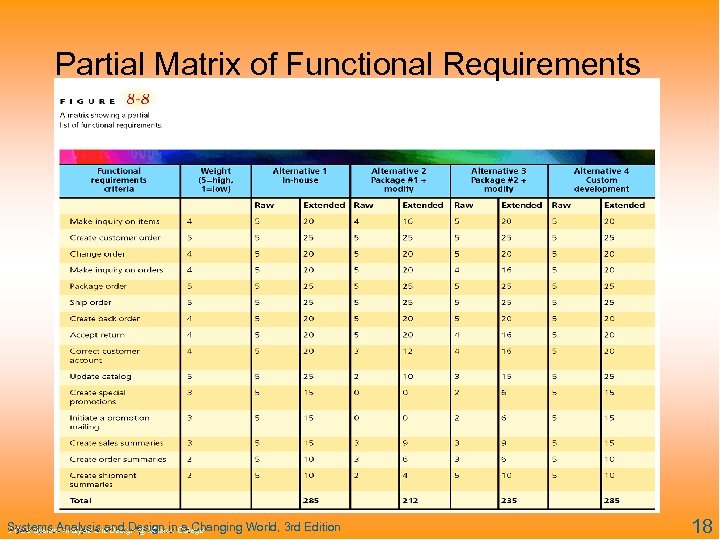 Partial Matrix of Functional Requirements Systems Analysis and Design in a Changing World, 3 rd Edition 18
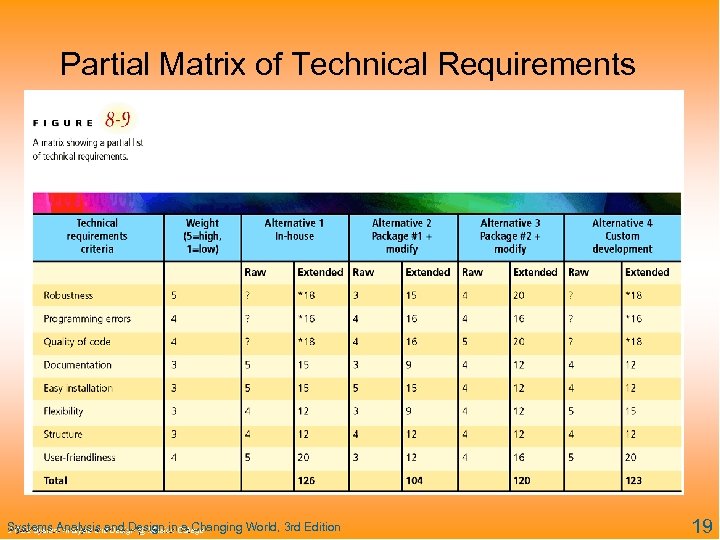 Partial Matrix of Technical Requirements Systems Analysis and Design in a Changing World, 3 rd Edition 19
 Making the Selection u First, rate each alternative with raw score u Weighted scores are then tabulated and compared to make a choice u RMO decided on in-house development for most CSS development to keep expertise within RMO u RMO wants to hire some new technical specialists u RMO feasibility review showed no serious problems – once specialists are added Systems Analysis and Design in a Changing World, 3 rd Edition 20
 Contracting with Vendors u Generating Request for Proposal (RFP) l Formal document sent to vendors if in-house development not selected l States requirements and solicits proposed solutions l Considered a competitive contract offer l Bid on supplying hardware, software, and/or support services Systems Analysis and Design in a Changing World, 3 rd Edition 21
 Sample RFP Table of Contents I. Introduction and Background II. Overview of Need III. Description of Technical Requirements IV. Description of Functional Requirements Systems Analysis and Design in a Changing World, 3 rd Edition 22
 Sample RFP Table of Contents (continued) V. Description of General Requirements VI. Requested Provider and Project Information VII. Details for Submitting Proposal IV. Evaluation Criteria and Process Systems Analysis and Design in a Changing World, 3 rd Edition 23
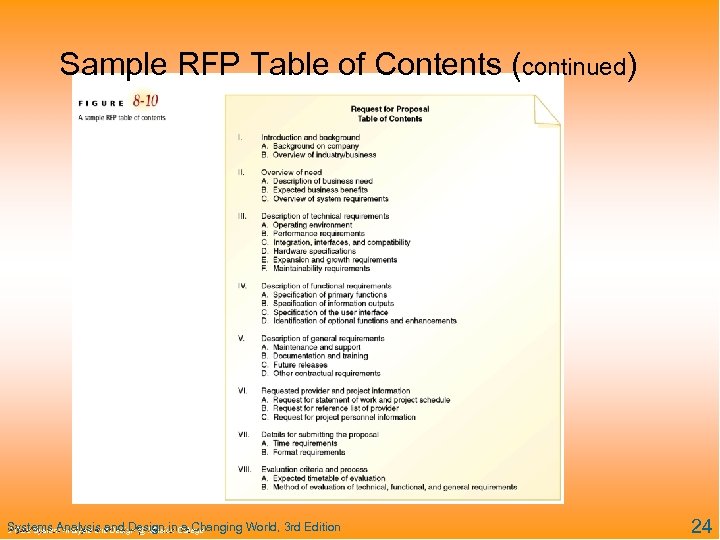 Sample RFP Table of Contents (continued) Systems Analysis and Design in a Changing World, 3 rd Edition 24
 Benchmarking and Choosing a Vendor u Observe in use or install trial version u Benchmark – evaluate the system against a standard u Visit another company using particular system u Developing a contract l Fixed-dollar contracts: Risk is on vendor l Cost-plus-percentage: Risk is on purchaser l Cost-plus-fixed-fee: Risk shared by both Systems Analysis and Design in a Changing World, 3 rd Edition 25
 Presenting Results and Making Decisions u Compile and organize documentation u Present alternatives and critical issues in easy-tounderstand but complete manner u Final choice generally made by executive steering committee u Format of documentation and presentation style varies with organization Systems Analysis and Design in a Changing World, 3 rd Edition 26
 Summary u These activities are primarily project manager responsibilities with support from project team u Focus of project changes from discovering requirements to developing solution system u Prioritize requirements based on scope and level of automation l Scope of new system determines functions it will support l Level of automation is measure of how automated selected functions will be Systems Analysis and Design in a Changing World, 3 rd Edition 27
 Summary (continued) u Application deployment environment l Computer hardware, systems software, and networks in which new system will operate l Determines constraints imposed on system development alternatives u Analyst must define environment to match: l Application requirements l Organization’s strategic application plans l Organization’s technology architecture plans Systems Analysis and Design in a Changing World, 3 rd Edition 28
 Summary (continued) u Determine what alternatives are possible for developing solution u Implementation alternatives include: l Building system in-house l Buying packaged or turnkey solution l Contracting with developer to build it (outsource) u Develop recommendations and present to management to make funding decisions Systems Analysis and Design in a Changing World, 3 rd Edition 29