


 Скачать презентацию Systemic and structural organization of the lexico and
кучеренко.ppt
- Количество слайдов: 20
 Systemic and structural organization of the lexico and semantic field “sporting terminology" in modern English. Master’s Paper Student: Olya Kucherenko Scientific supervisor: associate proffesor Gladka I. A.
 Topicality of work is predefined by the anthropocentric orientation of modern linguistics to the study of aspects of intercommunication of language and society on the whole and by the necessity of complex analysis of one of thematic groups of vocabulary.
 The aim of the investigation is systematic description of nomination of the lexicosemantic field " terminology of sport" in modern English.
 The object of the research - is nominations of the lexico-semantic field "sporting terminology" in modern English. The subject of research - is semantic descriptions of nomination of the lexicosemantic field "sporting terminology" in modern English.
 The lexical-semantic field – is a term, used in linguistics mostly for denotation of totality of language units, incorporated by some general (integral) semantic feature. Y. Trier L. Weisgerber R. Meyer F. Filin O. Potebnya
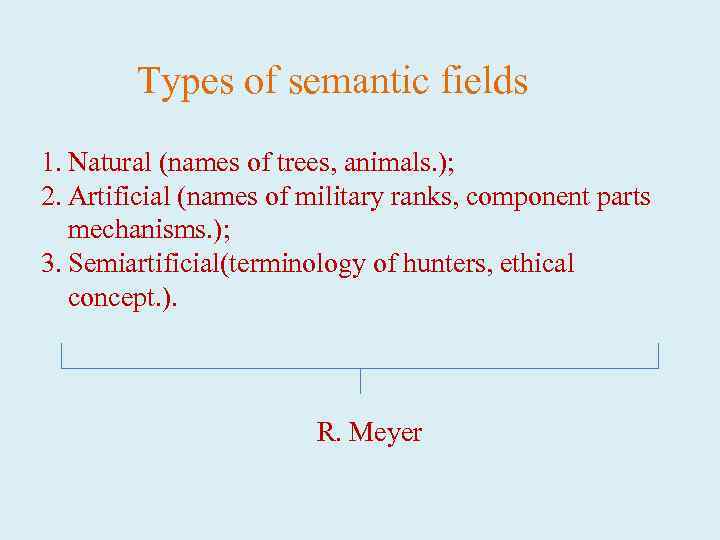 Types of semantic fields 1. Natural (names of trees, animals. ); 2. Artificial (names of military ranks, component parts mechanisms. ); 3. Semiartificial(terminology of hunters, ethical concept. ). R. Meyer
 Semantic structure of the field Periphery Center Kernel
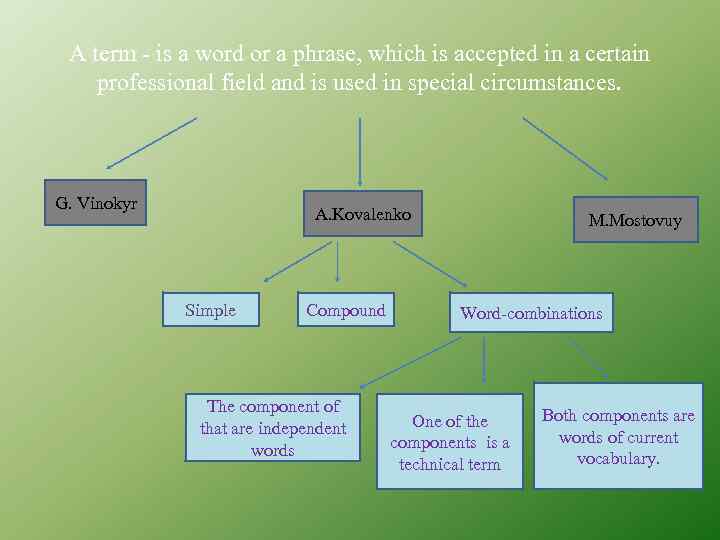 A term - is a word or a phrase, which is accepted in a certain professional field and is used in special circumstances. G. Vinokyr А. Kovalenko Simple Compound The component of that are independent words М. Mostovuy Word-combinations One of the components is a technical term Both components are words of current vocabulary.
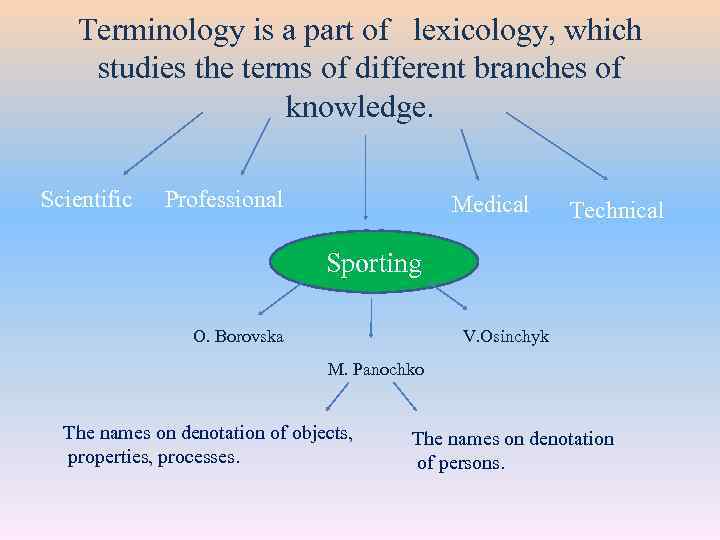 Terminology is a part of lexicology, which studies the terms of different branches of knowledge. Scientific Professional Medical Technical Sporting O. Borovska V. Osinchyk M. Panochko The names on denotation of objects, properties, processes. The names on denotation of persons.
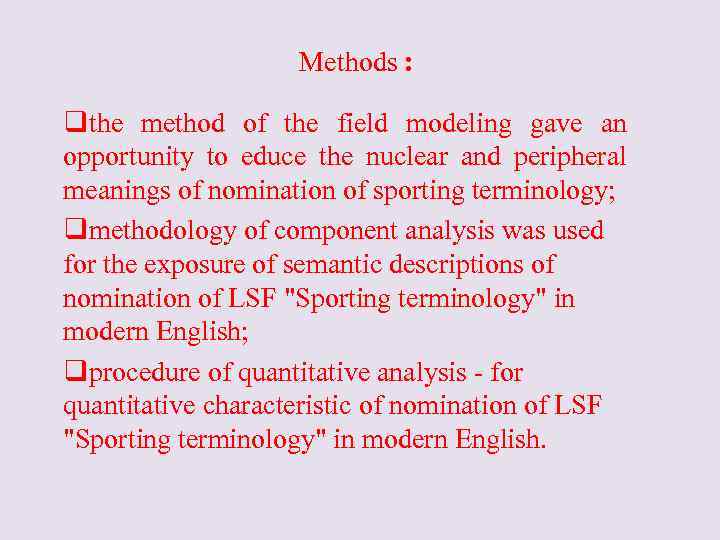 Methods : qthe method of the field modeling gave an opportunity to educe the nuclear and peripheral meanings of nomination of sporting terminology; qmethodology of component analysis was used for the exposure of semantic descriptions of nomination of LSF "Sporting terminology" in modern English; qprocedure of quantitative analysis - for quantitative characteristic of nomination of LSF "Sporting terminology" in modern English.
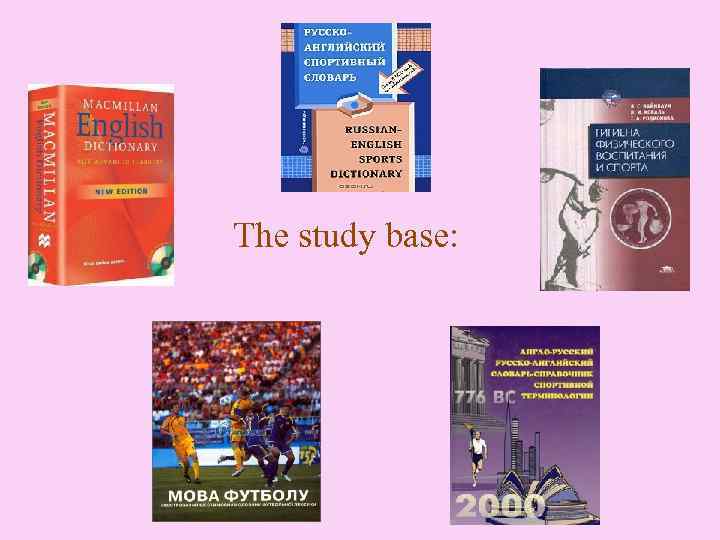 The study base:
 Platonov V. Sport is the educational, playing, contention activity, based on the usuge of physical exercises, that has socially meaningful results.
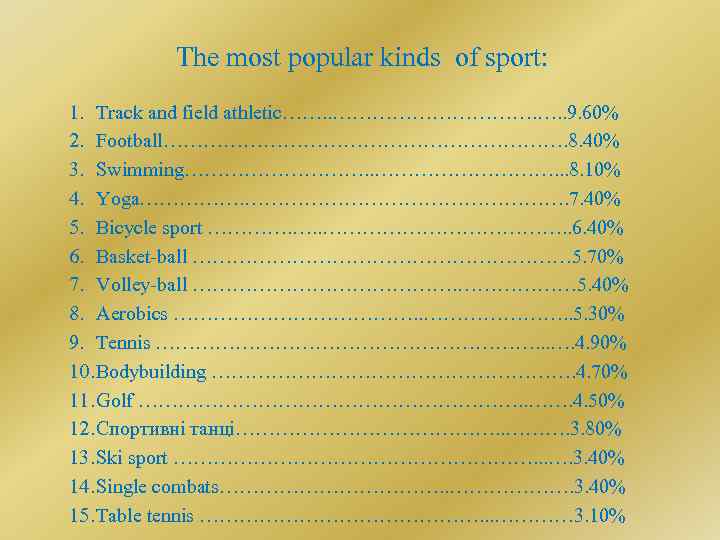 The most popular kinds of sport: 1. Track and field athletic……. . ……………. …. . 9. 60% 2. Football…………………………. 8. 40% 3. Swimming………………………. . . 8. 10% 4. Yoga……………………. 7. 40% 5. Bicycle sport …………. …. . ………………. . 6. 40% 6. Basket-ball ………………………… 5. 70% 7. Volley-ball ………………… 5. 40% 8. Aerobics ………………. . …………………. . 5. 30% 9. Tennis …………………………. . . …. 4. 90% 10. Bodybuilding ………………………. 4. 70% 11. Golf …………………………. 4. 50% 12. Спортивні танці…………………. 3. 80% 13. Ski sport ………………………. . . …. 3. 40% 14. Single combats………………. 3. 40% 15. Table tennis …………………. . . ………… 3. 10%
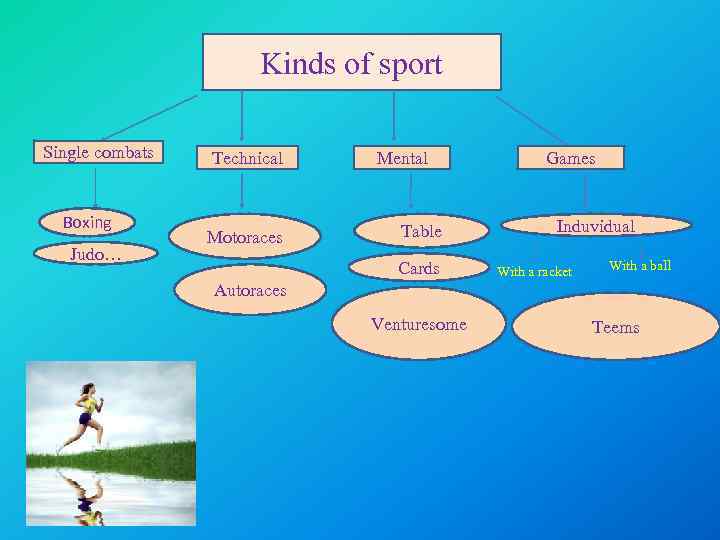 Kinds of sport Single combats Boxing Judo… Technical Motoraces Autoraces Mental Table Cards Venturesome Games Induvidual With a racket With a ball Teems
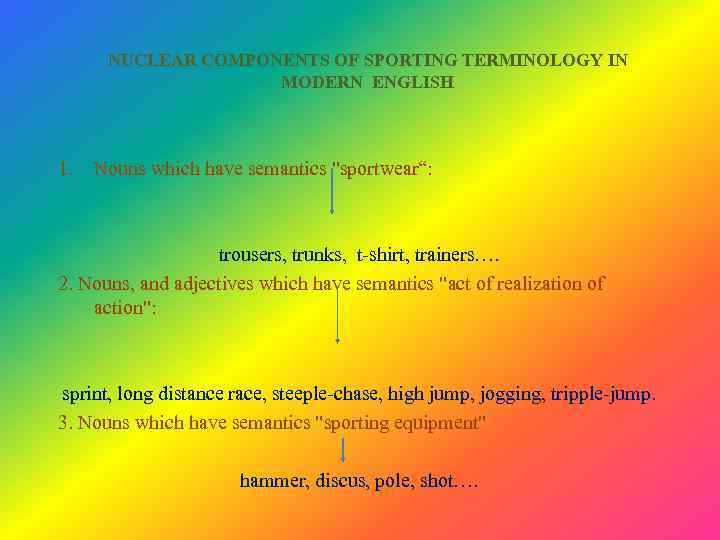 NUCLEAR COMPONENTS OF SPORTING TERMINOLOGY IN MODERN ENGLISH 1. Nouns which have semantics "sportwear“: trousers, trunks, t-shirt, trainers…. 2. Nouns, and adjectives which have semantics "act of realization of action": sprint, long distance race, steeple-chase, high jump, jogging, tripple-jump. 3. Nouns which have semantics "sporting equipment" hammer, discus, pole, shot….
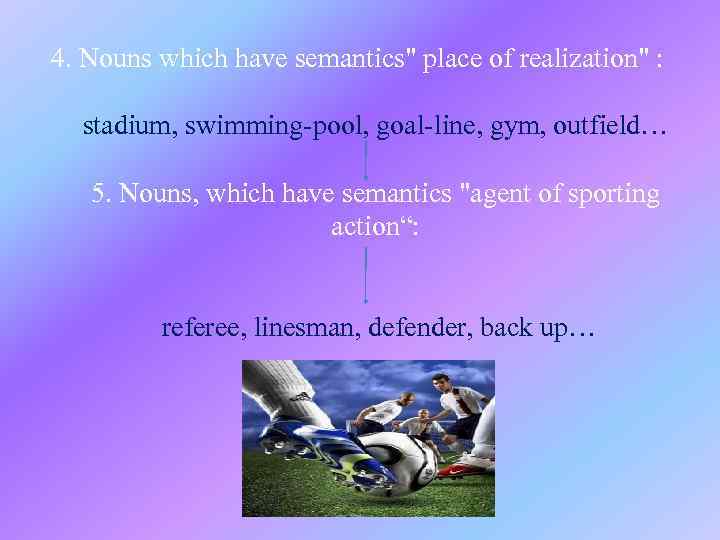 4. Nouns which have semantics" place of realization" : stadium, swimming-pool, goal-line, gym, outfield… 5. Nouns, which have semantics "agent of sporting action“: referee, linesman, defender, back up…
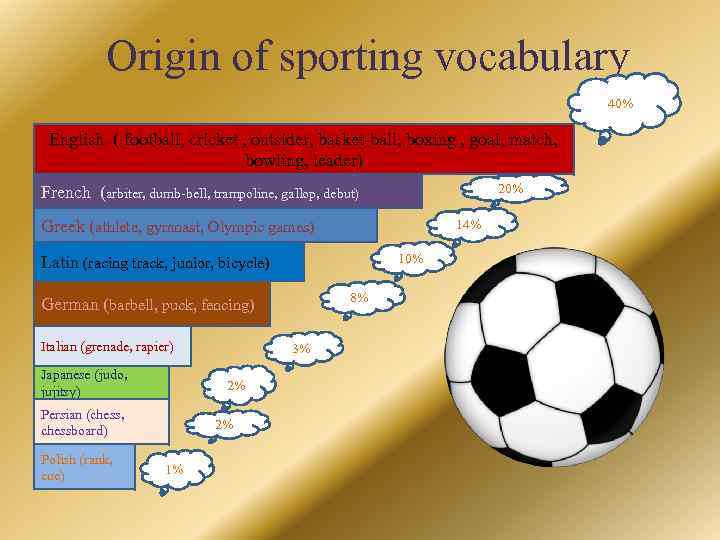 Origin of sporting vocabulary 40% English ( football, cricket , outsider, basket-ball, boxing , goal, match, bowling, leader) 20% French (arbiter, dumb-bell, trampoline, gallop, debut) Greek (athlete, gymnast, Olympic games) 14% 10% Latin (racing track, junior, bicycle) 8% German (barbell, puck, fencing) Italian (grenade, rapier) Japanese (judo, jujitsy) 2% Persian (chess, chessboard) Polish (rank, cue) 3% 2% 1%
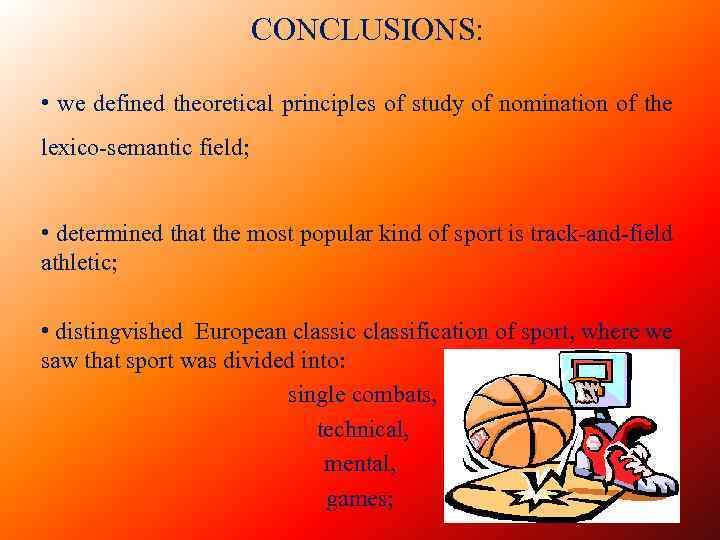 CONCLUSIONS: • we defined theoretical principles of study of nomination of the lexico-semantic field; • determined that the most popular kind of sport is track-and-field athletic; • distingvished European classic classification of sport, where we saw that sport was divided into: single combats, technical, mental, games;
 • distinguished that nouns are majority from the components of nuclear zone of units of sporting terminology, that have semantics: "sportwear", "sporting equipment", "place of realization", "agent of realization of sporting action".
 Thank you for your attention!