 Скачать презентацию System Planning Site Evaluation October 14 2005
83c74a08b95d7e3102d45dfd459dca1a.ppt
- Количество слайдов: 14



System Planning & Site Evaluation October 14, 2005 Jonathan Clemens Independent Renewable Energy Consultant
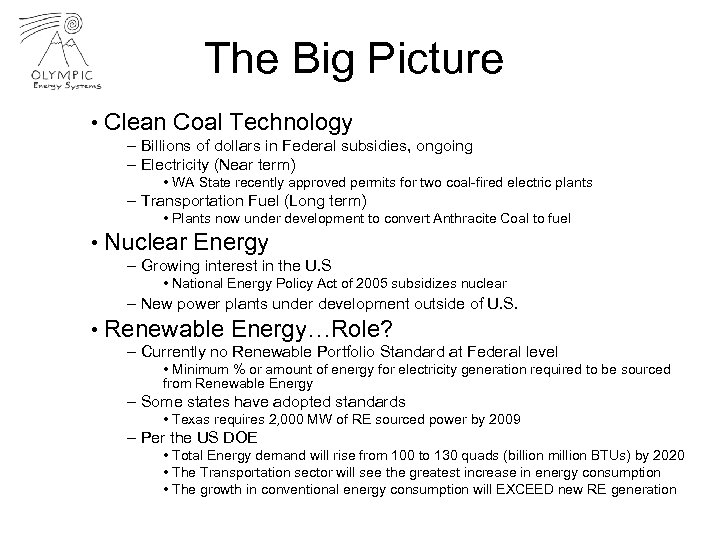
The Big Picture • Clean Coal Technology – Billions of dollars in Federal subsidies, ongoing – Electricity (Near term) • WA State recently approved permits for two coal-fired electric plants – Transportation Fuel (Long term) • Plants now under development to convert Anthracite Coal to fuel • Nuclear Energy – Growing interest in the U. S • National Energy Policy Act of 2005 subsidizes nuclear – New power plants under development outside of U. S. • Renewable Energy…Role? – Currently no Renewable Portfolio Standard at Federal level • Minimum % or amount of energy for electricity generation required to be sourced from Renewable Energy – Some states have adopted standards • Texas requires 2, 000 MW of RE sourced power by 2009 – Per the US DOE • Total Energy demand will rise from 100 to 130 quads (billion million BTUs) by 2020 • The Transportation sector will see the greatest increase in energy consumption • The growth in conventional energy consumption will EXCEED new RE generation
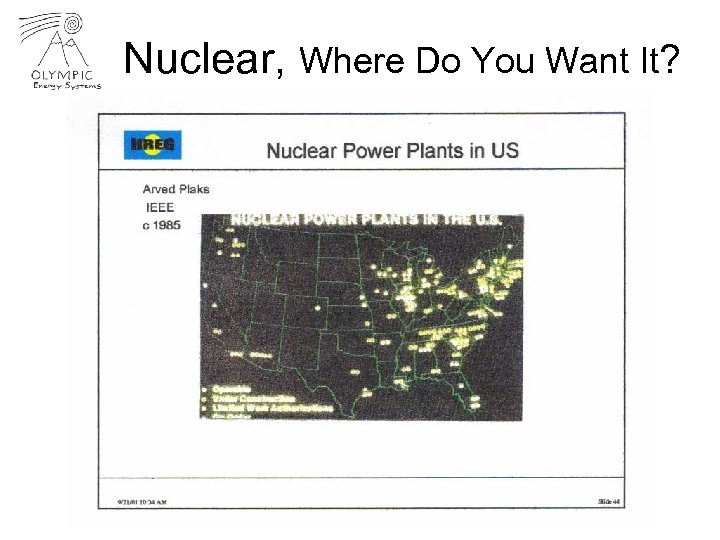
Nuclear, Where Do You Want It?
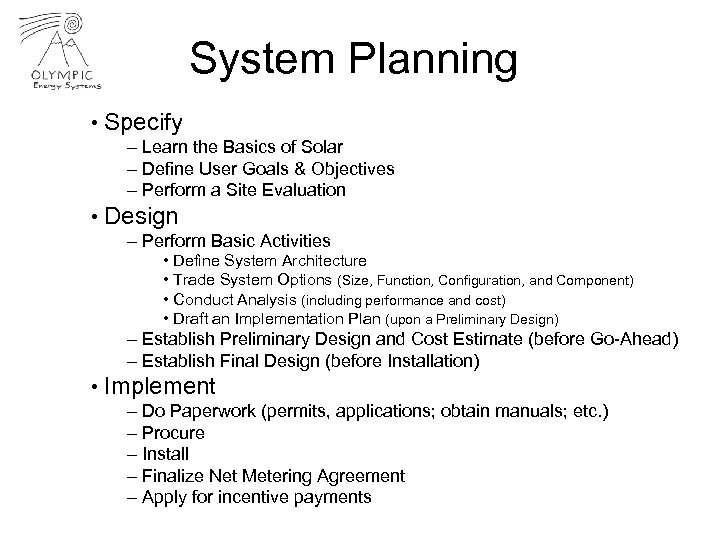
System Planning • Specify – Learn the Basics of Solar – Define User Goals & Objectives – Perform a Site Evaluation • Design – Perform Basic Activities • Define System Architecture • Trade System Options (Size, Function, Configuration, and Component) • Conduct Analysis (including performance and cost) • Draft an Implementation Plan (upon a Preliminary Design) – Establish Preliminary Design and Cost Estimate (before Go-Ahead) – Establish Final Design (before Installation) • Implement – Do Paperwork (permits, applications; obtain manuals; etc. ) – Procure – Install – Finalize Net Metering Agreement – Apply for incentive payments
Basics of Solar • Photovoltaic (PV) Panels – Generate electric charge by the photoelectric effect – Output is used, stored in batteries, or transmitted to the utility grid • PV Panels typically produce 12 or 24 Volts DC, 75 to 185 Watts, and are current limiting • PV Panel performance in cloudy weather is minimal (<20% of Rated Power) • PV Array • • – Series/Parallel connected PV Panels to achieve desired Voltage and Wattage • 100 Square Feet PV = 1000 Watts, typical, commonly at 48 Volts DC or High (> 250) – Mount on Roof, Ground, Wall, Pole (fixed), Pole (tracking - about 20% more energy) – Orient fixed arrays to True South +/-15 degrees at Latitude Angle (48 degrees) Inverter (converts DC to AC for household use or synchronized output to the utility grid) – Typically shut down when the utility grid is down or failed (for safety reasons) Net-Metering (State law in Washington and dozens of other states) – The tying of independent power producer output to the utility grid to acquire credit for on -site energy production; 1000 Watt array = 1500 KWh/year, typical in PNW • Available Incentives – Utility rebates (PSE $450 per 1 KW) – Utility production payments ($0. 18 - $0. 54 per KWh) – Green Tags (from NW Solar Co-Op at $0. 10 per KWh) – Federal tax credits (30% of system cost; capped at $2, 000 for residential) – Tax exemptions (WA State Sales Tax exemption for solar)
User Goals & Objectives • Establish User Goals – Save Money (on energy costs) – Achieve Energy Security – Lower Ecological Impacts – Other (Personal Legacy, Philanthropy, Grow the RE Industry, Invest) • Define Objectives – Reduce utility power consumption by xxx KWh – Achieve a specified Return, Present Worth, or Payback – Demonstrate a System (informing, teaching) – Reduce impact from a utility outage (maintain autonomy) – Maintain a system growth potential These goals and objectives should be established before designing a solar energy system.
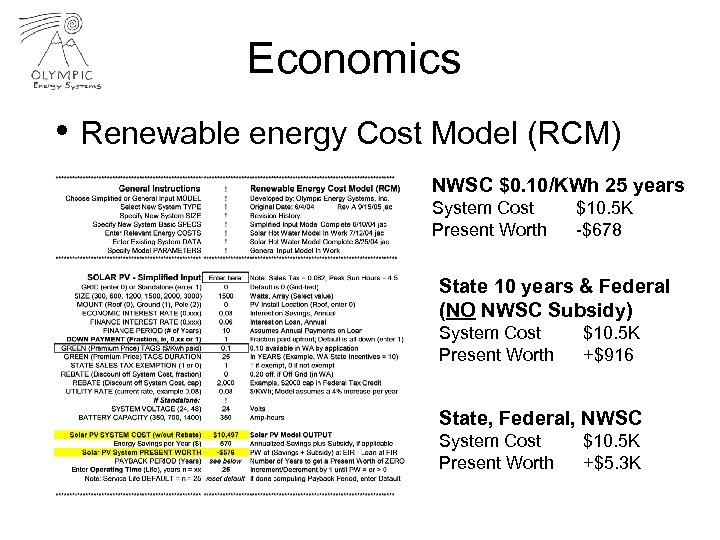
Economics • Renewable energy Cost Model (RCM) NWSC $0. 10/KWh 25 years System Cost Present Worth $10. 5 K -$678 State 10 years & Federal (NO NWSC Subsidy) System Cost Present Worth $10. 5 K +$916 State, Federal, NWSC System Cost Present Worth $10. 5 K +$5. 3 K
Site Evaluation • Load (Energy Reduction Potential) Assessment – Types of energy sources at site (electricity, propane, NG, wood, etc. ) – Number of occupants or users and their energy profiles and habits – Appliances and equipment – type, size, age, and expected lifetime • Space Heating Method and Domestic Hot Water – Potential energy use reductions (conservation or efficiency) - identify – Utility and fuel bills (monthly, yearly) • Solar (Energy Potential) Assessment – Local Planning Jurisdiction (applicable permits and codes - city, county) – Local Covenants (Neighborhood or Owners Associations) – Local Weather (Example, snow and wind; assess physical loads) – SOLAR ACCESS (Latitude, Blockages – trees, buildings, Climate) • Manual Method or Solar Pathfinder (tool) • Peak Sun Hours per Day (annualized): 3 to 3. 5 Seattle, 3. 5 to 4 NOP, 5 CA) – Collector mounting options (considering space and south facing) – Type and condition of mounting surfaces (particularly the roof) – Future site conditions (tree growth, area development plans, re-roofing)
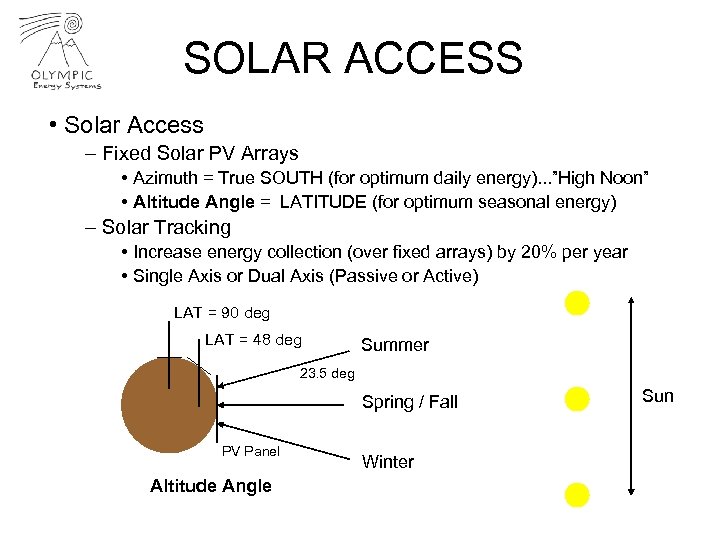
SOLAR ACCESS • Solar Access – Fixed Solar PV Arrays • Azimuth = True SOUTH (for optimum daily energy). . . ”High Noon” • Altitude Angle = LATITUDE (for optimum seasonal energy) – Solar Tracking • Increase energy collection (over fixed arrays) by 20% per year • Single Axis or Dual Axis (Passive or Active) LAT = 90 deg LAT = 48 deg Summer 23. 5 deg Spring / Fall PV Panel Altitude Angle Winter Sun
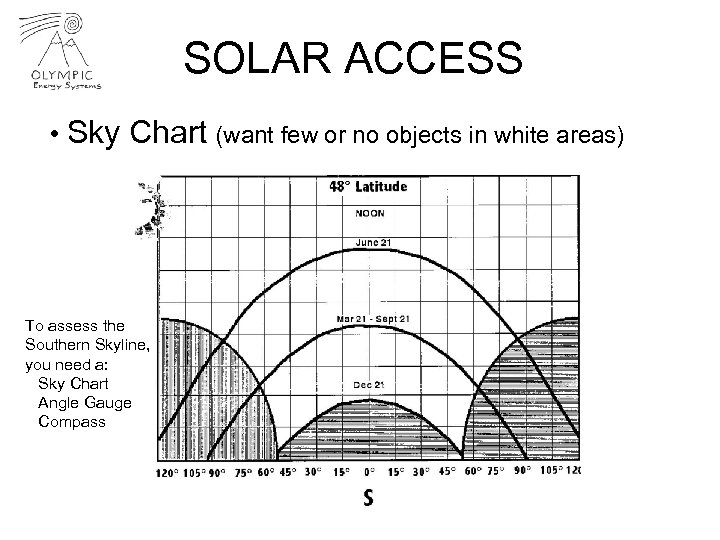
SOLAR ACCESS • Sky Chart (want few or no objects in white areas) To assess the Southern Skyline, you need a: Sky Chart Angle Gauge Compass
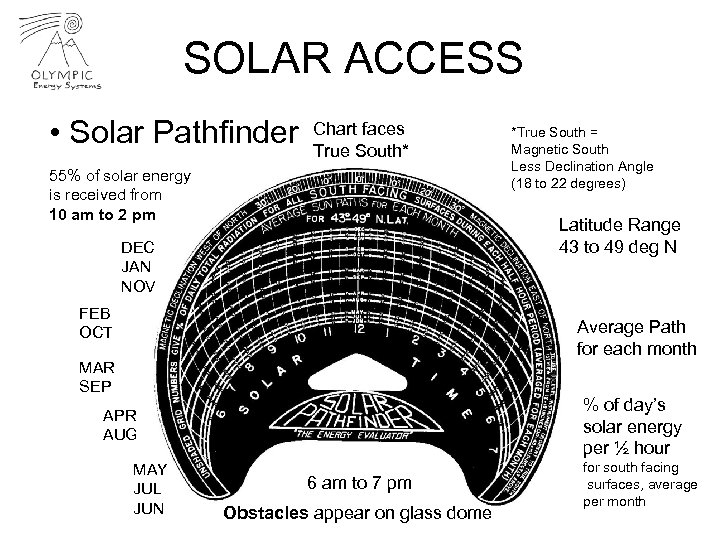
SOLAR ACCESS • Solar Pathfinder Chart faces True South* 55% of solar energy is received from 10 am to 2 pm *True South = Magnetic South Less Declination Angle (18 to 22 degrees) Latitude Range 43 to 49 deg N DEC JAN NOV FEB OCT Average Path for each month MAR SEP % of day’s solar energy per ½ hour APR AUG MAY JUL JUN 6 am to 7 pm Obstacles appear on glass dome for south facing surfaces, average per month
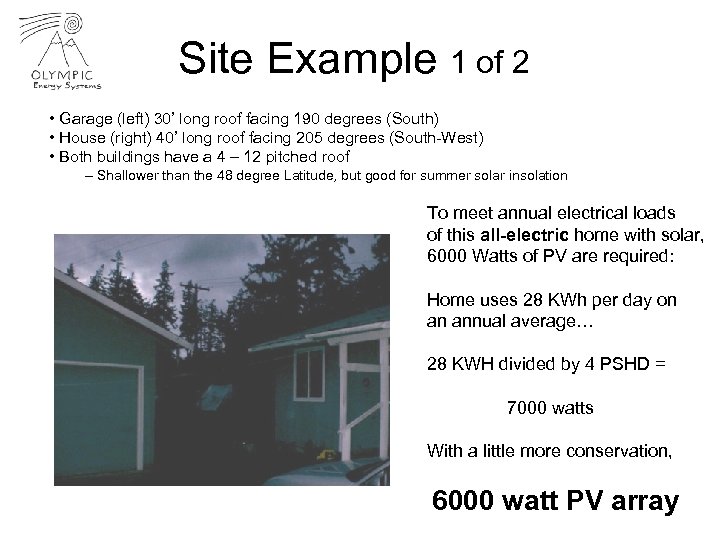
Site Example 1 of 2 • Garage (left) 30’ long roof facing 190 degrees (South) • House (right) 40’ long roof facing 205 degrees (South-West) • Both buildings have a 4 – 12 pitched roof – Shallower than the 48 degree Latitude, but good for summer solar insolation To meet annual electrical loads of this all-electric home with solar, 6000 Watts of PV are required: Home uses 28 KWh per day on an annual average… 28 KWH divided by 4 PSHD = 7000 watts With a little more conservation, 6000 watt PV array
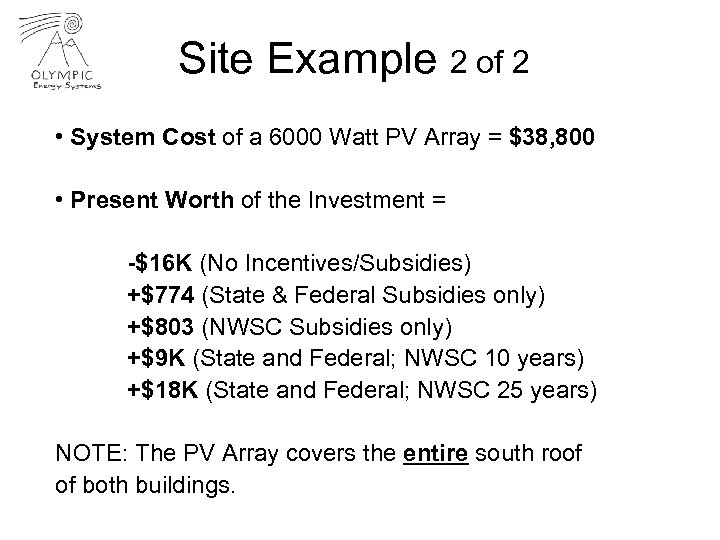
Site Example 2 of 2 • System Cost of a 6000 Watt PV Array = $38, 800 • Present Worth of the Investment = -$16 K (No Incentives/Subsidies) +$774 (State & Federal Subsidies only) +$803 (NWSC Subsidies only) +$9 K (State and Federal; NWSC 10 years) +$18 K (State and Federal; NWSC 25 years) NOTE: The PV Array covers the entire south roof of both buildings.
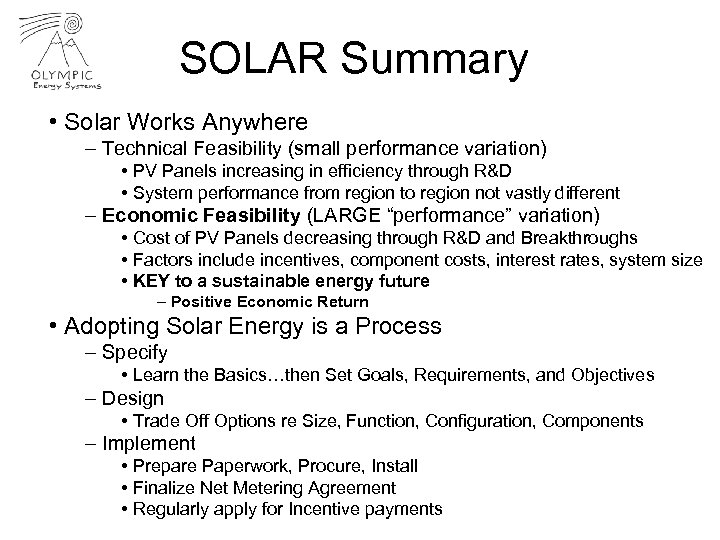
SOLAR Summary • Solar Works Anywhere – Technical Feasibility (small performance variation) • PV Panels increasing in efficiency through R&D • System performance from region to region not vastly different – Economic Feasibility (LARGE “performance” variation) • Cost of PV Panels decreasing through R&D and Breakthroughs • Factors include incentives, component costs, interest rates, system size • KEY to a sustainable energy future – Positive Economic Return • Adopting Solar Energy is a Process – Specify • Learn the Basics…then Set Goals, Requirements, and Objectives – Design • Trade Off Options re Size, Function, Configuration, Components – Implement • Prepare Paperwork, Procure, Install • Finalize Net Metering Agreement • Regularly apply for Incentive payments
Скачать презентацию System Planning Site Evaluation October 14 2005
83c74a08b95d7e3102d45dfd459dca1a.ppt