


 Скачать презентацию System C TLM virtual platforms Use of System C TLM
e8b1cdc99897966c05369f1c74eee03d.ppt
- Количество слайдов: 40
 System. C/TLM virtual platforms Use of System. C/TLM virtual platforms for the exploration, the specification and the validation of critical embedded So. C A. BERJAOUI (AKKA IS for Astrium) A. LEFEVRE & C. LE LANN (Astrium) Workshop - November 2011 - Toulouse
 Overview Context Separation of time & functionality presentation Timed TLM models Vs CABA models Design Space Exploration with System. C/TLM 2. 0 HW in the loop – Use of CHIPit® Future prospects Open questions 2
 Context Define a proper method to use System. C/TLM for So. C modelling Use System. C/TLM for DSE (performance estimation, bottleneck identification…) Use System. C/TLM models for HW specification Evaluate the selected methodology
 System. C/TLM Usage Context Define a proper method to use System. C/TLM for So. C modelling Use System. C/TLM for DSE (performance estimation, bottleneck identification…) Use System. C/TLM models for HW specification Evaluate the selected methodology
 Programmer’s View (PV) or functional simulation Time is not represented, only functionality is modelled. Functional synchronization is necessary. It is done at System Synchronization Points (SSP): configuration registers access, interrupts and all state alternating accesses.
 The need for time Performance measurements Design Space Exploration …how ? ? ? Precision? Modelling granularity? Simulation performance?
 The obvious solution: mixing time and functionality It works !!! …but… Functional modifications cannot be verified without having to verify all timed aspects as well Modelling granularity is hard to modify once it has been set Modules cannot be easily reused for other platforms
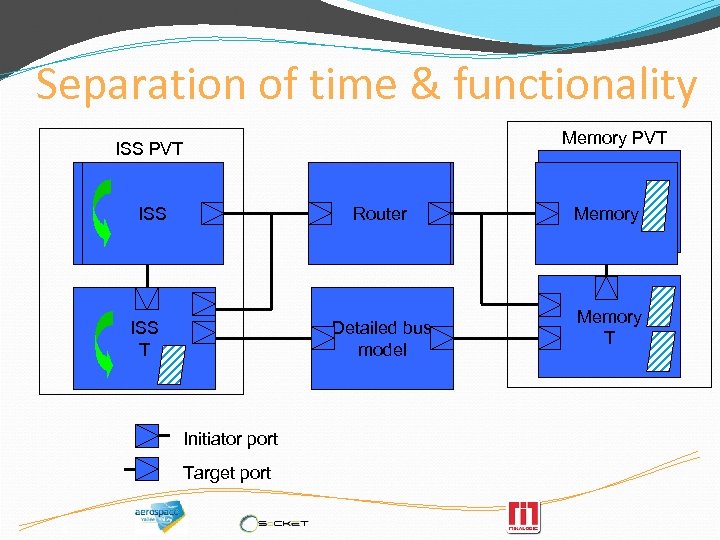 Separation of time & functionality Memory PVT ISS ISS PV PV router Router ISS T Detailed bus model Initiator port Target port 8 Memory PV Memory T
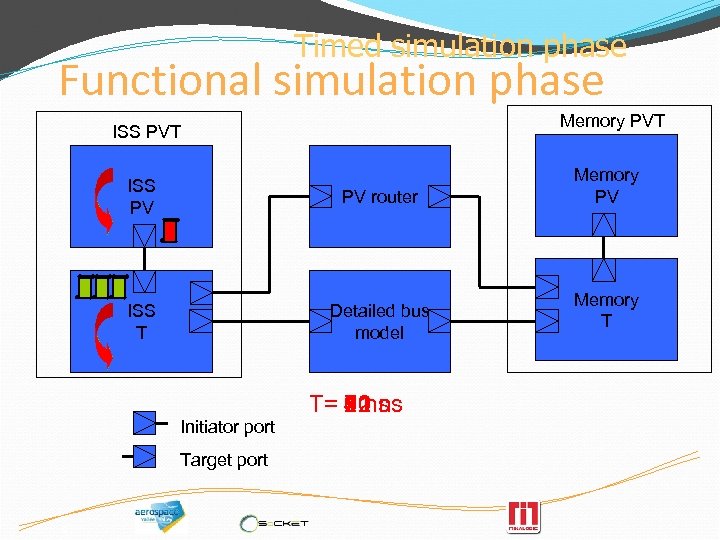 Timed simulation phase Functional simulation phase Memory PVT ISS PV PV router ISS T Detailed bus model Initiator port Target port 9 T= 0 ns 12 11 10 9 8 7 6 5 4 3 2 1 ns Memory PV Memory T
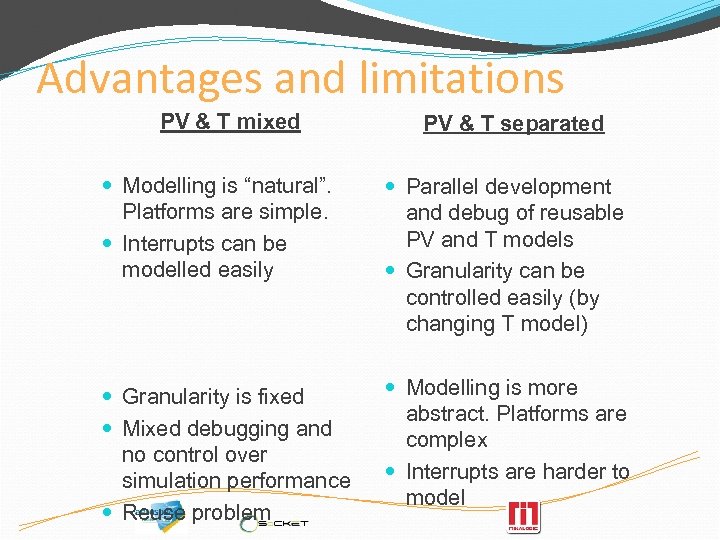 Advantages and limitations PV & T mixed PV & T separated Modelling is “natural”. Platforms are simple. Interrupts can be modelled easily Parallel development and debug of reusable PV and T models Granularity can be controlled easily (by changing T model) Granularity is fixed Mixed debugging and no control over simulation performance Reuse problem Modelling is more abstract. Platforms are complex Interrupts are harder to model
 TTP in the industry In its current form, TTP cannot be used on an industrial scale: Modelling is too complex to be used by architects Modules are not re-used enough to justify such a modelling effort Traffic generators are enough for DSE. Detailed functionality does not need to be specified for performance estimation. HW specification is easier using cycle “approximate”/bit accurate models
 Timed TLM vs CABA models Different time modelling granularities: CABA in HDL => available, but slow simulations CABA in System. C => not interesting (not available and slow simulations) Timed TLM (System. C AT) => preferred A timed TLM model of an existing RTL IP has been build to evaluate the methodology and assess the necessary effort RTL IP chosen = SDRAM memory controller, because: this is a central module in So. C architecture explorations its timing behaviour is harder to determine than other modules’ (AHB buses for example)
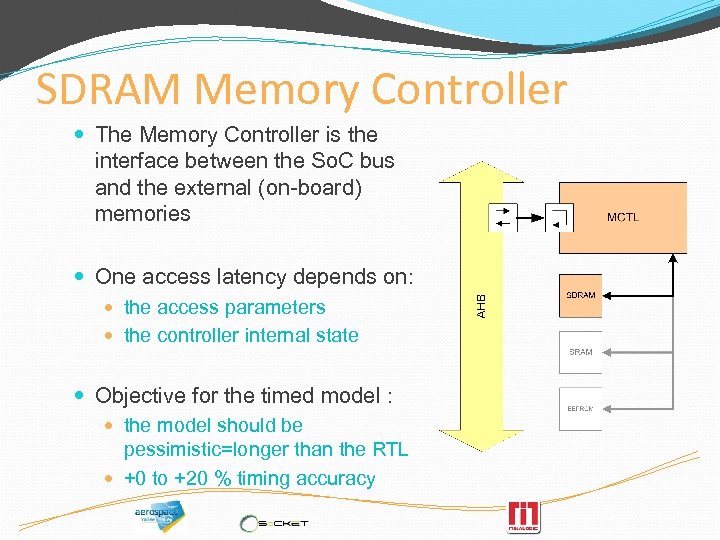 SDRAM Memory Controller The Memory Controller is the interface between the So. C bus and the external (on-board) memories One access latency depends on: the access parameters the controller internal state Objective for the timed model : the model should be pessimistic=longer than the RTL +0 to +20 % timing accuracy
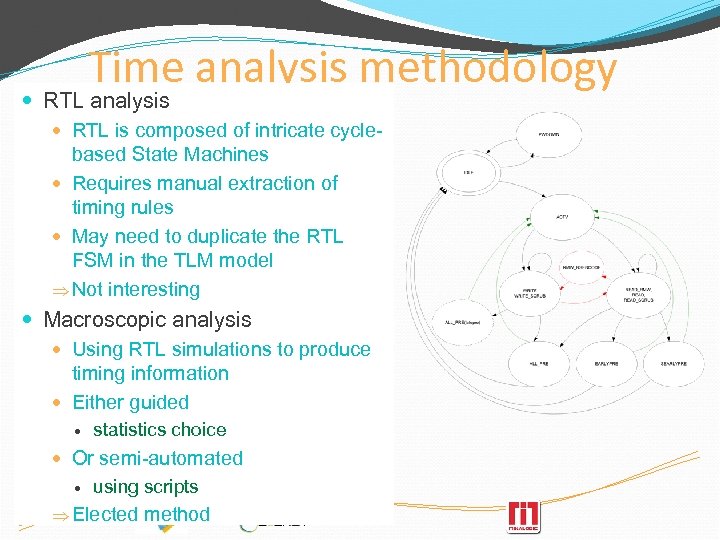 Time analysis methodology RTL analysis RTL is composed of intricate cycle- based State Machines Requires manual extraction of timing rules May need to duplicate the RTL FSM in the TLM model Þ Not interesting Macroscopic analysis Using RTL simulations to produce timing information Either guided statistics choice Or semi-automated using scripts Þ Elected method
 Macroscopic time analysis Guided time analysis Timing data is extracted from RTL simulations (traces of all the timings + relevant parameters) Rules are guessed by manually analyzing the traces… …and then automatically tested against a calibration test set This process iterates until the timing accuracy is satisfactory Results of the time analysis iterations The parameters of the previous access also have a major impact (in addition to the parameters of the current access) Some features interfere (refresh and automatic scrubbing)
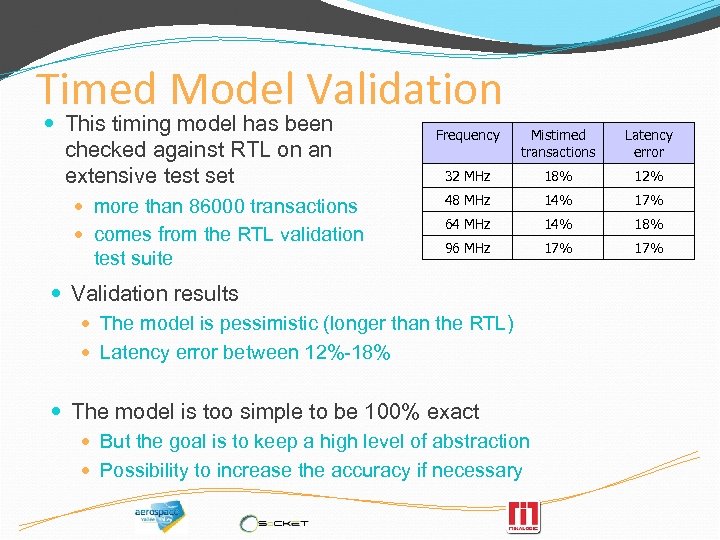 Timed Model Validation This timing model has been checked against RTL on an extensive test set more than 86000 transactions comes from the RTL validation test suite Frequency Mistimed transactions Latency error 32 MHz 18% 12% 48 MHz 14% 17% 64 MHz 14% 18% 96 MHz 17% Validation results The model is pessimistic (longer than the RTL) Latency error between 12%-18% The model is too simple to be 100% exact But the goal is to keep a high level of abstraction Possibility to increase the accuracy if necessary
 Context Overview Separation of time & functionality presentation Timed TLM models vs. CABA models Design Space Exploration with System. C/TLM 2. 0 HW in the loop – Use of CHIPit® Future prospects Open questions 17
 Design Space Exploration with System. C/TLM 2. 0 A simple image processing platform has been designed to assess the use of System. C/TLM for design space exploration
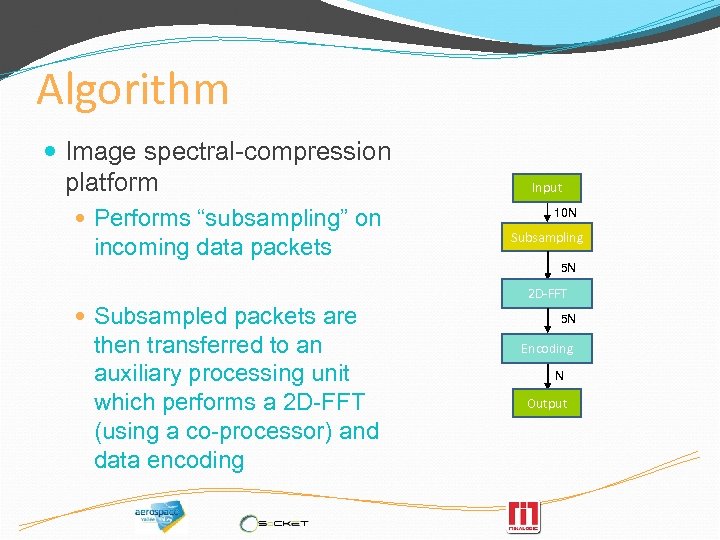 Algorithm Image spectral-compression platform Performs “subsampling” on incoming data packets Input 10 N Subsampling 5 N 2 D-FFT Subsampled packets are then transferred to an auxiliary processing unit which performs a 2 D-FFT (using a co-processor) and data encoding 5 N Encoding N Output
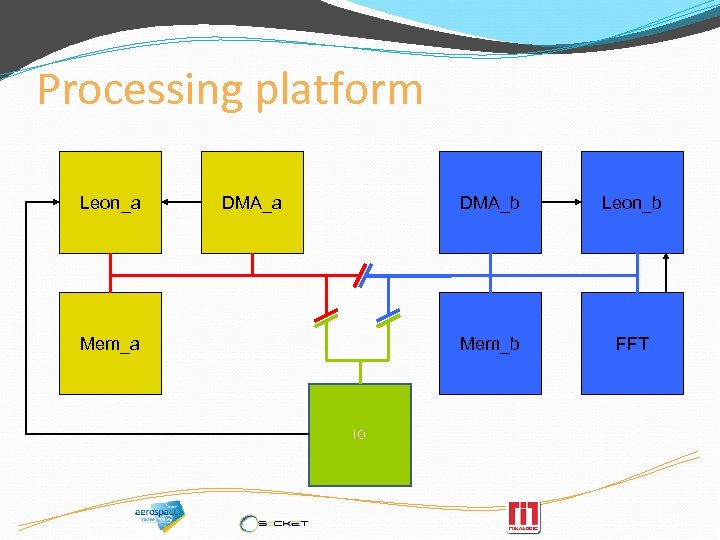 Processing platform Leon_a DMA_b Mem_a IO Leon_b FFT
 Processing platform (cont’d) IO module generates an interrupt causing DMA_a to transfer the input packet of size 10 N to Mem_a At the end of the transfer, Leon_a subsamples the data and writes the result to Mem_a Leon_a configures DMA_b to transfer the result to Mem_b At the end of the transfer, Leon_b configures the FFT module to perform a 2 D-FFT Leon_b encodes the result and programs DMA_b to send the result to the IO module
 System. C implementation TLM-2 compliant (time & functionality are mixed) Data exchange is AMBA – bus accurate (single/burst transactions, split) Data sizes are respected and packets are identified by a packet ID. The Leon processor modules act as “smart” traffic generators: they generate transactions in the correct order towards the appropriate targets. OS tasks are simulated using SC_THREADs
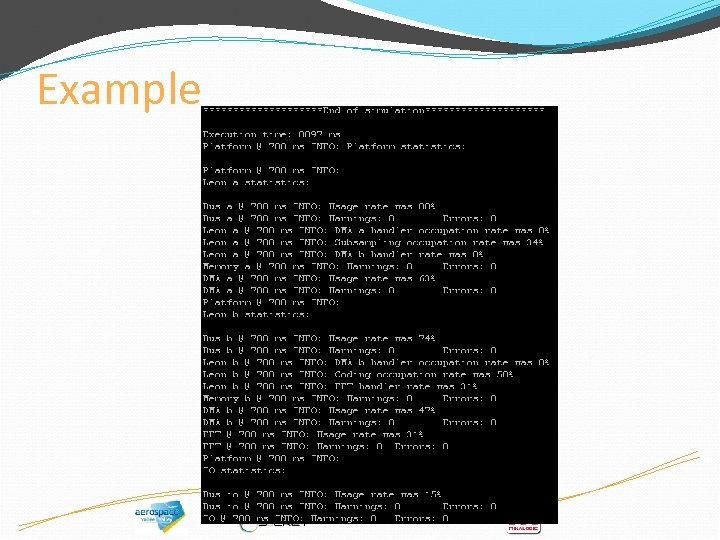
 System. C implementation (cont’d) No actual processing is performed. Processing time is simulated Bus occupation, processing loads for all processing units were measured accurately A system synchronization bug was identified => a “lock” register has been added to lock DMA_b during its configuration It was possible to observe the impact of the modification of HW parameters and the input data rate. DMA_a was identified as a bottleneck. ABV could also be implemented using ISIS
 Example
 Overview Context Separation of time & functionality presentation Timed TLM models vs. CABA models Design Space Exploration with System. C/TLM 2. 0 HW in the loop – Use of CHIPit® Future prospects Open questions 25
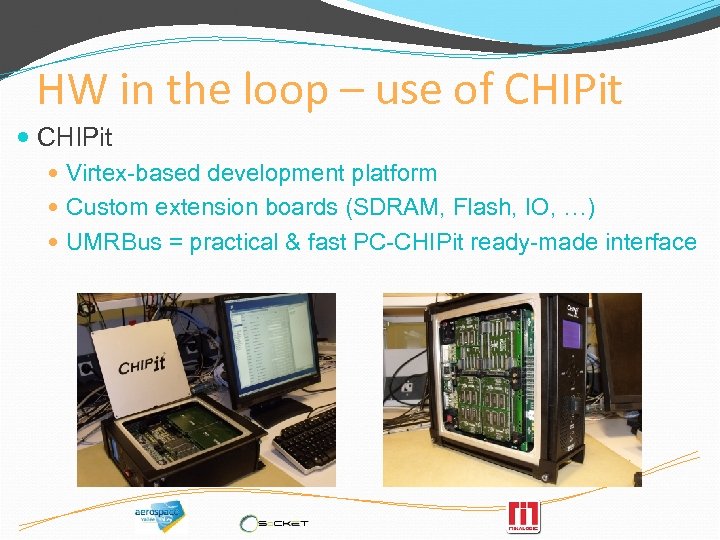 HW in the loop – use of CHIPit Virtex-based development platform Custom extension boards (SDRAM, Flash, IO, …) UMRBus = practical & fast PC-CHIPit ready-made interface
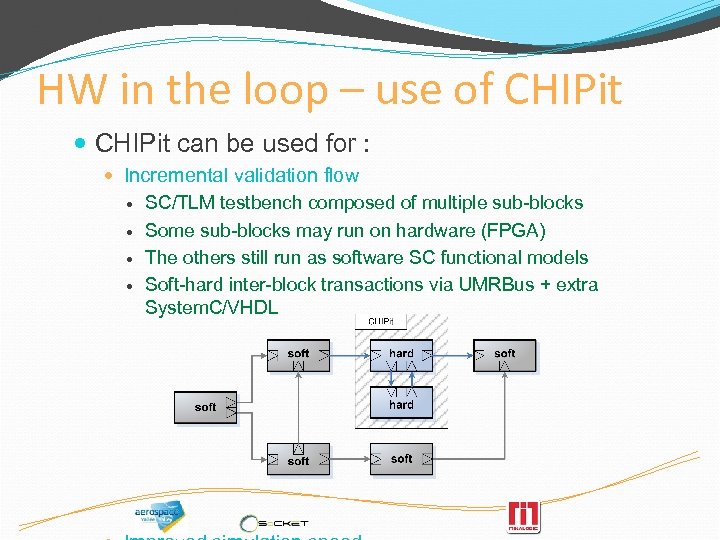 HW in the loop – use of CHIPit can be used for : Incremental validation flow SC/TLM testbench composed of multiple sub-blocks Some sub-blocks may run on hardware (FPGA) The others still run as software SC functional models Soft-hard inter-block transactions via UMRBus + extra System. C/VHDL
 HW in the loop – use of CHIPit What happens on a transaction ? Uncontrolled clock mode HW clock keeps working during a transaction SW clock and HW clock are not synchronised Easy to implement Controlled clock mode HW clock is stopped upon each transaction, waiting for soft SW clock and HW clock are synchronised on transaction bounds Needed if inputs/outputs must observe precise relative timings Harder to implement, more timing issues Not possible for all designs : complex designs require extra care SDRAM controller needs constant auto-refresh Inputs from extension boards may need immediate treatment
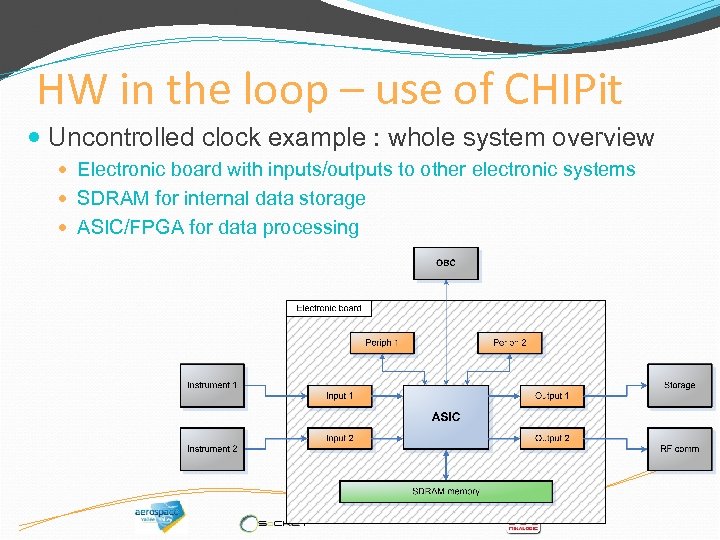 HW in the loop – use of CHIPit Uncontrolled clock example : whole system overview Electronic board with inputs/outputs to other electronic systems SDRAM for internal data storage ASIC/FPGA for data processing
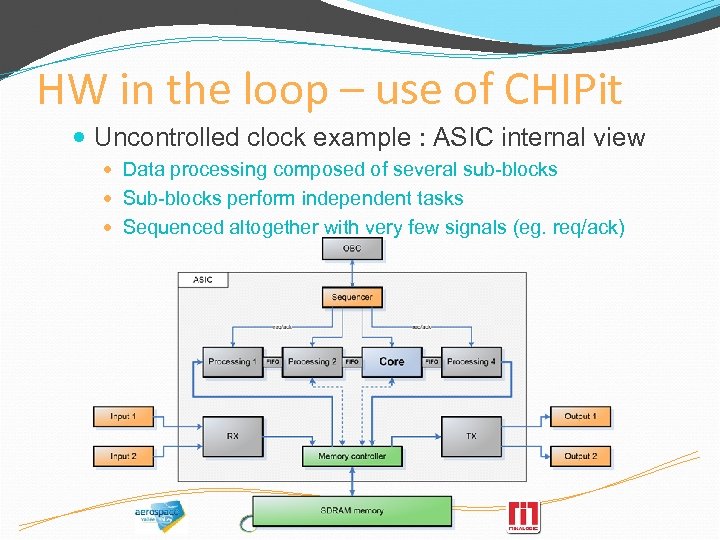 HW in the loop – use of CHIPit Uncontrolled clock example : ASIC internal view Data processing composed of several sub-blocks Sub-blocks perform independent tasks Sequenced altogether with very few signals (eg. req/ack)
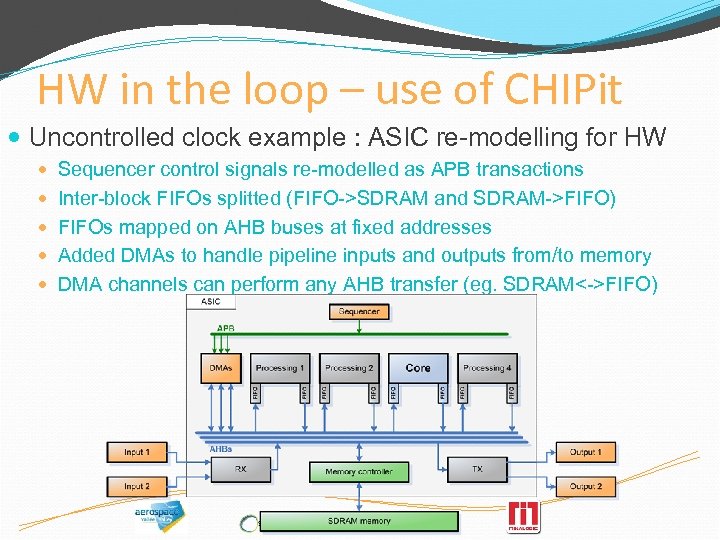 HW in the loop – use of CHIPit Uncontrolled clock example : ASIC re-modelling for HW Sequencer control signals re-modelled as APB transactions Inter-block FIFOs splitted (FIFO->SDRAM and SDRAM->FIFO) FIFOs mapped on AHB buses at fixed addresses Added DMAs to handle pipeline inputs and outputs from/to memory DMA channels can perform any AHB transfer (eg. SDRAM<->FIFO)
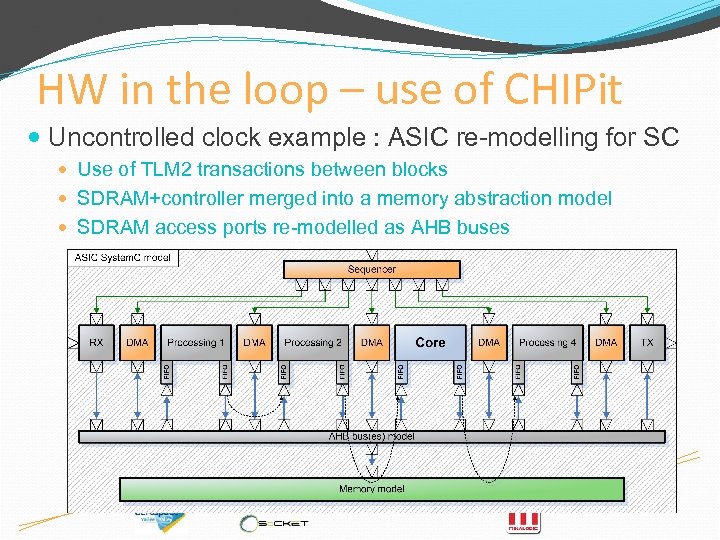 HW in the loop – use of CHIPit Uncontrolled clock example : ASIC re-modelling for SC Use of TLM 2 transactions between blocks SDRAM+controller merged into a memory abstraction model SDRAM access ports re-modelled as AHB buses
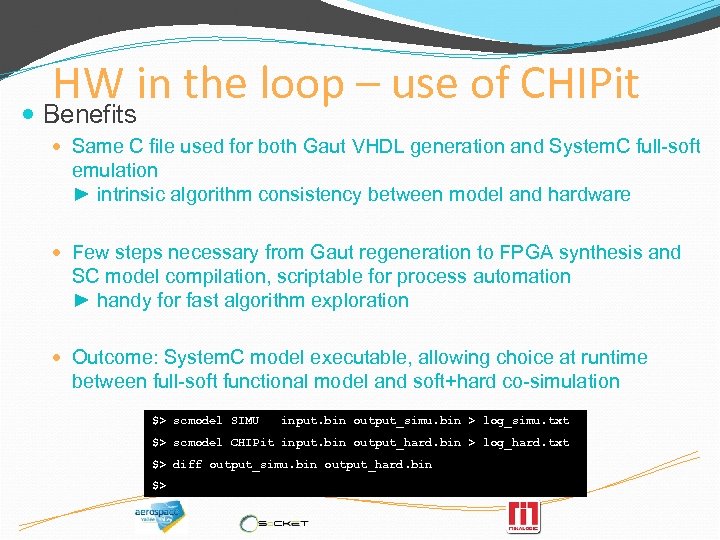 HW in the loop – use of CHIPit Benefits Same C file used for both Gaut VHDL generation and System. C full-soft emulation ► intrinsic algorithm consistency between model and hardware Few steps necessary from Gaut regeneration to FPGA synthesis and SC model compilation, scriptable for process automation ► handy for fast algorithm exploration Outcome: System. C model executable, allowing choice at runtime between full-soft functional model and soft+hard co-simulation $> scmodel SIMU input. bin output_simu. bin > log_simu. txt $> scmodel CHIPit input. bin output_hard. bin > log_hard. txt $> diff output_simu. bin output_hard. bin $>
 HW in the loop – use of CHIPit Limitations Still have to develop System. C+VHDL for each new transactor Limits whole process automation Encourages the use of common transactor types (AMBA, etc) Controlled clock mode much more complex to implement Encourages the design of independent blocks, inter-connected via a few FIFOs or via a common memory Blocks with strong timing requirements on IO hardly compatible with uncontrolled clock mode (better design with intelligent IO behaviour : req+ack, handshake, etc) Implementation limited to actual CHIPit resources SDRAM bus width is static (cannot test larger bus than available) Custom extension boards required as early as algorithm exploration
 HW in the loop – use of CHIPit Sce. Mi : the wanna-be standard for co-simulation Formerly proposed by Cadence, now transferred to Accelera Defines a C++ API for HW-SW co-simulation Controlled clock / uncontrolled clock modes Function-based interface Pipe-based interface (C++ stream = hardware FIFO) Multi-threaded operation on software side CHIPit Sce. Mi library available Needs a supplementary licence Just a wrapper over UMRBus libraries to provide clock control All transactors still need to be coded by hand (System. C+VHDL) ► still a lot of work to do before getting co-simulation working
 Context Overview Separation of time & functionality presentation Timed TLM models vs. CABA models Design Space Exploration with System. C/TLM 2. 0 HW in the loop – Use of CHIPit® Future prospects Open questions 36
 Space industry applicability System. C/TLM is suitable for DSE with the use of HLS Specification flow needs to be sorted out
 Future prospects Important need in development infrastructure: Abstraction layer (architects are not TLM 2 experts) Interrupts and streaming modelling (TLM is currently a memory mapped platform oriented protocol) Build and assembly tools are needed Well defined modelling guidelines should be established
 Thank you ? ? ? Any questions ? Workshop - November 2011
 Open questions Who does the modelling? System, HW or SW architect? SW validation uses paper specs => Towards validation using HW based models in System. C/TLM? Towards a TLM 3 standard? With embedded systems industrial partners such as Airbus and Astrium? (Business model? )