


 Скачать презентацию System C and the future of design languages
c57208176c0c47d07ca36e46ea40f6a1.ppt
- Количество слайдов: 31
 System. C and the future of design languages: Opportunities for users and research Grant Martin Fellow, Cadence Berkeley Labs SBCCI 2003, São Paolo, Brazil, 8 -11 Sept 2003 9 September 2003: 10: 20 -11: 10 CADENCE CONFIDENTIAL
 Outline • Alphabet Soup • A language war? • Or peaceful co-existence • System. C, HDLs and software modelling • New Methodologies and Flows • New Research Opportunities • Conclusion 2
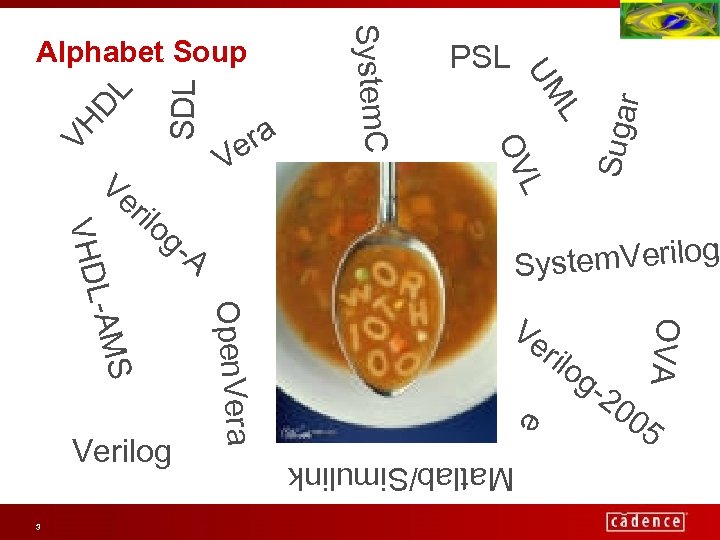 VH r Suga ystem. Verilog S OVA Ve rilo ge Matlab/Simulink DL SDL L 3 L UM Verilog -A Open. Vera S L-AM VHD ril og PSL OV Ve ra Ve System. C Alphabet Soup 20 05
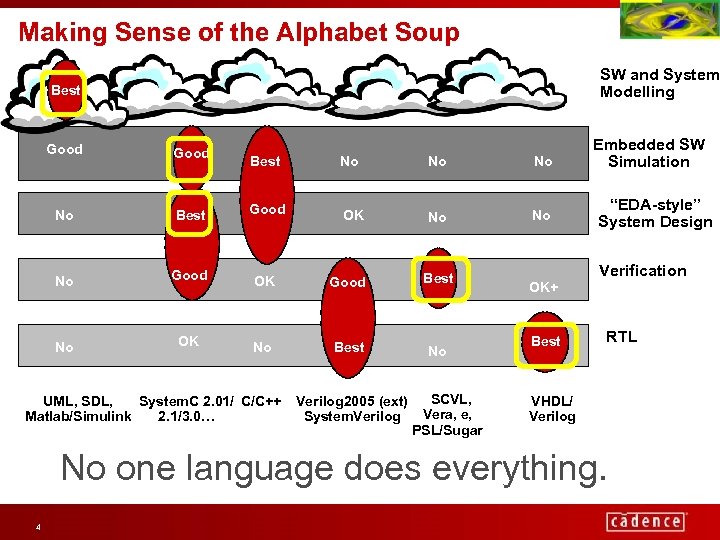 Making Sense of the Alphabet Soup SW and System Modelling Best Good No Best No No No Best Good OK No No No Good OK Good No OK No Best UML, SDL, System. C 2. 01/ C/C++ Matlab/Simulink 2. 1/3. 0… Verilog 2005 (ext) System. Verilog Best No SCVL, Vera, e, PSL/Sugar Embedded SW Simulation “EDA-style” System Design Verification OK+ Best RTL VHDL/ Verilog No one language does everything. 4
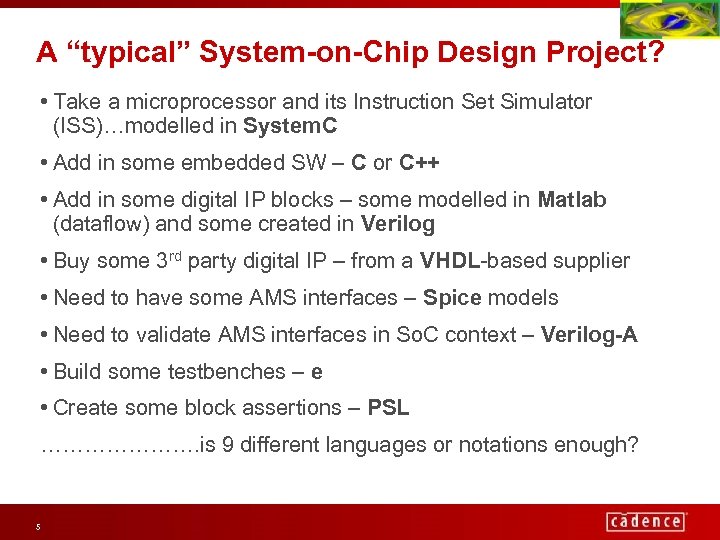 A “typical” System-on-Chip Design Project? • Take a microprocessor and its Instruction Set Simulator (ISS)…modelled in System. C • Add in some embedded SW – C or C++ • Add in some digital IP blocks – some modelled in Matlab (dataflow) and some created in Verilog • Buy some 3 rd party digital IP – from a VHDL-based supplier • Need to have some AMS interfaces – Spice models • Need to validate AMS interfaces in So. C context – Verilog-A • Build some testbenches – e • Create some block assertions – PSL …………………. is 9 different languages or notations enough? 5
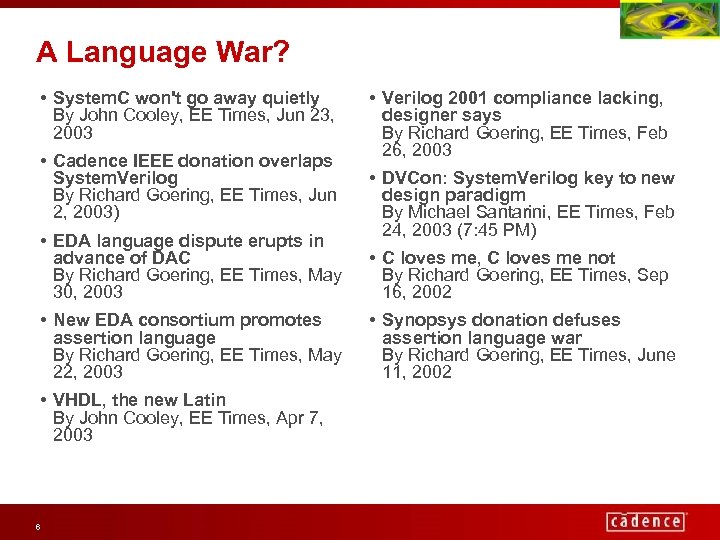 A Language War? • System. C won't go away quietly By John Cooley, EE Times, Jun 23, 2003 • Cadence IEEE donation overlaps System. Verilog By Richard Goering, EE Times, Jun 2, 2003) • EDA language dispute erupts in advance of DAC By Richard Goering, EE Times, May 30, 2003 • New EDA consortium promotes assertion language By Richard Goering, EE Times, May 22, 2003 • VHDL, the new Latin By John Cooley, EE Times, Apr 7, 2003 6 • Verilog 2001 compliance lacking, designer says By Richard Goering, EE Times, Feb 26, 2003 • DVCon: System. Verilog key to new design paradigm By Michael Santarini, EE Times, Feb 24, 2003 (7: 45 PM) • C loves me, C loves me not By Richard Goering, EE Times, Sep 16, 2002 • Synopsys donation defuses assertion language war By Richard Goering, EE Times, June 11, 2002
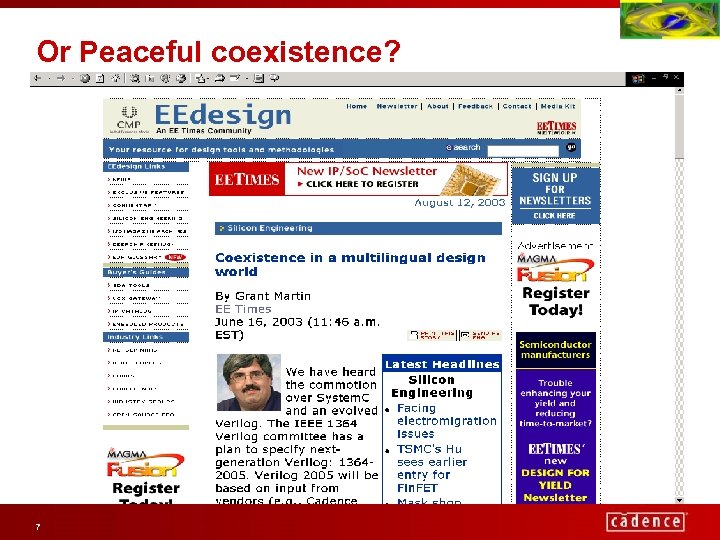 Or Peaceful coexistence? 7
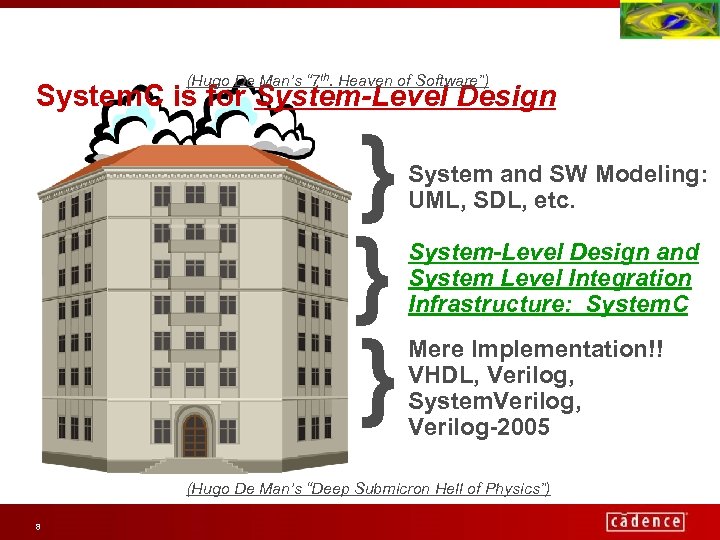 (Hugo De Man’s “ 7 th. Heaven of Software”) System. C is for System-Level Design } } } System and SW Modeling: UML, SDL, etc. System-Level Design and System Level Integration Infrastructure: System. C Mere Implementation!! VHDL, Verilog, System. Verilog, Verilog-2005 (Hugo De Man’s “Deep Submicron Hell of Physics”) 8
 Important System. C Milestones • 1. 0 – Layered on C++ – Fixed-point modelling – RTL (as refinement target ………. but weak on system level modelling) • 1. 2 – Master-Slave library – methodology specific libraries layered on top of kernel • 2. 0 – True system level abstractions: channels, interfaces, events – Basis for multiple Models of Computation and abstraction levels • SCV 1. 0 – Layered verification library on top of System. C • Current and future: 2. 01 and LRM for IEEE standards transfer – Transaction-level modelling standard for IP interoperability (2. 1? ) – Synthesisable subset work – System. C 3. 0 – RTOS, SW tasking and scheduling modelling constructs – Continued experiments with Analogue/Mixed-Signal extensions 9
 Role of System. C • System-level design at all levels of abstraction: – Functional modelling using various models of computation – Transaction-level modelling of hardware platforms – Refinement of design from untimed functional models through to RTL implementation – Creation of HW-SW platform models for use by system designers and embedded software developers – System-level testbenches (using the new SCV library) which can be propagated through implementation • But clearly not: – A substitute for HDL’s, nor – A software modelling language 10
 HDL Evolution • Despite the appearance of language wars, there is a clear path for HDL evolution: – Via IEEE 1364 for Verilog – Via IEEE 1076 for VHDL • The IEEE process provides a mechanism for the reconciliation of various interests: – Commercial proprietary interests – Industry bodies in language based design such as Accellera – Academia – users 11
 Verilog Evolution • IEEE 1364 Verilog working group has begun a process for evolving Verilog beyond Verilog-2001 (“Verilog-2005”…) • Will accept donations • Is conducting User Surveys as to needs and priorities • Opportunity for Accellera to donate System. Verilog 3. 1 or further version as input • Some companies have already donated technology as inputs – E. g. Cadence – June 2003: testbench, IP encryption • Opportunity for others to contribute • IEEE 1364 is also a forum for users to influence the standardisation process – as much or perhaps more than tool vendors • Nothing proposed in this area moves Verilog up to true system-level design abstractions 12
 VHDL Evolution • IEEE 1076 has begun a process to look at VHDL evolution beyond VHDL-1998: called VHDL-200 x – Web site URL: http: //www. eda. org/vhdl-200 x/ • Led by Steve Bailey, now at Mentor Graphics • Areas of interest in extending: – Assertions, testbenches and verification – Datatypes and abstraction – Environment (simulation control) and interoperability – Modeling and productivity – Performance • Hope to have finished by late 2004/early 2005 • Wants strong user input – Users will have the strongest impact on the evolution and longevity of VHDL 13
 HDL Evolution • Despite the proprietary and commercial interests, ultimately users decide on what happens with languages and tools • Usage attracts tool vendors • Revenues are more important than ideologies • Legacy and conversion costs as well as differences of capabilities are significant factors in language longevity • ……………. . it’s a multilingual world • …………and likely to stay that way 14
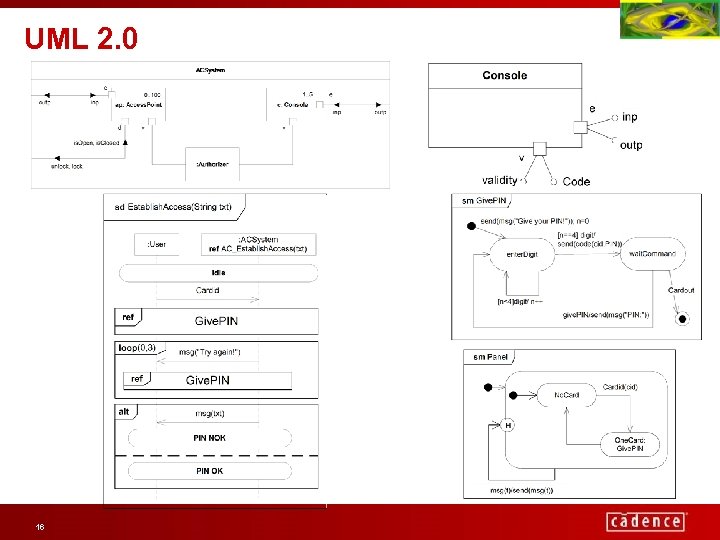
 Software Modelling Evolution • UML moving towards finalisation in 2003 of UML 2. 0 • Adds significant system modelling capabilities to UML’s object-oriented software modelling capabilities: – Structured classes or components (what in ROOM were called capsules) – Ports as interfaces and service specifications – Hierarchical sequence diagrams with loops and alternatives – Hierarchical state machines • In addition, UML profile for Scheduling, Performance and Time (SPT), and Action semantics definition, support more complete modelling of real-time aspects of systems, and more optimised code generation • Finally, the Object Management Group (OMG)’s embrace of MDA – Model Driven Architecture – fits more closely with the EDA/HW design world notions of design methodology and flow 15
 UML 2. 0 16
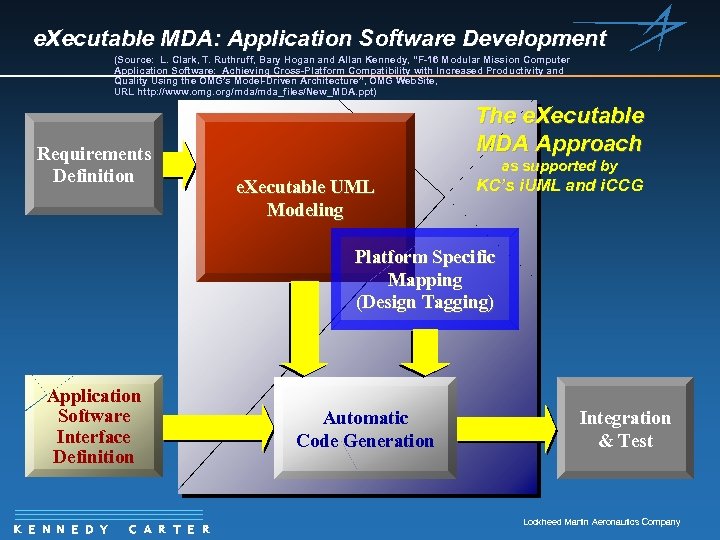 e. Xecutable MDA: Application Software Development (Source: L. Clark, T. Ruthruff, Bary Hogan and Allan Kennedy, “F-16 Modular Mission Computer Application Software: Achieving Cross-Platform Compatibility with Increased Productivity and Quality Using the OMG’s Model-Driven Architecture”, OMG Web. Site, URL http: //www. omg. org/mda_files/New_MDA. ppt) Requirements Definition The e. Xecutable MDA Approach as supported by e. Xecutable UML Modeling KC’s i. UML and i. CCG Platform Specific Mapping (Design Tagging) Application Software Interface Definition K E N N E D Y C A R T E R Automatic Code Generation Integration & Test Lockheed Martin Aeronautics Company
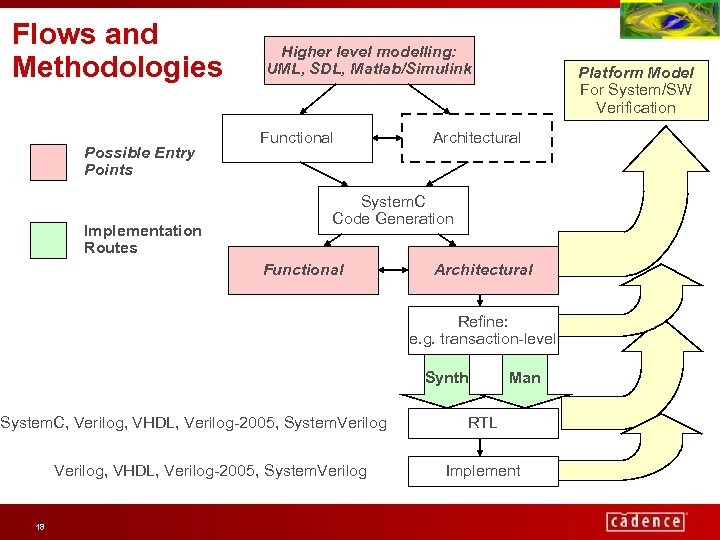 Flows and Methodologies Possible Entry Points Implementation Routes Higher level modelling: UML, SDL, Matlab/Simulink Functional Platform Model For System/SW Verification Architectural System. C Code Generation Functional Architectural Refine: e. g. transaction-level Synth System. C, Verilog, VHDL, Verilog-2005, System. Verilog 18 Man RTL Implement
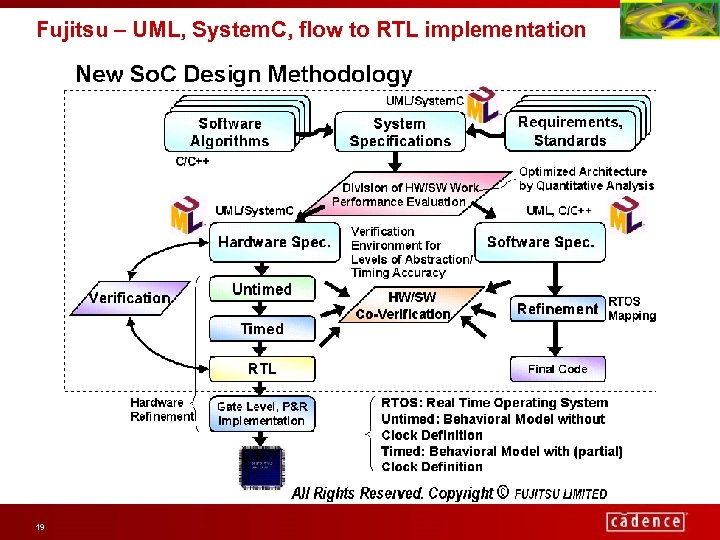 Fujitsu – UML, System. C, flow to RTL implementation 19
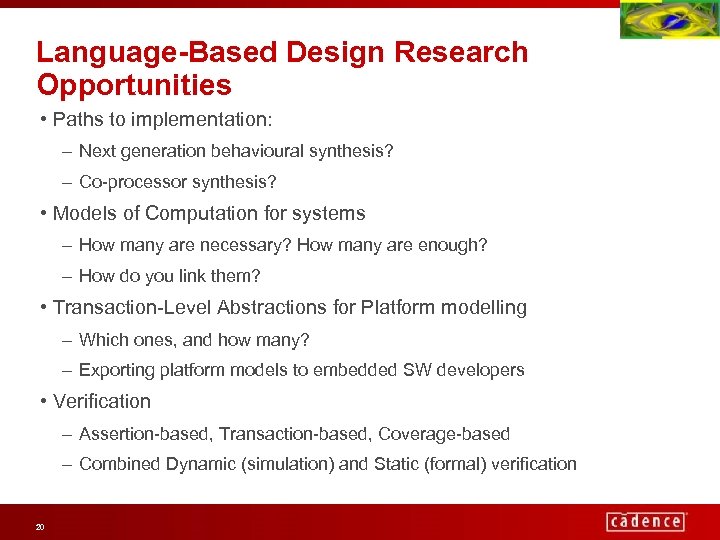 Language-Based Design Research Opportunities • Paths to implementation: – Next generation behavioural synthesis? – Co-processor synthesis? • Models of Computation for systems – How many are necessary? How many are enough? – How do you link them? • Transaction-Level Abstractions for Platform modelling – Which ones, and how many? – Exporting platform models to embedded SW developers • Verification – Assertion-based, Transaction-based, Coverage-based – Combined Dynamic (simulation) and Static (formal) verification 20
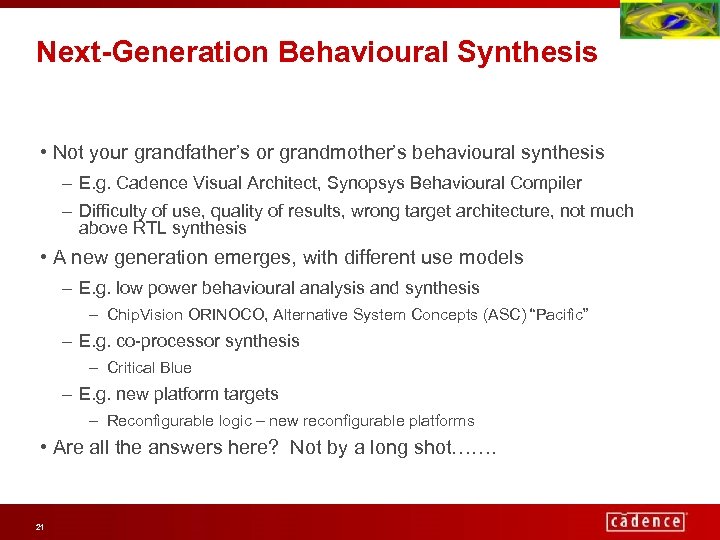 Next-Generation Behavioural Synthesis • Not your grandfather’s or grandmother’s behavioural synthesis – E. g. Cadence Visual Architect, Synopsys Behavioural Compiler – Difficulty of use, quality of results, wrong target architecture, not much above RTL synthesis • A new generation emerges, with different use models – E. g. low power behavioural analysis and synthesis – Chip. Vision ORINOCO, Alternative System Concepts (ASC) “Pacific” – E. g. co-processor synthesis – Critical Blue – E. g. new platform targets – Reconfigurable logic – new reconfigurable platforms • Are all the answers here? Not by a long shot……. 21
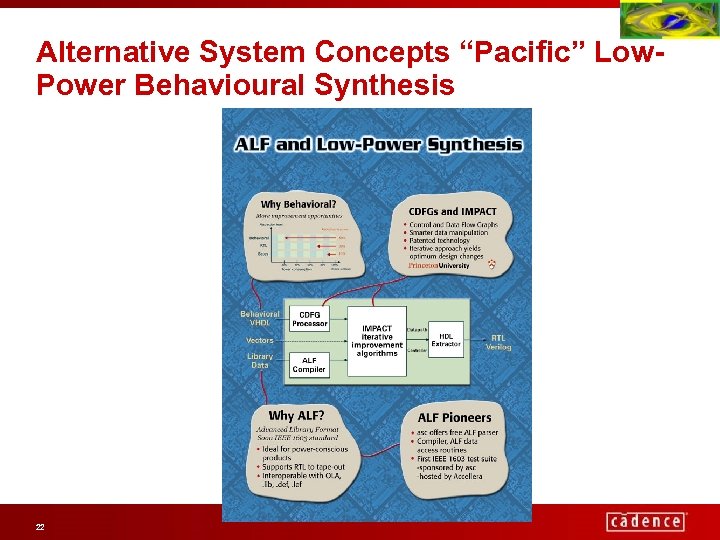 Alternative System Concepts “Pacific” Low. Power Behavioural Synthesis 22
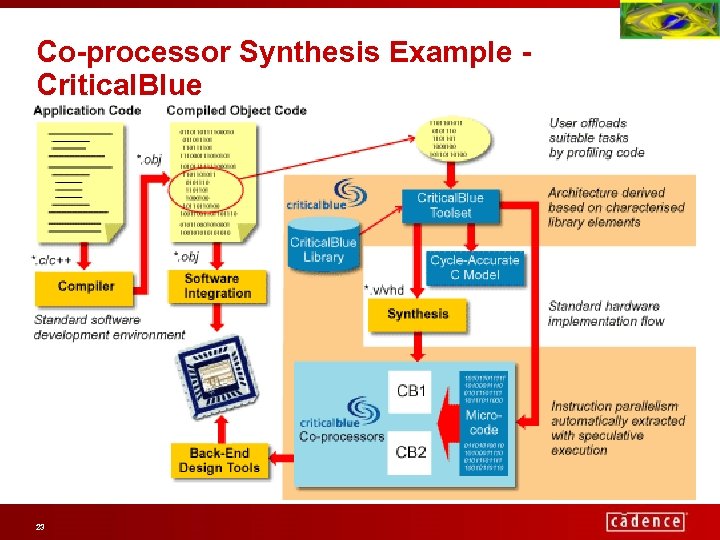 Co-processor Synthesis Example Critical. Blue 23
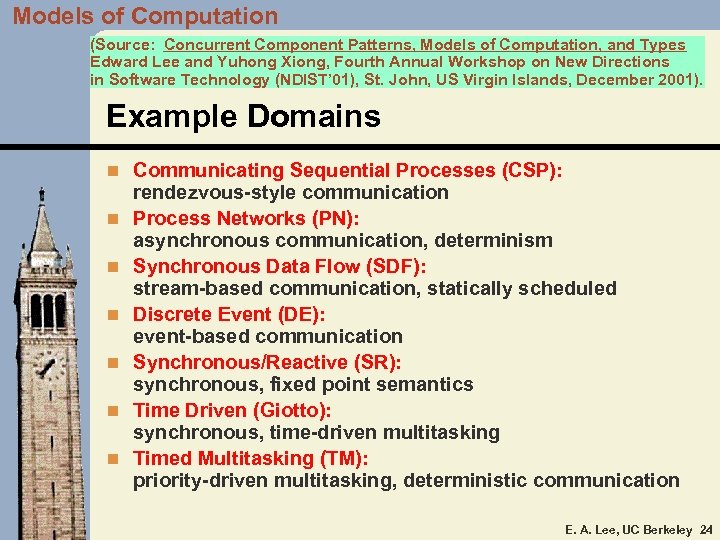 Models of Computation (Source: Concurrent Component Patterns, Models of Computation, and Types Edward Lee and Yuhong Xiong, Fourth Annual Workshop on New Directions in Software Technology (NDIST’ 01), St. John, US Virgin Islands, December 2001). Example Domains n Communicating Sequential Processes (CSP): n n n rendezvous-style communication Process Networks (PN): asynchronous communication, determinism Synchronous Data Flow (SDF): stream-based communication, statically scheduled Discrete Event (DE): event-based communication Synchronous/Reactive (SR): synchronous, fixed point semantics Time Driven (Giotto): synchronous, time-driven multitasking Timed Multitasking (TM): priority-driven multitasking, deterministic communication E. A. Lee, UC Berkeley 24
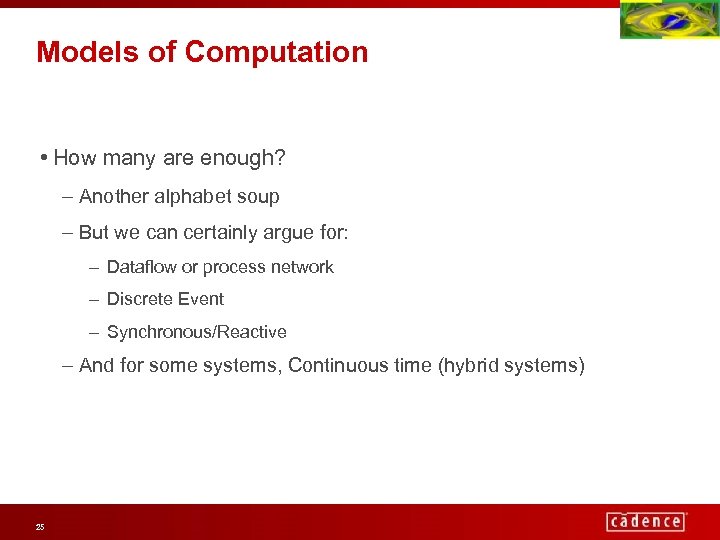 Models of Computation • How many are enough? – Another alphabet soup – But we can certainly argue for: – Dataflow or process network – Discrete Event – Synchronous/Reactive – And for some systems, Continuous time (hybrid systems) 25
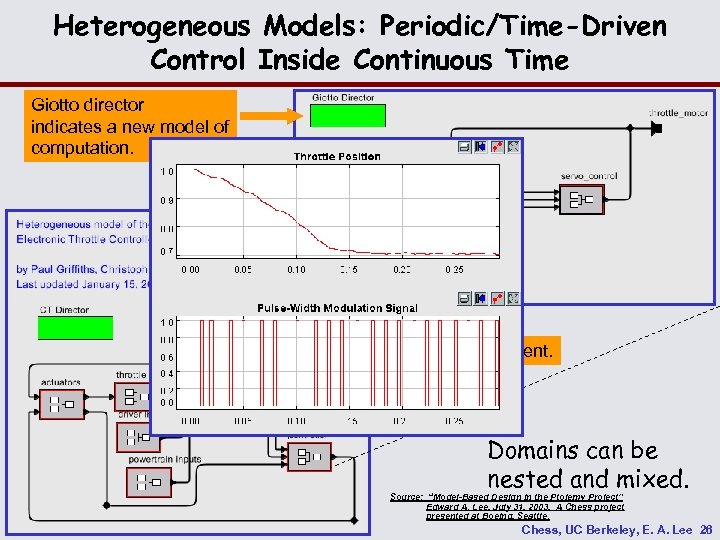 Heterogeneous Models: Periodic/Time-Driven Control Inside Continuous Time Giotto director indicates a new model of computation. Domain-polymorphic component. Domains can be nested and mixed. Source: “Model-Based Design in the Ptolemy Project” Edward A. Lee, July 31, 2003, A Chess project presented at Boeing, Seattle. Chess, UC Berkeley, E. A. Lee 26
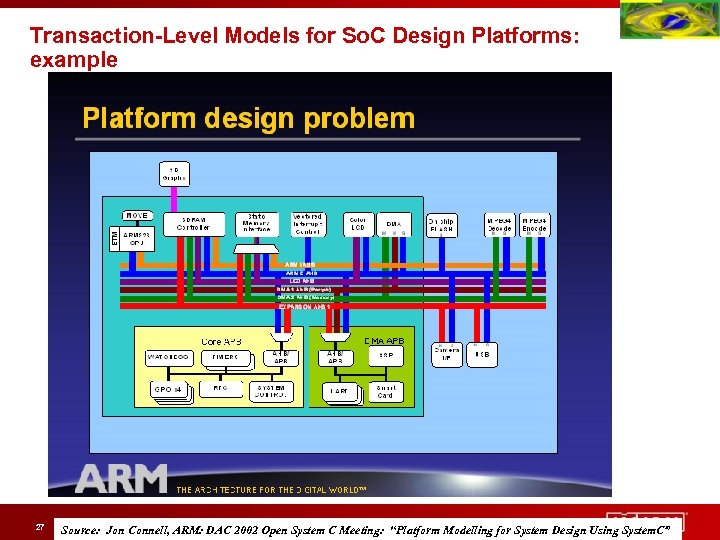 Transaction-Level Models for So. C Design Platforms: example 27 Source: Jon Connell, ARM: DAC 2002 Open System C Meeting: “Platform Modelling for System Design Using System. C”
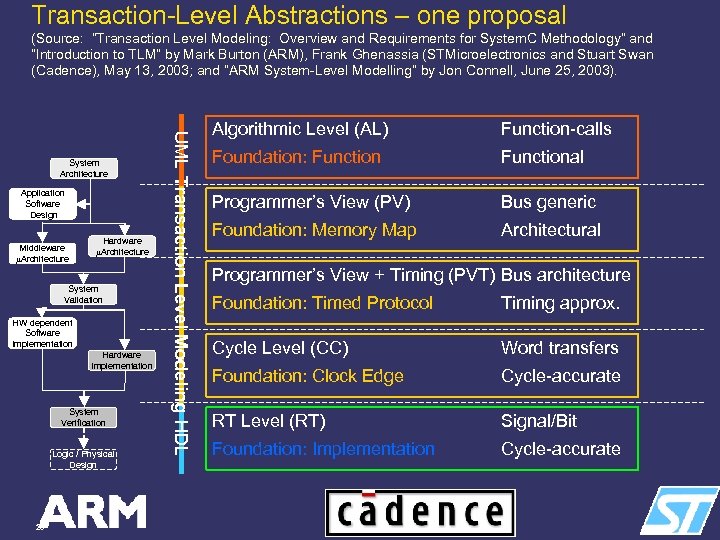 Transaction-Level Abstractions – one proposal (Source: “Transaction Level Modeling: Overview and Requirements for System. C Methodology” and “Introduction to TLM” by Mark Burton (ARM), Frank Ghenassia (STMicroelectronics and Stuart Swan (Cadence), May 13, 2003; and “ARM System-Level Modelling” by Jon Connell, June 25, 2003). Application Software Design Middleware Architecture Hardware Architecture System Validation HW dependent Software Implementation Hardware Implementation System Verification Logic / Physical Design 28 UML Transaction Level Modeling HDL System Architecture Algorithmic Level (AL) Function-calls Foundation: Functional Programmer’s View (PV) Bus generic Foundation: Memory Map Architectural Programmer’s View + Timing (PVT) Bus architecture Foundation: Timed Protocol Timing approx. Cycle Level (CC) Word transfers Foundation: Clock Edge Cycle-accurate RT Level (RT) Signal/Bit Foundation: Implementation Cycle-accurate
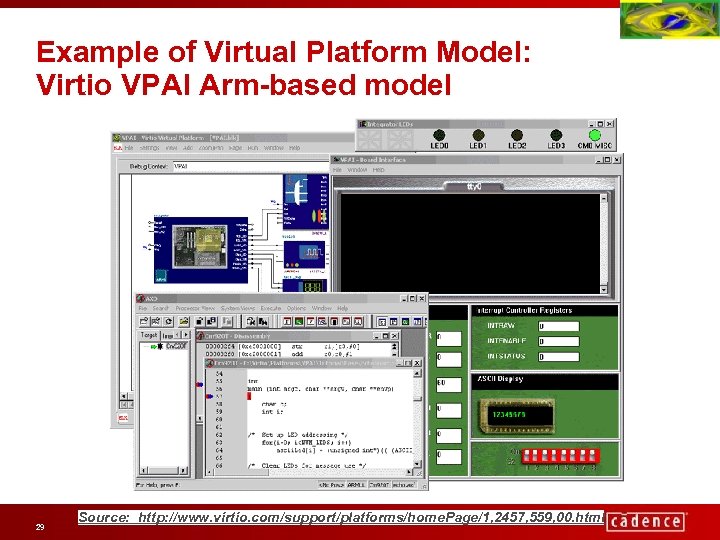 Example of Virtual Platform Model: Virtio VPAI Arm-based model 29 Source: http: //www. virtio. com/support/platforms/home. Page/1, 2457, 559, 00. html
 Verification • Transaction-based verification – Beyond the abstraction level decisions – where do the verification stimuli, monitors and checkers come from? – From assertions? - Expressed in what form? of a protocol? How can we cover all ‘interesting’ properties – From other notations? Output of system-level simulations? – Non-functional properties such as performance? • Assertion-based verification – How do we efficiently generate assertions from specifications? – Can a research language such as Rosetta be useful in this context? – How do we combine static and dynamic verification methods? • Coverage – The old question – “how much simulation (verification) is enough? ” – Are we adequately exploiting the years of experience in verifying large systems in building our verification methodologies and tools – and decision making criteria? – Can Verification be put on a more sound theoretical footing? 30
 Conclusions • The role of System. C is becoming well-defined • It makes no pretence to cover the full design flow from specification to full physical implementation • But it covers, reasonably, a set of well-defined use models and requirements in system modelling, refinement, model generation and links to implementation • We should think of it in the context of a multi-language, multidisciplinary flow that covers the whole specify-design-implement space • Notwithstanding the progress that has been made – there are many interesting design problems yet to solve, and many interesting research contributions yet to be made. 31