


 Скачать презентацию Synthesis of Iron Oxides nanorods for water splitting
1c3e59638f2a93dd72a643cd6b13832b.ppt
- Количество слайдов: 16
 Synthesis of Iron Oxides nanorods for water splitting application Cebo. Ndlangamandla i. Themba LABS/ Uni. Zulu Energy Postgraduate Conference 2013
 OUTLINE • Introduction • What has been done • Why Iron Oxide? • Experimental Approach • Results Discussion • Conclusion
 INTRODUCTION Energy Crisis: The world’s economy depend on fossil fuel and countries without fossil fuel depend to those with it. Very Expensive so renewable Energy (cheap) is a need. Non-Renewable Resources for the Production of Energy are limited. Global warming: is due to the continuous emission of green house gases. so environmental friendly energy production systems are needed. The Fossil fuel need to be substituted
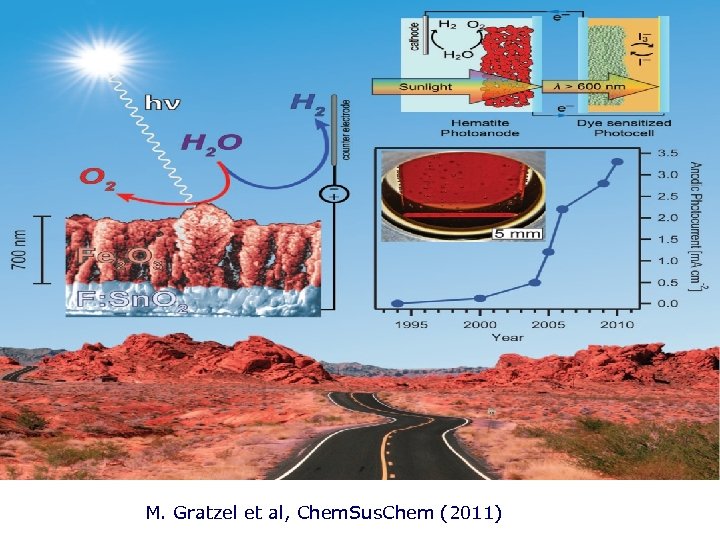
 Nanosystems for water splitting Photo catalysis of water first reported by Honda and co-worker in 1970 and now has received interest since it offers a renewable nonpolluting approach of hydrogen production. US DEO’s target for photo electrochemical hydrogen production for solar hydrogen conversion efficiency is (8% by 2010 and 10% by 2015). ØSolar Hydrogen at Tungsten Trioxide, Vaysseries et al (2001) ØSolar Hydrogen at Titanium Dioxide, Honda et al (1970) ØSolar Hydrogen at nano-composite semiconductors, Yoshihiro et al (2006) ØHydrogen System nanodevices, Vaysseries et al (2005) ØHydrogen System on Zn. O, Levey-Clement et al (2003) In all systems, the efficiency is still less than 6%
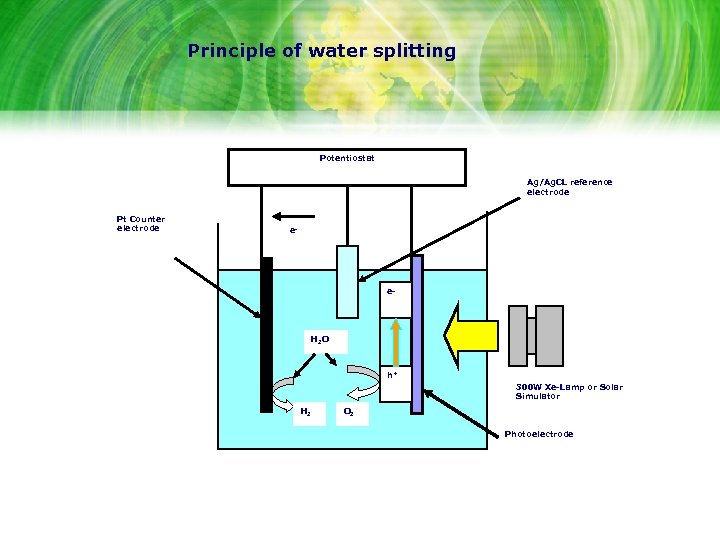 Principle of water splitting Potentiostat Ag/Ag. CL reference electrode Pt Counter electrode e- e- H 2 O h+ 300 W Xe-Lamp or Solar Simulator H 2 O 2 Photoelectrode
 M. Gratzel et al, Chem. Sus. Chem (2011)
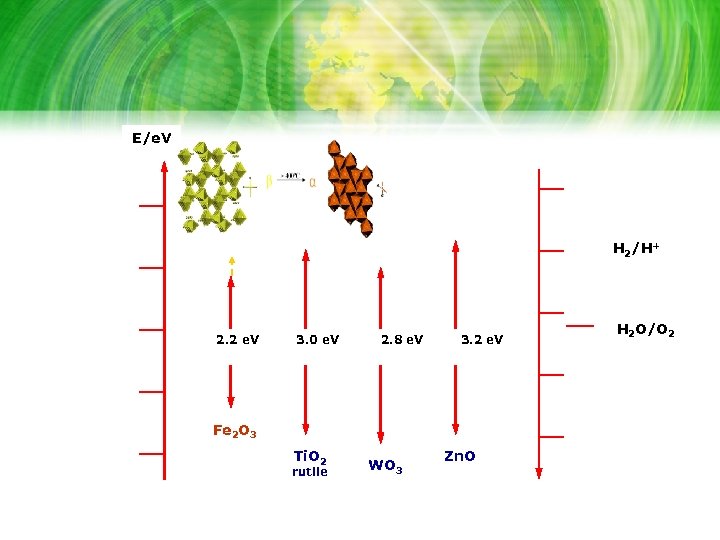
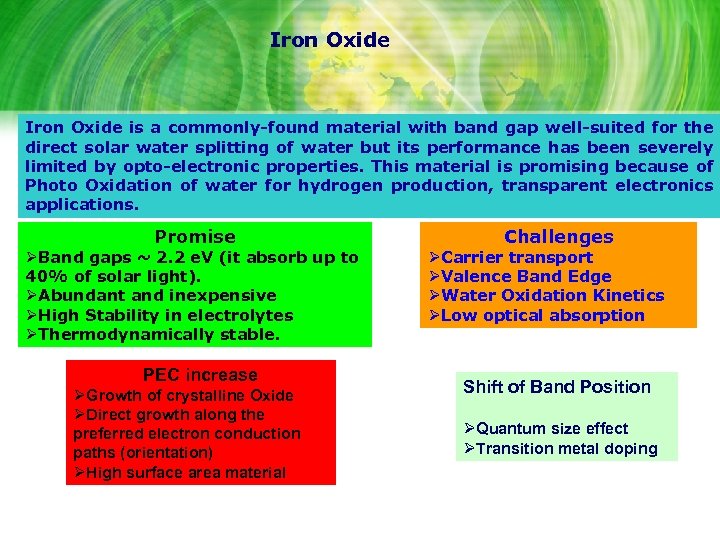 Iron Oxide is a commonly-found material with band gap well-suited for the direct solar water splitting of water but its performance has been severely limited by opto-electronic properties. This material is promising because of Photo Oxidation of water for hydrogen production, transparent electronics applications. Promise ØBand gaps ~ 2. 2 e. V (it absorb up to 40% of solar light). ØAbundant and inexpensive ØHigh Stability in electrolytes ØThermodynamically stable. PEC increase ØGrowth of crystalline Oxide ØDirect growth along the preferred electron conduction paths (orientation) ØHigh surface area material Challenges ØCarrier transport ØValence Band Edge ØWater Oxidation Kinetics ØLow optical absorption Shift of Band Position ØQuantum size effect ØTransition metal doping
 E/e. V -1 -4 0 H 2/H+ -5 1 -6 2. 2 e. V 3. 0 e. V 2. 8 e. V H 2 O/O 2 3. 2 e. V 2 -7 Fe 2 O 3 -8 3 Ti. O 2 rutile WO 3 Zn. O
 BACK CONTACT IN DEFERENT MORPHOLOGY SUN e e
 EXPERIMENTAL APPROACH ACG uses simple equipments, low temperature deposition and the reaction is less hazardous, Template-less, Surfactant-free and there is no need to use the metal catalysts. The size, shape and the orientation of the nanostructure can be easily being tailored. The coverage and the growth of the nanostructures on the substrate can be monitored. An aqueous solution of Fe. Cl 3 and Na. NO 3 is used and parameters such as Time, p. H can be controlled. 95 o. C was used for deposition.
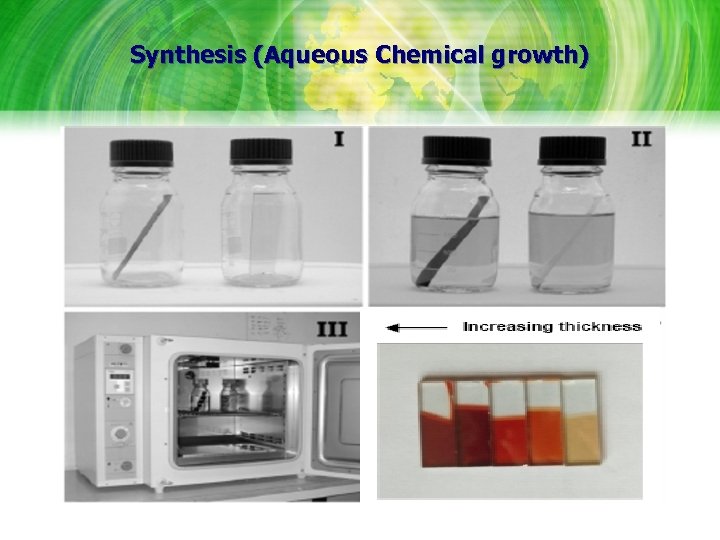 Synthesis (Aqueous Chemical growth) Vaysseries et al (2001)
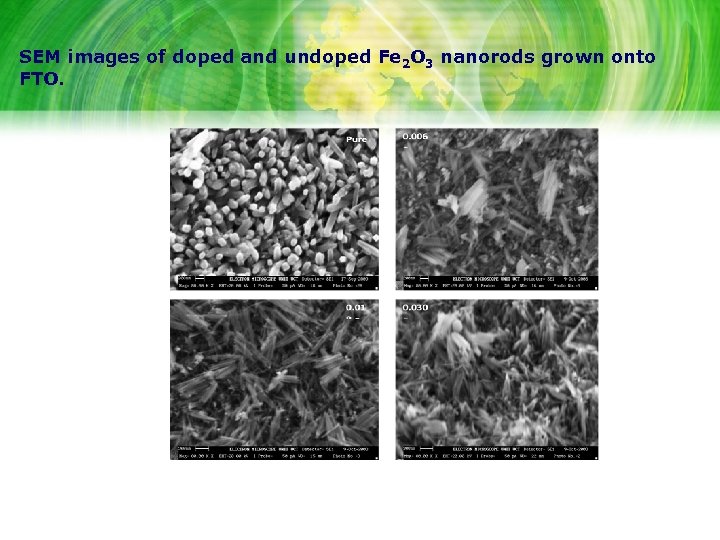 SEM images of doped and undoped Fe 2 O 3 nanorods grown onto FTO.
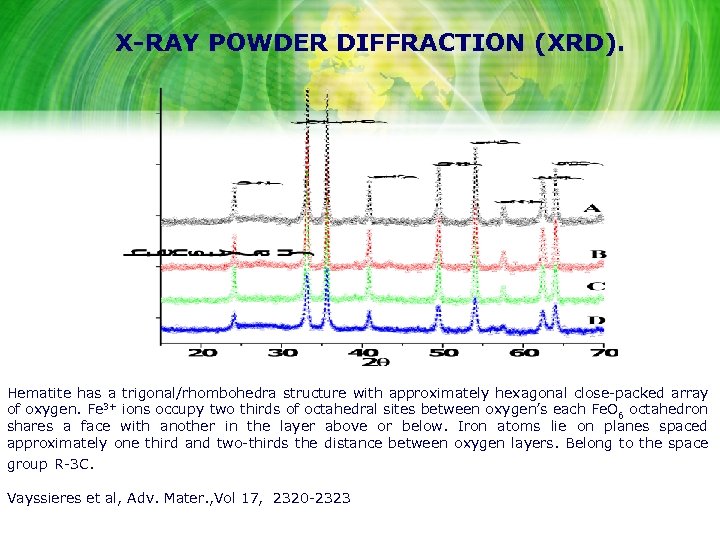 X-RAY POWDER DIFFRACTION (XRD). Hematite has a trigonal/rhombohedra structure with approximately hexagonal close-packed array of oxygen. Fe 3+ ions occupy two thirds of octahedral sites between oxygen’s each Fe. O 6 octahedron shares a face with another in the layer above or below. Iron atoms lie on planes spaced approximately one third and two-thirds the distance between oxygen layers. Belong to the space group R-3 C. Vayssieres et al, Adv. Mater. , Vol 17, 2320 -2323
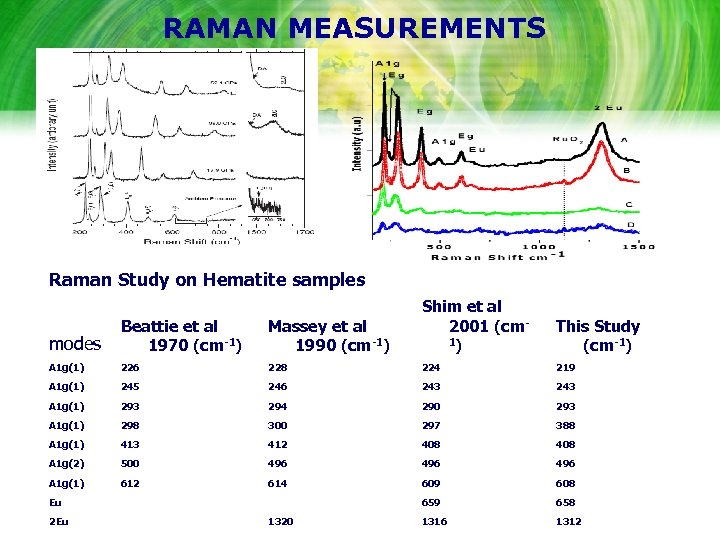 RAMAN MEASUREMENTS Raman Study on Hematite samples modes Beattie et al 1970 (cm-1) Massey et al 1990 (cm-1) Shim et al 2001 (cm 1) A 1 g(1) 226 228 224 219 A 1 g(1) 245 246 243 A 1 g(1) 293 294 290 293 A 1 g(1) 298 300 297 388 A 1 g(1) 413 412 408 A 1 g(2) 500 496 496 A 1 g(1) 612 614 609 608 659 658 1316 1312 Eu 2 Eu 1320 This Study (cm-1)
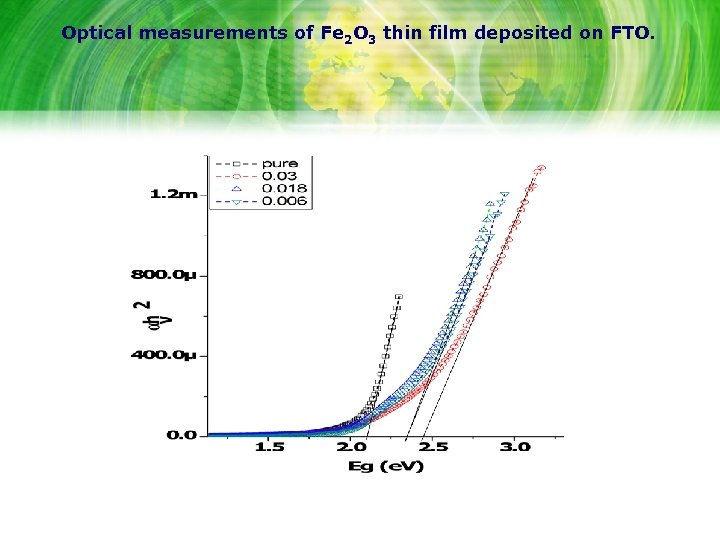 Optical measurements of Fe 2 O 3 thin film deposited on FTO.
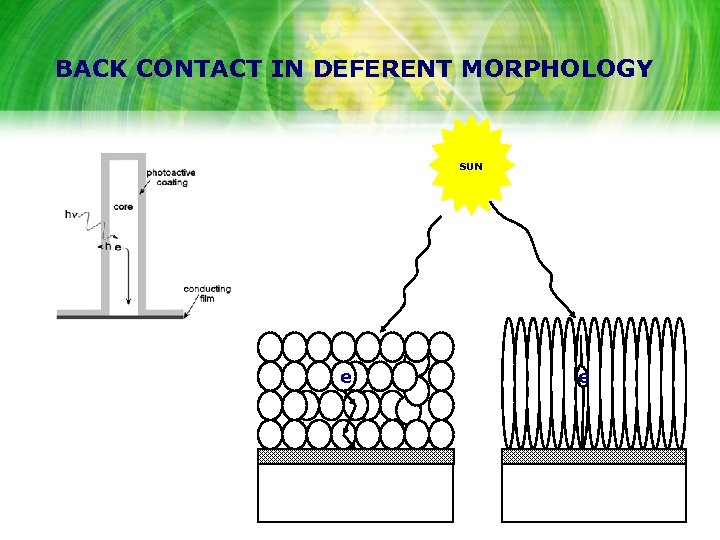
 CONCLUSION Randomly perpendicular oriented nanorods were obtained by adjusting the solution p. H. This orientation is preferred to avoid recombination. Spherical may not provide a good electrical pathway for the photo-generated electron to travel to the FTO back contact. The band gap of hematite can be tailored by growth parameters such doping.