 Скачать презентацию Syntax Lecture 9 Verb Types 1 Introduction
3adb3056c2e46ab486384b9ef27b0367.ppt
- Количество слайдов: 31



Syntax Lecture 9: Verb Types 1
Introduction • We have seen: – The subject starts off close to the verb, but moves to specifier of IP – The verb starts off inside the VP, but may move to I or C depending on the construction and other conditions • In this lecture we will see that the verb itself is a complex entity and cannot always be analysed as a single thing
Causatives • One obvious case of a complex verb is the following: – He made the ice melt • Here, the ice melt has the meaning of a clause (the ice melted), but it is not an IP or CP – There can be no complementiser • * he made that the ice melt • * he made for the ice melt – There can be no inflection • * he made the ice will/to melt • * he made the ice melted
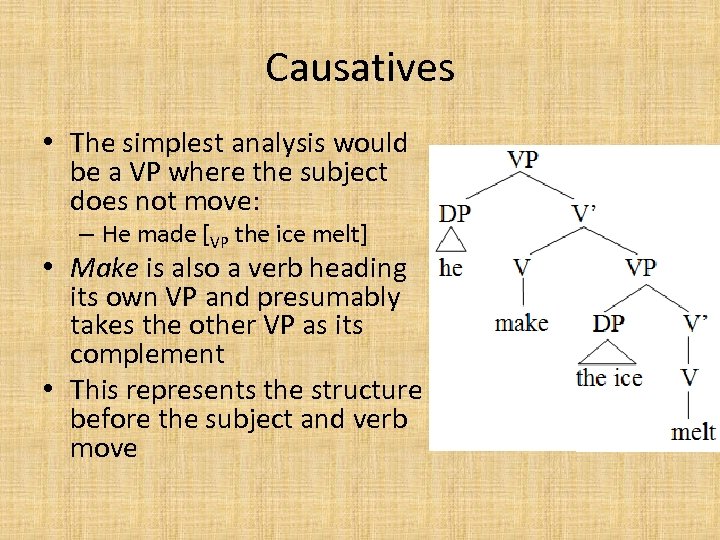
Causatives • The simplest analysis would be a VP where the subject does not move: – He made [VP the ice melt] • Make is also a verb heading its own VP and presumably takes the other VP as its complement • This represents the structure before the subject and verb move
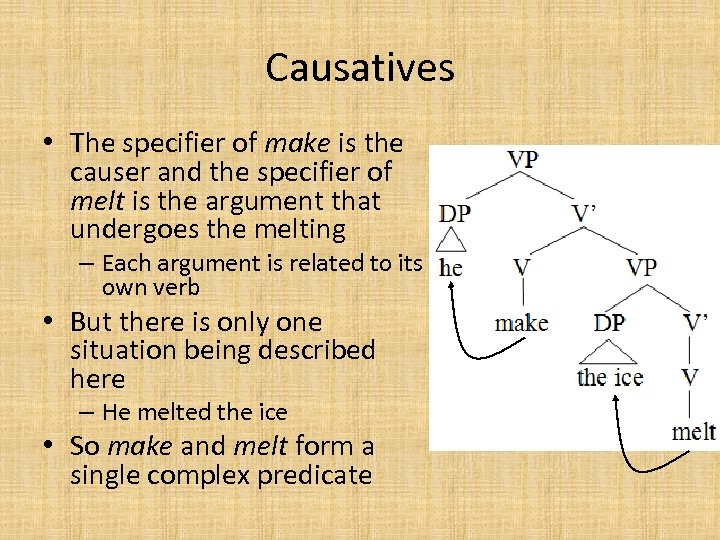
Causatives • The specifier of make is the causer and the specifier of melt is the argument that undergoes the melting – Each argument is related to its own verb • But there is only one situation being described here – He melted the ice • So make and melt form a single complex predicate
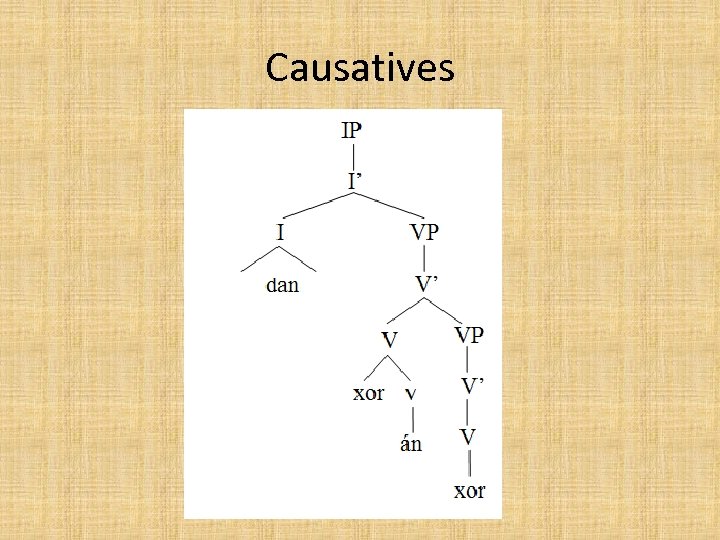
Causatives • There are many languages where the complex causative predicate is expressed as an inflected form of the verb. E. g. Persian: – xordan = to eat – xorándan = feed (cause to eat) • Presumably this works in the same way that other inflections do: the verb moves and sticks to the causative before it moves to the inflection
Causatives
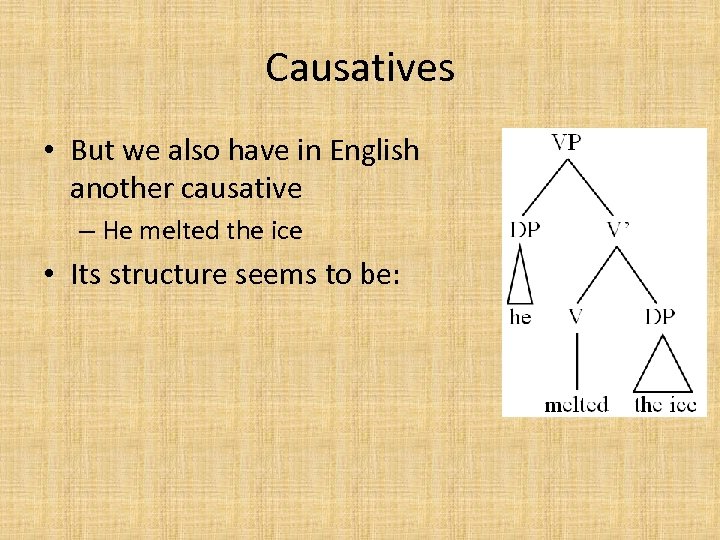
Causatives • But we also have in English another causative – He melted the ice • Its structure seems to be:
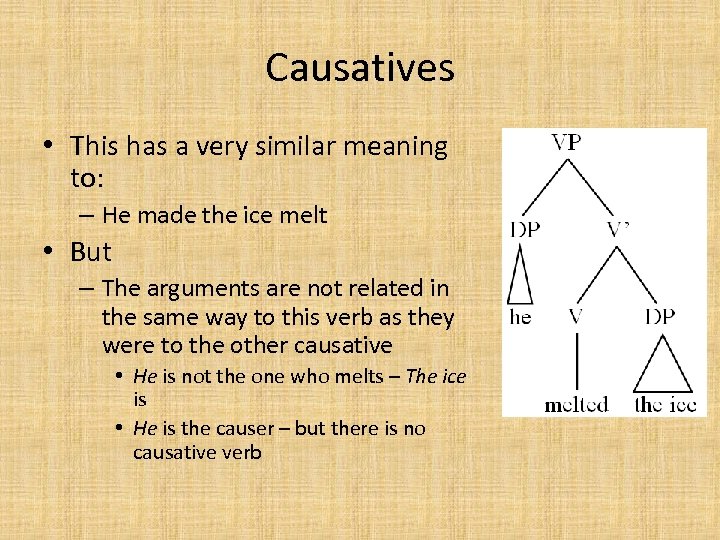
Causatives • This has a very similar meaning to: – He made the ice melt • But – The arguments are not related in the same way to this verb as they were to the other causative • He is not the one who melts – The ice is • He is the causer – but there is no causative verb
Causatives • We can account for these observations if we assume that this kind of causative is like the Persian morphological causative – with a phonologically null morpheme
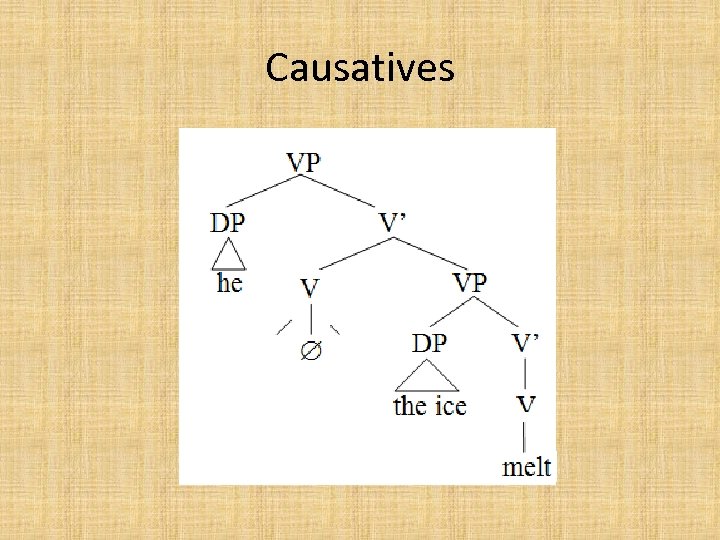
Causatives
Things to note • The subject is not an argument of the overt verb, but of an independent abstract causative verb • The object is not in complement position of the verb, but in its specifier • The word order V O is due to the verb moving
Something to think about • Are causatives the only verbs that behave like this? – Constructed of more than one element – Have arguments which are only indirectly related to them – Ordered with respect to other arguments by movement
Transitives • Traditionally, a transitive verb is one which has an object • They also have subjects, so there are two arguments – Typically • Agent: the one that carries out the action and • Theme/Patient: the one who undergoes the process – E. g. • John hit Bill • He wrote the letter • They built a house
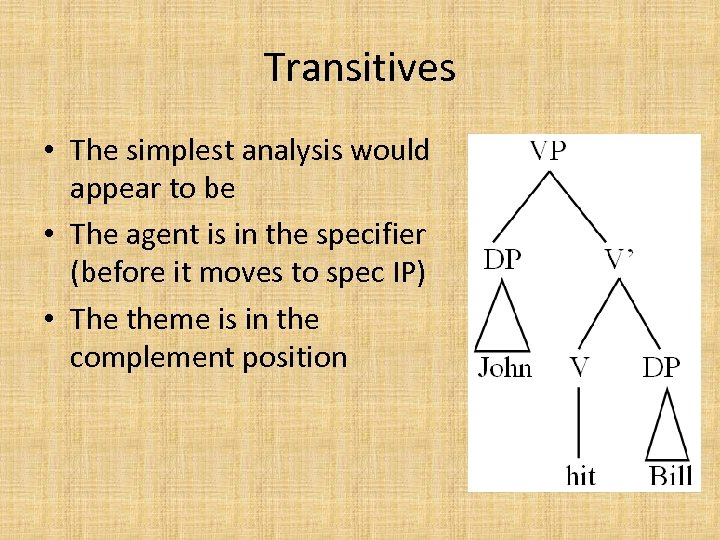
Transitives • The simplest analysis would appear to be • The agent is in the specifier (before it moves to spec IP) • The theme is in the complement position
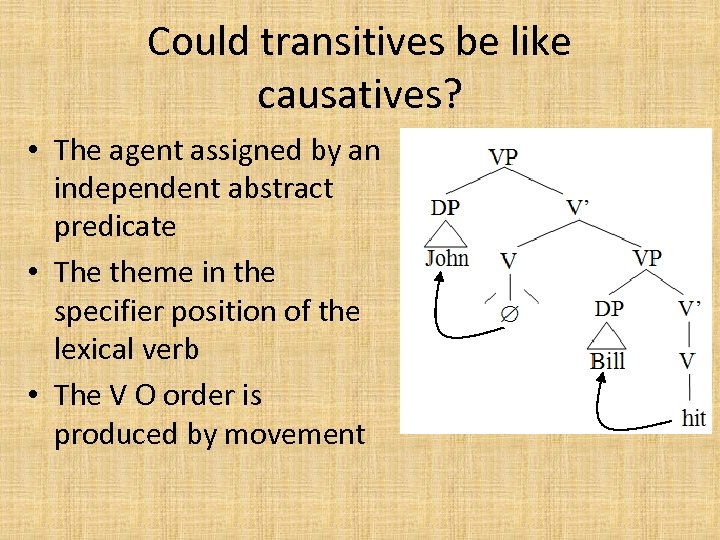
Could transitives be like causatives? • The agent assigned by an independent abstract predicate • The theme in the specifier position of the lexical verb • The V O order is produced by movement
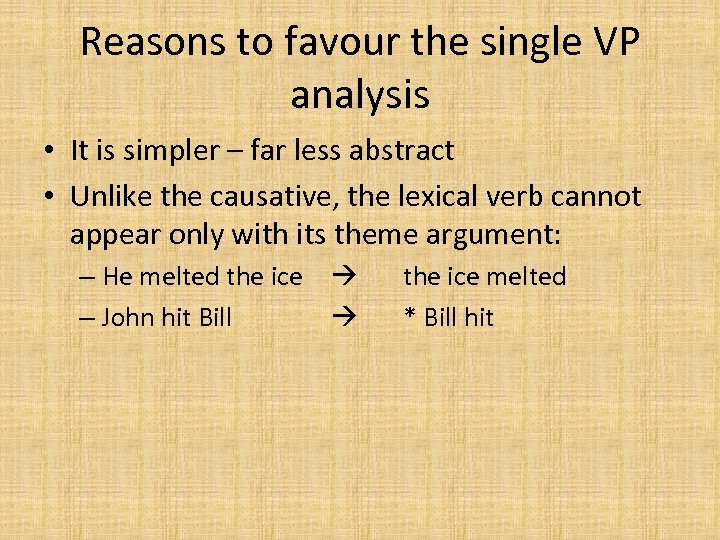
Reasons to favour the single VP analysis • It is simpler – far less abstract • Unlike the causative, the lexical verb cannot appear only with its theme argument: – He melted the ice – John hit Bill the ice melted * Bill hit
Reasons to favour the double VP analysis • The subject of the transitive is more distant from the lexical verb both semantically and syntactically
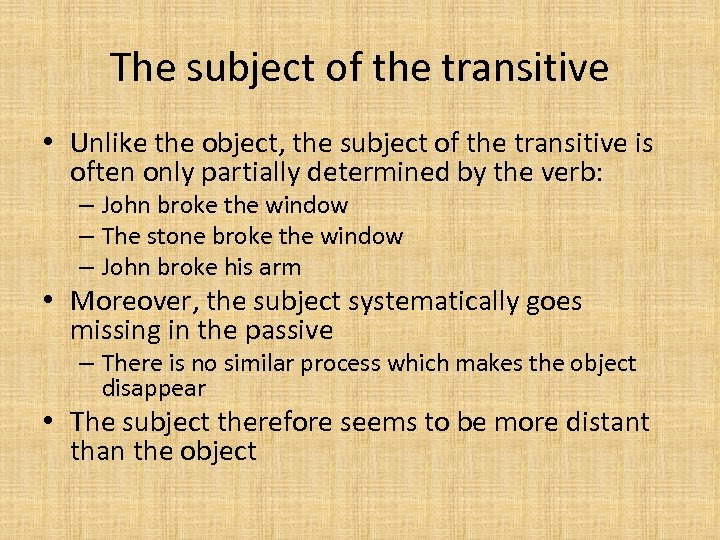
The subject of the transitive • Unlike the object, the subject of the transitive is often only partially determined by the verb: – John broke the window – The stone broke the window – John broke his arm • Moreover, the subject systematically goes missing in the passive – There is no similar process which makes the object disappear • The subject therefore seems to be more distant than the object
Reasons to favour the double VP analysis • The subject of the transitive is more distant from the lexical verb both semantically and syntactically • The analysis gives a more uniform treatment of argument positions (= simpler? )
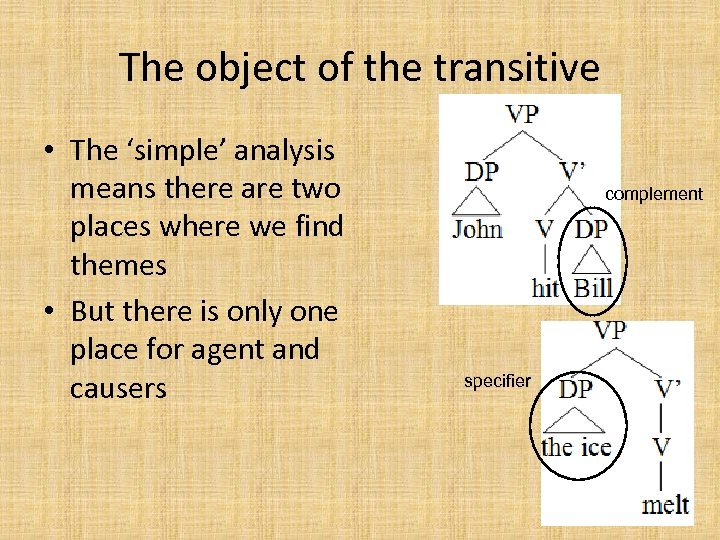
The object of the transitive • The ‘simple’ analysis means there are two places where we find themes • But there is only one place for agent and causers complement specifier
The object of the transitive • This is a complex situation with no one-to-one relationship between arguments and positions: – Theme specifier OR complement – Specifier agent OR theme
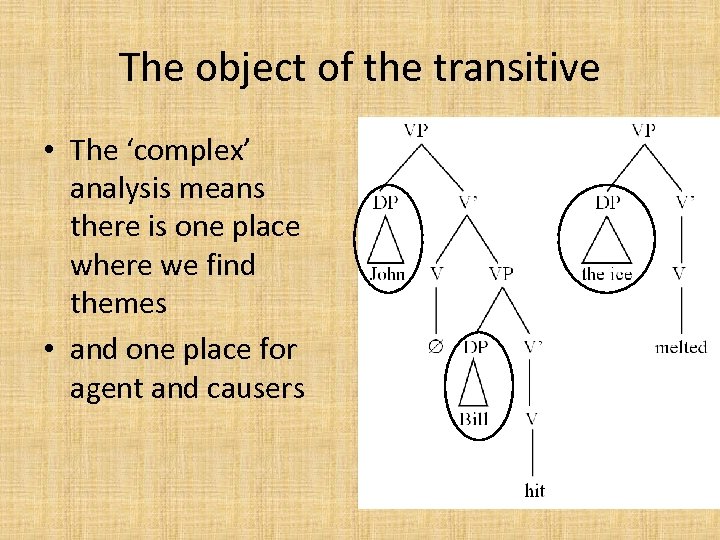
The object of the transitive • The ‘complex’ analysis means there is one place where we find themes • and one place for agent and causers
The meaning of the abstract predicate • If we accept the complex VP analysis for transitive verbs, what does the abstract verb do? • The way to understand this is to break the situation described into its parts – John hit Bill • John does something – We don’t exactly know what • As a result of what John does, Bill comes to be hit
The meaning of the abstract predicate • The abstract predicate is equivalent to “do something” • When this combines with e. g. hit the action is restricted to one which can result in someone getting hit – i. e. Swinging a fist or throwing a rock, but not playing the violin or solving a problem
The meaning of the abstract predicate • This abstract predicate is obviously present in all situations which involve an agent – John wrote a letter • John does something • As a result, a letter is written – John ate an apple • John does something • As a result, an apple is eaten
Non-agentive transitives • Not all transitive verbs involve agents: – John saw Bill – John loves ice cream – John remembered the answer • These tend to be verbs of cognition, emotion or perception • They involve an experiencer not an agent
Non-agentive transitives • However, they can be analysed in the same way – John saw Bill • John experiences something • As a result, Bill is seen – John remembered the answer • John experiences something • As a result, the answer is remembered • Again, what is experienced is restricted by what is compatible with the interpretation of the lexical predicate – John saw Bill • What is experienced is a visual perception
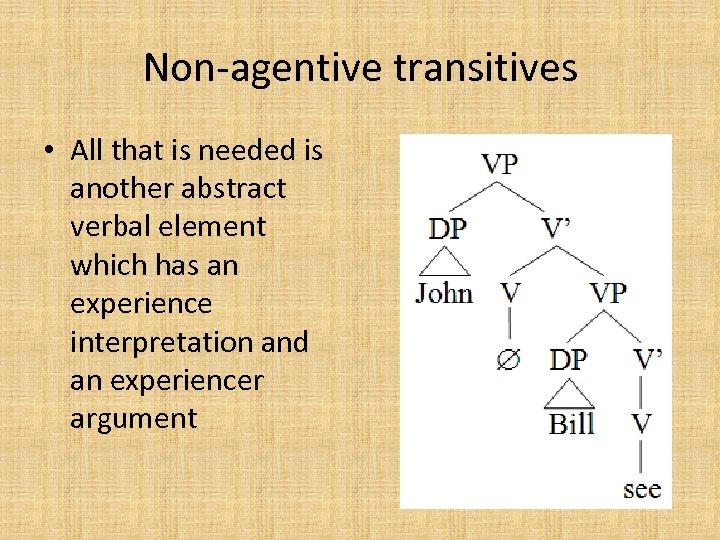
Non-agentive transitives • All that is needed is another abstract verbal element which has an experience interpretation and an experiencer argument
A conclusion on argument positions • What we have seen suggests that particular arguments have universal positions (before movement) – Theme: specifier of lexical verb – Agent: specifier of (abstract) agentive verb – Experiencer: specifier of (abstract) experience verb – Causer: specifier of (abstract/non-abstract) causative verb • This idea is known as the UTAH – Universal Theta Assignment Hypothesis
Conclusion • The causative construction consists of two verbs: – The causing verb: make – The lexical verb: e. g. melt • That this analysis can be extended to all transitive verbs is suggested by: – The single verb causative • They melted the ice – The fact that the subject is more distant from the verb than the object – The fact that a simpler theory of argument position is obtained
Скачать презентацию Syntax Lecture 9 Verb Types 1 Introduction
3adb3056c2e46ab486384b9ef27b0367.ppt