 Скачать презентацию SYNTAX Introduction to Linguistics BASIC
334c96a8429acff45289e9a3bb6c38c8.ppt
- Количество слайдов: 22




SYNTAX Introduction to Linguistics

• BASIC IDEAS
• What is a sentence?
• Grammaticality • • • Grammatical vs. ungrammatical • well formed vs. ill formed • words must conform to specific patterns determined by the syntactic rules of the language based on • syntactic rules NOT based on • what is taught in school • whether it is meaningful • whether you have heard the sentences before.
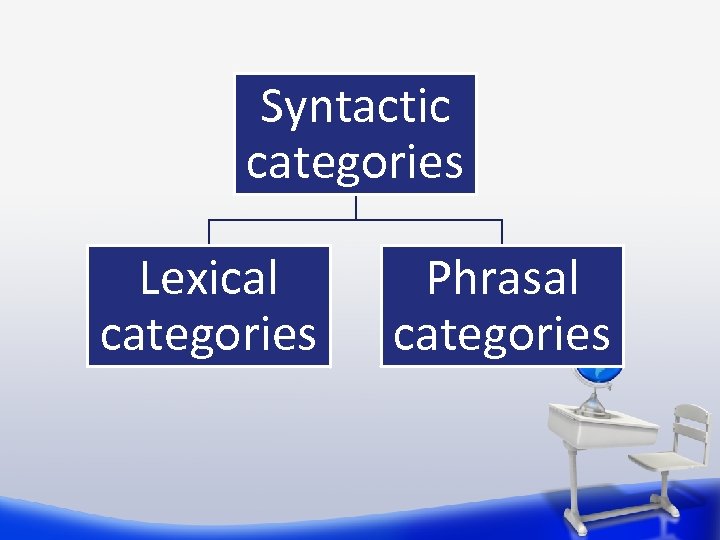
Syntactic categories Lexical categories Phrasal categories
• Lexical categories Open lexical categories • nouns • verbs • adjectives • Adverbs Closed lexical categoreis • Pronouns • prepositions • Auxiliary verbs • determiners (articles, demonstratives, quantifiers)

• PHRASE STRUCTURE
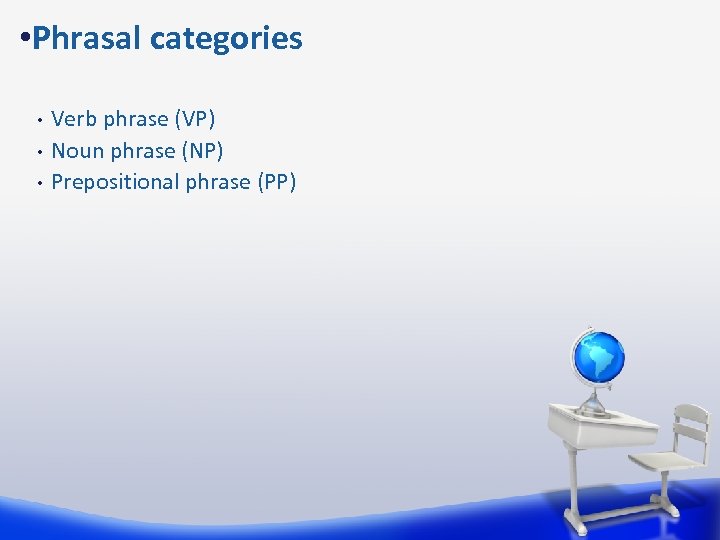
• Phrasal categories • • • Verb phrase (VP) Noun phrase (NP) Prepositional phrase (PP)
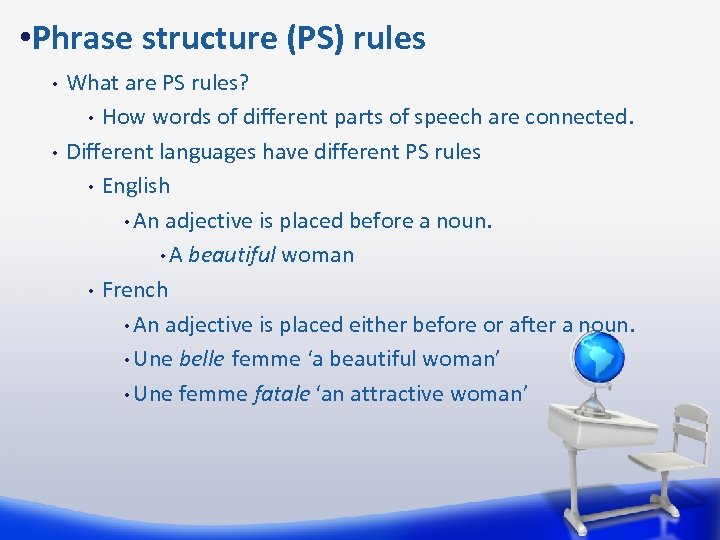
• Phrase structure (PS) rules • • What are PS rules? • How words of different parts of speech are connected. Different languages have different PS rules • English • An adjective is placed before a noun. • A beautiful woman • French • An adjective is placed either before or after a noun. • Une belle femme ‘a beautiful woman’ • Une femme fatale ‘an attractive woman’
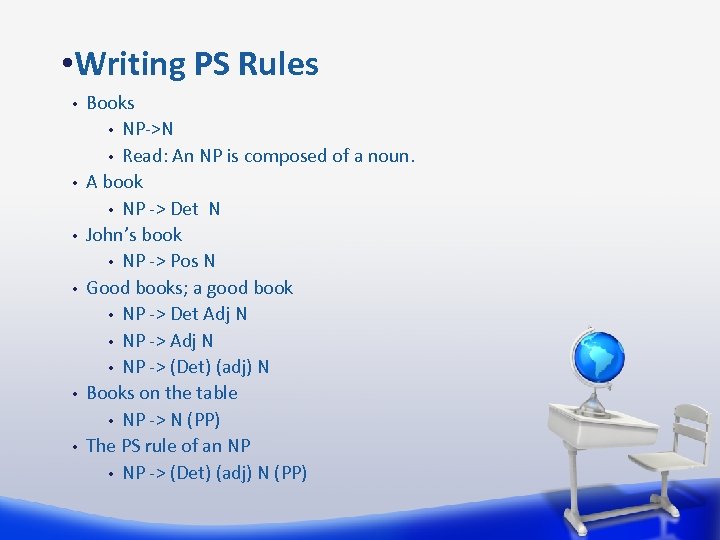
• Writing PS Rules • • • Books • NP->N • Read: An NP is composed of a noun. A book • NP -> Det N John’s book • NP -> Pos N Good books; a good book • NP -> Det Adj N • NP -> (Det) (adj) N Books on the table • NP -> N (PP) The PS rule of an NP • NP -> (Det) (adj) N (PP)
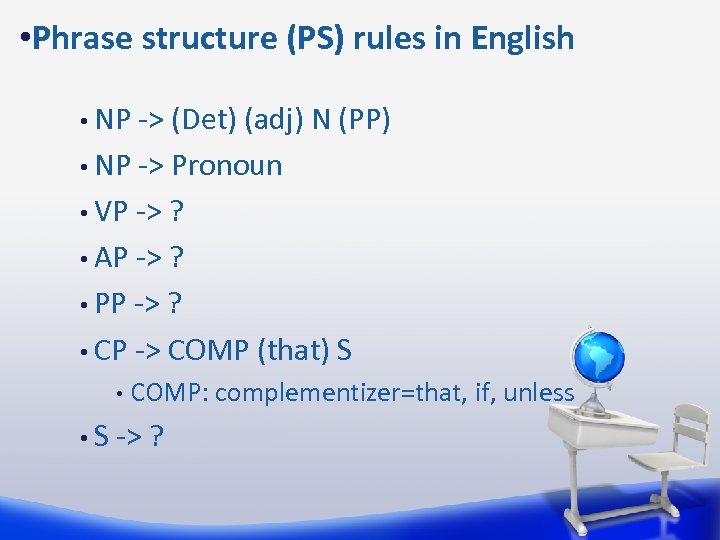
• Phrase structure (PS) rules in English • NP -> (Det) (adj) N (PP) • NP -> Pronoun • VP -> ? • AP -> ? • PP -> ? • CP -> COMP (that) S • • S COMP: complementizer=that, if, unless -> ?
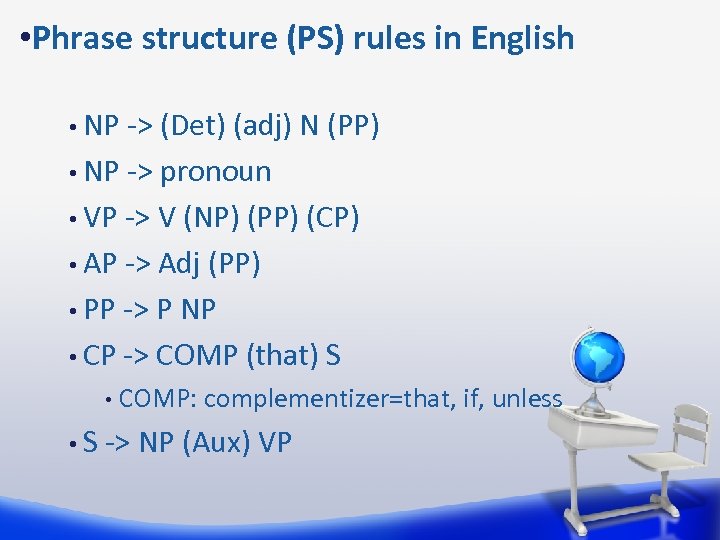
• Phrase structure (PS) rules in English • NP -> (Det) (adj) N (PP) • NP -> pronoun • VP -> V (NP) (PP) (CP) • AP -> Adj (PP) • PP -> P NP • CP -> COMP (that) S • • S COMP: complementizer=that, if, unless -> NP (Aux) VP
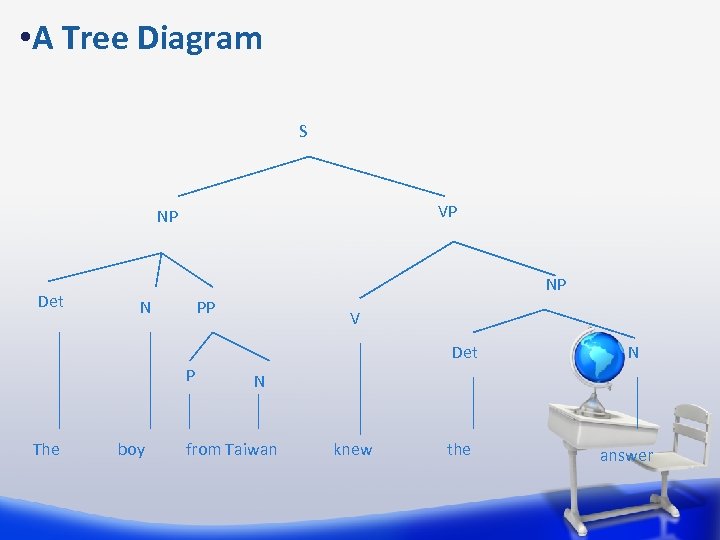
• A Tree Diagram S VP NP Det NP N PP V Det P The boy N N from Taiwan knew the answer
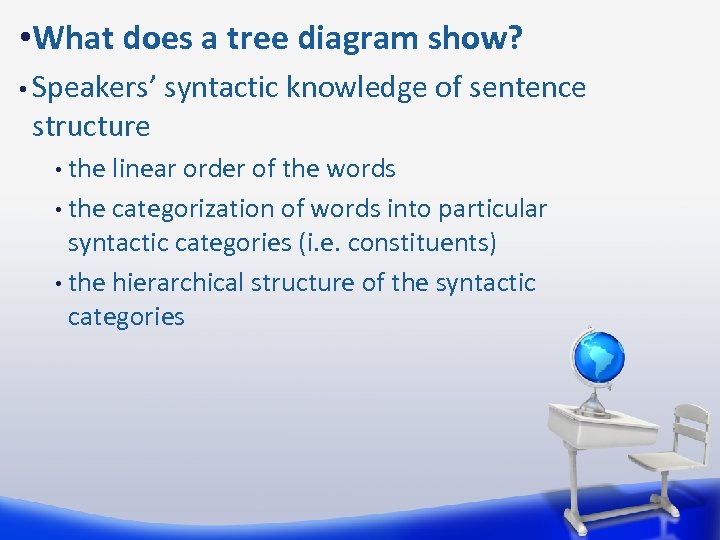
• What does a tree diagram show? • Speakers’ structure syntactic knowledge of sentence the linear order of the words • the categorization of words into particular syntactic categories (i. e. constituents) • the hierarchical structure of the syntactic categories •
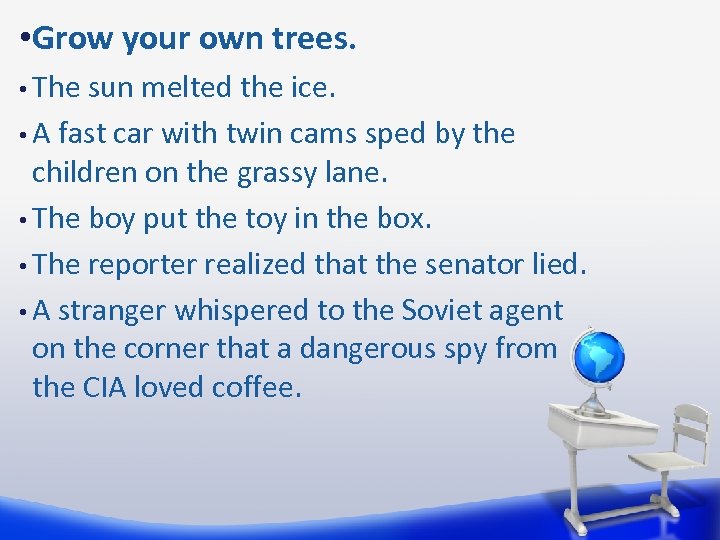
• Grow your own trees. • The sun melted the ice. • A fast car with twin cams sped by the children on the grassy lane. • The boy put the toy in the box. • The reporter realized that the senator lied. • A stranger whispered to the Soviet agent on the corner that a dangerous spy from the CIA loved coffee.
• What can tree diagrams explain? • Structural ambiguity • long-distance relationships
• Structural ambiguity • A sentence may have two interpretations due to different structural compositions of constituents. • Example : • The boy left Mary with a broken heart.
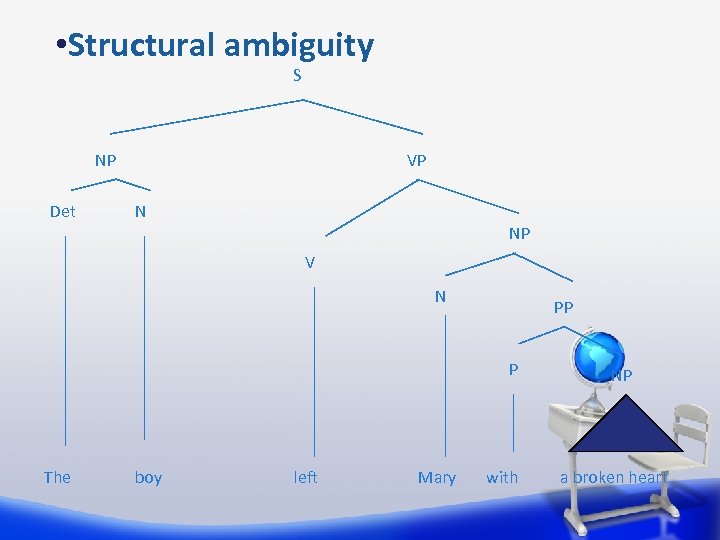
• Structural ambiguity S NP Det VP N NP V N PP P The boy left Mary with NP a broken heart
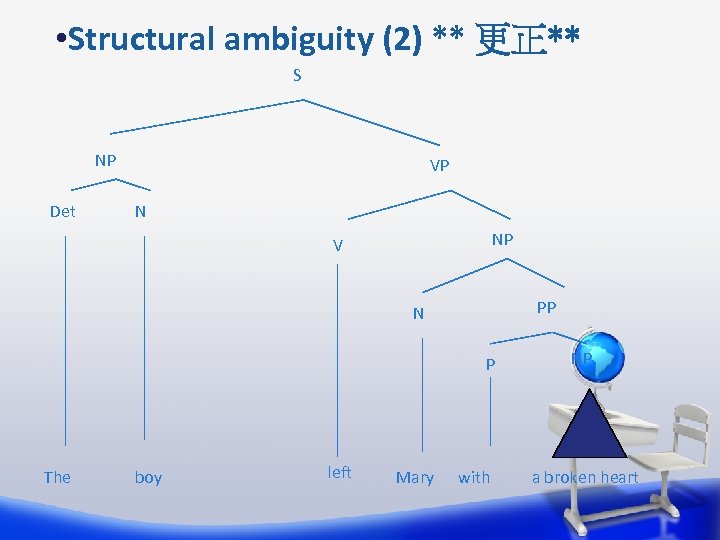
• Structural ambiguity (2) ** 更正** S NP Det VP N NP V PP N P The boy left Mary with NP a broken heart
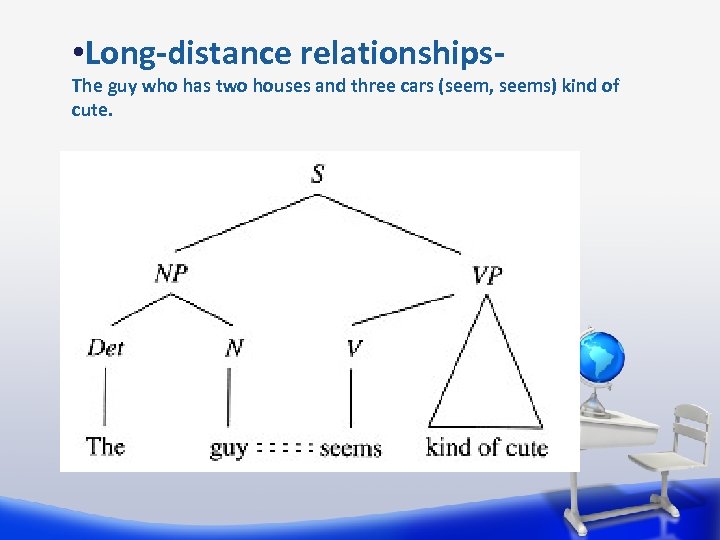
• Long-distance relationships- The guy who has two houses and three cars (seem, seems) kind of cute.
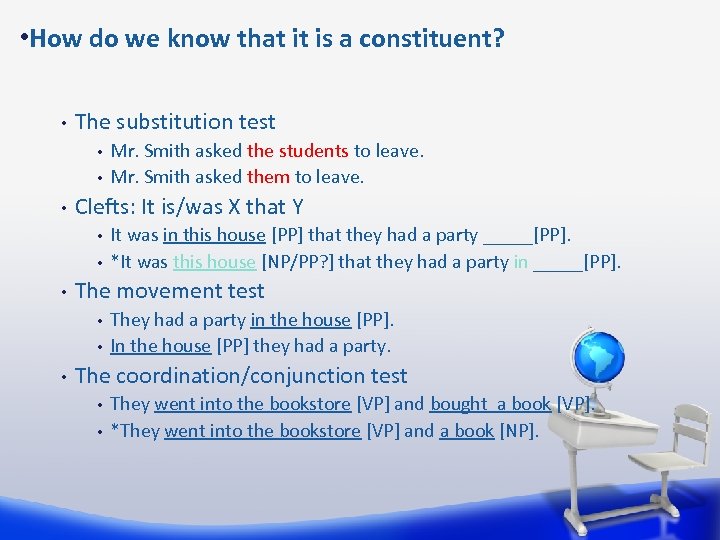
• How do we know that it is a constituent? • The substitution test • • • Clefts: It is/was X that Y • • • It was in this house [PP] that they had a party _____[PP]. *It was this house [NP/PP? ] that they had a party in _____[PP]. The movement test • • • Mr. Smith asked the students to leave. Mr. Smith asked them to leave. They had a party in the house [PP]. In the house [PP] they had a party. The coordination/conjunction test • • They went into the bookstore [VP] and bought a book [VP]. *They went into the bookstore [VP] and a book [NP].

Questions?
Скачать презентацию SYNTAX Introduction to Linguistics BASIC
334c96a8429acff45289e9a3bb6c38c8.ppt