


 Скачать презентацию Syntax Definition of Syntax Types of Grammar Hierarchical
cc0eef14f9ca6df0ecb900b0dff9e2e3.ppt
- Количество слайдов: 53
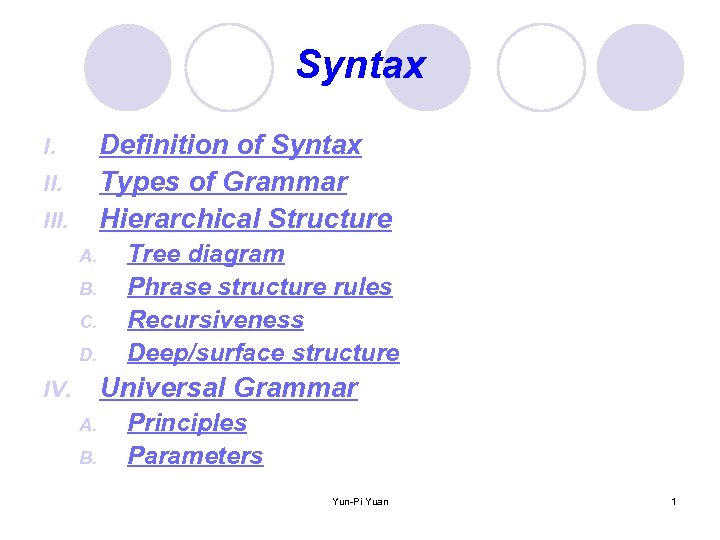 Syntax Definition of Syntax Types of Grammar Hierarchical Structure I. III. A. B. C. D. Tree diagram Phrase structure rules Recursiveness Deep/surface structure Universal Grammar IV. A. B. Principles Parameters Yun-Pi Yuan 1
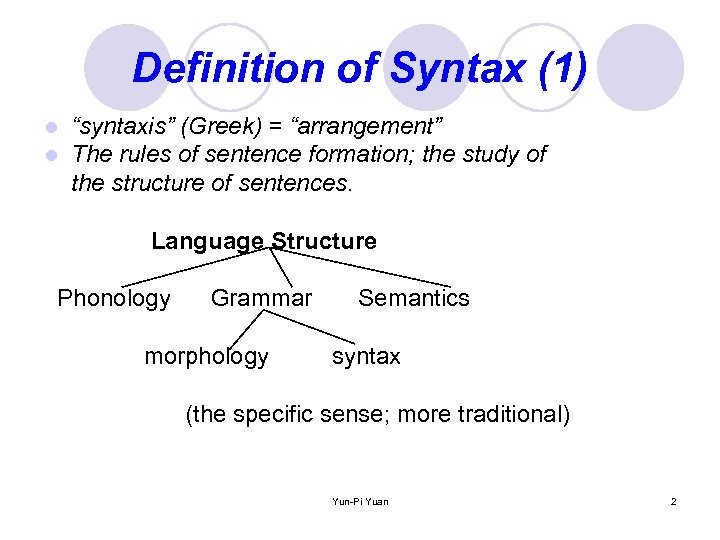 Definition of Syntax (1) l l “syntaxis” (Greek) = “arrangement” The rules of sentence formation; the study of the structure of sentences. Language Structure Phonology Grammar morphology Semantics syntax (the specific sense; more traditional) Yun-Pi Yuan 2
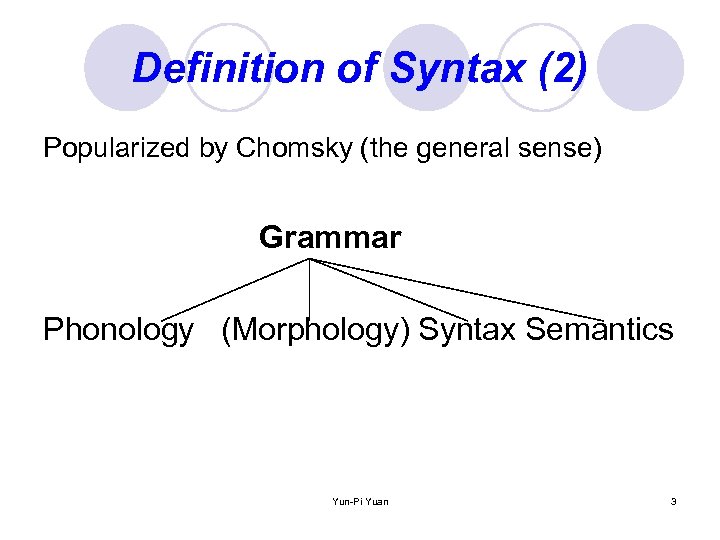 Definition of Syntax (2) Popularized by Chomsky (the general sense) Grammar Phonology (Morphology) Syntax Semantics Yun-Pi Yuan 3
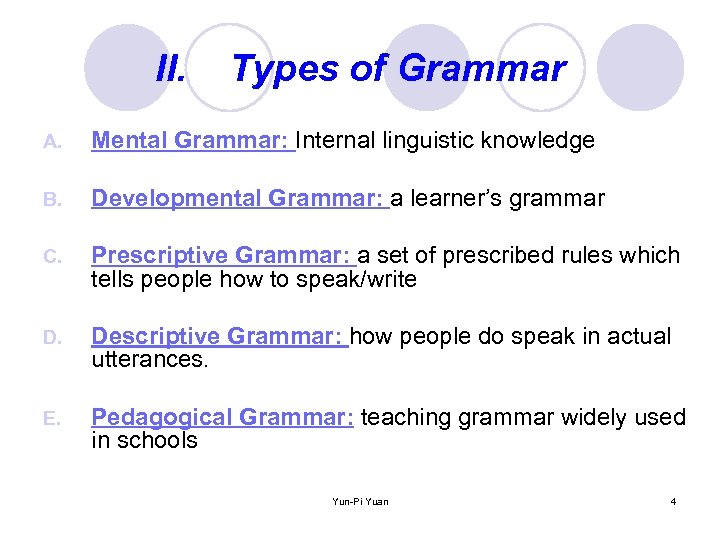 II. Types of Grammar A. Mental Grammar: Internal linguistic knowledge B. Developmental Grammar: a learner’s grammar C. Prescriptive Grammar: a set of prescribed rules which tells people how to speak/write D. Descriptive Grammar: how people do speak in actual utterances. E. Pedagogical Grammar: teaching grammar widely used in schools Yun-Pi Yuan 4
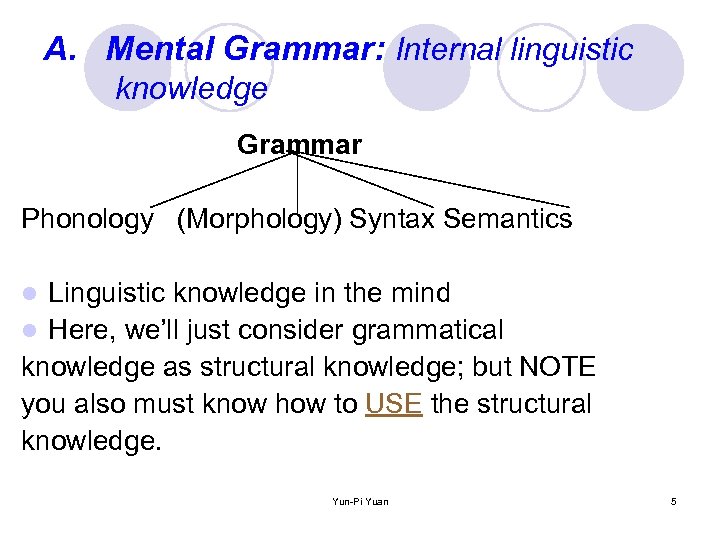 A. Mental Grammar: Internal linguistic knowledge Grammar Phonology (Morphology) Syntax Semantics Linguistic knowledge in the mind l Here, we’ll just consider grammatical knowledge as structural knowledge; but NOTE you also must know how to USE the structural knowledge. l Yun-Pi Yuan 5
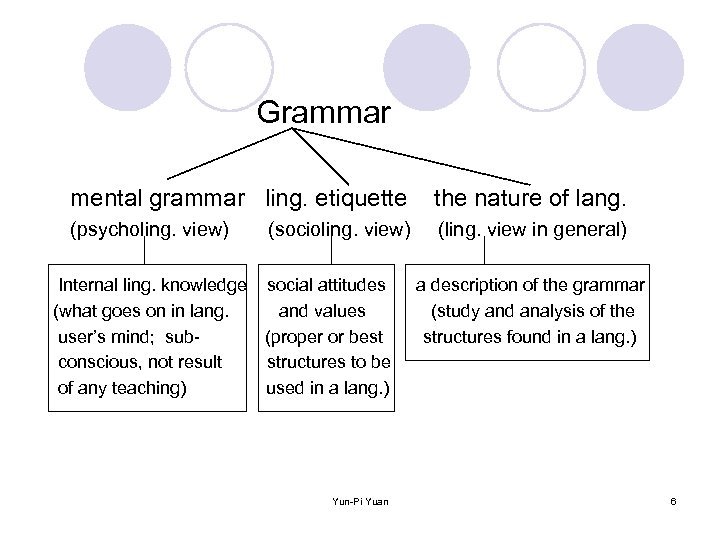 Grammar mental grammar ling. etiquette the nature of lang. (psycholing. view) (ling. view in general) (socioling. view) Internal ling. knowledge social attitudes (what goes on in lang. and values user’s mind; sub(proper or best conscious, not result structures to be of any teaching) used in a lang. ) Yun-Pi Yuan a description of the grammar (study and analysis of the structures found in a lang. ) 6
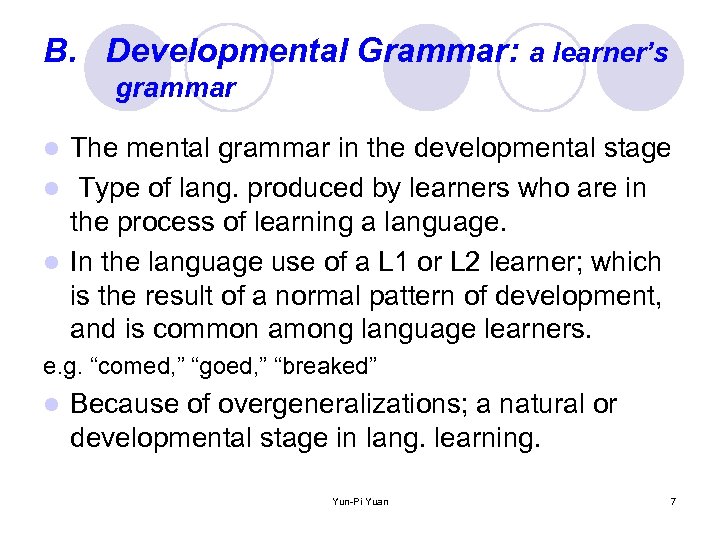 B. Developmental Grammar: a learner’s grammar The mental grammar in the developmental stage l Type of lang. produced by learners who are in the process of learning a language. l In the language use of a L 1 or L 2 learner; which is the result of a normal pattern of development, and is common among language learners. l e. g. “comed, ” “goed, ” “breaked” l Because of overgeneralizations; a natural or developmental stage in lang. learning. Yun-Pi Yuan 7
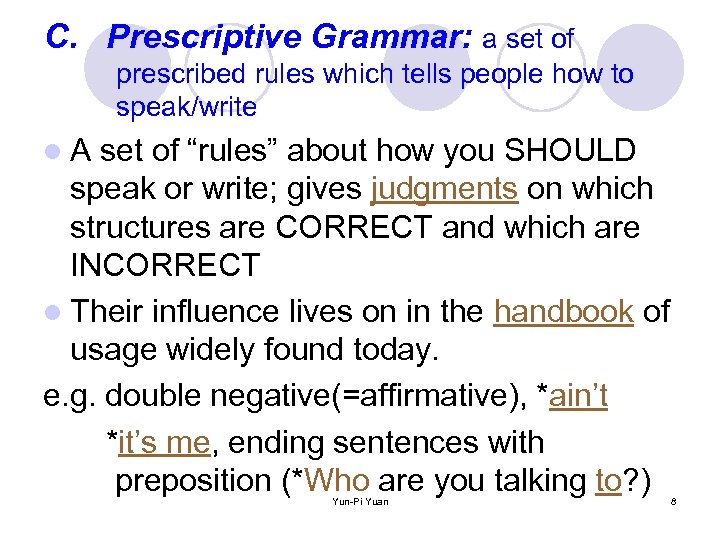 C. Prescriptive Grammar: a set of prescribed rules which tells people how to speak/write l. A set of “rules” about how you SHOULD speak or write; gives judgments on which structures are CORRECT and which are INCORRECT l Their influence lives on in the handbook of usage widely found today. e. g. double negative(=affirmative), *ain’t *it’s me, ending sentences with preposition (*Who are you talking to? ) Yun-Pi Yuan 8
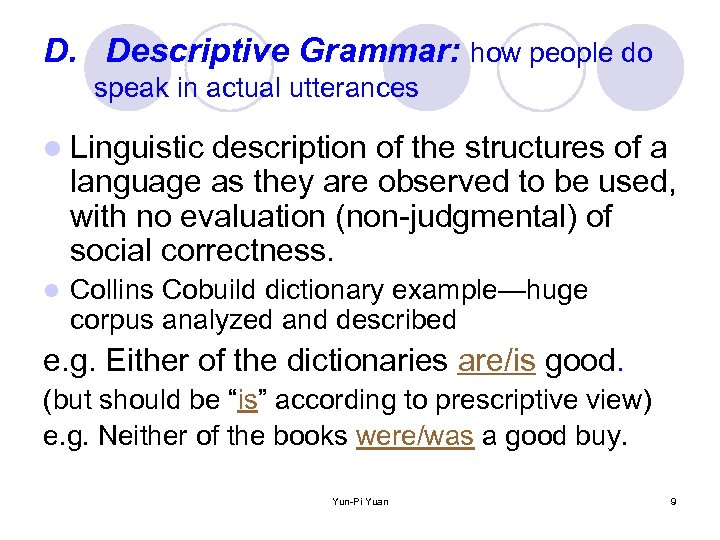 D. Descriptive Grammar: how people do speak in actual utterances l Linguistic description of the structures of a language as they are observed to be used, with no evaluation (non-judgmental) of social correctness. l Collins Cobuild dictionary example—huge corpus analyzed and described e. g. Either of the dictionaries are/is good. (but should be “is” according to prescriptive view) e. g. Neither of the books were/was a good buy. Yun-Pi Yuan 9
 E. Pedagogical Grammar: teaching grammars widely used in schools l. A “teaching grammar”—designed for developing NS students’ awareness of their mother tongue, or for teaching a language as a foreign language. l Often a combination of descriptive & prescriptive grammars; more contemporary pedagogical grammars moving away from prescriptive. e. g. M. Swam. Practical English Usage or a textbook ; a grammar book. Yun-Pi Yuan 10
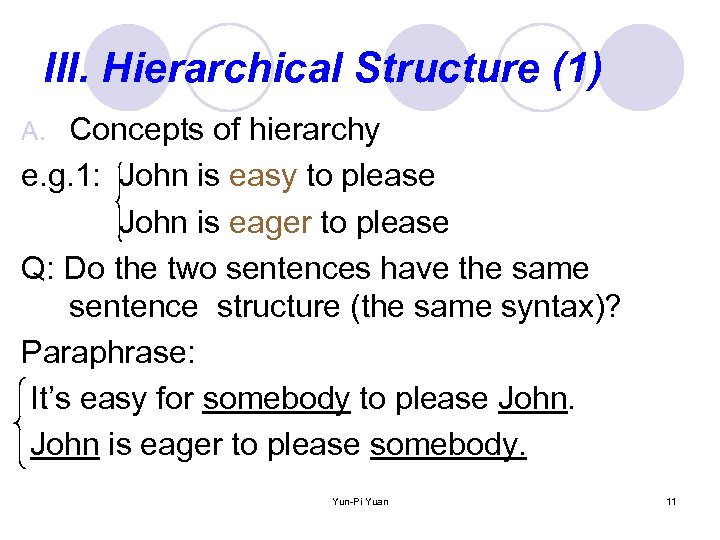 III. Hierarchical Structure (1) Concepts of hierarchy e. g. 1: John is easy to please John is eager to please Q: Do the two sentences have the same sentence structure (the same syntax)? Paraphrase: It’s easy for somebody to please John is eager to please somebody. A. Yun-Pi Yuan 11
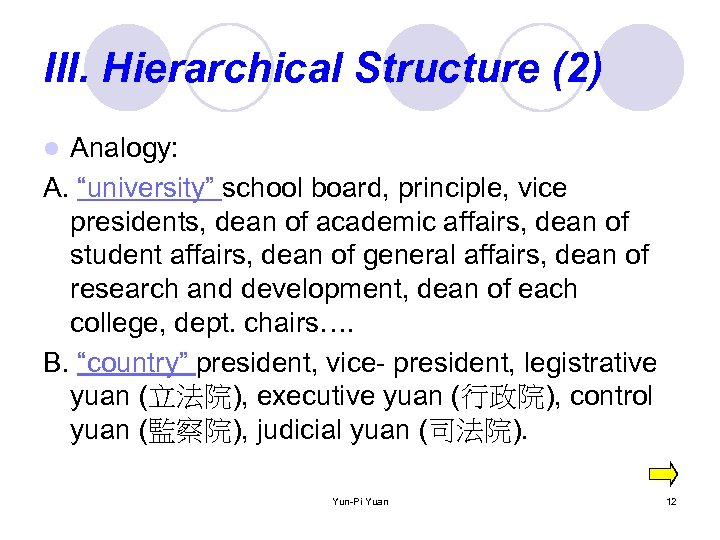 III. Hierarchical Structure (2) Analogy: A. “university” school board, principle, vice presidents, dean of academic affairs, dean of student affairs, dean of general affairs, dean of research and development, dean of each college, dept. chairs…. B. “country” president, vice- president, legistrative yuan (立法院), executive yuan (行政院), control yuan (監察院), judicial yuan (司法院). l Yun-Pi Yuan 12
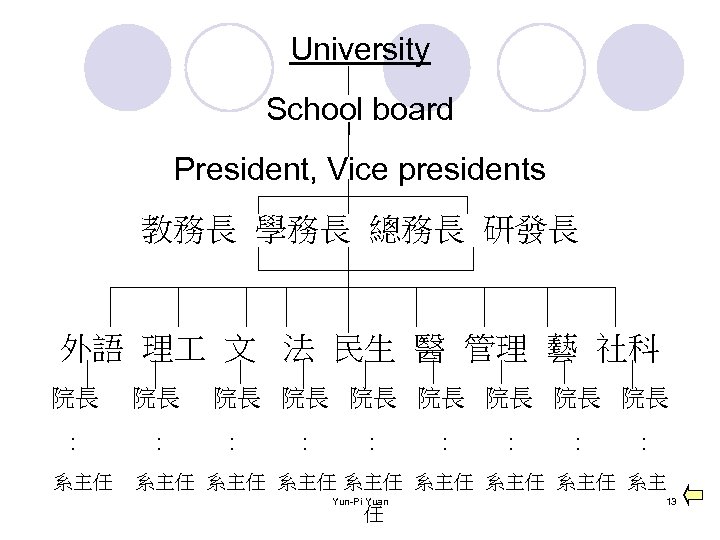 University School board President, Vice presidents 教務長 學務長 總務長 研發長 外語 理 文 法 民生 醫 管理 藝 社科 院長 院長 : : 系主任 院長 院長 : : 系主任 系主任 系主 Yun-Pi Yuan 任 13
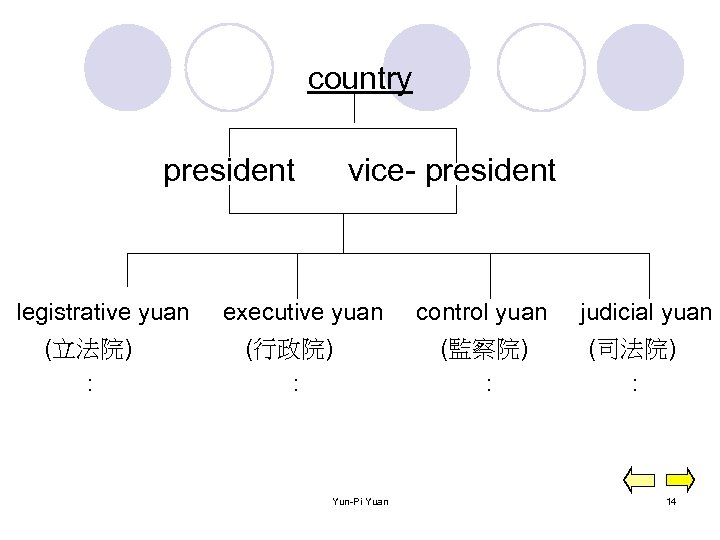 country president legistrative yuan (立法院) : vice- president executive yuan (行政院) : Yun-Pi Yuan control yuan (監察院) : judicial yuan (司法院) : 14
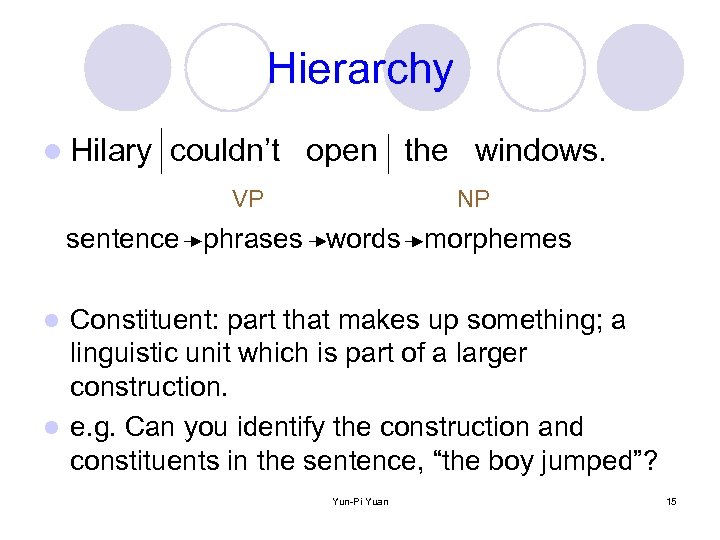 Hierarchy l Hilary couldn’t open the windows. VP NP sentence phrases words morphemes Constituent: part that makes up something; a linguistic unit which is part of a larger construction. l e. g. Can you identify the construction and constituents in the sentence, “the boy jumped”? l Yun-Pi Yuan 15
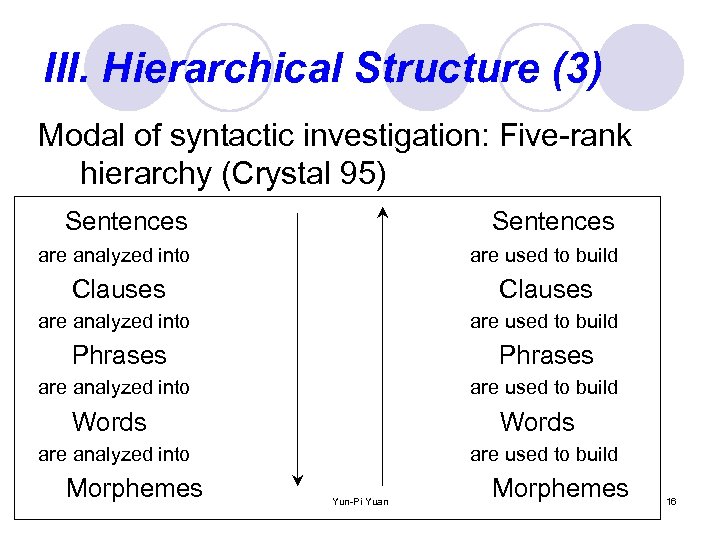 III. Hierarchical Structure (3) Modal of syntactic investigation: Five-rank hierarchy (Crystal 95) Sentences are analyzed into are used to build Clauses are analyzed into are used to build Phrases are analyzed into are used to build Words are analyzed into Morphemes are used to build Yun-Pi Yuan Morphemes 16
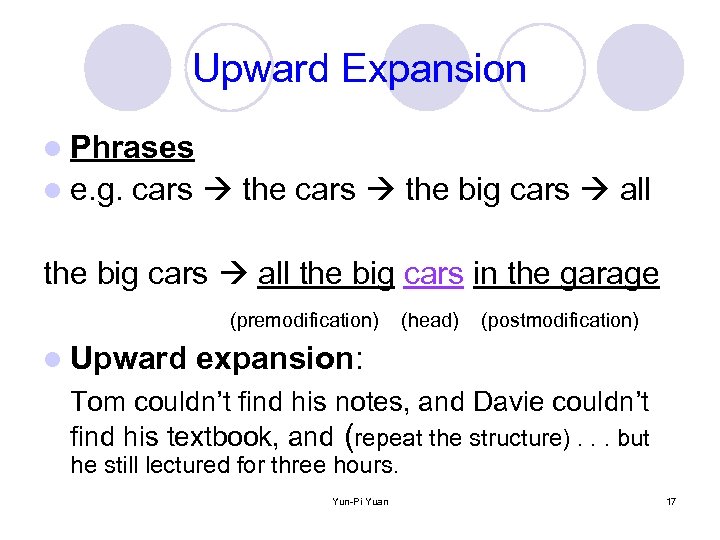 Upward Expansion l Phrases l e. g. cars the big cars all the big cars in the garage (premodification) l Upward (head) (postmodification) expansion: Tom couldn’t find his notes, and Davie couldn’t find his textbook, and (repeat the structure). . . but he still lectured for three hours. Yun-Pi Yuan 17
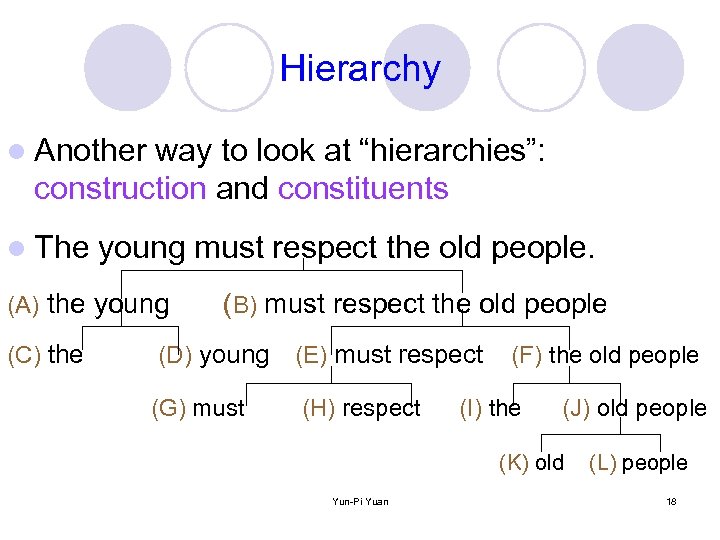 Hierarchy l Another way to look at “hierarchies”: construction and constituents l The young must respect the old people. (A) the young (C) the (B) must respect the old people (D) young (G) must (E) must respect (H) respect (F) the old people (I) the (J) old people (K) old Yun-Pi Yuan (L) people 18
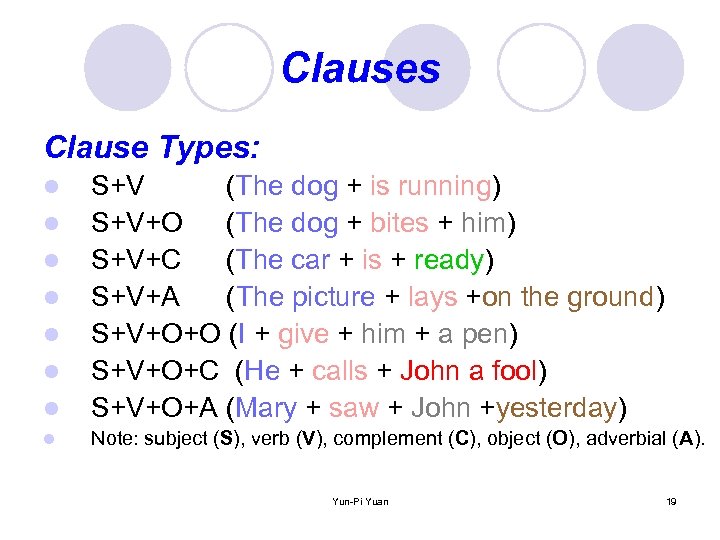 Clauses Clause Types: l S+V (The dog + is running) S+V+O (The dog + bites + him) S+V+C (The car + is + ready) S+V+A (The picture + lays +on the ground) S+V+O+O (I + give + him + a pen) S+V+O+C (He + calls + John a fool) S+V+O+A (Mary + saw + John +yesterday) l Note: subject (S), verb (V), complement (C), object (O), adverbial (A). l l l Yun-Pi Yuan 19
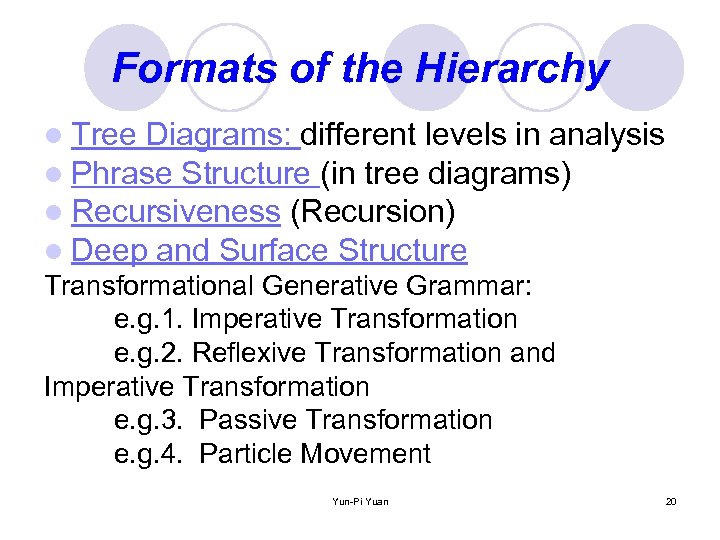 Formats of the Hierarchy l Tree Diagrams: different levels in analysis l Phrase Structure (in tree diagrams) l Recursiveness (Recursion) l Deep and Surface Structure Transformational Generative Grammar: e. g. 1. Imperative Transformation e. g. 2. Reflexive Transformation and Imperative Transformation e. g. 3. Passive Transformation e. g. 4. Particle Movement Yun-Pi Yuan 20
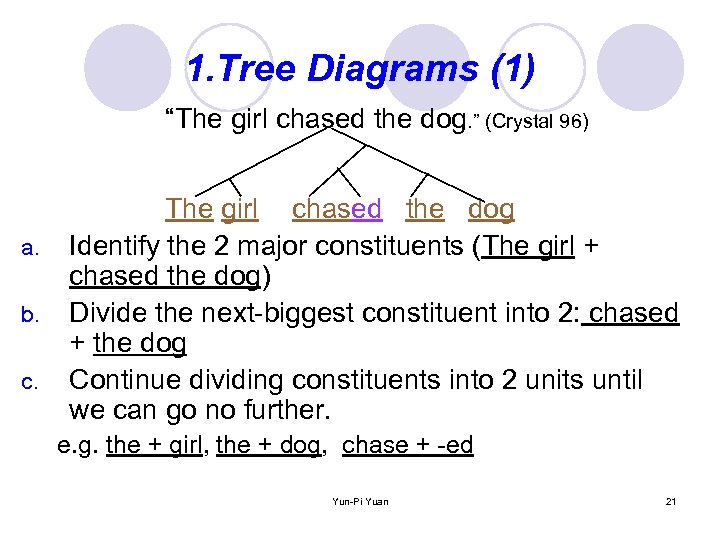 1. Tree Diagrams (1) “The girl chased the dog. ” (Crystal 96) a. b. c. The girl chased the dog Identify the 2 major constituents (The girl + chased the dog) Divide the next-biggest constituent into 2: chased + the dog Continue dividing constituents into 2 units until we can go no further. e. g. the + girl, the + dog, chase + -ed Yun-Pi Yuan 21
 1. Tree Diagrams (2) Tree Diagrams: Different levels in analysis l The tree diagram format may be viewed as: l a. b. A static representation of the structure of the sentence at the bottom of the diagram. A dynamic format, representing a way of “generating” a very large number of sentences with similar structures (by the use of phrase structure rules). Yun-Pi Yuan 22
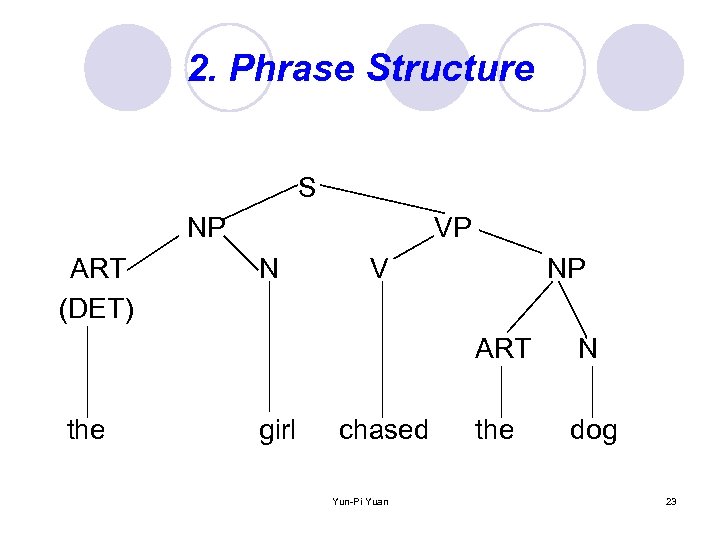 2. Phrase Structure S NP ART (DET) VP N V NP ART the girl chased Yun-Pi Yuan N the dog 23
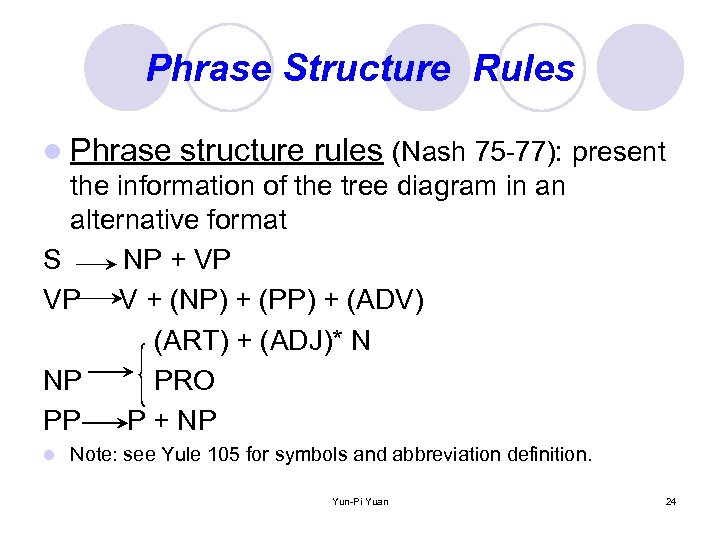 Phrase Structure Rules l Phrase structure rules (Nash 75 -77): present the information of the tree diagram in an alternative format S NP + VP VP V + (NP) + (PP) + (ADV) (ART) + (ADJ)* N NP PRO PP P + NP l Note: see Yule 105 for symbols and abbreviation definition. Yun-Pi Yuan 24
 3. Recursiveness (Recursion) Recursive rule: VP VS (Yule 107) e. g. : John said [ Cathy thought (Mary helped George)]. l Another e. g. of recursiveness The Rose in My Garden This is the rose in my garden. l This is the bee that sleeps on the rose in my garden. These are the holly hocks high above ground, that give shade to the bee that sleeps on the rose in my garden. Yun-Pi Yuan 25
 4. Deep and Surface Structure l Deep and surface structure: “the form of a sentence we produce and understand is very often not the same as the basic form which shows its meaning” (Nash 79) A. Deep Structure: the abstract, underlying level, but basic form of the sentence B. Surface Structure: the superficial, syntactic form that we produce in reality e. g. old men and women e. g. Annie whacked a man with an umbrella. (Yule 103) same surface structure form, two underlying interpretations (deep structures) Other examples: 1. Look! 2. *Help herself. 3. The runner broke the world record. Yun-Pi Yuan 26
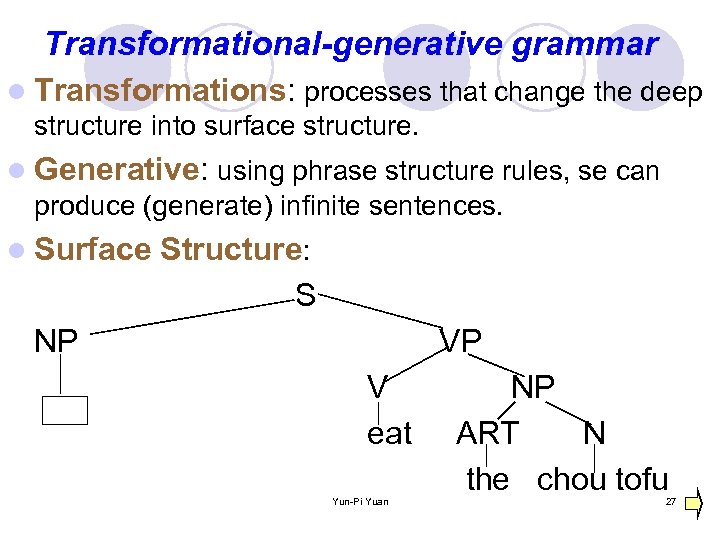 Transformational-generative grammar l Transformations: processes that change the deep structure into surface structure. l Generative: using phrase structure rules, se can produce (generate) infinite sentences. l Surface Structure: S NP VP V eat Yun-Pi Yuan NP ART N the chou tofu 27
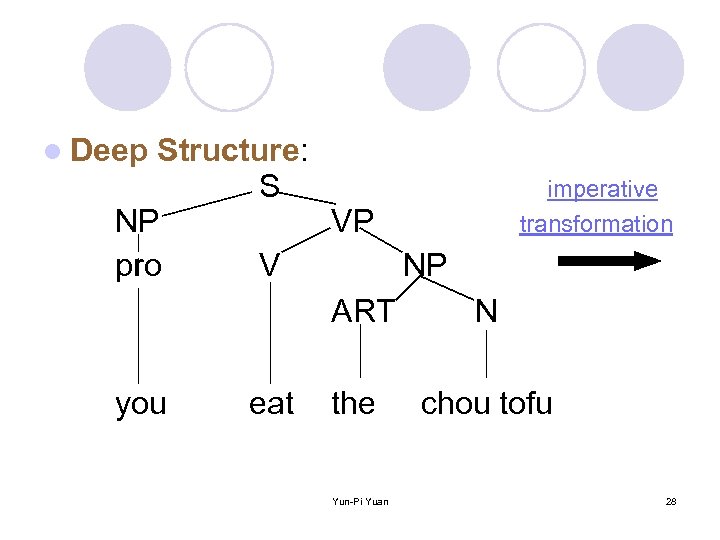 l Deep Structure: S NP VP pro V NP ART N you eat the Yun-Pi Yuan imperative transformation chou tofu 28
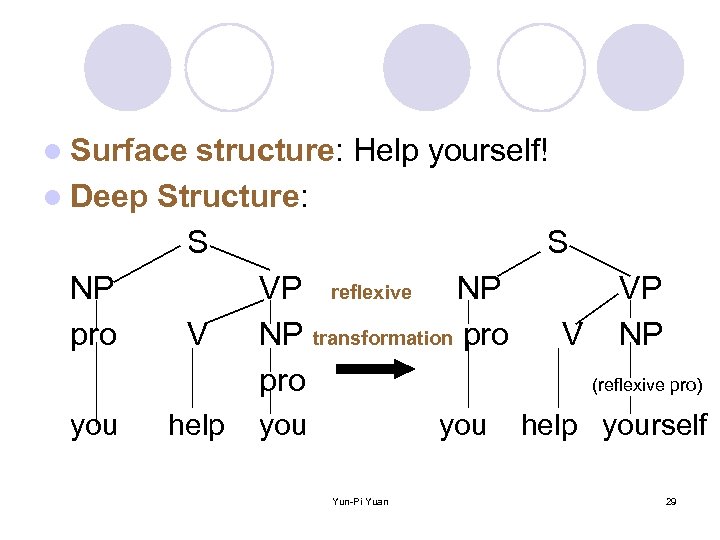 l Surface structure: Help yourself! l Deep Structure: S S NP VP reflexive NP VP pro V NP transformation pro V NP pro (reflexive pro) you help you Yun-Pi Yuan help yourself 29
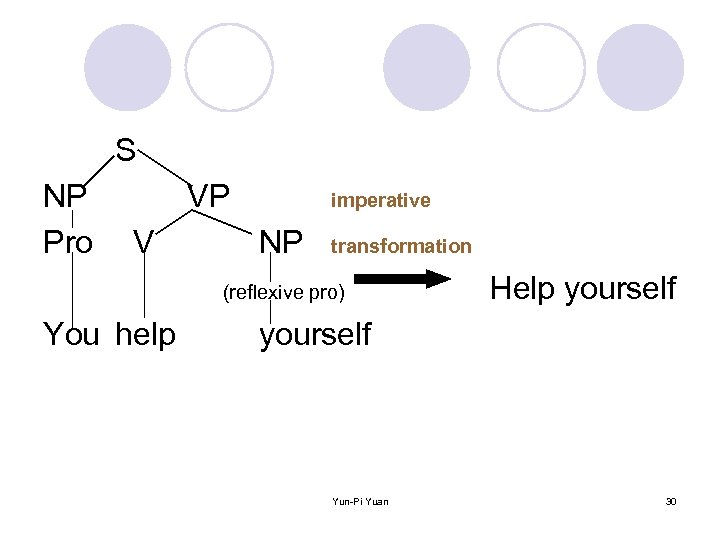 S NP Pro VP V imperative NP transformation (reflexive pro) You help Help yourself Yun-Pi Yuan 30
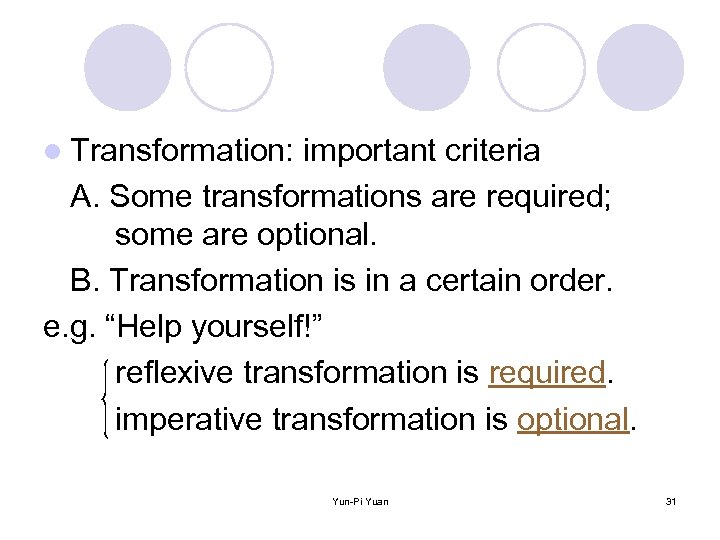 l Transformation: important criteria A. Some transformations are required; some are optional. B. Transformation is in a certain order. e. g. “Help yourself!” reflexive transformation is required. imperative transformation is optional. Yun-Pi Yuan 31
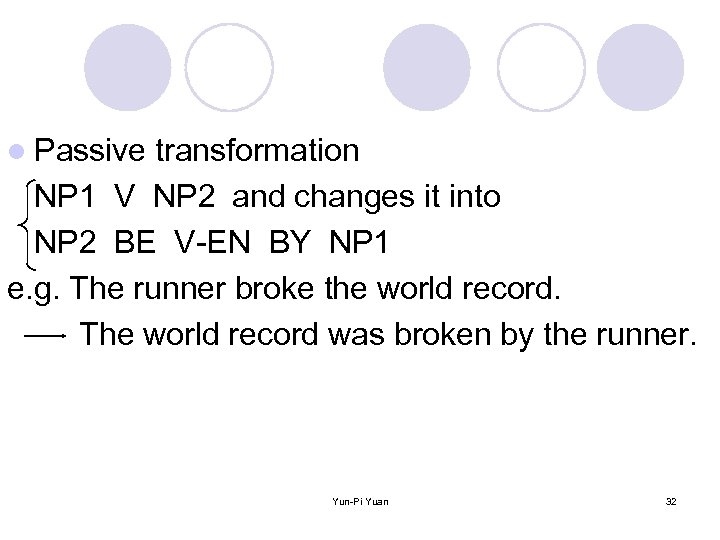 l Passive transformation NP 1 V NP 2 and changes it into NP 2 BE V-EN BY NP 1 e. g. The runner broke the world record. The world record was broken by the runner. Yun-Pi Yuan 32
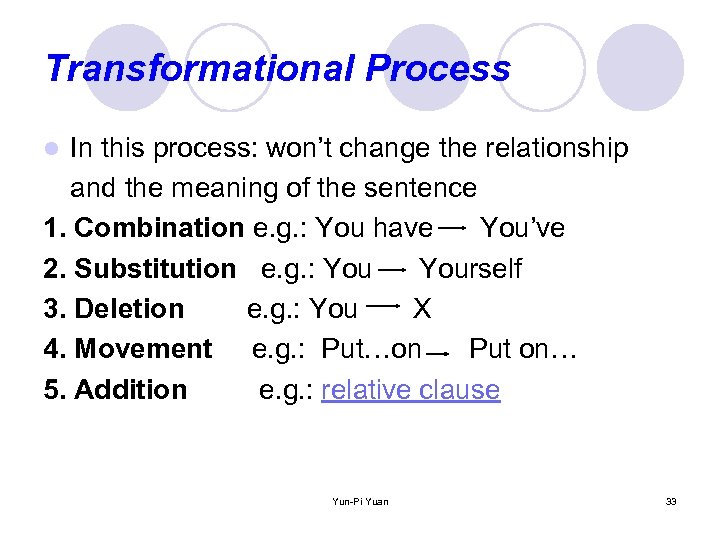 Transformational Process In this process: won’t change the relationship and the meaning of the sentence 1. Combination e. g. : You have You’ve 2. Substitution e. g. : Yourself 3. Deletion e. g. : You X 4. Movement e. g. : Put…on Put on… 5. Addition e. g. : relative clause l Yun-Pi Yuan 33
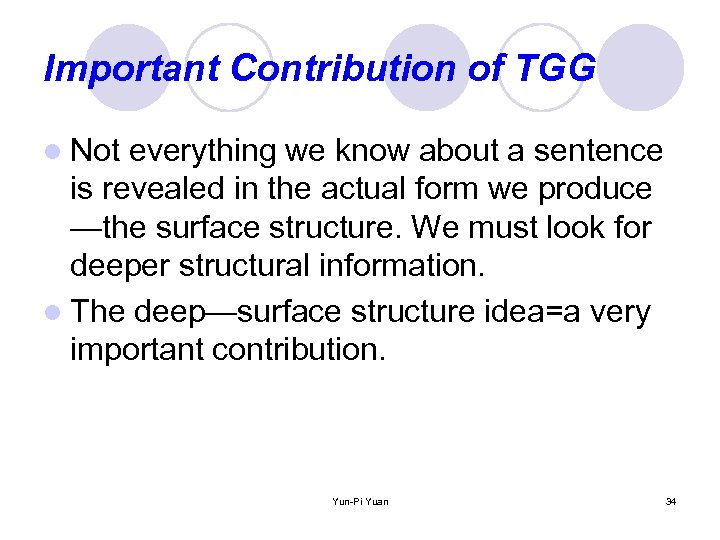 Important Contribution of TGG l Not everything we know about a sentence is revealed in the actual form we produce —the surface structure. We must look for deeper structural information. l The deep—surface structure idea=a very important contribution. Yun-Pi Yuan 34
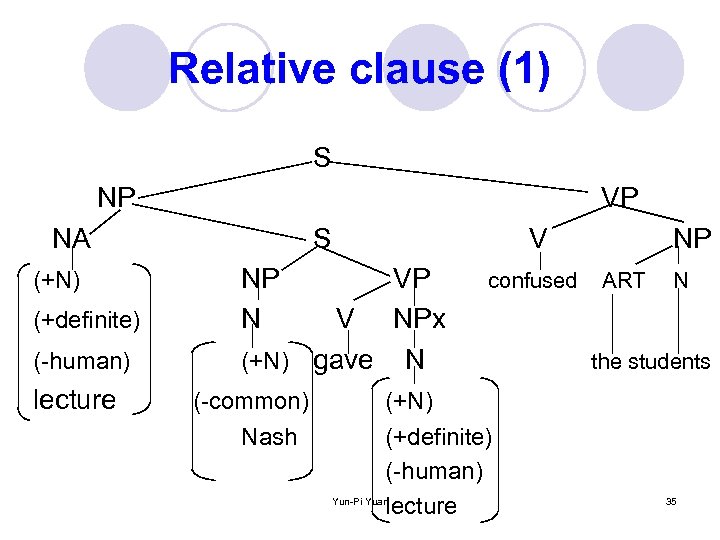 Relative clause (1) S NP VP NA (+N) (+definite) (-human) lecture S NP N V VP V NPx (+N) gave N (-common) Nash confused (+N) (+definite) (-human) Yun-Pi Yuan lecture NP ART N the students 35
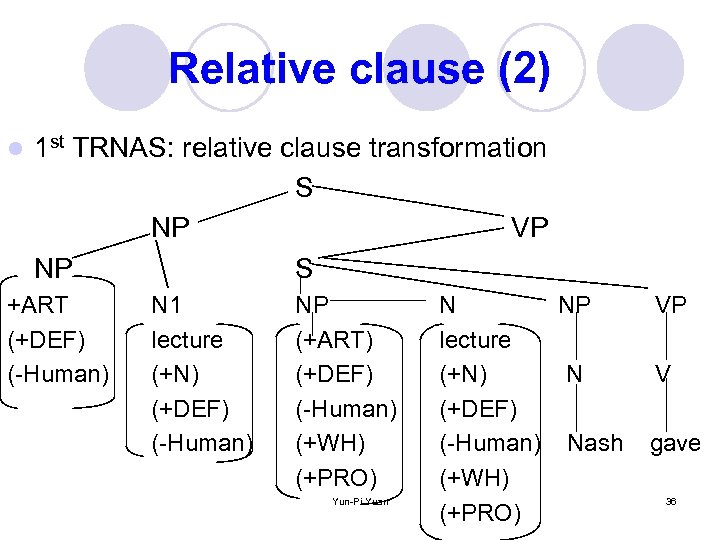 Relative clause (2) l 1 st TRNAS: relative clause transformation S NP VP NP S +ART (+DEF) (-Human) N 1 lecture (+N) (+DEF) (-Human) NP (+ART) (+DEF) (-Human) (+WH) (+PRO) Yun-Pi Yuan N NP lecture (+N) N (+DEF) (-Human) Nash (+WH) (+PRO) VP V gave 36
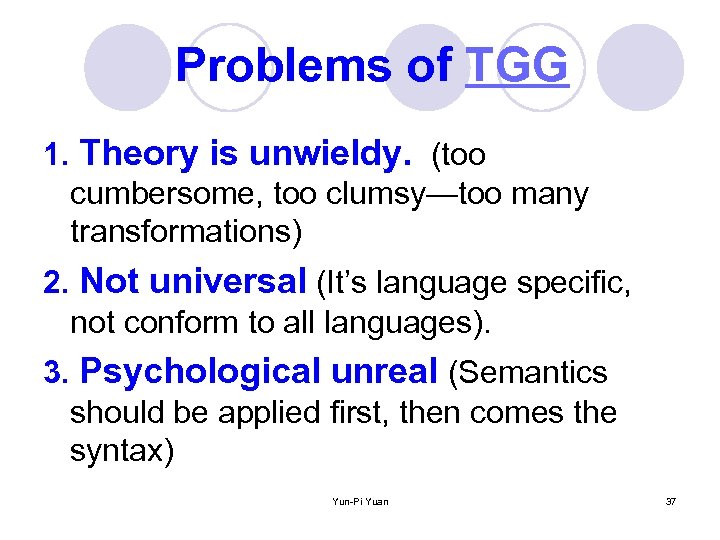 Problems of TGG 1. Theory is unwieldy. (too cumbersome, too clumsy—too many transformations) 2. Not universal (It’s language specific, not conform to all languages). 3. Psychological unreal (Semantics should be applied first, then comes the syntax) Yun-Pi Yuan 37
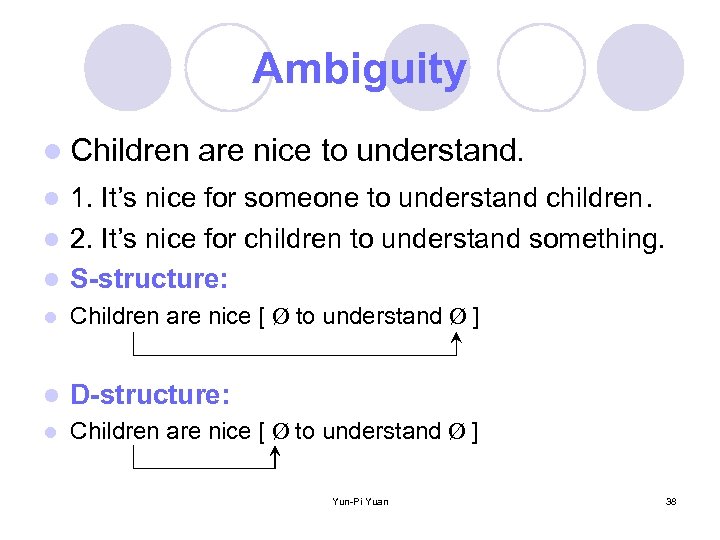 Ambiguity l Children are nice to understand. 1. It’s nice for someone to understand children. l 2. It’s nice for children to understand something. l S-structure: l l Children are nice [ Ø to understand Ø ] l D-structure: l Children are nice [ Ø to understand Ø ] Yun-Pi Yuan 38
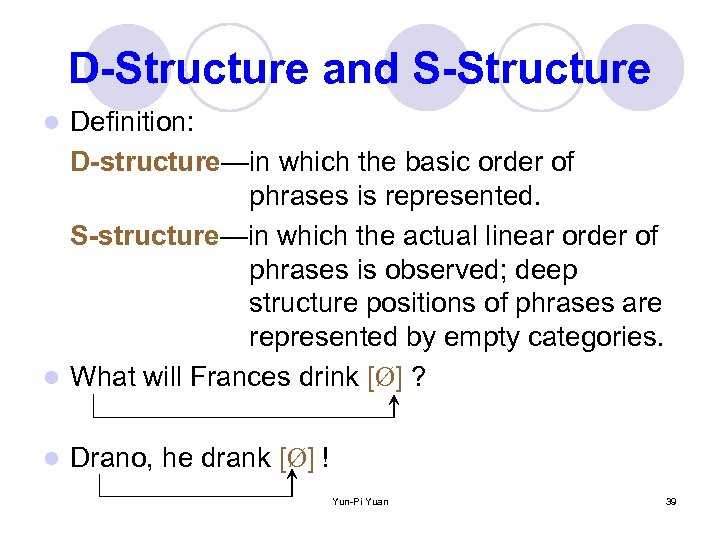 D-Structure and S-Structure Definition: D-structure—in which the basic order of phrases is represented. S-structure—in which the actual linear order of phrases is observed; deep structure positions of phrases are represented by empty categories. l What will Frances drink [Ø] ? l l Drano, he drank [Ø] ! Yun-Pi Yuan 39
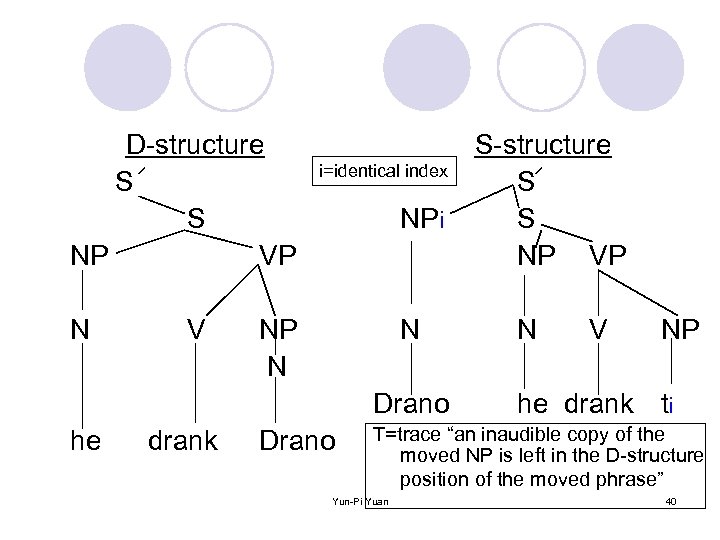 D-structure S S NP VP N V i=identical index NPi NP N N Drano he drank Drano S-structure S S NP VP N V NP he drank ti T=trace “an inaudible copy of the moved NP is left in the D-structure position of the moved phrase” Yun-Pi Yuan 40
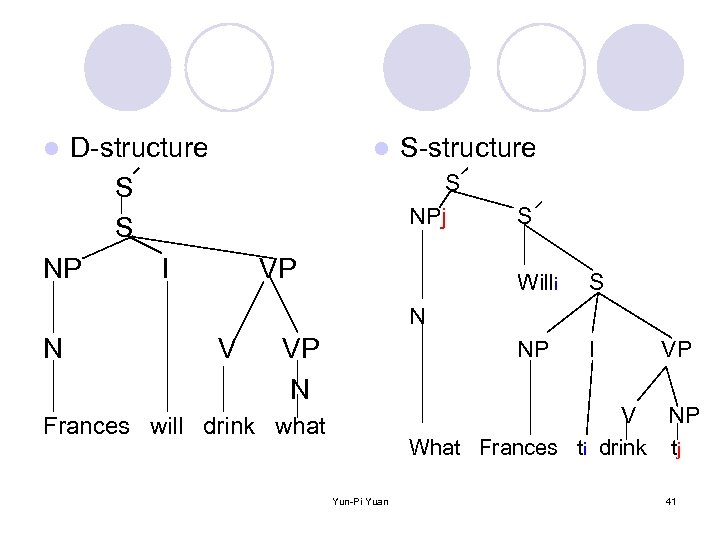 D-structure S S NP I l l S-structure S NPj VP S Willi S NP I N N V VP N VP V NP What Frances ti drink tj Frances will drink what Yun-Pi Yuan 41
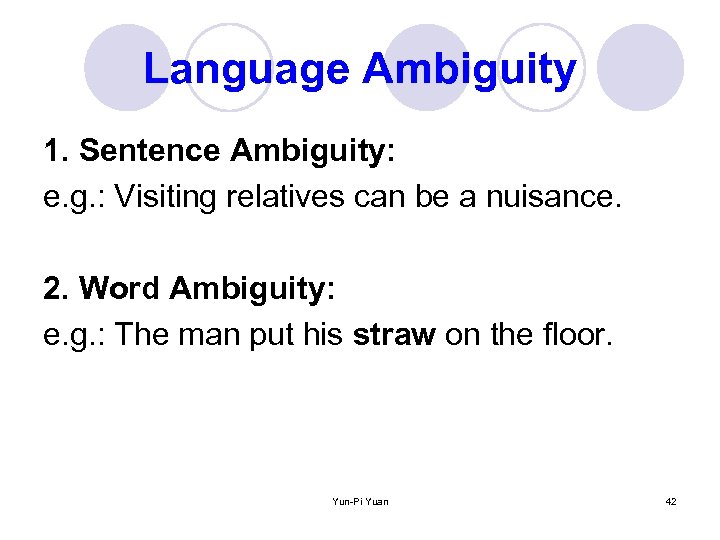 Language Ambiguity 1. Sentence Ambiguity: e. g. : Visiting relatives can be a nuisance. 2. Word Ambiguity: e. g. : The man put his straw on the floor. Yun-Pi Yuan 42
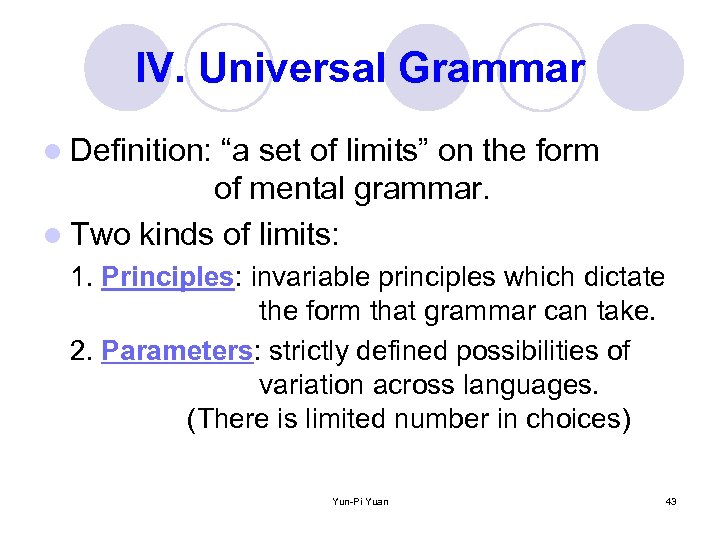 IV. Universal Grammar l Definition: “a set of limits” on the form of mental grammar. l Two kinds of limits: 1. Principles: invariable principles which dictate the form that grammar can take. 2. Parameters: strictly defined possibilities of variation across languages. (There is limited number in choices) Yun-Pi Yuan 43
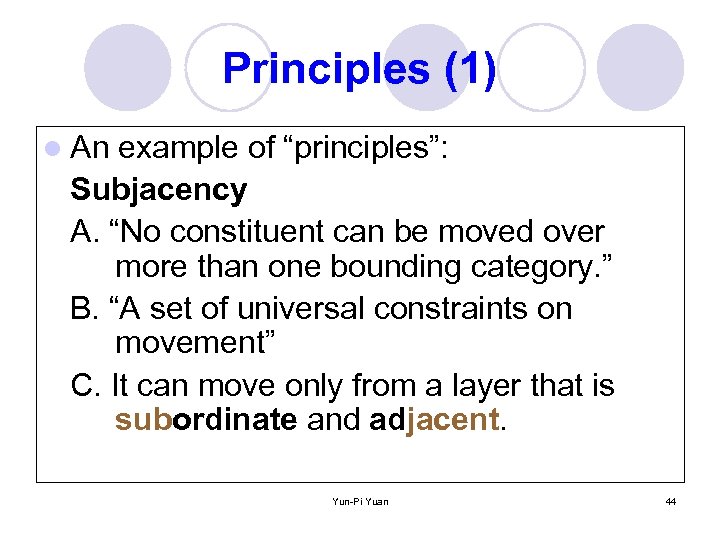 Principles (1) l An example of “principles”: Subjacency A. “No constituent can be moved over more than one bounding category. ” B. “A set of universal constraints on movement” C. It can move only from a layer that is subordinate and adjacent. Yun-Pi Yuan 44
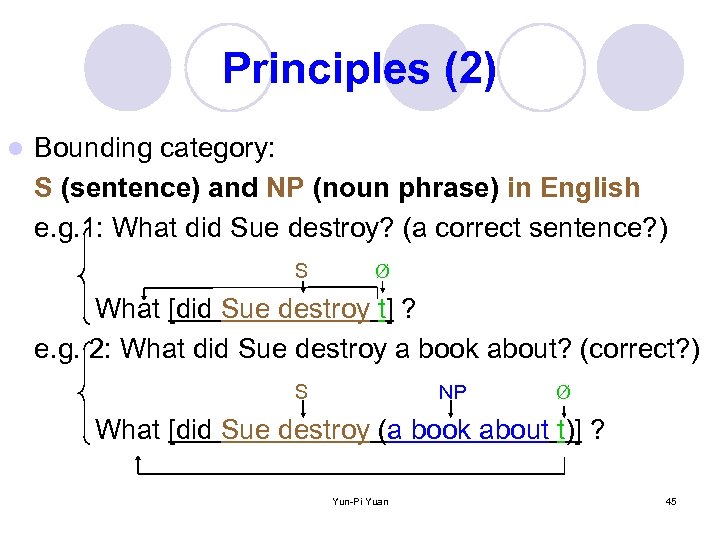 Principles (2) l Bounding category: S (sentence) and NP (noun phrase) in English e. g. 1: What did Sue destroy? (a correct sentence? ) S Ø What [did Sue destroy t] ? e. g. 2: What did Sue destroy a book about? (correct? ) S NP Ø What [did Sue destroy (a book about t)] ? Yun-Pi Yuan 45
![Principles (3) S [(That all of us but you were upset) is obvious. ]](https://present5.com/presentation/cc0eef14f9ca6df0ecb900b0dff9e2e3/image-46.jpg "Principles (3) S [(That all of us but you were upset) is obvious. ]") Principles (3) S [(That all of us but you were upset) is obvious. ] S [(That all of us were upset) but you is obvious. ] S S *[(That all of us were upset) is obvious] but you. Yun-Pi Yuan 46
Principles (3) S [(That all of us but you were upset) is obvious. ] S [(That all of us were upset) but you is obvious. ] S S *[(That all of us were upset) is obvious] but you. Yun-Pi Yuan 46
![Principles (4) S S [(John saw a horse) that kicked a box. ] S](https://present5.com/presentation/cc0eef14f9ca6df0ecb900b0dff9e2e3/image-47.jpg "Principles (4) S S [(John saw a horse) that kicked a box. ] S") Principles (4) S S [(John saw a horse) that kicked a box. ] S S *[(What did John see a horse) that kicked Ø]? S [What did John see a horse kick Ø? ] Yun-Pi Yuan 47
Principles (4) S S [(John saw a horse) that kicked a box. ] S S *[(What did John see a horse) that kicked Ø]? S [What did John see a horse kick Ø? ] Yun-Pi Yuan 47
 Parameters (1) l Definition: ¡ Any of the established limits within which something must operate. [dictionary definition] ¡ Strictly defined possibilities of variation across languages. ¡ A range of possibilities and languages choose within that range: every language must set its parameters. Yun-Pi Yuan 48
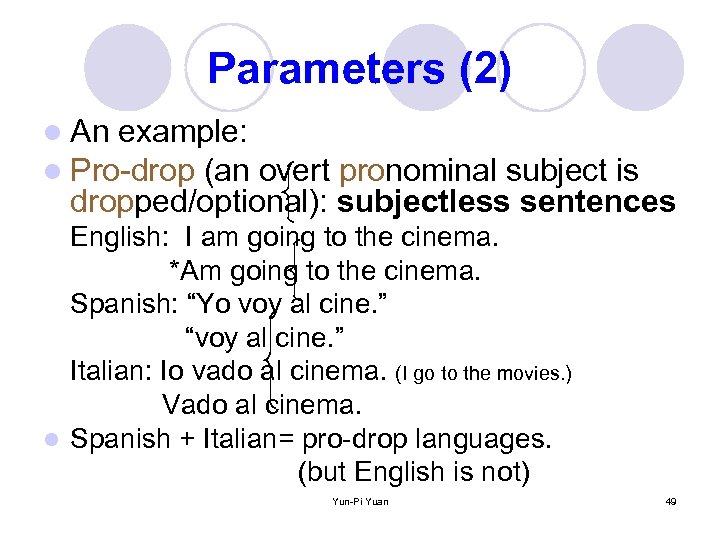 Parameters (2) l An example: l Pro-drop (an overt pronominal subject is dropped/optional): subjectless sentences English: I am going to the cinema. *Am going to the cinema. Spanish: “Yo voy al cine. ” “voy al cine. ” Italian: Io vado al cinema. (I go to the movies. ) Vado al cinema. l Spanish + Italian= pro-drop languages. (but English is not) Yun-Pi Yuan 49
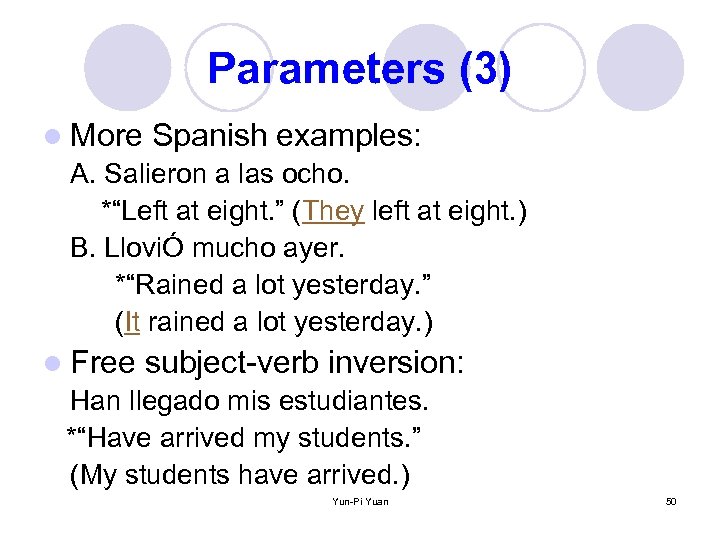 Parameters (3) l More Spanish examples: A. Salieron a las ocho. *“Left at eight. ” (They left at eight. ) B. LloviÓ mucho ayer. *“Rained a lot yesterday. ” (It rained a lot yesterday. ) l Free subject-verb inversion: Han llegado mis estudiantes. *“Have arrived my students. ” (My students have arrived. ) Yun-Pi Yuan 50
 Conclusion l UG: the ling. System involved rules too abstract and complex to be learned without the aid of innate knowledge about the nature of the system. . . The child is equipped with a set of blueprints that define and limit what a human language can be like. Yun-Pi Yuan 51
 l The child is assumed to be biologically equipped with knowledge of universal grammar—the basics of lang. structure. The child has blueprints for all the possible types of lang. in her head. In the course of lang. development she settles on the particular grammar of the lang. surrounding her. Yun-Pi Yuan 52
 l The primary role of UG in lang. development is to limit the hypotheses that a child can form concerning the rules of speech and ease with which lang. is learned. Yun-Pi Yuan 53