


 Скачать презентацию Syntactical Expressive Means Items for discussion q Compositional
18-04-2012_8_45_Lecture_4.ppt
- Количество слайдов: 19
 Syntactical Expressive Means Items for discussion: q Compositional patterns of syntactical arrangement q Particular ways of combining parts of the utterance q Particular use of colloquial constructions q Stylistic use of structural meaning
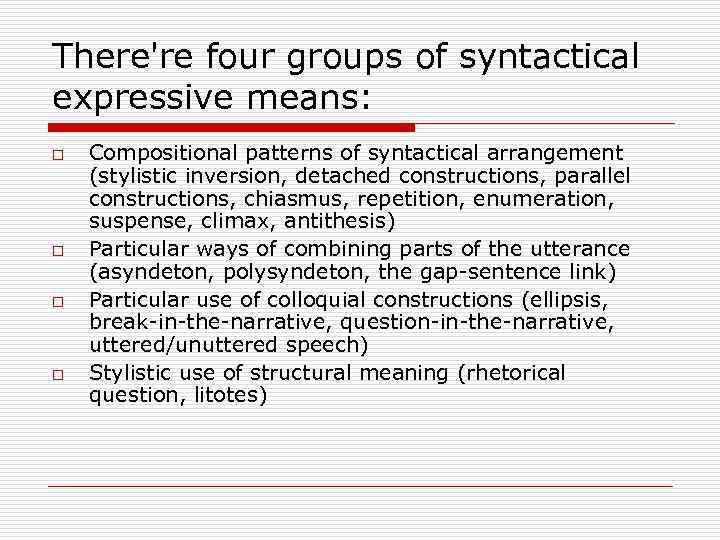 There're four groups of syntactical expressive means: o o Compositional patterns of syntactical arrangement (stylistic inversion, detached constructions, parallel constructions, chiasmus, repetition, enumeration, suspense, climax, antithesis) Particular ways of combining parts of the utterance (asyndeton, polysyndeton, the gap-sentence link) Particular use of colloquial constructions (ellipsis, break-in-the-narrative, question-in-the-narrative, uttered/unuttered speech) Stylistic use of structural meaning (rhetorical question, litotes)
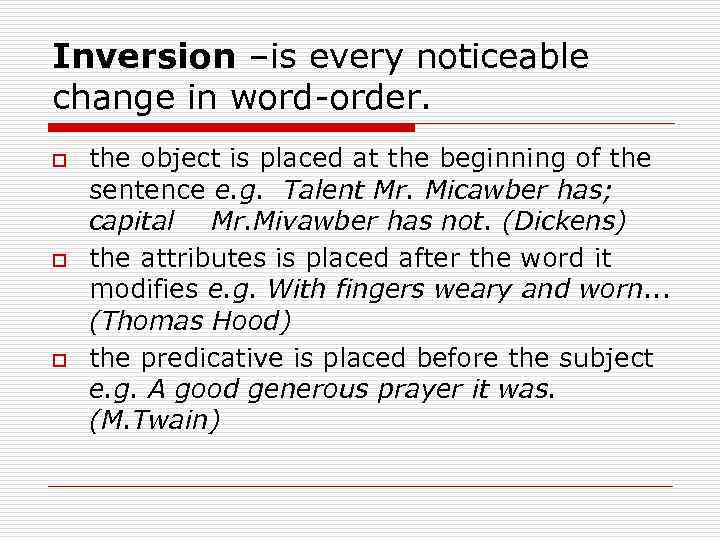 Inversion –is every noticeable change in word-order. o o o the object is placed at the beginning of the sentence e. g. Talent Mr. Micawber has; capital Mr. Mivawber has not. (Dickens) the attributes is placed after the word it modifies e. g. With fingers weary and worn. . . (Thomas Hood) the predicative is placed before the subject e. g. A good generous prayer it was. (M. Twain)
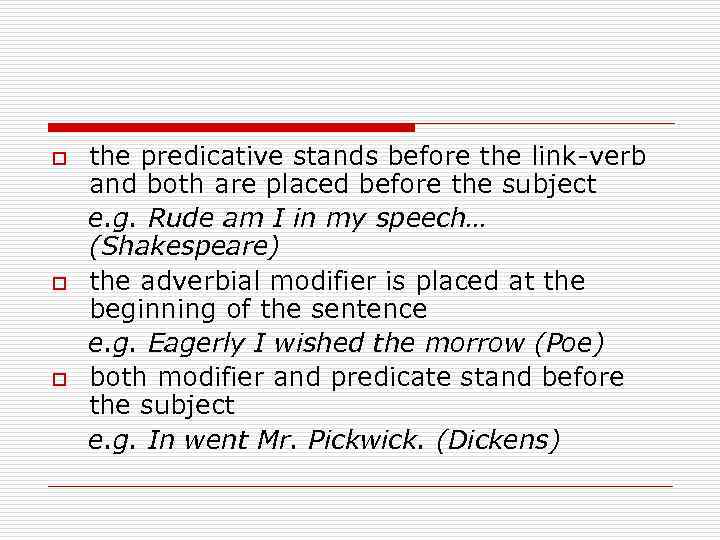 o o o the predicative stands before the link-verb and both are placed before the subject e. g. Rude am I in my speech… (Shakespeare) the adverbial modifier is placed at the beginning of the sentence e. g. Eagerly I wished the morrow (Poe) both modifier and predicate stand before the subject e. g. In went Mr. Pickwick. (Dickens)
 Detached construction is such a secondary part of a sentence which is placed so that it seems independent of the word it logically refers to. o o . E. g. Sir Pitt came in first, very much flushed, and rather unsteady in his gait. (Thackeray). E. g. And he walked slowly past again, along the river- an evening of clear, quiet beauty, all harmony and comfort, except within his heart. (Galsworthy)
 Parallel constructions are often backed up by repetition of words (lexical repetition) and conjunctions and prepositions (polysendeton) o E. g. It is the mob that labour in your fields and serve in your houses- that man your navy and recruit your army, that have enabled you to defy all the world, and can also defy you when neglect and calamity have driven them to despair. (Byron)
 Chiasmus/ Reversed Parallel Construction is based on the repetition of a syntactical pattern, but it has a cross order of words and phases. o E. g. "Nice to see you, nice!" (catchphrase of British TV entertainer Bruce Forsyth) You forget what you want to remember, and you remember what you want to forget. " (Cormac Mc. Carthy) o
 Repetition is a recurrence of the same word, word combination or phrase for two or more times. o o anaphora ( a repeated unit comes at the beginning of two or more consecutive sentences, clauses or phrases) e. g. I needed a drink, I needed a lot of life insurance, I needed a vacation, I needed a home in the country. What I had was a coat, a hat and a gun. " (Raymond Chandler) epiphora ( a repeated unit is placed at the end of consecutive sentences) e. g. "There is nothing wrong with America that cannot be cured by what is right with America. " (Bill Clinton)
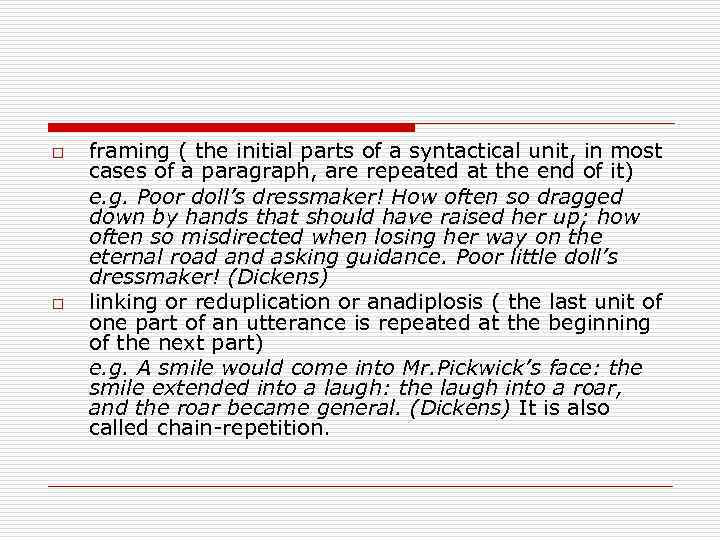 o o framing ( the initial parts of a syntactical unit, in most cases of a paragraph, are repeated at the end of it) e. g. Poor doll’s dressmaker! How often so dragged down by hands that should have raised her up; how often so misdirected when losing her way on the eternal road and asking guidance. Poor little doll’s dressmaker! (Dickens) linking or reduplication or anadiplosis ( the last unit of one part of an utterance is repeated at the beginning of the next part) e. g. A smile would come into Mr. Pickwick’s face: the smile extended into a laugh: the laugh into a roar, and the roar became general. (Dickens) It is also called chain-repetition.
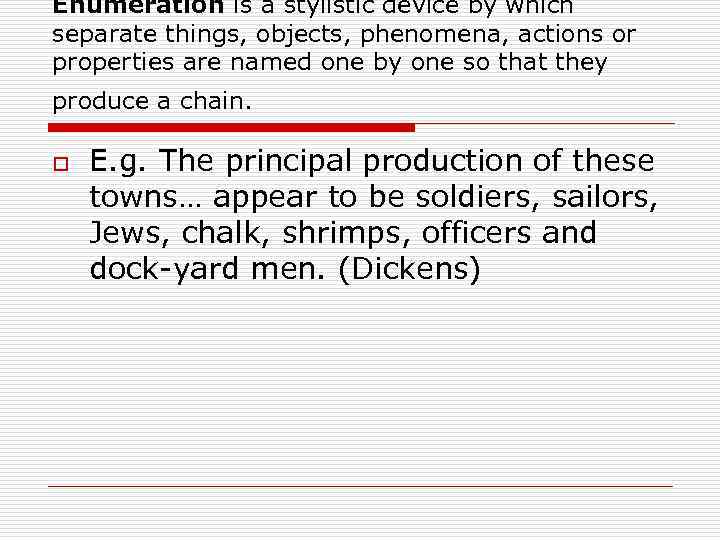 Enumeration is a stylistic device by which separate things, objects, phenomena, actions or properties are named one by one so that they produce a chain. o E. g. The principal production of these towns… appear to be soldiers, sailors, Jews, chalk, shrimps, officers and dock-yard men. (Dickens)
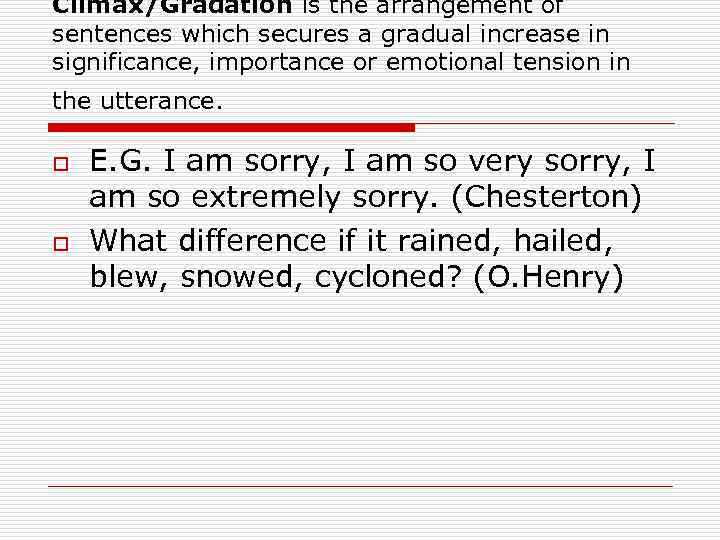 Climax/Gradation is the arrangement of sentences which secures a gradual increase in significance, importance or emotional tension in the utterance. o o E. G. I am sorry, I am so very sorry, I am so extremely sorry. (Chesterton) What difference if it rained, hailed, blew, snowed, cycloned? (O. Henry)
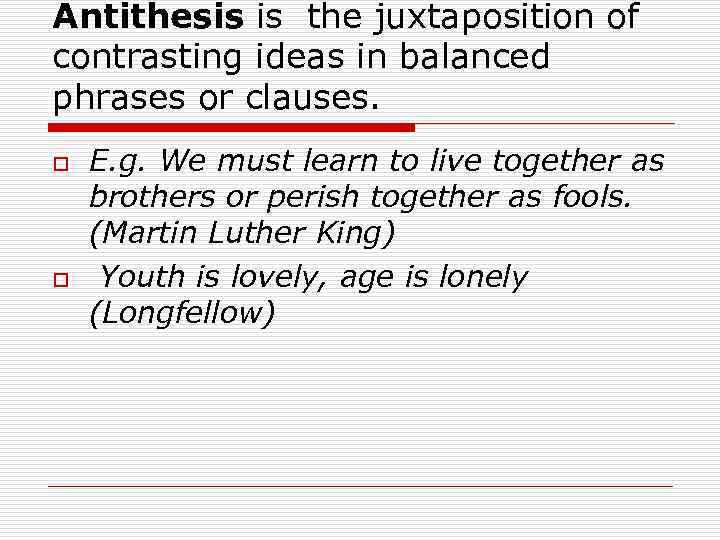 Antithesis is the juxtaposition of contrasting ideas in balanced phrases or clauses. o o E. g. We must learn to live together as brothers or perish together as fools. (Martin Luther King) Youth is lovely, age is lonely (Longfellow)
 Asyndeton is a deliberate omission of connectives between parts of sentences where they are generally expected to be according to the norms of the language. o E. g. Soams turned away; he had an utter disinclination to talk.
 Polysyndeton is the stylistic device of connecting sentences or phrases or words by using connectives before each component. o E. g. The heaviest rain, and snow, and hail, and sleet, could boast of the advantage over him in only one respect. (Dickens)
 The Gap-Sentence Link (GSL) is a peculiar type of connection of sentences in which the connection is not immediately seen and it requires an effort to grasp the interrelation between the parts of the utterance. o E. g. She and that fellow ought to be the sufferers, and they are in Italy.
 Ellipsis is an intentional omission of any part of a sentence (the subject, the predicate or any other principal parts). q E. g. Were they interesting books? Don’t know. Haven’t read them. Looked pretty hopeless. (Christie)
 Break-in-the-Narrative (Aposiopesis) serves to convey to the reader a very strong upsurge of emotions. o E. g. You just come home or I’ll…
 Rhetorical questions q E. g. Have I not had to wrestle with my lot? (Byron)
 Litotes is a figure of speech consisting of an understatement in which an affirmative is expressed by negating its opposite. o o . E. g. It is not bad. He is no coward.