


 Скачать презентацию Synoptic I ATMS 410 Tropical
fc0646ab951a69b1684e867de567ec1e.ppt
- Количество слайдов: 56
 Synoptic I – ATMS 410 • Tropical & Extratropical Oscillations (LP#3) – Intertropical convergence zone – Oscillations – Description of atmospheric oscillations
 Synoptic I – ATMS 410 http: //data 2. collectionscanada. ca/ap/a/a 051546. jpg • Introduction – Up to now we have looked at latitudinal averages • Assume changes across the latitudes are more significant than changes across longitude average
 Synoptic I – ATMS 410 • Introduction – In this section of the course, we’ll explore atmospheric changes across lines of longitude http: //www. photos. org. au/userimages/user 756_1157947541. jpg
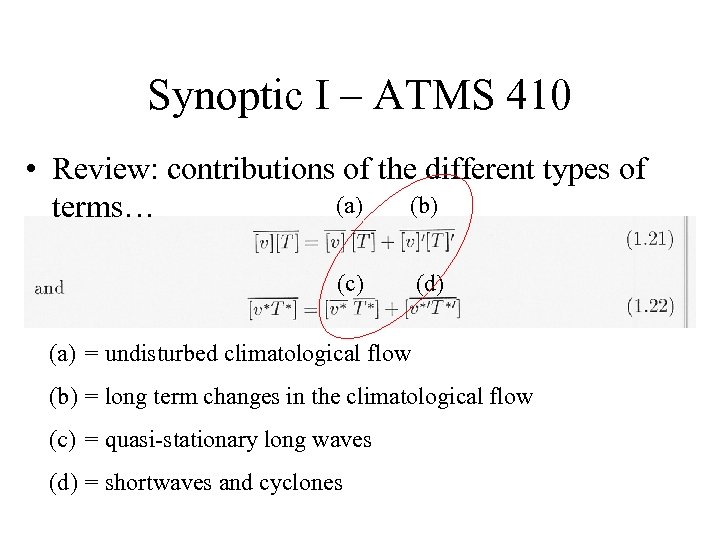 Synoptic I – ATMS 410 • Review: contributions of the different types of (a) (b) terms… (c) (d) (a) = undisturbed climatological flow (b) = long term changes in the climatological flow (c) = quasi-stationary long waves (d) = shortwaves and cyclones
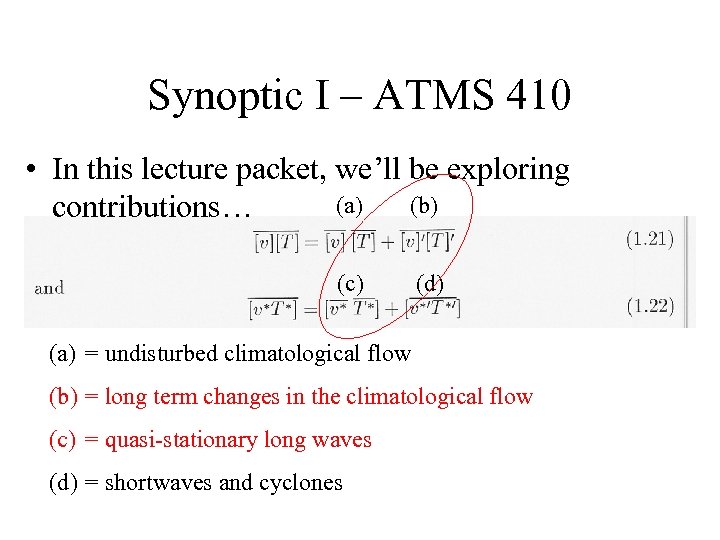 Synoptic I – ATMS 410 • In this lecture packet, we’ll be exploring (a) (b) contributions… (c) (d) (a) = undisturbed climatological flow (b) = long term changes in the climatological flow (c) = quasi-stationary long waves (d) = shortwaves and cyclones
 Synoptic I – ATMS 410 • Purpose – To begin to understand how a better understanding of oscillations across the globe might improve our ability to forecast in the mid-latitudes http: //www. physics. pomona. edu/faculty/STAFF/HALEY/Lecture%20 Demonstrations/TOC 2. htm
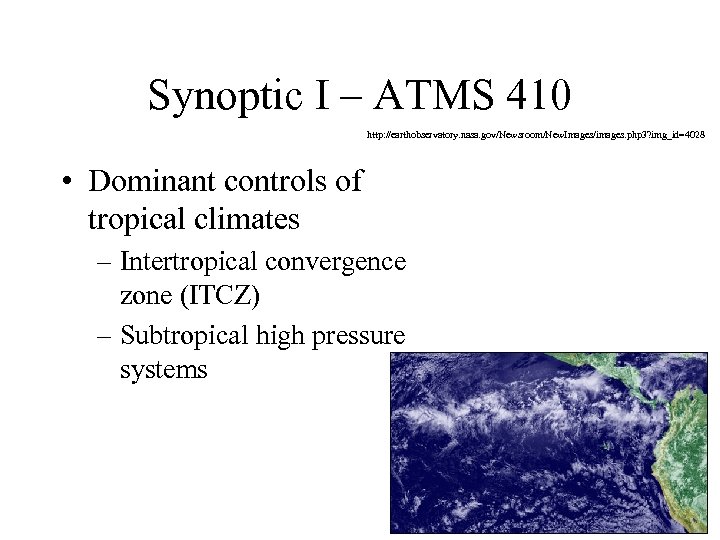 Synoptic I – ATMS 410 http: //earthobservatory. nasa. gov/Newsroom/New. Images/images. php 3? img_id=4028 • Dominant controls of tropical climates – Intertropical convergence zone (ITCZ) – Subtropical high pressure systems
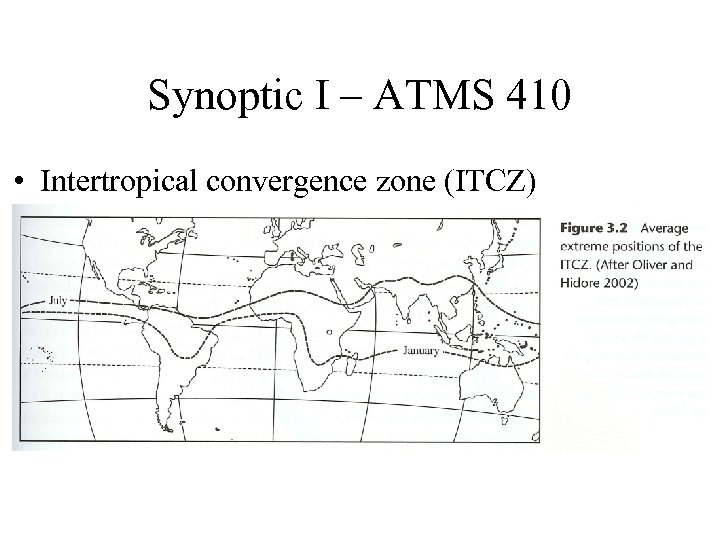 Synoptic I – ATMS 410 • Intertropical convergence zone (ITCZ) – East-west oriented low pressure region at the surface located near the equator – Position varies seasonally • Migration over land is greater than that over the ocean
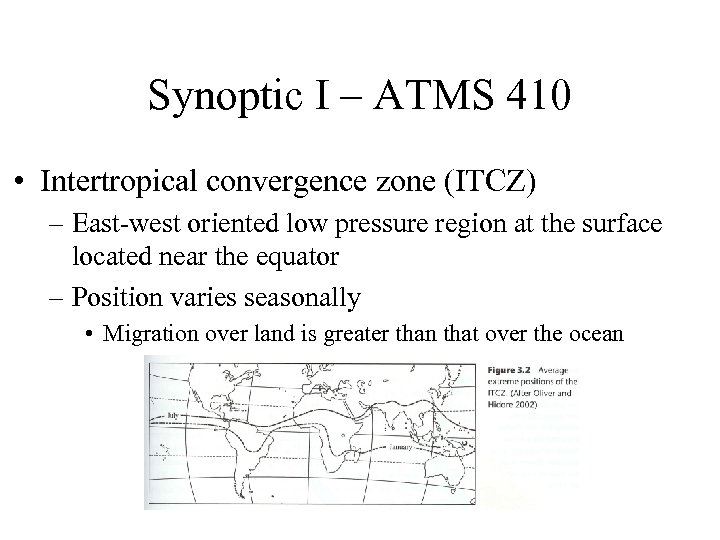 Synoptic I – ATMS 410 • Intertropical convergence zone (ITCZ) – East-west oriented low pressure region at the surface located near the equator – Position varies seasonally • Migration over land is greater than that over the ocean
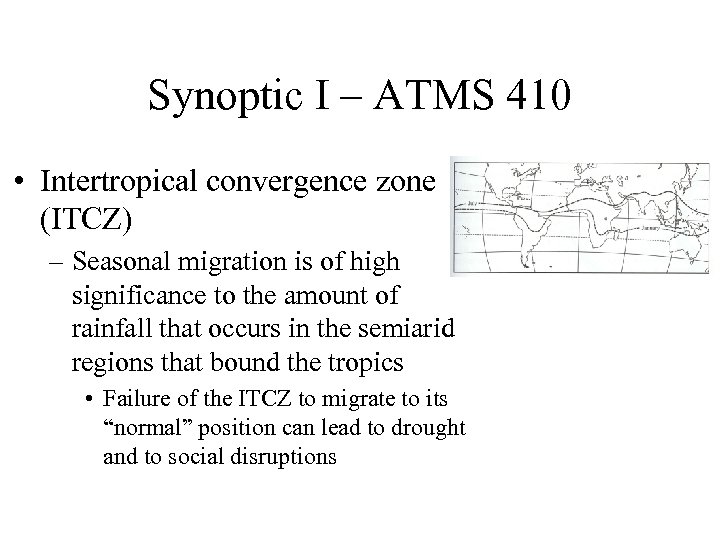 Synoptic I – ATMS 410 • Intertropical convergence zone (ITCZ) – Seasonal migration is of high significance to the amount of rainfall that occurs in the semiarid regions that bound the tropics • Failure of the ITCZ to migrate to its “normal” position can lead to drought and to social disruptions
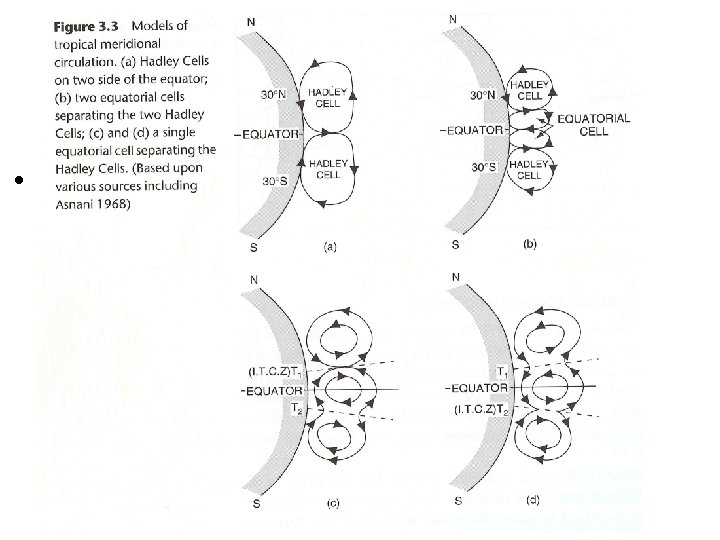 Synoptic I – ATMS 410 • Intertropical convergence zone (ITCZ) – Formation is thought to be tied to the ascending branch between the Hadley Cells – Oscillations can exert a significant influence on the strength and location of the ITCZ
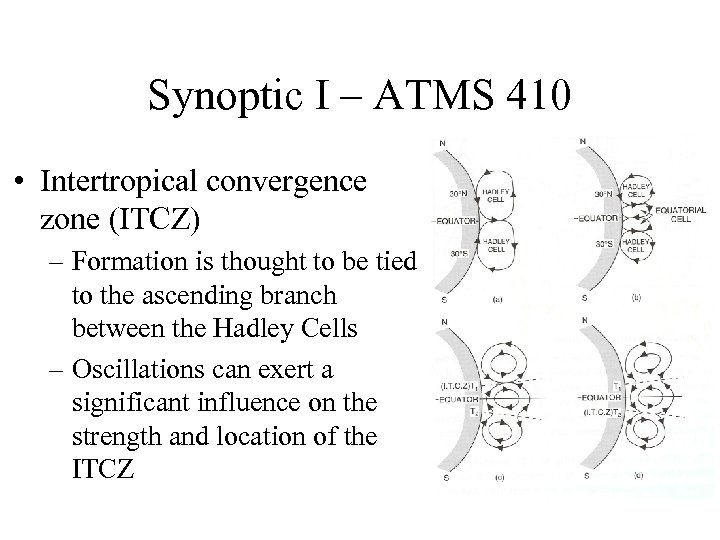 Synoptic I – ATMS 410 • Intertropical convergence zone (ITCZ) – Formation is thought to be tied to the ascending branch between the Hadley Cells – Oscillations can exert a significant influence on the strength and location of the ITCZ
 Synoptic I – ATMS 410 • Definition; oscillation – Any phenomenon that tends to vary above or below a mean value in some sort of periodic way • Occurs when a system is disturbed from a position of stable equilibrium – If an oscillation has a recognized periodicity, then it may be called a cycle (occurs rarely in the atmosphere) • Can exploit periodicity to make forecasts
 Synoptic I – ATMS 410 • Types of oscillations – Damped • Constantly decreasing amplitude – Unstable • Growing amplitude, then breaking down – Neutral, persistent or undamped • Maintains constant amplitude – Forced oscillation • External forces initiates and maintains it – Free oscillation • External force initiates it
 Synoptic I – ATMS 410 • Examples of atmospheric oscillations – Southern Oscillation (SO) – North Atlantic Oscillation (NAO) – North Pacific Oscillation (NPO)/ Pacific Decadal Oscillation (PDO) – Madden-Julian Oscillation (MJO) – Quasi-biennial Oscillation (QBO) – Pacific North American Oscillation (PNA) – Arctic Oscillation (AO) – Antarctic Oscillation (AAO)
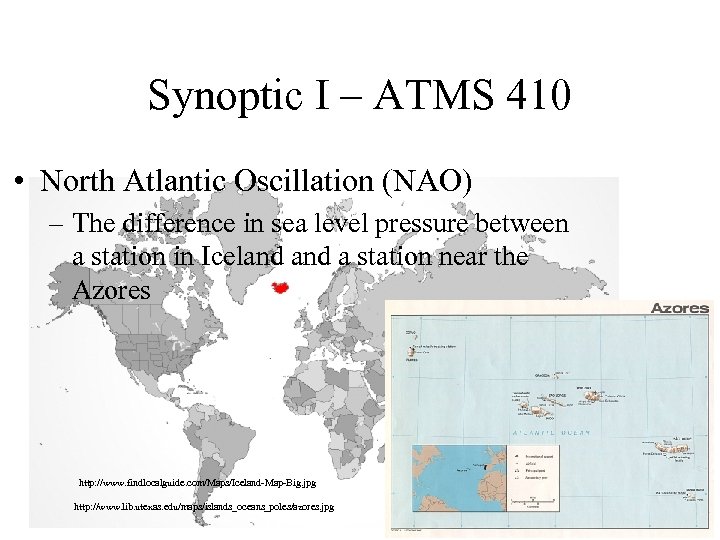 Synoptic I – ATMS 410 • North Atlantic Oscillation (NAO) – The difference in sea level pressure between a station in Iceland a station near the Azores http: //www. findlocalguide. com/Maps/Iceland-Map-Big. jpg http: //www. lib. utexas. edu/maps/islands_oceans_poles/azores. jpg
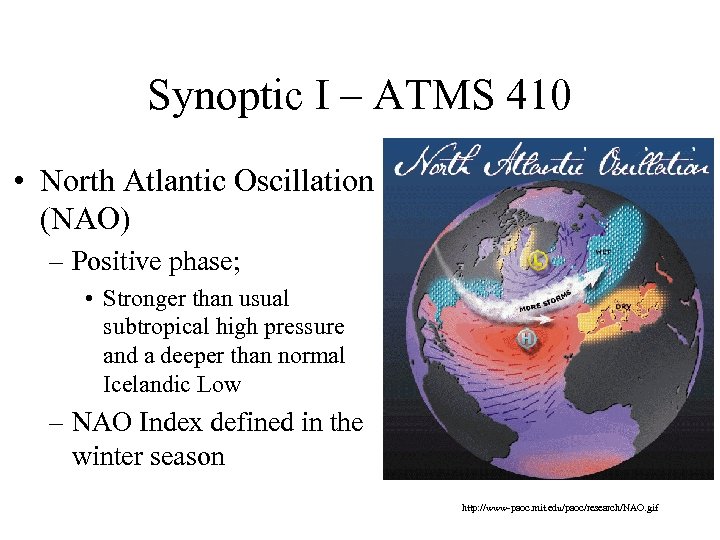 Synoptic I – ATMS 410 • North Atlantic Oscillation (NAO) – Positive phase; • Stronger than usual subtropical high pressure and a deeper than normal Icelandic Low – NAO Index defined in the winter season http: //www-paoc. mit. edu/paoc/research/NAO. gif
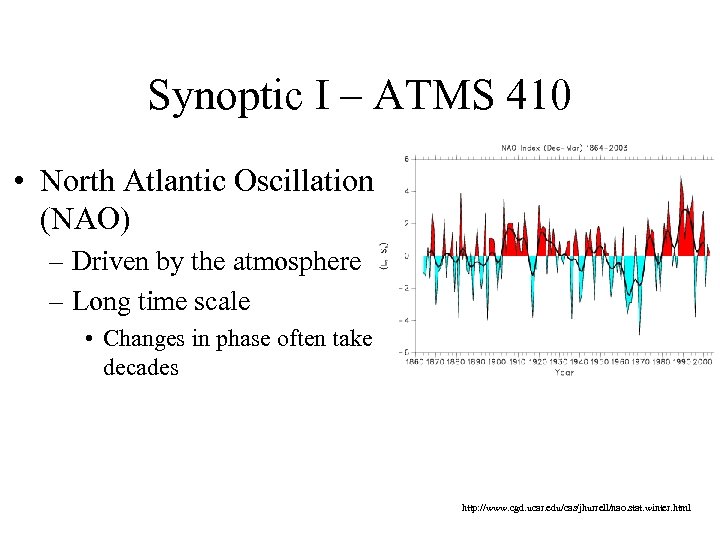 Synoptic I – ATMS 410 • North Atlantic Oscillation (NAO) – Driven by the atmosphere – Long time scale • Changes in phase often take decades http: //www. cgd. ucar. edu/cas/jhurrell/nao. stat. winter. html
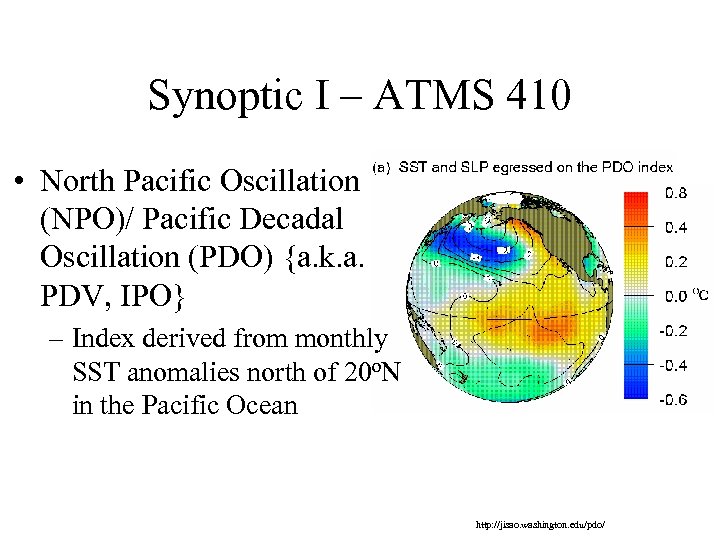 Synoptic I – ATMS 410 • North Pacific Oscillation (NPO)/ Pacific Decadal Oscillation (PDO) {a. k. a. PDV, IPO} – Index derived from monthly SST anomalies north of 20 o. N in the Pacific Ocean http: //jisao. washington. edu/pdo/
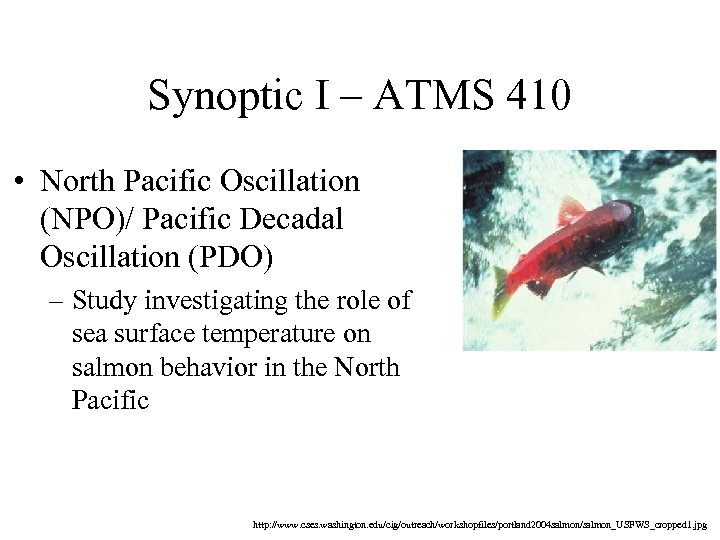 Synoptic I – ATMS 410 • North Pacific Oscillation (NPO)/ Pacific Decadal Oscillation (PDO) – Study investigating the role of sea surface temperature on salmon behavior in the North Pacific http: //www. cses. washington. edu/cig/outreach/workshopfiles/portland 2004 salmon/salmon_USFWS_cropped 1. jpg
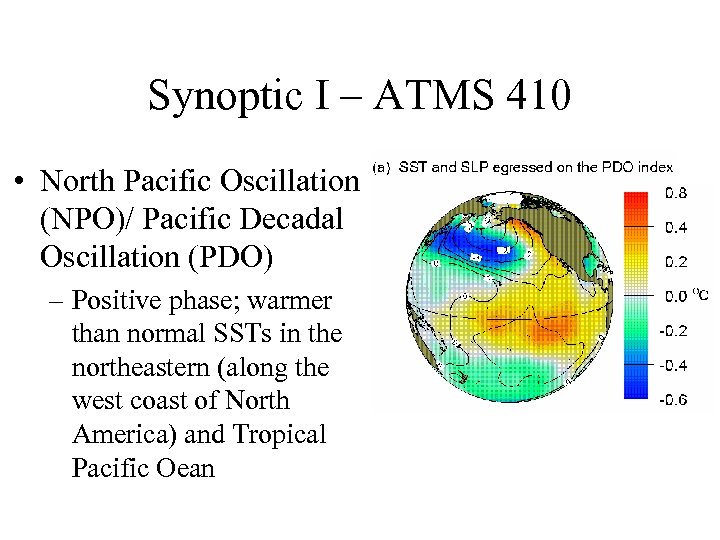 Synoptic I – ATMS 410 • North Pacific Oscillation (NPO)/ Pacific Decadal Oscillation (PDO) – Positive phase; warmer than normal SSTs in the northeastern (along the west coast of North America) and Tropical Pacific Oean
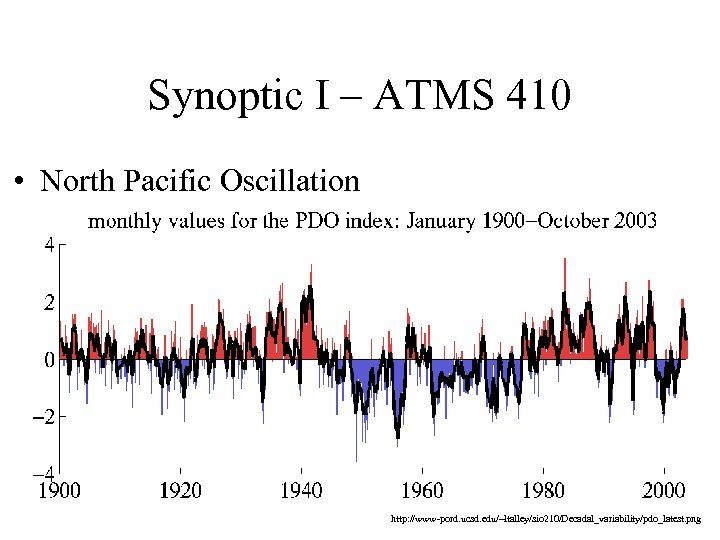 Synoptic I – ATMS 410 • North Pacific Oscillation (NPO)/ Pacific Decadal Oscillation (PDO) {a. k. a. PDV, IPO} – Positive phase; northwest SST anomalies are negative, eastern tropical Pacific Ocean anomalies are positive http: //www-pord. ucsd. edu/~ltalley/sio 210/Decadal_variability/pdo_latest. png
 Synoptic I – ATMS 410 • North Pacific Oscillation (NPO)/ Pacific Decadal Oscillation (PDO) – Represented by a shift of SST that occurs on a 20 to 30 year cycle – There have been just two full PDO cycles in the last 100 years http: //www-pord. ucsd. edu/~ltalley/sio 210/Decadal_variability/pdo_latest. png
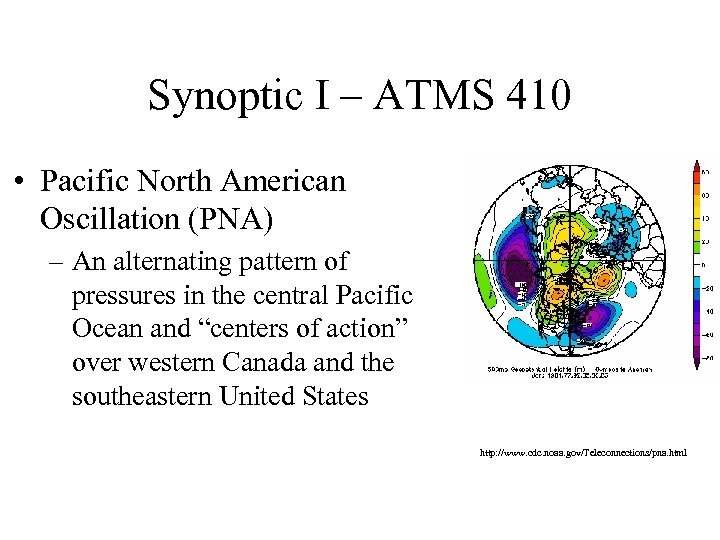 Synoptic I – ATMS 410 • Pacific North American Oscillation (PNA) – An alternating pattern of pressures in the central Pacific Ocean and “centers of action” over western Canada and the southeastern United States http: //www. cdc. noaa. gov/Teleconnections/pna. html
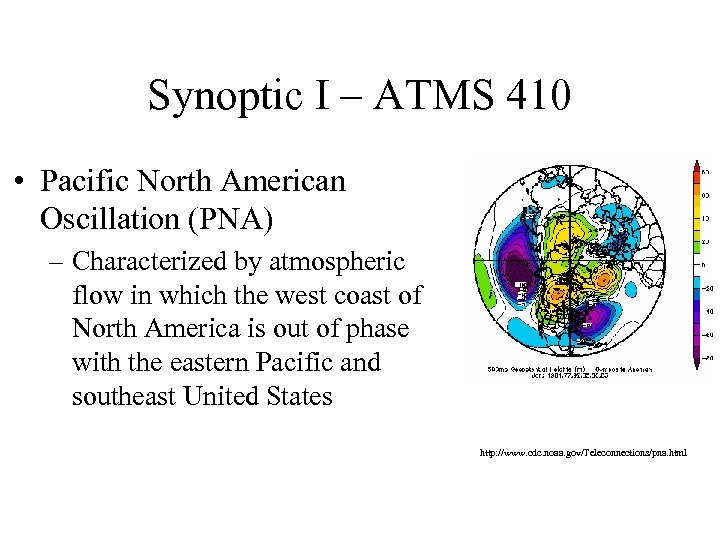 Synoptic I – ATMS 410 • Pacific North American Oscillation (PNA) – Characterized by atmospheric flow in which the west coast of North America is out of phase with the eastern Pacific and southeast United States http: //www. cdc. noaa. gov/Teleconnections/pna. html
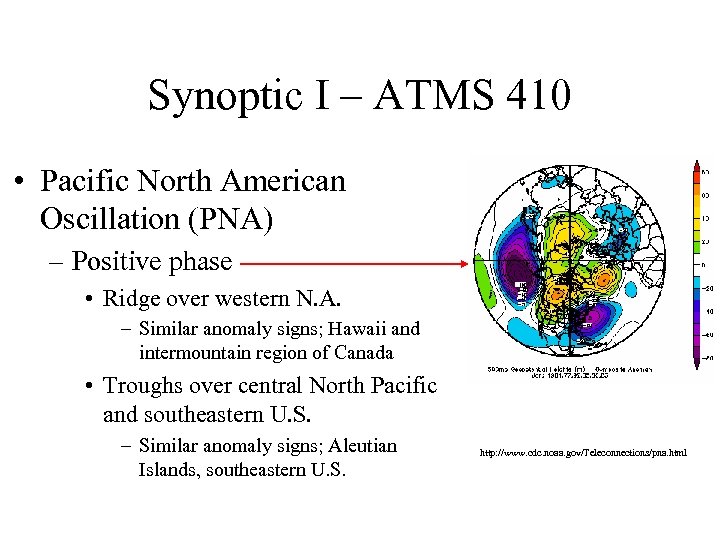 Synoptic I – ATMS 410 • Pacific North American Oscillation (PNA) – Positive phase • Ridge over western N. A. – Similar anomaly signs; Hawaii and intermountain region of Canada • Troughs over central North Pacific and southeastern U. S. – Similar anomaly signs; Aleutian Islands, southeastern U. S. http: //www. cdc. noaa. gov/Teleconnections/pna. html
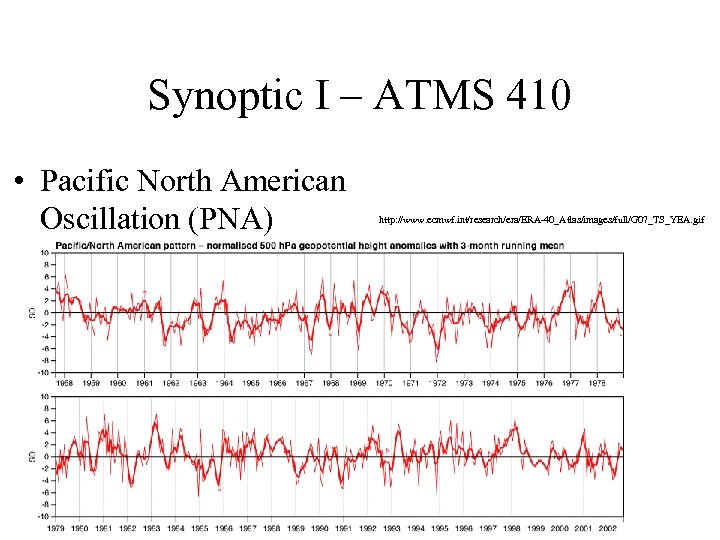 Synoptic I – ATMS 410 • Pacific North American Oscillation (PNA) http: //www. ecmwf. int/research/era/ERA-40_Atlas/images/full/G 07_TS_YEA. gif – index • Ridge over western N. A. – Similar anomaly signs; Hawaii and intermountain region of Canada • Troughs over central North Pacific and southeastern U. S. – Similar anomaly signs; Aleutian Islands, southeastern U. S.
 Synoptic I – ATMS 410 • Pacific North American Oscillation (PNA) – index • Positive; strong Aleutian Low and a strong ridge over western Canada • Derived at (20 o. N, 160 o. W), (45 o. N, 165 o. W), (55 o. N, 115 o. W), and (30 o. N, 85 o. W)
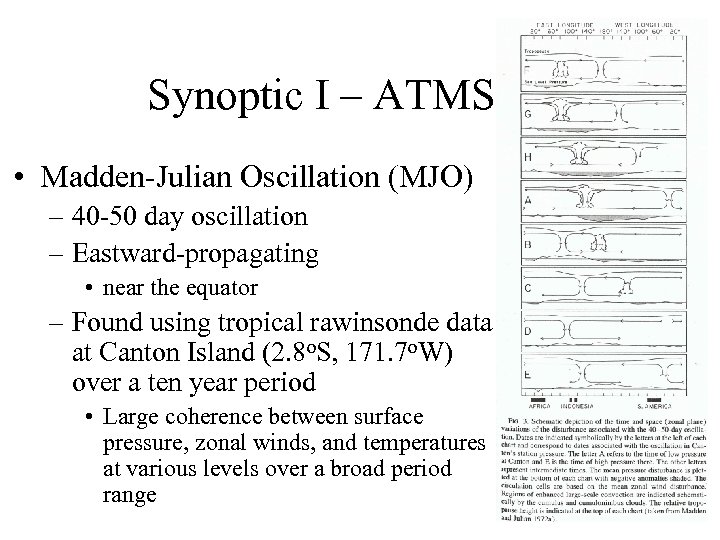 Synoptic I – ATMS 410 • Madden-Julian Oscillation (MJO) – 40 -50 day oscillation – Eastward-propagating • near the equator – Found using tropical rawinsonde data at Canton Island (2. 8 o. S, 171. 7 o. W) over a ten year period • Large coherence between surface pressure, zonal winds, and temperatures at various levels over a broad period range
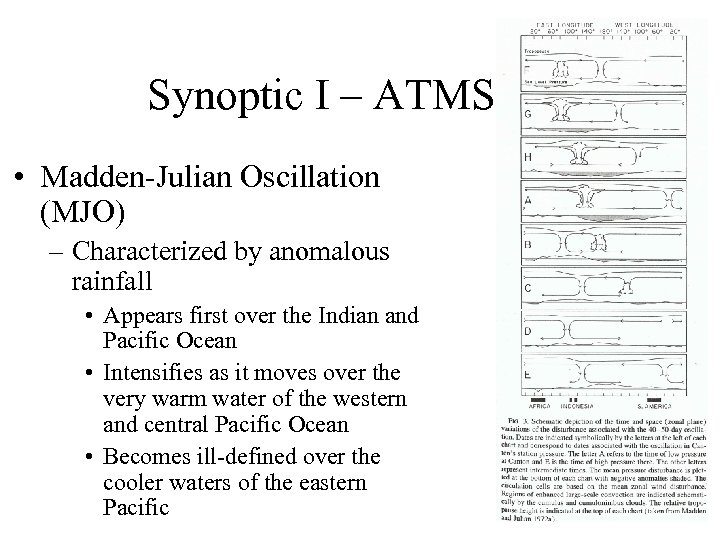 Synoptic I – ATMS 410 • Madden-Julian Oscillation (MJO) – Characterized by anomalous rainfall • Appears first over the Indian and Pacific Ocean • Intensifies as it moves over the very warm water of the western and central Pacific Ocean • Becomes ill-defined over the cooler waters of the eastern Pacific
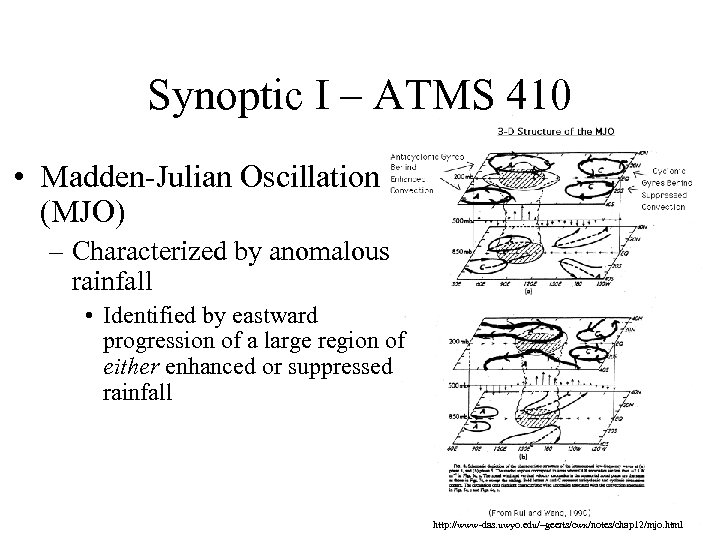 Synoptic I – ATMS 410 • Madden-Julian Oscillation (MJO) – Characterized by anomalous rainfall • Identified by eastward progression of a large region of either enhanced or suppressed rainfall http: //www-das. uwyo. edu/~geerts/cwx/notes/chap 12/mjo. html
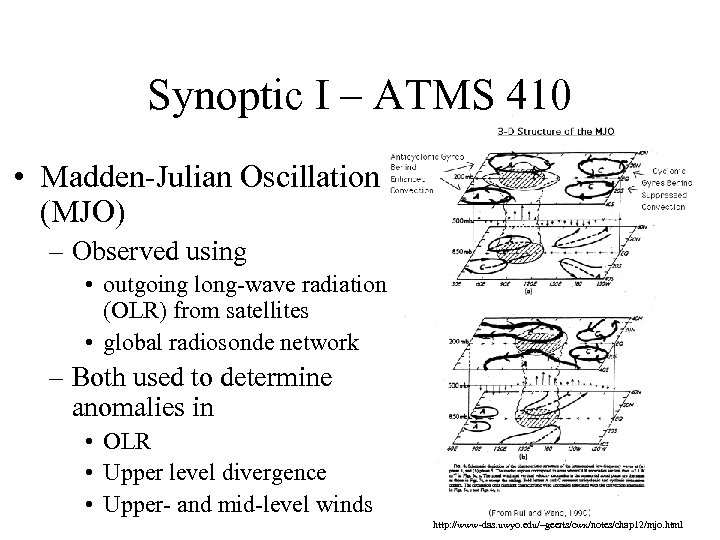 Synoptic I – ATMS 410 • Madden-Julian Oscillation (MJO) – Observed using • outgoing long-wave radiation (OLR) from satellites • global radiosonde network – Both used to determine anomalies in • OLR • Upper level divergence • Upper- and mid-level winds http: //www-das. uwyo. edu/~geerts/cwx/notes/chap 12/mjo. html
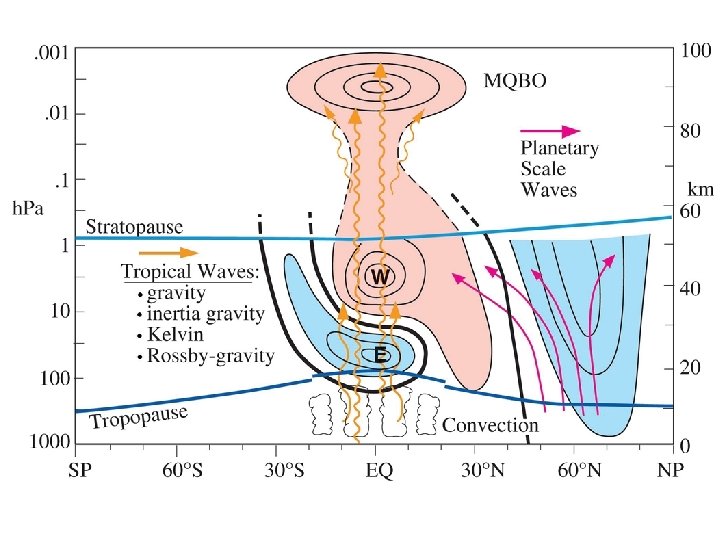 Synoptic I – ATMS 410 • Quasi-biennial Oscillation (QBO) HERE!!
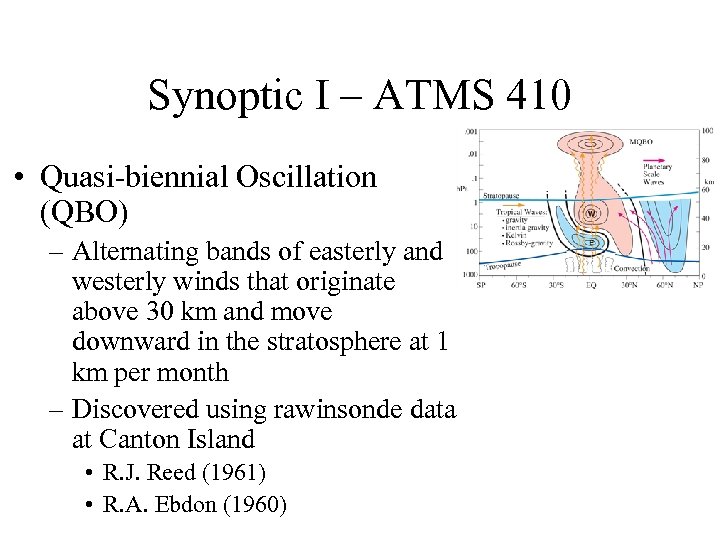 Synoptic I – ATMS 410 • Quasi-biennial Oscillation (QBO) – Alternating bands of easterly and westerly winds that originate above 30 km and move downward in the stratosphere at 1 km per month – Discovered using rawinsonde data at Canton Island • R. J. Reed (1961) • R. A. Ebdon (1960)
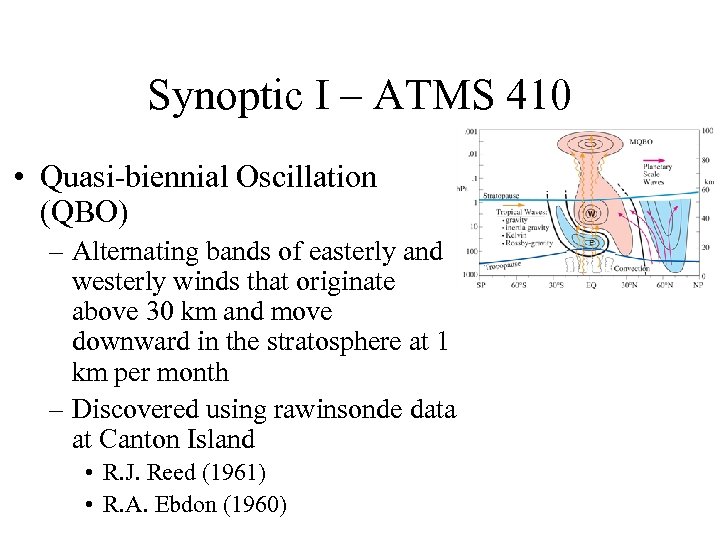 Synoptic I – ATMS 410 • Quasi-biennial Oscillation (QBO) – Alternating bands of easterly and westerly winds that originate above 30 km and move downward in the stratosphere at 1 km per month – Discovered using rawinsonde data at Canton Island • R. J. Reed (1961) • R. A. Ebdon (1960)
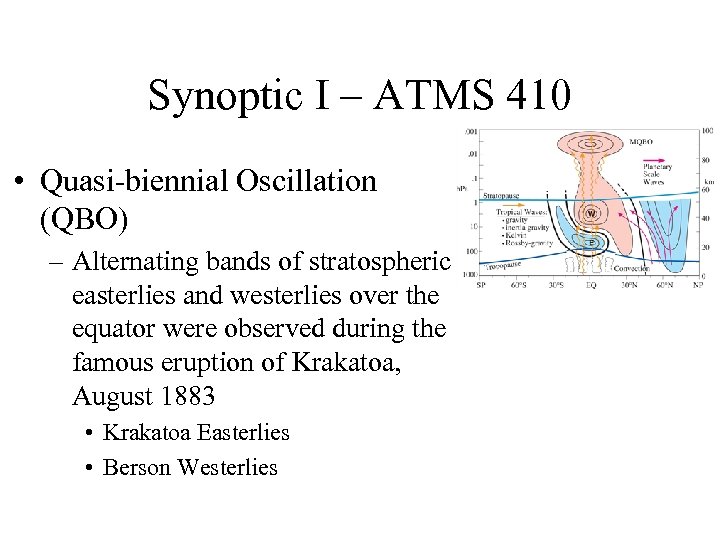 Synoptic I – ATMS 410 • Quasi-biennial Oscillation (QBO) – Alternating bands of stratospheric easterlies and westerlies over the equator were observed during the famous eruption of Krakatoa, August 1883 • Krakatoa Easterlies • Berson Westerlies
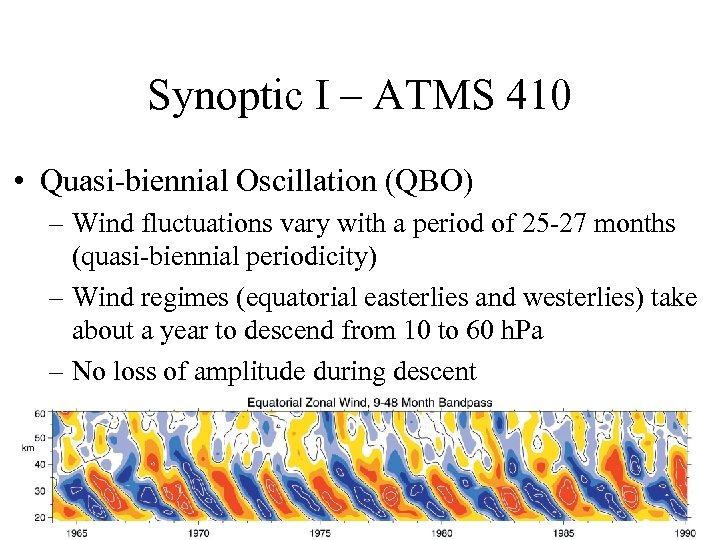 Synoptic I – ATMS 410 • Quasi-biennial Oscillation (QBO) – Wind fluctuations vary with a period of 25 -27 months (quasi-biennial periodicity) – Wind regimes (equatorial easterlies and westerlies) take about a year to descend from 10 to 60 h. Pa – No loss of amplitude during descent
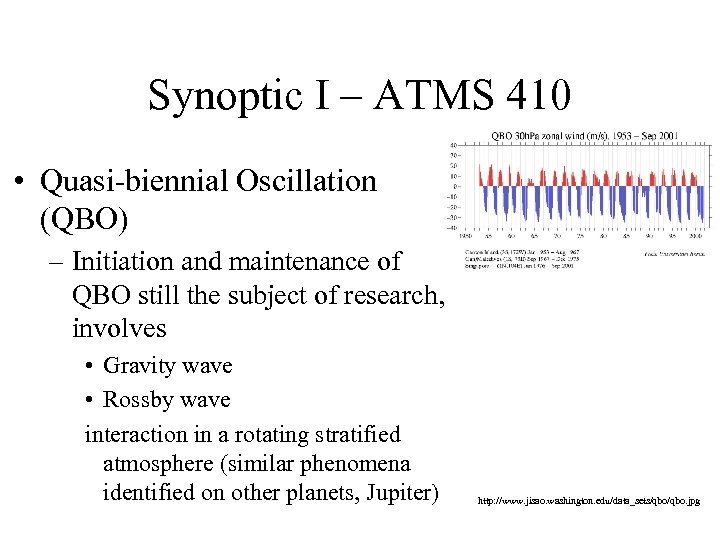 Synoptic I – ATMS 410 • Quasi-biennial Oscillation (QBO) – Initiation and maintenance of QBO still the subject of research, involves • Gravity wave • Rossby wave interaction in a rotating stratified atmosphere (similar phenomena identified on other planets, Jupiter) http: //www. jisao. washington. edu/data_sets/qbo. jpg
 Synoptic I – ATMS 410 • Quasi-biennial Oscillation (QBO) – Initiation and maintenance of QBO still the subject of research, involves • Simulation of QBO remains a great challenge for general circulation models (GCMs) – Gravity waves generated by equatorial convection are essential – Better modeling of dynamics of mesoscale convective systems, and the synoptic-scale tropical waves in which these systems are embedded http: //www. theoldcomputer. com/Misc%20 Artwork/Calendar_Past%20 Computers_2005. jpg
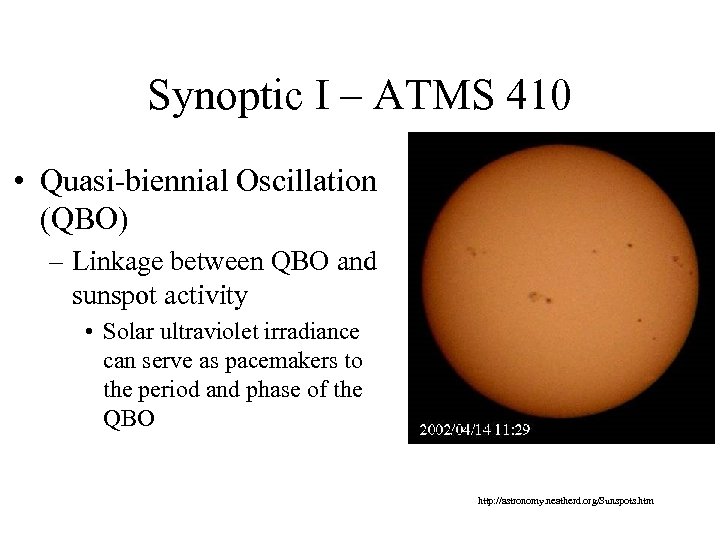 Synoptic I – ATMS 410 • Quasi-biennial Oscillation (QBO) – Linkage between QBO and sunspot activity • Solar ultraviolet irradiance can serve as pacemakers to the period and phase of the QBO http: //astronomy. neatherd. org/Sunspots. htm
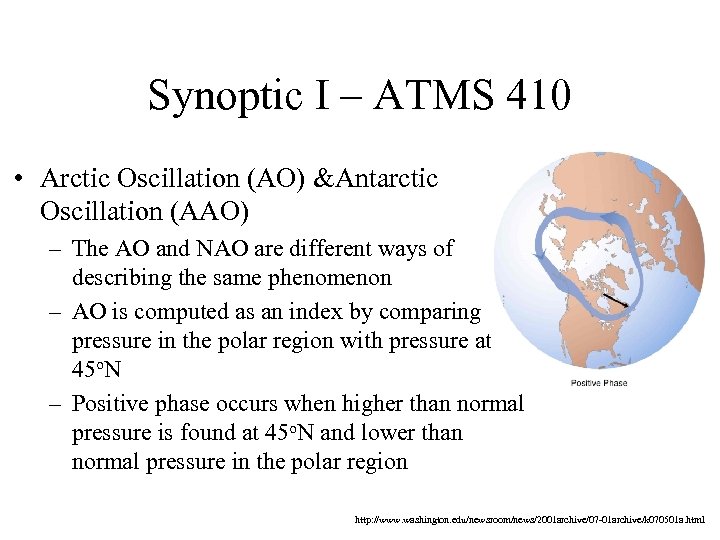 Synoptic I – ATMS 410 • Arctic Oscillation (AO) &Antarctic Oscillation (AAO) – The AO and NAO are different ways of describing the same phenomenon – AO is computed as an index by comparing pressure in the polar region with pressure at 45 o. N – Positive phase occurs when higher than normal pressure is found at 45 o. N and lower than normal pressure in the polar region http: //www. washington. edu/newsroom/news/2001 archive/07 -01 archive/k 070501 a. html
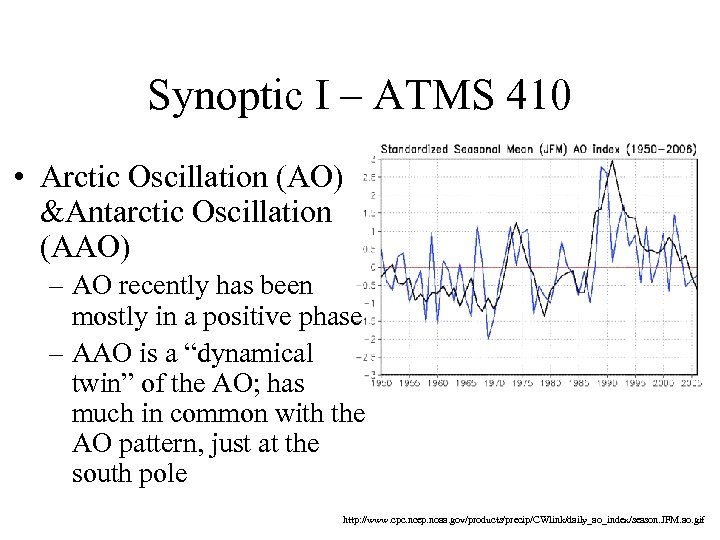 Synoptic I – ATMS 410 • Arctic Oscillation (AO) &Antarctic Oscillation (AAO) – AO recently has been mostly in a positive phase – AAO is a “dynamical twin” of the AO; has much in common with the AO pattern, just at the south pole http: //www. cpc. ncep. noaa. gov/products/precip/CWlink/daily_ao_index/season. JFM. ao. gif
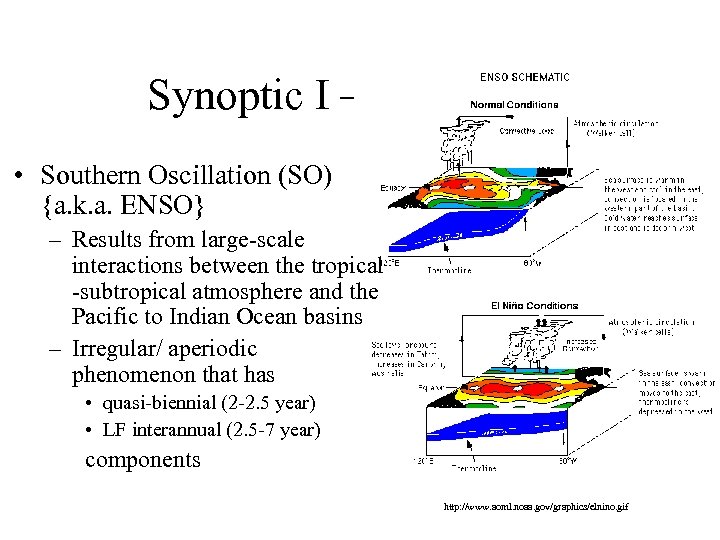 Synoptic I – ATMS 410 • Southern Oscillation (SO) {a. k. a. ENSO} – Results from large-scale interactions between the tropical -subtropical atmosphere and the Pacific to Indian Ocean basins – Irregular/ aperiodic phenomenon that has • quasi-biennial (2 -2. 5 year) • LF interannual (2. 5 -7 year) components http: //www. aoml. noaa. gov/graphics/elnino. gif
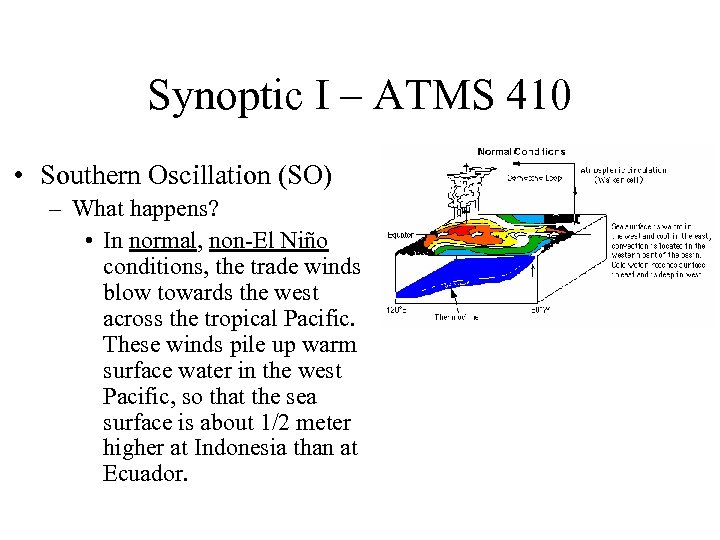 Synoptic I – ATMS 410 • Southern Oscillation (SO) – What happens? • In normal, non-El Niño conditions, the trade winds blow towards the west across the tropical Pacific. These winds pile up warm surface water in the west Pacific, so that the sea surface is about 1/2 meter higher at Indonesia than at Ecuador.
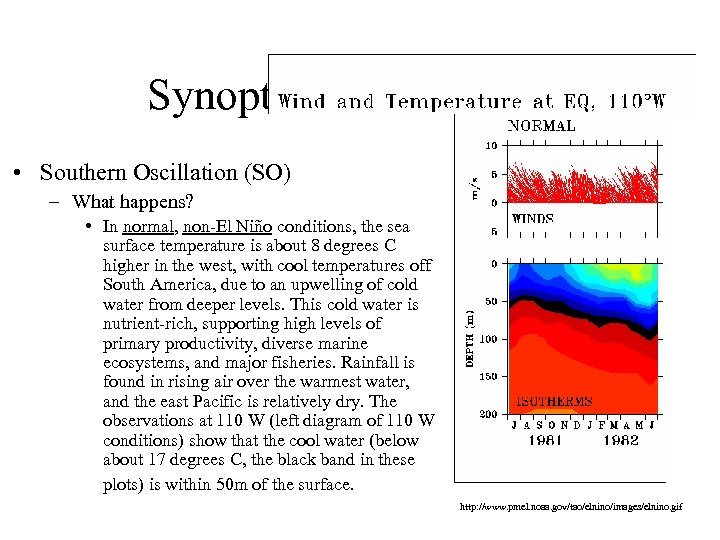 Synoptic I – ATMS 410 • Southern Oscillation (SO) – What happens? • In normal, non-El Niño conditions, the sea surface temperature is about 8 degrees C higher in the west, with cool temperatures off South America, due to an upwelling of cold water from deeper levels. This cold water is nutrient-rich, supporting high levels of primary productivity, diverse marine ecosystems, and major fisheries. Rainfall is found in rising air over the warmest water, and the east Pacific is relatively dry. The observations at 110 W (left diagram of 110 W conditions) show that the cool water (below about 17 degrees C, the black band in these plots) is within 50 m of the surface. http: //www. pmel. noaa. gov/tao/elnino/images/elnino. gif
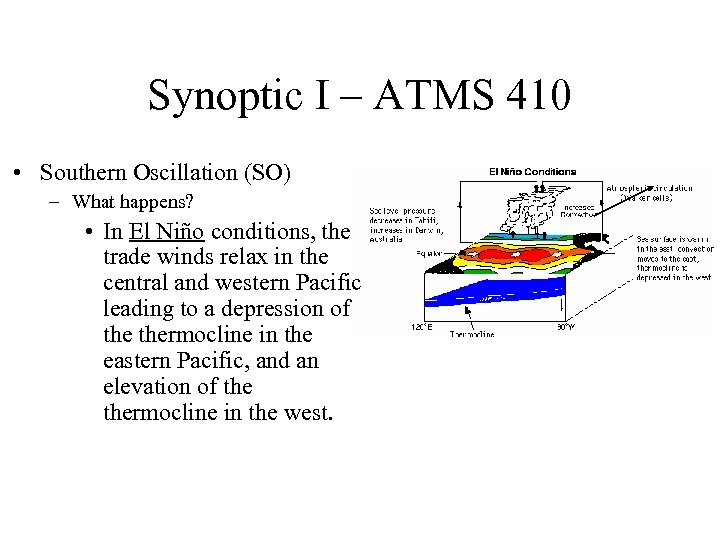 Synoptic I – ATMS 410 • Southern Oscillation (SO) – What happens? • In El Niño conditions, the trade winds relax in the central and western Pacific leading to a depression of thermocline in the eastern Pacific, and an elevation of thermocline in the west.
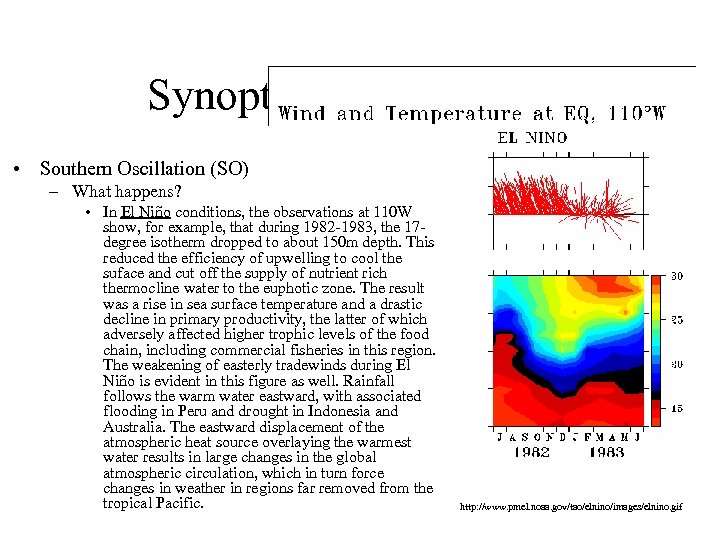 Synoptic I – ATMS 410 • Southern Oscillation (SO) – What happens? • In El Niño conditions, the observations at 110 W show, for example, that during 1982 -1983, the 17 degree isotherm dropped to about 150 m depth. This reduced the efficiency of upwelling to cool the suface and cut off the supply of nutrient rich thermocline water to the euphotic zone. The result was a rise in sea surface temperature and a drastic decline in primary productivity, the latter of which adversely affected higher trophic levels of the food chain, including commercial fisheries in this region. The weakening of easterly tradewinds during El Niño is evident in this figure as well. Rainfall follows the warm water eastward, with associated flooding in Peru and drought in Indonesia and Australia. The eastward displacement of the atmospheric heat source overlaying the warmest water results in large changes in the global atmospheric circulation, which in turn force changes in weather in regions far removed from the tropical Pacific. http: //www. pmel. noaa. gov/tao/elnino/images/elnino. gif
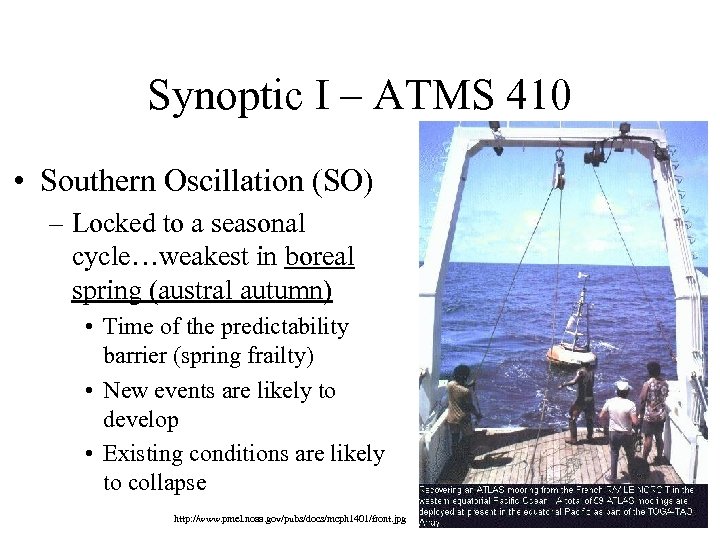 Synoptic I – ATMS 410 • Southern Oscillation (SO) – Locked to a seasonal cycle…weakest in boreal spring (austral autumn) • Time of the predictability barrier (spring frailty) • New events are likely to develop • Existing conditions are likely to collapse http: //www. pmel. noaa. gov/pubs/docs/mcph 1401/front. jpg
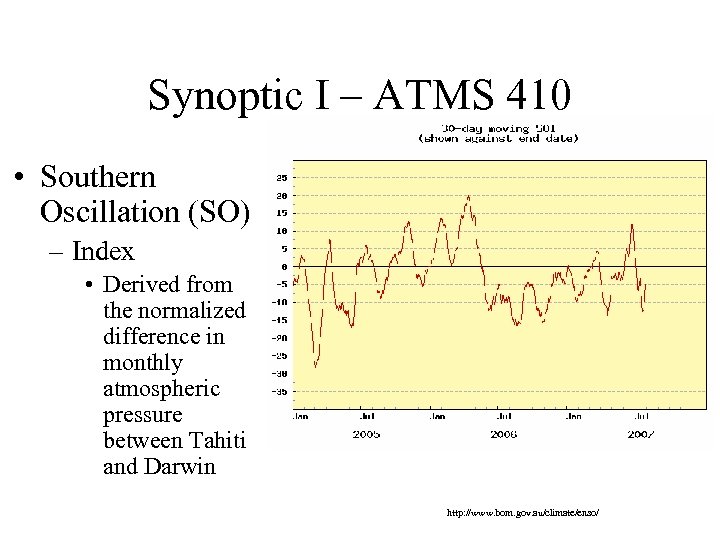 Synoptic I – ATMS 410 • Southern Oscillation (SO) – Index • Derived from the normalized difference in monthly atmospheric pressure between Tahiti and Darwin http: //www. bom. gov. au/climate/enso/
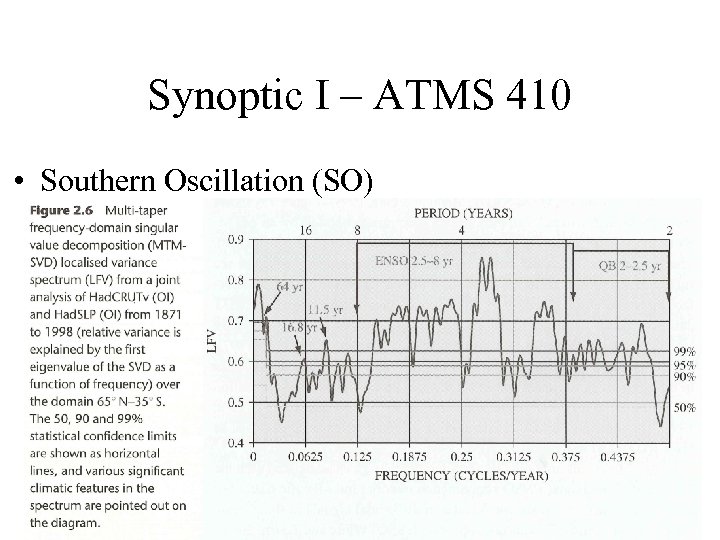 Synoptic I – ATMS 410 • Southern Oscillation (SO) – ENSO-like fluctuations
 Synoptic I – ATMS 410 • Southern Oscillation (SO) – A more objective way to analyse the nature of ENSO is through the use of spectral and signal detection techniques (e. g. MTM-SVD)
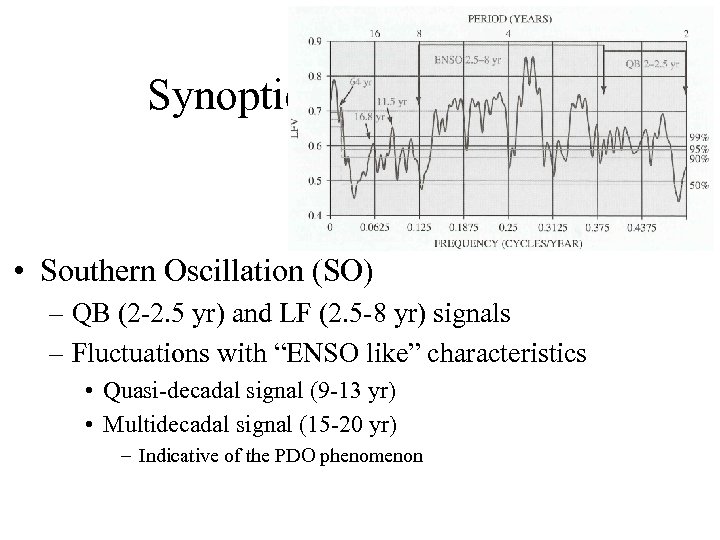 Synoptic I – ATMS 410 • Southern Oscillation (SO) – QB (2 -2. 5 yr) and LF (2. 5 -8 yr) signals – Fluctuations with “ENSO like” characteristics • Quasi-decadal signal (9 -13 yr) • Multidecadal signal (15 -20 yr) – Indicative of the PDO phenomenon
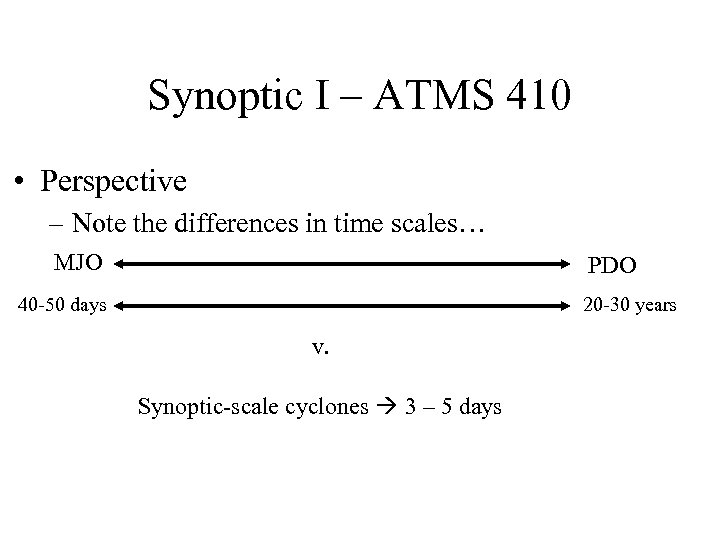 Synoptic I – ATMS 410 • Perspective – Note the differences in time scales… MJO PDO 40 -50 days 20 -30 years v. Synoptic-scale cyclones 3 – 5 days
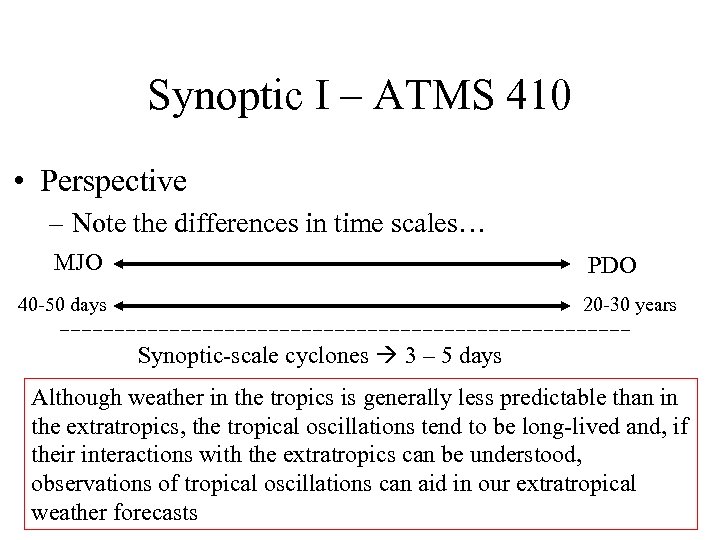 Synoptic I – ATMS 410 • Perspective – Note the differences in time scales… MJO PDO 40 -50 days 20 -30 years Synoptic-scale cyclones 3 – 5 days Although weather in the tropics is generally less predictable than in the extratropics, the tropical oscillations tend to be long-lived and, if their interactions with the extratropics can be understood, observations of tropical oscillations can aid in our extratropical weather forecasts
 Synoptic I – ATMS 410 • In other words, why do we care about tropical oscillations in a course focusing on the extratropics (mid-latitudes)? – Example…the relatives who visit for an extended stay • Aunt Matilda and Uncle Billy visit your house for four weeks, what do you predict will happen in your household after the first week of their visit?
 Synoptic I – ATMS 410 • References – Baldwin, M. P. , L. J. Gray, T. J. Dunkerton, K. Hamilton, P. H. Haynes, W. J. Randel, J. R. Holton, M. J. Alexander, I. Hirota, T. Horinouchi, D. B. A. Jones, J. S. Kinnersley, C. Marquardt, K. Sato, and M. Takahashi, 2001: The Quasi. Biennial Oscillation, Reviews of Geophysics, 39, 179 -229. – Bridgman and Oliver, 2006: The Global Climate System; Patterns, Processes and Teleconnections. Cambridge University Press, 331 pp. – Diaz, H. F. , and V. Markgraf (Eds. ), 2000: El Niño and the Southern Oscillation: Multiscale Variability and Global and Regional Impacts, Cambridge University Press, 496 pp. – Madden, R. A. , and P. R. Julian, 1994: Observations of the 40 -50 day tropical oscillation: A review. Mon. Wea. Rev. , 122, 814 -837.