 Скачать презентацию synaptic transmission Basic Neuroscience NBL 120 2007
4ddb6e2064763eee499104e8bd3b9b1d.ppt
- Количество слайдов: 36



synaptic transmission Basic Neuroscience NBL 120 (2007)
how is the signal transferred? ü electrical currents in the presynaptic process induce currents in the postsynaptic process ü not very efficient………. . high low
![how do synapses work? “I vividly remember visiting him [Eccles] in his pleasant house](https://present5.com/presentation/4ddb6e2064763eee499104e8bd3b9b1d/image-3.jpg "how do synapses work? “I vividly remember visiting him [Eccles] in his pleasant house")
how do synapses work? “I vividly remember visiting him [Eccles] in his pleasant house with its fine tennis court and beautiful view over Sydney harbor. ” (Katz, 1985) pharmacologists versus physiologists

the lawnmower incident
chemical transmission ü a synapse is both anatomically and functionally optimized ü Ca 2+ ü vesicles ü postsynaptic receptors ü central synapses are just smaller than the nmj ü integration
nmj structure - anatomy overview axon endplate boutons mitochondria vesicles active zone synaptic cleft basement membrane junctional fold 10, 000 / m 2 acetylcholine receptors
nmj - physiology overview ü stimulate motorneuron: muscle contraction ü record potential change in muscle fiber ü AP (high safety factor)
origin of the EPP ü EPP: passive decay ü length constant ü AP: regenerative
nmj - actetylcholine receptor a-bungarotoxin PORE BINDING SITE GATE Bungarus californica (pacific electric ray) Torpedo multicinctus (many-banded krait)
acetylcholine receptor channel single channel EPP closed open non-selective cation channel
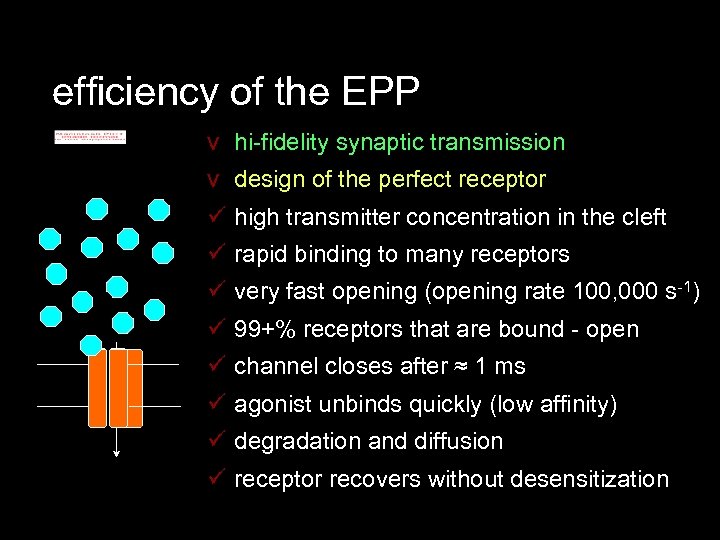
efficiency of the EPP v hi-fidelity synaptic transmission v design of the perfect receptor ü high transmitter concentration in the cleft ü rapid binding to many receptors ü very fast opening (opening rate 100, 000 s-1) ü 99+% receptors that are bound - open ü channel closes after ≈ 1 ms ü agonist unbinds quickly (low affinity) ü degradation and diffusion ü receptor recovers without desensitization
m. EPPs quantal hypothesis smallest evoked EPP = spontaneous m. EPP Fatt and Katz (1952) “It has been suggested that the end-plate potential (epp) at a single nerve-muscle junction is built up statistically of small allor-none units [quanta or discrete packets of transmitter] which are identical in size with the spontaneous ‘miniature epp’s’” (Del Castillo & Katz, 1954) normal EPP ≈ 200 quanta or vesicles (quantal content)
presynaptic mechanisms ü object: ü synchronous + fast release of many vesicles
vesicle cycling……. ü synthesis of transmitter ü storage of transmitter in vesicles ü docking+priming of vesicles ü release (fusion) of vesicles ü action of transmitter on postsynaptic receptors ü termination of transmitter action ü recycling of vesicle membrane (endocytosis)
many proteins are involved….
release…. . delay? ü depolarization and Ca 2+ are required
synaptic delay ü Ca 2+ channels open slowly…
presynaptic Ca 2+ microdomains presynaptic terminal ü Ca 2+ is only high while channels are open Llinas et al (1995)
Ca 2+ channels / vesicles ü synaptotagmin (on vesicle): Ca 2+ sensor ü low affinity for Ca 2+ ü vesicles must be close to Ca 2+ channels
everything is in close proximity
clearance of transmitter ü acetycholinesterase: ü 10 molecules ACh per ms (one every 100 s) ü inhibition prolongs synaptic transmission…. . ü diffusion is very fast Katz and Miledi (1973)
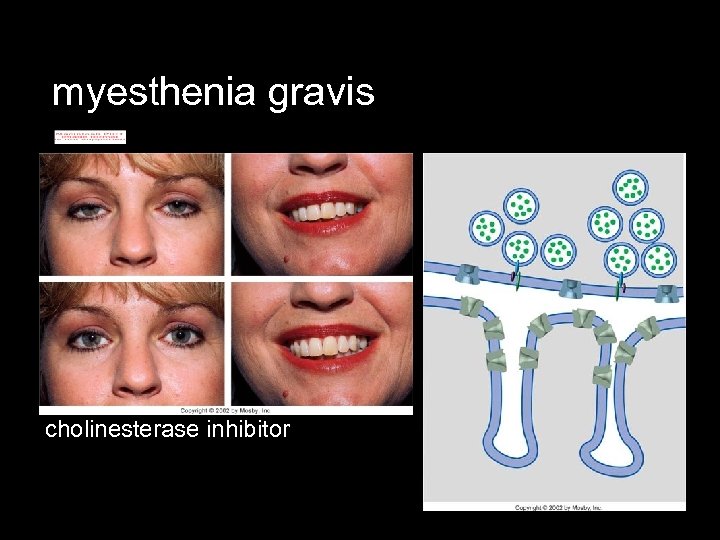
myesthenia gravis cholinesterase inhibitor
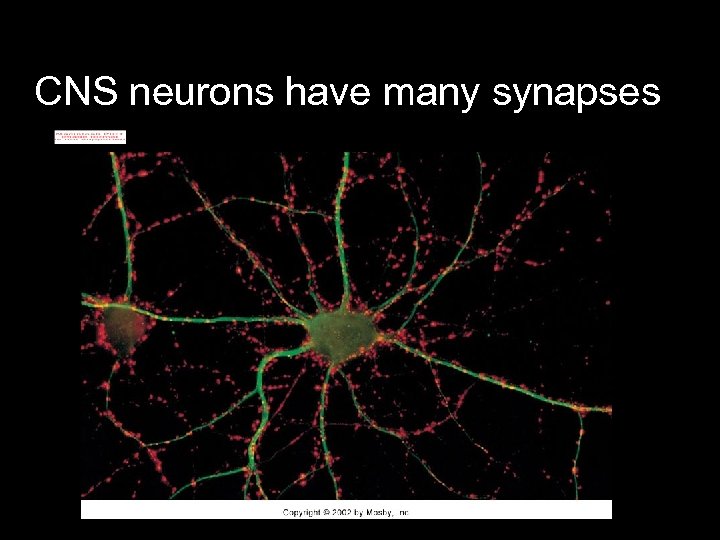
CNS neurons have many synapses
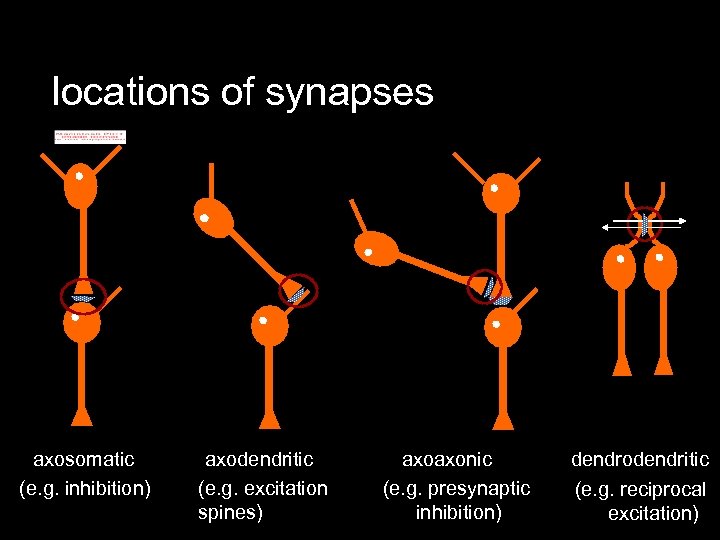
locations of synapses axosomatic (e. g. inhibition) axodendritic (e. g. excitation spines) axoaxonic (e. g. presynaptic inhibition) dendrodendritic (e. g. reciprocal excitation)
coping with multiple synapses how do the multiple inputs combine to determine the output firing pattern of the neuron? dendritic integration and other mechanisms
central synapses smaller (<1 m) synaptic contact fewer active zones: release few vesicles failures don’t reach AP threshold
inhibition versus excitation GABA glycine chloride hyperpolarizing? glutamate ACh serotonin depolarizing
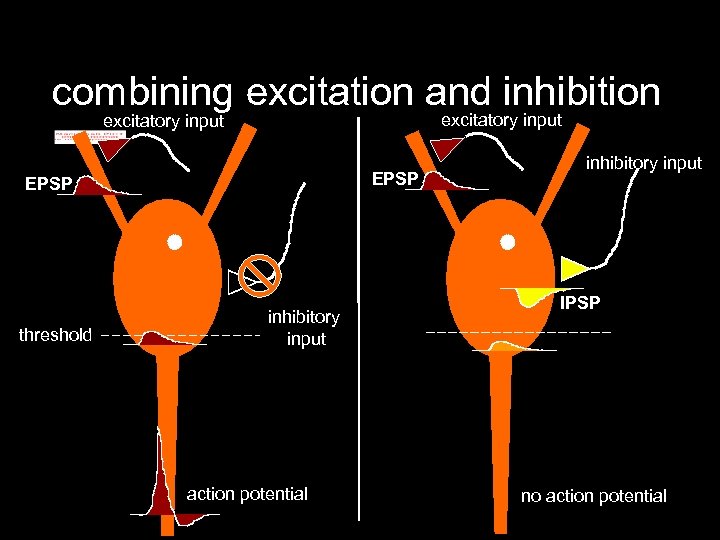
combining excitation and inhibition excitatory input EPSP threshold inhibitory input action potential inhibitory input IPSP no action potential
mechanism of inhibition ü “Shunting inhibition” ü Inhibitory transmitters (e. g. GABA) open Cl- permeable channels. ECl is always more negative than AP threshold. Thus, opening up a large amount of inhibitory channels will oppose the depolarzation by any excitatory transmitter/receptor and keep the membrane close to Ecl.
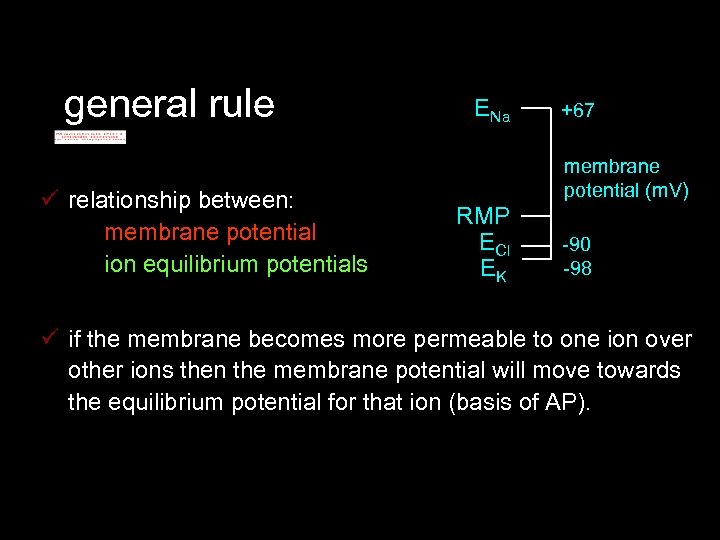
general rule ü relationship between: membrane potential ion equilibrium potentials ENa +67 membrane potential (m. V) RMP ECl EK -90 -98 ü if the membrane becomes more permeable to one ion over other ions then the membrane potential will move towards the equilibrium potential for that ion (basis of AP).
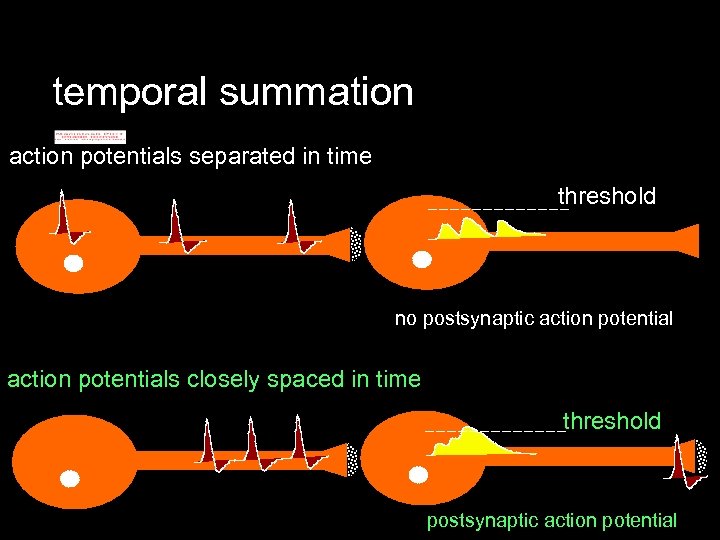
temporal summation action potentials separated in time threshold no postsynaptic action potentials closely spaced in time threshold postsynaptic action potential
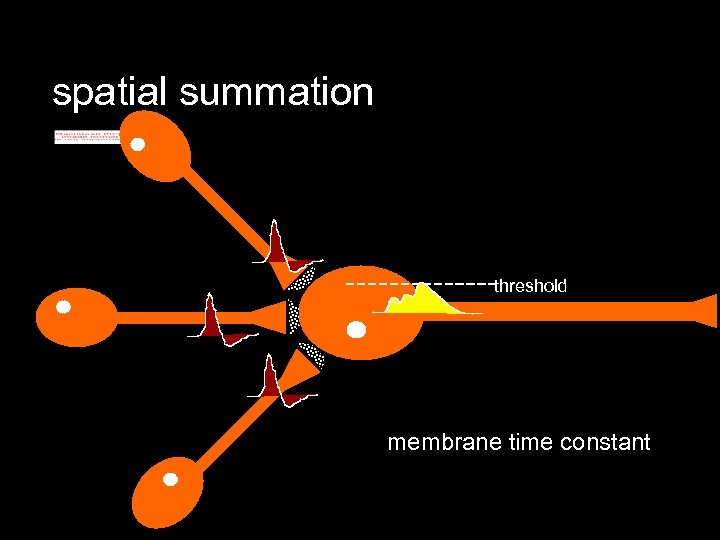
spatial summation threshold membrane time constant
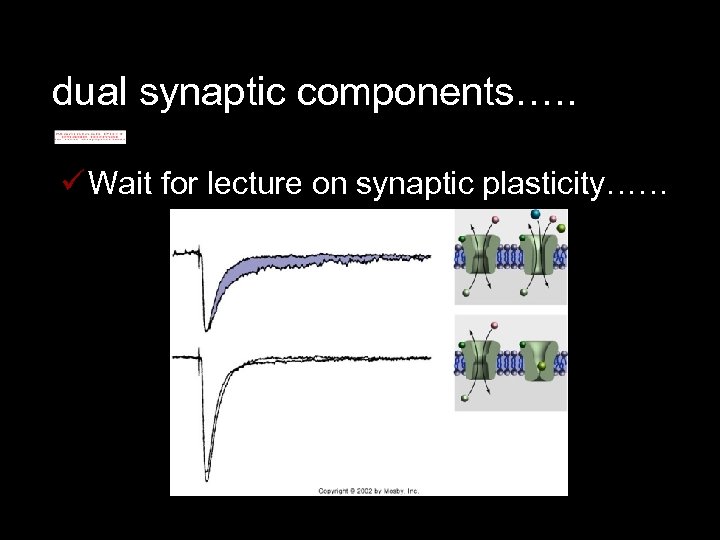
dual synaptic components…. . ü Wait for lecture on synaptic plasticity……
terminating the synaptic signal just how much glutamate is around?
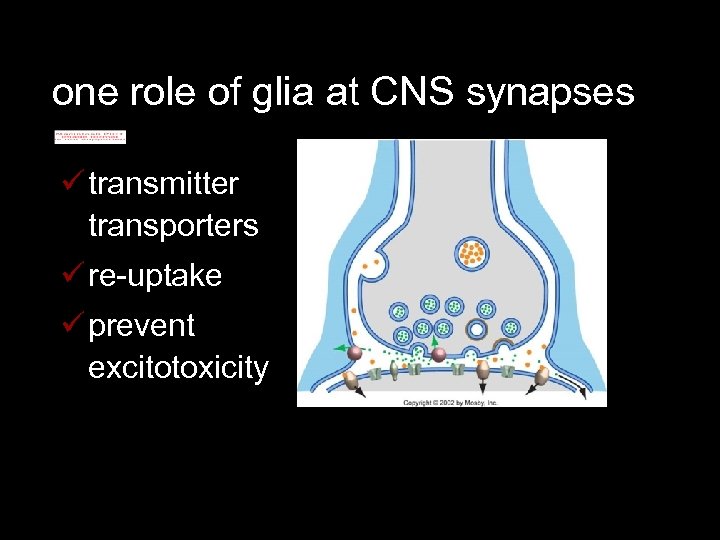
one role of glia at CNS synapses ü transmitter transporters ü re-uptake ü prevent excitotoxicity
synaptic summary ü neuromuscular junction ü fast synaptic transmission - highly efficient ü Ca 2+-dependent release of vesicles (quanta) ü postsynaptic ligand-gated ion channels ü synaptic integration in the CNS ü ü synapse location inhibition versus excitation “shunting” inhibition temporal versus spatial summation
Скачать презентацию synaptic transmission Basic Neuroscience NBL 120 2007
4ddb6e2064763eee499104e8bd3b9b1d.ppt