


 Скачать презентацию Sympthoms in the elderly Asthenia Marta Mazzoli Settimio
7144e614b47e2cf347cfcaf4833b3fbd.ppt
- Количество слайдов: 17
 Sympthoms in the elderly Asthenia Marta Mazzoli, Settimio Tempera Hospice residenziale e domiciliare Casa di Cura Merry House, Roma
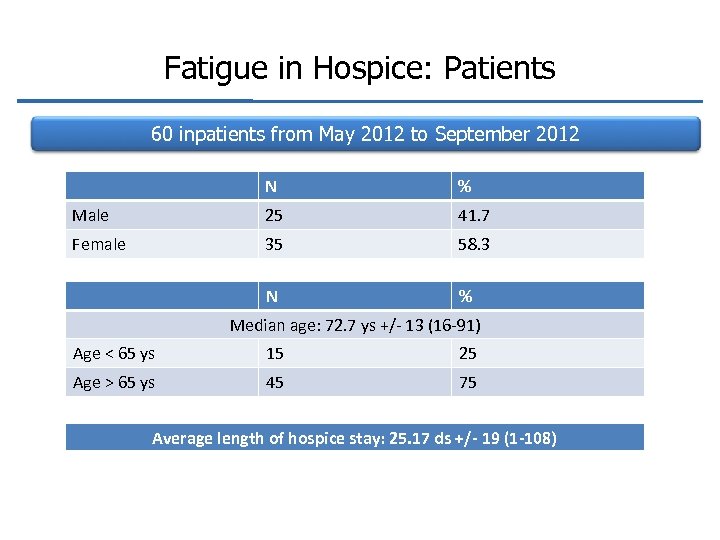 Fatigue in Hospice: Patients 60 inpatients from May 2012 to September 2012 N % Male 25 41. 7 Female 35 58. 3 N % Median age: 72. 7 ys +/- 13 (16 -91) Age < 65 ys 15 25 Age > 65 ys 45 75 Average length of hospice stay: 25. 17 ds +/- 19 (1 -108)
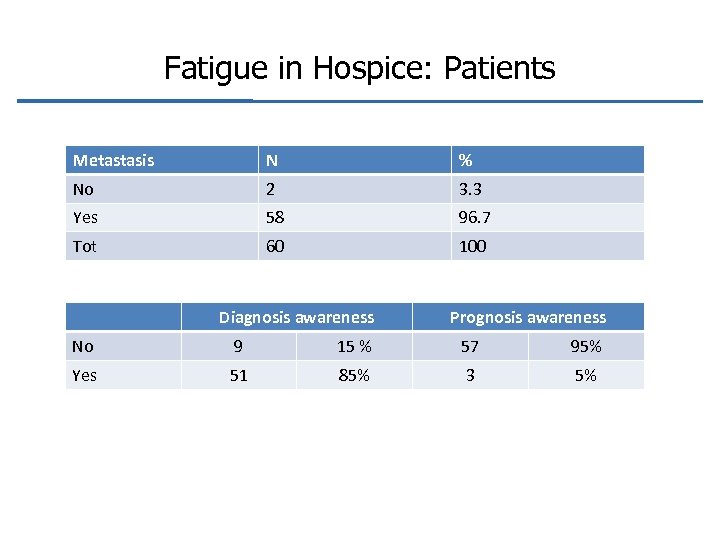 Fatigue in Hospice: Patients Metastasis N % No 2 3. 3 Yes 58 96. 7 Tot 60 100 Diagnosis awareness Prognosis awareness No 9 15 % 57 95% Yes 51 85% 3 5%
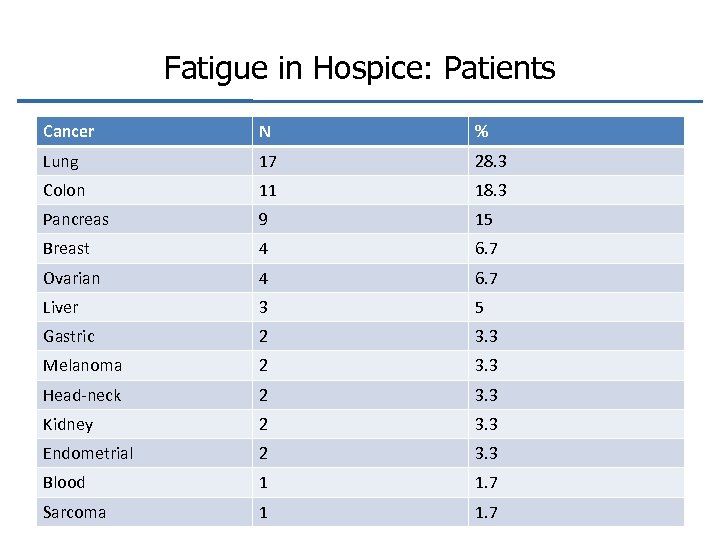 Fatigue in Hospice: Patients Cancer N % Lung 17 28. 3 Colon 11 18. 3 Pancreas 9 15 Breast 4 6. 7 Ovarian 4 6. 7 Liver 3 5 Gastric 2 3. 3 Melanoma 2 3. 3 Head-neck 2 3. 3 Kidney 2 3. 3 Endometrial 2 3. 3 Blood 1 1. 7 Sarcoma 1 1. 7
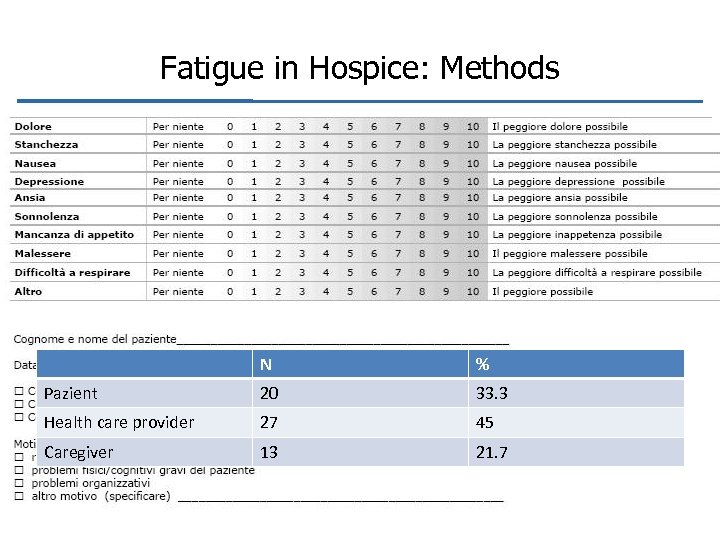 Fatigue in Hospice: Methods N % Pazient 20 33. 3 Health care provider 27 45 Caregiver 13 21. 7
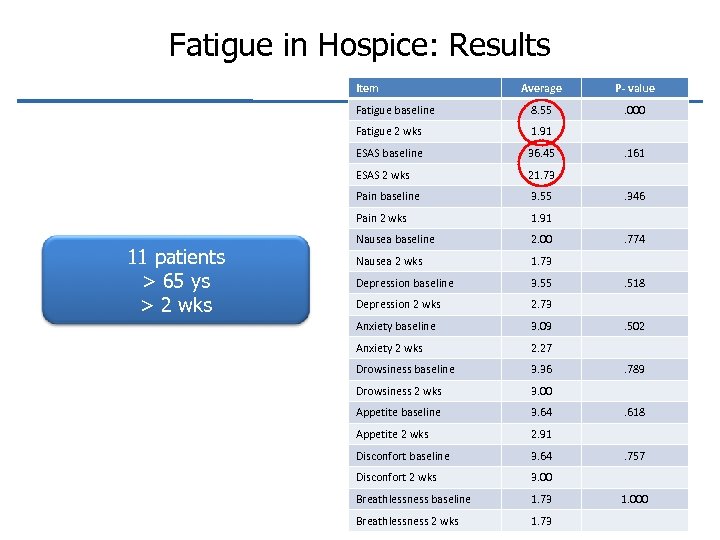 Fatigue in Hospice: Results Item P- value Fatigue baseline 8. 55 . 000 Fatigue 2 wks 1. 91 ESAS baseline 36. 45 ESAS 2 wks 21. 73 Pain baseline 3. 55 Pain 2 wks 11 patients > 65 ys > 2 wks Average 1. 91 Nausea baseline 2. 00 Nausea 2 wks 1. 73 Depression baseline 3. 55 Depression 2 wks 2. 73 Anxiety baseline 3. 09 Anxiety 2 wks 2. 27 Drowsiness baseline 3. 36 Drowsiness 2 wks 3. 00 Appetite baseline 3. 64 Appetite 2 wks 2. 91 Disconfort baseline 3. 64 Disconfort 2 wks 3. 00 Breathlessness baseline 1. 73 Breathlessness 2 wks 1. 73 . 161. 346. 774. 518. 502. 789. 618. 757 1. 000
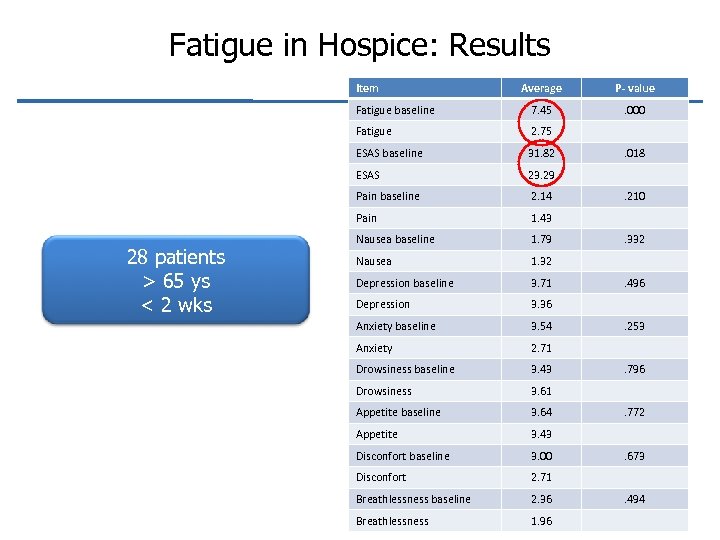 Fatigue in Hospice: Results Item P- value Fatigue baseline 7. 45 . 000 Fatigue 2. 75 ESAS baseline 31. 82 ESAS 23. 29 Pain baseline 2. 14 Pain 28 patients > 65 ys < 2 wks Average 1. 43 Nausea baseline 1. 79 Nausea 1. 32 Depression baseline 3. 71 Depression 3. 36 Anxiety baseline 3. 54 Anxiety 2. 71 Drowsiness baseline 3. 43 Drowsiness 3. 61 Appetite baseline 3. 64 Appetite 3. 43 Disconfort baseline 3. 00 Disconfort 2. 71 Breathlessness baseline 2. 36 Breathlessness 1. 96 . 018. 210. 332. 496. 253. 796. 772. 673. 494
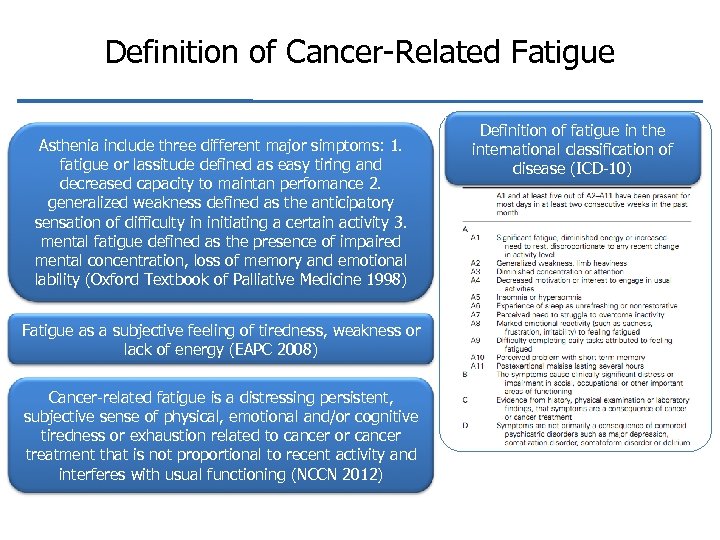 Definition of Cancer-Related Fatigue Asthenia include three different major simptoms: 1. fatigue or lassitude defined as easy tiring and decreased capacity to maintan perfomance 2. generalized weakness defined as the anticipatory sensation of difficulty in initiating a certain activity 3. mental fatigue defined as the presence of impaired mental concentration, loss of memory and emotional lability (Oxford Textbook of Palliative Medicine 1998) Fatigue as a subjective feeling of tiredness, weakness or lack of energy (EAPC 2008) Cancer-related fatigue is a distressing persistent, subjective sense of physical, emotional and/or cognitive tiredness or exhaustion related to cancer or cancer treatment that is not proportional to recent activity and interferes with usual functioning (NCCN 2012) Definition of fatigue in the international classification of disease (ICD-10)
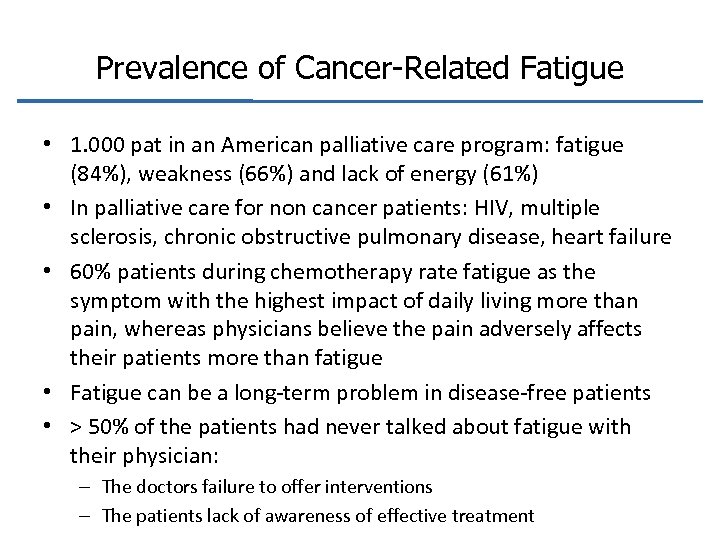 Prevalence of Cancer-Related Fatigue • 1. 000 pat in an American palliative care program: fatigue (84%), weakness (66%) and lack of energy (61%) • In palliative care for non cancer patients: HIV, multiple sclerosis, chronic obstructive pulmonary disease, heart failure • 60% patients during chemotherapy rate fatigue as the symptom with the highest impact of daily living more than pain, whereas physicians believe the pain adversely affects their patients more than fatigue • Fatigue can be a long-term problem in disease-free patients • > 50% of the patients had never talked about fatigue with their physician: – The doctors failure to offer interventions – The patients lack of awareness of effective treatment
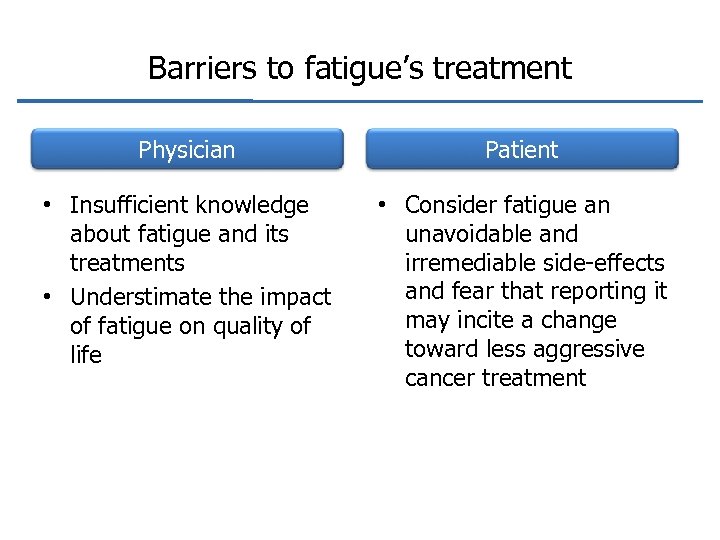 Barriers to fatigue’s treatment Physician Patient • Insufficient knowledge about fatigue and its treatments • Understimate the impact of fatigue on quality of life • Consider fatigue an unavoidable and irremediable side-effects and fear that reporting it may incite a change toward less aggressive cancer treatment
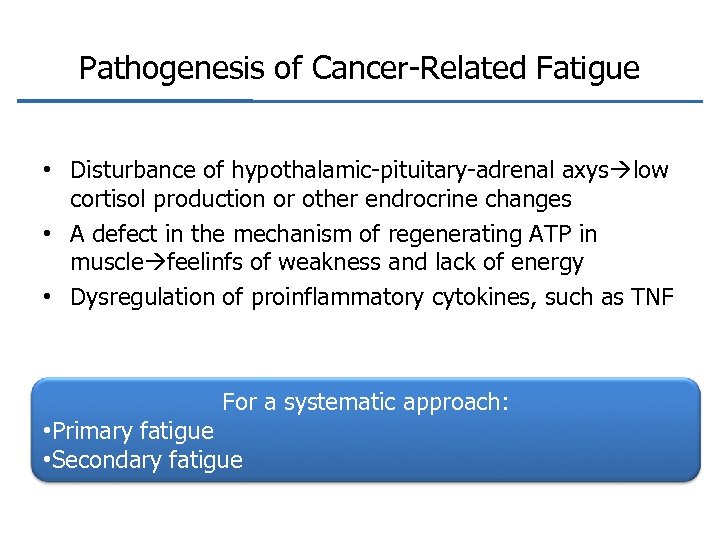 Pathogenesis of Cancer-Related Fatigue • Disturbance of hypothalamic-pituitary-adrenal axys low cortisol production or other endrocrine changes • A defect in the mechanism of regenerating ATP in muscle feelinfs of weakness and lack of energy • Dysregulation of proinflammatory cytokines, such as TNF For a systematic approach: • Primary fatigue • Secondary fatigue
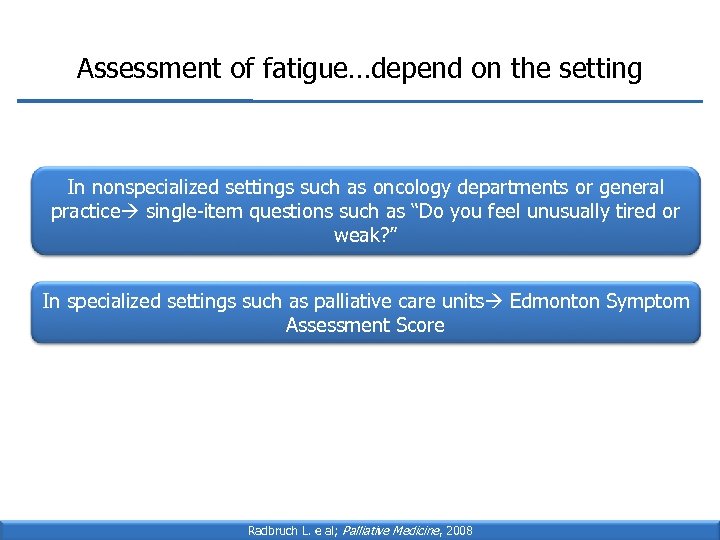 Assessment of fatigue…depend on the setting In nonspecialized settings such as oncology departments or general practice single-item questions such as “Do you feel unusually tired or weak? ” In specialized settings such as palliative care units Edmonton Symptom Assessment Score Radbruch L. e al; Palliative Medicine, 2008
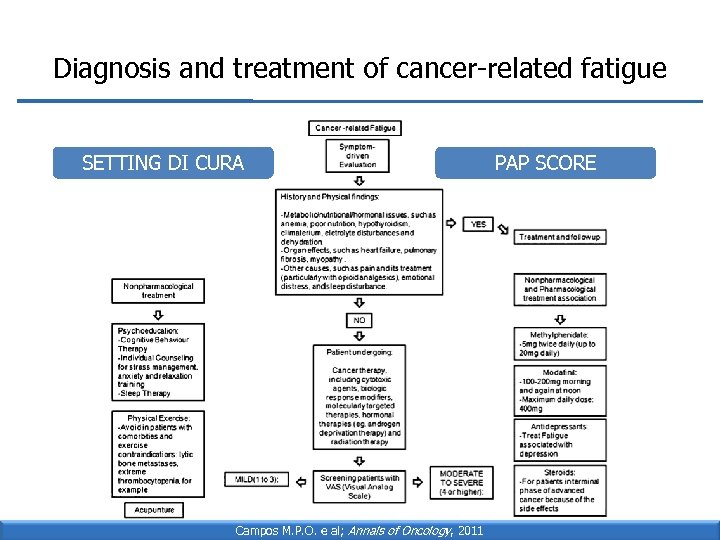 Diagnosis and treatment of cancer-related fatigue SETTING DI CURA Campos M. P. O. e al; Annals of Oncology, 2011 PAP SCORE
 Nonpharmacological treatment • Cognitive-behavioral interventions-interventions specifically focused on fatigue are more effective than general interventions • Exercise-activity enhancement and sleep therapy – in patients receiving cancer treatment • Counselling for energy conservation principles • Complementary and alternative medicine – in patients receiving cancer treatment Campos M. P. O. e al; Annals of Oncology, 2011
 Pharmacological treatment • Methylphenidate – no differences comparing methylphenidate and placebo in elderly patients with fatigue • Modafinil • Pemoline – superior to placebo in patients with AIDS • Donazepil • Erythropoietin – in anemic cancer patients receiving chemotherapy • Corticosteroids – may be used to alleviate fatigue for well-defined goals Campos M. P. O. e al; Annals of Oncology, 2011
 Take home messages Fatigue in cancer and non cancer elderly palliative care patients is under-recognized, under-assessed and under-treated Screening and Assessment Combined approach and individualized treatment plans in the setting of a dedicated cancer-related fatigue clinic Fatigue should be treated more aggressively in patients actively undergoing anticancer treatment with curative or palliative intent In end of life, fatigue may provide protection and shielding from suffering for older patient and treatment of fatigue may be detrimental
 THANK YOU FOR YOUR ATTENTION!!