


 Скачать презентацию Symmetry Energy of Neutron-Rich Matter on Earth and
78a7bec716a32ec31d1349192c2fceff.ppt
- Количество слайдов: 59
 Symmetry Energy of Neutron-Rich Matter on Earth and in Heaven Bao-An Li Collaborators: Baojun Cai and W. G. Newton, Texas A&M University-Commerce, USA Farrooh J. Fattoyev, Indiana University, USA Plamen Krastev, Harvard University, USA Larry Weinstein, Old Dominion University, USA Or Hen, MIT, USA Lie-Wen Chen, Shanghai Jiao Tong University, China Jun Xu, Shanghai Institute of Applied Physics, China Eli Piasetzky, Tel Aviv University, Israel
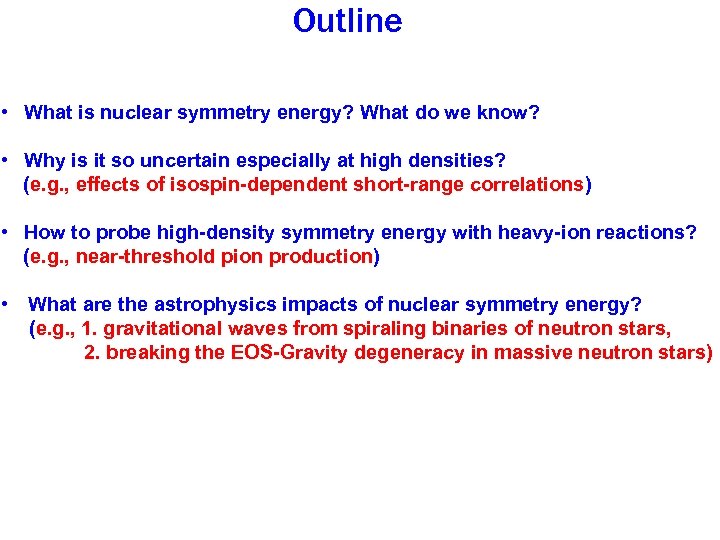 Outline • What is nuclear symmetry energy? What do we know? • Why is it so uncertain especially at high densities? (e. g. , effects of isospin-dependent short-range correlations) • How to probe high-density symmetry energy with heavy-ion reactions? (e. g. , near-threshold pion production) • What are the astrophysics impacts of nuclear symmetry energy? (e. g. , 1. gravitational waves from spiraling binaries of neutron stars, 2. breaking the EOS-Gravity degeneracy in massive neutron stars)
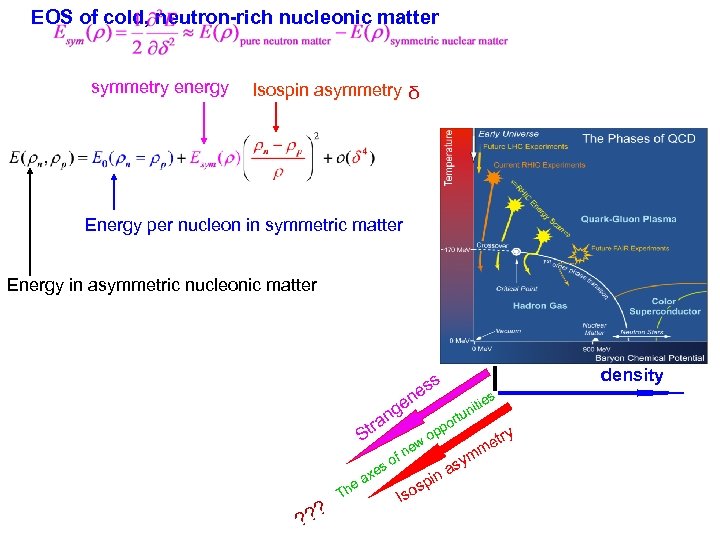 EOS of cold, neutron-rich nucleonic matter symmetry energy Isospin asymmetry δ 12 12 12 Energy per nucleon in symmetric matter 18 18 3 r tte ma ic etr =ρ p m ρn ? ym S ? ? density Energy in asymmetric nucleonic matter s n ra St ge s ne o ew fn so e x ? ? ? ea Th ies it tun r p op Is i sp o y as n m y etr m
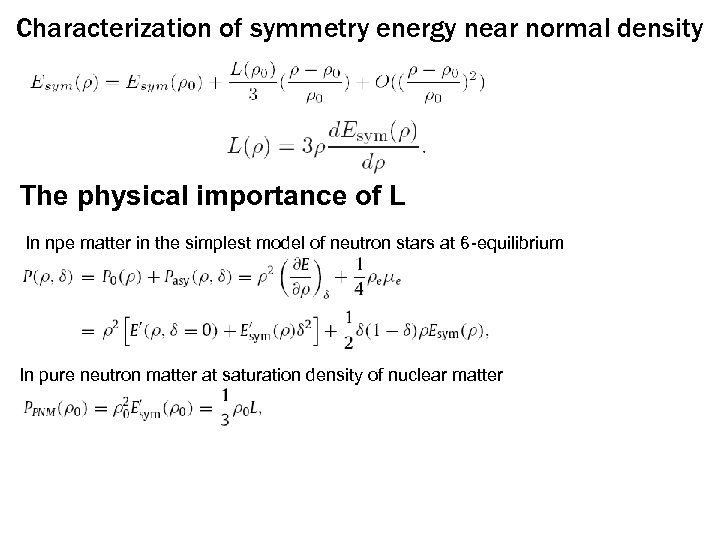 Characterization of symmetry energy near normal density The physical importance of L In npe matter in the simplest model of neutron stars at ϐ-equilibrium In pure neutron matter at saturation density of nuclear matter
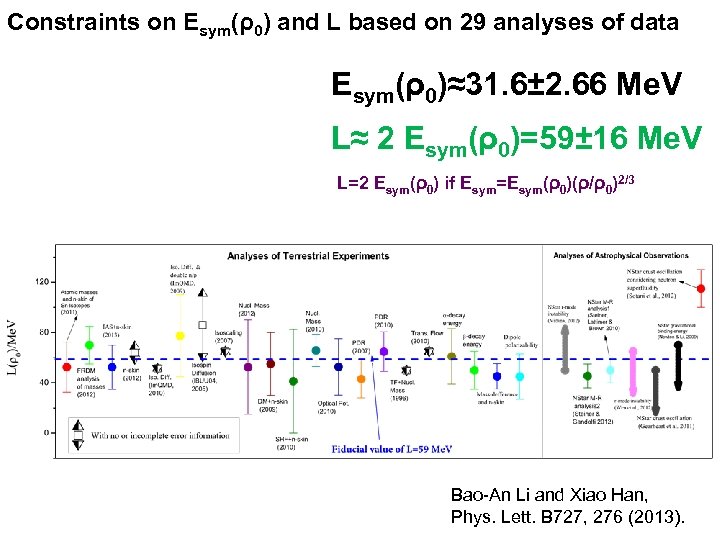 Constraints on Esym(ρ0) and L based on 29 analyses of data Esym(ρ0)≈31. 6± 2. 66 Me. V L≈ 2 Esym(ρ0)=59± 16 Me. V L=2 Esym(ρ0) if Esym=Esym(ρ0)(ρ/ρ0)2/3 Bao-An Li and Xiao Han, Phys. Lett. B 727, 276 (2013).
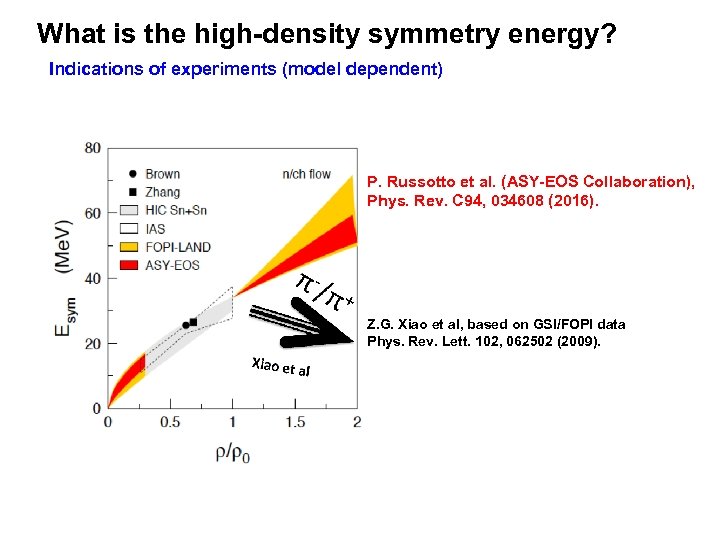
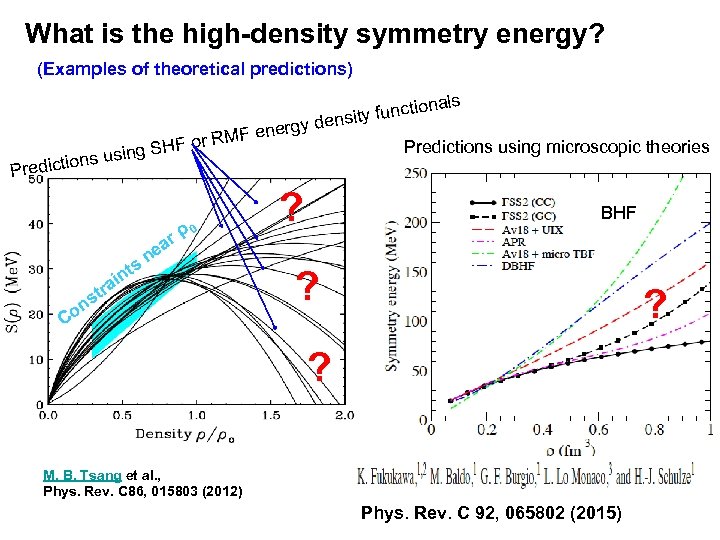 What is the high-density symmetry energy? (Examples of theoretical predictions) g SH ons usin Predicti ts in ra t rgy d ne r RMF e Fo ρ ar 0 ne s on als ion ity funct ens ? Predictions using microscopic theories BHF ? ? C ? M. B. Tsang et al. , Phys. Rev. C 86, 015803 (2012) Phys. Rev. C 92, 065802 (2015)
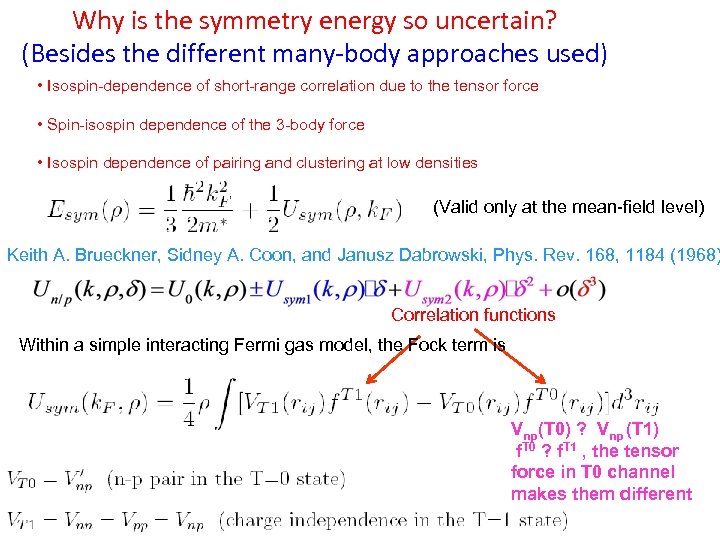 Why is the symmetry energy so uncertain? (Besides the different many-body approaches used) • Isospin-dependence of short-range correlation due to the tensor force • Spin-isospin dependence of the 3 -body force • Isospin dependence of pairing and clustering at low densities (Valid only at the mean-field level) Keith A. Brueckner, Sidney A. Coon, and Janusz Dabrowski, Phys. Rev. 168, 1184 (1968) Correlation functions Within a simple interacting Fermi gas model, the Fock term is Vnp(T 0) ? Vnp (T 1) f. T 0 ? f. T 1 , the tensor force in T 0 channel makes them different
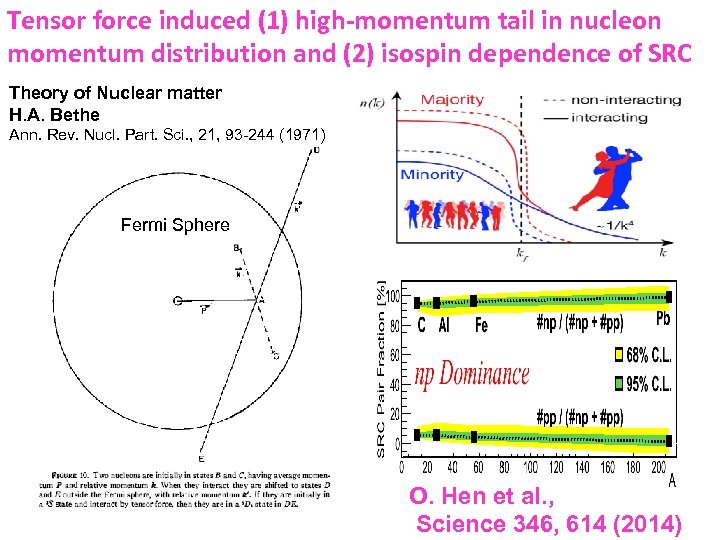 Tensor force induced (1) high-momentum tail in nucleon momentum distribution and (2) isospin dependence of SRC Theory of Nuclear matter H. A. Bethe Ann. Rev. Nucl. Part. Sci. , 21, 93 -244 (1971) Fermi Sphere O. Hen et al. , Science 346, 614 (2014)
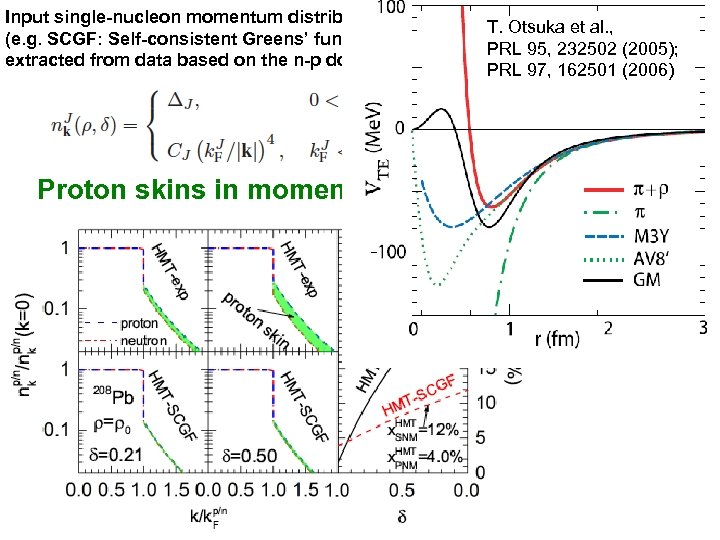 Input single-nucleon momentum distribution from many-body theories T. Otsuka et al. , (e. g. SCGF: Self-consistent Greens’ function approach) and/or information PRL 95, 232502 (2005); extracted from data based on the n-p dominance model PRL 97, 162501 (2006) Proton skins in momentum space
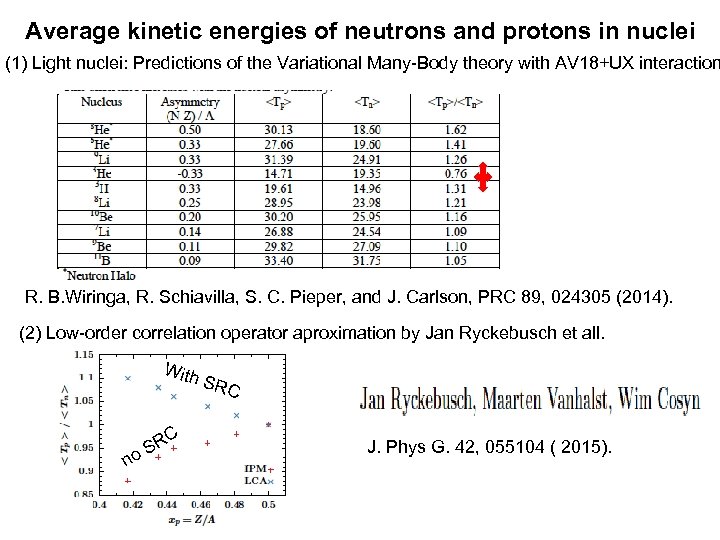
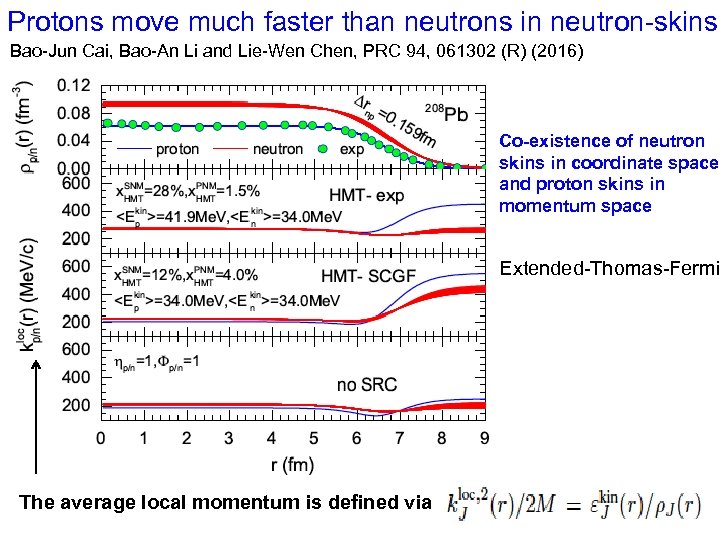 Protons move much faster than neutrons in neutron-skins Bao-Jun Cai, Bao-An Li and Lie-Wen Chen, PRC 94, 061302 (R) (2016) Co-existence of neutron skins in coordinate space and proton skins in momentum space Extended-Thomas-Fermi The average local momentum is defined via
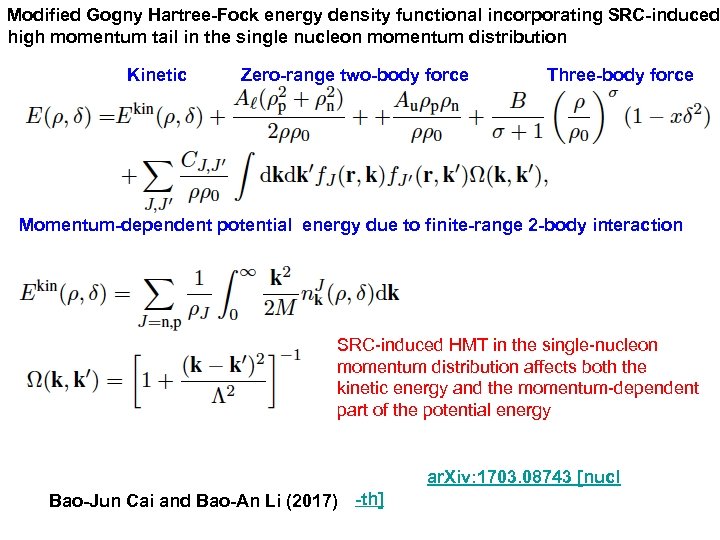 Modified Gogny Hartree-Fock energy density functional incorporating SRC-induced high momentum tail in the single nucleon momentum distribution Kinetic Zero-range two-body force Three-body force Momentum-dependent potential energy due to finite-range 2 -body interaction SRC-induced HMT in the single-nucleon momentum distribution affects both the kinetic energy and the momentum-dependent part of the potential energy ar. Xiv: 1703. 08743 [nucl Bao-Jun Cai and Bao-An Li (2017) -th]
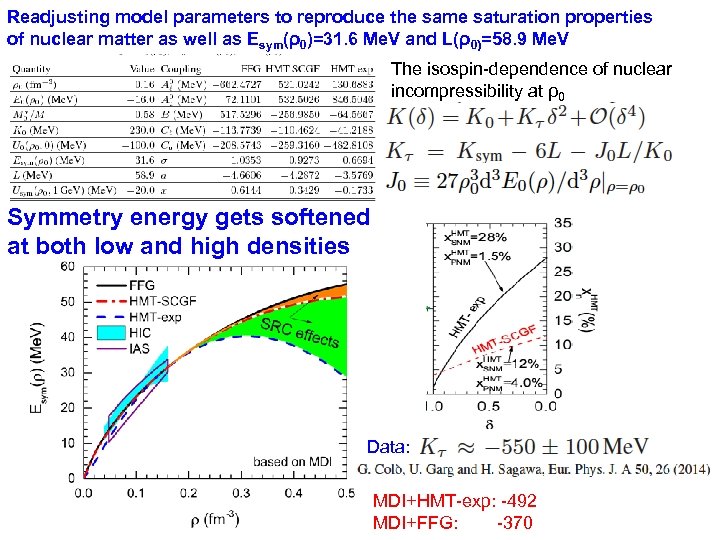 Readjusting model parameters to reproduce the same saturation properties of nuclear matter as well as Esym(ρ0)=31. 6 Me. V and L(ρ0)=58. 9 Me. V The isospin-dependence of nuclear incompressibility at ρ0 Symmetry energy gets softened at both low and high densities Data: MDI+HMT-exp: -492 MDI+FFG: -370
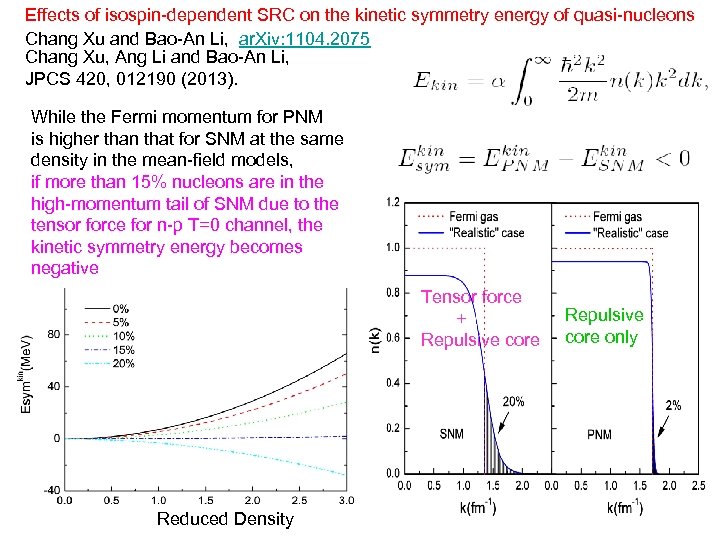
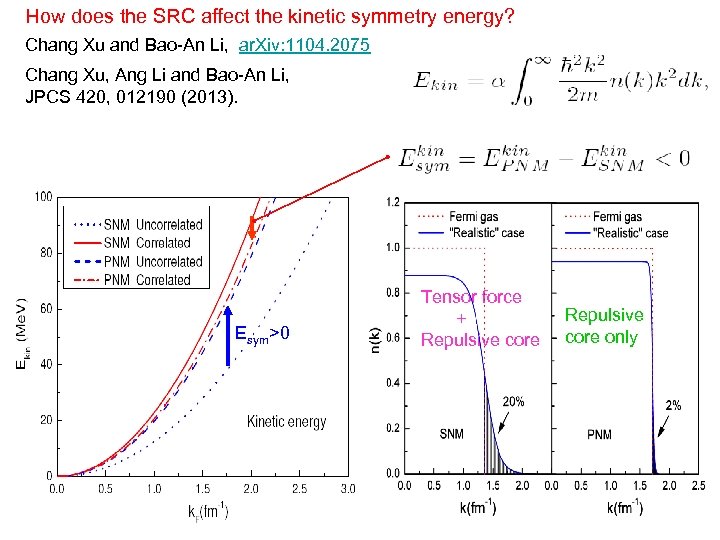 How does the SRC affect the kinetic symmetry energy? Chang Xu and Bao-An Li, ar. Xiv: 1104. 2075 Chang Xu, Ang Li and Bao-An Li, JPCS 420, 012190 (2013). Esym>0 Tensor force + Repulsive core only
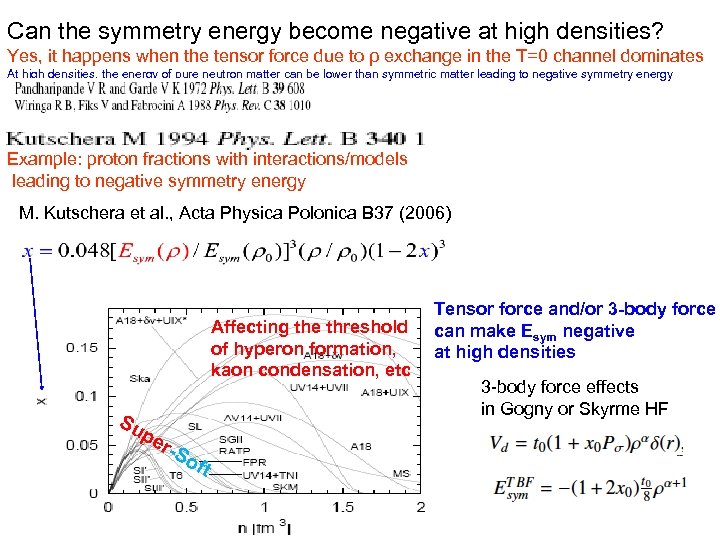 Can the symmetry energy become negative at high densities? Yes, it happens when the tensor force due to ρ exchange in the T=0 channel dominates At high densities, the energy of pure neutron matter can be lower than symmetric matter leading to negative symmetry energy Example: proton fractions with interactions/models leading to negative symmetry energy M. Kutschera et al. , Acta Physica Polonica B 37 (2006) Affecting the threshold of hyperon formation, kaon condensation, etc Su pe r-S oft Tensor force and/or 3 -body force can make Esym negative at high densities 3 -body force effects in Gogny or Skyrme HF
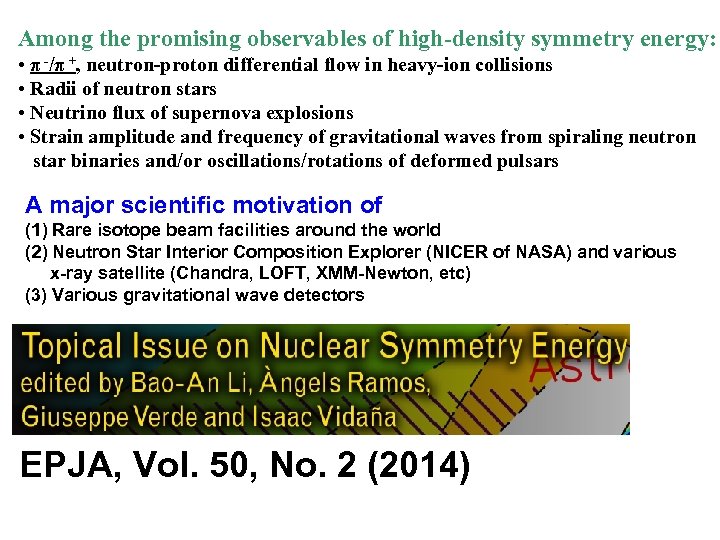 Among the promising observables of high-density symmetry energy: • π -/π +, neutron-proton differential flow in heavy-ion collisions • Radii of neutron stars • Neutrino flux of supernova explosions • Strain amplitude and frequency of gravitational waves from spiraling neutron star binaries and/or oscillations/rotations of deformed pulsars A major scientific motivation of (1) Rare isotope beam facilities around the world (2) Neutron Star Interior Composition Explorer (NICER of NASA) and various x-ray satellite (Chandra, LOFT, XMM-Newton, etc) (3) Various gravitational wave detectors EPJA, Vol. 50, No. 2 (2014)
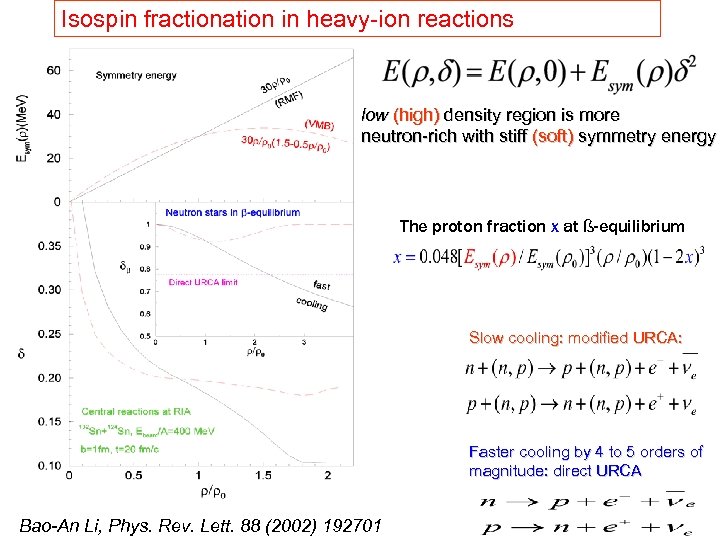 Isospin fractionation in heavy-ion reactions low (high) density region is more neutron-rich with stiff (soft) symmetry energy The proton fraction x at ß-equilibrium Slow cooling: modified URCA: Faster cooling by 4 to 5 orders of magnitude: direct URCA Bao-An Li, Phys. Rev. Lett. 88 (2002) 192701
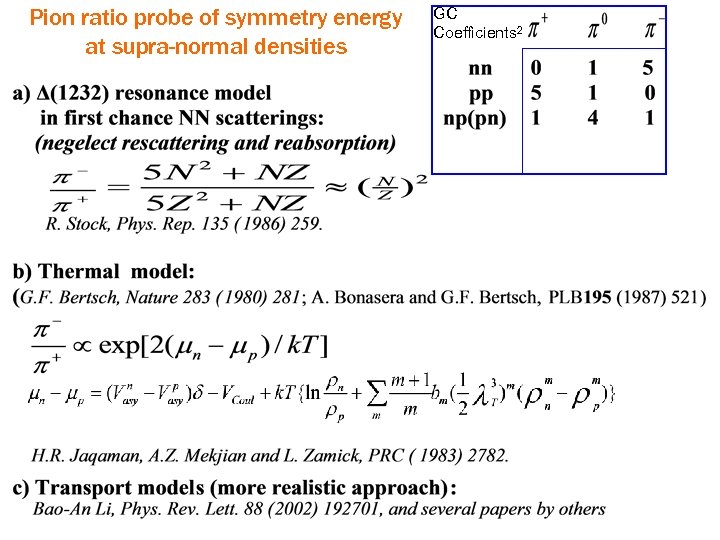
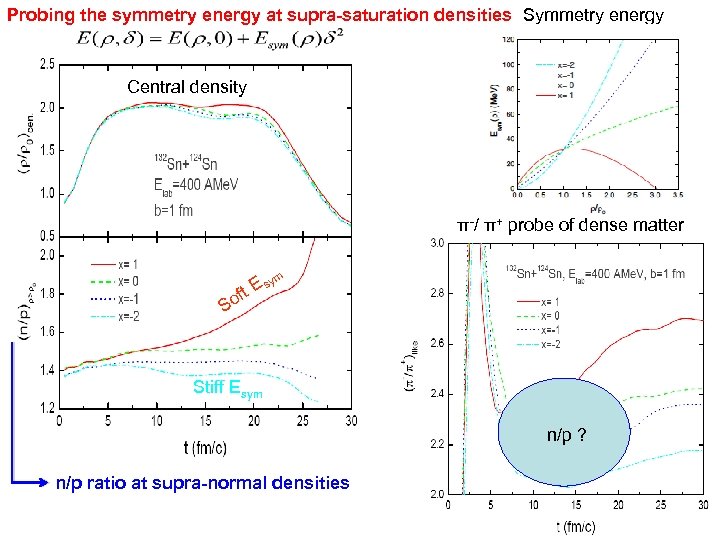 S ti ff Probing the symmetry energy at supra-saturation densities Symmetry energy Central density π-/ π+ probe of dense matter y t Es f m So Stiff Esym n/p ? n/p ratio at supra-normal densities
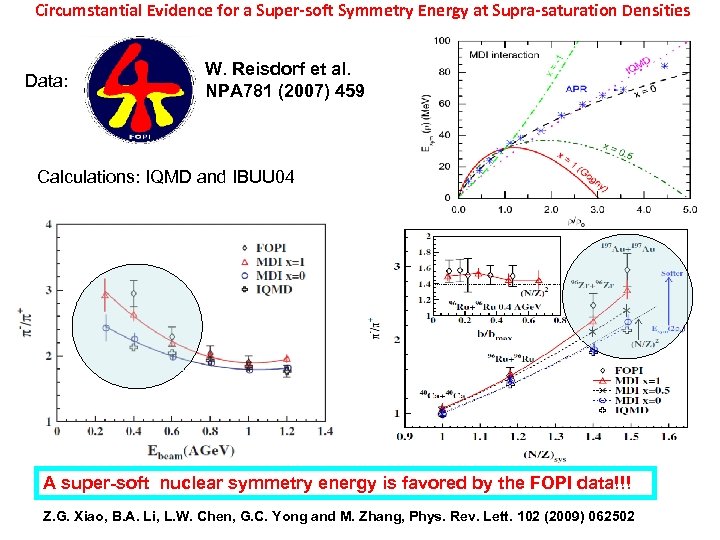 Circumstantial Evidence for a Super-soft Symmetry Energy at Supra-saturation Densities Data: W. Reisdorf et al. NPA 781 (2007) 459 Calculations: IQMD and IBUU 04 A super-soft nuclear symmetry energy is favored by the FOPI data!!! Z. G. Xiao, B. A. Li, L. W. Chen, G. C. Yong and M. Zhang, Phys. Rev. Lett. 102 (2009) 062502
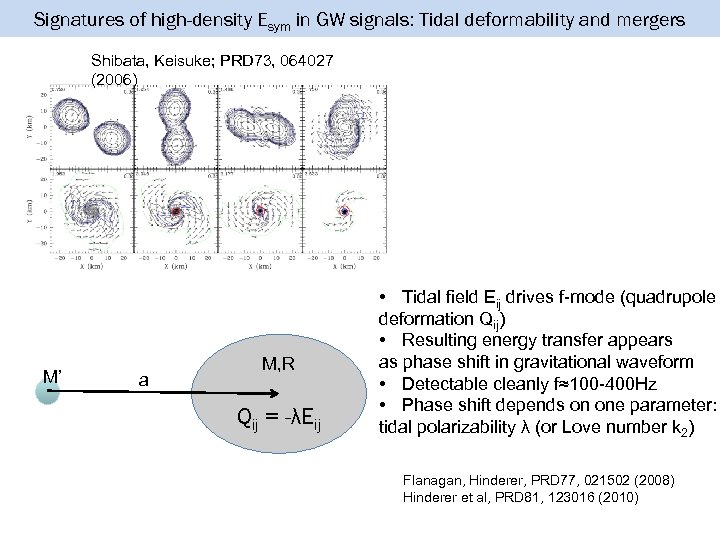 Signatures of high-density Esym in GW signals: Tidal deformability and mergers Shibata, Keisuke; PRD 73, 064027 (2006) M’ a M, R Qij = -λEij • Tidal field Eij drives f-mode (quadrupole deformation Qij) • Resulting energy transfer appears as phase shift in gravitational waveform • Detectable cleanly f≈100 -400 Hz • Phase shift depends on one parameter: tidal polarizability λ (or Love number k 2) Flanagan, Hinderer, PRD 77, 021502 (2008) Hinderer et al, PRD 81, 123016 (2010)
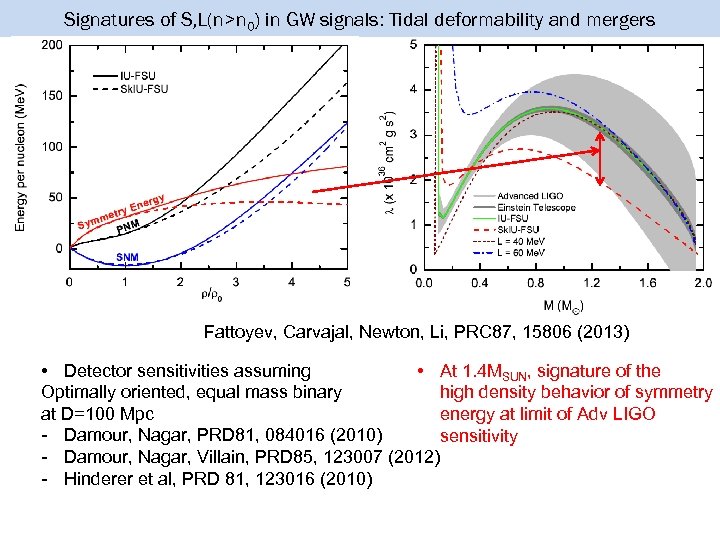 Signatures of S, L(n>n 0) in GW signals: Tidal deformability and mergers Fattoyev, Carvajal, Newton, Li, PRC 87, 15806 (2013) • Detector sensitivities assuming • At 1. 4 MSUN, signature of the Optimally oriented, equal mass binary high density behavior of symmetry at D=100 Mpc energy at limit of Adv LIGO - Damour, Nagar, PRD 81, 084016 (2010) sensitivity - Damour, Nagar, Villain, PRD 85, 123007 (2012) - Hinderer et al, PRD 81, 123016 (2010)
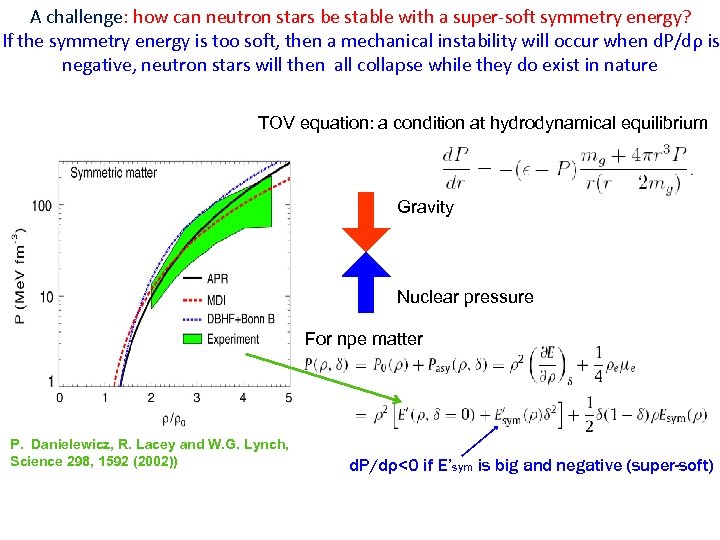 A challenge: how can neutron stars be stable with a super-soft symmetry energy? If the symmetry energy is too soft, then a mechanical instability will occur when d. P/dρ is negative, neutron stars will then all collapse while they do exist in nature TOV equation: a condition at hydrodynamical equilibrium Gravity Nuclear pressure For npe matter P. Danielewicz, R. Lacey and W. G. Lynch, Science 298, 1592 (2002)) d. P/dρ<0 if E’sym is big and negative (super-soft)
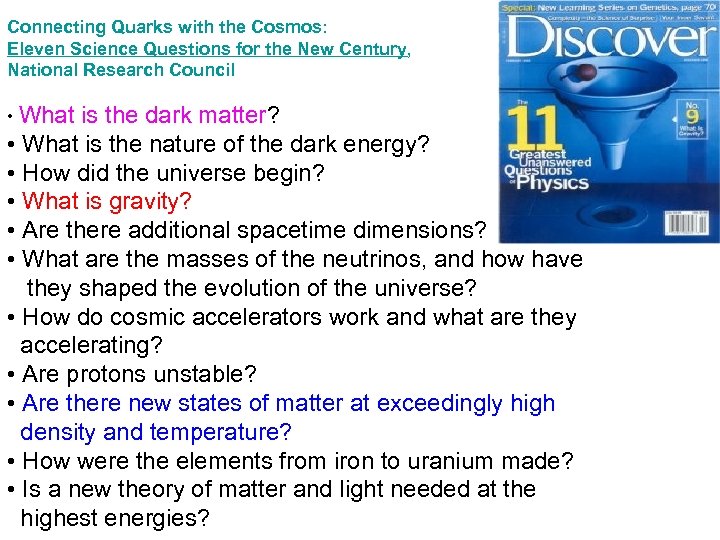 Connecting Quarks with the Cosmos: Eleven Science Questions for the New Century, National Research Council • What is the dark matter? • What is the nature of the dark energy? • How did the universe begin? • What is gravity? • Are there additional spacetime dimensions? • What are the masses of the neutrinos, and how have they shaped the evolution of the universe? • How do cosmic accelerators work and what are they accelerating? • Are protons unstable? • Are there new states of matter at exceedingly high density and temperature? • How were the elements from iron to uranium made? • Is a new theory of matter and light needed at the highest energies?
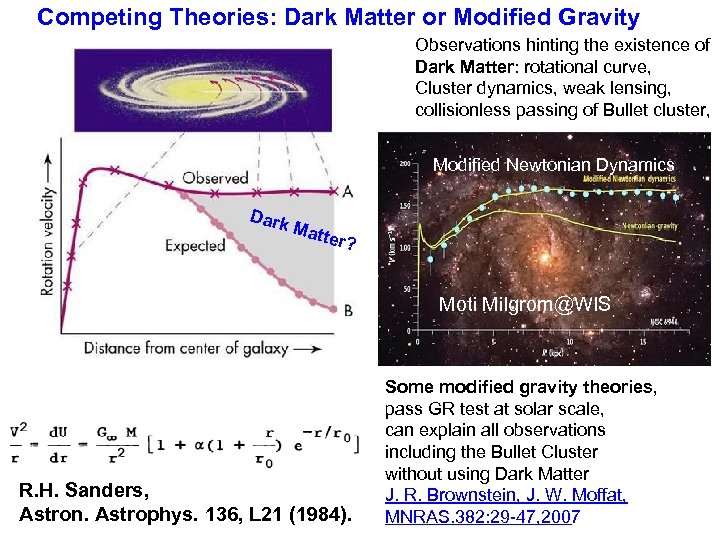 Competing Theories: Dark Matter or Modified Gravity Observations hinting the existence of Dark Matter: rotational curve, Cluster dynamics, weak lensing, collisionless passing of Bullet cluster, …. Modified Newtonian Dynamics Dark Matt er? Moti Milgrom@WIS R. H. Sanders, Astron. Astrophys. 136, L 21 (1984). Some modified gravity theories, pass GR test at solar scale, can explain all observations including the Bullet Cluster without using Dark Matter J. R. Brownstein, J. W. Moffat, MNRAS. 382: 29 -47, 2007
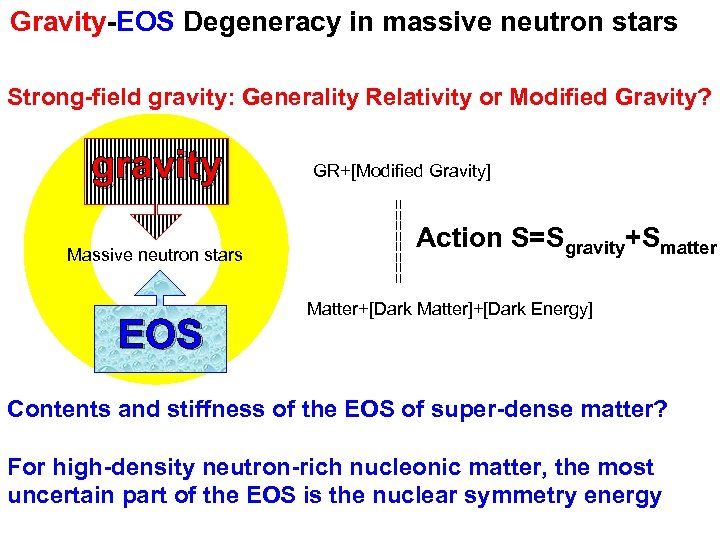 Gravity-EOS Degeneracy in massive neutron stars Strong-field gravity: Generality Relativity or Modified Gravity? ? gravity EOS ==== Massive neutron stars GR+[Modified Gravity] Action S=Sgravity+Smatter Matter+[Dark Matter]+[Dark Energy] ? Contents and stiffness of the EOS of super-dense matter? For high-density neutron-rich nucleonic matter, the most uncertain part of the EOS is the nuclear symmetry energy
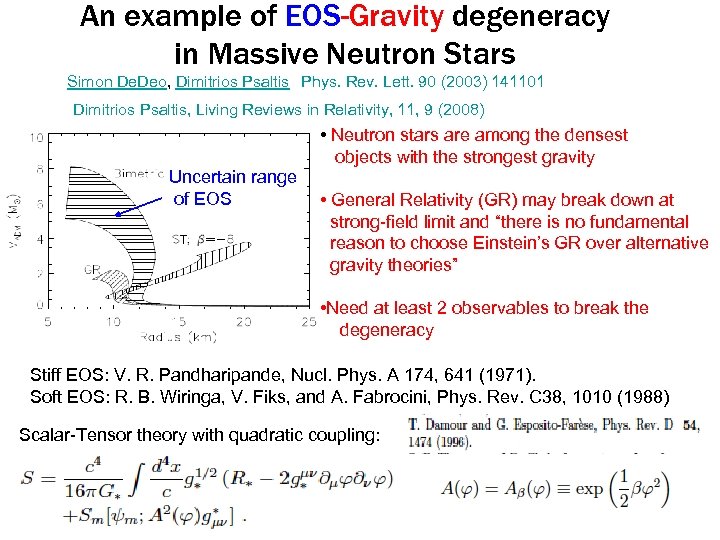 An example of EOS-Gravity degeneracy in Massive Neutron Stars Simon De. Deo, Dimitrios Psaltis Phys. Rev. Lett. 90 (2003) 141101 Dimitrios Psaltis, Living Reviews in Relativity, 11, 9 (2008) • Neutron stars are among the densest objects with the strongest gravity Uncertain range of EOS • General Relativity (GR) may break down at strong-field limit and “there is no fundamental reason to choose Einstein’s GR over alternative gravity theories” • Need at least 2 observables to break the degeneracy Stiff EOS: V. R. Pandharipande, Nucl. Phys. A 174, 641 (1971). Soft EOS: R. B. Wiringa, V. Fiks, and A. Fabrocini, Phys. Rev. C 38, 1010 (1988) Scalar-Tensor theory with quadratic coupling:
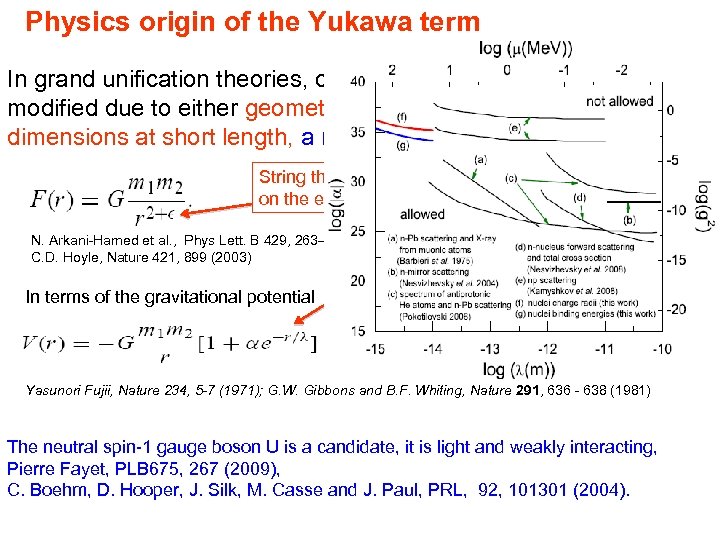 Physics origin of the Yukawa term In grand unification theories, conventional gravity has to be modified due to either geometrical effects of extra space-time dimensions at short length, a new boson or the 5 th force String theorists have published TONS of papers on the extra space-time dimensions N. Arkani-Hamed et al. , Phys Lett. B 429, 263– 272 (1998); J. C. Long et al. , Nature 421, 922 (2003); C. D. Hoyle, Nature 421, 899 (2003) In terms of the gravitational potential Yukawa potential due to the exchange of a new boson proposed in the super-symmetric extension of the Standard Model of the Grand Unification Theory, or the fifth force Yasunori Fujii, Nature 234, 5 -7 (1971); G. W. Gibbons and B. F. Whiting, Nature 291, 636 - 638 (1981) The neutral spin-1 gauge boson U is a candidate, it is light and weakly interacting, Pierre Fayet, PLB 675, 267 (2009), C. Boehm, D. Hooper, J. Silk, M. Casse and J. Paul, PRL, 92, 101301 (2004).
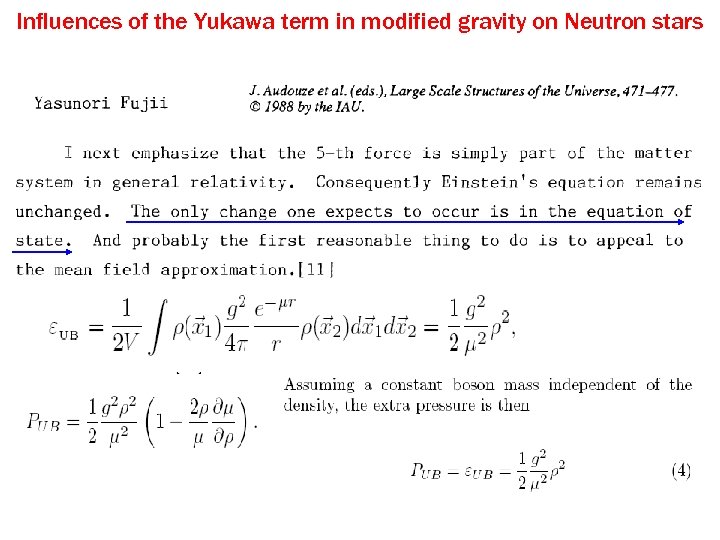 Influences of the Yukawa term in modified gravity on Neutron stars
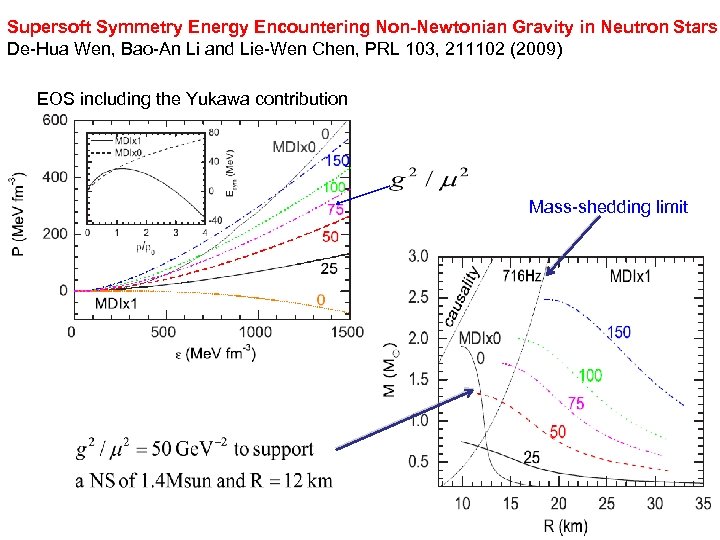 Supersoft Symmetry Energy Encountering Non-Newtonian Gravity in Neutron Stars De-Hua Wen, Bao-An Li and Lie-Wen Chen, PRL 103, 211102 (2009) EOS including the Yukawa contribution Mass-shedding limit
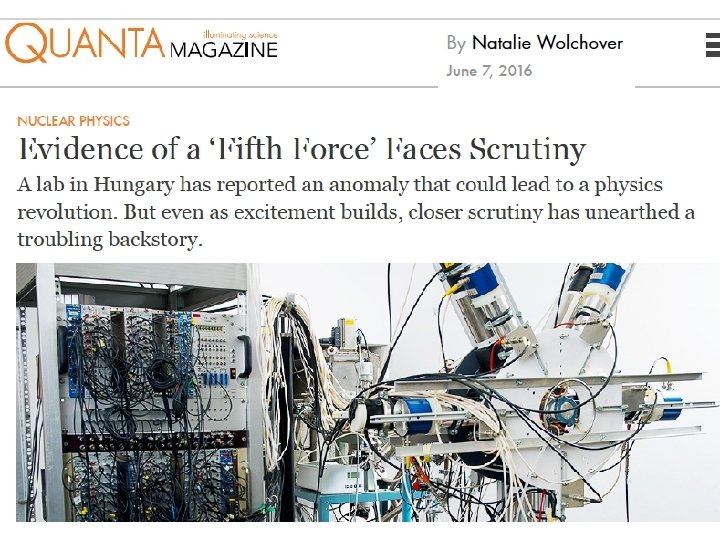
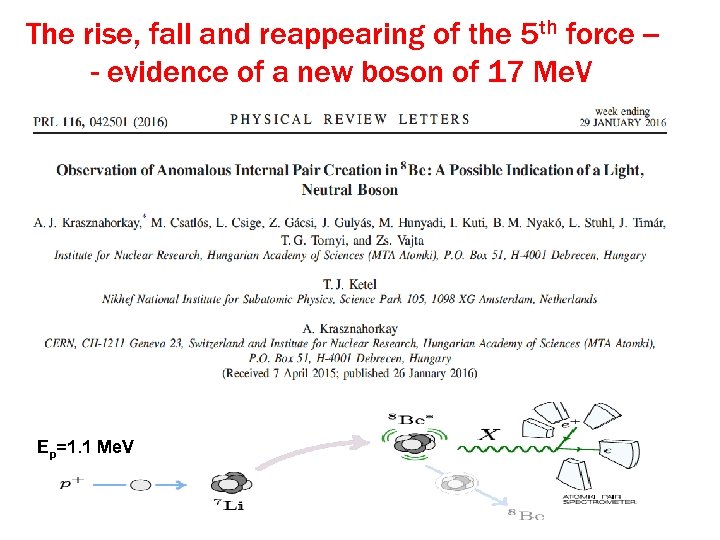 The rise, fall and reappearing of the 5 th force -- evidence of a new boson of 17 Me. V Ep=1. 1 Me. V
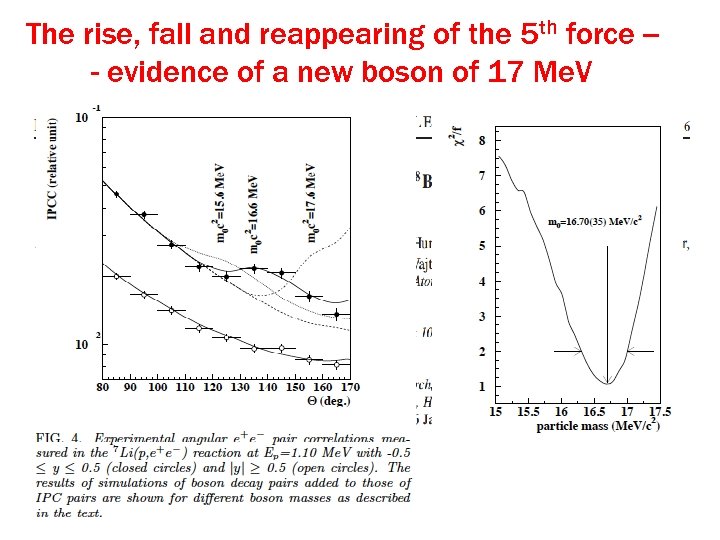 The rise, fall and reappearing of the 5 th force -- evidence of a new boson of 17 Me. V
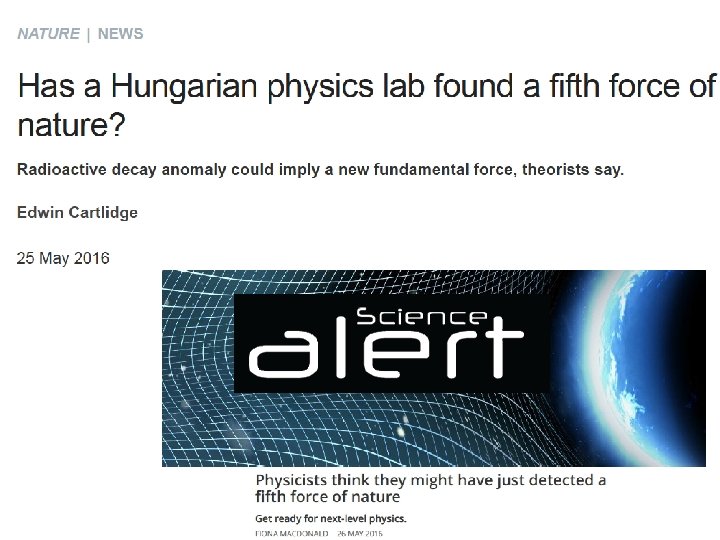
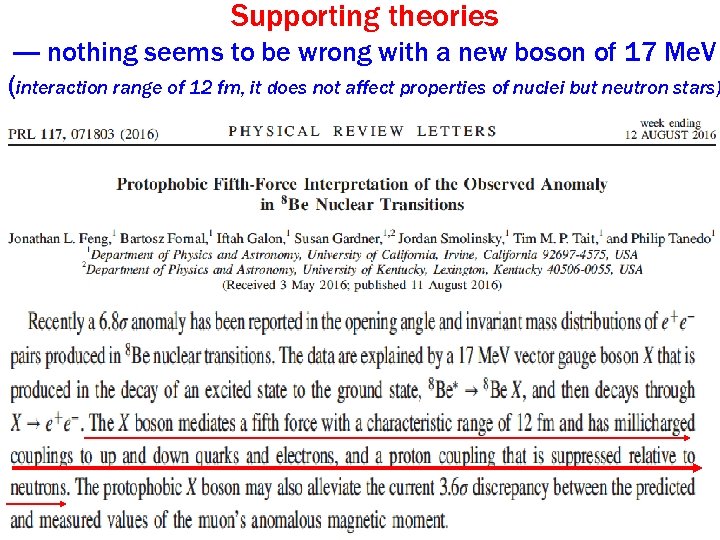 Supporting theories ---- nothing seems to be wrong with a new boson of 17 Me. V (interaction range of 12 fm, it does not affect properties of nuclei but neutron stars)
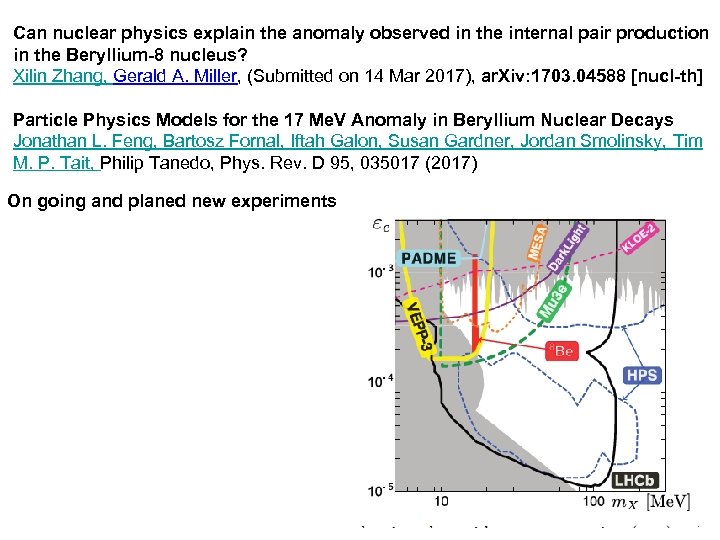 Can nuclear physics explain the anomaly observed in the internal pair production in the Beryllium-8 nucleus? Xilin Zhang, Gerald A. Miller, (Submitted on 14 Mar 2017), ar. Xiv: 1703. 04588 [nucl-th] Particle Physics Models for the 17 Me. V Anomaly in Beryllium Nuclear Decays Jonathan L. Feng, Bartosz Fornal, Iftah Galon, Susan Gardner, Jordan Smolinsky, Tim M. P. Tait, Philip Tanedo, Phys. Rev. D 95, 035017 (2017) On going and planed new experiments
 Summary • The study of nuclear symmetry energy and its astrophysical impacts is Exciting! • Symmetry energy at supra-saturation densities is the most uncertain part of the EOS of dense neutron-rich nucleonic matter • Symmetry energy has significant effects on terrestrial experiments and astrophysical observables
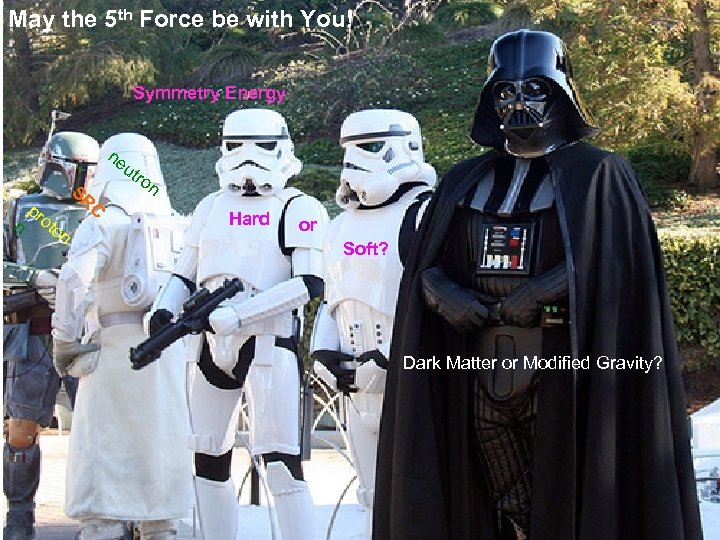 May the 5 th Force be with You! Symmetry Energy ne pr n oto n SR ut C ro n Hard or Soft? Dark Matter or Modified Gravity?
 What is the high-density symmetry energy? Indications of experiments (model dependent) P. Russotto et al. (ASY-EOS Collaboration), Phys. Rev. C 94, 034608 (2016). Z. G. Xiao et al, based on GSI/FOPI data Phys. Rev. Lett. 102, 062502 (2009).
 Effects of isospin-dependent SRC on the kinetic symmetry energy of quasi-nucleons Chang Xu and Bao-An Li, ar. Xiv: 1104. 2075 Chang Xu, Ang Li and Bao-An Li, JPCS 420, 012190 (2013). While the Fermi momentum for PNM is higher than that for SNM at the same density in the mean-field models, if more than 15% nucleons are in the high-momentum tail of SNM due to the tensor force for n-p T=0 channel, the kinetic symmetry energy becomes negative Tensor force + Repulsive core Reduced Density Repulsive core only
 Pion ratio probe of symmetry energy at supra-normal densities GC Coefficients 2
 Average kinetic energies of neutrons and protons in nuclei (1) Light nuclei: Predictions of the Variational Many-Body theory with AV 18+UX interaction R. B. Wiringa, R. Schiavilla, S. C. Pieper, and J. Carlson, PRC 89, 024305 (2014). (2) Low-order correlation operator aproximation by Jan Ryckebusch et all. With n C SR o SRC J. Phys G. 42, 055104 ( 2015).
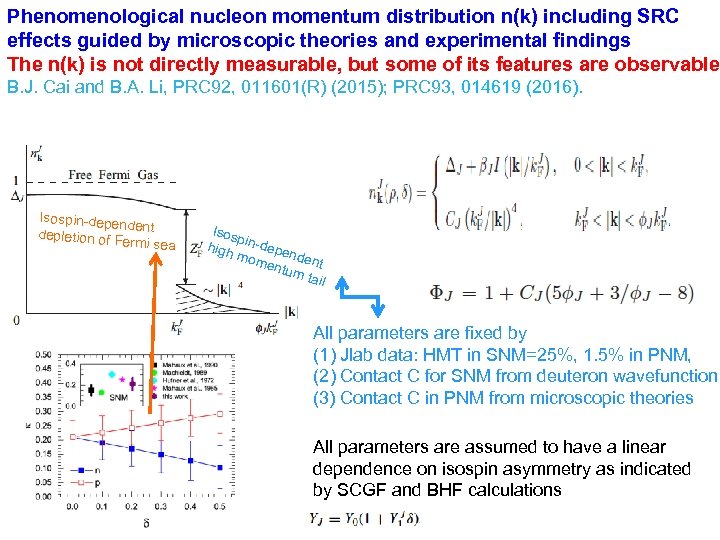 Phenomenological nucleon momentum distribution n(k) including SRC effects guided by microscopic theories and experimental findings The n(k) is not directly measurable, but some of its features are observable B. J. Cai and B. A. Li, PRC 92, 011601(R) (2015); PRC 93, 014619 (2016). Isospin-depen dent depletion of F ermi sea Isos p high in-depe nd mom entu ent m ta il All parameters are fixed by (1) Jlab data: HMT in SNM=25%, 1. 5% in PNM, (2) Contact C for SNM from deuteron wavefunction (3) Contact C in PNM from microscopic theories All parameters are assumed to have a linear dependence on isospin asymmetry as indicated by SCGF and BHF calculations
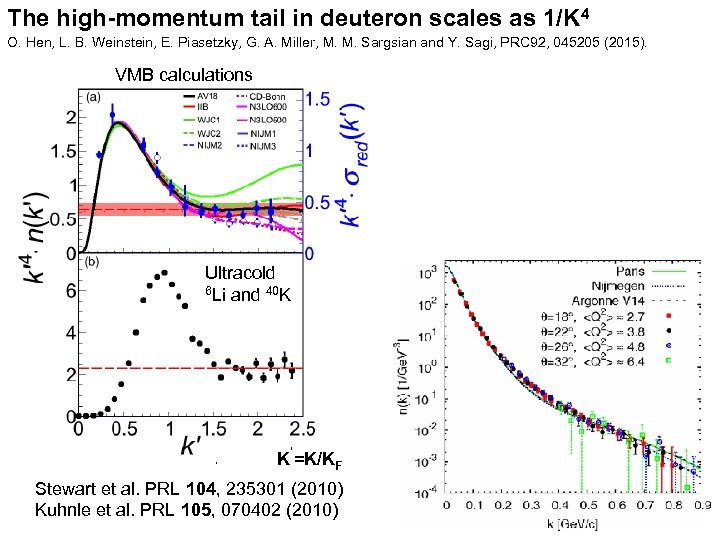 The high-momentum tail in deuteron scales as 1/K 4 O. Hen, L. B. Weinstein, E. Piasetzky, G. A. Miller, M. M. Sargsian and Y. Sagi, PRC 92, 045205 (2015). VMB calculations Ultracold 6 Li and 40 K =k/k. F K’=K/KF Stewart et al. PRL 104, 235301 (2010) Kuhnle et al. PRL 105, 070402 (2010)
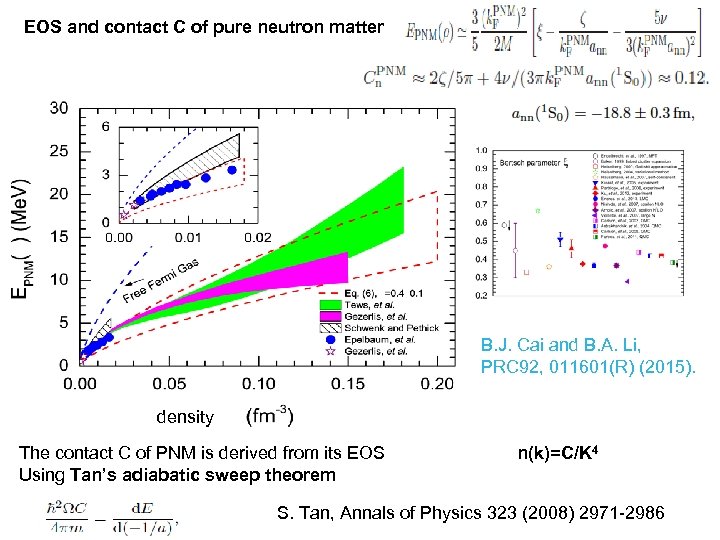 EOS and contact C of pure neutron matter B. J. Cai and B. A. Li, PRC 92, 011601(R) (2015). density The contact C of PNM is derived from its EOS Using Tan’s adiabatic sweep theorem n(k)=C/K 4 S. Tan, Annals of Physics 323 (2008) 2971 -2986
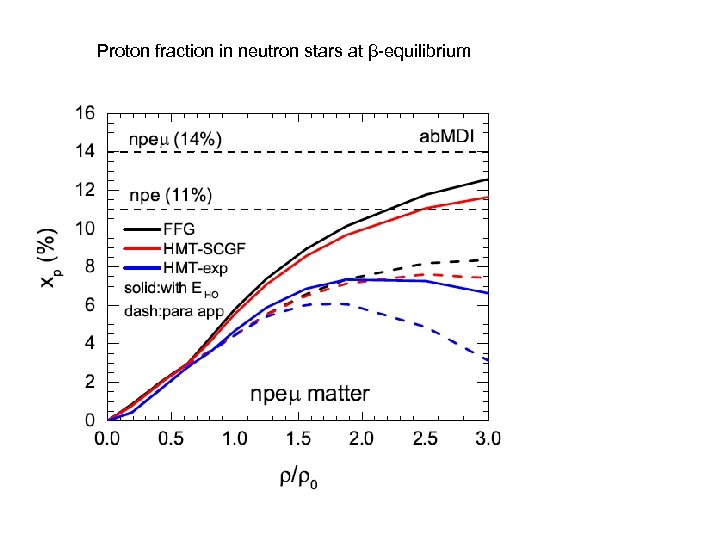 Proton fraction in neutron stars at β-equilibrium
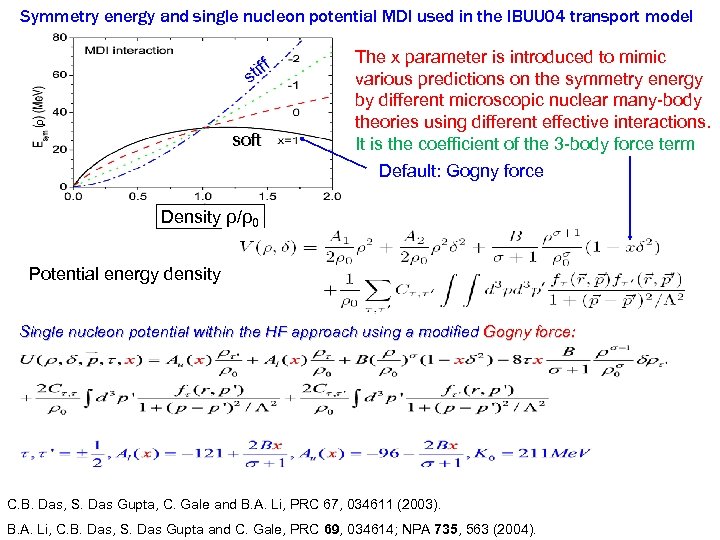 Symmetry energy and single nucleon potential MDI used in the IBUU 04 transport model ρ tiff s soft The x parameter is introduced to mimic various predictions on the symmetry energy by different microscopic nuclear many-body theories using different effective interactions. It is the coefficient of the 3 -body force term Default: Gogny force Density ρ/ρ0 Potential energy density Single nucleon potential within the HF approach using a modified Gogny force: C. B. Das, S. Das Gupta, C. Gale and B. A. Li, PRC 67, 034611 (2003). B. A. Li, C. B. Das, S. Das Gupta and C. Gale, PRC 69, 034614; NPA 735, 563 (2004).
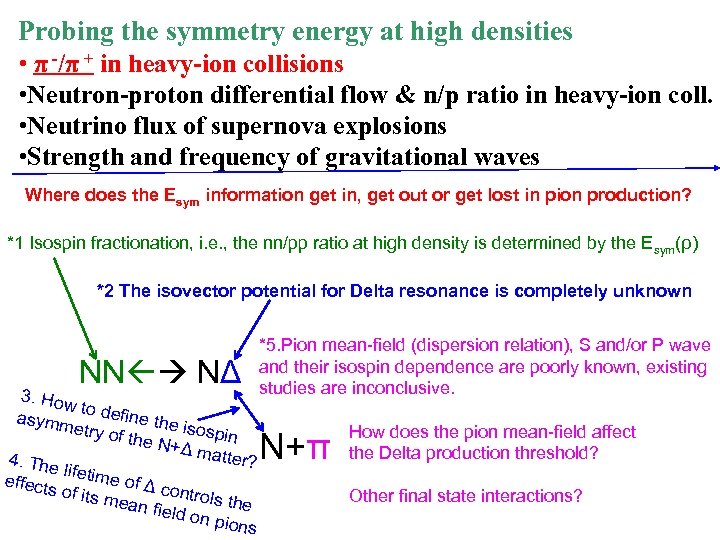 Probing the symmetry energy at high densities • π -/π + in heavy-ion collisions • Neutron-proton differential flow & n/p ratio in heavy-ion coll. • Neutrino flux of supernova explosions • Strength and frequency of gravitational waves Where does the Esym information get in, get out or get lost in pion production? *1 Isospin fractionation, i. e. , the nn/pp ratio at high density is determined by the Esym(ρ) *2 The isovector potential for Delta resonance is completely unknown NN NΔ 3. How t asymm o define the is etry of the N+ ospin Δ matt er? 4. The lifetime effects o of its m f Δ controls th ean fie ld on p e ions *5. Pion mean-field (dispersion relation), S and/or P wave and their isospin dependence are poorly known, existing studies are inconclusive. N+π How does the pion mean-field affect the Delta production threshold? Other final state interactions?
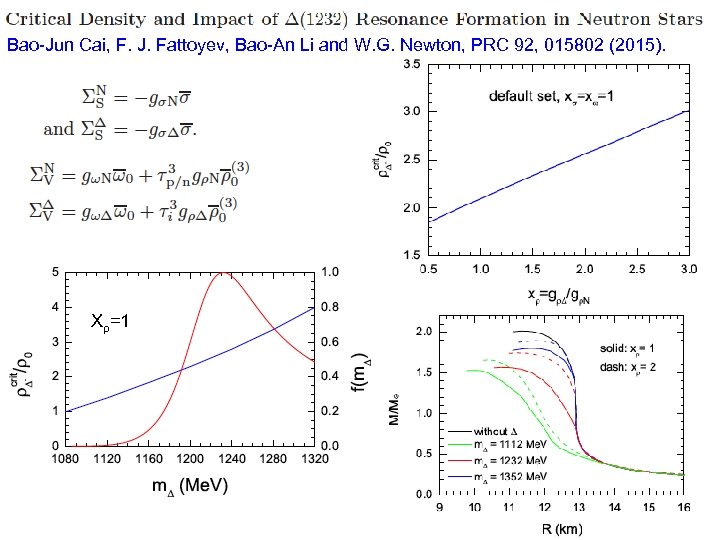 Bao-Jun Cai, F. J. Fattoyev, Bao-An Li and W. G. Newton, PRC 92, 015802 (2015). Xρ=1
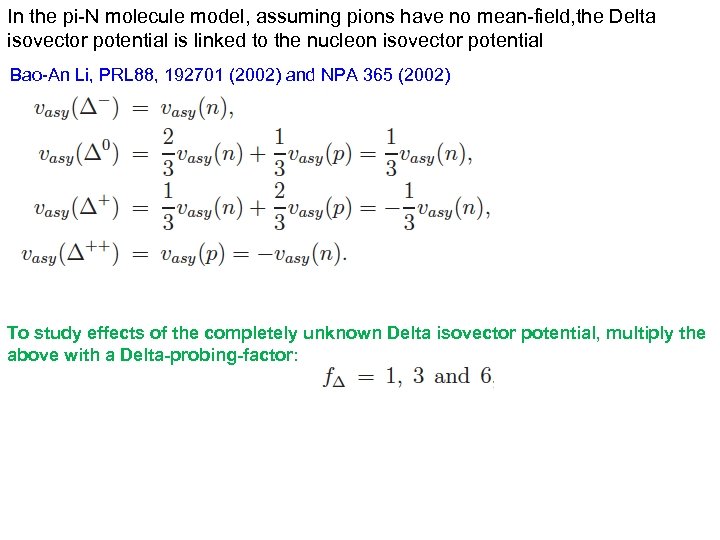 In the pi-N molecule model, assuming pions have no mean-field, the Delta isovector potential is linked to the nucleon isovector potential Bao-An Li, PRL 88, 192701 (2002) and NPA 365 (2002) To study effects of the completely unknown Delta isovector potential, multiply the above with a Delta-probing-factor:
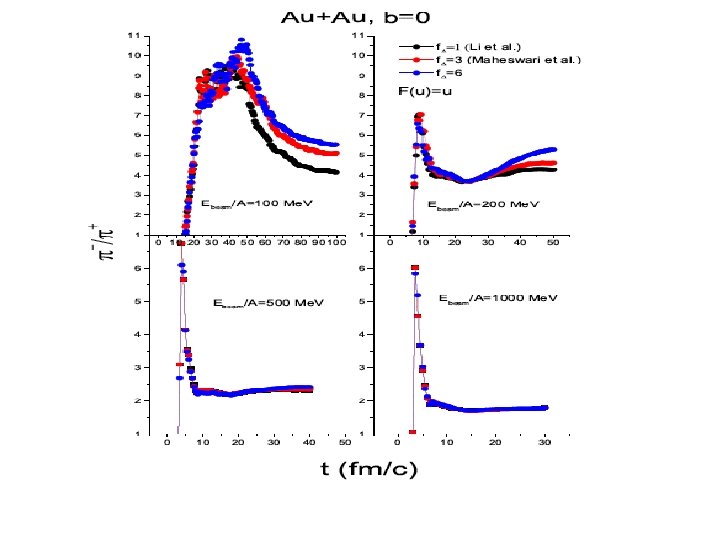
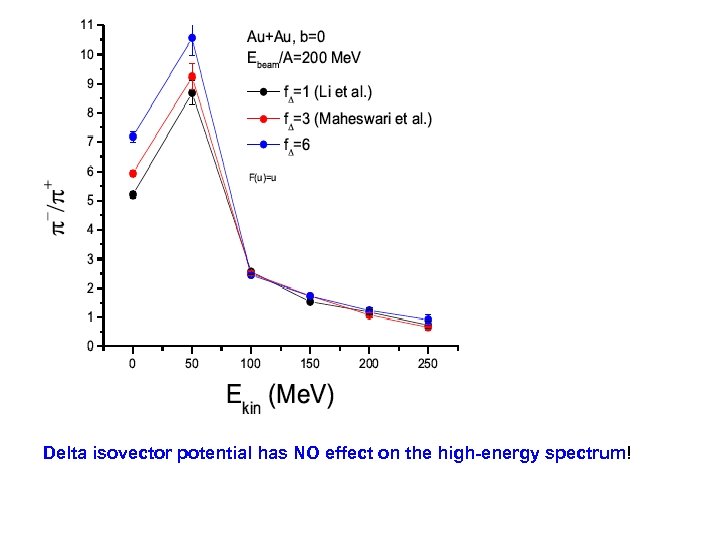 Delta isovector potential has NO effect on the high-energy spectrum!
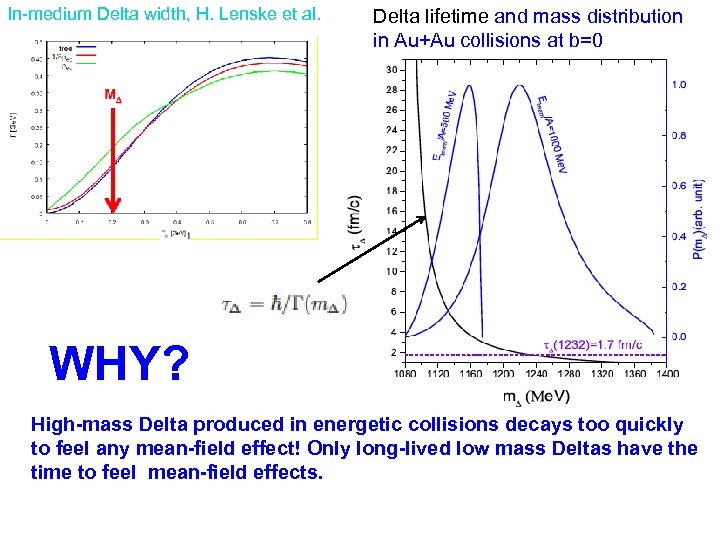 In-medium Delta width, H. Lenske et al. Delta lifetime and mass distribution in Au+Au collisions at b=0 WHY? High-mass Delta produced in energetic collisions decays too quickly to feel any mean-field effect! Only long-lived low mass Deltas have the time to feel mean-field effects.
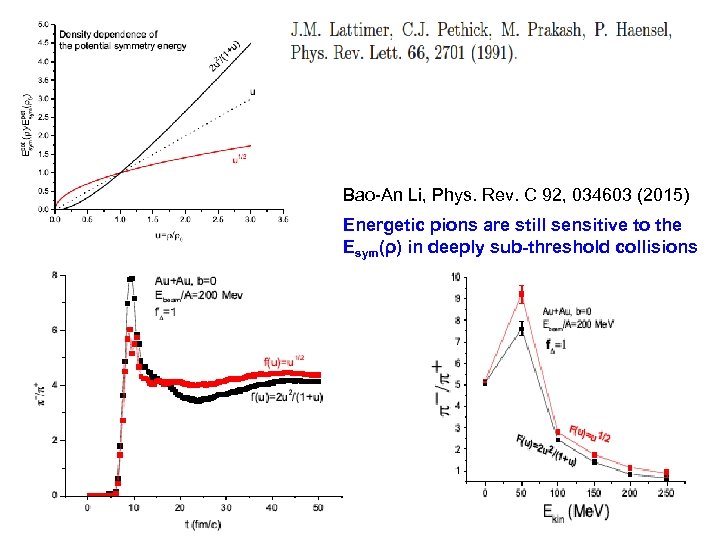 Bao-An Li, Phys. Rev. C 92, 034603 (2015) Energetic pions are still sensitive to the Esym(ρ) in deeply sub-threshold collisions
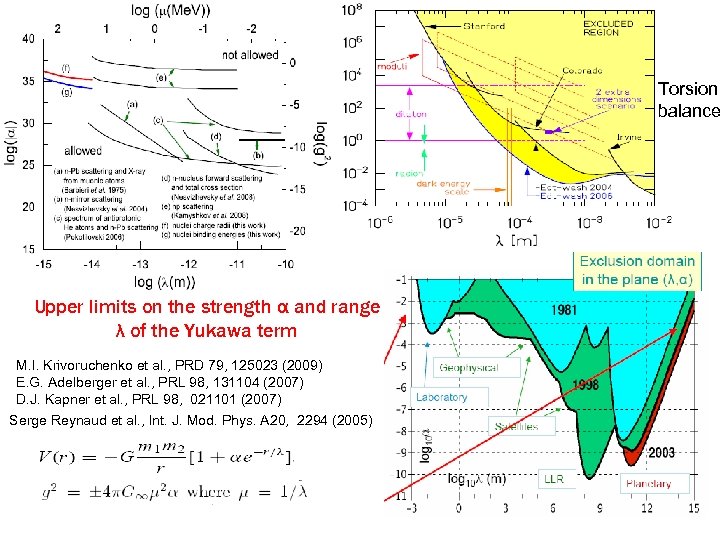 Torsion balance Upper limits on the strength α and range λ of the Yukawa term M. I. Krivoruchenko et al. , PRD 79, 125023 (2009) E. G. Adelberger et al. , PRL 98, 131104 (2007) D. J. Kapner et al. , PRL 98, 021101 (2007) Serge Reynaud et al. , Int. J. Mod. Phys. A 20, 2294 (2005)
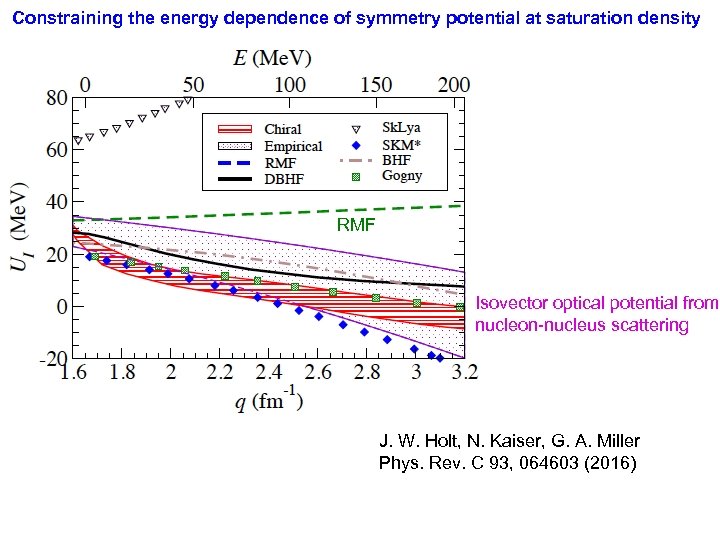 Constraining the energy dependence of symmetry potential at saturation density RMF Isovector optical potential from nucleon-nucleus scattering J. W. Holt, N. Kaiser, G. A. Miller Phys. Rev. C 93, 064603 (2016)
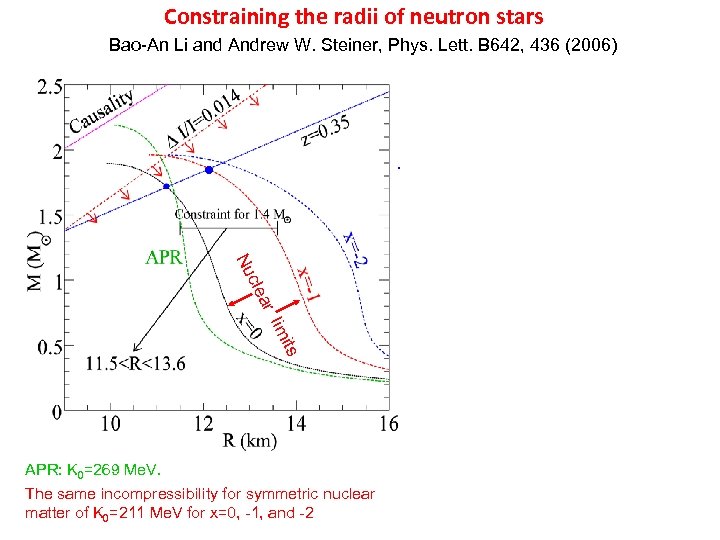 Constraining the radii of neutron stars Bao-An Li and Andrew W. Steiner, Phys. Lett. B 642, 436 (2006) . ● ar cle Nu lim its APR: K 0=269 Me. V. The same incompressibility for symmetric nuclear matter of K 0=211 Me. V for x=0, -1, and -2
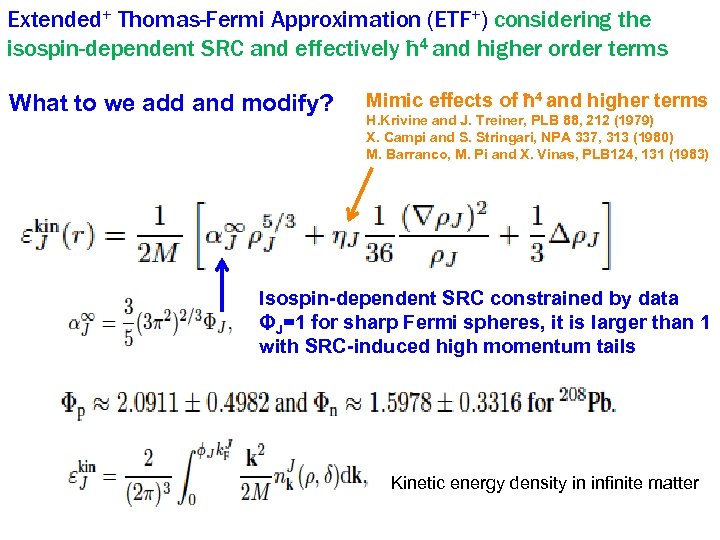 Extended+ Thomas-Fermi Approximation (ETF+) considering the isospin-dependent SRC and effectively ħ 4 and higher order terms What to we add and modify? Mimic effects of ħ 4 and higher terms H. Krivine and J. Treiner, PLB 88, 212 (1979) X. Campi and S. Stringari, NPA 337, 313 (1980) M. Barranco, M. Pi and X. Vinas, PLB 124, 131 (1983) Isospin-dependent SRC constrained by data ΦJ=1 for sharp Fermi spheres, it is larger than 1 with SRC-induced high momentum tails Kinetic energy density in infinite matter
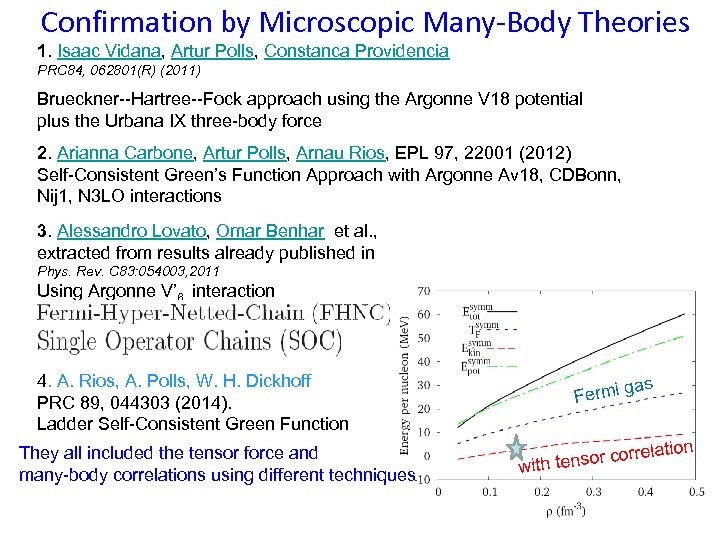 Confirmation by Microscopic Many-Body Theories 1. Isaac Vidana, Artur Polls, Constanca Providencia PRC 84, 062801(R) (2011) Brueckner--Hartree--Fock approach using the Argonne V 18 potential plus the Urbana IX three-body force 2. Arianna Carbone, Artur Polls, Arnau Rios, EPL 97, 22001 (2012) Self-Consistent Green’s Function Approach with Argonne Av 18, CDBonn, Nij 1, N 3 LO interactions 3. Alessandro Lovato, Omar Benhar et al. , extracted from results already published in Phys. Rev. C 83: 054003, 2011 Using Argonne V’ 6 interaction 4. A. Rios, A. Polls, W. H. Dickhoff PRC 89, 044303 (2014). Ladder Self-Consistent Green Function They all included the tensor force and many-body correlations using different techniques as g Fermi relation cor ith tensor w
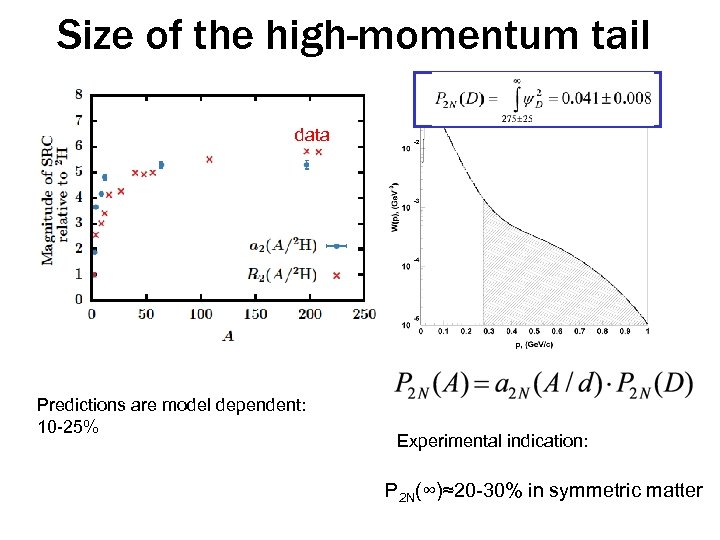 Size of the high-momentum tail data Predictions are model dependent: 10 -25% Experimental indication: P 2 N(∞)≈20 -30% in symmetric matter
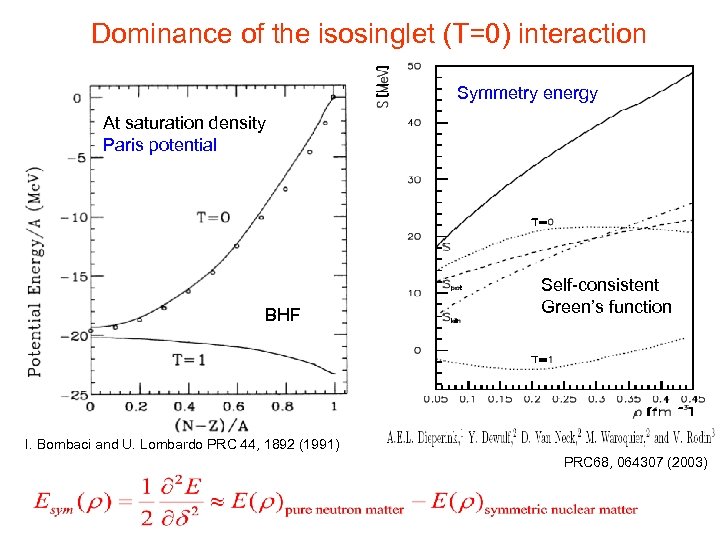 Dominance of the isosinglet (T=0) interaction Symmetry energy At saturation density Paris potential BHF Self-consistent Green’s function I. Bombaci and U. Lombardo PRC 44, 1892 (1991) PRC 68, 064307 (2003)