 Скачать презентацию Symbolic interactionism is trend in sociology
Symbolic Interactionism.pptx
- Количество слайдов: 12



*
*Symbolic interactionism is trend in sociology and social psychology, mainly American, focused on the interaction of individuals and their ability to interpret each other's behavior. Elements of the interaction are called interactions. Interpretation of the behavior of another possible thanks to the symbolic component of this behavior. Symbolic interactionism is derived from the work of George Herbert Mead, who argued that people's selves are social products, but that these selves are also purposive and creative.
*Herbert Blumer, a student and interpreter of Mead, coined the term "symbolic interactionism" and put forward an influential summary of the perspective: people act toward things based on the meaning those things have for them; and these meanings are derived from social interaction and modified through interpretation.
* *George Herbert Mead (1863 -1931) - American philosopher, sociologist *According to Mead, the society and the social individual (social "I") is stated in the set of processes of interindividual interactions. Taking the role of another stage - the stages of transformation in the body's physiology reflexive social "I". *Thus, the basic concept of symbolic interactionism interaction (Interaction). And this interaction is an exchange of symbols. *Interactions are carried out through language, through the exchange of gestures and symbols.
* *To interact, people need to interpret values and intentions of others. This is accomplished through a process that Mead defined as "taking the role. " Process “taking the role” involves that the individual by the imagination puts himself in the person with whom communication is carried out. *Through the taking the role individuals develop "self" - the ability of people to present themselves as objects of their own thoughts, that converts the external social control in self-control.
* Mead distinguishes between two aspects of the formation of the self: * 1. I (I) - this is what I think about others and about myself, this is my inner world. * 2. I (Me) - is that, in my opinion, other people think about me, it's my social external shell, as I conceive it. * Individual, believes Mead, develops self-awareness at a time when he sees himself as others see him. Concept of self is not innate, its origin is entirely social.
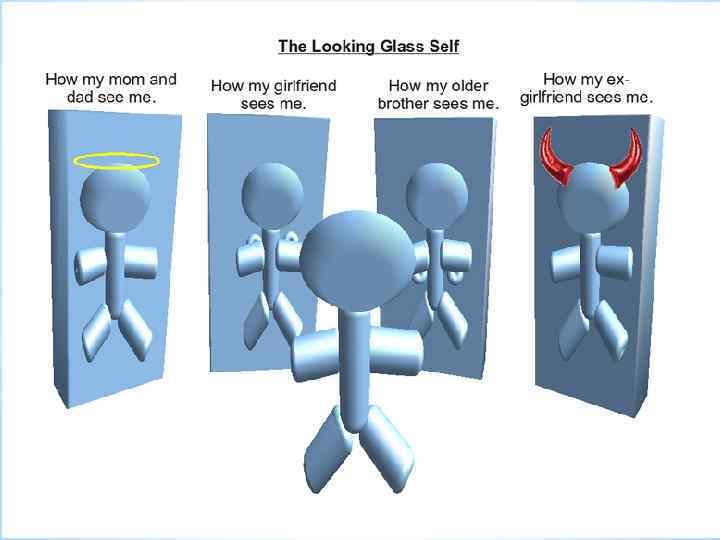
* *The looking-glass self is a social psychological concept, created by Charles Horton Cooley stating that a person's self grows out of society's interpersonal interactions and the perceptions of others. The term refers to people shaping their self-concepts based on their understanding of how others perceive them.
*The Looking Glass Self has three major components and is unique to humans. According to Lisa Mc. Intyre’s The Practical Skeptic: Core Concepts in Sociology, in the looking-glass self a person views himself or herself through others' perceptions in society and in turn gains identity. Identity, or self, is the result of the concept in which we learn to see ourselves as others do. The looking-glass self begins at an early age and continues throughout the entirety of a person’s life as one will never stop modifying their self unless all social interactions are ceased. Some sociologists believe that the concept wanes over time.
*There are three main components of the looking-glass self *We imagine how we must appear to others. *We imagine and react to what we feel their judgment of that appearance must be. *We develop our self through the judgments of others.
*"The whole world - theater. The men and women - are all actors. They have their exits and their entrances, and every plays not one role. . . “ W. Shakespeare
* *Dramaturgical approach This is approach, existing in the framework of the symbolic interactionism, associated mainly with the name of Erving Goffman. The main idea of the approach lies in the fact that in the process of interaction people act out to each other a "spectacle" doing "dramatic" statement of impressions received by others. So, social roles similar to theatrical roles. People are projecting outward image of themselves, usually doing it in a way that is most conducive to the realization of their own goals.
Скачать презентацию Symbolic interactionism is trend in sociology
Symbolic Interactionism.pptx