 Скачать презентацию Symbol XCPL Rodman Renshaw 9 th Annual
1afcadddf8b9b8291ab7d0d33511298a.ppt
- Количество слайдов: 30



(Symbol: XCPL) Rodman & Renshaw 9 th Annual Healthcare Conference November 7, 2007
Forward-Looking Statements Except for statements of historical fact, the matters discussed in this presentation are forward looking and pursuant to the safe harbor provisions of the private Securities Litigation Reform Act of 1995. These forward-looking statements reflect numerous assumptions and involve a variety of risk and uncertainties, many of which are beyond the company’s control that may cause actual results to differ materially from stated expectations. These risk factors include, among others, limited operating history, difficulty in developing, exploiting, and protecting proprietary technologies, the risk that our technology may not be effective, uncertainty as to the outcome of legal proceedings, intense competition, and substantial regulation in the medical device and healthcare industries, as discussed in the Company’s periodic reports filed with the Securities and Exchange Commission, available on its website at http: //www. sec. gov. 2
Company Overview • Medical device company • Developing and commercializing extracorporeal medical devices that will replace the function of failing or failed organs • Innovative platform technology believed to be superior to those currently in use • Focusing on three renal replacement therapy applications arising from platform technology 3
Renal Disease Overview • Acute Renal Failure – Hospital-based, majority in Intensive Care Unit – 200, 000 acute renal failure patients – 50% mortality rate • End Stage Renal Failure – Approximately 2 million “known” ESRD patients worldwide – 65% of patients “expire” within 5 years – Patient’s poor quality of life • Care provided primarily outside the home • Non-ambulatory • Intermittent care – Significant peaks and valleys – Constantly ill – Majority disabled 4
Xcorporeal’s Renal Replacement Therapy Devices • Portable Hemodialysis Device - Hospital CRRT/Acute Hemodialysis • Portable Hemodialysis Device - Home Hemodialysis - ESRD • Wearable Artificial Kidney - Home Hemodialysis - ESRD 5
Portable Hemodialysis Device for Hospital CRRT/Acute Hemodialysis 6
Acute Renal Failure-Hospital • Prevalence >200, 000/year in the U. S. with 50% mortality; majority hospitalized in ICUs • Growing at 10% per year due to aging population and increasing severity of hospitalized patients • Continuous Renal Replacement Therapy (CRRT) is emerging therapy of choice – 24 hour/7 day therapy mimics normal kidney – Slow and gentle therapy (No sudden volume shifts) • Adoption of CRRT limited by – Labor intensive therapy – Expensive replacement fluid 7
Xcorporeal’s Hospital Renal Replacement Device • • Smaller, truly portable device (30 -40 lbs) Multifunctional – CRRT & Intermittent HD Sorbent-based dialysate regeneration Decrease Workload for ICU staff – – No plumbing requirements or bagged dialysate Simple to use operator interface Snap-in disposable unit Simple set-up, tear down • Cost effective – Decrease in medical staff time (nurse, pharmacist) – No need for bagged dialysate ($180/treatment) 8
Portable Hemodialysis Device for Home Renal Replacement Therapy 9
Chronic Renal Failure • 75 M Americans at risk of developing CRF • 9 th leading cause of death in the US • No “cure” and therapy focuses on slowing progression to end-stage renal disease • End-Stage Renal Disease – >350, 000 patients receiving dialysis – Healthcare Expenditures ~$32 b/yr in 2004 – 0. 2% population but 7% of Medicare budget – Mature, cost-constrained industry 10
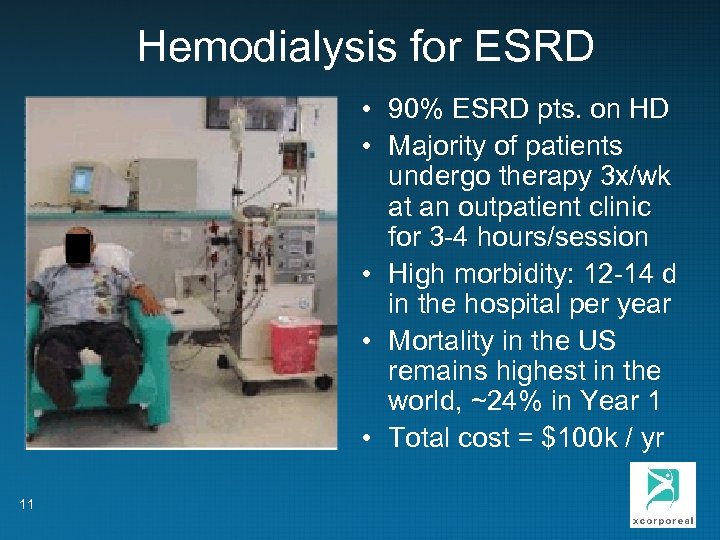
Hemodialysis for ESRD • 90% ESRD pts. on HD • Majority of patients undergo therapy 3 x/wk at an outpatient clinic for 3 -4 hours/session • High morbidity: 12 -14 d in the hospital per year • Mortality in the US remains highest in the world, ~24% in Year 1 • Total cost = $100 k / yr 11
Why an Opportunity for Xcorporeal? • Recognition that more hemodialysis treatments produce better patient outcomes – Reduces meds, e. g. erythropoietins (WW sales >$5 B) – Reduces hospitalizations – Improves quality of life • Insurance company potential net savings of 25% • Hemodialysis clinics are expensive to build, ~$1. 5 M for a 20 station, 120 patient unit • Major efficiencies already achieved within the industry – consolidation, vertical integration • Cost-constraints, price compression – Capitation: single reimbursement rate – Bundling of all services including meds. on the horizon 12
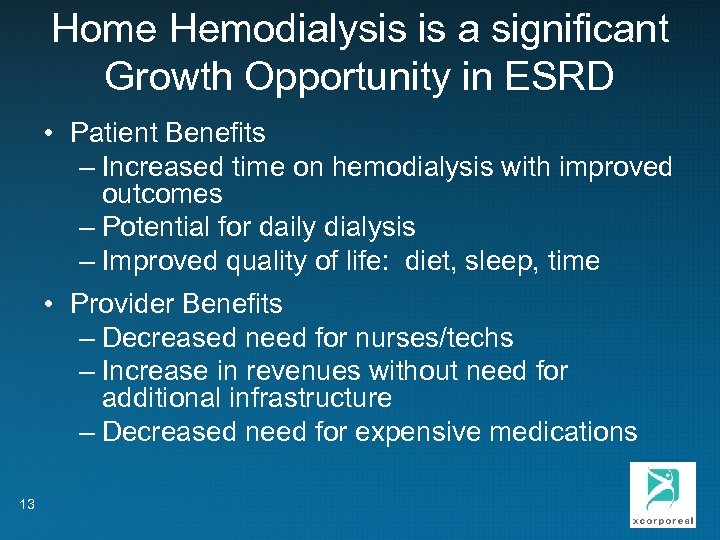
Home Hemodialysis is a significant Growth Opportunity in ESRD • Patient Benefits – Increased time on hemodialysis with improved outcomes – Potential for daily dialysis – Improved quality of life: diet, sleep, time • Provider Benefits – Decreased need for nurses/techs – Increase in revenues without need for additional infrastructure – Decreased need for expensive medications 13
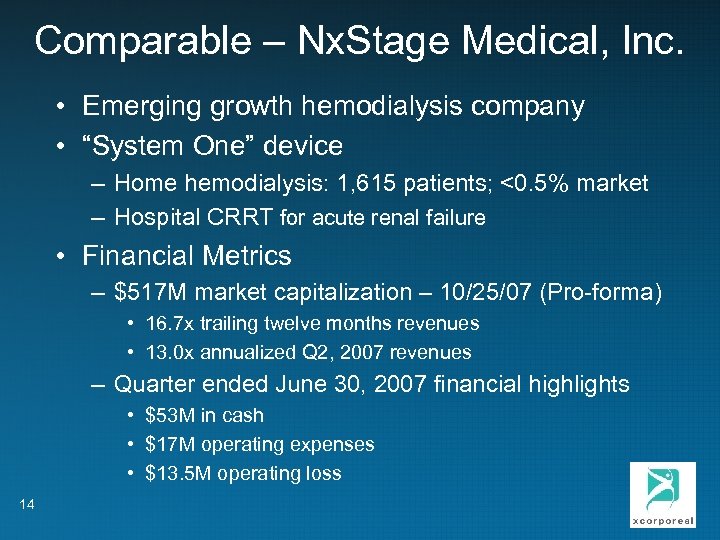
Comparable – Nx. Stage Medical, Inc. • Emerging growth hemodialysis company • “System One” device – Home hemodialysis: 1, 615 patients; <0. 5% market – Hospital CRRT for acute renal failure • Financial Metrics – $517 M market capitalization – 10/25/07 (Pro-forma) • 16. 7 x trailing twelve months revenues • 13. 0 x annualized Q 2, 2007 revenues – Quarter ended June 30, 2007 financial highlights • $53 M in cash • $17 M operating expenses • $13. 5 M operating loss 14
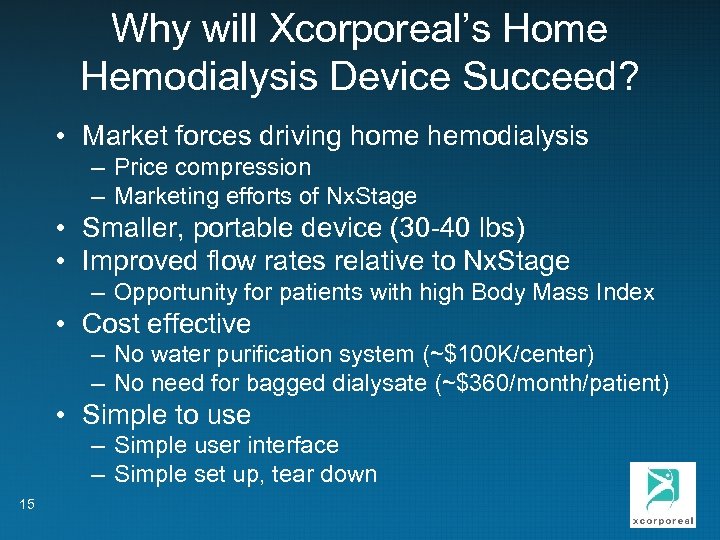
Why will Xcorporeal’s Home Hemodialysis Device Succeed? • Market forces driving home hemodialysis – Price compression – Marketing efforts of Nx. Stage • Smaller, portable device (30 -40 lbs) • Improved flow rates relative to Nx. Stage – Opportunity for patients with high Body Mass Index • Cost effective – No water purification system (~$100 K/center) – No need for bagged dialysate (~$360/month/patient) • Simple to use – Simple user interface – Simple set up, tear down 15
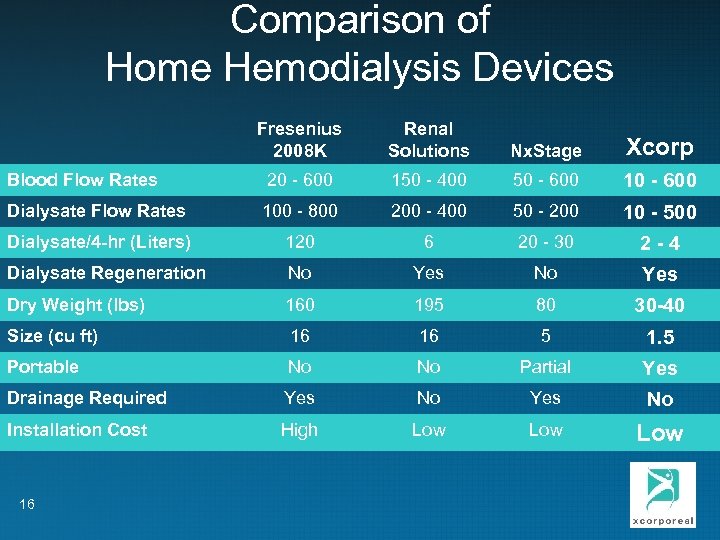
Comparison of Home Hemodialysis Devices Fresenius 2008 K Renal Solutions Nx. Stage Xcorp Blood Flow Rates 20 - 600 150 - 400 50 - 600 10 - 600 Dialysate Flow Rates 100 - 800 200 - 400 50 - 200 10 - 500 Dialysate/4 -hr (Liters) 120 6 20 - 30 2 -4 Dialysate Regeneration No Yes Dry Weight (lbs) 160 195 80 30 -40 Size (cu ft) 16 16 5 1. 5 Portable No No Partial Yes Drainage Required Yes No Installation Cost High Low Low 16
Wearable Artificial Kidney 17
Wearable Artificial Kidney • • • 18 “Disruptive” technology Wearable, light-weight device Battery operated Fully automated, simple to use Dialysate regeneration with sorbents 24 hrs/7 days therapy with potential to revolutionize care of ESRD patients
Wearable Artificial Kidney • Initial clinical study conducted with a prototype device at The Royal Free Hospital, London – 8 ESRD subjects dialyzed for mean of 6. 4 hrs – Clearances of creatinine, urea, and beta-2 microglobulin achieved – No adverse events reported – Subjects ambulated both untethered and w/o impact on device performance – Compelling data presented at ASN November 5, 2007 – Publication submitted to peer review journal 19
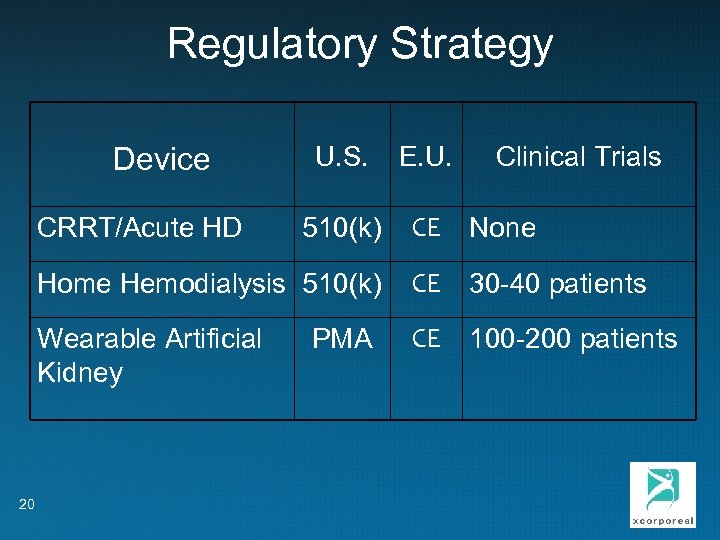
Regulatory Strategy U. S. E. U. 510(k) CE None Home Hemodialysis 510(k) CE 30 -40 patients Wearable Artificial Kidney CE 100 -200 patients Device CRRT/Acute HD 20 PMA Clinical Trials
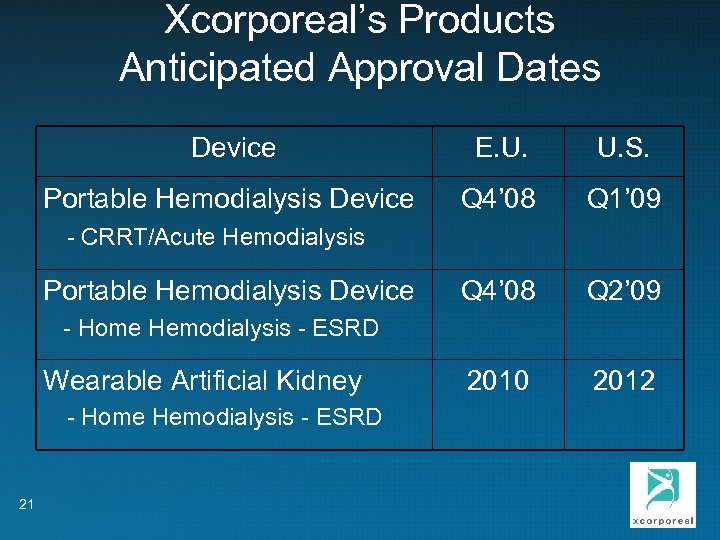
Xcorporeal’s Products Anticipated Approval Dates Device E. U. S. Portable Hemodialysis Device - CRRT/Acute Hemodialysis Q 4’ 08 Q 1’ 09 Portable Hemodialysis Device Q 4’ 08 Q 2’ 09 2010 2012 - Home Hemodialysis - ESRD Wearable Artificial Kidney - Home Hemodialysis - ESRD 21
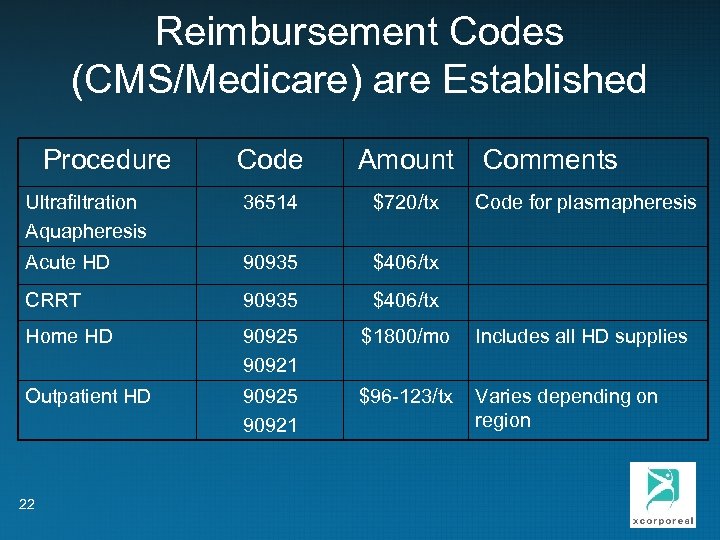
Reimbursement Codes (CMS/Medicare) are Established Procedure Code Amount Comments Ultrafiltration Aquapheresis 36514 $720/tx Acute HD 90935 $406/tx CRRT 90935 $406/tx Home HD 90925 90921 $1800/mo Includes all HD supplies Outpatient HD 90925 90921 $96 -123/tx Varies depending on region 22 Code for plasmapheresis
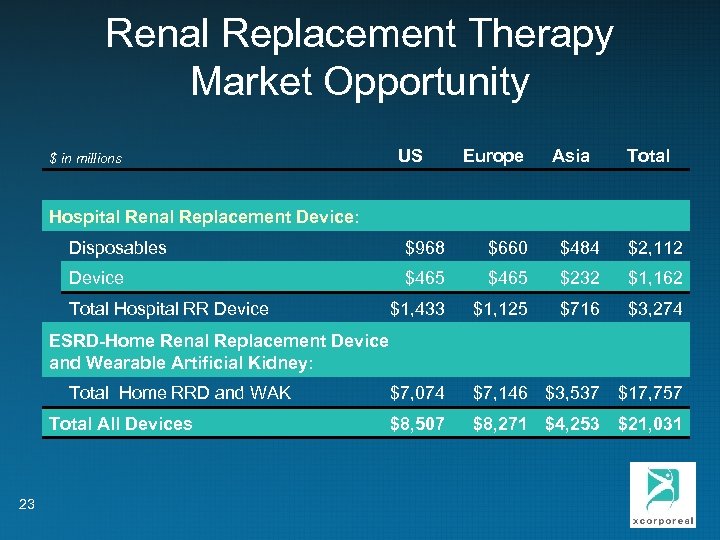
Renal Replacement Therapy Market Opportunity $ in millions US Europe Asia Total Hospital Renal Replacement Device: Disposables $968 $660 $484 $2, 112 Device $465 $232 $1, 162 $1, 433 $1, 125 $716 $3, 274 $7, 074 $7, 146 $3, 537 $17, 757 $8, 507 $8, 271 $4, 253 $21, 031 Total Hospital RR Device ESRD-Home Renal Replacement Device and Wearable Artificial Kidney: Total Home RRD and WAK Total All Devices 23
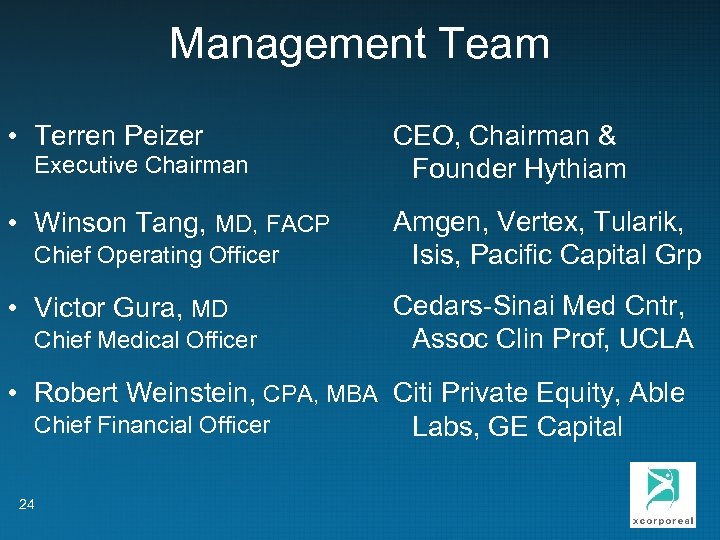
Management Team • Terren Peizer Executive Chairman CEO, Chairman & Founder Hythiam • Winson Tang, MD, FACP Chief Operating Officer Amgen, Vertex, Tularik, Isis, Pacific Capital Grp • Victor Gura, MD Cedars-Sinai Med Cntr, Assoc Clin Prof, UCLA Chief Medical Officer • Robert Weinstein, CPA, MBA Citi Private Equity, Able Chief Financial Officer Labs, GE Capital 24
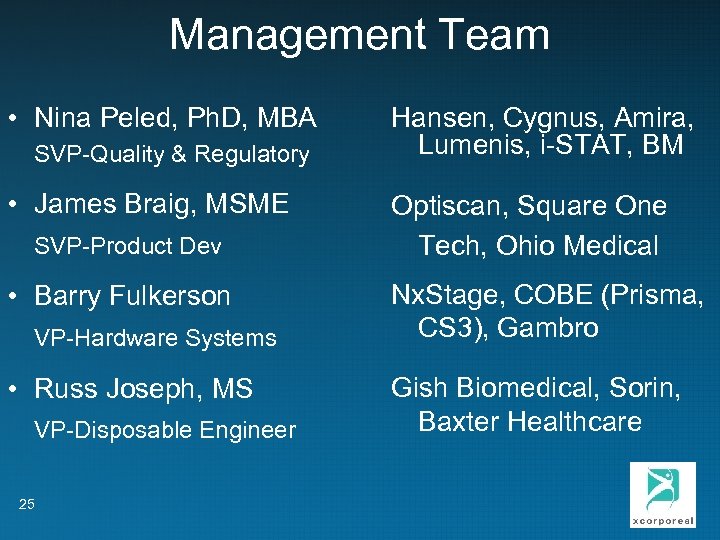
Management Team • Nina Peled, Ph. D, MBA SVP-Quality & Regulatory • James Braig, MSME SVP-Product Dev • Barry Fulkerson VP-Hardware Systems • Russ Joseph, MS VP-Disposable Engineer 25 Hansen, Cygnus, Amira, Lumenis, i-STAT, BM Optiscan, Square One Tech, Ohio Medical Nx. Stage, COBE (Prisma, CS 3), Gambro Gish Biomedical, Sorin, Baxter Healthcare
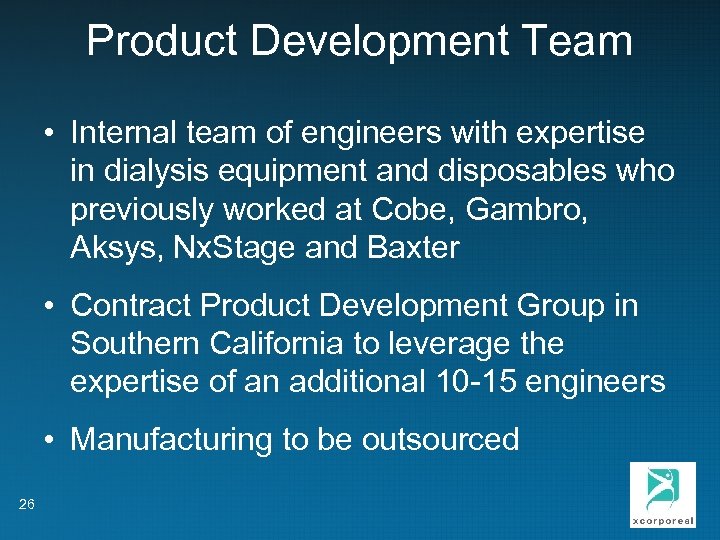
Product Development Team • Internal team of engineers with expertise in dialysis equipment and disposables who previously worked at Cobe, Gambro, Aksys, Nx. Stage and Baxter • Contract Product Development Group in Southern California to leverage the expertise of an additional 10 -15 engineers • Manufacturing to be outsourced 26
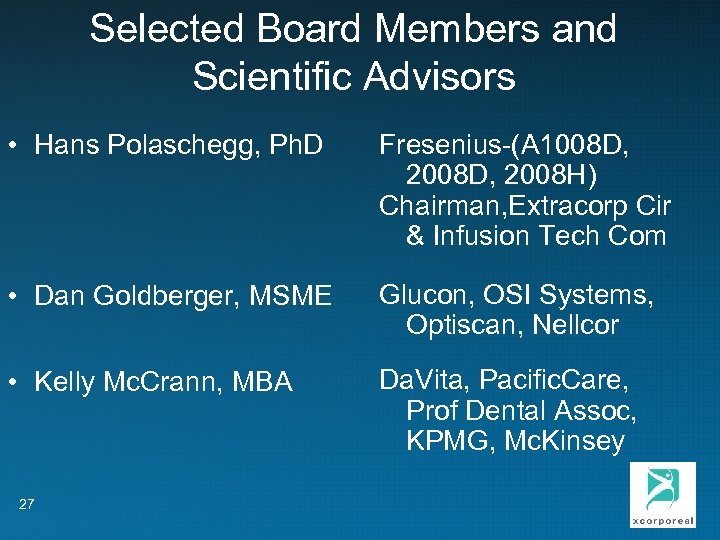
Selected Board Members and Scientific Advisors • Hans Polaschegg, Ph. D Fresenius-(A 1008 D, 2008 D, 2008 H) Chairman, Extracorp Cir & Infusion Tech Com • Dan Goldberger, MSME Glucon, OSI Systems, Optiscan, Nellcor • Kelly Mc. Crann, MBA Da. Vita, Pacific. Care, Prof Dental Assoc, KPMG, Mc. Kinsey 27
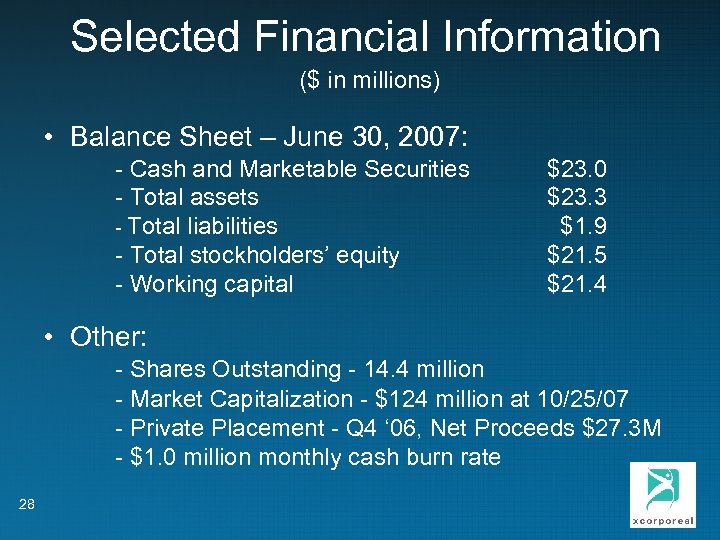
Selected Financial Information ($ in millions) • Balance Sheet – June 30, 2007: - Cash and Marketable Securities - Total assets - Total liabilities - Total stockholders’ equity - Working capital $23. 0 $23. 3 $1. 9 $21. 5 $21. 4 • Other: - Shares Outstanding - 14. 4 million - Market Capitalization - $124 million at 10/25/07 - Private Placement - Q 4 ‘ 06, Net Proceeds $27. 3 M - $1. 0 million monthly cash burn rate 28
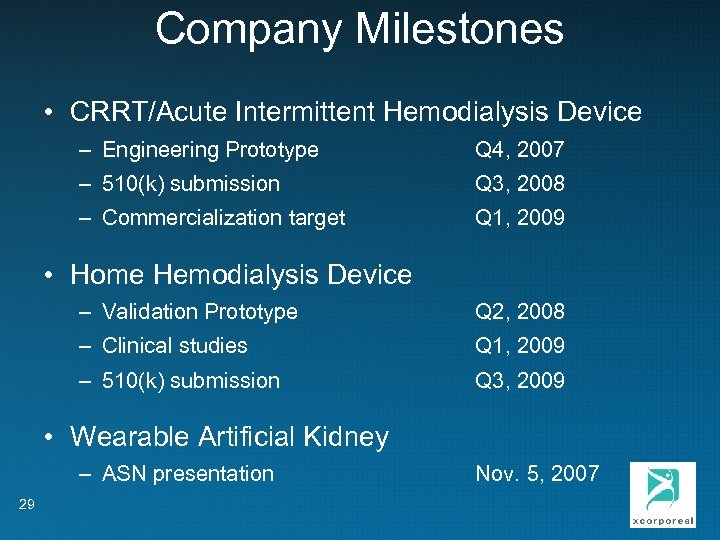
Company Milestones • CRRT/Acute Intermittent Hemodialysis Device – Engineering Prototype Q 4, 2007 – 510(k) submission Q 3, 2008 – Commercialization target Q 1, 2009 • Home Hemodialysis Device – Validation Prototype Q 2, 2008 – Clinical studies Q 1, 2009 – 510(k) submission Q 3, 2009 • Wearable Artificial Kidney – ASN presentation 29 Nov. 5, 2007
Xcorporeal Advantages • Experienced management team • Multiple products • Minimal to low risk – – Improved “Next Generation” devices – ARF & ESRD Prototype device tested successfully in humans Well defined regulatory approval strategy Well delineated reimbursement codes • US commercialization of first device targeted Q 1, ‘ 09 • Multi-billion dollar markets • Wearable Artificial Kidney – “Disruptive” Technology 30
Скачать презентацию Symbol XCPL Rodman Renshaw 9 th Annual
1afcadddf8b9b8291ab7d0d33511298a.ppt