 Скачать презентацию Symbiosis from organisms to Earth KAUST
bfee2086be32baad09248f6ceab07923.ppt
- Количество слайдов: 99



Symbiosis – from organisms to Earth KAUST – Winter Enrichment Program 31 January 2011 John Cheeseman University of Illinois, USA http: //www. life. illinois. edu/cheeseman/KAUST/symbiosis. ppt
All organisms on earth occur in some sort of symbiotic relationship with other organisms. • Symbiosis was probably critical for the colonization of land by multicellular organisms. Symbiosis affects all parts of our lives… • • plant growth, productivity and survival human pathogens and diseases biogeochemical cycling functioning of the planet itself Today - we will look at symbiosis at all levels, however briefly, with particular emphasis on some of the consequences of disrupting it at the planetary scale. Some implications for the future of humans on earth will also be discussed. 2
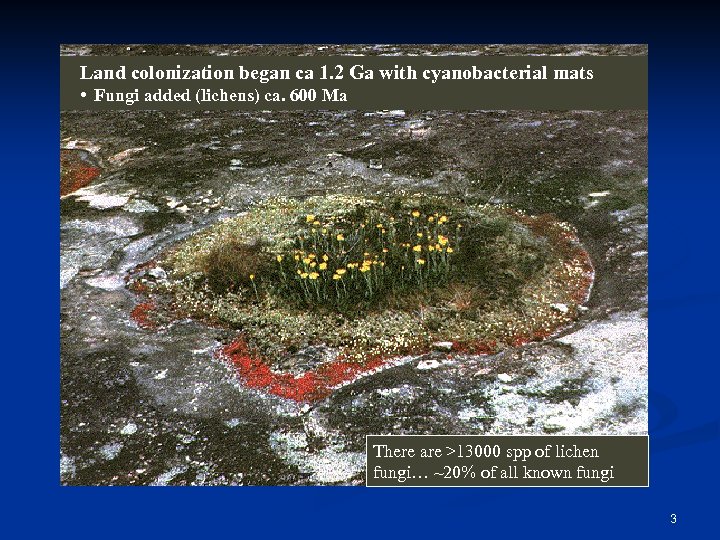
Land colonization began ca 1. 2 Ga with cyanobacterial mats • Fungi added (lichens) ca. 600 Ma There are >13000 spp of lichen fungi… ~20% of all known fungi 3
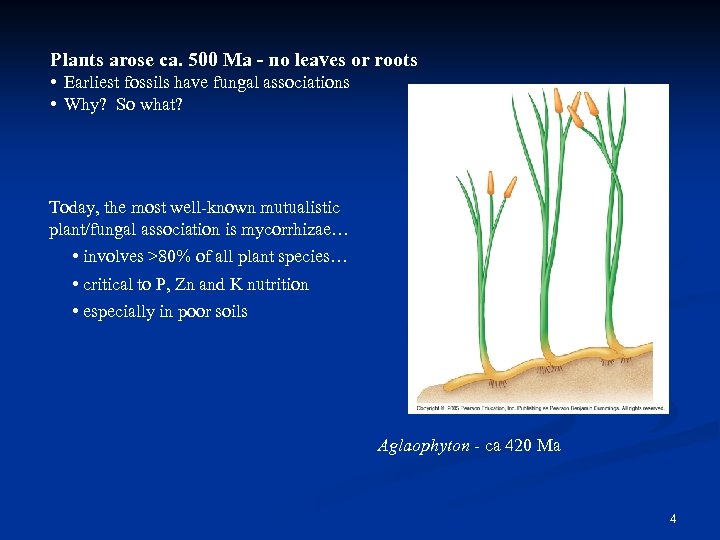
Plants arose ca. 500 Ma - no leaves or roots • Earliest fossils have fungal associations • Why? So what? Today, the most well-known mutualistic plant/fungal association is mycorrhizae… • involves >80% of all plant species… • critical to P, Zn and K nutrition • especially in poor soils Aglaophyton - ca 420 Ma 4
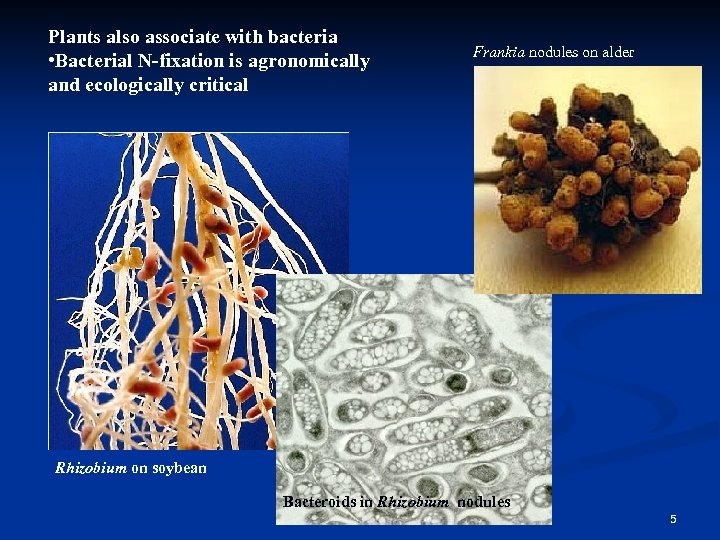
Plants also associate with bacteria • Bacterial N-fixation is agronomically and ecologically critical Frankia nodules on alder Rhizobium on soybean Bacteroids in Rhizobium nodules 5
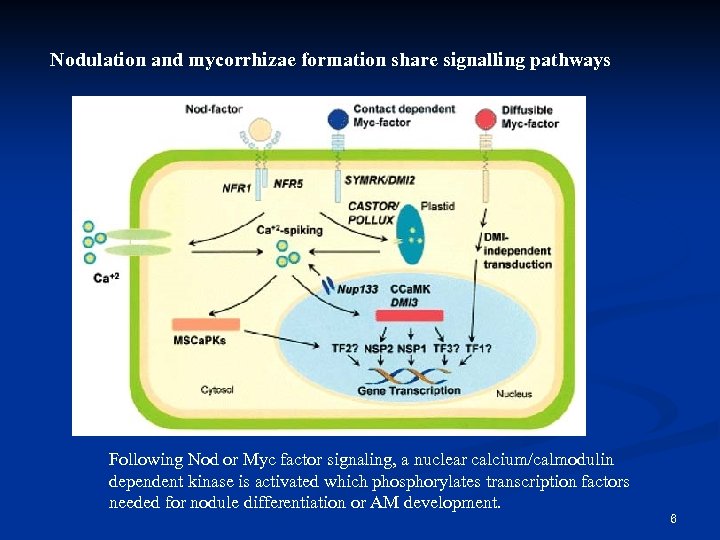
Nodulation and mycorrhizae formation share signalling pathways Following Nod or Myc factor signaling, a nuclear calcium/calmodulin dependent kinase is activated which phosphorylates transcription factors needed for nodule differentiation or AM development. 6
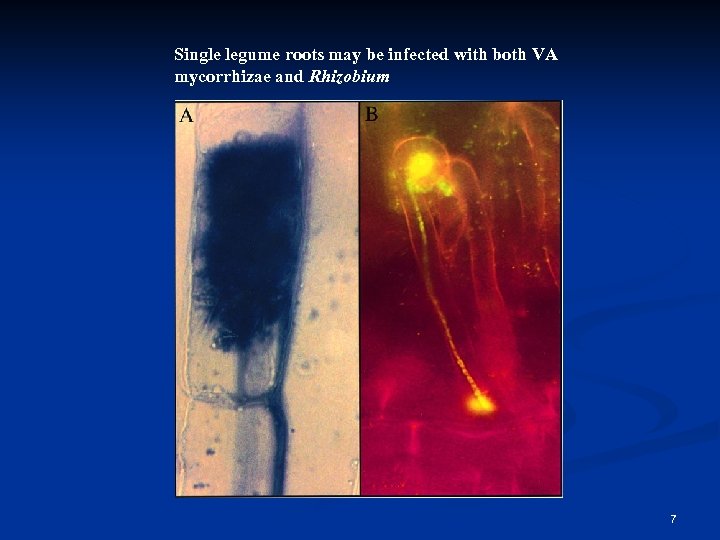
Single legume roots may be infected with both VA mycorrhizae and Rhizobium 7
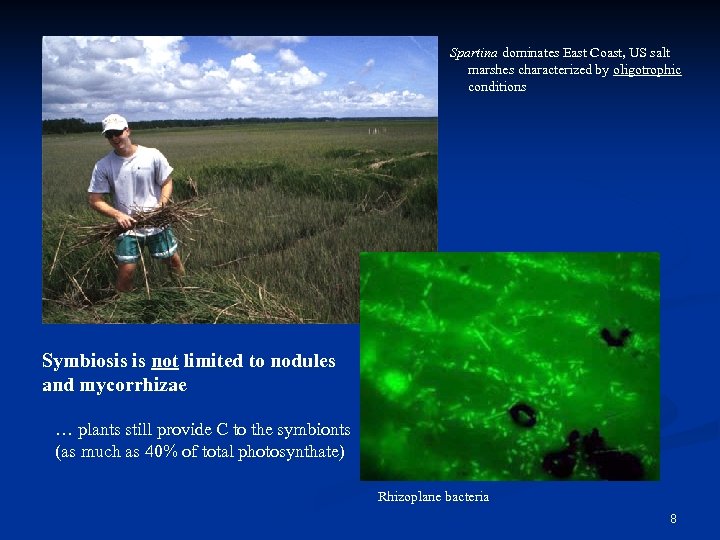
Spartina dominates East Coast, US salt marshes characterized by oligotrophic conditions Symbiosis is not limited to nodules and mycorrhizae … plants still provide C to the symbionts (as much as 40% of total photosynthate) Rhizoplane bacteria 8
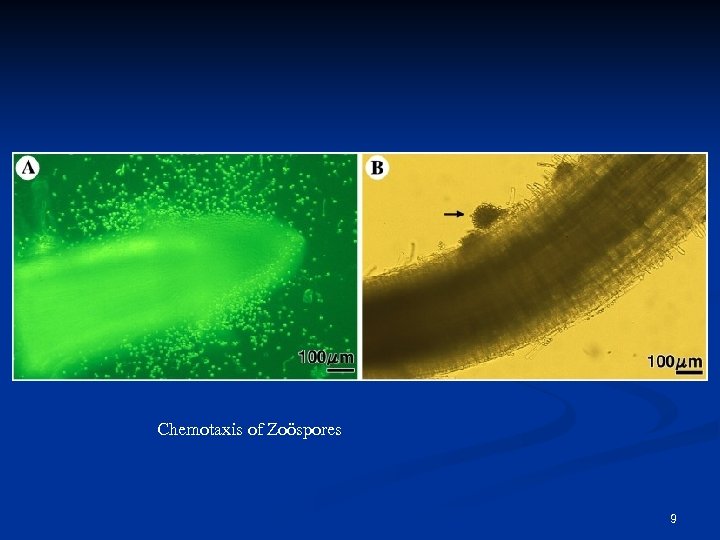
Chemotaxis of Zoöspores 9
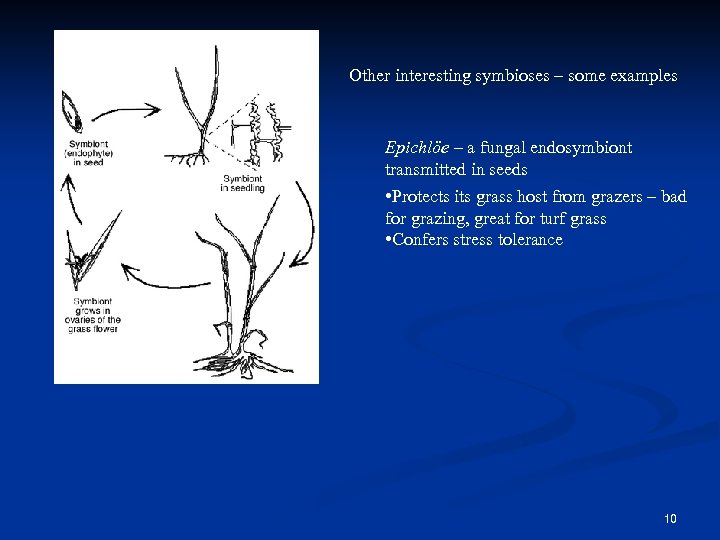
Other interesting symbioses – some examples Epichlöe – a fungal endosymbiont transmitted in seeds • Protects its grass host from grazers – bad for grazing, great for turf grass • Confers stress tolerance 10
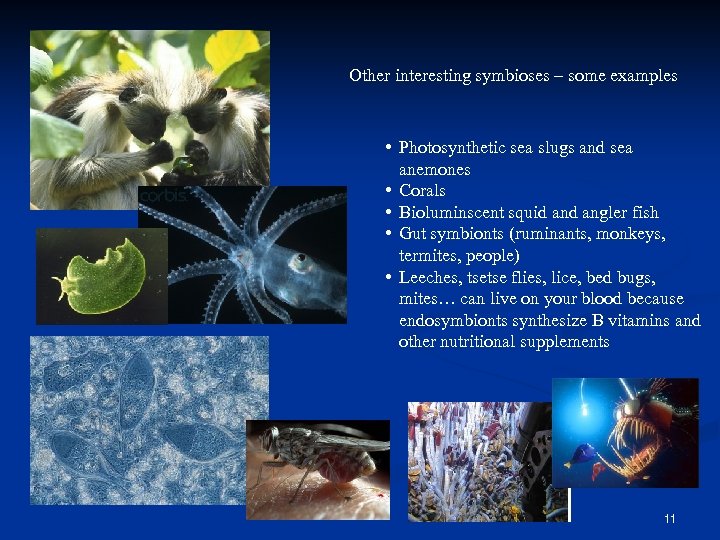
Other interesting symbioses – some examples • Photosynthetic sea slugs and sea anemones • Corals • Bioluminscent squid angler fish • Gut symbionts (ruminants, monkeys, termites, people) • Leeches, tsetse flies, lice, bed bugs, mites… can live on your blood because endosymbionts synthesize B vitamins and other nutritional supplements 11
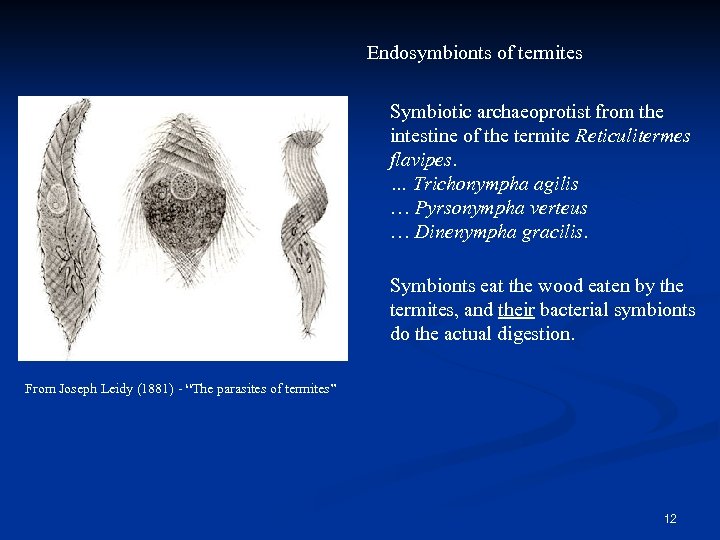
Endosymbionts of termites Symbiotic archaeoprotist from the intestine of the termite Reticulitermes flavipes. … Trichonympha agilis … Pyrsonympha verteus … Dinenympha gracilis. Symbionts eat the wood eaten by the termites, and their bacterial symbionts do the actual digestion. From Joseph Leidy (1881) - “The parasites of termites” 12
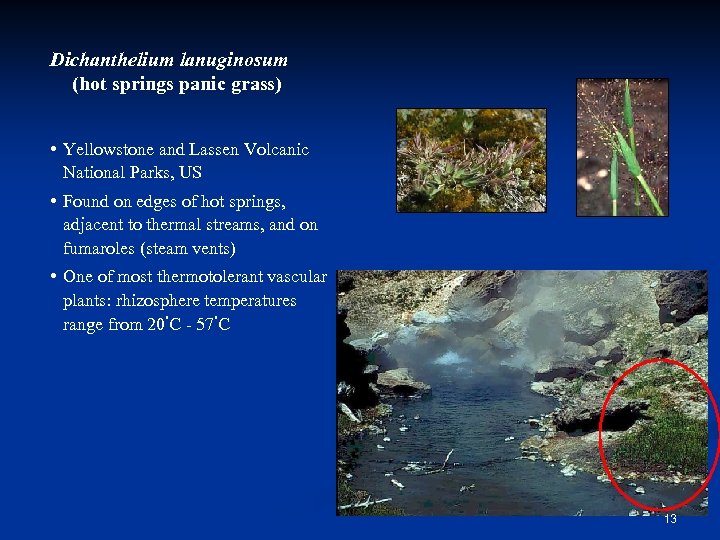
Dichanthelium lanuginosum (hot springs panic grass) • Yellowstone and Lassen Volcanic National Parks, US • Found on edges of hot springs, adjacent to thermal streams, and on fumaroles (steam vents) • One of most thermotolerant vascular plants: rhizosphere temperatures range from 20˚C - 57˚C 13
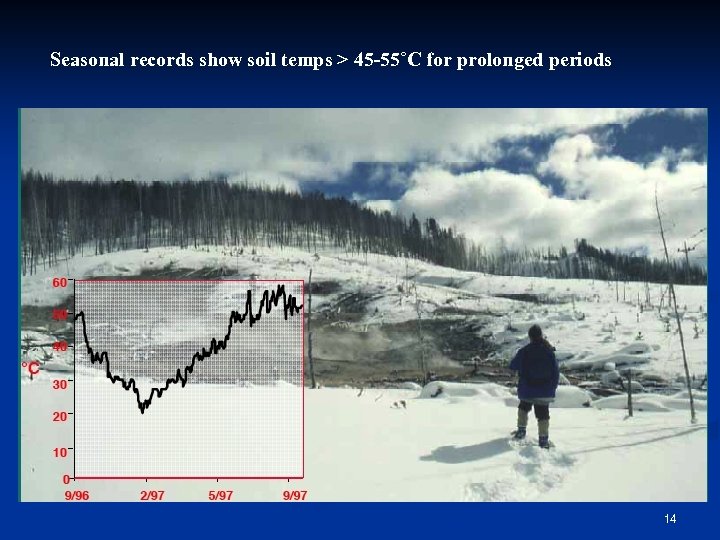
Seasonal records show soil temps > 45 -55˚C for prolonged periods 14
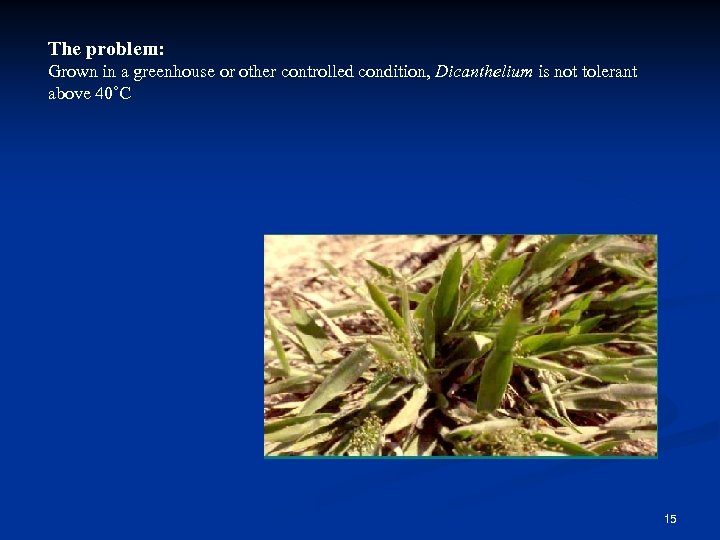
The problem: Grown in a greenhouse or other controlled condition, Dicanthelium is not tolerant above 40˚C 15
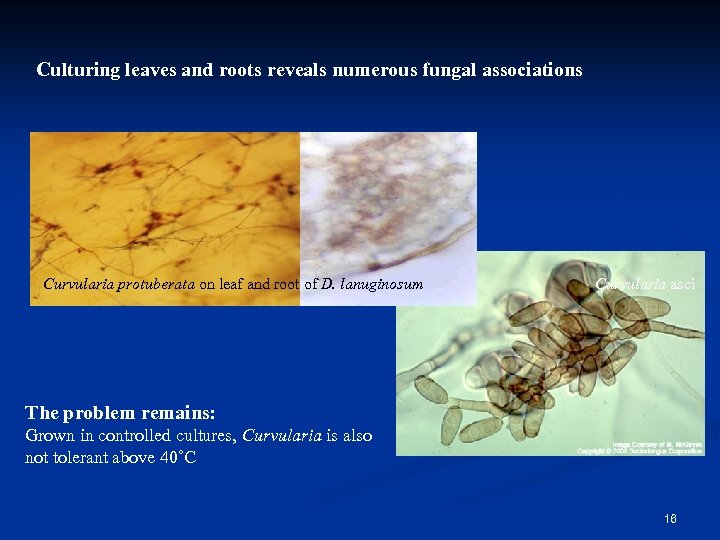
Culturing leaves and roots reveals numerous fungal associations Curvularia protuberata on leaf and root of D. lanuginosum Curvularia asci The problem remains: Grown in controlled cultures, Curvularia is also not tolerant above 40˚C 16
An even more interesting problem: Cultured together, the pair is tolerant of 60˚C • Curvularia is not the only fungus that does this… Fusarium culmorum confers salt tolerance on dune grasses, watermelon and other plants… different strains dominate in different microhabitats. And… it is not just the plant fungal interaction: The fungus is infected with a virus that is required for the heat tolerance 17

Break 18
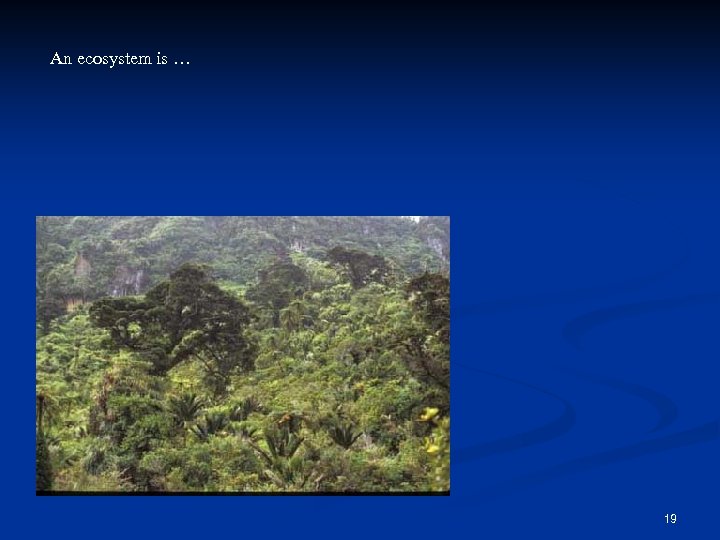
An ecosystem is … 19
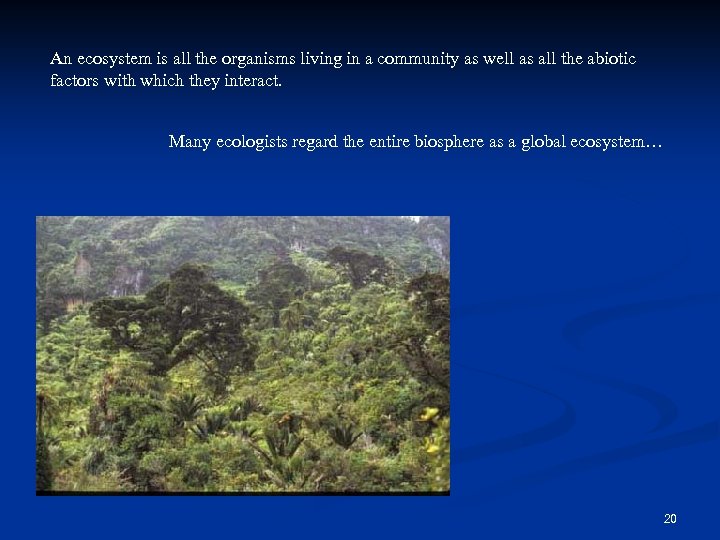
An ecosystem is all the organisms living in a community as well as all the abiotic factors with which they interact. Many ecologists regard the entire biosphere as a global ecosystem… 20
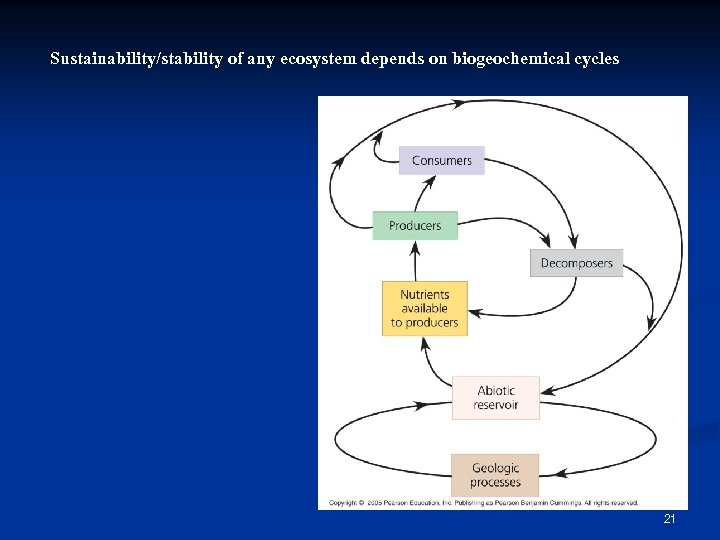
Sustainability/stability of any ecosystem depends on biogeochemical cycles 21
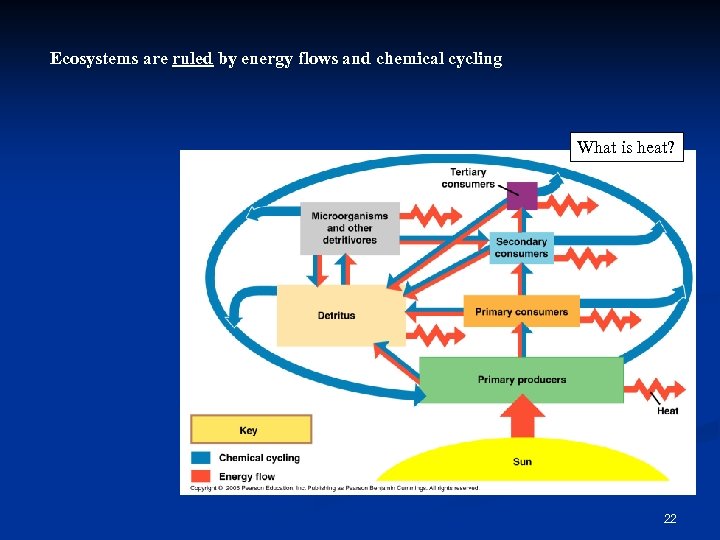
Ecosystems are ruled by energy flows and chemical cycling What is heat? 22
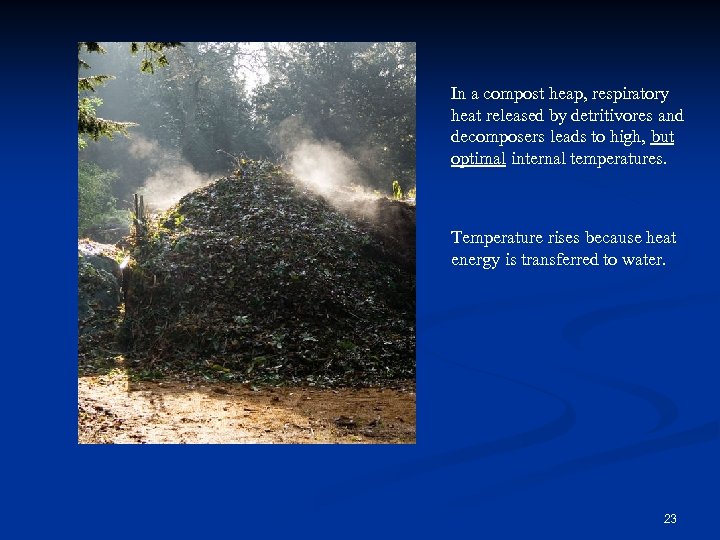
In a compost heap, respiratory heat released by detritivores and decomposers leads to high, but optimal internal temperatures. Temperature rises because heat energy is transferred to water. 23
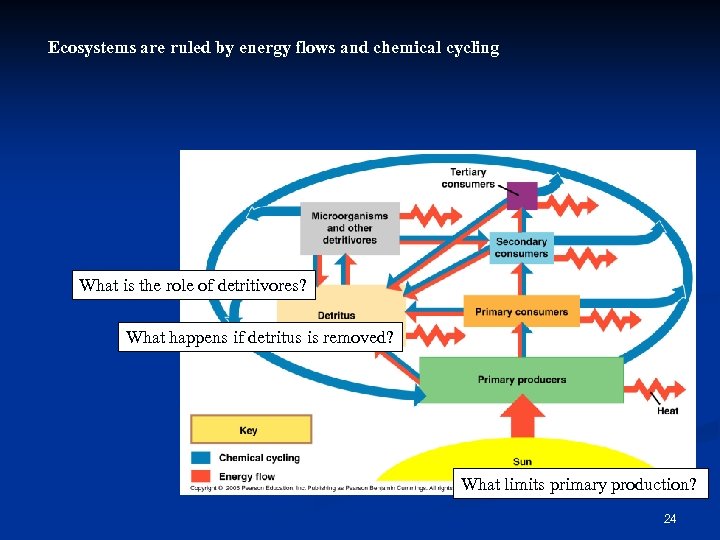
Ecosystems are ruled by energy flows and chemical cycling What is the role of detritivores? What happens if detritus is removed? What limits primary production? 24
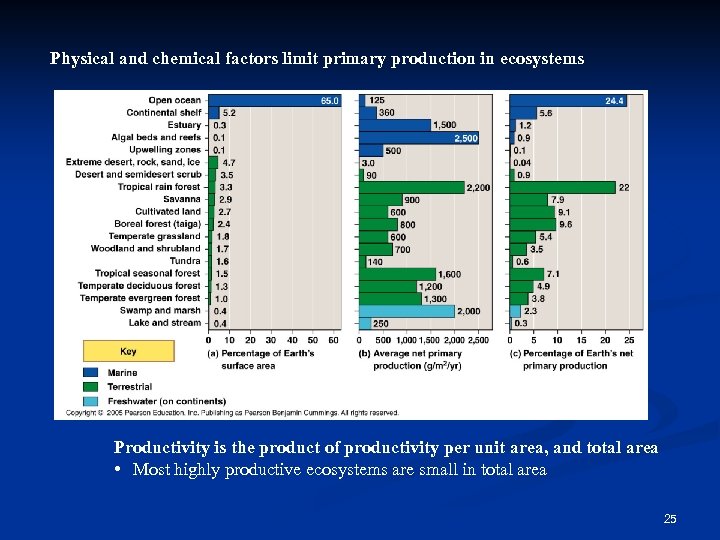
Physical and chemical factors limit primary production in ecosystems Productivity is the product of productivity per unit area, and total area • Most highly productive ecosystems are small in total area 25
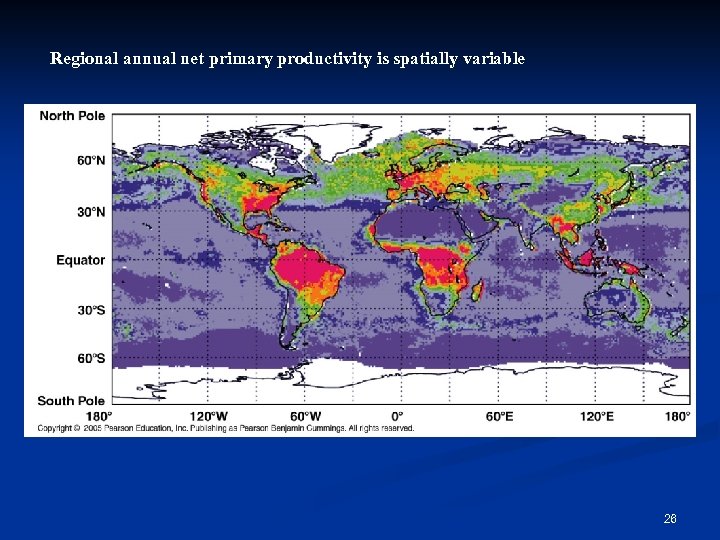
Regional annual net primary productivity is spatially variable 26
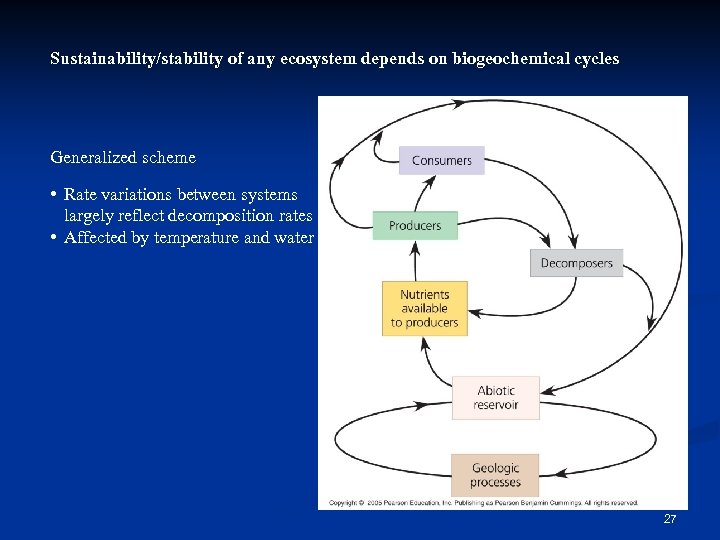
Sustainability/stability of any ecosystem depends on biogeochemical cycles Generalized scheme • Rate variations between systems largely reflect decomposition rates • Affected by temperature and water 27
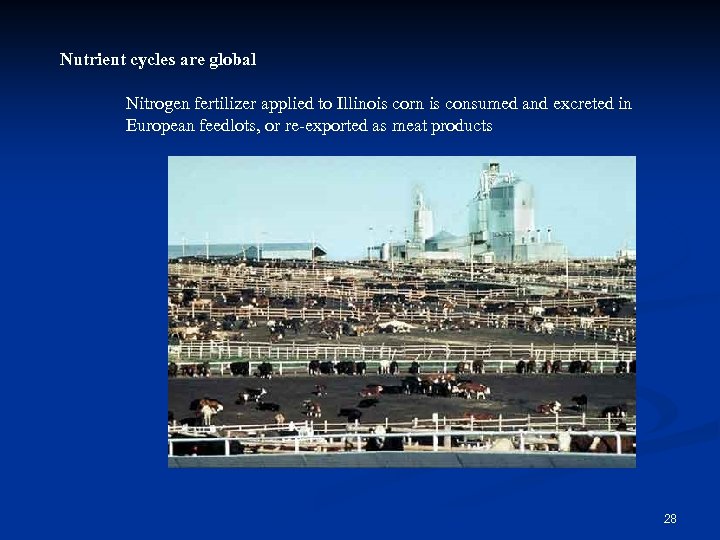
Nutrient cycles are global Nitrogen fertilizer applied to Illinois corn is consumed and excreted in European feedlots, or re-exported as meat products 28
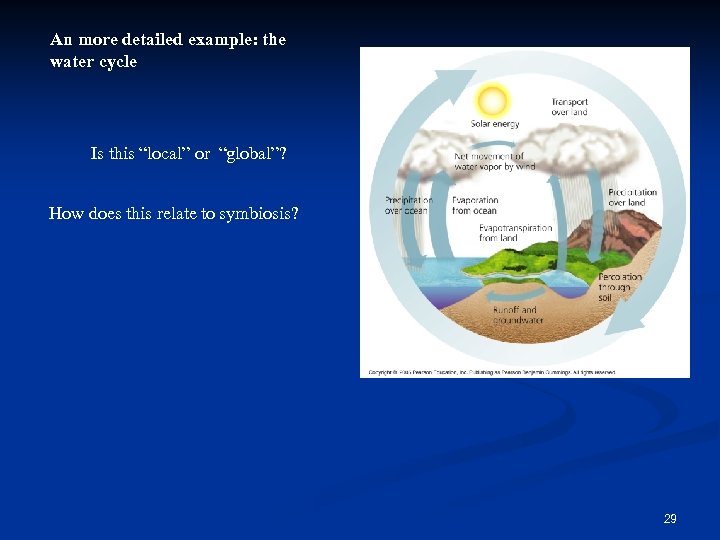
An more detailed example: the water cycle Is this “local” or “global”? How does this relate to symbiosis? 29
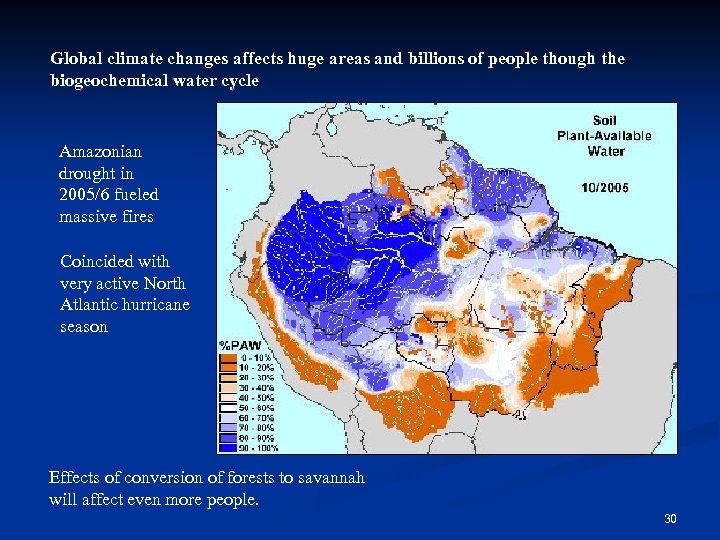
Global climate changes affects huge areas and billions of people though the biogeochemical water cycle Amazonian drought in 2005/6 fueled massive fires Coincided with very active North Atlantic hurricane season Effects of conversion of forests to savannah will affect even more people. 30
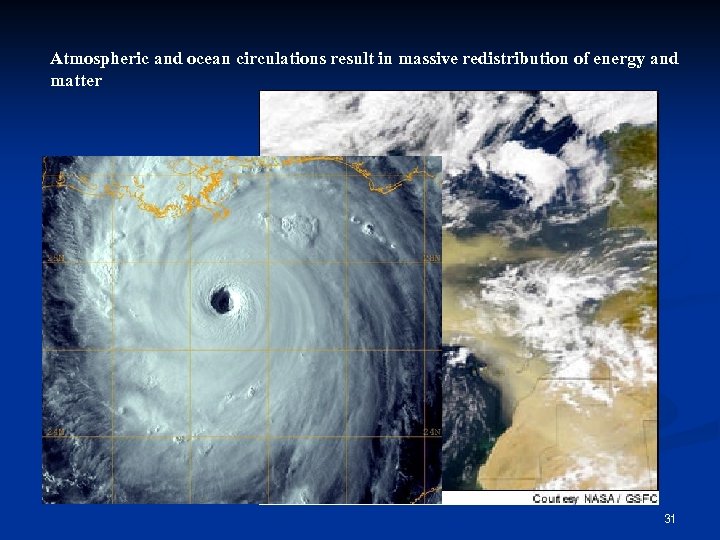
Atmospheric and ocean circulations result in massive redistribution of energy and matter 31
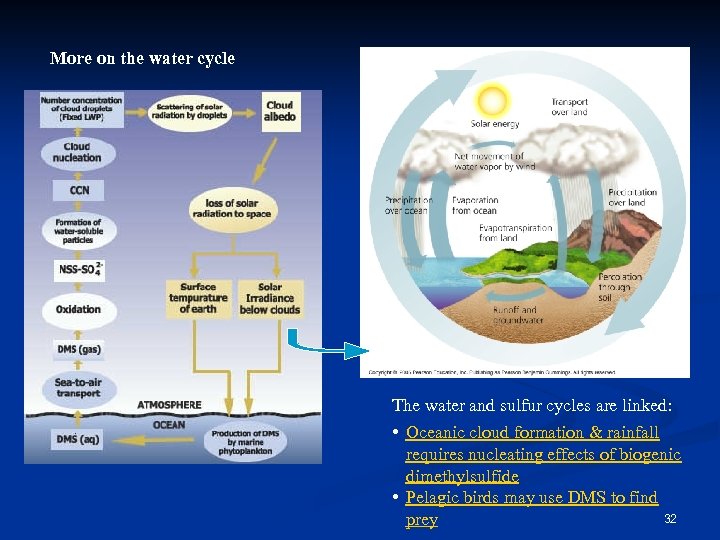
More on the water cycle The water and sulfur cycles are linked: • Oceanic cloud formation & rainfall requires nucleating effects of biogenic dimethylsulfide • Pelagic birds may use DMS to find 32 prey
Earth is characterized by unexpected stabilities Atmospheric composition varies very little over very long periods Hyperreactive gases such as O 2, O 3 and CH 4 exist at relatively stable levels Ocean salinity varies little even though ocean makeup is far from equilibrium: river salt inputs should raise SW well above 3. 4% salinity as should ocean circulation through hot basaltic vents CO 2 cycle involves release from volcanoes, dissolution in ocean waters and precipitation in limestone both bioactively and inorganically… but changes are (were) slow over long periods. 33
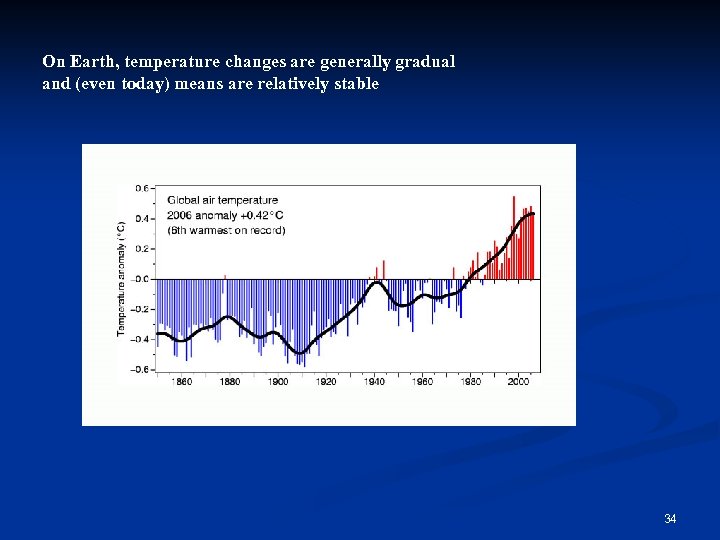
On Earth, temperature changes are generally gradual and (even today) means are relatively stable 34
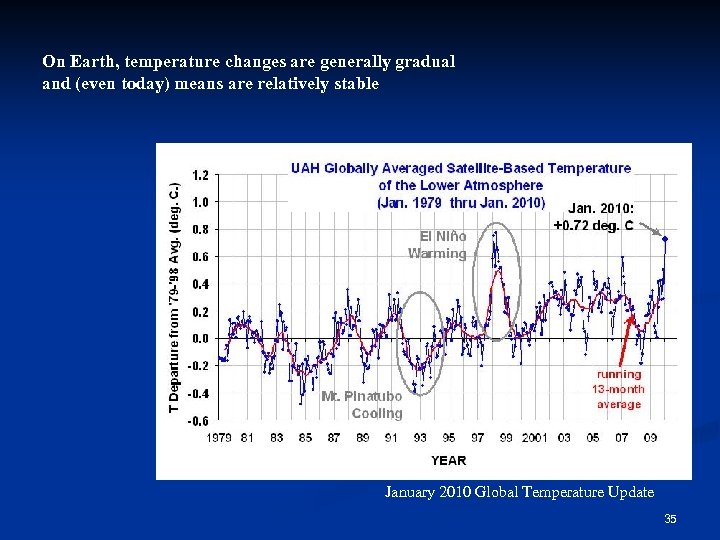
On Earth, temperature changes are generally gradual and (even today) means are relatively stable January 2010 Global Temperature Update 35
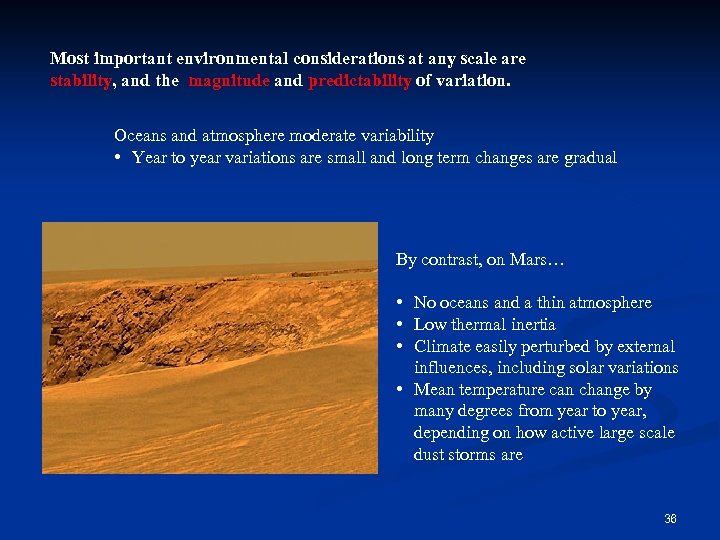
Most important environmental considerations at any scale are stability, and the magnitude and predictability of variation. Oceans and atmosphere moderate variability • Year to year variations are small and long term changes are gradual By contrast, on Mars… • No oceans and a thin atmosphere • Low thermal inertia • Climate easily perturbed by external influences, including solar variations • Mean temperature can change by many degrees from year to year, depending on how active large scale dust storms are 36
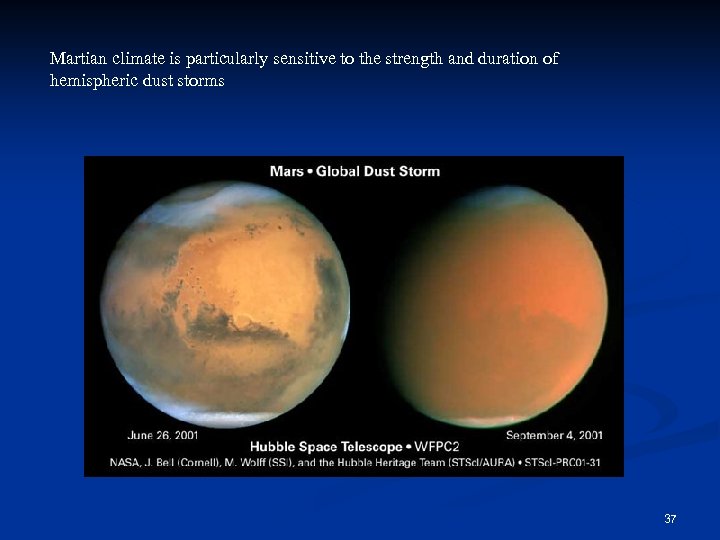
Martian climate is particularly sensitive to the strength and duration of hemispheric dust storms 37
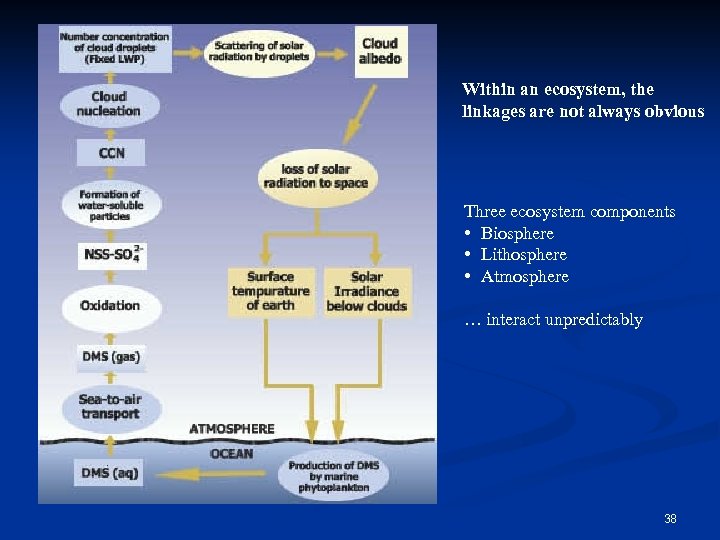
Within an ecosystem, the linkages are not always obvious Three ecosystem components • Biosphere • Lithosphere • Atmosphere … interact unpredictably 38
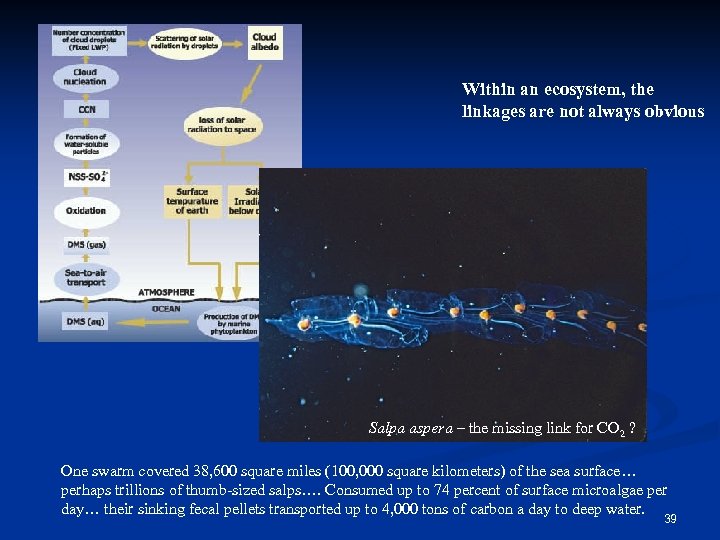
Within an ecosystem, the linkages are not always obvious Salpa aspera – the missing link for CO 2 ? One swarm covered 38, 600 square miles (100, 000 square kilometers) of the sea surface… perhaps trillions of thumb-sized salps…. Consumed up to 74 percent of surface microalgae per day… their sinking fecal pellets transported up to 4, 000 tons of carbon a day to deep water. 39
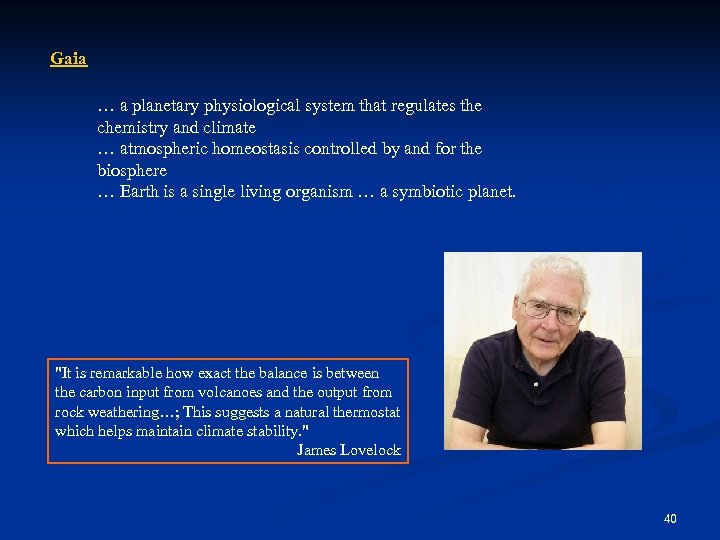
Gaia … a planetary physiological system that regulates the chemistry and climate … atmospheric homeostasis controlled by and for the biosphere … Earth is a single living organism … a symbiotic planet. "It is remarkable how exact the balance is between the carbon input from volcanoes and the output from rock weathering…; This suggests a natural thermostat which helps maintain climate stability. " James Lovelock 40

Lynn Margulis Gaia can be viewed not as an organism but as an emergent property of a complex system, reflecting interaction among organisms Complex systems show non-linear behavior full of unknowns. • Small changes have profound consequences • “Tipping points” 41
Homeostasis, homeorhesis and emergent properties Population as an example of emergent properties in complex systems 42

Break 43
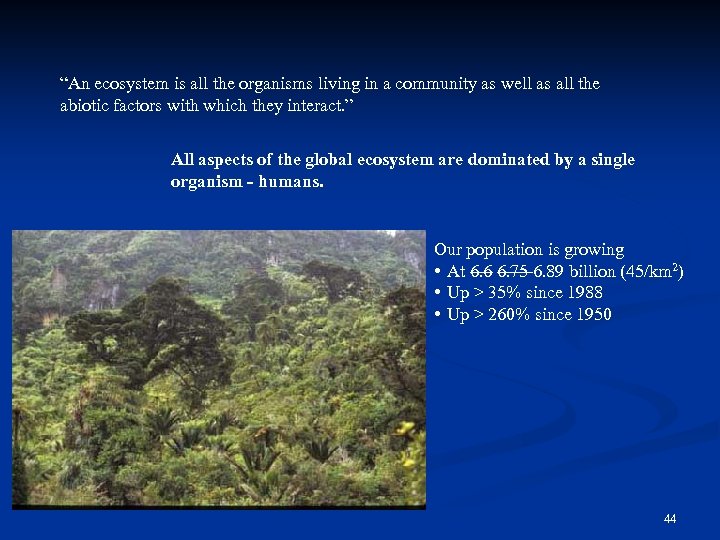
“An ecosystem is all the organisms living in a community as well as all the abiotic factors with which they interact. ” All aspects of the global ecosystem are dominated by a single organism - humans. Our population is growing • At 6. 6 6. 75 6. 89 billion (45/km 2) • Up > 35% since 1988 • Up > 260% since 1950 44
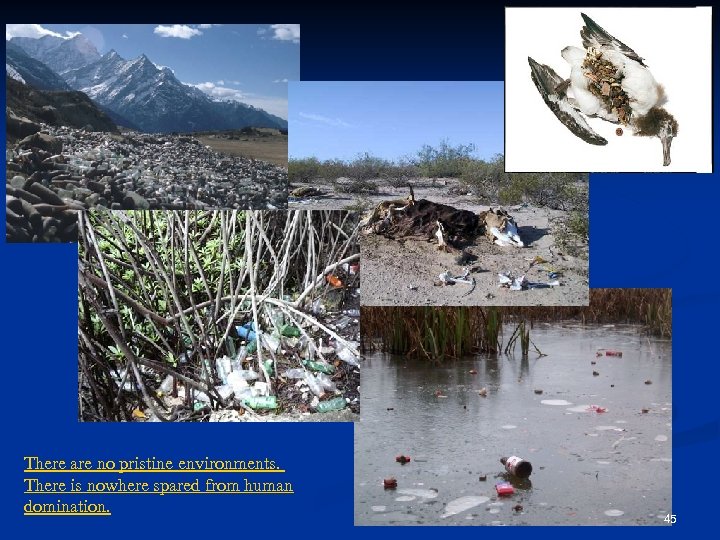
There are no pristine environments. There is nowhere spared from human domination. 45
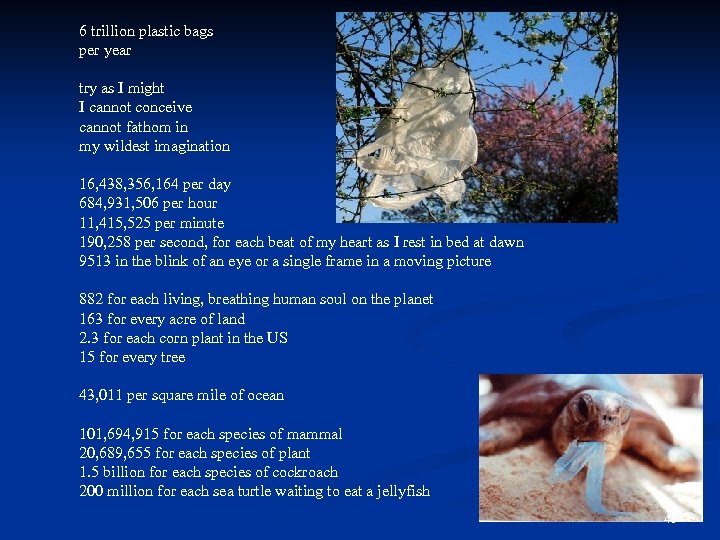
6 trillion plastic bags per year try as I might I cannot conceive cannot fathom in my wildest imagination 16, 438, 356, 164 per day 684, 931, 506 per hour 11, 415, 525 per minute 190, 258 per second, for each beat of my heart as I rest in bed at dawn 9513 in the blink of an eye or a single frame in a moving picture 882 for each living, breathing human soul on the planet 163 for every acre of land 2. 3 for each corn plant in the US 15 for every tree 43, 011 per square mile of ocean 101, 694, 915 for each species of mammal 20, 689, 655 for each species of plant 1. 5 billion for each species of cockroach 200 million for each sea turtle waiting to eat a jellyfish 46
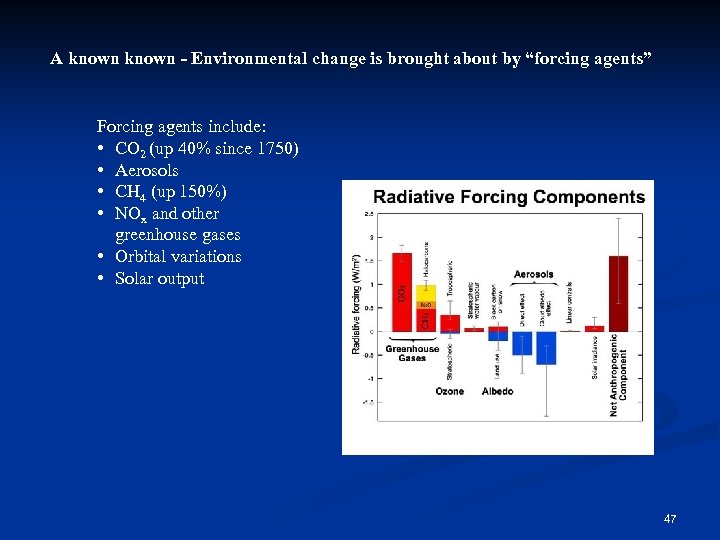
A known - Environmental change is brought about by “forcing agents” Forcing agents include: • CO 2 (up 40% since 1750) • Aerosols • CH 4 (up 150%) • NOx and other greenhouse gases • Orbital variations • Solar output 47
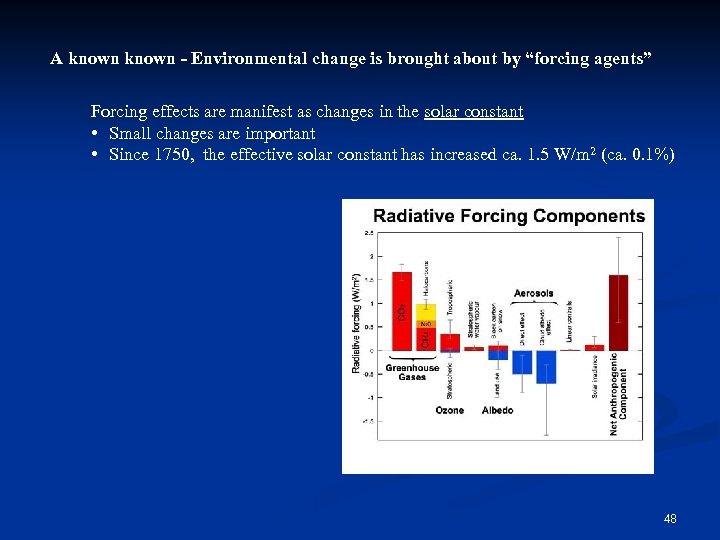
A known - Environmental change is brought about by “forcing agents” Forcing effects are manifest as changes in the solar constant • Small changes are important • Since 1750, the effective solar constant has increased ca. 1. 5 W/m 2 (ca. 0. 1%) 48
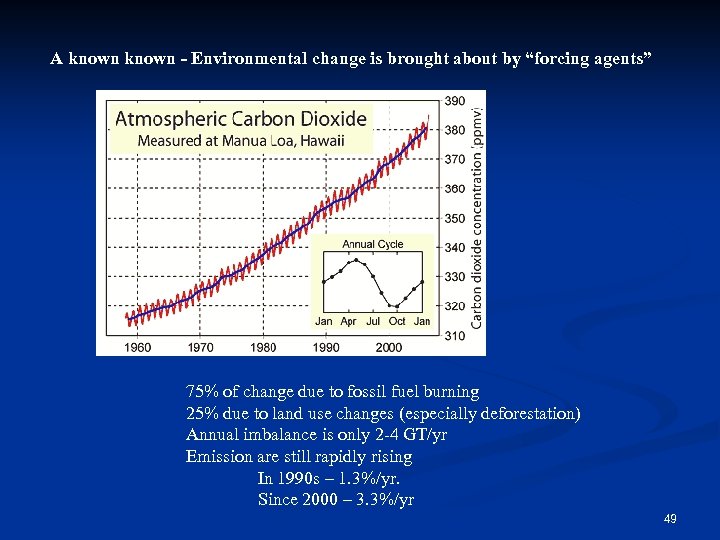
A known - Environmental change is brought about by “forcing agents” 75% of change due to fossil fuel burning 25% due to land use changes (especially deforestation) Annual imbalance is only 2 -4 GT/yr Emission are still rapidly rising In 1990 s – 1. 3%/yr. Since 2000 – 3. 3%/yr 49
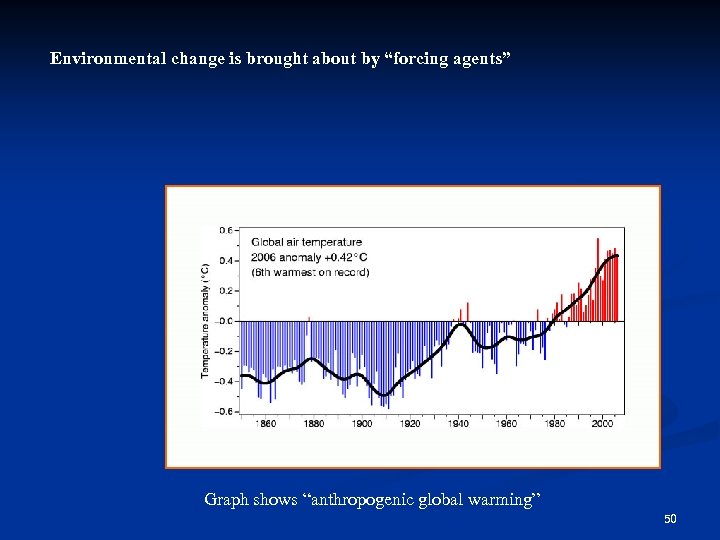
Environmental change is brought about by “forcing agents” Graph shows “anthropogenic global warming” 50
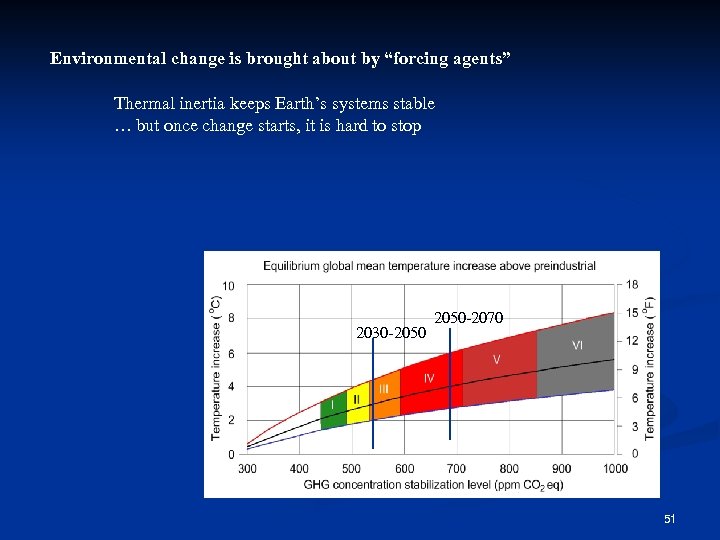
Environmental change is brought about by “forcing agents” Thermal inertia keeps Earth’s systems stable … but once change starts, it is hard to stop 2030 -2050 -2070 51
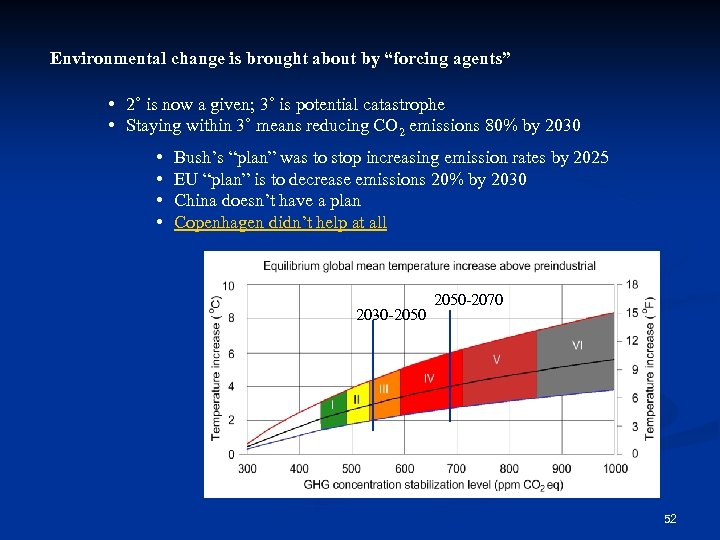
Environmental change is brought about by “forcing agents” • 2˚ is now a given; 3˚ is potential catastrophe • Staying within 3˚ means reducing CO 2 emissions 80% by 2030 • • Bush’s “plan” was to stop increasing emission rates by 2025 EU “plan” is to decrease emissions 20% by 2030 China doesn’t have a plan Copenhagen didn’t help at all 2030 -2050 -2070 52
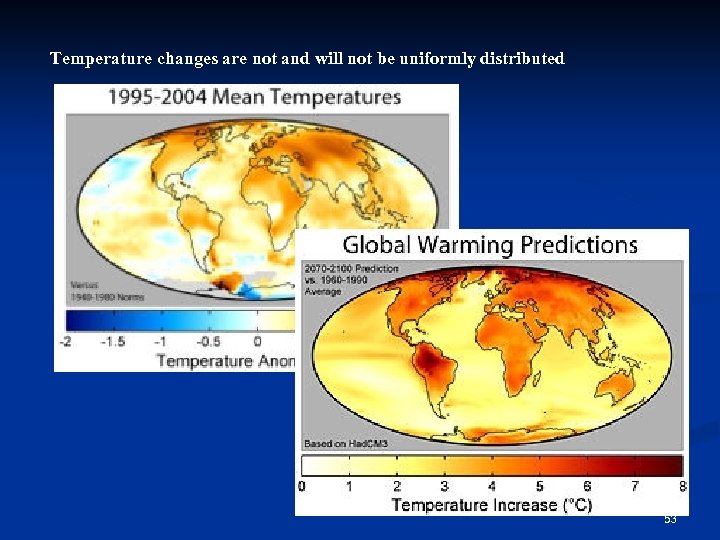
Temperature changes are not and will not be uniformly distributed 53
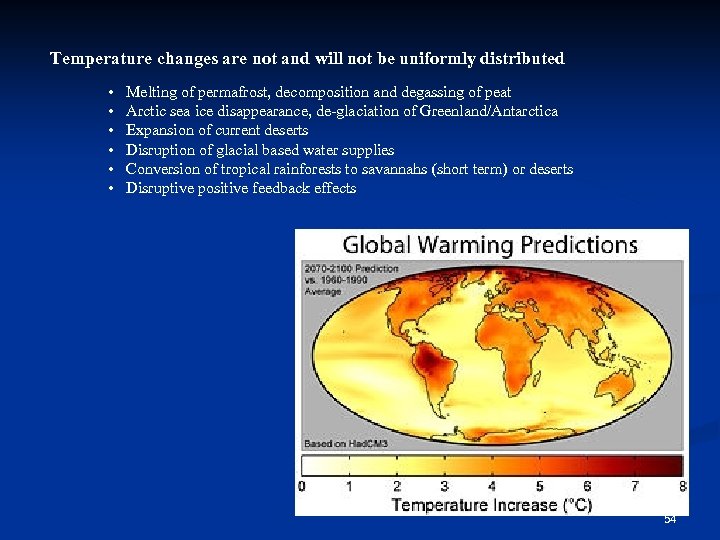
Temperature changes are not and will not be uniformly distributed • • • Melting of permafrost, decomposition and degassing of peat Arctic sea ice disappearance, de-glaciation of Greenland/Antarctica Expansion of current deserts Disruption of glacial based water supplies Conversion of tropical rainforests to savannahs (short term) or deserts Disruptive positive feedback effects 54
Transition – from Global warming to challenges facing human societies • • • Oil supplies and security Water security Temperature effects Collapse of natural systems Remediation of established declines and system failures 55
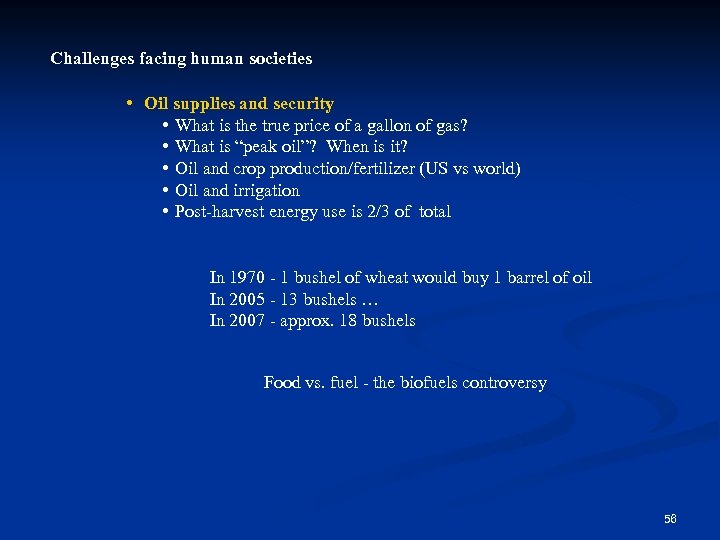
Challenges facing human societies • Oil supplies and security • What is the true price of a gallon of gas? • What is “peak oil”? When is it? • Oil and crop production/fertilizer (US vs world) • Oil and irrigation • Post-harvest energy use is 2/3 of total In 1970 - 1 bushel of wheat would buy 1 barrel of oil In 2005 - 13 bushels … In 2007 - approx. 18 bushels Food vs. fuel - the biofuels controversy 56
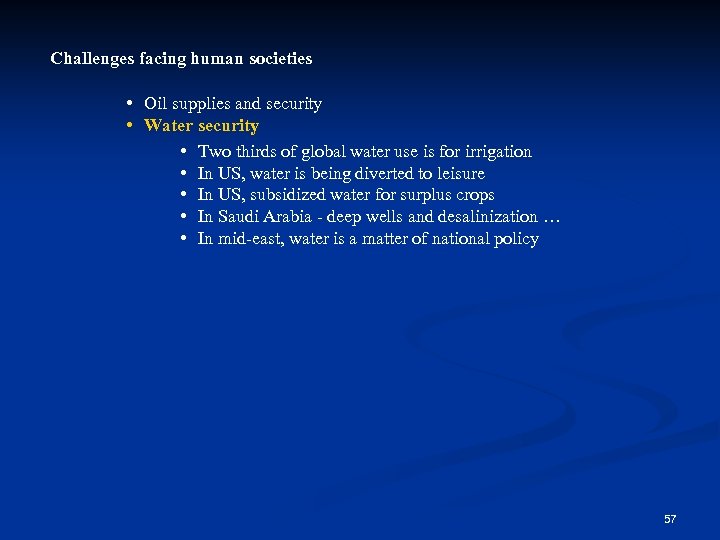
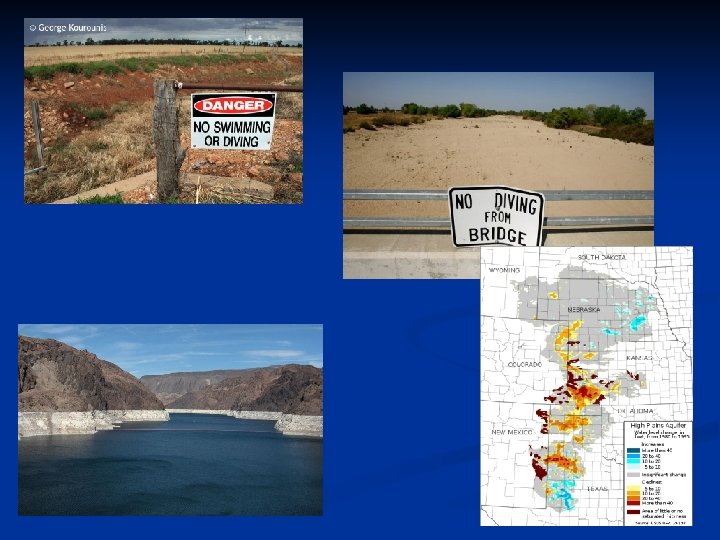
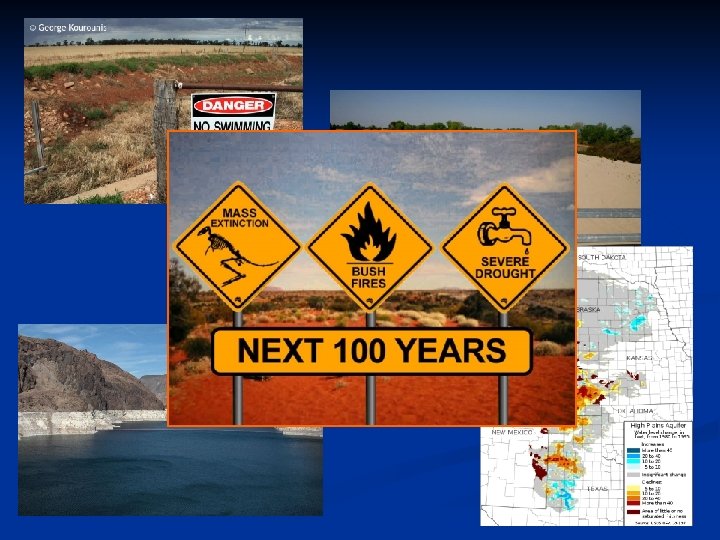
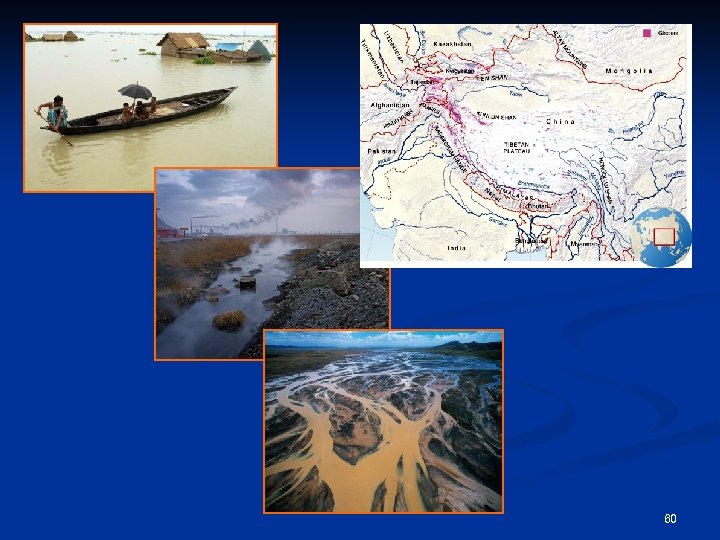
Challenges facing human societies • Oil supplies and security • Water security • Two thirds of global water use is for irrigation • In US, water is being diverted to leisure • In US, subsidized water for surplus crops • In Saudi Arabia - deep wells and desalinization … • In mid-east, water is a matter of national policy 57
58
59
60
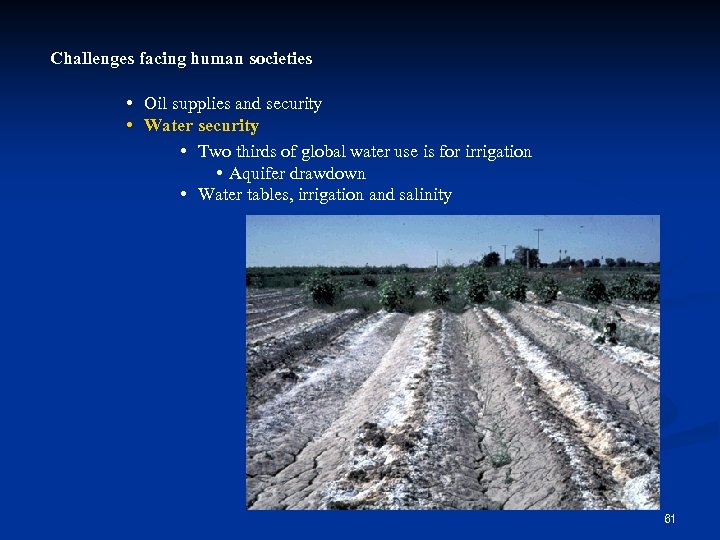
Challenges facing human societies • Oil supplies and security • Water security • Two thirds of global water use is for irrigation • Aquifer drawdown • Water tables, irrigation and salinity 61
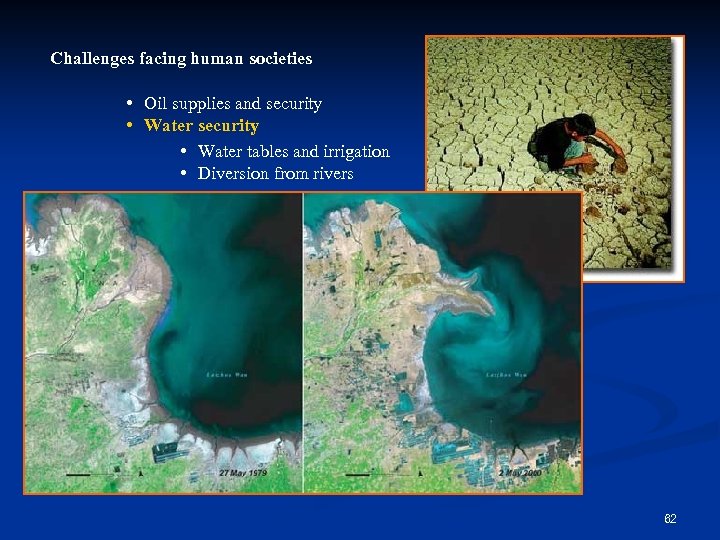
Challenges facing human societies • Oil supplies and security • Water tables and irrigation • Diversion from rivers 62
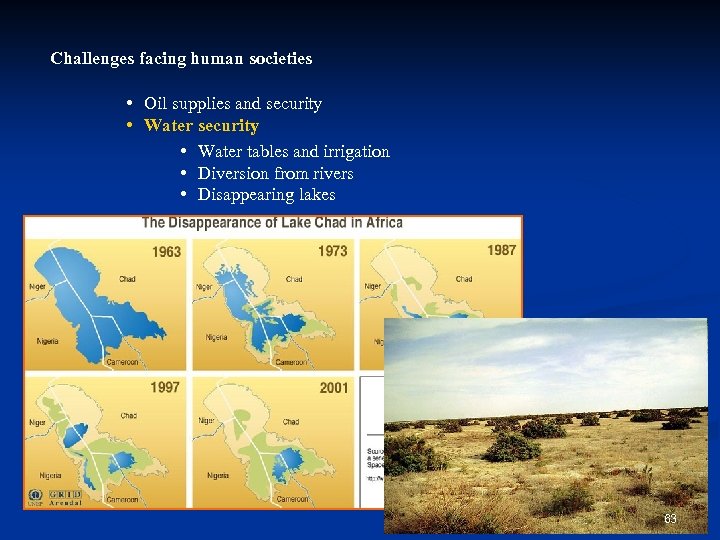
Challenges facing human societies • Oil supplies and security • Water tables and irrigation • Diversion from rivers • Disappearing lakes 63
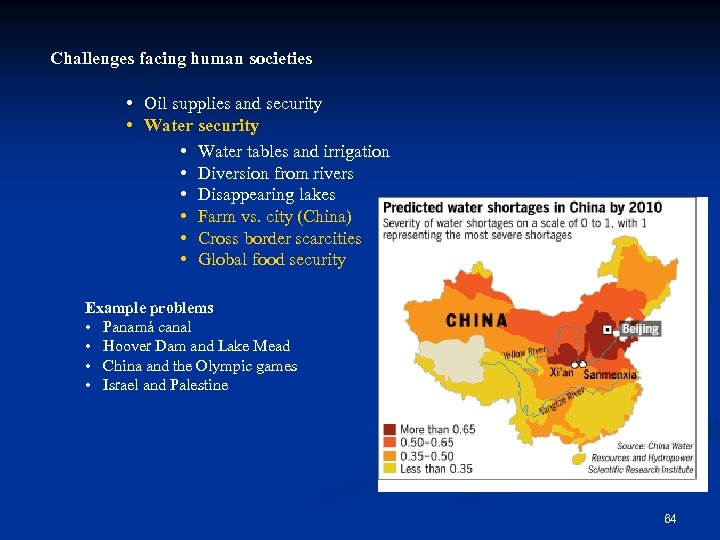
Challenges facing human societies • Oil supplies and security • Water tables and irrigation • Diversion from rivers • Disappearing lakes • Farm vs. city (China) • Cross border scarcities • Global food security Example problems • Panamá canal • Hoover Dam and Lake Mead • China and the Olympic games • Israel and Palestine 64
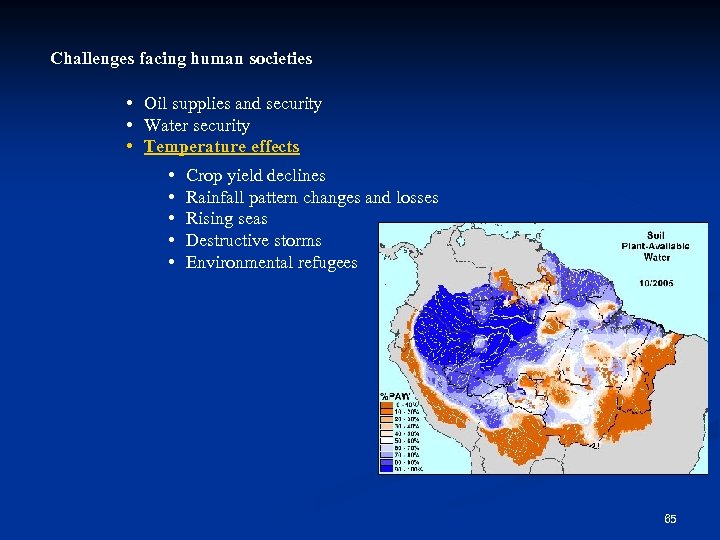
Challenges facing human societies • Oil supplies and security • Water security • Temperature effects • • • Crop yield declines Rainfall pattern changes and losses Rising seas Destructive storms Environmental refugees 65
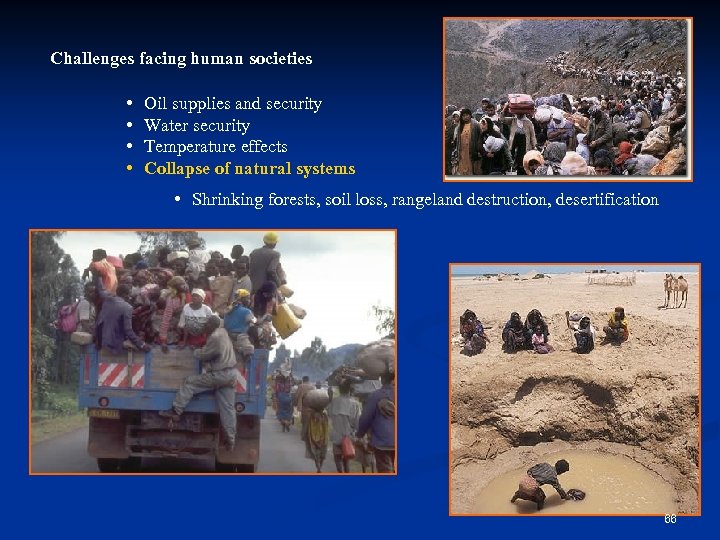
Challenges facing human societies • • Oil supplies and security Water security Temperature effects Collapse of natural systems • Shrinking forests, soil loss, rangeland destruction, desertification 66
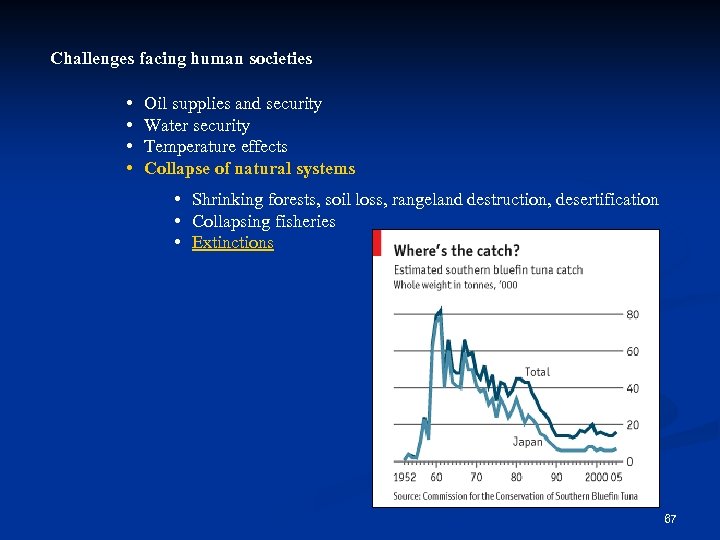
Challenges facing human societies • • Oil supplies and security Water security Temperature effects Collapse of natural systems • Shrinking forests, soil loss, rangeland destruction, desertification • Collapsing fisheries • Extinctions 67
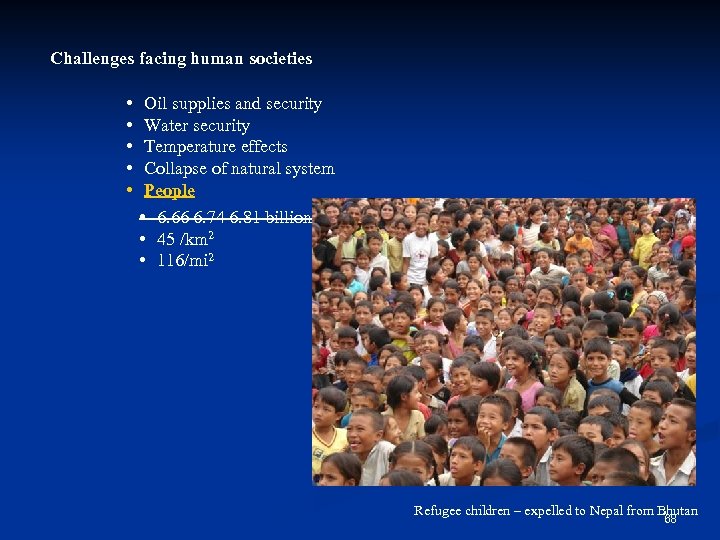
Challenges facing human societies • • • Oil supplies and security Water security Temperature effects Collapse of natural system People • 6. 66 6. 74 6. 81 billion • 45 /km 2 • 116/mi 2 Refugee children – expelled to Nepal from Bhutan 68
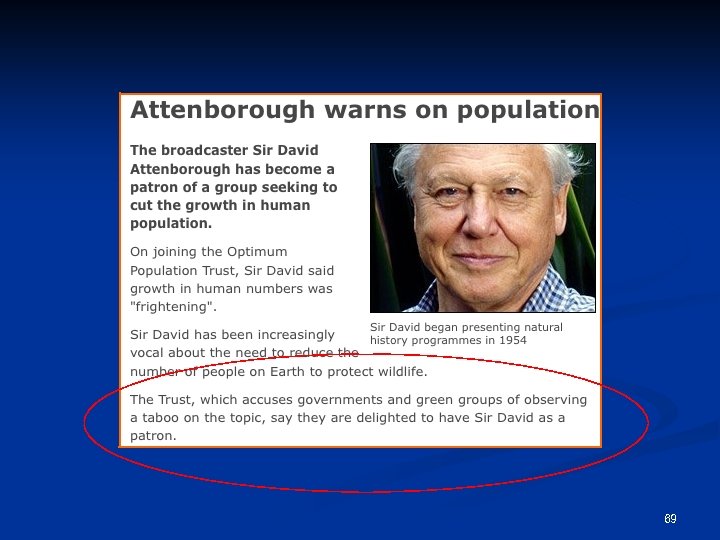
On population 69
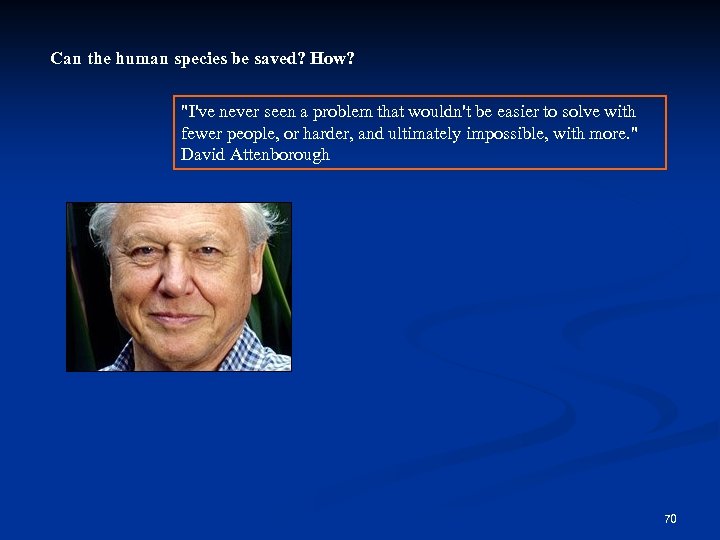
Can the human species be saved? How? "I've never seen a problem that wouldn't be easier to solve with fewer people, or harder, and ultimately impossible, with more. " David Attenborough Saving civilization 70
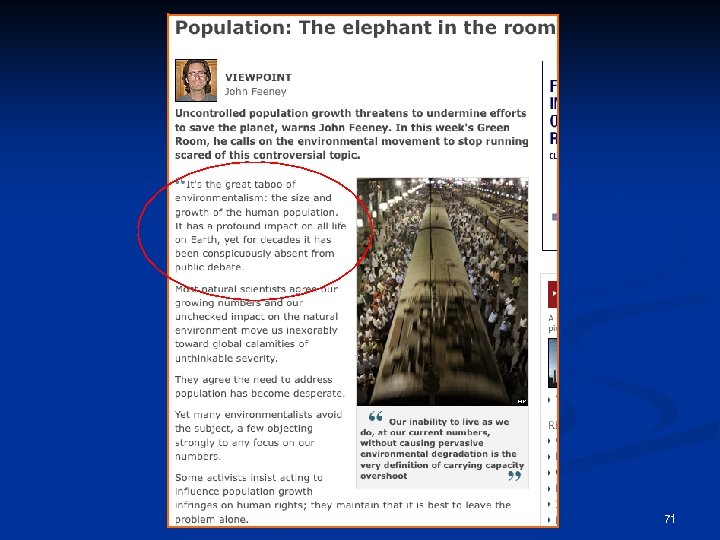
On population 71
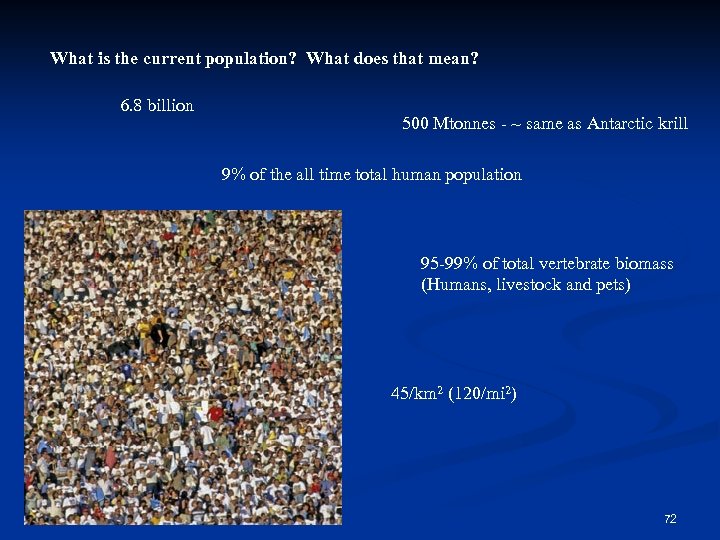
What is the current population? What does that mean? 6. 8 billion 500 Mtonnes - ~ same as Antarctic krill 9% of the all time total human population 95 -99% of total vertebrate biomass (Humans, livestock and pets) 45/km 2 (120/mi 2) Current population 72

Growth rate is declining? What does that mean? Population and growth 73
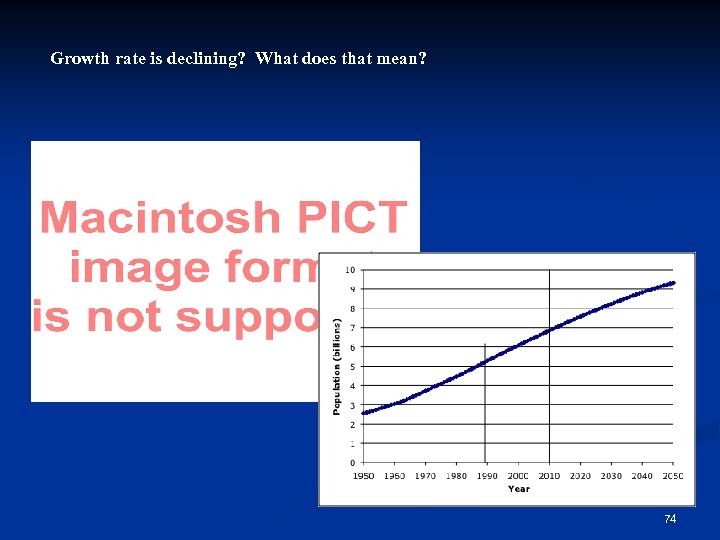
Growth rate is declining? What does that mean? Population and growth 74

Growth rate is declining? What does that mean? +43% +280% 96% of current growth is in less developed countries (including China) Population and growth 75
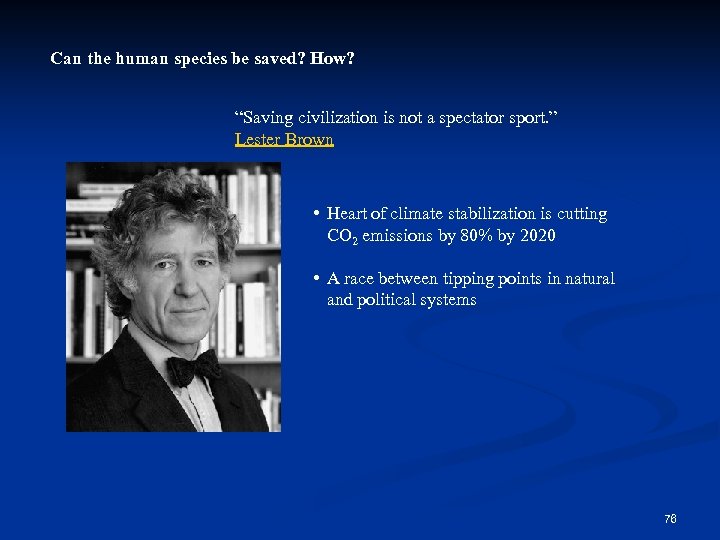
Can the human species be saved? How? “Saving civilization is not a spectator sport. ” Lester Brown • Heart of climate stabilization is cutting CO 2 emissions by 80% by 2020 • A race between tipping points in natural and political systems Saving civilization 76
What is Earth’s carrying capacity (for humans)? At what standard of living? At what levels of consumption? What are we using now? Based on global averages with huge spatial variability • Agriculture, land occupation, grazing, forestry • Humans use 20 Pg Carbon = 32% of the total TNPP Carrying capacity 77
How will population growth be constrained? War and Genocide? • World population in 1900 was ca. 1. 5 billion • The combined deaths due to all wars, epidemics and genocides since 1900 was no more than 200, 000 • The population in 2000 was 6 billion • War is not the answer pollution 78
How will population growth be constrained? Continually worsening pollution? Former Soviet Union • 11% of children have birth defects • 55% have health problems other than normal childhood diseases • 10% of food supply and 50% of drinking water is chemically contaminated • Life expectancy is declining China - Olympics called attention to grave and worsening pollution • Trans-Pacific export of air pollution • Water and soil pollution • Heavy metals from high-tech trash pollution 79
How will population growth be constrained? Water supplies/shortages? • • Japan - 1993 - imported water by ship load Australia - current water use restrictions nation-wide China - too little rainfall, insecure supplies India - retreating water tables, encroaching saline water, drought In US, 21% of all irrigation is by over-pumping ground water Same in China and India … even before indoor plumbing, flush toilets, kitchen water … 300 of largest cities have severe water scarcity Water supplies 80
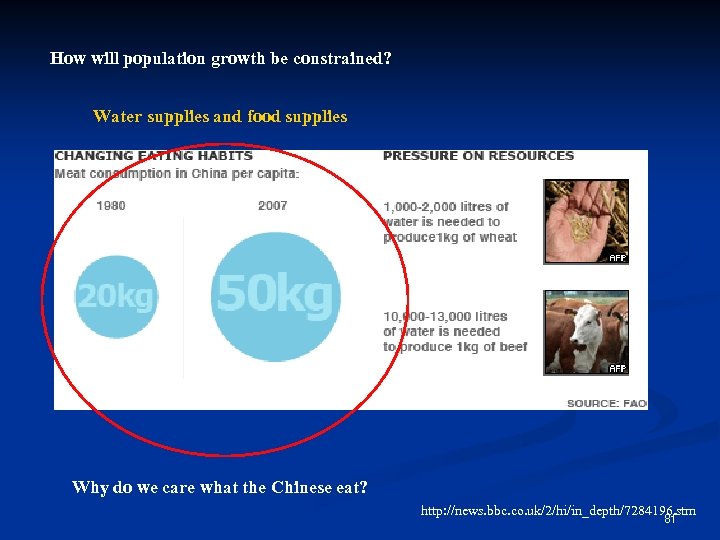
How will population growth be constrained? Water supplies and food supplies Why do we care what the Chinese eat? http: //news. bbc. co. uk/2/hi/in_depth/7284196. stm Water use for food 81
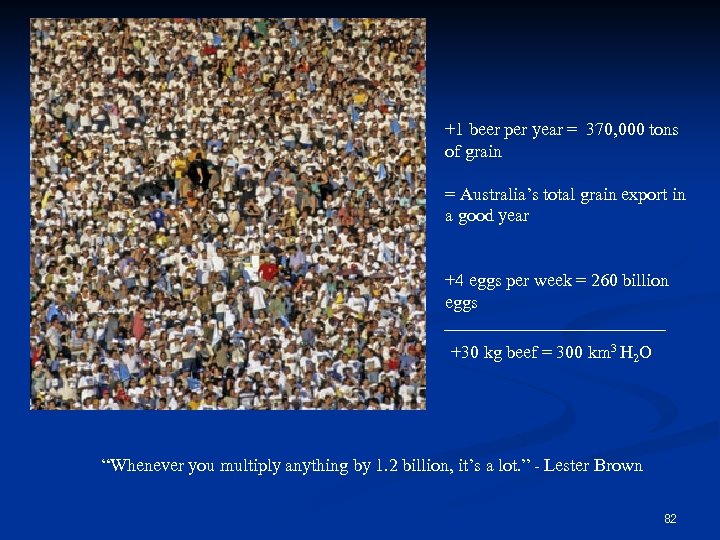
+1 beer per year = 370, 000 tons of grain = Australia’s total grain export in a good year +4 eggs per week = 260 billion eggs +30 kg beef = 300 km 3 H 2 O “Whenever you multiply anything by 1. 2 billion, it’s a lot. ” - Lester Brown Masses 82
How will population growth be constrained? Food? • Grain supplies? • Fisheries? Food 83
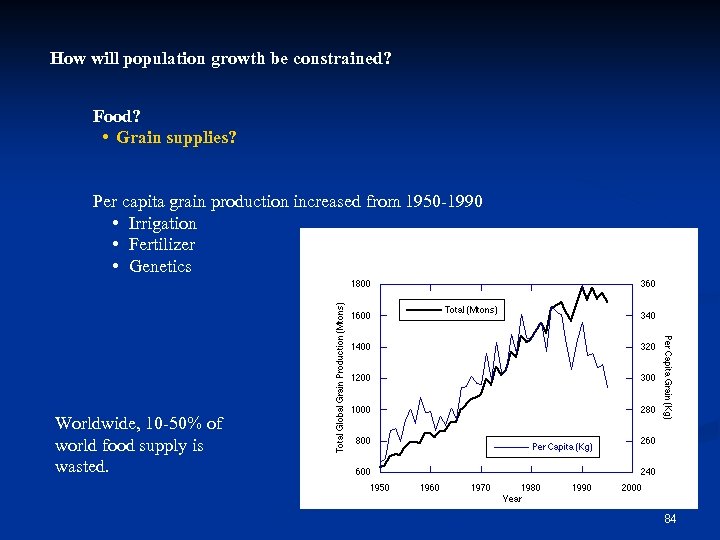
How will population growth be constrained? Food? • Grain supplies? Per capita grain production increased from 1950 -1990 • Irrigation • Fertilizer • Genetics Worldwide, 10 -50% of world food supply is wasted. Grain 84
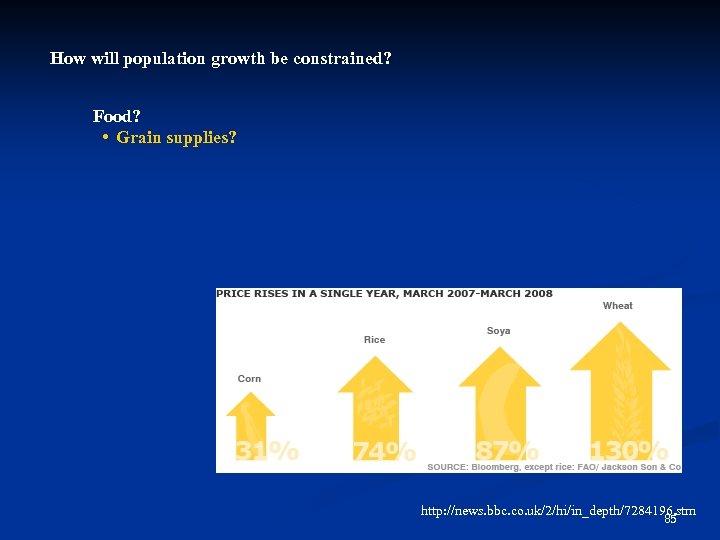
How will population growth be constrained? Food? • Grain supplies? http: //news. bbc. co. uk/2/hi/in_depth/7284196. stm Recent prices 85
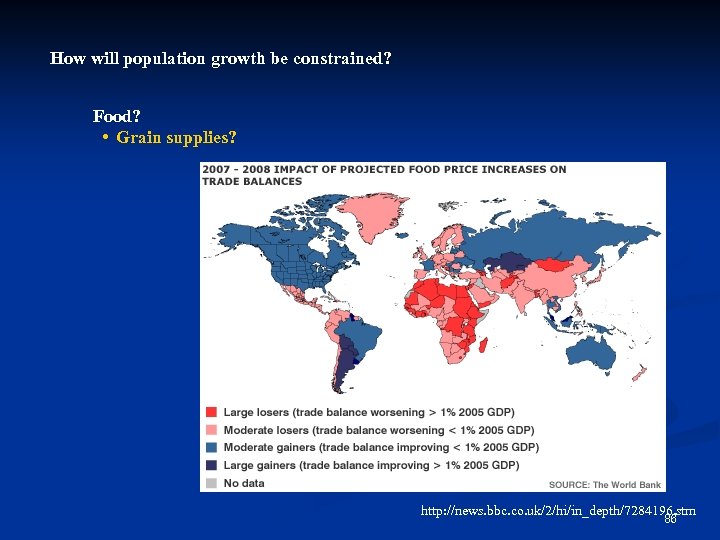
How will population growth be constrained? Food? • Grain supplies? http: //news. bbc. co. uk/2/hi/in_depth/7284196. stm Recent prices 86
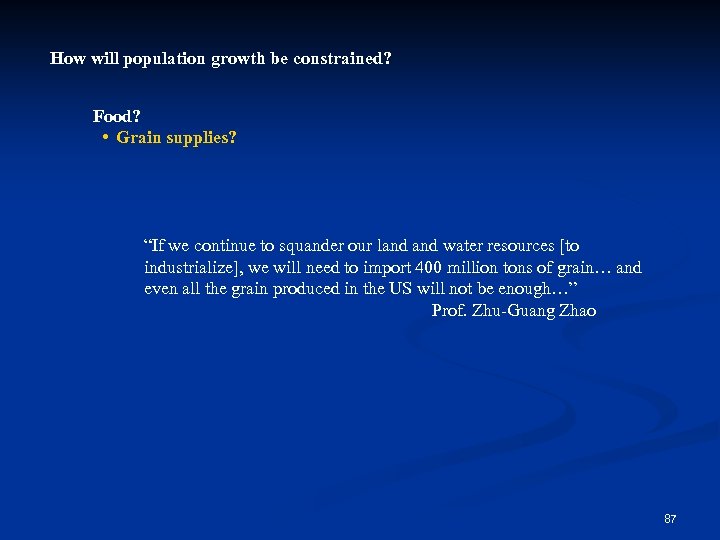
How will population growth be constrained? Food? • Grain supplies? “If we continue to squander our land water resources [to industrialize], we will need to import 400 million tons of grain… and even all the grain produced in the US will not be enough…” Prof. Zhu-Guang Zhao China 87
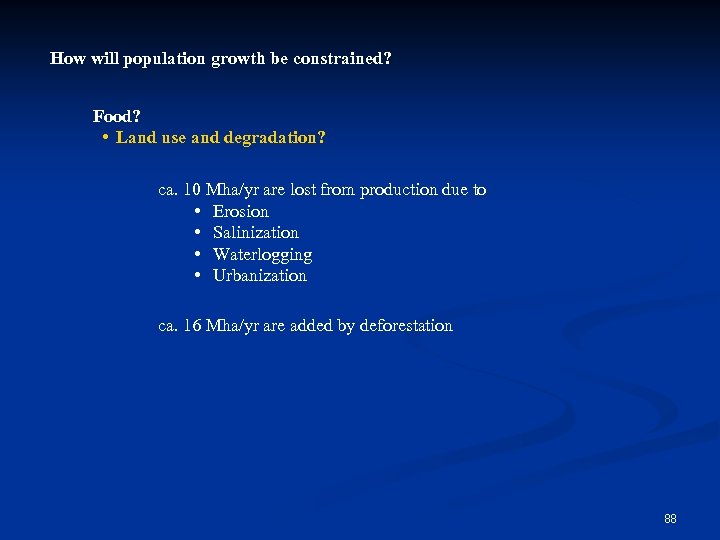
How will population growth be constrained? Food? • Land use and degradation? ca. 10 Mha/yr are lost from production due to • Erosion • Salinization • Waterlogging • Urbanization ca. 16 Mha/yr are added by deforestation Land use changes 88
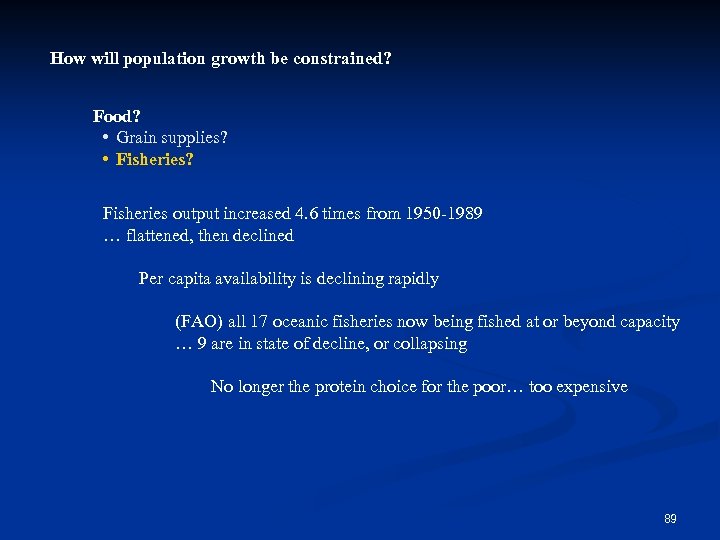
How will population growth be constrained? Food? • Grain supplies? • Fisheries? Fisheries output increased 4. 6 times from 1950 -1989 … flattened, then declined Per capita availability is declining rapidly (FAO) all 17 oceanic fisheries now being fished at or beyond capacity … 9 are in state of decline, or collapsing No longer the protein choice for the poor… too expensive Fisheries 89
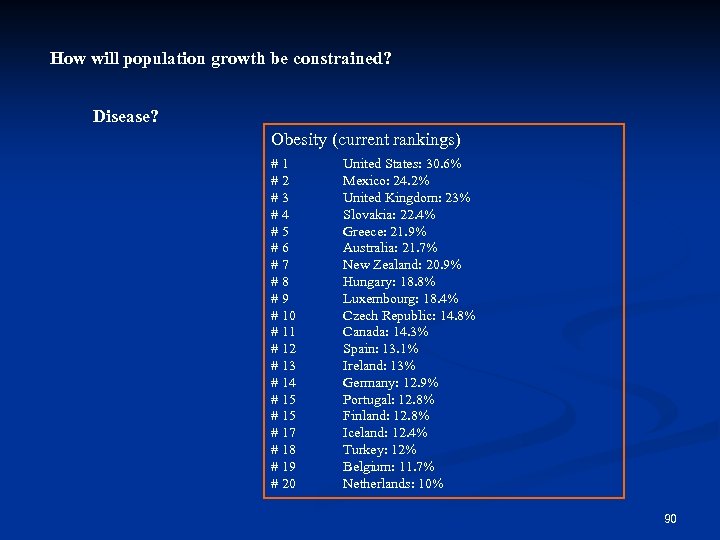
How will population growth be constrained? Disease? Obesity (current rankings) # 1 # 2 # 3 # 4 # 5 # 6 # 7 # 8 # 9 # 10 # 11 # 12 # 13 # 14 # 15 # 17 # 18 # 19 # 20 Fisheries United States: 30. 6% Mexico: 24. 2% United Kingdom: 23% Slovakia: 22. 4% Greece: 21. 9% Australia: 21. 7% New Zealand: 20. 9% Hungary: 18. 8% Luxembourg: 18. 4% Czech Republic: 14. 8% Canada: 14. 3% Spain: 13. 1% Ireland: 13% Germany: 12. 9% Portugal: 12. 8% Finland: 12. 8% Iceland: 12. 4% Turkey: 12% Belgium: 11. 7% Netherlands: 10% 90
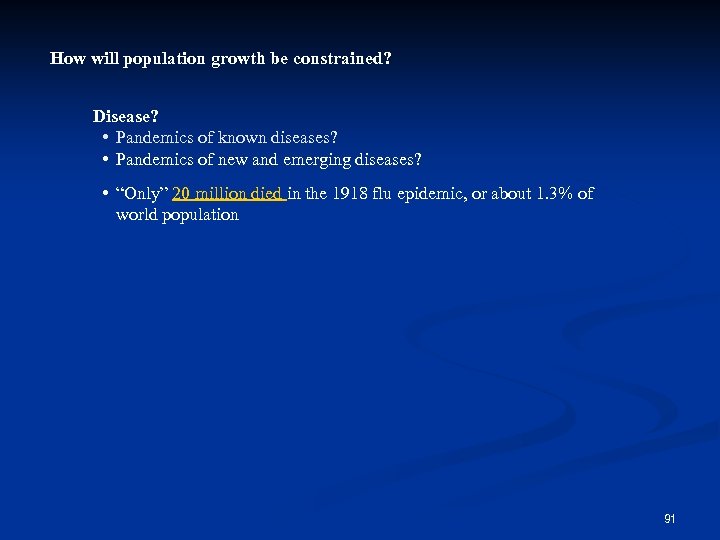
How will population growth be constrained? Disease? • Pandemics of known diseases? • Pandemics of new and emerging diseases? • “Only” 20 million died in the 1918 flu epidemic, or about 1. 3% of world population Fisheries 91
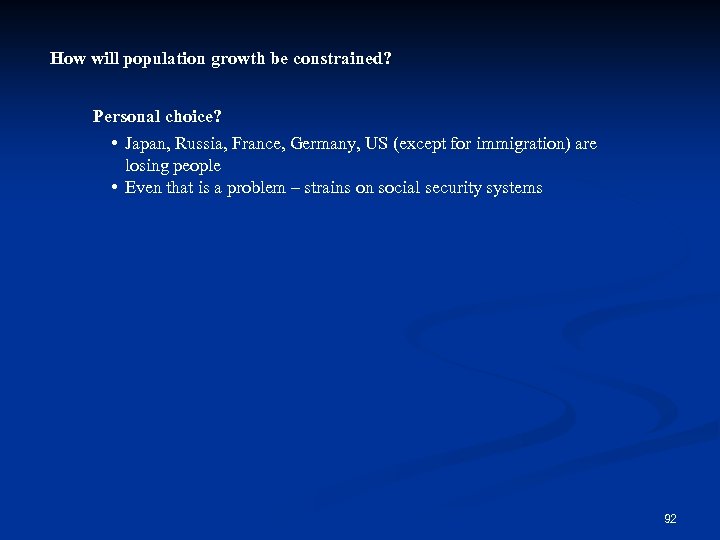
How will population growth be constrained? Personal choice? • Japan, Russia, France, Germany, US (except for immigration) are losing people • Even that is a problem – strains on social security systems Fisheries 92
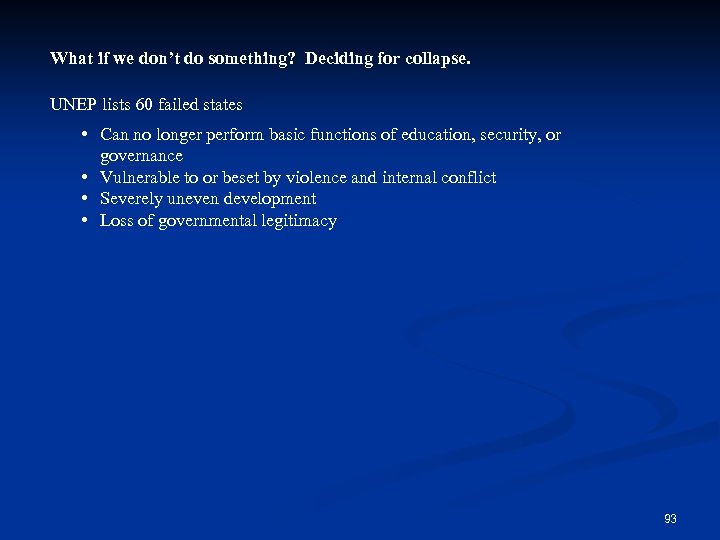
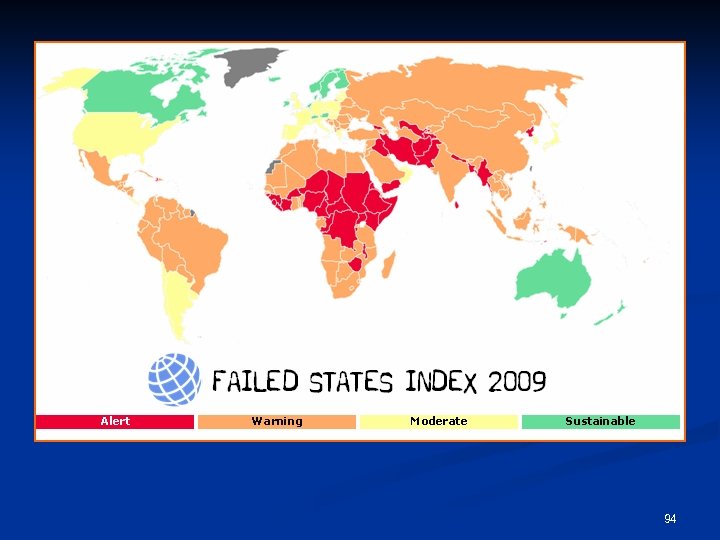
What if we don’t do something? Deciding for collapse. UNEP lists 60 failed states • Can no longer perform basic functions of education, security, or governance • Vulnerable to or beset by violence and internal conflict • Severely uneven development • Loss of governmental legitimacy Failed states 93
94
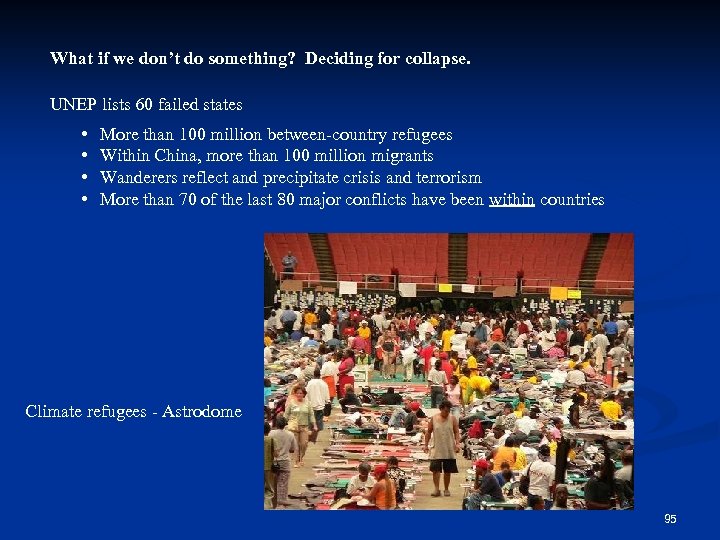
What if we don’t do something? Deciding for collapse. UNEP lists 60 failed states • • More than 100 million between-country refugees Within China, more than 100 million migrants Wanderers reflect and precipitate crisis and terrorism More than 70 of the last 80 major conflicts have been within countries Climate refugees - Astrodome Refugees 95
Winning the battle – Plan B 4. 0 Stabilize CO 2 – cut emissions by 80% by 2020 Stabilize population at ≤ 8 billion Eradicate poverty ($77 B/yr) Restore natural systems ($110 B/yr) All that is needed for the triumph of evil is for good folks to do nothing. Four futures - summary 96
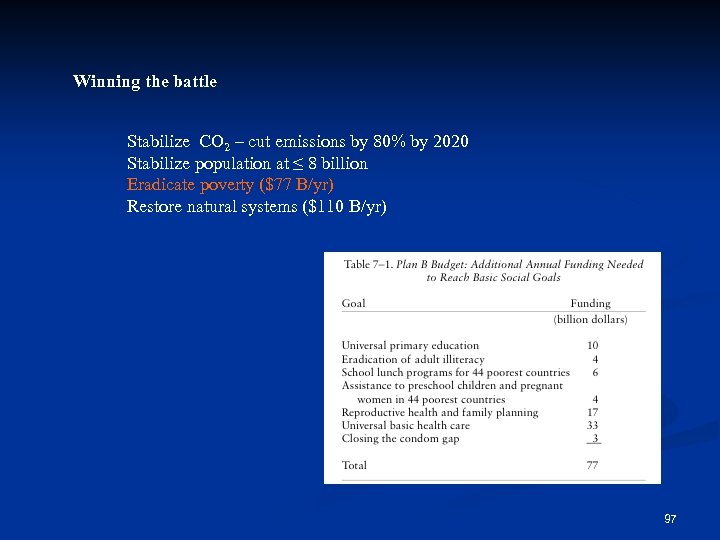
Winning the battle Stabilize CO 2 – cut emissions by 80% by 2020 Stabilize population at ≤ 8 billion Eradicate poverty ($77 B/yr) Restore natural systems ($110 B/yr) Four futures - summary 97
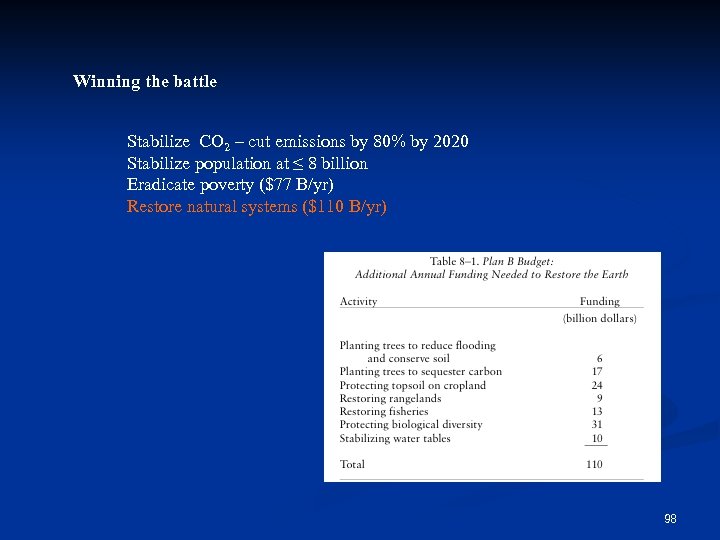
Winning the battle Stabilize CO 2 – cut emissions by 80% by 2020 Stabilize population at ≤ 8 billion Eradicate poverty ($77 B/yr) Restore natural systems ($110 B/yr) Four futures - summary 98

"You can't have a light without a dark to stick it in. " Arlo Guthrie 99
Скачать презентацию Symbiosis from organisms to Earth KAUST
bfee2086be32baad09248f6ceab07923.ppt