 Скачать презентацию Syllabus CS 765 Intro to Database Systems 3208
9ee8034feb646f0b0a280f2c9379bd2a.ppt
- Количество слайдов: 7



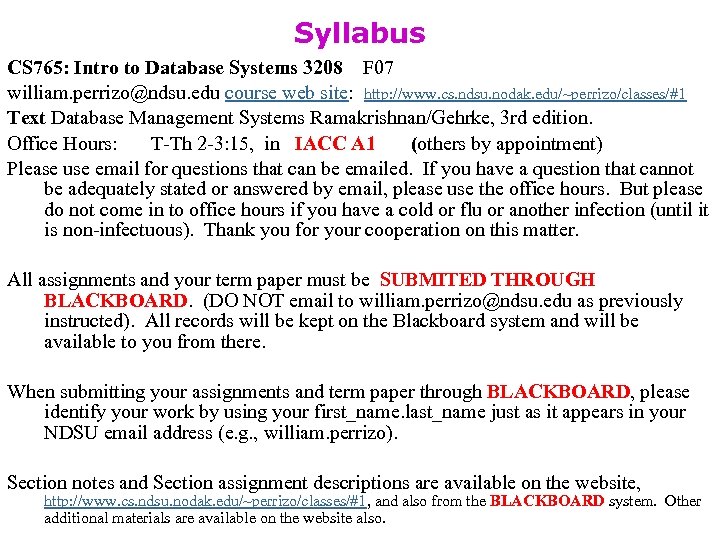
Syllabus CS 765: Intro to Database Systems 3208 F 07 william. perrizo@ndsu. edu course web site: http: //www. cs. ndsu. nodak. edu/~perrizo/classes/#1 Text Database Management Systems Ramakrishnan/Gehrke, 3 rd edition. Office Hours: T-Th 2 -3: 15, in IACC A 1 (others by appointment) Please use email for questions that can be emailed. If you have a question that cannot be adequately stated or answered by email, please use the office hours. But please do not come in to office hours if you have a cold or flu or another infection (until it is non-infectuous). Thank you for your cooperation on this matter. All assignments and your term paper must be SUBMITED THROUGH BLACKBOARD. (DO NOT email to william. perrizo@ndsu. edu as previously instructed). All records will be kept on the Blackboard system and will be available to you from there. When submitting your assignments and term paper through BLACKBOARD, please identify your work by using your first_name. last_name just as it appears in your NDSU email address (e. g. , william. perrizo). Section notes and Section assignment descriptions are available on the website, http: //www. cs. ndsu. nodak. edu/~perrizo/classes/#1, and also from the BLACKBOARD system. Other additional materials are available on the website also.
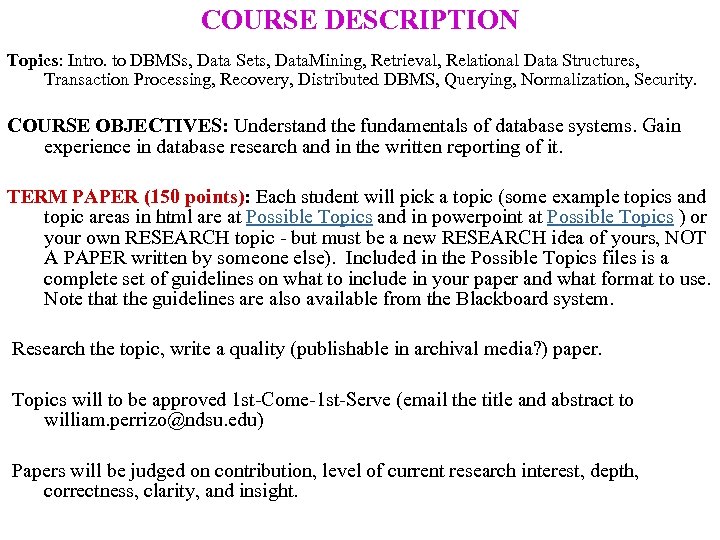
COURSE DESCRIPTION Topics: Intro. to DBMSs, Data Sets, Data. Mining, Retrieval, Relational Data Structures, Transaction Processing, Recovery, Distributed DBMS, Querying, Normalization, Security. COURSE OBJECTIVES: Understand the fundamentals of database systems. Gain experience in database research and in the written reporting of it. TERM PAPER (150 points): Each student will pick a topic (some example topics and topic areas in html are at Possible Topics and in powerpoint at Possible Topics ) or your own RESEARCH topic - but must be a new RESEARCH idea of yours, NOT A PAPER written by someone else). Included in the Possible Topics files is a complete set of guidelines on what to include in your paper and what format to use. Note that the guidelines are also available from the Blackboard system. Research the topic, write a quality (publishable in archival media? ) paper. Topics will to be approved 1 st-Come-1 st-Serve (email the title and abstract to william. perrizo@ndsu. edu) Papers will be judged on contribution, level of current research interest, depth, correctness, clarity, and insight.
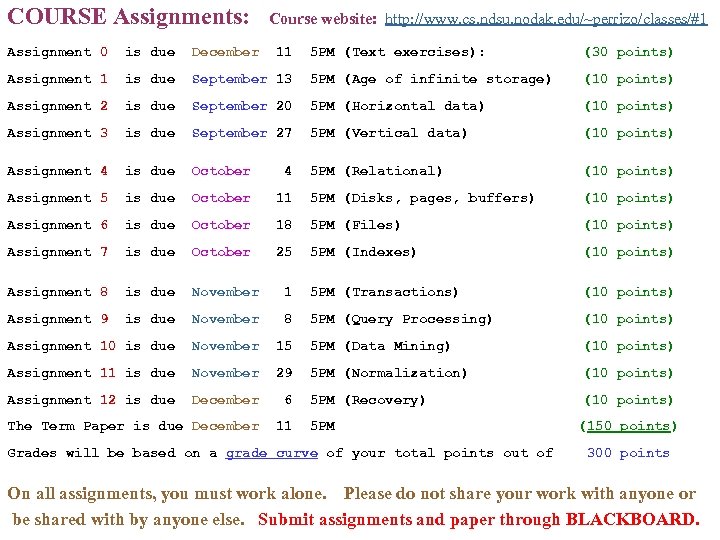
COURSE Assignments: Assignment 0 is due December Assignment 1 is due Assignment 2 Course website: http: //www. cs. ndsu. nodak. edu/~perrizo/classes/#1 11 5 PM (Text exercises): (30 points) September 13 5 PM (Age of infinite storage) (10 points) is due September 20 5 PM (Horizontal data) (10 points) Assignment 3 is due September 27 5 PM (Vertical data) (10 points) Assignment 4 is due October 4 5 PM (Relational) (10 points) Assignment 5 is due October 11 5 PM (Disks, pages, buffers) (10 points) Assignment 6 is due October 18 5 PM (Files) (10 points) Assignment 7 is due October 25 5 PM (Indexes) (10 points) Assignment 8 is due November 1 5 PM (Transactions) (10 points) Assignment 9 is due November 8 5 PM (Query Processing) (10 points) Assignment 10 is due November 15 5 PM (Data Mining) (10 points) Assignment 11 is due November 29 5 PM (Normalization) (10 points) Assignment 12 is due December 6 5 PM (Recovery) (10 points) The Term Paper is due December 11 5 PM Grades will be based on a grade curve of your total points out of (150 points) 300 points On all assignments, you must work alone. Please do not share your work with anyone or be shared with by anyone else. Submit assignments and paper through BLACKBOARD.
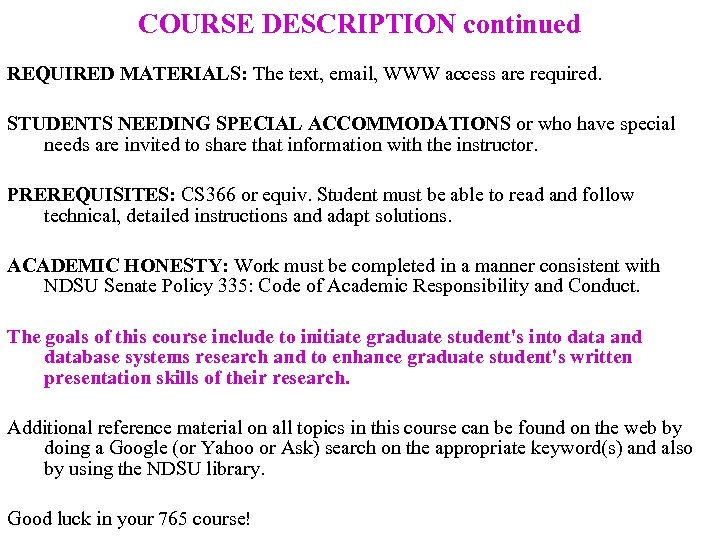
COURSE DESCRIPTION continued REQUIRED MATERIALS: The text, email, WWW access are required. STUDENTS NEEDING SPECIAL ACCOMMODATIONS or who have special needs are invited to share that information with the instructor. PREREQUISITES: CS 366 or equiv. Student must be able to read and follow technical, detailed instructions and adapt solutions. ACADEMIC HONESTY: Work must be completed in a manner consistent with NDSU Senate Policy 335: Code of Academic Responsibility and Conduct. The goals of this course include to initiate graduate student's into data and database systems research and to enhance graduate student's written presentation skills of their research. Additional reference material on all topics in this course can be found on the web by doing a Google (or Yahoo or Ask) search on the appropriate keyword(s) and also by using the NDSU library. Good luck in your 765 course!
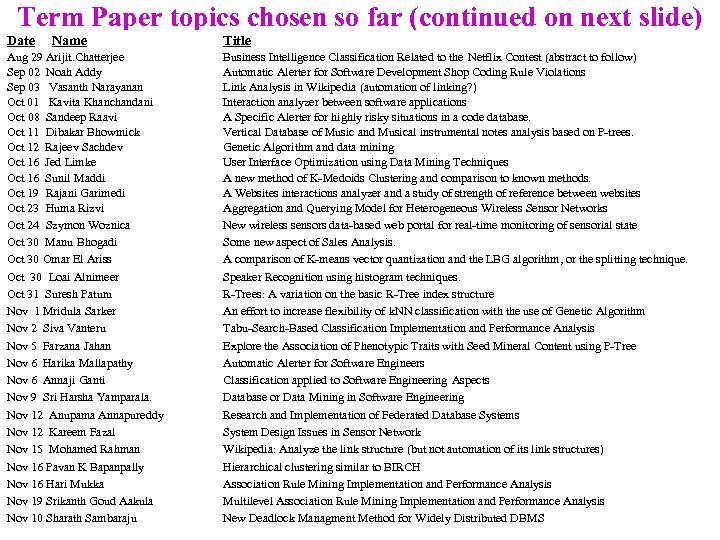
Term Paper topics chosen so far (continued on next slide) Date Name Aug 29 Arijit. Chatterjee Sep 02 Noah Addy Sep 03 Vasanth Narayanan Oct 01 Kavita Khanchandani Oct 08 Sandeep Raavi Oct 11 Dibakar Bhowmick Oct 12 Rajeev Sachdev Oct 16 Jed Limke Oct 16 Sunil Maddi Oct 19 Rajani Garimedi Oct 23 Huma Rizvi Oct 24 Szymon Woznica Oct 30 Manu Bhogadi Oct 30 Omar El Ariss Oct 30 Loai Alnimeer Oct 31 Suresh Paturu Nov 1 Mridula Sarker Nov 2 Siva Vanteru Nov 5 Farzana Jahan Nov 6 Harika Mallapathy Nov 6 Annaji Ganti Nov 9 Sri Harsha Yamparala. Nov 12 Anupama Annapureddy Nov 12 Kareem Fazal Nov 15 Mohamed Rahman Nov 16 Pavan K Bapanpally Nov 16 Hari Mukka Nov 19 Srikanth Goud Aakula Nov 10 Sharath Sambaraju Title Business Intelligence Classification Related to the Netflix Contest (abstract to follow) Automatic Alerter for Software Development Shop Coding Rule Violations Link Analysis in Wikipedia (automation of linking? ) Interaction analyzer between software applications A Specific Alerter for highly risky situations in a code database. Vertical Database of Music and Musical instrumental notes analysis based on P-trees. Genetic Algorithm and data mining User Interface Optimization using Data Mining Techniques A new method of K-Medoids Clustering and comparison to known methods. A Websites interactions analyzer and a study of strength of reference between websites Aggregation and Querying Model for Heterogeneous Wireless Sensor Networks New wireless sensors data-based web portal for real-time monitoring of sensorial state Some new aspect of Sales Analysis. A comparison of K-means vector quantization and the LBG algorithm, or the splitting technique. Speaker Recognition using histogram techniques. R-Trees: A variation on the basic R-Tree index structure An effort to increase flexibility of k. NN classification with the use of Genetic Algorithm Tabu-Search-Based Classification Implementation and Performance Analysis Explore the Association of Phenotypic Traits with Seed Mineral Content using P-Tree Automatic Alerter for Software Engineers Classification applied to Software Engineering Aspects Database or Data Mining in Software Engineering Research and Implementation of Federated Database Systems System Design Issues in Sensor Network Wikipedia: Analyze the link structure (but not automation of its link structures) Hierarchical clustering similar to BIRCH Association Rule Mining Implementation and Performance Analysis Multilevel Association Rule Mining Implementation and Performance Analysis New Deadlock Managment Method for Widely Distributed DBMS
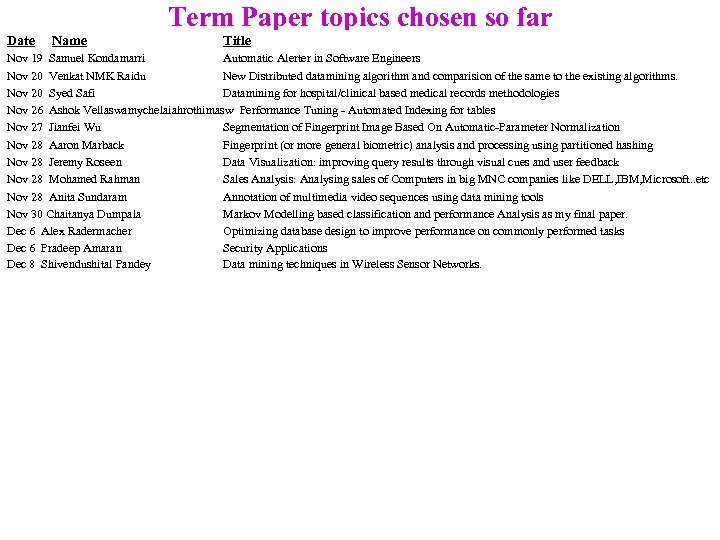
Term Paper topics chosen so far Date Name Title Nov 19 Samuel Kondamarri Automatic Alerter in Software Engineers Nov 20 Venkat NMK Raidu New Distributed datamining algorithm and comparision of the same to the existing algorithms. Nov 20 Syed Safi Datamining for hospital/clinical based medical records methodologies Nov 26 Ashok Vellaswamychelaiahrothimasw Performance Tuning - Automated Indexing for tables Nov 27 Jianfei Wu Segmentation of Fingerprint Image Based On Automatic-Parameter Normalization Nov 28 Aaron Marback Fingerprint (or more general biometric) analysis and processing using partitioned hashing Nov 28 Jeremy Roseen Data Visualization: improving query results through visual cues and user feedback Nov 28 Mohamed Rahman Sales Analysis: Analysing sales of Computers in big MNC companies like DELL, IBM, Microsoft. . etc Nov 28 Anita Sundaram Annotation of multimedia video sequences using data mining tools Nov 30 Chaitanya Dumpala Markov Modelling based classification and performance Analysis as my final paper. Dec 6 Alex Radermacher Optimizing database design to improve performance on commonly performed tasks Dec 6 Pradeep Amaran Security Applications Dec 8 Shivendushital Pandey Data mining techniques in Wireless Sensor Networks.
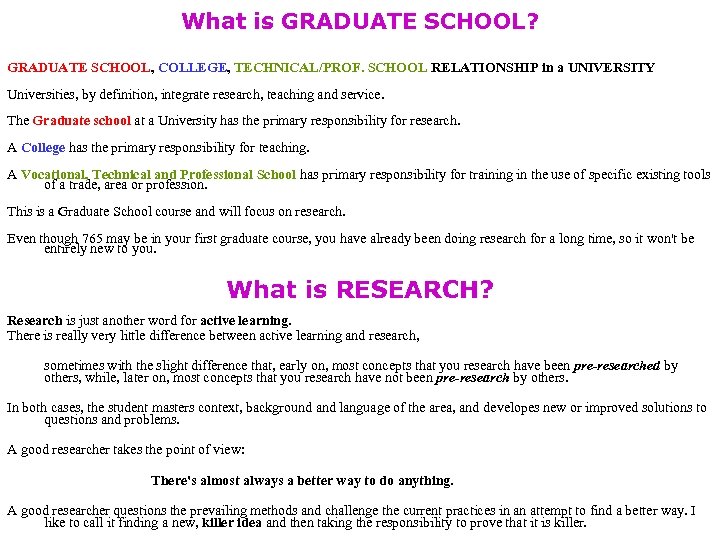
What is GRADUATE SCHOOL? GRADUATE SCHOOL, COLLEGE, TECHNICAL/PROF. SCHOOL RELATIONSHIP in a UNIVERSITY Universities, by definition, integrate research, teaching and service. The Graduate school at a University has the primary responsibility for research. A College has the primary responsibility for teaching. A Vocational, Technical and Professional School has primary responsibility for training in the use of specific existing tools of a trade, area or profession. This is a Graduate School course and will focus on research. Even though 765 may be in your first graduate course, you have already been doing research for a long time, so it won't be entirely new to you. What is RESEARCH? Research is just another word for active learning. There is really very little difference between active learning and research, sometimes with the slight difference that, early on, most concepts that you research have been pre-researched by others, while, later on, most concepts that you research have not been pre-research by others. In both cases, the student masters context, background and language of the area, and developes new or improved solutions to questions and problems. A good researcher takes the point of view: There's almost always a better way to do anything. A good researcher questions the prevailing methods and challenge the current practices in an attempt to find a better way. I like to call it finding a new, killer idea and then taking the responsibility to prove that it is killer.
Скачать презентацию Syllabus CS 765 Intro to Database Systems 3208
9ee8034feb646f0b0a280f2c9379bd2a.ppt