


 Скачать презентацию Sy CHOSys Synchronous Circuit Hardware Orchestration System Ronny
bcd21ecf2f57aea21236453a8d29e82e.ppt
- Количество слайдов: 26
 Sy. CHOSys Synchronous Circuit Hardware Orchestration System Ronny Krashinsky Seongmoo Heo Michael Zhang Krste Asanovic MIT Laboratory for Computer Sci www. cag. lcs. mit. edu/scale ronny@mit. edu
 Motivation Given a proposed processor architecture, we want to: • Simulate performance (cycle count) • Determine energy usage (Joules) • Investigate SW, compiler, and architecture changes Existing simulators – Prohibitively slow or inaccurate
 Sy. CHOSys generates compiled cycle simulators Can optionally track energy usage: • Exploits low power microprocessor design domain to obtain accurate transition-sensitive energy models • Factors out common transition counts • Uses fast bit-parallel transition counting • 7 orders of magnitude faster than SPICE (7% error) • 5 orders of accurately faster than Power. Mill Sy. CHOSys can magnitude simulate the energy usage of a CPU circuit at speeds on the order of a billion cycles per day
 Overview of talk l l l Sy. CHOSys Framework Microprocessor Energy Modeling Energy Simulation in Sy. CHOSys Results Status & Future Work
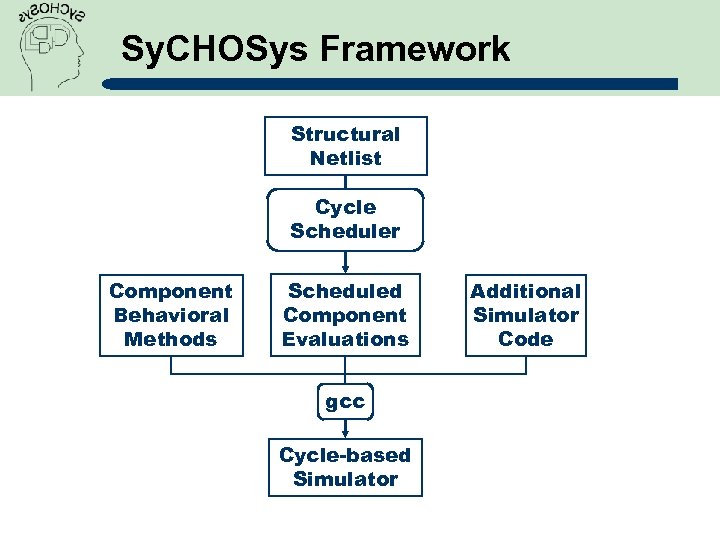 Sy. CHOSys Framework Structural Netlist Cycle Scheduler Component Behavioral Methods Scheduled Component Evaluations gcc Cycle-based Simulator Additional Simulator Code
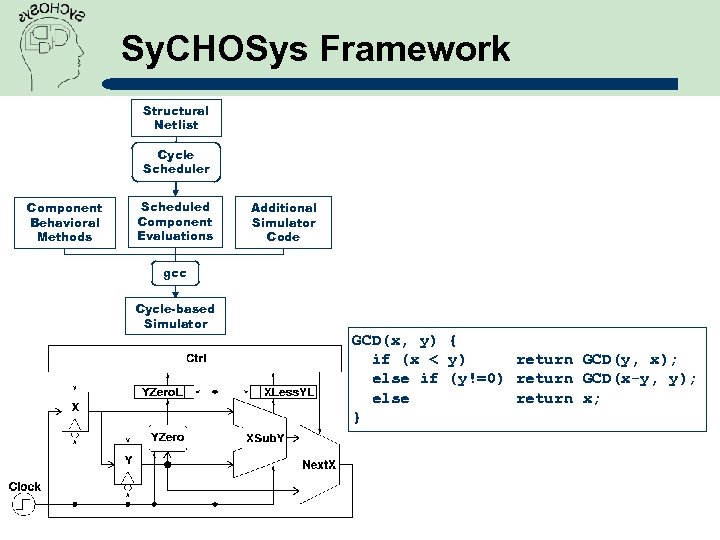 Sy. CHOSys Framework Structural Netlist Cycle Scheduler Component Behavioral Methods Scheduled Component Evaluations Additional Simulator Code gcc Cycle-based Simulator GCD(x, y) { if (x < y) return GCD(y, x); else if (y!=0) return GCD(x-y, y); else return x; }
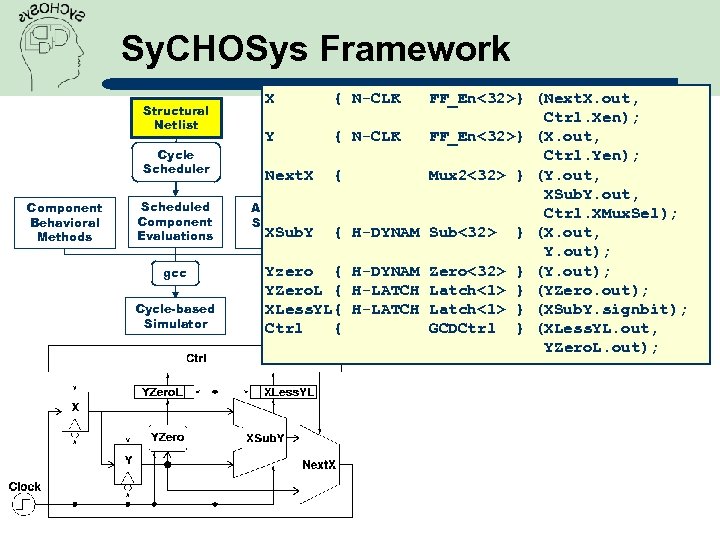 Sy. CHOSys Framework Structural Netlist Cycle Scheduler Component Behavioral Methods Scheduled Component Evaluations gcc Cycle-based Simulator X { N-CLK Y { N-CLK Next. X { Additional Simulator XSub. Y Code { H-DYNAM Yzero { H-DYNAM YZero. L { H-LATCH XLess. YL{ H-LATCH Ctrl { FF_En<32>} (Next. X. out, Ctrl. Xen); FF_En<32>} (X. out, Ctrl. Yen); Mux 2<32> } (Y. out, XSub. Y. out, Ctrl. XMux. Sel); Sub<32> } (X. out, Y. out); Zero<32> } (Y. out); Latch<1> } (YZero. out); Latch<1> } (XSub. Y. signbit); GCDCtrl } (XLess. YL. out, YZero. L. out);
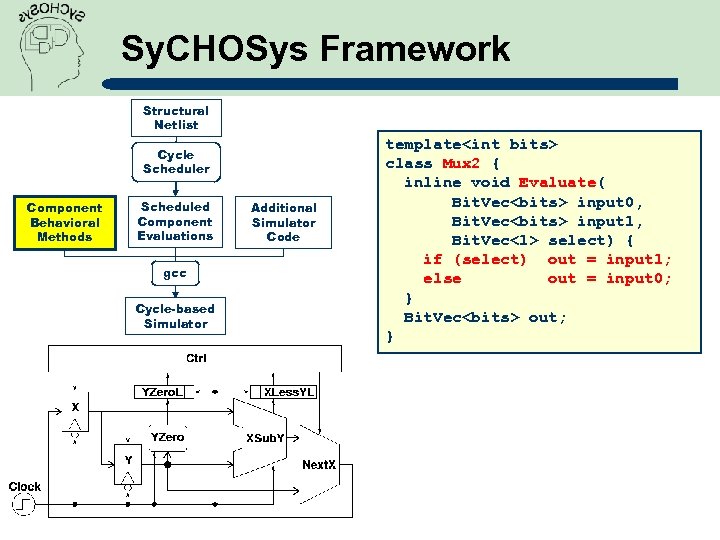 Sy. CHOSys Framework Structural Netlist Cycle Scheduler Component Behavioral Methods Scheduled Component Evaluations gcc Cycle-based Simulator Additional Simulator Code template
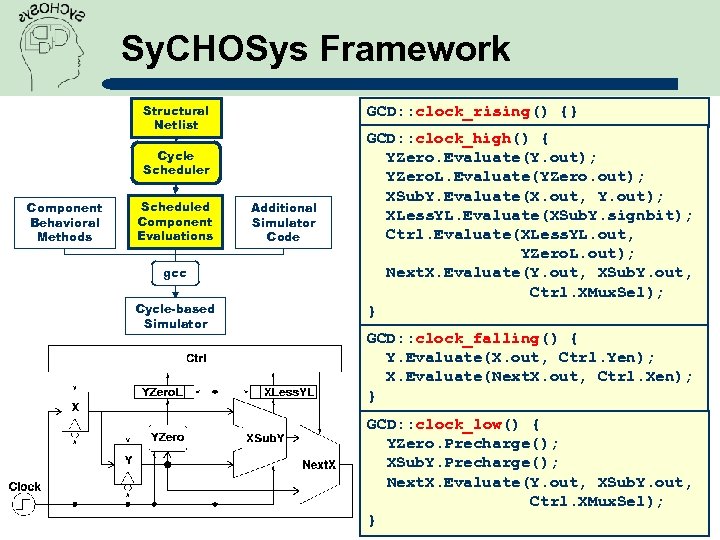 Sy. CHOSys Framework Structural Netlist GCD: : clock_rising() {} Cycle Scheduler Component Behavioral Methods Scheduled Component Evaluations gcc Cycle-based Simulator Additional Simulator Code GCD: : clock_high() { YZero. Evaluate(Y. out); YZero. L. Evaluate(YZero. out); XSub. Y. Evaluate(X. out, Y. out); XLess. YL. Evaluate(XSub. Y. signbit); Ctrl. Evaluate(XLess. YL. out, YZero. L. out); Next. X. Evaluate(Y. out, XSub. Y. out, Ctrl. XMux. Sel); } GCD: : clock_falling() { Y. Evaluate(X. out, Ctrl. Yen); X. Evaluate(Next. X. out, Ctrl. Xen); } GCD: : clock_low() { YZero. Precharge(); XSub. Y. Precharge(); Next. X. Evaluate(Y. out, XSub. Y. out, Ctrl. XMux. Sel); }
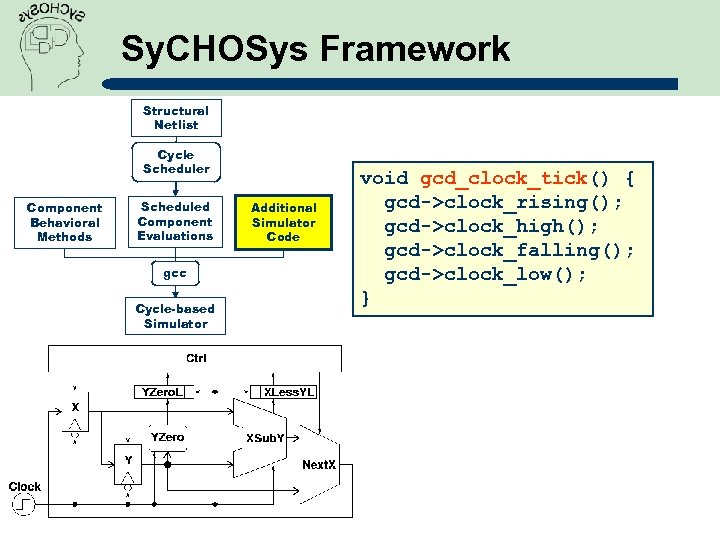 Sy. CHOSys Framework Structural Netlist Cycle Scheduler Component Behavioral Methods Scheduled Component Evaluations gcc Cycle-based Simulator Additional Simulator Code void gcd_clock_tick() { gcd->clock_rising(); gcd->clock_high(); gcd->clock_falling(); gcd->clock_low(); }
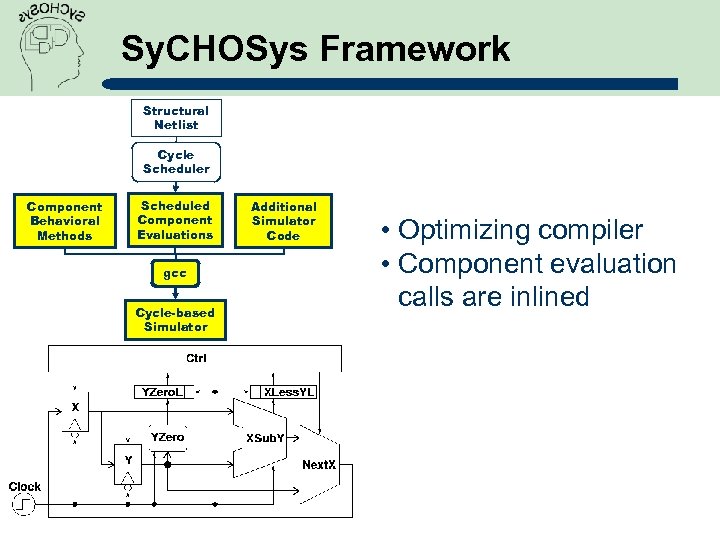 Sy. CHOSys Framework Structural Netlist Cycle Scheduler Component Behavioral Methods Scheduled Component Evaluations gcc Cycle-based Simulator Additional Simulator Code • Optimizing compiler • Component evaluation calls are inlined
 Energy Modeling Power consumption in digital CMOS: • Dynamic Switching • Short Circuit Current • Leakage Current
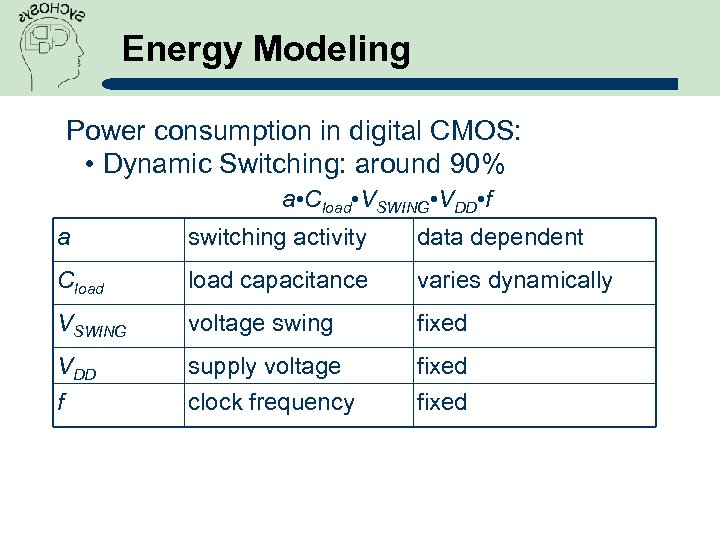 Energy Modeling Power consumption in digital CMOS: • Dynamic Switching: around 90% a • Cload • VSWING • VDD • f a switching activity data dependent Cload capacitance varies dynamically VSWING voltage swing fixed VDD f supply voltage clock frequency fixed
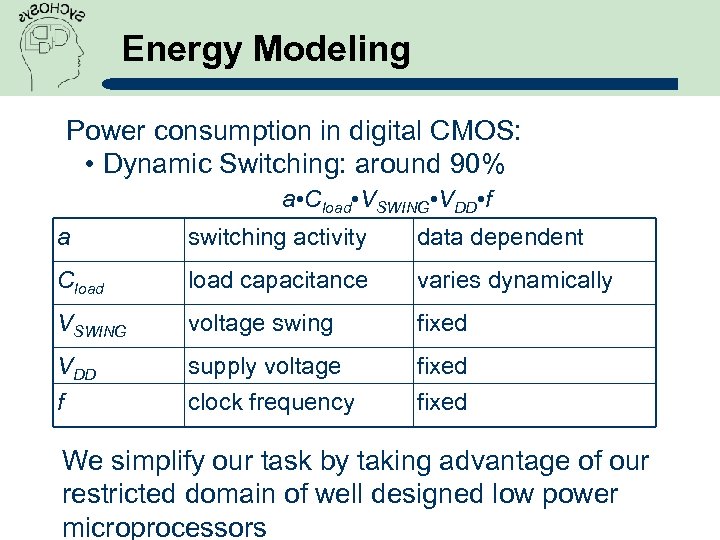 Energy Modeling Power consumption in digital CMOS: • Dynamic Switching: around 90% a • Cload • VSWING • VDD • f a switching activity data dependent Cload capacitance varies dynamically VSWING voltage swing fixed VDD f supply voltage clock frequency fixed We simplify our task by taking advantage of our restricted domain of well designed low power microprocessors
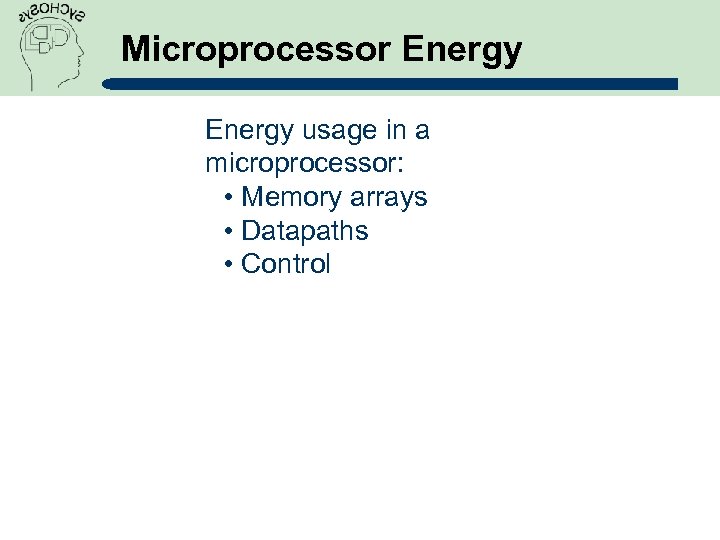 Microprocessor Energy usage in a microprocessor: • Memory arrays • Datapaths • Control
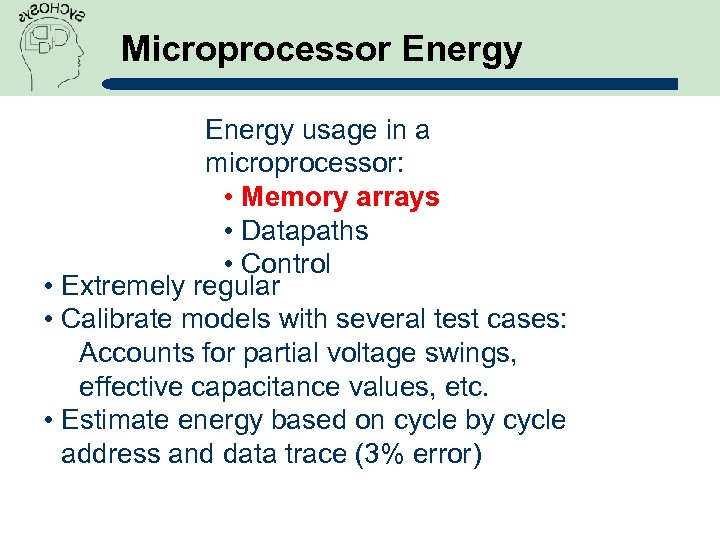 Microprocessor Energy usage in a microprocessor: • Memory arrays • Datapaths • Control • Extremely regular • Calibrate models with several test cases: Accounts for partial voltage swings, effective capacitance values, etc. • Estimate energy based on cycle by cycle address and data trace (3% error)
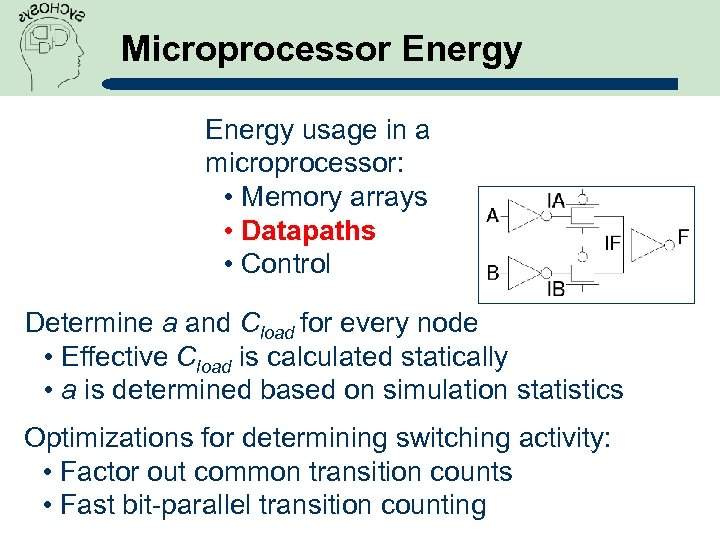 Microprocessor Energy usage in a microprocessor: • Memory arrays • Datapaths • Control Determine a and Cload for every node • Effective Cload is calculated statically • a is determined based on simulation statistics Optimizations for determining switching activity: • Factor out common transition counts • Fast bit-parallel transition counting
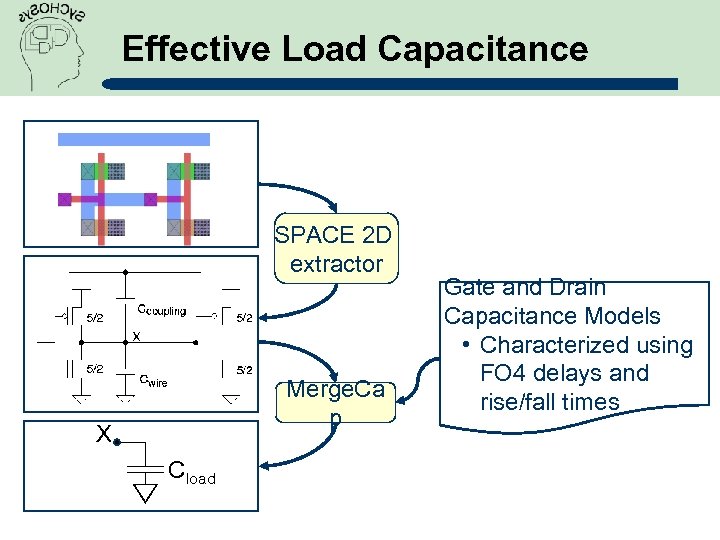 Effective Load Capacitance SPACE 2 D extractor Merge. Ca p X Cload Gate and Drain Capacitance Models • Characterized using FO 4 delays and rise/fall times
 Microprocessor Energy usage in a microprocessor: • Memory arrays • Datapaths • Control • Synthesized using automated tools — Irregular, hard to model • Less than 10% of energy in simple RISC designs • Will become more important in low power designs • Can be modeled at the level of standard cell gates • Work in progress
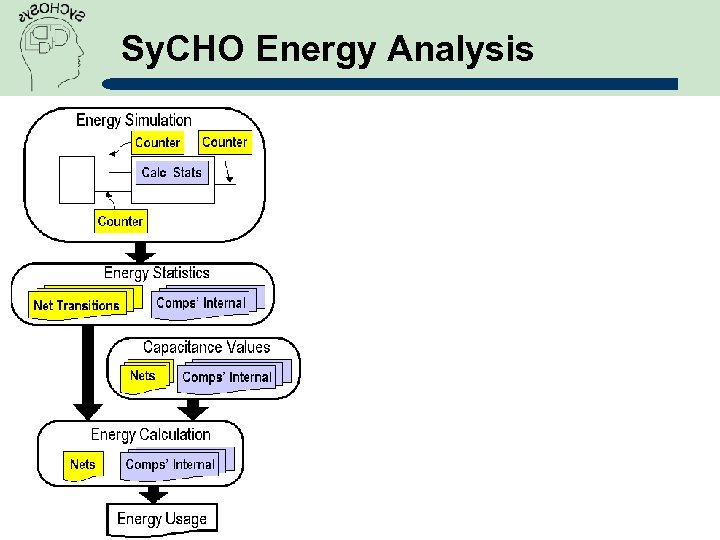 Sy. CHO Energy Analysis
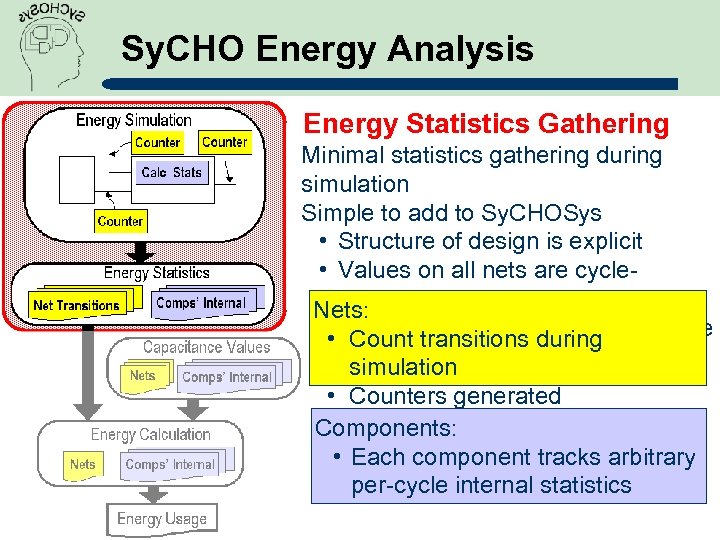 Sy. CHO Energy Analysis Energy Statistics Gathering Minimal statistics gathering during simulation Simple to add to Sy. CHOSys • Structure of design is explicit • Values on all nets are cycleaccurate Nets: • • Can incorporate arbitrary C++ code Count transitions during simulation • Counters generated automatically Components: • Each component tracks arbitrary per-cycle internal statistics
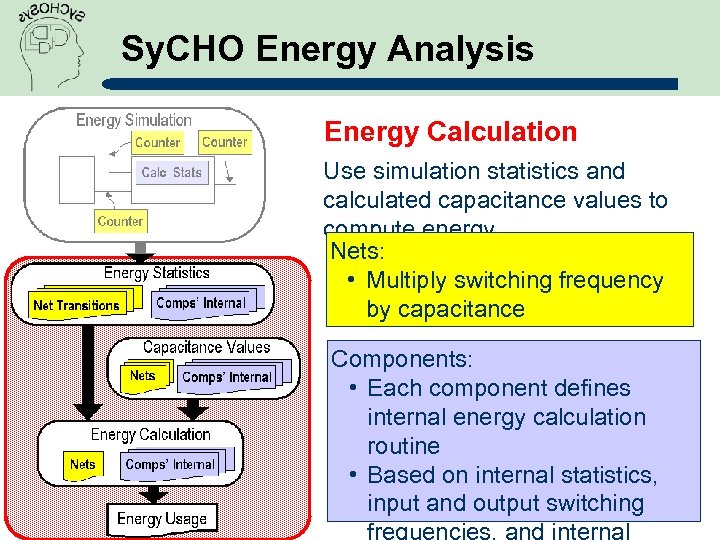 Sy. CHO Energy Analysis Energy Calculation Use simulation statistics and calculated capacitance values to compute energy Nets: • Multiply switching frequency by capacitance Components: • Each component defines internal energy calculation routine • Based on internal statistics, input and output switching
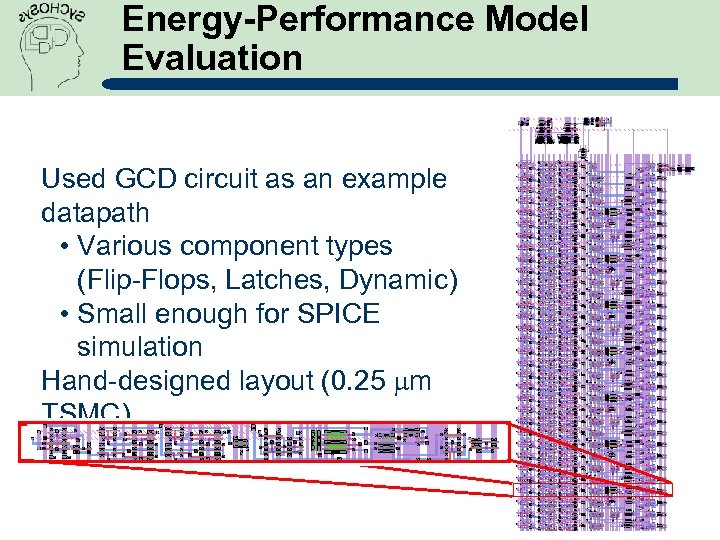 Energy-Performance Model Evaluation Used GCD circuit as an example datapath • Various component types (Flip-Flops, Latches, Dynamic) • Small enough for SPICE simulation Hand-designed layout (0. 25 mm TSMC)
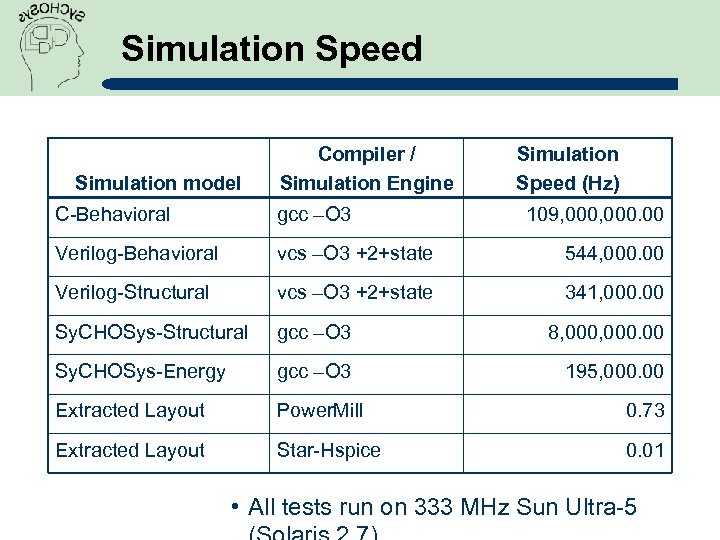 Simulation Speed Simulation model Compiler / Simulation Engine Simulation Speed (Hz) C-Behavioral gcc –O 3 109, 000. 00 Verilog-Behavioral vcs –O 3 +2+state 544, 000. 00 Verilog-Structural vcs –O 3 +2+state 341, 000. 00 Sy. CHOSys-Structural gcc –O 3 8, 000. 00 Sy. CHOSys-Energy gcc –O 3 195, 000. 00 Extracted Layout Power. Mill 0. 73 Extracted Layout Star-Hspice 0. 01 • All tests run on 333 MHz Sun Ultra-5
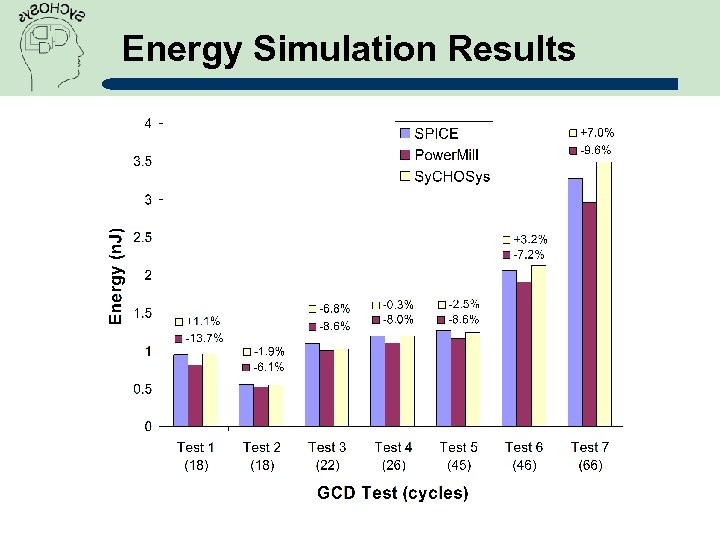 Energy Simulation Results
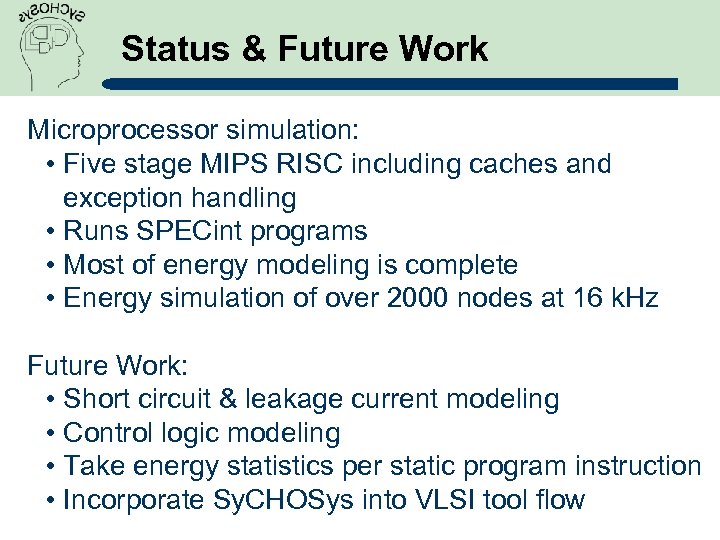 Status & Future Work Microprocessor simulation: • Five stage MIPS RISC including caches and exception handling • Runs SPECint programs • Most of energy modeling is complete • Energy simulation of over 2000 nodes at 16 k. Hz Future Work: • Short circuit & leakage current modeling • Control logic modeling • Take energy statistics per static program instruction • Incorporate Sy. CHOSys into VLSI tool flow