



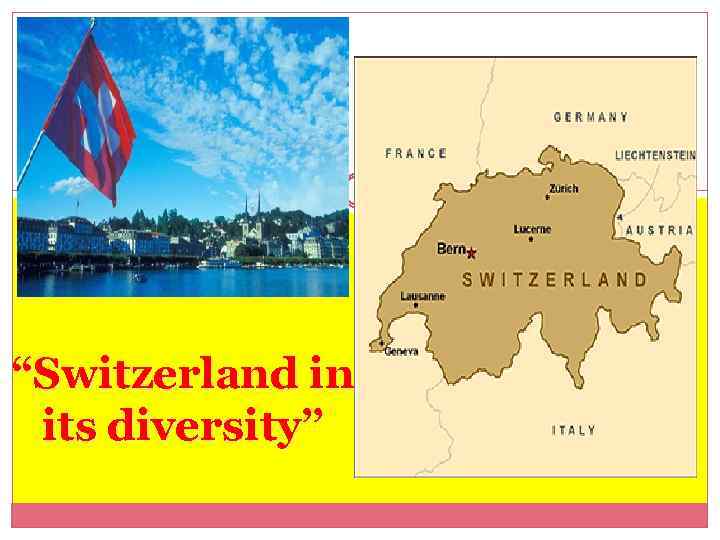
 “Switzerland in its diversity”
 12 Parts : 1. Geography 2. Way of life 3. Socializing 4. Accommodation 5. Standard of living 6. Education 7. Economy 8. Climate 9. People 10. Science 11. Culture 12. Food
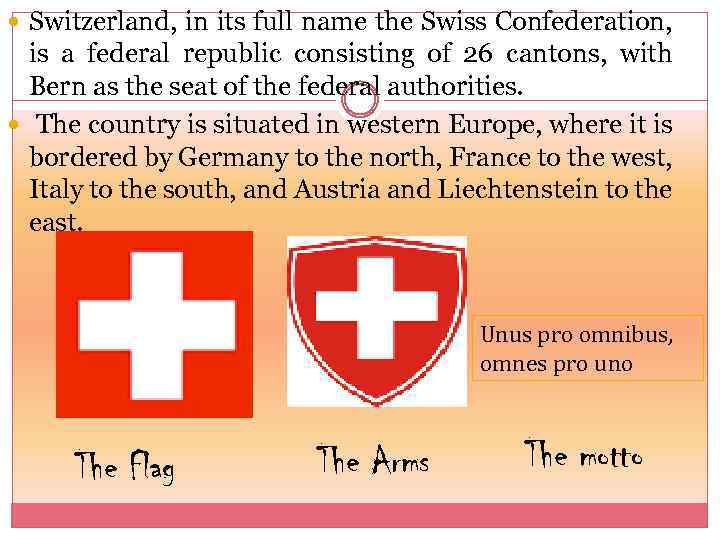 Switzerland, in its full name the Swiss Confederation, is a federal republic consisting of 26 cantons, with Bern as the seat of the federal authorities. The country is situated in western Europe, where it is bordered by Germany to the north, France to the west, Italy to the south, and Austria and Liechtenstein to the east. Unus pro omnibus, omnes pro uno The Flag The Arms The motto
 Capital – Bern Largest cities - Zurich, Geneva, Basel, Bern, Lausanne. Subdivisions - 23 cantons Official languages : German (63. 7 %), French (20. 4 %), Italian (6. 5 %), Romansh(0. 5%) Ethnic groups - 55, 0% Swiss, - 45, 0% Other, (mostly from neighboring EU-states, ex. Yugoslavia and Turkey) (2008) Demonym - Swiss
 Government - Federal republic, with directorial system and direct democracy. Federal state - 12 September 1848 The President of Switzerland - Micheline Anne-Marie Calmy-Rey. Prime Minister - Moritz Leuenberger Currency - Swiss franc Area - Total - 41, 285 km 2; - Water (%) - 4. 2 Population: - 2012 estimate 8, 000(96 th); 2000 census 7, 452, 075 The Swiss climate is generally temperate, but can vary greatly between the localities, from glacial conditions on the mountaintops.
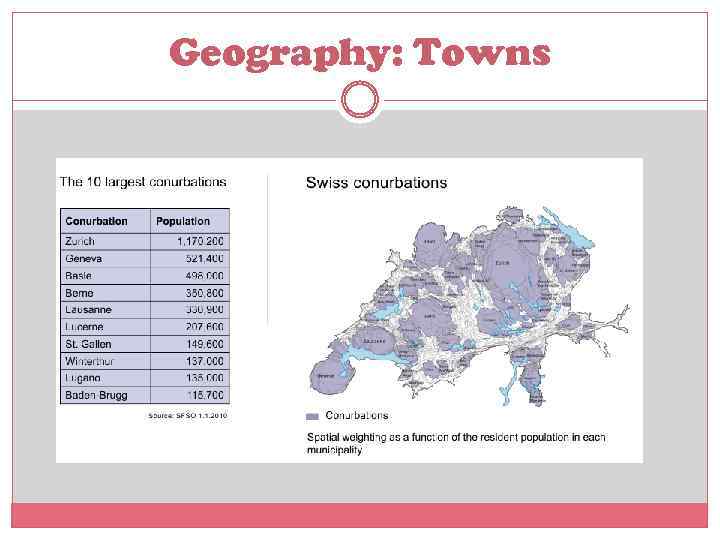 Geography: Towns
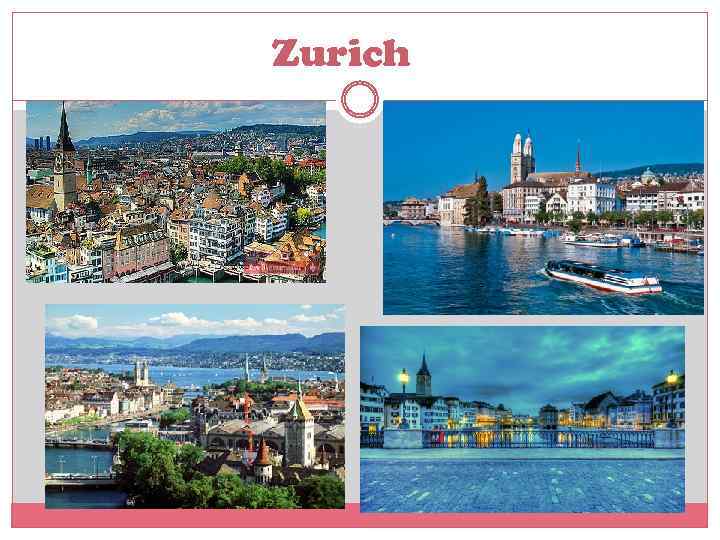 Zurich
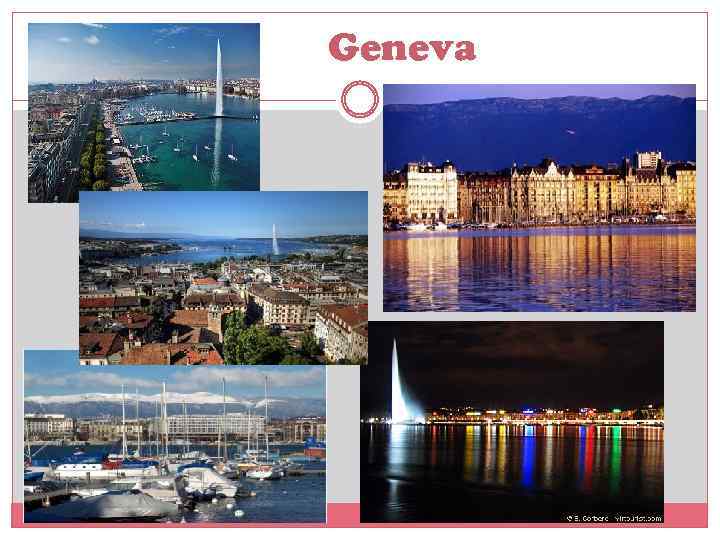 Geneva
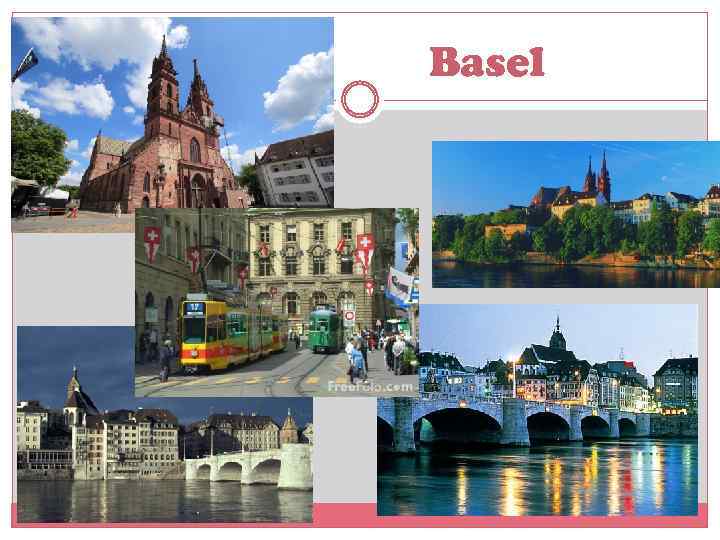 Basel
Basel
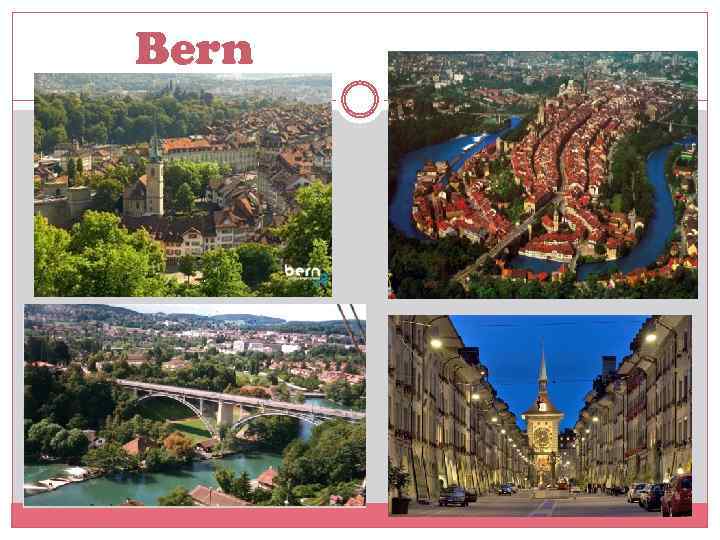 Bern
Bern
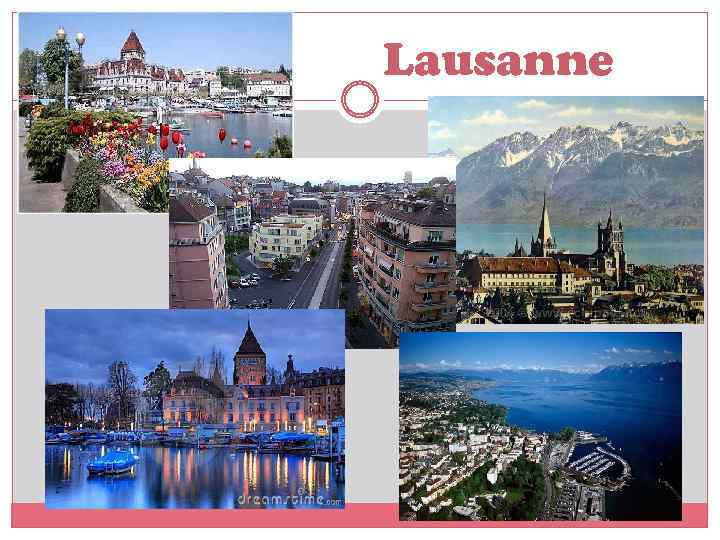 Lausanne
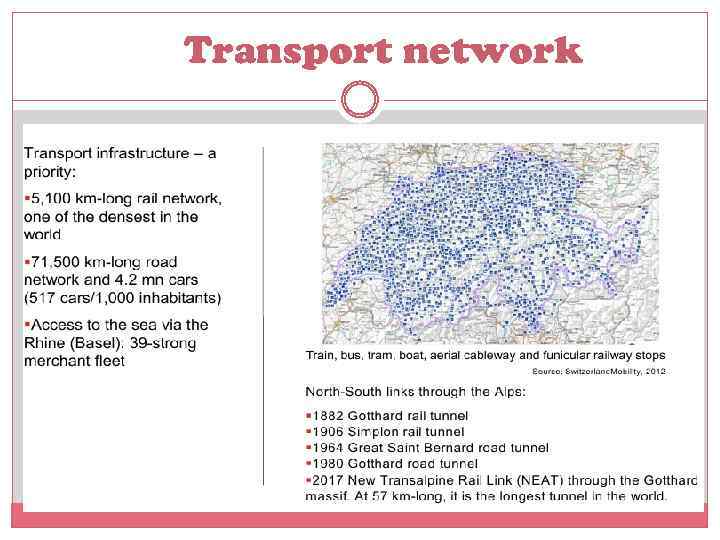 Transport network
 Way of life • Health Switzerland has a reputation for high-quality and efficient healthcare. A family of four could easily spend more than $800 a month for fairly standard insurance, dental care not included. • Shopping Urbanites looking for a calmer existence will welcome the smaller shops, the communities with butchers, bakers, and shoe-menders. Although there are plenty of supermarkets in Switzerland, the choices and hours may take a while to get used to. Closing times are 12: 15 and 2 p. m. , like many other shops and the post-office. Special purchases include embroidery and linen, Bernese woodcarving, chocolate, cheese, Swiss army knives and luxury handmade clocks and watches.
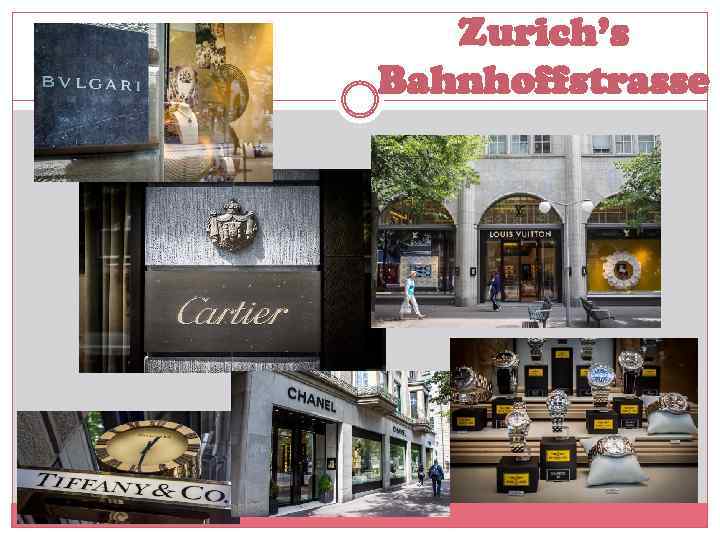 Zurich’s Bahnhoffstrasse
 Socializing In general the Swiss are as reserved as the British. They probably won't approach you or invite you out until you have invited them. Acquaintances will respond favorably if you invite them over for coffee, pizza, or a grilled dinner if you want to get to know them better. Probably the most important piece of advice with regards to socializing is punctuality. You will be expected no later than five minutes after the arranged time.
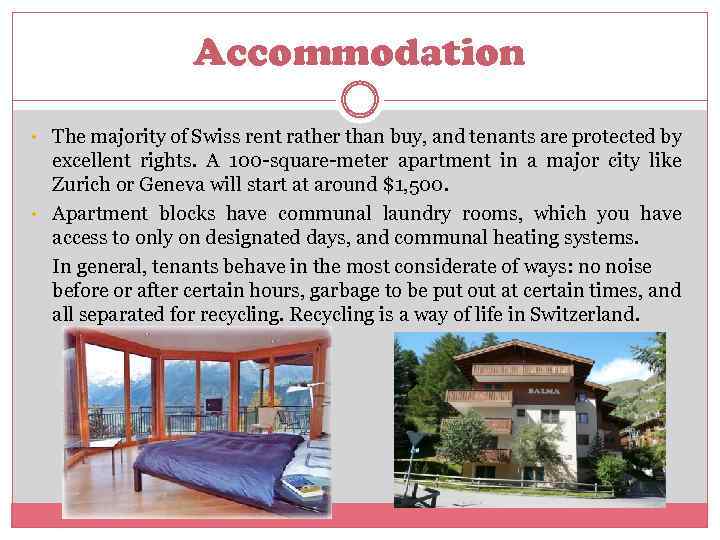 Accommodation • The majority of Swiss rent rather than buy, and tenants are protected by excellent rights. A 100 -square-meter apartment in a major city like Zurich or Geneva will start at around $1, 500. • Apartment blocks have communal laundry rooms, which you have access to only on designated days, and communal heating systems. In general, tenants behave in the most considerate of ways: no noise before or after certain hours, garbage to be put out at certain times, and all separated for recycling. Recycling is a way of life in Switzerland.
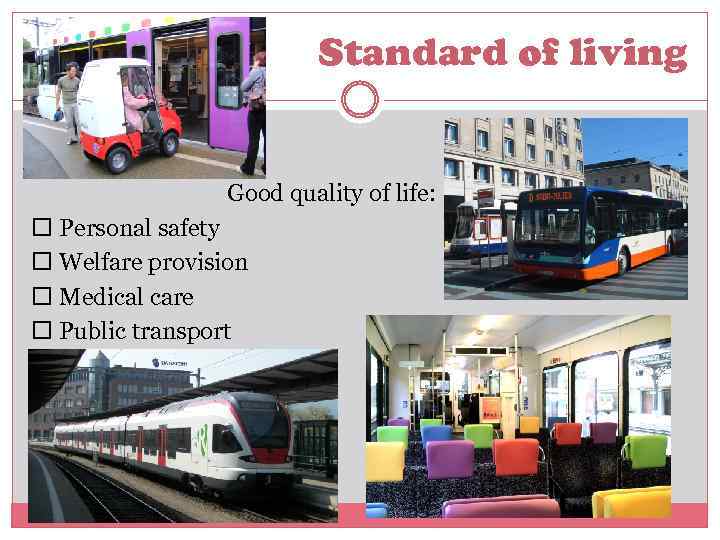 Standard of living Good quality of life: Personal safety Welfare provision Medical care Public transport
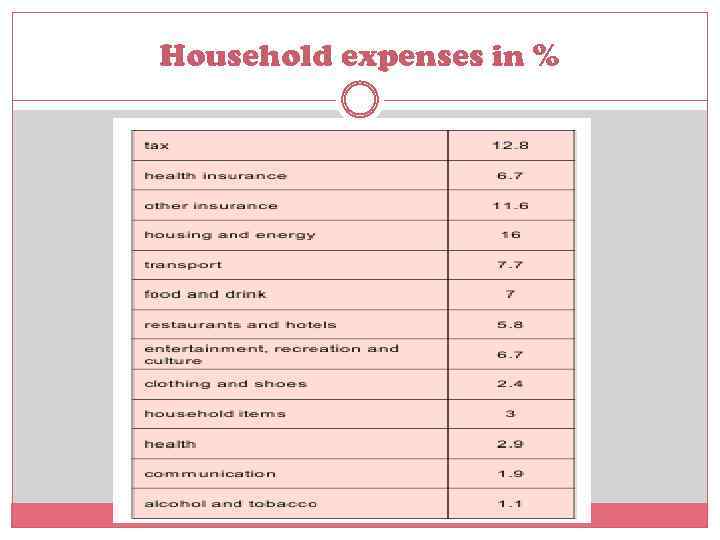 Household expenses in %
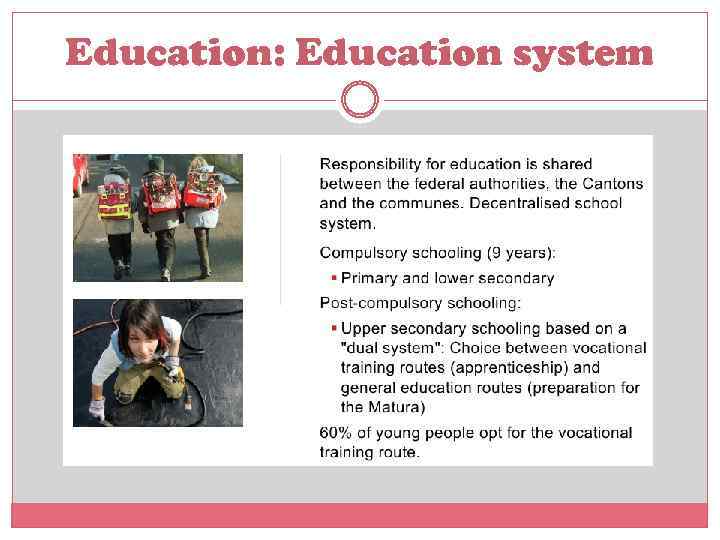 Education: Education system
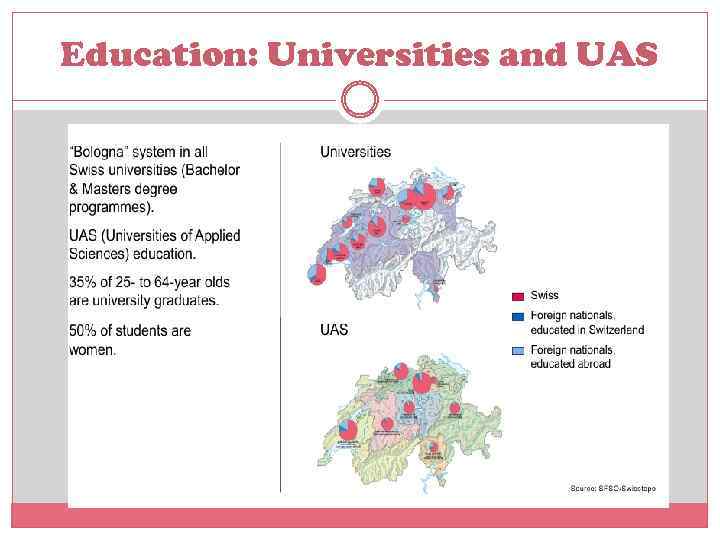 Education: Universities and UAS
 Economy: Structure and competitiveness
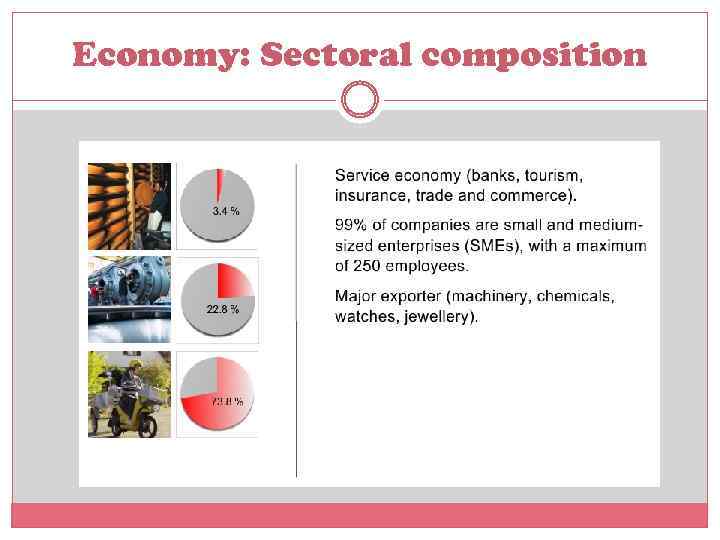 Economy: Sectoral composition
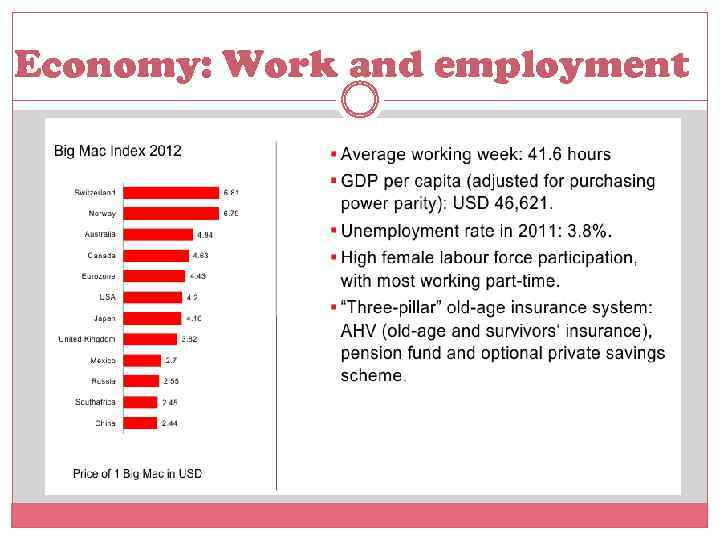 Economy: Work and employment
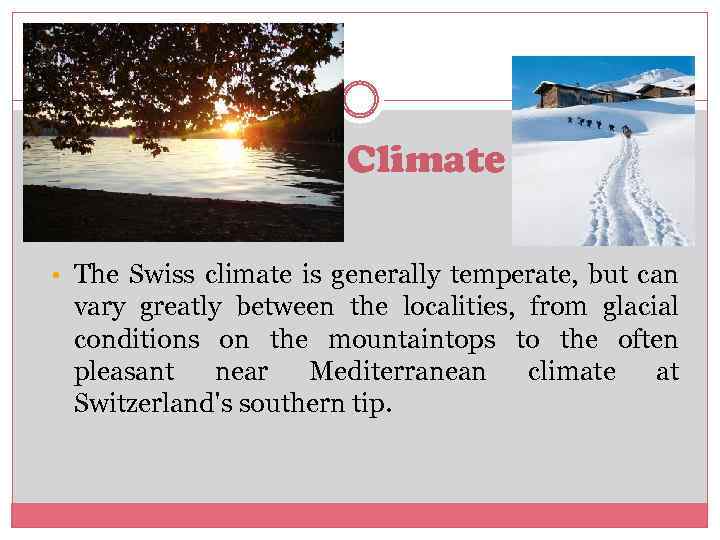 Climate • The Swiss climate is generally temperate, but can vary greatly between the localities, from glacial conditions on the mountaintops to the often pleasant near Mediterranean climate at Switzerland's southern tip.
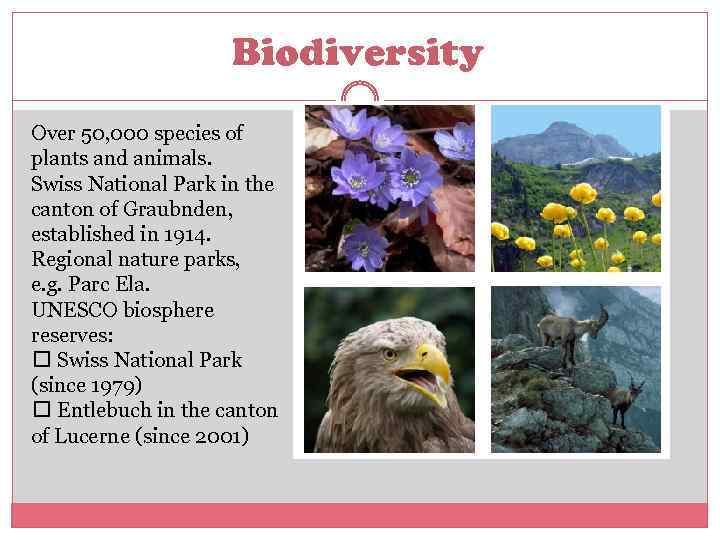 Biodiversity Over 50, 000 species of plants and animals. Swiss National Park in the canton of Graubnden, established in 1914. Regional nature parks, e. g. Parc Ela. UNESCO biosphere reserves: Swiss National Park (since 1979) Entlebuch in the canton of Lucerne (since 2001)
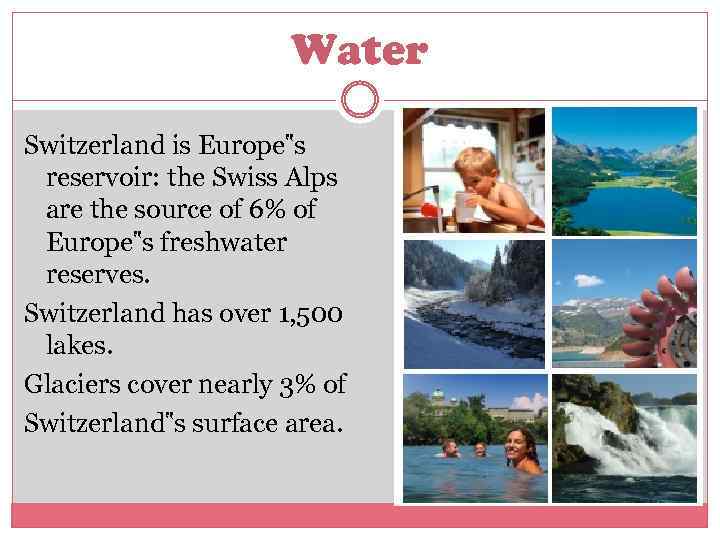 Water Switzerland is Europe‟s reservoir: the Swiss Alps are the source of 6% of Europe‟s freshwater reserves. Switzerland has over 1, 500 lakes. Glaciers cover nearly 3% of Switzerland‟s surface area.
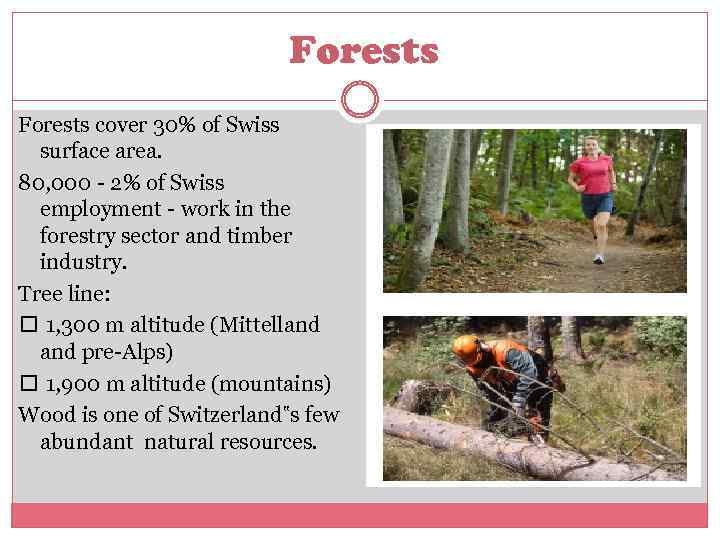 Forests cover 30% of Swiss surface area. 80, 000 - 2% of Swiss employment - work in the forestry sector and timber industry. Tree line: 1, 300 m altitude (Mittelland pre-Alps) 1, 900 m altitude (mountains) Wood is one of Switzerland‟s few abundant natural resources.
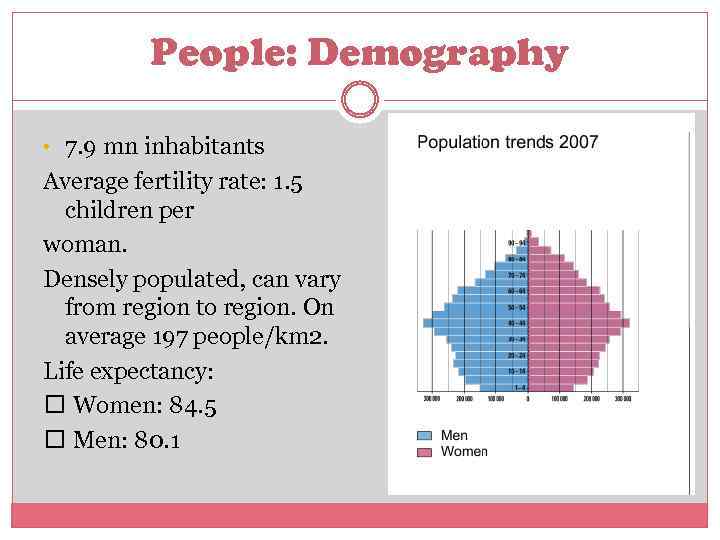 People: Demography • 7. 9 mn inhabitants Average fertility rate: 1. 5 children per woman. Densely populated, can vary from region to region. On average 197 people/km 2. Life expectancy: Women: 84. 5 Men: 80. 1
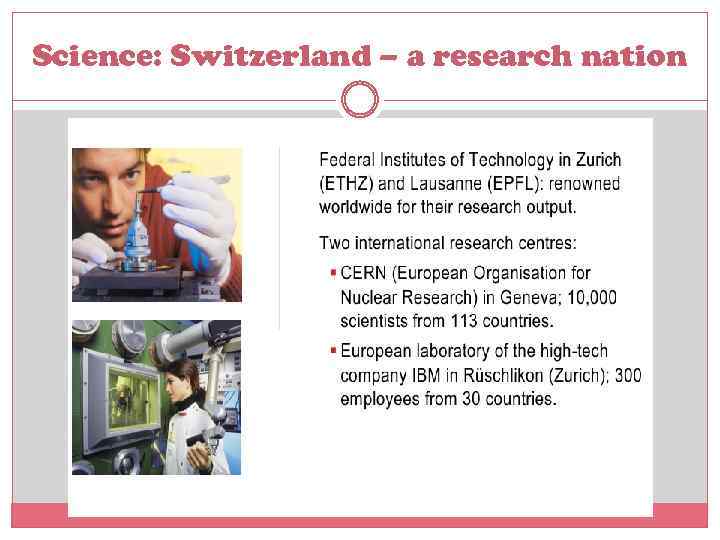 Science: Switzerland – a research nation
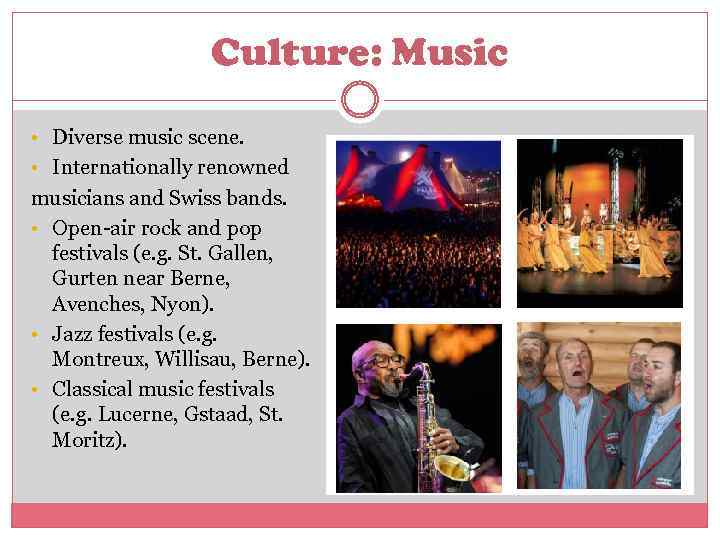 Culture: Music • Diverse music scene. • Internationally renowned musicians and Swiss bands. • Open-air rock and pop festivals (e. g. St. Gallen, Gurten near Berne, Avenches, Nyon). • Jazz festivals (e. g. Montreux, Willisau, Berne). • Classical music festivals (e. g. Lucerne, Gstaad, St. Moritz).
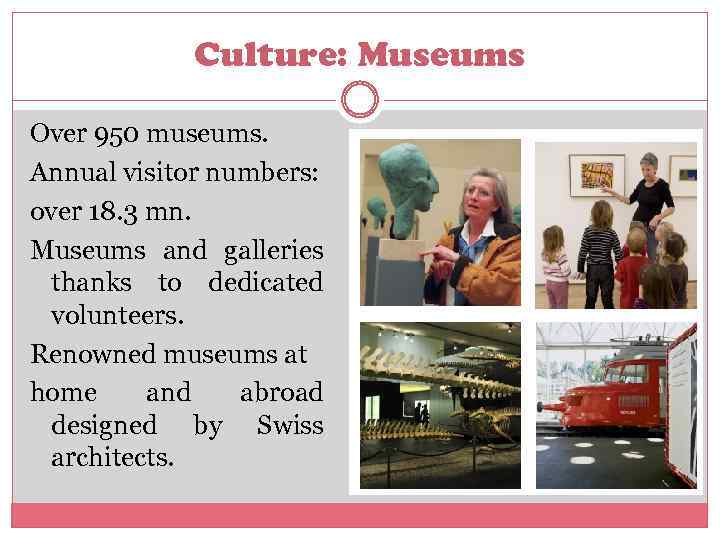 Culture: Museums Over 950 museums. Annual visitor numbers: over 18. 3 mn. Museums and galleries thanks to dedicated volunteers. Renowned museums at home and abroad designed by Swiss architects.
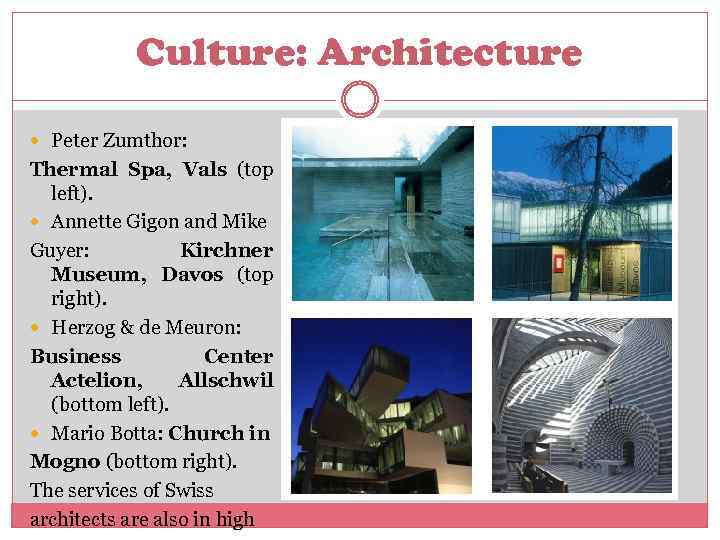 Culture: Architecture Peter Zumthor: Thermal Spa, Vals (top left). Annette Gigon and Mike Guyer: Kirchner Museum, Davos (top right). Herzog & de Meuron: Business Center Actelion, Allschwil (bottom left). Mario Botta: Church in Mogno (bottom right). The services of Swiss architects are also in high
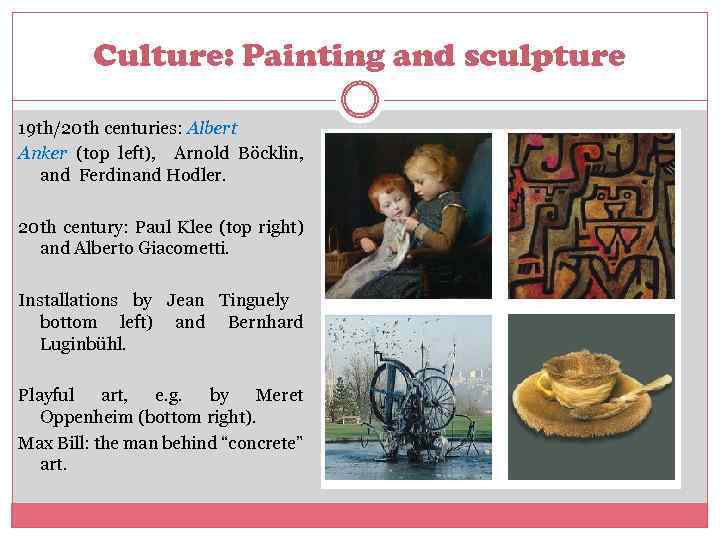 Culture: Painting and sculpture 19 th/20 th centuries: Albert Anker (top left), Arnold Böcklin, and Ferdinand Hodler. 20 th century: Paul Klee (top right) and Alberto Giacometti. Installations by Jean Tinguely bottom left) and Bernhard Luginbühl. Playful art, e. g. by Meret Oppenheim (bottom right). Max Bill: the man behind “concrete” art.
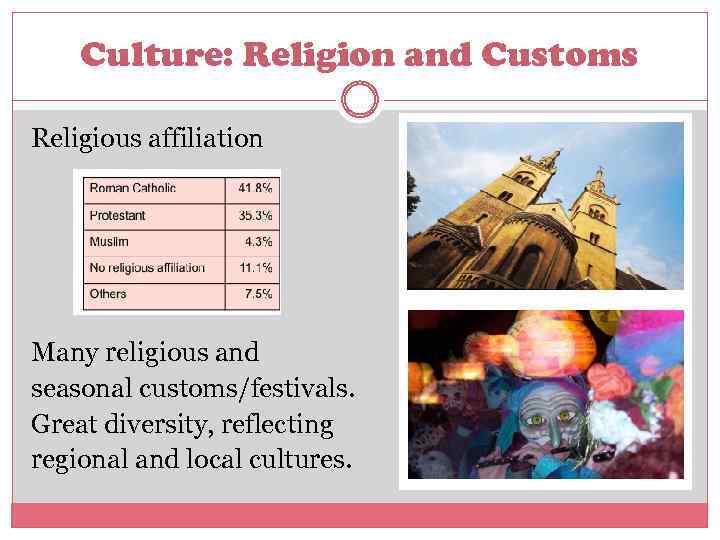 Culture: Religion and Customs Religious affiliation Many religious and seasonal customs/festivals. Great diversity, reflecting regional and local cultures.
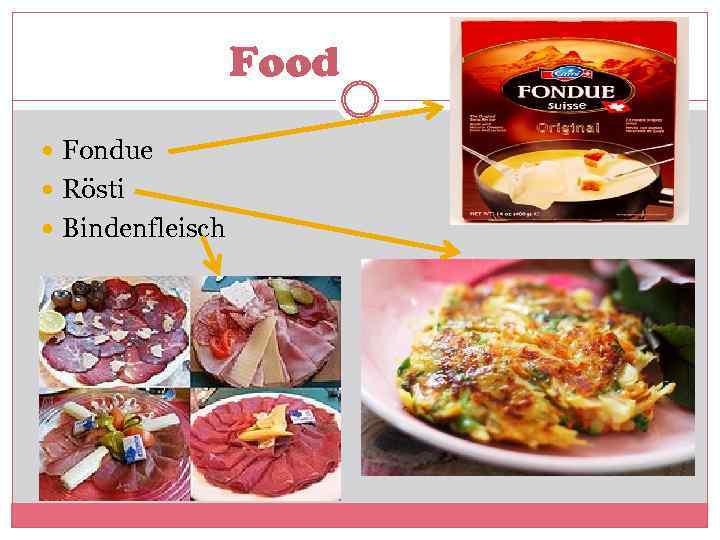 Food Fondue Rösti Bindenfleisch
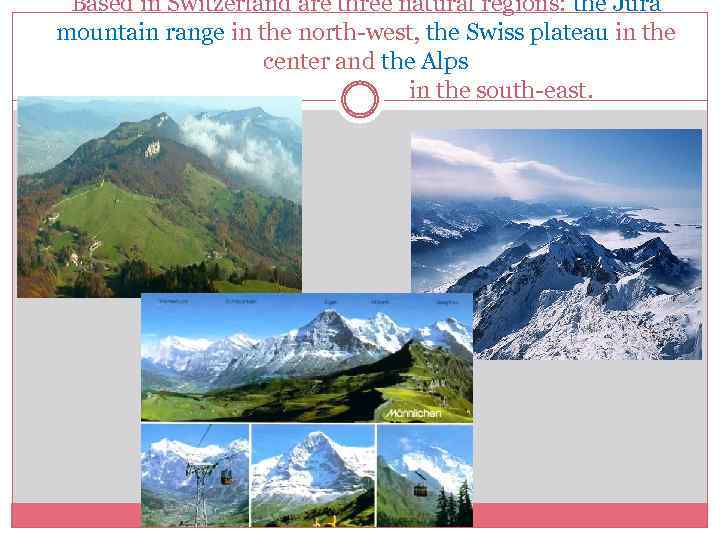 Based in Switzerland are three natural regions: the Jura mountain range in the north-west, the Swiss plateau in the center and the Alps in the south-east.
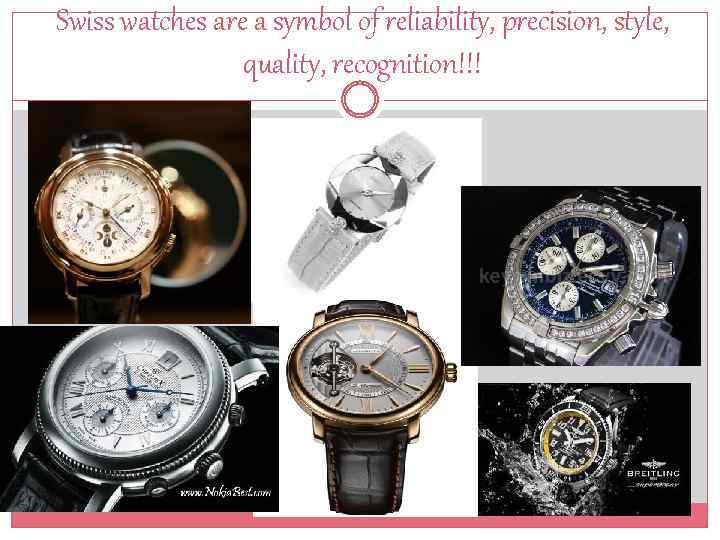 Swiss watches are a symbol of reliability, precision, style, quality, recognition!!!
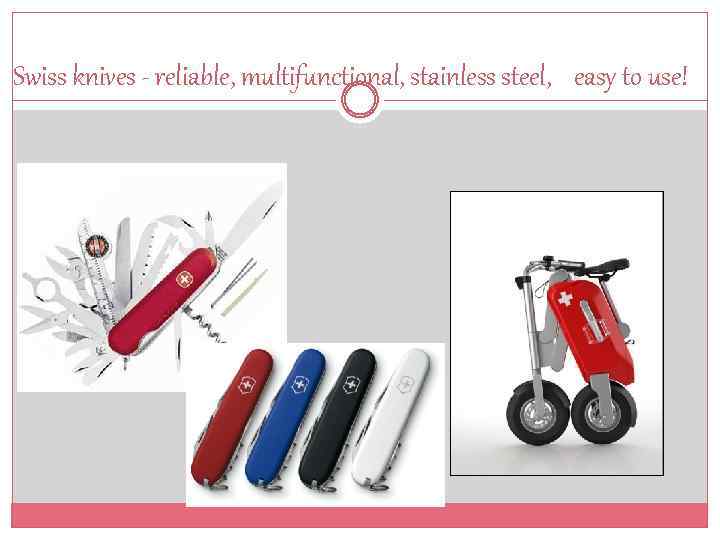 Swiss knives - reliable, multifunctional, stainless steel, easy to use!
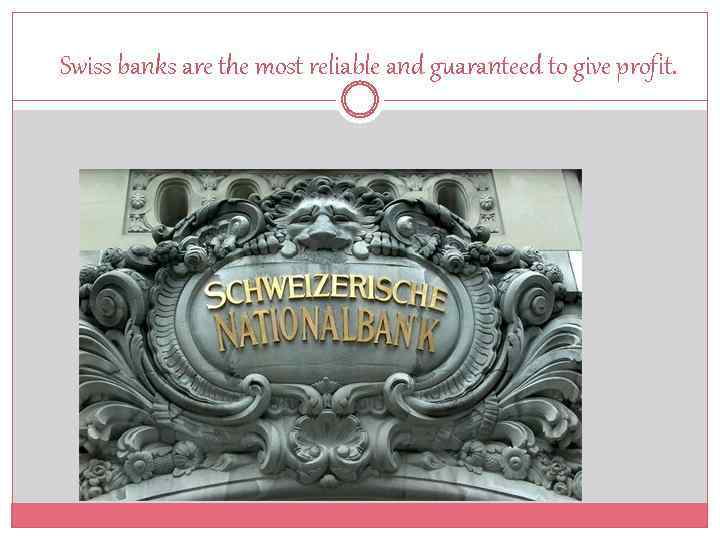 Swiss banks are the most reliable and guaranteed to give profit.
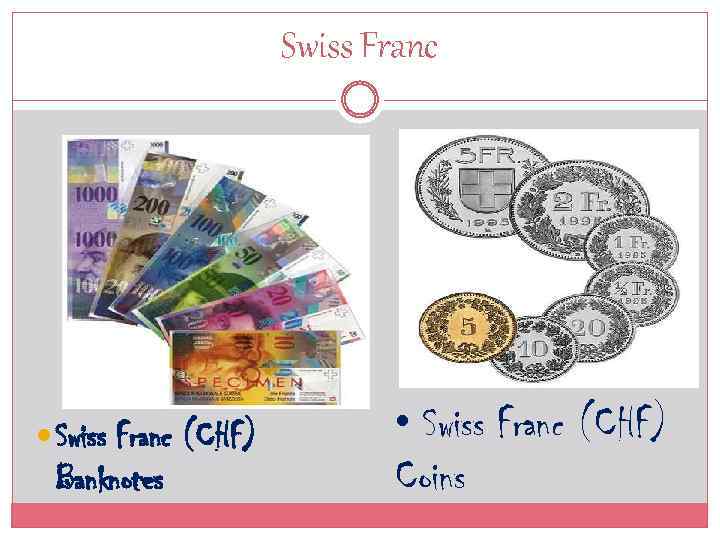 Swiss Franc (CHF) Banknotes • Swiss Franc (CHF) Coins
 To sum up You have to visit Switzerland because it is a beautiful country. Switzerland is one of the most respected and the largest financial centers in Europe. It is a developed country, and reliable in production. Switzerland is a country that offers a high quality of life. The Swiss are very good and punctual people.
 Thank you for your attention!!!