 Скачать презентацию Swimming and Boating Safety Teaching the Basics of
360f55f92adbf5ab1bd475bd72cf1370.ppt
- Количество слайдов: 45



Swimming and Boating Safety Teaching the Basics of Surviving in the Water to the Soldiers Fort Worth District – Building Strong!
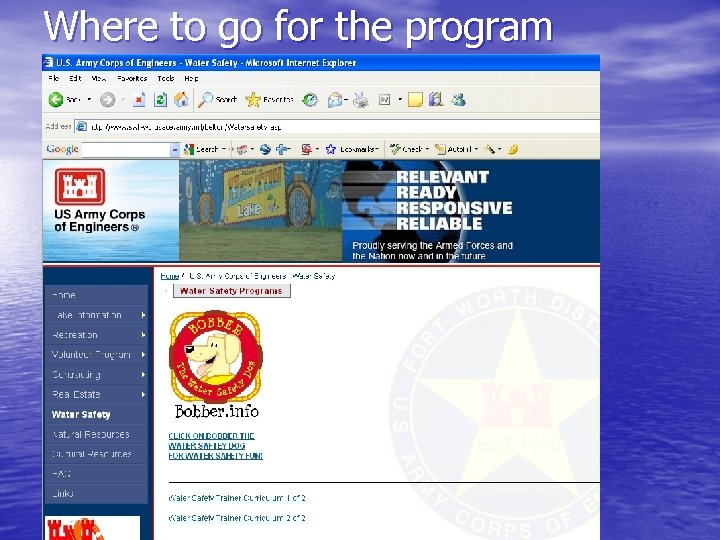
Where to go for the program
Drowning is second leading cause of accidental death for people 0 -44 years old Drownings on Belton and Stillhouse Hollow Lakes • 25% are soldiers or dependents of soldiers • 2 main causes are swimming activities and boating activities • 85% are Male • Almost all knew how to Swim • Many drownings are within 10 feet of safety and are people who did not intend to be in the water
Causes of Adult Swimming Fatalities TOP TEN 1. Not admitting you are a poor swimmer (to yourself or to your group) 2. Alcohol or Drug Use 3. Trying to Rescue Someone Else 4. Jumping Off Cliffs or Bridges or other High Risk Behaviors 5. Wading off Steep Drop-off 6. Swimming after wind-blown objects 7. Falling in Without intending to Swim Wade/drop-off 8. Cold Water – Hypothermia decreases physical ability 9. Falling Off Flotation TOYS 10. Over Estimating One’s Ability
Causes of Adult Swimming Fatalities TOP TEN 10. Over Estimating One’s Ability
Causes of Adult Swimming Fatalities TOP TEN 9. Falling Off Flotation TOYS
Causes of Adult Swimming Fatalities TOP TEN 8. Cold Water – 9. Hypothermia decreases physical ability
Causes of Adult Swimming Fatalities TOP TEN 7. Falling in Without Intending to 8. Swim Wade/drop-off
Causes of Adult Swimming Fatalities TOP TEN 6. Swimming after wind-blown objects
Causes of Adult Swimming Fatalities TOP TEN 5. Wading off Steep Drop-off
Causes of Adult Swimming Fatalities TOP TEN 4. Jumping Off Cliffs or Bridges 5. or other High Risk Behaviors
Causes of Adult Swimming Fatalities TOP TEN 3. Trying to Rescue Someone Else
Causes of Adult Swimming Fatalities TOP TEN 2. Alcohol or Drug Use
Causes of Adult Swimming Fatalities TOP TEN 1. Not admitting you are a poor swimmer 2. (to yourself or to your group)
Drowning is called the “Silent Killer” Recognize the Drowning “Look” • Drowning is called the “Silent Killer” • Vertical in water, head back, arms out, working to keep head out of water • Not calling for help
Ways to Decrease Swimming Drownings in Open Water • Education - Teach Basic Water Safety Concepts • Teach “Reach, Throw, Row- Don’t Go!” • Natural Hazards – Lake level Changes at BN/SH, - Flash Flooding Turn (Around-Don’t Drown) • Watch Your Children – Stay within an arm’s reach • Swim with a Group – (Battle Buddy = Swim Buddy) • Easy on the Booze • Respect the Weather – it is very unforgiving. In Texas it changes fast
Summary of Swimming Safety • Know Swimming Safety Rules • FOLLOW them • Avoid high risk behaviors – Know where your “Stupid” line is • Swim with a buddy • Easy on the booze

Break
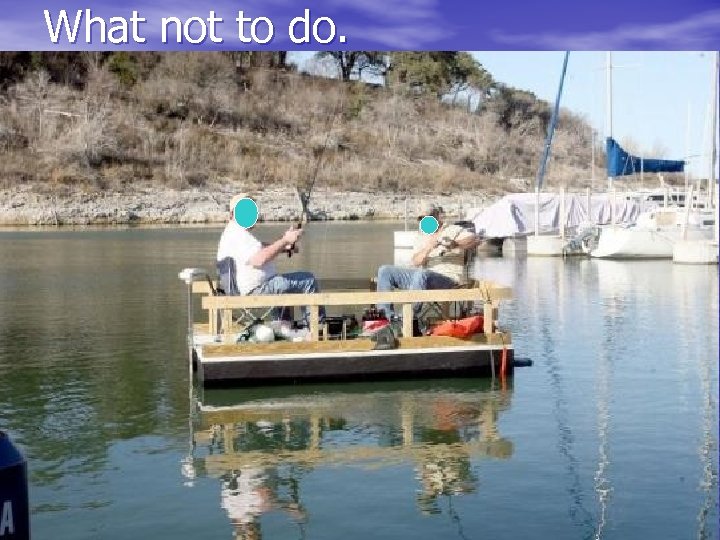
What not to do.
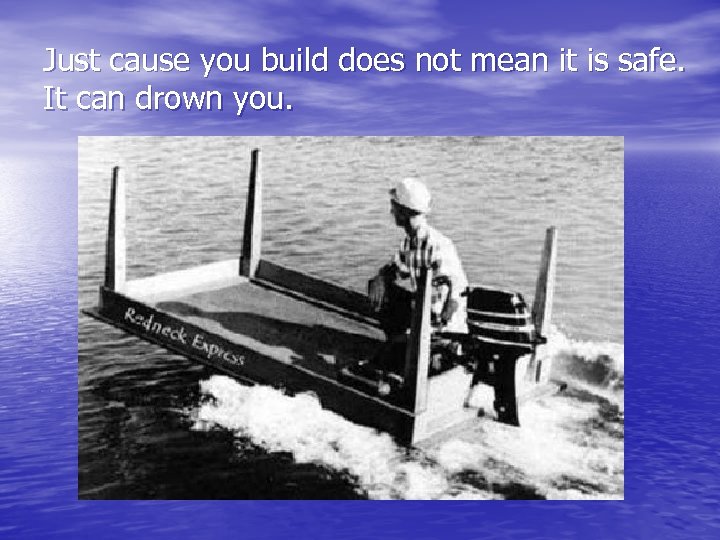
Just cause you build does not mean it is safe. It can drown you.
Basics of Boating Safety Single best way to prevent boating fatalities is to Wear a PFD. Know Before you GO! Take a Boating Course • BLORA Courses • Tx Parks and Wildlife on-line • Tx Parks and Wildlife instructor led classes – Check web site for classes • US Coast Guard Aux and US Power Squadron
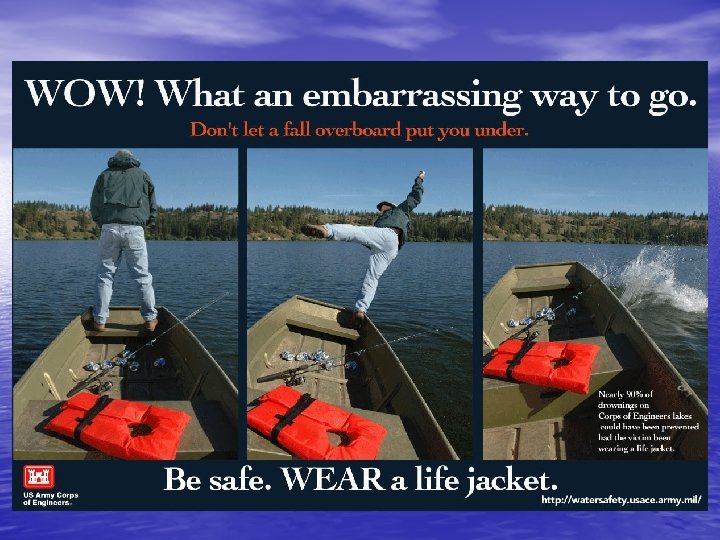
Single best way to prevent boating fatalities is to Wear a PFDs – Life Jackets Type III Type IV Type V
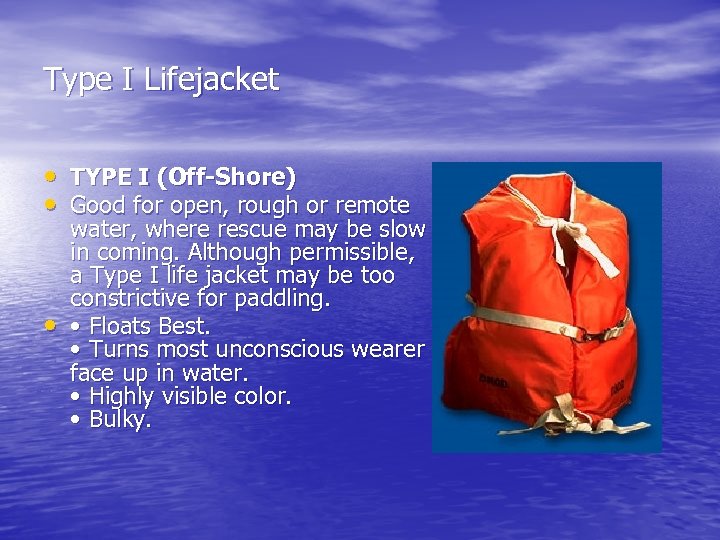
Type I Lifejacket • TYPE I (Off-Shore) • Good for open, rough or remote • water, where rescue may be slow in coming. Although permissible, a Type I life jacket may be too constrictive for paddling. • Floats Best. • Turns most unconscious wearer face up in water. • Highly visible color. • Bulky.
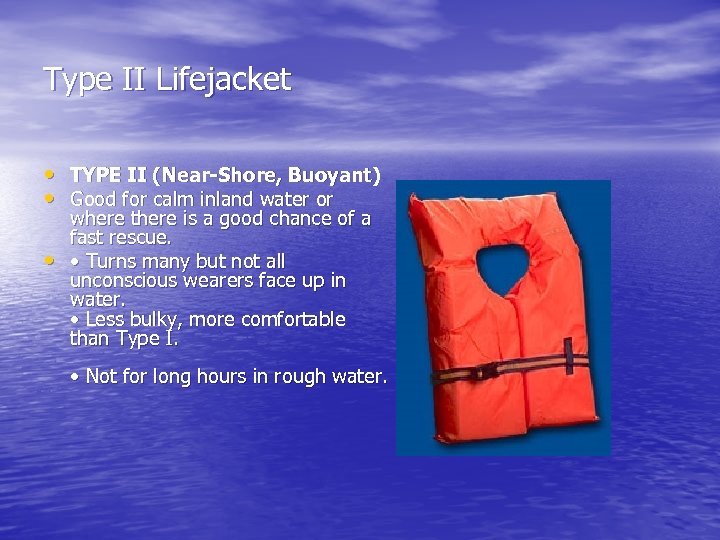
Type II Lifejacket • TYPE II (Near-Shore, Buoyant) • Good for calm inland water or • where there is a good chance of a fast rescue. • Turns many but not all unconscious wearers face up in water. • Less bulky, more comfortable than Type I. • Not for long hours in rough water.
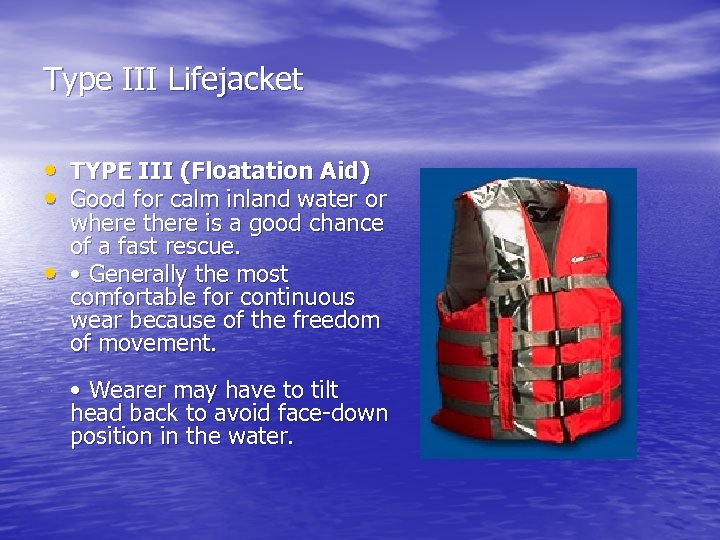
Type III Lifejacket • TYPE III (Floatation Aid) • Good for calm inland water or • where there is a good chance of a fast rescue. • Generally the most comfortable for continuous wear because of the freedom of movement. • Wearer may have to tilt head back to avoid face-down position in the water.
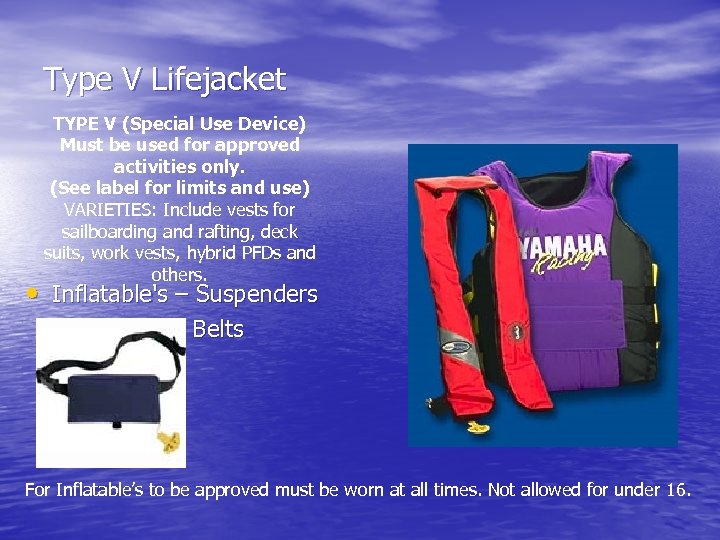
Type V Lifejacket TYPE V (Special Use Device) Must be used for approved activities only. (See label for limits and use) VARIETIES: Include vests for sailboarding and rafting, deck suits, work vests, hybrid PFDs and others. • Inflatable's – Suspenders Belts For Inflatable’s to be approved must be worn at all times. Not allowed for under 16.
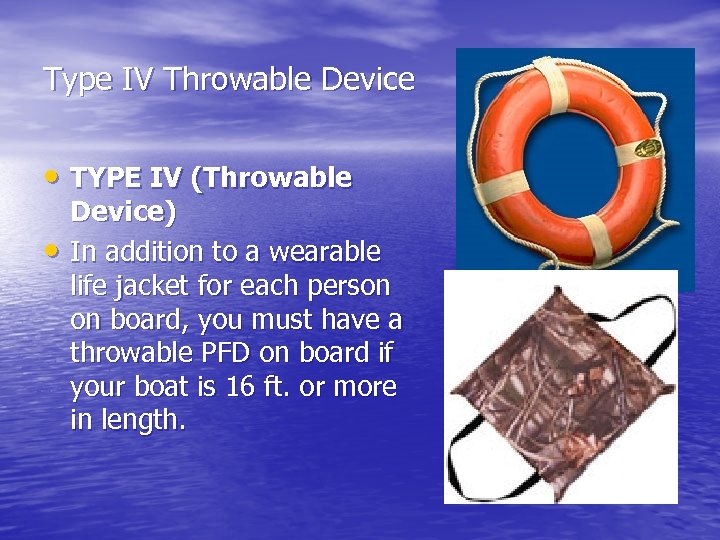
Type IV Throwable Device • TYPE IV (Throwable • Device) In addition to a wearable life jacket for each person on board, you must have a throwable PFD on board if your boat is 16 ft. or more in length.
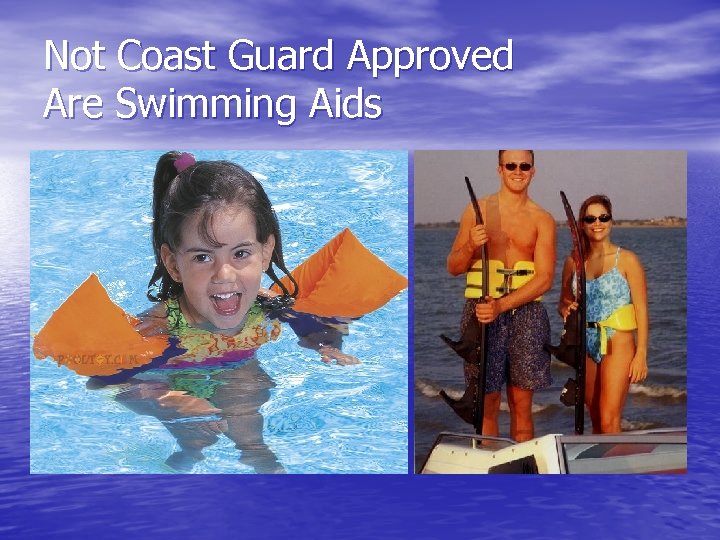
Not Coast Guard Approved Are Swimming Aids
Single best way to prevent boating fatalities is to Wear a PFD. Life Jackets: • Number Required • Easily Accessible, • In good condition, • Right size for passengers on board • Throwable required for boats > 16’
Single best way to prevent boating fatalities is to Wear a PFD. Life Jackets: • New styles more comfortable and no longer “geeky” • Inflatable's are now USCG approved
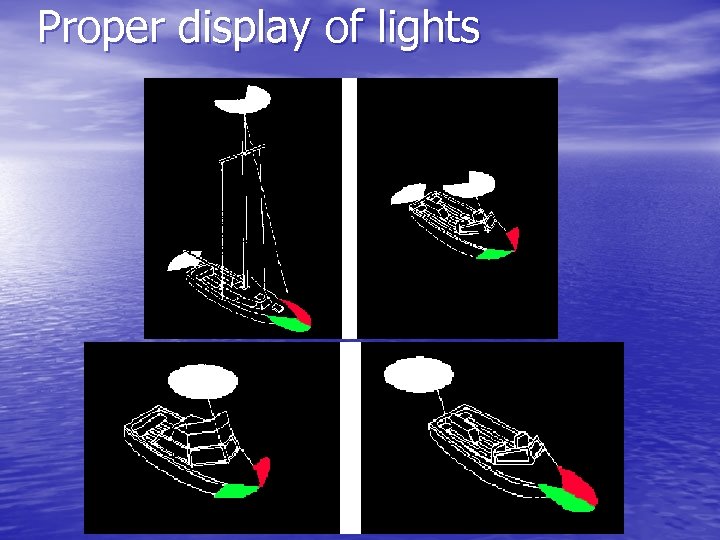
Required Safety Equipment on Board • Life Jackets • Fire Extinguishers • Boat Identification/Registration, Certificate of Numbers • Sound Producing Device • Proper Ventilation (Inboards and Inboard/Outboards) • Navigation lights if out at night
Proper display of lights
Dangers of Gasoline
Required Safety Equipment on Board LIVES acronym • Life Jackets • Identification/Registration of Boat • Ventilation (Inboards and Inboard/Outboards) • Extinguishers • Sound Producing Device
Best Practices on Board • Basic Boating Equipment - Basic Tools, Oar or Paddle, Anchor, Boat Ladder • Be Prepared for Unexpected- Flashlight, First Aid Equipment, Maps • Let someone Know where you are – File a Float Plan • Working Cell Phone • Know the Rules of the Roads • Easy on the Suds- Put water in the cooler too
Causes of Boating Fatalities • Falling Overboard – i. e. , Standing up to Urinate • Collisions • Boat Capsizing • Alcohol Use • Exposure – Hypothermia • Sudden Weather Changes • Trying to Swim to Shore • Basically – Poor Decisions or a combination of them
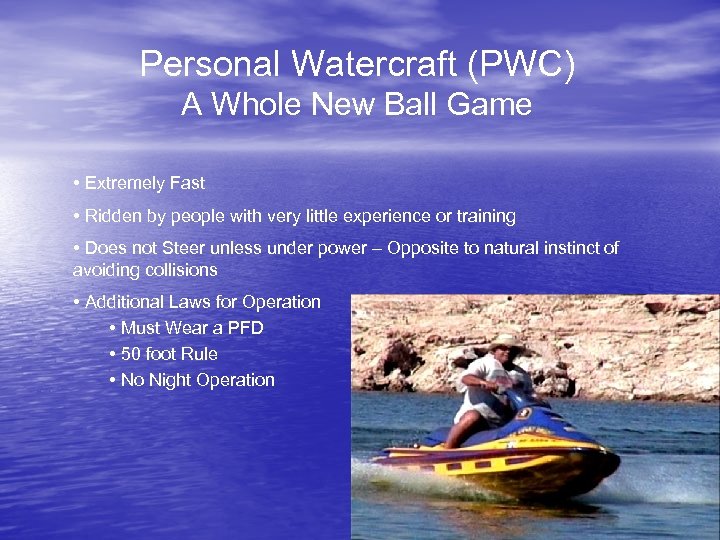
Personal Watercraft (PWC) A Whole New Ball Game • Extremely Fast • Ridden by people with very little experience or training • Does not Steer unless under power – Opposite to natural instinct of avoiding collisions • Additional Laws for Operation • Must Wear a PFD • 50 foot Rule • No Night Operation
The January Boating Fatality What Caused it. • Inexperienced Boaters • Life Jackets on Board but not worn • Did Not Heed Weather Warning • Flotation of Boat had Been Removed • Didn’t realize danger of Hypothermia
• TRAGIC MISTAKES • On January 7, 2007, two friends embarked on what was • supposed to be a relaxing day of fishing. These two soldiers, aged 29 and 22, had recently returned to Ft. Hood from Iraq. One of them was married while the other was single. Their combined weight was 375 pounds, and only one of them was a swimmer. They enthusiastically launched their boat from Cedar Gap Park on Stillhouse Hollow Lake, and headed out to fish around the 9 th pillar below the bridge on FM 3481. The water temperature was 48 degrees and they wore boots and layered clothing under their BDU’s in an attempt to stay warm on this cold, overcast day. Their vessel was an older, 12 ft. flat bottom boat that one of them had repainted and fixed up. The flotation in the middle seat had been removed to make room for a live well. A 12 volt car battery powered a trolling motor and fish finder that had been mounted in the bow. Life jackets were present in the boat but were not worn. The two men had been out most of the day when the weather started turning bad. A passing fisherman warned them that the misting rain and falling temperatures were due to a storm sweeping in from the north. Little did he realize that he would be the last person to see them alive.
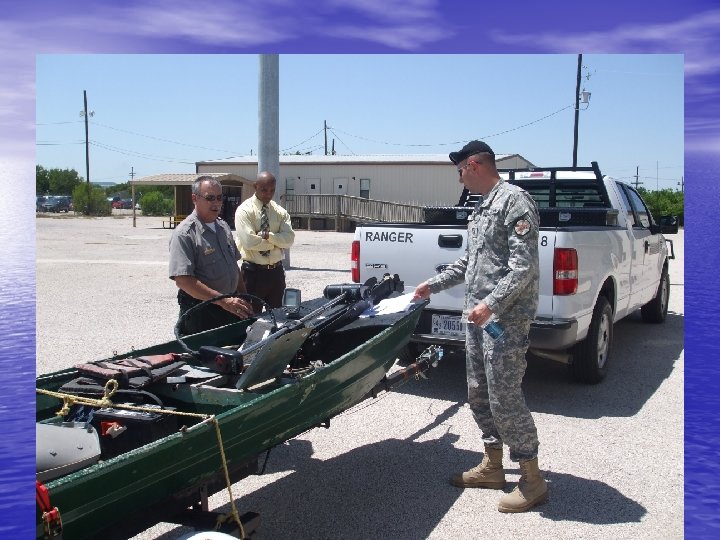
As their day drew to a close, something happened that caused their boat to sink. Both men struggled to make it to shore, but eventually exhaustion and the weight of their water soaked clothing drew them beneath the choppy surface of the lake. They were reported as missing at 1600 hrs on January 7 th. Texas Parks and Wildlife officials and the Corps of Engineers searched for them into the night, but to no avail. The boat was recovered the following day from its resting place in 29 feet of water near the 9 th pillar of the bridge. Their bodies were finally recovered on January 9 th. The non-swimmer was found near the 9 th pillar with his boots still on, while the other was found near the 7 th pillar with his boots off. A life jacket and a pair of boots were found washed up on the south shore of Stillhouse Hollow Lake. This is the boat. Can you identify the boating safety hazards on this vessel? What changes could have been made to prevent this tragedy? (Boat donated to the Corps by their families for Water Safety)
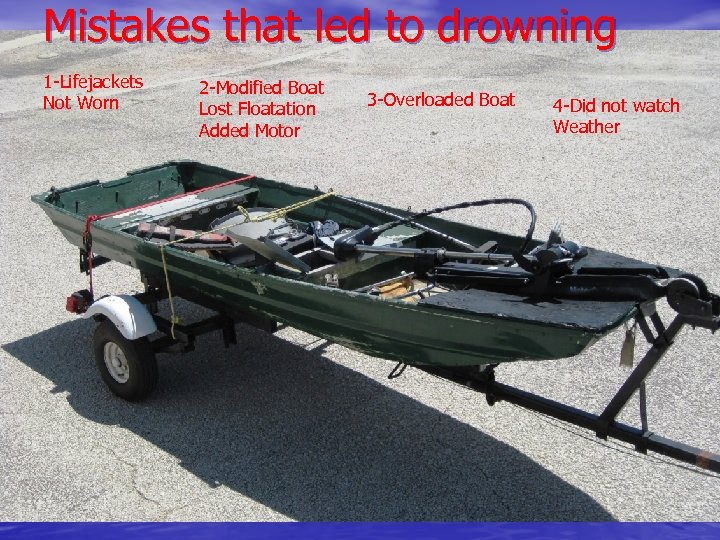
Mistakes that led to drowning 1 -Lifejackets Not Worn 2 -Modified Boat Lost Floatation Added Motor 3 -Overloaded Boat 4 -Did not watch Weather
Where to go for more information • • Web sites for more info: National Safe Boating Council - http: //www. safeboatingcouncil. org/ National Water Safety Congress- http: //www. watersafetycongress. org/ Texas Parks & Wildlife- http: //www. tpwd. state. tx. us/fishboat/ US Army Corps of Engineers National Water Safety Programhttp: //watersafety. usace. army. mil/ More Water Safety Lesson Planshttp: //corpslakes. usace. army. mil/employees/watersafety/pdfs/resguide. pdf Aqua. Smart- http: //dbw. ca. gov/Aqua. Smart/html/aq_navmap. html
Summary Know Before You Go! You Train as a Soldier – You Should Train as a Boater Wear A PFD! You Gear up for Battle – You should Gear up for Boating Think – Don’t Sink! Fort Worth District – Building Strong!
Скачать презентацию Swimming and Boating Safety Teaching the Basics of
360f55f92adbf5ab1bd475bd72cf1370.ppt