 Скачать презентацию SWEG 2006 The Semantic Web meets e
da1aea9ac456c888f424f678dba07ef8.ppt
- Количество слайдов: 22



SWEG 2006 – The Semantic Web meets e. Government 2006 AAAI Spring Symposium Series, Stanford University, CA, March 2006 An e. Government system for temporal- and semantic-aware access to norms Federica Mandreoli Riccardo Martoglia Enrico Ronchetti Paolo Tiberio Università degli Studi di Modena e Reggio Emilia Fabio Grandi Maria Rita Scalas Università degli Studi di Bologna
Overview § Our research activities concern the implementation of Web information systems for e. Government applications § Development of e. Government initiatives: more and more on-line resources and services are being made available by Public Administrations (PAs) § We make use of temporal database and semantic Web techniques to provide personalized access to such resources and services § In particular, we consider multi-version norm texts (stored in XML format) available in Web repositories SWEG 2006 An e. Government system for temporal- and semantic-aware access to norms
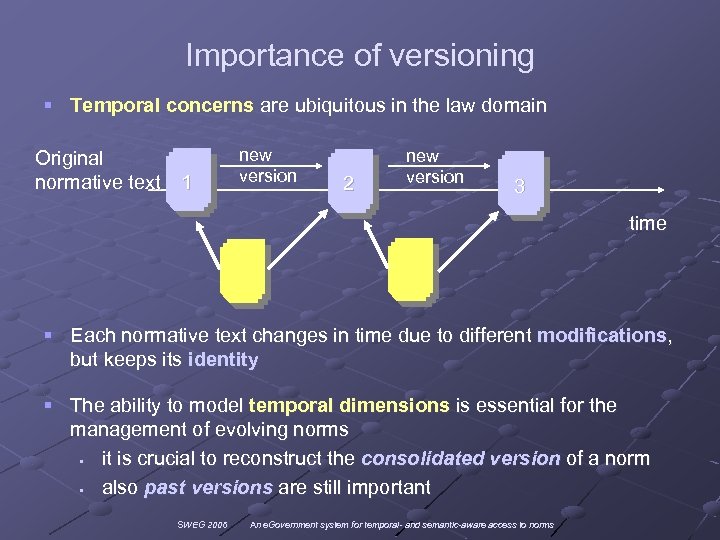
Importance of versioning § Temporal concerns are ubiquitous in the law domain Original normative text 1 new version 2 new version 3 time § Each normative text changes in time due to different modifications, but keeps its identity § The ability to model temporal dimensions is essential for the management of evolving norms § it is crucial to reconstruct the consolidated version of a norm § also past versions are still important SWEG 2006 An e. Government system for temporal- and semantic-aware access to norms
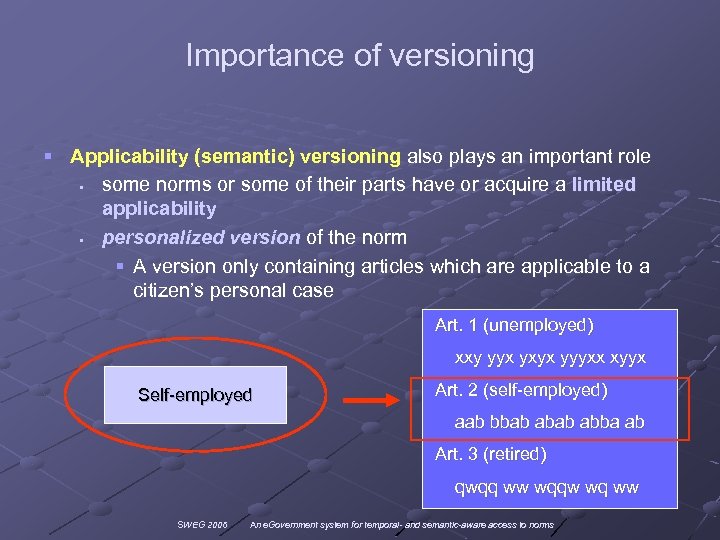
Importance of versioning § Applicability (semantic) versioning also plays an important role § some norms or some of their parts have or acquire a limited applicability § personalized version of the norm § A version only containing articles which are applicable to a citizen’s personal case Art. 1 (unemployed) xxy yyx yxyx yyyxx xyyx Self-employed Art. 2 (self-employed) aab bbab abba ab Art. 3 (retired) qwqq ww wqqw wq ww SWEG 2006 An e. Government system for temporal- and semantic-aware access to norms
Motivation § Large XML collections of norms are made available by the PA on the Web but personalization is: § Absent, e. g. http: //www. normeinrete. it (temporal versioning partially supported) § Predefined in the Website structure and contents, e. g. http: //www. italia. gov. it (hardwired by human experts following the life-events approach) § Lack of an effective, flexible, on-demand (“intelligent”, efficient) personalization facility SWEG 2006 An e. Government system for temporal- and semantic-aware access to norms
Objectives § Development of an effective and efficient Web information system where: § § norms are represented as XML documents dynamics of norms in time is captured limited applicability of norms (and their parts) is captured selective access and reconstruction of versions is supported by a query engine § Aimed at: § enabling citizens to access personalized versions of multiversion resources § improving and optimizing the involvement of citizens in the e. Governance process SWEG 2006 An e. Government system for temporal- and semantic-aware access to norms
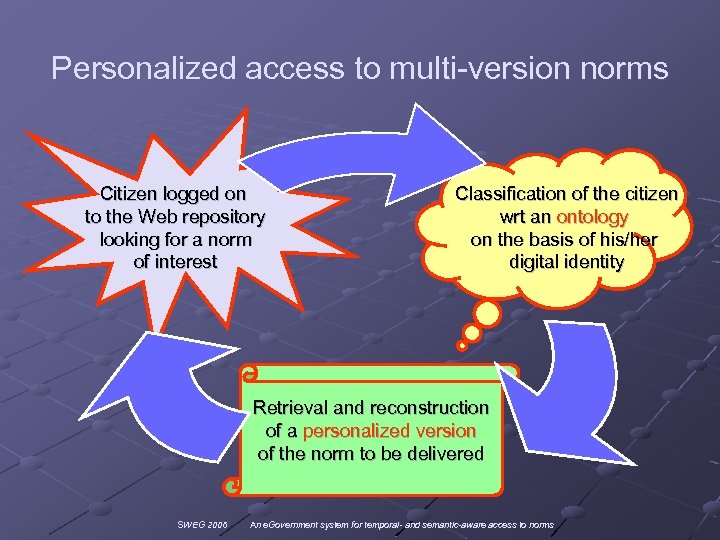
Personalized access to multi-version norms Citizen logged on to the Web repository looking for a norm of interest Classification of the citizen wrt an ontology on the basis of his/her digital identity Retrieval and reconstruction of a personalized version of the norm to be delivered SWEG 2006 An e. Government system for temporal- and semantic-aware access to norms
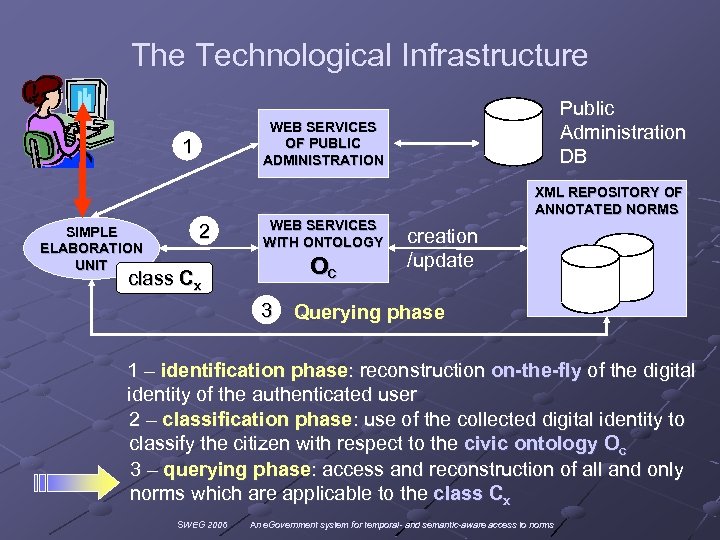
The Technological Infrastructure WEB SERVICES OF PUBLIC ADMINISTRATION 1 SIMPLE ELABORATION UNIT Public Administration DB 2 WEB SERVICES WITH ONTOLOGY OC class Cx 3 XML REPOSITORY OF ANNOTATED NORMS creation /update Querying phase 1 – identification phase: reconstruction on-the-fly of the digital identity of the authenticated user 2 – classification phase: use of the collected digital identity to classify the citizen with respect to the civic ontology Oc 3 – querying phase: access and reconstruction of all and only norms which are applicable to the class Cx SWEG 2006 An e. Government system for temporal- and semantic-aware access to norms
Approach § Definition of a temporal XML model including § a temporal multi-version XML schema n n n is based on the hierarchical organization of normative texts: contents-section-article-paragraph at each level of the hierarchy, the history of changes is represented by the (time-stamped) versions produced it supports ancestor-descendant inheritance § temporal manipulation operations § Extension of the XML model with applicability annotations in order to support semantic versioning § Design, implementation and evaluation of system prototypes supporting the model SWEG 2006 An e. Government system for temporal- and semantic-aware access to norms
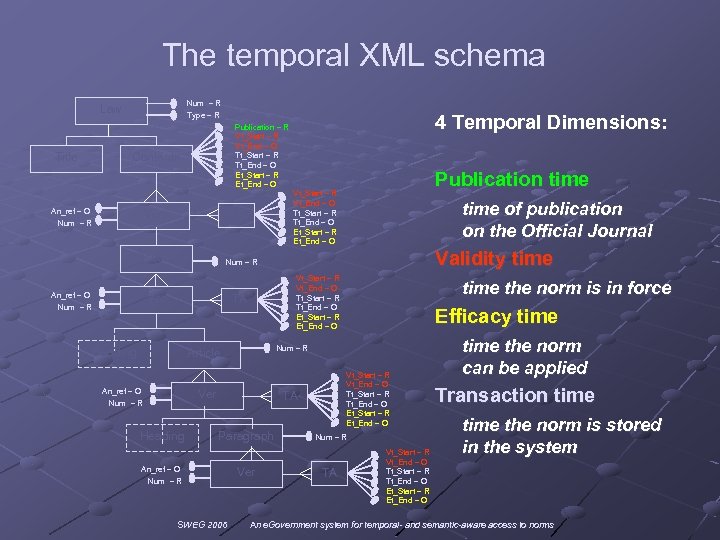
The temporal XML schema Num – R Type – R Law Title Contents An_ref – O Num – R Ver Publication time Vt_Start – R Vt_End – O Tt_Start – R Tt_End – O Et_Start – R Et_End – O TA Section An_ref – O Num – R 4 Temporal Dimensions: Publication – R Vt_Start – R Vt_End – O Tt_Start – R Tt_End – O Et_Start – R Et_End – O time of publication on the Official Journal Validity time Num – R Ver Vt_Start – R Vt_End – O Tt_Start – R Tt_End – O Et_Start – R Et_End – O TA Heading Ver Heading Vt_Start – R Vt_End – O Tt_Start – R Tt_End – O Et_Start – R Et_End – O TA Paragraph An_ref – O Num – R SWEG 2006 Efficacy time Num – R Article An_ref – O Num – R time the norm is in force Ver Num – R TA Vt_Start – R Vt_End – O Tt_Start – R Tt_End – O Et_Start – R Et_End – O time the norm can be applied Transaction time the norm is stored in the system An e. Government system for temporal- and semantic-aware access to norms
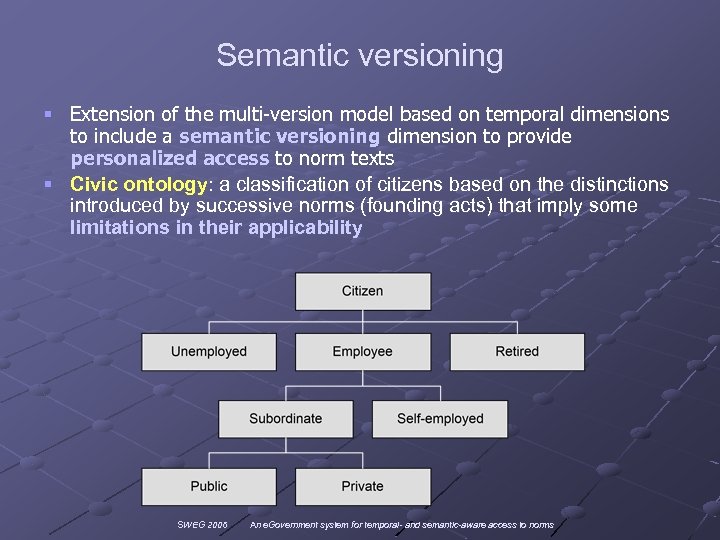
Semantic versioning § Extension of the multi-version model based on temporal dimensions to include a semantic versioning dimension to provide personalized access to norm texts § Civic ontology: a classification of citizens based on the distinctions introduced by successive norms (founding acts) that imply some limitations in their applicability SWEG 2006 An e. Government system for temporal- and semantic-aware access to norms
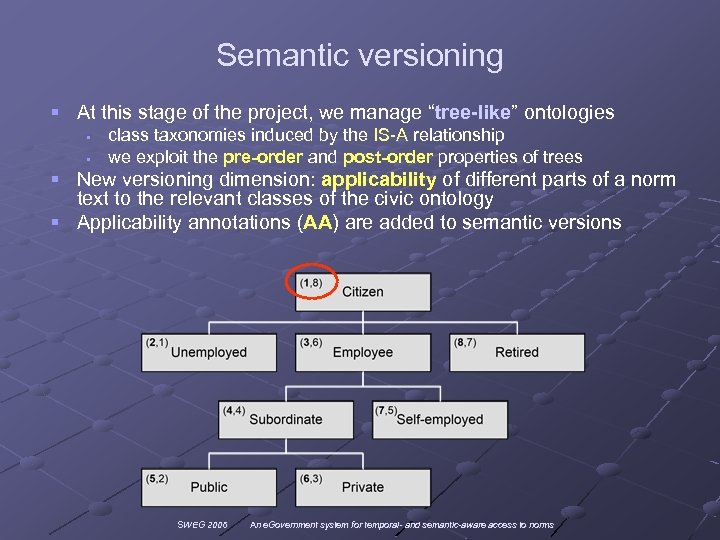
Semantic versioning § At this stage of the project, we manage “tree-like” ontologies § § class taxonomies induced by the IS-A relationship we exploit the pre-order and post-order properties of trees § New versioning dimension: applicability of different parts of a norm text to the relevant classes of the civic ontology § Applicability annotations (AA) are added to semantic versions SWEG 2006 An e. Government system for temporal- and semantic-aware access to norms
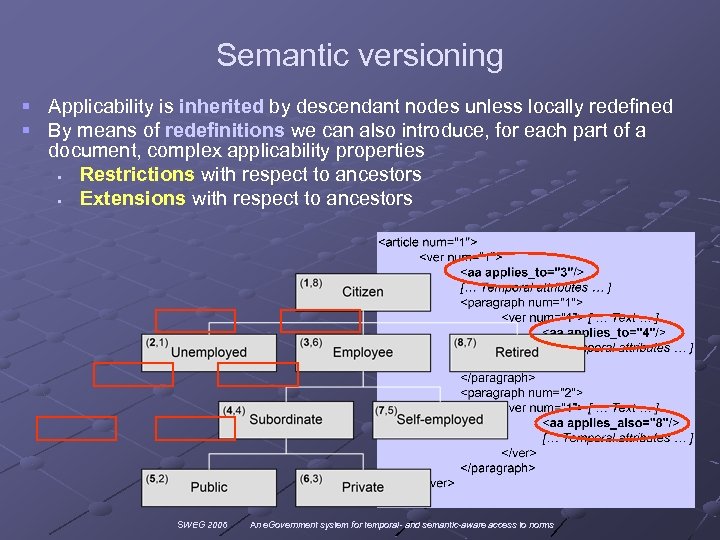
Semantic versioning § Applicability is inherited by descendant nodes unless locally redefined § By means of redefinitions we can also introduce, for each part of a document, complex applicability properties § Restrictions with respect to ancestors § Extensions with respect to ancestors SWEG 2006 An e. Government system for temporal- and semantic-aware access to norms
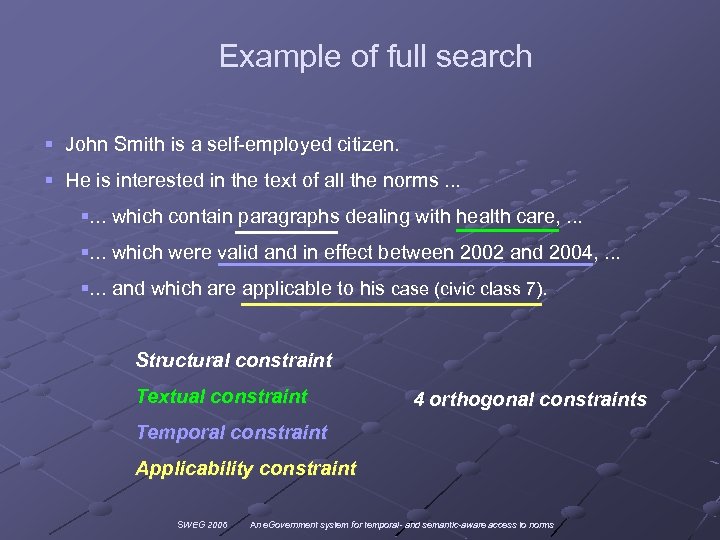
Example of full search § John Smith is a self-employed citizen. § He is interested in the text of all the norms. . . §. . . which contain paragraphs dealing with health care, . . . §. . . which were valid and in effect between 2002 and 2004, . . . §. . . and which are applicable to his case (civic class 7). Structural constraint Textual constraint 4 orthogonal constraints Temporal constraint Applicability constraint SWEG 2006 An e. Government system for temporal- and semantic-aware access to norms
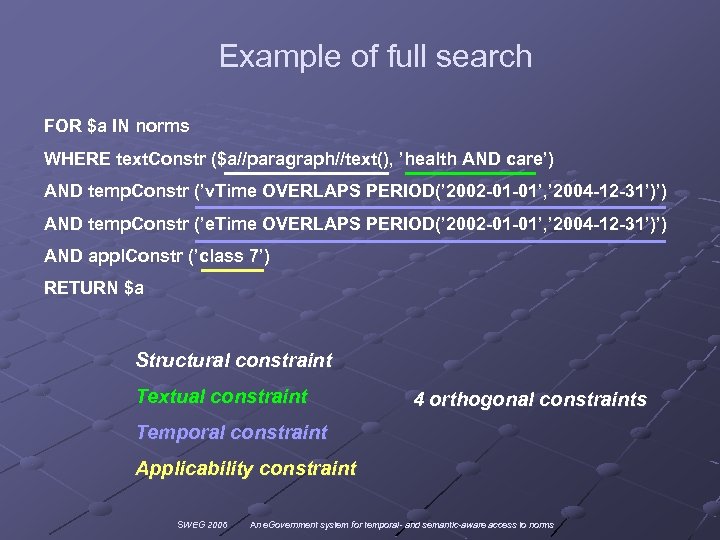
Example of full search FOR $a IN norms WHERE text. Constr ($a//paragraph//text(), ’health AND care’) AND temp. Constr (’v. Time OVERLAPS PERIOD(’ 2002 -01 -01’, ’ 2004 -12 -31’)’) AND temp. Constr (’e. Time OVERLAPS PERIOD(’ 2002 -01 -01’, ’ 2004 -12 -31’)’) AND appl. Constr (’class 7’) RETURN $a Structural constraint Textual constraint 4 orthogonal constraints Temporal constraint Applicability constraint SWEG 2006 An e. Government system for temporal- and semantic-aware access to norms
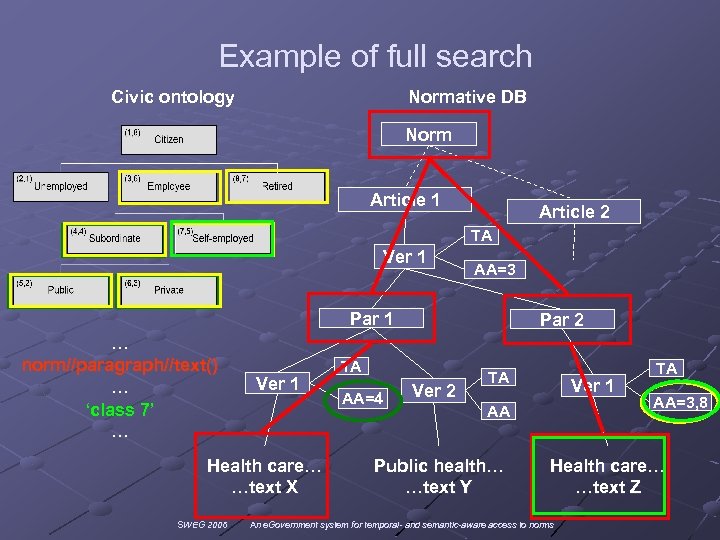
Example of full search Civic ontology Normative DB Norm Article 1 Article 2 TA Ver 1 AA=3 Par 1 … norm//paragraph//text() … ‘class 7’ … Ver 1 Health care… …text X SWEG 2006 Par 2 TA AA=4 Ver 2 TA Ver 1 AA Public health… …text Y TA AA=3, 8 Health care… …text Z An e. Government system for temporal- and semantic-aware access to norms
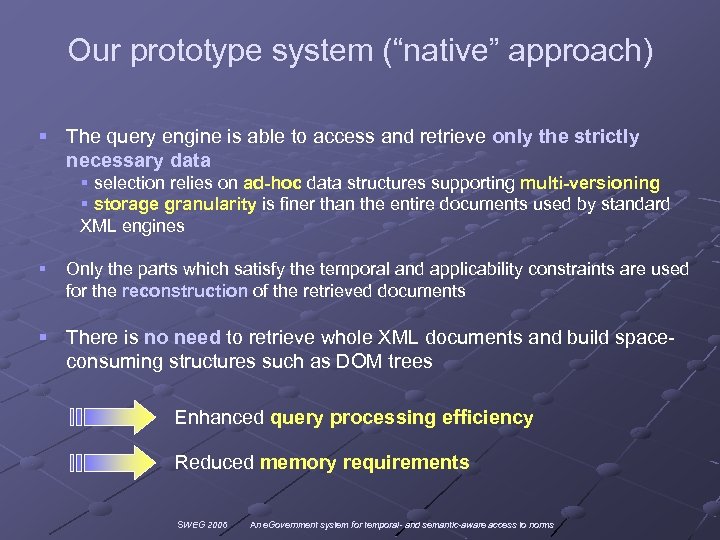
Our prototype system (“native” approach) § The query engine is able to access and retrieve only the strictly necessary data § selection relies on ad-hoc data structures supporting multi-versioning § storage granularity is finer than the entire documents used by standard XML engines § Only the parts which satisfy the temporal and applicability constraints are used for the reconstruction of the retrieved documents § There is no need to retrieve whole XML documents and build spaceconsuming structures such as DOM trees Enhanced query processing efficiency Reduced memory requirements SWEG 2006 An e. Government system for temporal- and semantic-aware access to norms
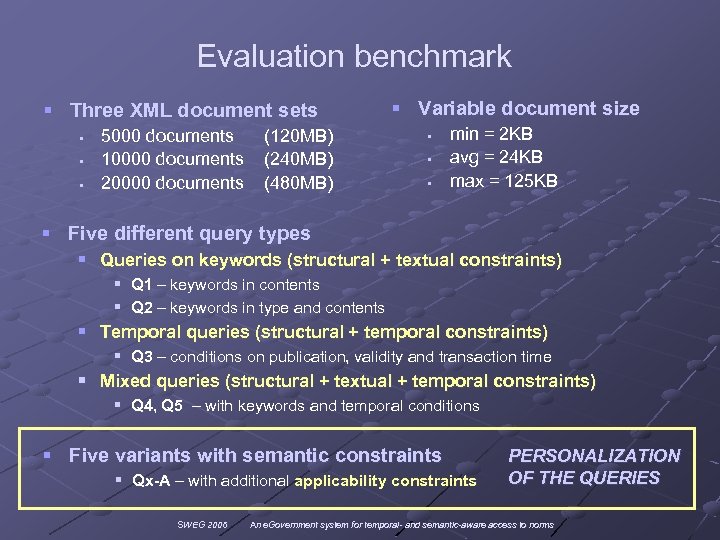
Evaluation benchmark § Three XML document sets § § § 5000 documents 10000 documents 20000 documents (120 MB) (240 MB) (480 MB) § Variable document size § § § min = 2 KB avg = 24 KB max = 125 KB § Five different query types § Queries on keywords (structural + textual constraints) § Q 1 – keywords in contents § Q 2 – keywords in type and contents § Temporal queries (structural + temporal constraints) § Q 3 – conditions on publication, validity and transaction time § Mixed queries (structural + textual + temporal constraints) § Q 4, Q 5 – with keywords and temporal conditions § Five variants with semantic constraints § Qx-A – with additional applicability constraints SWEG 2006 PERSONALIZATION OF THE QUERIES An e. Government system for temporal- and semantic-aware access to norms
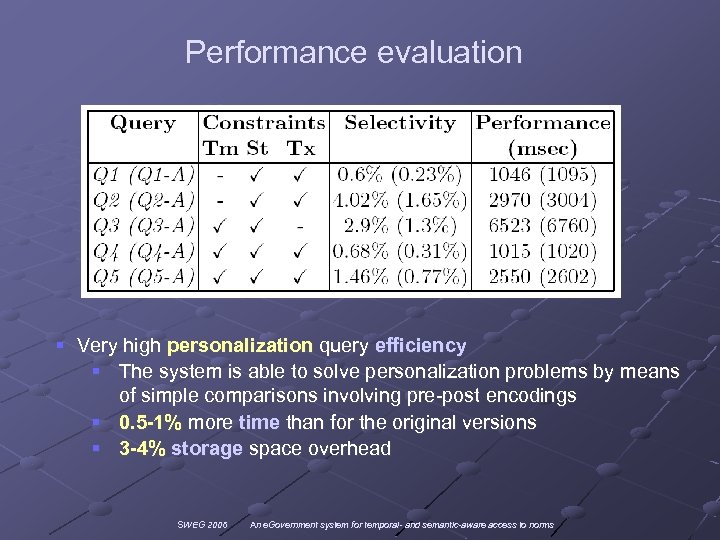
Performance evaluation § Very high personalization query efficiency § The system is able to solve personalization problems by means of simple comparisons involving pre-post encodings § 0. 5 -1% more time than for the original versions § 3 -4% storage space overhead SWEG 2006 An e. Government system for temporal- and semantic-aware access to norms
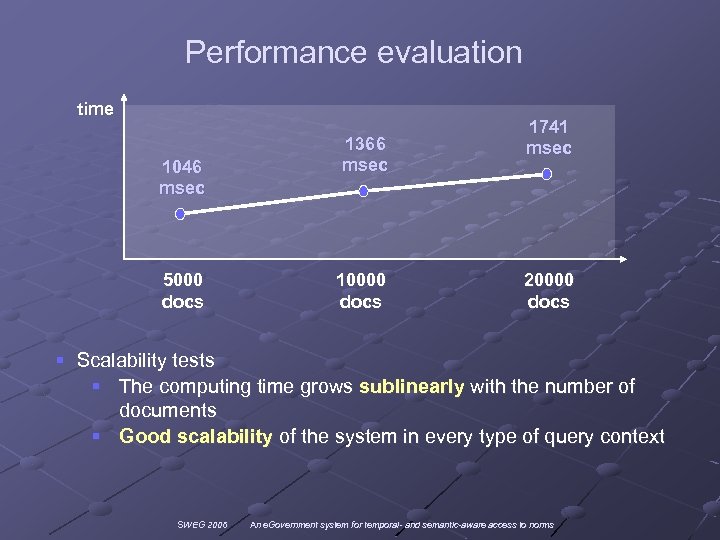
Performance evaluation time 1046 msec 5000 docs 1366 msec 10000 docs 1741 msec 20000 docs § Scalability tests § The computing time grows sublinearly with the number of documents § Good scalability of the system in every type of query context SWEG 2006 An e. Government system for temporal- and semantic-aware access to norms
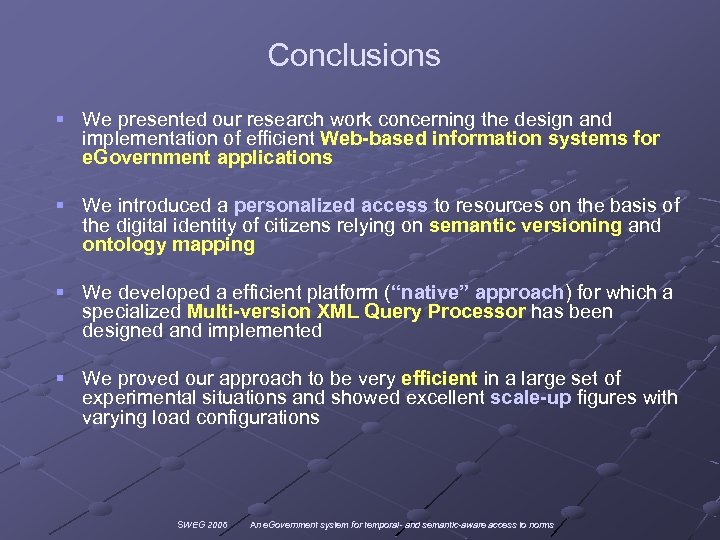
Conclusions § We presented our research work concerning the design and implementation of efficient Web-based information systems for e. Government applications § We introduced a personalized access to resources on the basis of the digital identity of citizens relying on semantic versioning and ontology mapping § We developed a efficient platform (“native” approach) for which a specialized Multi-version XML Query Processor has been designed and implemented § We proved our approach to be very efficient in a large set of experimental situations and showed excellent scale-up figures with varying load configurations SWEG 2006 An e. Government system for temporal- and semantic-aware access to norms
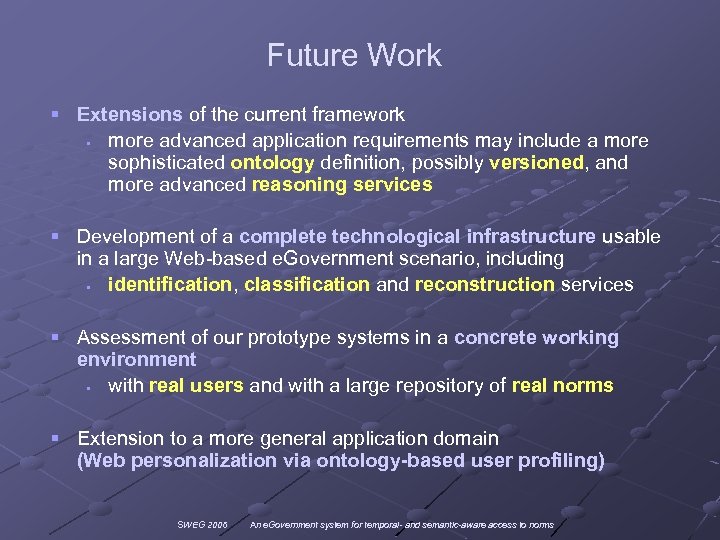
Future Work § Extensions of the current framework § more advanced application requirements may include a more sophisticated ontology definition, possibly versioned, and more advanced reasoning services § Development of a complete technological infrastructure usable in a large Web-based e. Government scenario, including § identification, classification and reconstruction services § Assessment of our prototype systems in a concrete working environment § with real users and with a large repository of real norms § Extension to a more general application domain (Web personalization via ontology-based user profiling) SWEG 2006 An e. Government system for temporal- and semantic-aware access to norms
Скачать презентацию SWEG 2006 The Semantic Web meets e
da1aea9ac456c888f424f678dba07ef8.ppt