


 Скачать презентацию Sweetwater Mesa Applications Stanley W Lamport Cox Castle
be95a8ca5dc0f2cfec1a9b4a49d92718.ppt
- Количество слайдов: 39
 Sweetwater Mesa Applications Stanley W. Lamport Cox Castle & Nicholson, LLP California Coastal Commission June 16, 2011 Agenda Item No. 13(c)-(h)
 Staff Recommendation Come back with houses on only 2 or 3 of the lots n At least two of the owners would end up with nothing n
 That Is A Taking n A categorical taking results where a regulation “denies an owner economically viable use of his land. ” n Lucas v. South Carolina Coastal Council (1992) 505 U. S. 1003, 1016.
 The Commission Cannot Take Property Without Just Compensation n Pub. Res. Code Section 30010: n The commission is not authorized “to exercise [its] power to grant or deny a permit in a manner which will take or damage private property for public use, without the payment of just compensation therefor. "
 Would A Court Find this Was A Taking? n Staff Report: “The commission is not a court and may not ultimately adjudicate whether its denial would constitute a taking. . . ” (Staff Report, p. 76) n In other words, the question for the Commission is whether a California Court would call it a taking.
 Ownership Determined by State Law n Courts look to state law to determine what is a protected property interest. Lucas v. South Carolina Coastal Council (1992) 505 US 1003, 1030. n In order to determine whether a taking has occurred, courts “traditional[ly] resort to ‘existing rules or understandings that stem from an independent source such as state law’ to define the range of interests that qualify for protection as ‘property’ under the Fifth and Fourteenth Amendments. ” n
 What Would California Courts Do? n No California Court has ever recognized the “single economic ownership” theory advanced in the staff report n All of the cases the staff report cites for this theory come from other states, not California
 Two Guiding Principles n Entities are distinct from their owners. n There is a strong presumption of ownership
 Entities Are Distinct From Their Owner n “A basic tenet of American corporate law is that the corporation and its shareholders are distinct entities. An individual shareholder, by virtue of his ownership of shares, does not own the corporation's assets …” n Dole Food Co. v. Patrickson (2003) 538 US 468
 California’s Presumption of Ownership n Evidence Code Sec 662 n "[t]he owner of the legal title to property is presumed to be the owner of the full beneficial title. This presumption may be rebutted only by clear and convincing proof. “ n The owner of record is presumed to own the land n Extremely rigorous burden of proof to rebut.
 Clear & Convincing Proof n Evidence that is "sufficiently strong to command the unhesitating assent of every reasonable mind. " n In re Marriage of Weaver (1990) 224 Cal. App. 3 d 478, 487. n Speculation is not enough n The evidence must be beyond debate
 The Owners Have Met Their Burden of Proof n Three steps n Deeds to the properties. n Recorded certificates of conversion n Corporations Code § 17540. 7(A)(1) n The certificates of conversion change the ownership to LLCs as a matter of law.
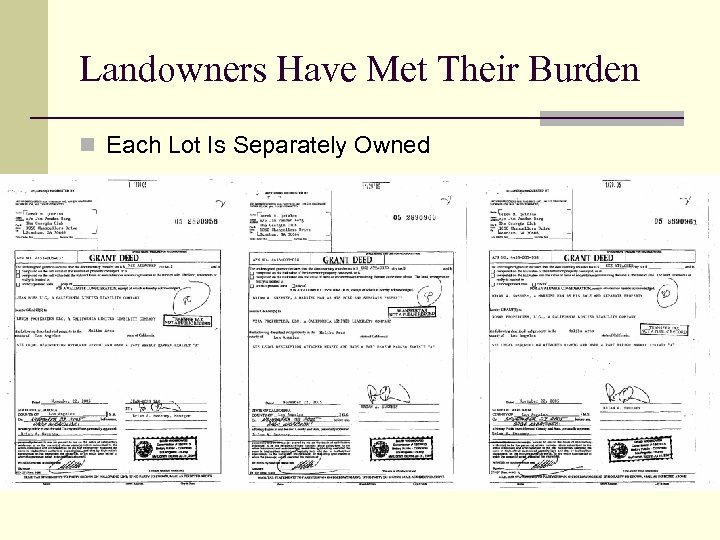 Landowners Have Met Their Burden n Each Lot Is Separately Owned
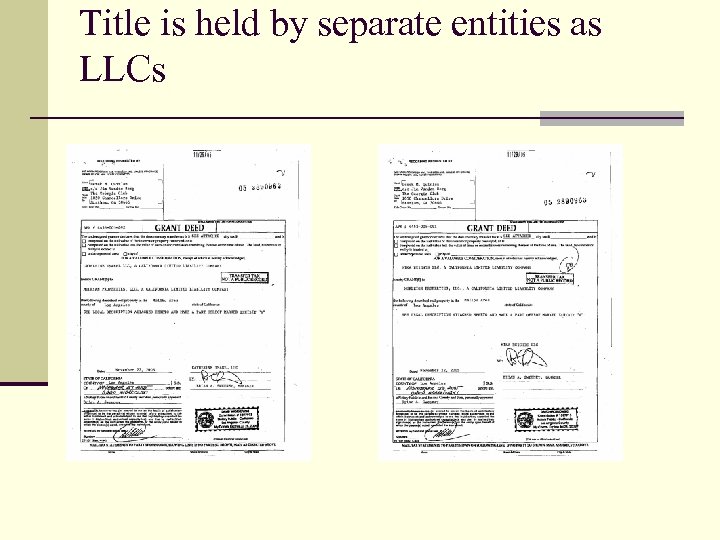 Title is held by separate entities as LLCs
 The LLCs Were Converted to LLLPs n “Whenever a limited liability company … converts into a … an other business entity … the filing for record in the office of the county recorder. . . in which any of the real property of the converting limited liability company or other converting entity is located of. . . a certificate of conversion … shall evidence record ownership in the … converted entity of all interest of the converting limited liability company … to the real property located in that county. ” n California Corporations Code § 17540. 7(A)(1).
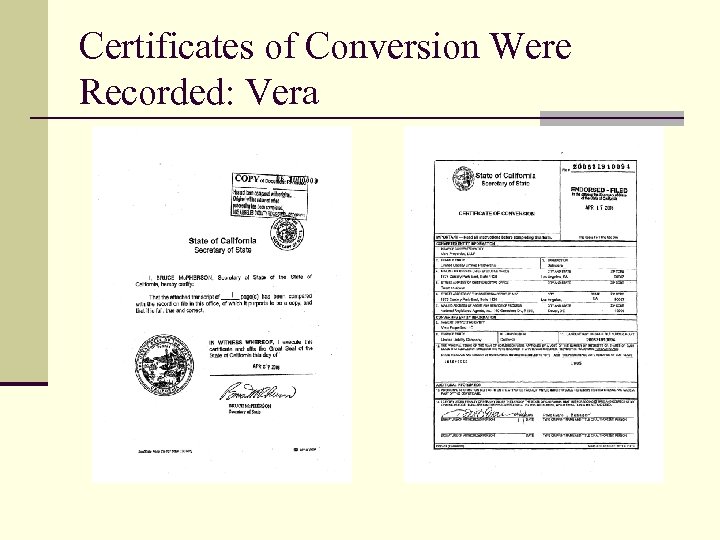 Certificates of Conversion Were Recorded: Vera
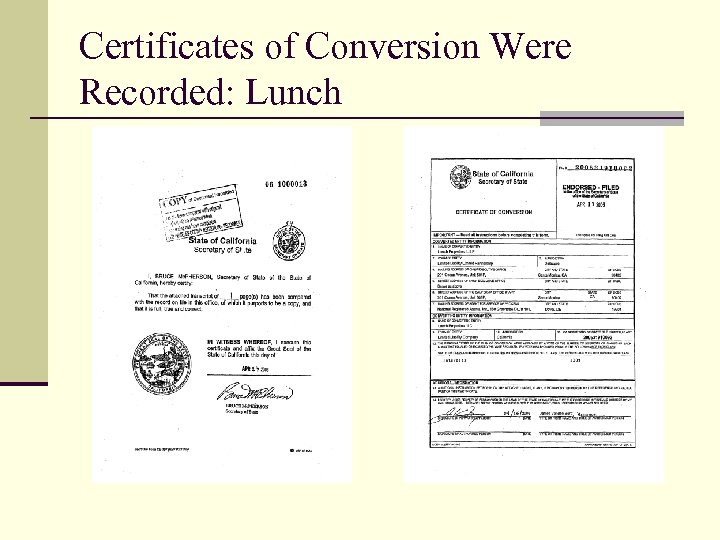 Certificates of Conversion Were Recorded: Lunch
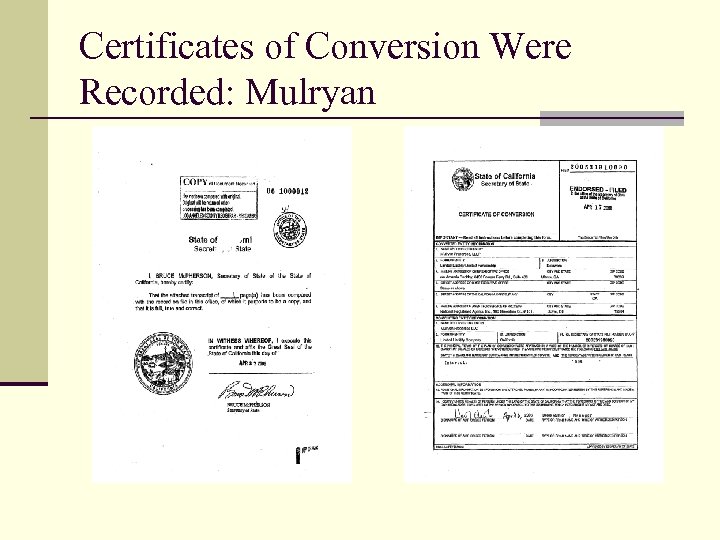 Certificates of Conversion Were Recorded: Mulryan
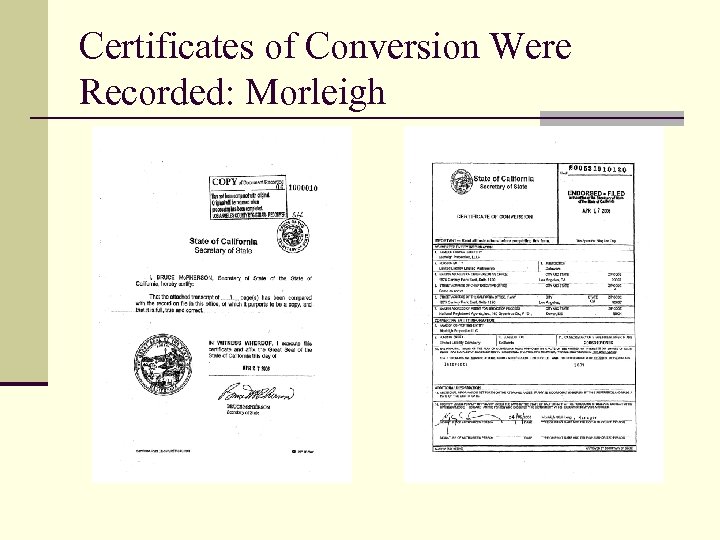 Certificates of Conversion Were Recorded: Morleigh
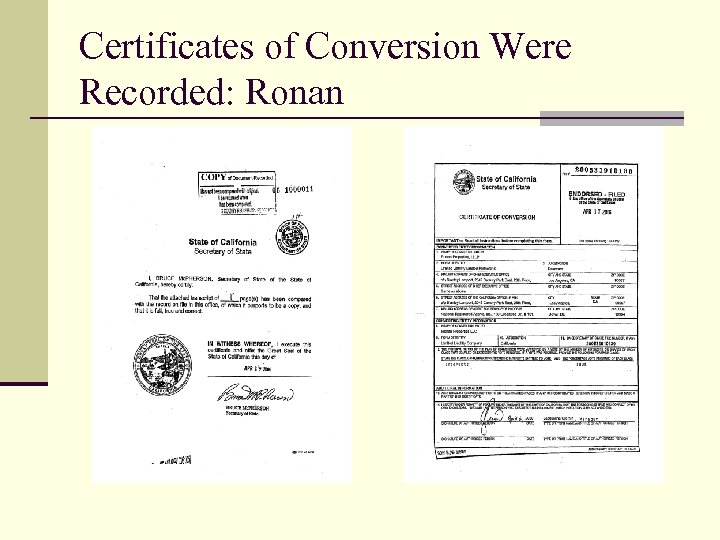 Certificates of Conversion Were Recorded: Ronan
 Presumed Owners n By statute, each LLLP is presumed to be the only owner of its lot. n The owners of the entities are not the owners n No one else is the owner
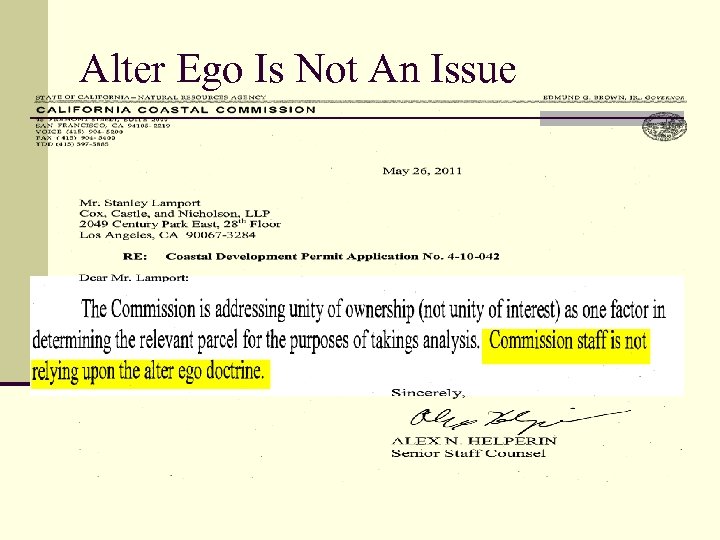 Alter Ego Is Not An Issue
 Staff Report Contention n Two contentions n “multiple parcels, if not all of the parcels are actually effectively owned or controlled by David Evans. n “some combination of [the parcels] is owned by a single entity consisting of a partnership among some combination of the LLLP, with David Evans perhaps functioning as the managing general partner. ” n Staff Report, p. 87
 In Other Words n Some one other than the LLLPs owns the properties. n To reach this conclusion the Staff Report would have to prove it with clear and convincing evidence.
 Staff Report Does Not Rebut Presumption n Evidence? n Two “news reports” n Website statements about David Evan’s interest in the design of the homes n Evan’s other statements regarding design influence
 No Evidence of Ownership n No court would adjudicate title based on a “news report” n Involvement in design does not equate to ownership n None of the “evidence” in the staff report conclusively proves that anyone other the entities owns the lots.
 Not Even Substantial Evidence n Substantial evidence is NOT argument, speculation, conjecture or unsubstantiated opinion. n n Buckley v. California Coastal Com. (1998) 68 Cal. App. 4 th 178, 192 Feduniak v. California Coastal Com. (2007) 148 Cal. App. 4 th 1346, 1360 n The Staff Report is largely speculation, guesswork and conclusions based on faulty assumptions. n If it is not even substantial evidence, it certainly isn’t clear and convincing evidence.
 Theory Two: Partnership n Even if the Commission could adjudicate the existence of a partnership (which it cannot): The Commission would still have to rebut the presumption of separate ownership… n By clear and convincing evidence. n
![Partnerships Don’t Change Ownership n “[I]t is not unusual that property be used for](https://present5.com/presentation/be95a8ca5dc0f2cfec1a9b4a49d92718/image-29.jpg "Partnerships Don’t Change Ownership n “[I]t is not unusual that property be used for") Partnerships Don’t Change Ownership n “[I]t is not unusual that property be used for partnership purposes and not belong to the partnership. . . the mere fact that real property belonging to individual partners is used in the partnership business is not sufficient to justify the conclusion that it becomes a partnership asset. n Ellis v. Mihelis (1963) 60 Cal. 2 d 206, 211, 218219.
Partnerships Don’t Change Ownership n “[I]t is not unusual that property be used for partnership purposes and not belong to the partnership. . . the mere fact that real property belonging to individual partners is used in the partnership business is not sufficient to justify the conclusion that it becomes a partnership asset. n Ellis v. Mihelis (1963) 60 Cal. 2 d 206, 211, 218219.
 Clear and Convincing Evidence Required n Toney v. Nolder (1985) 173 Cal. App. 3 d 791 n Evidence Code § 662 applied to claim that property belonged to oral partnership
 Cases Require Proof of a Written Agreement to Rebut the Presumption n Toney v. Nolder (1985) 173 Cal. App. 3 d 791 n Oral statements not enough to prove partnership owned land held as separate property.
 Partnerships Don’t Change Ownership n Corporations Code § 16204(d) n Property acquired in the name of one or more of the partners, without an indication in the instrument transferring title to the property of the person’s capacity as a partner or of the existence of a partnership and without use of partnership assets, is presumed to be separate property, even if used for partnership purposes.
 Required Proof n Clear and convincing evidence n That the partnership had assets n That the assets were used to buy the lots n That the lots were purchased to be partnership assets n A reference to the partnership in the deeds.
 Staff Reports “One Noteworthy Opinion” n Chapman v. Hughes (1894) 104 Cal. 302 n Decision was based on a written syndicate agreement between the parties. n Court that, without the agreement, the property would have been separately owned. n “The fact being that [defendant] was the owner and, and entitled to the sole and absolute possession of the whole thereof. . . ” n “The entire claim of plaintiffs. . . independent of the syndicate agreement. . . must fall to the ground. ”
 Evidence a Partnership Owns the Lots? n Six deeds of trust – which prove separate ownership, not one n Bank of Ireland as the lender - loans are not assets n Deeds of trust were sent to one law firm – which represented the lender n A water line easement – also evidence of separate ownership n (Staff Report, pp. 97 -98)
 No Evidence n No deed referencing the partnership as the intended owner as required by statute. n No evidence that the “partnership” had any assets… n Let alone that any such assets were used to buy the property n No agreement proving a partnership owns the property
 Summary n Each LLLP is presumed to have the only ownership interest in its property n No substantial (or clear and convincing) evidence to the contrary n An implied partnership theory does not allow the Commission to determine the lots are commonly-owned
 A Presumption Is A Presumption n A Court must regard these properties as separately owned n And the Commission must regard these lots as separately owned n The Commission cannot ignore the presumption because it does not have the evidence to rebut it. n That would be contrary to the whole point of the presumption
 There Is No Partnership n Staff Report Theory: n Personal and social relationships between owners of the entities n Common sustainable design features n “Suspicious activities” – changes in general partners n Applications processed together n Simultaneously closing n News reports