


 Скачать презентацию Сверхфразовое единство и текст Сверхфразовое
Стилистика-4.ppt
- Количество слайдов: 27
 Сверхфразовое единство и текст
 • Сверхфразовое единство - (сложное синтаксическое целое, микротекст, период) — отрезок речи в форме последовательности двух и более самостоятельных предложений, объединённых общностью темы в смысловые блоки.
 • «Это положение обусловлено следующими факторами: во первых. . . , во вторых. . . »
 • При конструировании текста используются максимальные единицы языка (предложения), которые становятся минимальными единицами речи (высказываниями) • Компоненты высказывания тема и рема (тема данное, исходное; рема новое, искомое).
 • Информативные высказывания, в которых разворачивается содержательная информация (это сообщения описательного, повествовательного, аргументирующего, анализирующего типа), и высказывания верификативные, которые служат целям утверждения или опровержения, контраргументации (высказывания полемические, убеждающие, воздействующие).
 • «В очень известном и большом городе жил царь, вдовец. У царя была дочь, невеста. Царевна далеко славилась и лицом и умом, и потому многие весьма хорошие люди желали сосватать ее. Среди этих женихов были князья, воеводы, и гости торговые, и ловкие проходимцы, которые всегда толкаются в знатных домах и выискивают, чем бы услужить» (Н. Рерих. Детская сказка)
 • All types of food are classified into three distinct groups – protein, fat and carbohydrate. Of these, only refined carbohydrate is reported to cause caries as it is the only food which can be turned into acid by the bacteria concerned. Refined carbohydrates are sugar and white flour, so anything containing these can give rise to carries. Such foods are cake, biscuits, bread, jam and sweets.
 • В тексте целесообразно различать информацию • а) содержательно фактуальную (СФИ), • б) содержательно концептуальную (СКИ), • в) содержательно подтекстовую (СПИ)
 Содержательно фактуальная информация • содержит сообщения о фактах, событиях, процессах, происходящих, происходивших, которые будут происходить в окружающем нас мире, действительном или воображаемом.
 Содержательно концептуальная информация • сообщает читателю индивидуально авторское понимание отношений между явлениями, описанными средствами СФИ, понимание их причинно следственных связей, их значимости в социальной, экономической, поли тической, культурной жизни народа, включая отношения между отдель ными индивидуумами, их сложного психологического и эстетико познавательного взаимодействия.
 Содержательно подтекстовая информация • представляет собой скрытую информацию, извлекаемую из СФИ благодаря способности единиц языка порождать ассоциативные и коннотативные значения, а также благодаря способности предложений внутри СФЕ приращивать смыслы.
 Сообщение • форма информации, предназначенная для пере дачи получателю (получателям) сведений о событиях происходящих, происшедших или которые будут происходить в ближайшее время.
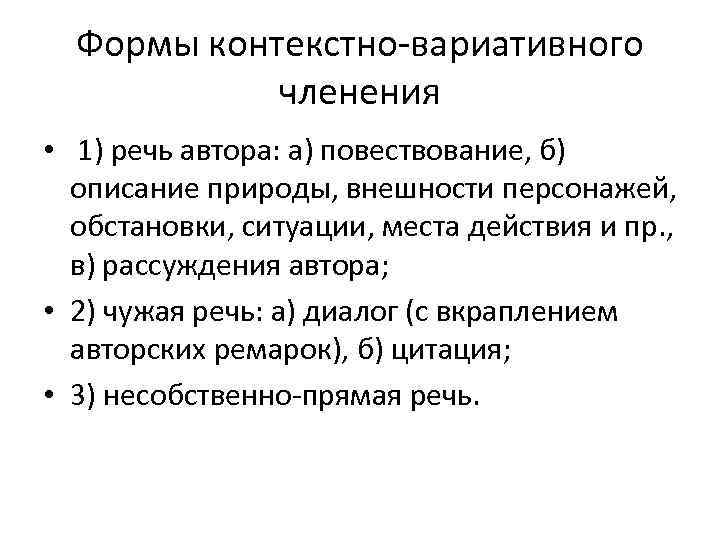 Формы контекстно вариативного членения • 1) речь автора: а) повествование, б) описание природы, внешности персонажей, обстановки, ситуации, места действия и пр. , в) рассуждения автора; • 2) чужая речь: а) диалог (с вкраплением авторских ремарок), б) цитация; • 3) несобственно прямая речь.
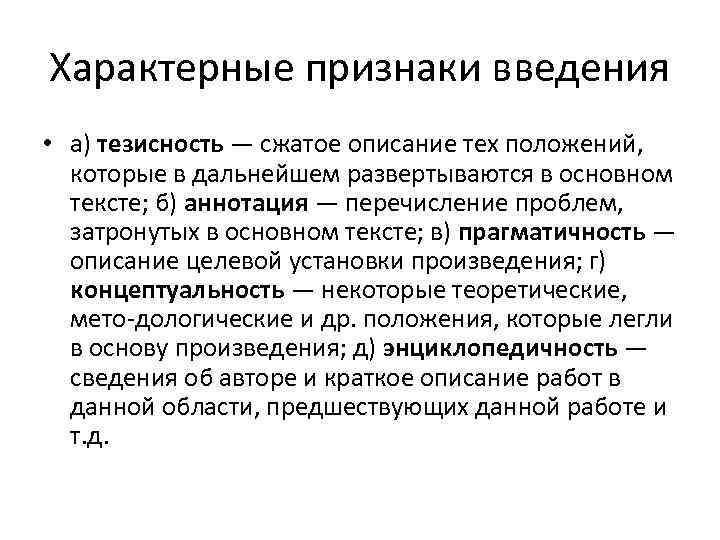 Характерные признаки введения • а) тезисность — сжатое описание тех положений, которые в дальнейшем развертываются в основном тексте; б) аннотация — перечисление проблем, затронутых в основном тексте; в) прагматичность — описание целевой установки произведения; г) концептуальность — некоторые теоретические, мето дологические и др. положения, которые легли в основу произведения; д) энциклопедичность — сведения об авторе и краткое описание работ в данной области, предшествующих данной работе и т. д.
 КОГЕЗИЯ (ВНУТРИТЕКСТОВЫЕ СВЯЗИ) • это особые виды связи, обеспечивающие континуум, т. е. логическую последовательность, (темпоральную и/или пространственную) взаимозависимость отдельных сообщений, фактов, действий и пр
 Автосемантия смысловых частей текста
 Ретроспекция и проспекция • Ретроспекция — грамматическая категория текста, объединяющая формы языкового выражения, относящие читателя к предшествующей содержательно фактуальной информации.
 • Проспекция — один из приемов повествования, который дает читателю возможность яснее представить себе связь и об условленность событий и эпизодов.
 • "The more particular implications of structuralism may be left for the following pages; we shall look further into some of theoretical differences. . . later in this chapter"
 МОДАЛЬНОСТЬ ТЕКСТА • Отношение говорящего (пишущего) к фрагменту действительности, описываемому в тексте
 Интеграция • понятие теории систем, означающее состояние связанности отдельных дифференцированных частей в целое, а также процесс, ведущий к такому состоянию.
 План анализа текста • • Цельность Информативность Структура Когезия Ретроспекция и проспекция Модальность Интеграция
 Primary Prevention of Cardiovascular Disease with Statins in the Elderly. Abstract Owing to the progressive aging of the population, and the fact that cardiovascular disease (CVD) is the leading cause of death among the elderly, the prevention of CVD in the elderly is becoming increasingly important. Although there is no doubt that statin treatment should be used for reducing CVD risk in the elderly in secondary prevention in the same way as in younger individuals, the evidence that such treatment really prolongs life in elderly subjects in primary prevention is still not so clear. However, it seems that it does reduce CVD morbidity in elderly individuals. Because of limited evidence regarding the benefit of such therapy, particularly in very old subjects (older than 80 85 years), the decision whether to treat or not treat an elderly individual with statins in primary prevention should be based on good clinical judgment and considering the individual subject's situation regarding comorbidities, polypharmacy, and possible adverse effects.
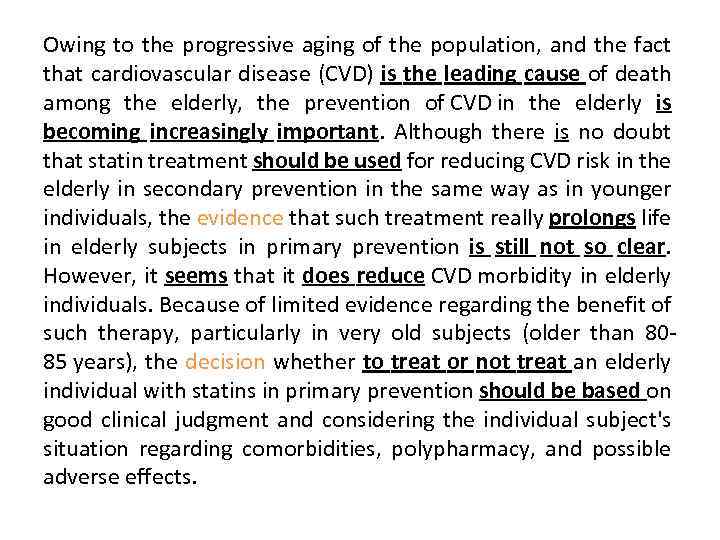 Owing to the progressive aging of the population, and the fact that cardiovascular disease (CVD) is the leading cause of death among the elderly, the prevention of CVD in the elderly is becoming increasingly important. Although there is no doubt that statin treatment should be used for reducing CVD risk in the elderly in secondary prevention in the same way as in younger individuals, the evidence that such treatment really prolongs life in elderly subjects in primary prevention is still not so clear. However, it seems that it does reduce CVD morbidity in elderly individuals. Because of limited evidence regarding the benefit of such therapy, particularly in very old subjects (older than 80 85 years), the decision whether to treat or not treat an elderly individual with statins in primary prevention should be based on good clinical judgment and considering the individual subject's situation regarding comorbidities, polypharmacy, and possible adverse effects.
 Owing to the progressive aging of the population, and the fact that cardiovascular disease (CVD) is the leading cause of death among the elderly, the prevention of CVD in the elderly is becoming increasingly important. Although there is no doubt that statin treatment should be used for reducing CVD risk in the elderly in secondary prevention in the same way as in younger individuals, the evidence that such treatment really prolongs life in elderly subjects in primary prevention is still not so clear. However, it seems that it does reduce CVD morbidity in elderly individuals. Because of limited evidence regarding the benefit of such therapy, particularly in very old subjects (older than 80 85 years), the decision whether to treat or not treat an elderly individual with statins in primary prevention should be based on good clinical judgment and considering the individual subject's situation regarding comorbidities, polypharmacy, and possible adverse effects.
 Owing to the progressive aging of the population, and the fact that cardiovascular disease (CVD) is the leading cause of death among the elderly, the prevention of CVD in the elderly is becoming increasingly important. Although there is no doubt that statin treatment should be used for reducing CVD risk in the elderly in secondary prevention in the same way as in younger individuals, the evidence that such treatment really prolongs life in elderly subjects in primary prevention is still not so clear. However, it seems that it does reduce CVD morbidity in elderly individuals. Because of limited evidence regarding the benefit of such therapy, particularly in very old subjects (older than 80 85 years), the decision whether to treat or not treat an elderly individual with statins in primary prevention should be based on good clinical judgment and considering the individual subject's situation regarding comorbidities, polypharmacy, and possible adverse effects.
 Insulin Resistance, Diabetes, and Cardiovascular Risk. Paneni F 1, Costantino S, Cosentino F. Abstract Obesity and type 2 diabetes mellitus (T 2 DM) are major drivers of cardiovascular disease (CVD). The link between environmental factors, obesity, and dysglycemia indicates that progression to diabetes with time occurs along a "continuum", not necessarily linear, which involves different cellular mechanisms including alterations of insulin signaling, changes in glucose transport, pancreatic beta cell dysfunction, as well as the deregulation of key genes involved in oxidative stress and inflammation. The present review critically addresses key pathophysiological aspects including (i) hyperglycemia and insulin resistance as predictors of CV outcome, (ii) molecular mechanisms underpinning the progression of diabetic vascular complications despite intensive glycemic control, and (iii) stratification of CV risk, with particular emphasis on emerging biomarkers. Taken together, these important aspects may contribute to the development of promising diagnostic approaches as well as mechanism based therapeutic strategies to reduce CVD burden in obese and diabetic subjects.