


 Скачать презентацию Susti Net The original policy proposal Stan Dorn
dbd032723aa54526a4b59290957e25b5.ppt
- Количество слайдов: 48
 Susti. Net: The original policy proposal Stan Dorn The Urban Institute sdorn@urban. org 202. 261. 5561 September 16, 2009 THE URBAN INSTITUTE 1
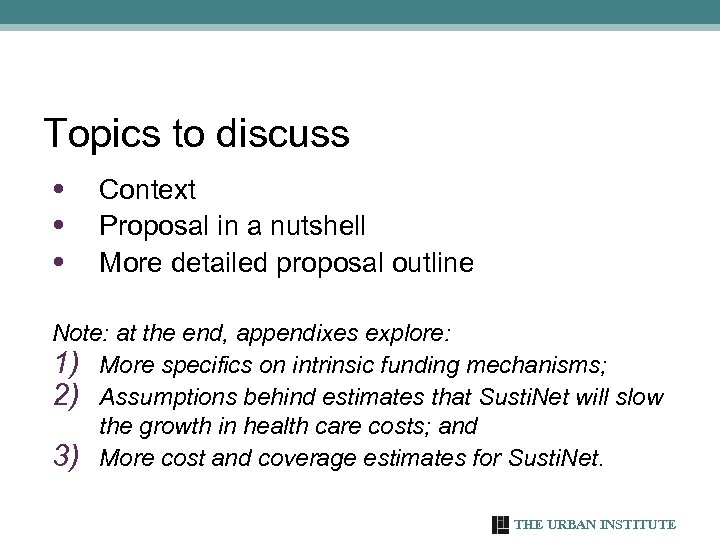 Topics to discuss • • • Context Proposal in a nutshell More detailed proposal outline Note: at the end, appendixes explore: 1) More specifics on intrinsic funding mechanisms; 2) Assumptions behind estimates that Susti. Net will slow the growth in health care costs; and 3) More cost and coverage estimates for Susti. Net. THE URBAN INSTITUTE 2
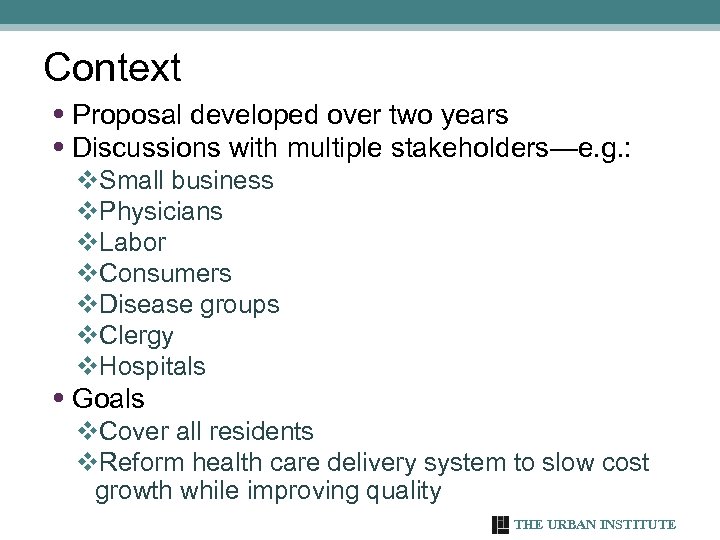 Context • Proposal developed over two years • Discussions with multiple stakeholders—e. g. : v. Small business v. Physicians v. Labor v. Consumers v. Disease groups v. Clergy v. Hospitals • Goals v. Cover all residents v. Reform health care delivery system to slow cost growth while improving quality THE URBAN INSTITUTE 3
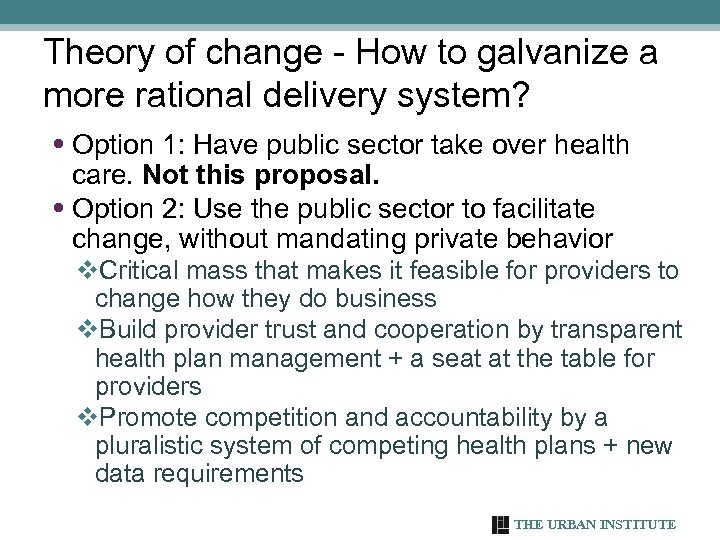 Theory of change - How to galvanize a more rational delivery system? • Option 1: Have public sector take over health care. Not this proposal. • Option 2: Use the public sector to facilitate change, without mandating private behavior v. Critical mass that makes it feasible for providers to change how they do business v. Build provider trust and cooperation by transparent health plan management + a seat at the table for providers v. Promote competition and accountability by a pluralistic system of competing health plans + new data requirements THE URBAN INSTITUTE 4
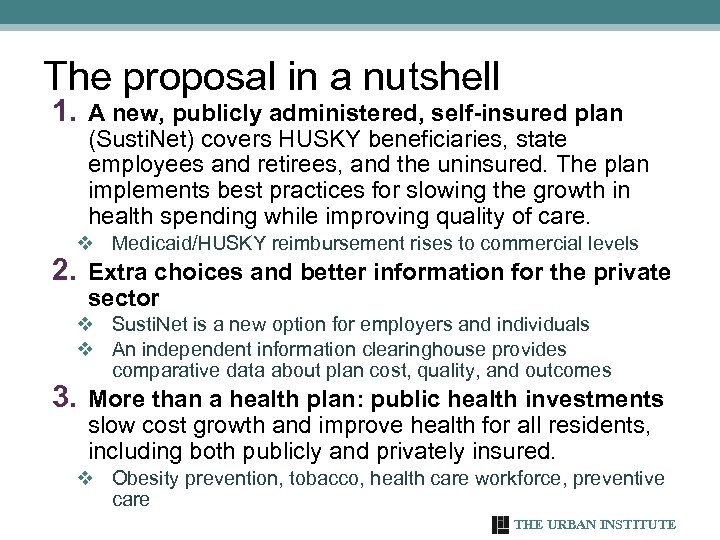 The proposal in a nutshell 1. A new, publicly administered, self-insured plan (Susti. Net) covers HUSKY beneficiaries, state employees and retirees, and the uninsured. The plan implements best practices for slowing the growth in health spending while improving quality of care. v Medicaid/HUSKY reimbursement rises to commercial levels 2. Extra choices and better information for the private sector v Susti. Net is a new option for employers and individuals v An independent information clearinghouse provides comparative data about plan cost, quality, and outcomes 3. More than a health plan: public health investments slow cost growth and improve health for all residents, including both publicly and privately insured. v Obesity prevention, tobacco, health care workforce, preventive care THE URBAN INSTITUTE 5
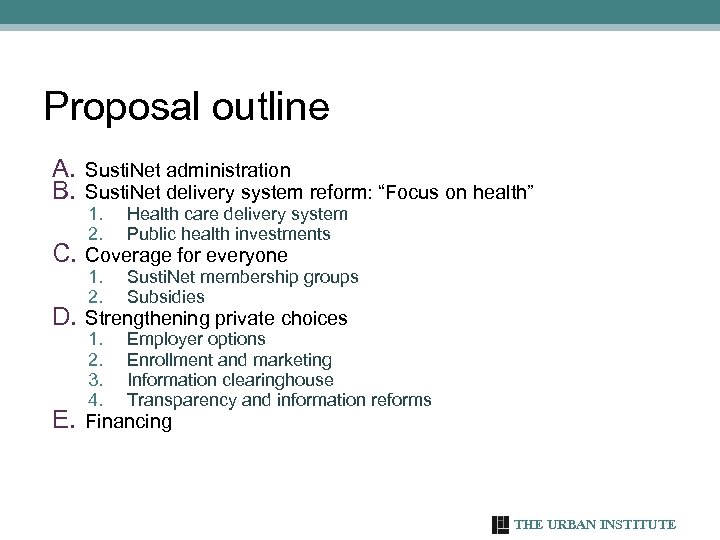 Proposal outline A. B. Susti. Net administration Susti. Net delivery system reform: “Focus on health” C. Coverage for everyone D. Strengthening private choices E. Financing 1. 2. Health care delivery system Public health investments 1. 2. Susti. Net membership groups Subsidies 1. 2. 3. 4. Employer options Enrollment and marketing Information clearinghouse Transparency and information reforms THE URBAN INSTITUTE 6
 A. Susti. Net administration THE URBAN INSTITUTE 7
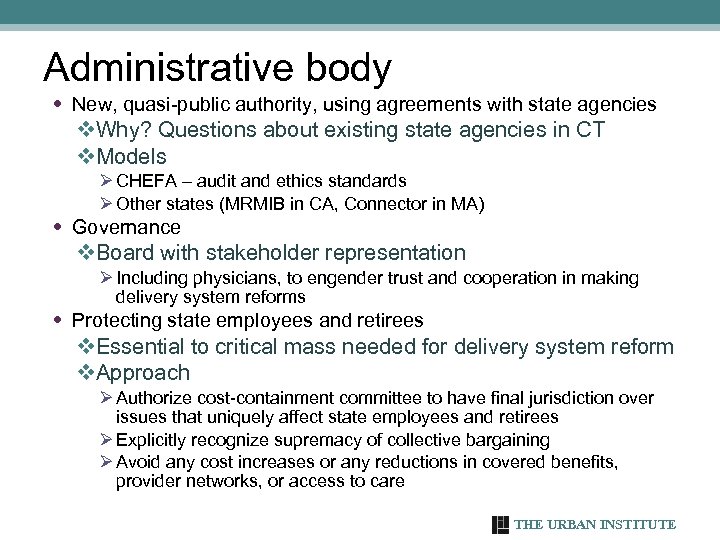 Administrative body • New, quasi-public authority, using agreements with state agencies v. Why? Questions about existing state agencies in CT v. Models • Ø CHEFA – audit and ethics standards Ø Other states (MRMIB in CA, Connector in MA) Governance v. Board with stakeholder representation • Ø Including physicians, to engender trust and cooperation in making delivery system reforms Protecting state employees and retirees v. Essential to critical mass needed for delivery system reform v. Approach Ø Authorize cost-containment committee to have final jurisdiction over issues that uniquely affect state employees and retirees Ø Explicitly recognize supremacy of collective bargaining Ø Avoid any cost increases or any reductions in covered benefits, provider networks, or access to care THE URBAN INSTITUTE 8
 Plan structure • Self-insured plan – why? v. Transparency v. Management capacity • ASO contractor v. Any number possible: 0, 1, >1 • Gain-sharing authorized from plan to provider THE URBAN INSTITUTE 9
 Mid-course corrections possible • With public notice, but without legislative change, Susti. Net Board can: v. Change rules if the proposal is unsuccessful in its attempts to prevent the following from becoming serious problems: ØAdverse selection ØCrowd-out ØInadequate ESI v. Modify delivery system to incorporate new research findings • Annual reports recommend legislative changes to CGA THE URBAN INSTITUTE 10
 B. Delivery system reform within the new, Susti. Net health plan: “Focus on health” THE URBAN INSTITUTE 11
 Health care delivery system goals • Change the goal to improving health v. Prevention and management of chronic illness v. Promote wellness v. End racial and ethnic disparities in health care and health outcomes • How are these goals achieved in Susti. Net? v. Patient-centered medical home v. Health information technology v. Evidence-based medicine v. Public health investments v. Transparency and information reforms v. Other methods THE URBAN INSTITUTE 12
 Patient-centered medical home • Functions v. Patient education to better manage their own conditions v. Care coordination v 24/7 availability • Structure in a state with many small practices v. Each practice chooses its functions from a menu v. Partners vetted by Susti. Net perform the remaining functions Ø Community-based nurses, patient educators, social workers Ø Insurers Ø Susti. Net staff THE URBAN INSTITUTE 13
 Health information technology • Make HIT affordable to providers v CHEFA bonding to cover capital costs v Subscriptions, from Susti. Net providers and others, covering Ø Hardware and software, including updates, replacements, and digitizing paper files Ø Support for installation, operation, maintenance, customization • • v Leverage to get good prices on all the above Make HIT useful to providers v Platform for integrating data from multiple providers into a single record for each patient (HIE) v Incorporate interface with labs, pharmacies v Financial gain-sharing To participate in Susti. Net, physicians, hospitals, etc. , must implement HIT by a date certain (e. g. , 2015) v Need not use state-contracting HIT vendors, but must be interoperable THE URBAN INSTITUTE 14
 Evidence-based medicine, without cookbooks • Physicians, nurses, other clinicians work with Board to • choose from among national/international guidelines Encouraged to implement guidelines when reasonable, without lapsing into “cookbook medicine” v. Reminders embedded in Electronic Health Records v“Safe harbor” from malpractice liability v. Confidential practice profiles, comparisons to peers • Certify high-quality providers for particular conditions, based on transparent criteria • Periodic quality reviews THE URBAN INSTITUTE 15
 Public health investments • Obesity • Tobacco • Provider workforce • Immunizations, screenings at work, school, community THE URBAN INSTITUTE 16
 Other • Medical home will require new payment modality v. Risk-adjusted monthly fee for basic case management v. May need supplemental payment for outliers, given ØUncertainties surrounding new payment methods ØRandom fluctuations that affect small medical practices • More broadly, Susti. Net can implement new methods of provider reimbursement v. Permitted, but not required v. Critically important to involve physicians in developing new payment methods THE URBAN INSTITUTE 17
 C. Coverage for everyone THE URBAN INSTITUTE 18
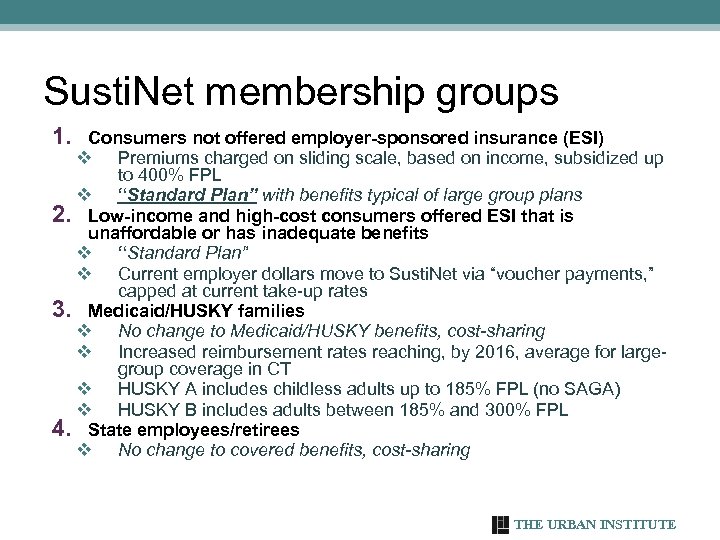 Susti. Net membership groups 1. Consumers not offered employer-sponsored insurance (ESI) v Premiums charged on sliding scale, based on income, subsidized up to 400% FPL v “Standard Plan” with benefits typical of large group plans 2. Low-income and high-cost consumers offered ESI that is unaffordable or has inadequate benefits v “Standard Plan” v Current employer dollars move to Susti. Net via “voucher payments, ” capped at current take-up rates 3. Medicaid/HUSKY families v No change to Medicaid/HUSKY benefits, cost-sharing v Increased reimbursement rates reaching, by 2016, average for largegroup coverage in CT v HUSKY A includes childless adults up to 185% FPL (no SAGA) v HUSKY B includes adults between 185% and 300% FPL 4. State employees/retirees v No change to covered benefits, cost-sharing THE URBAN INSTITUTE 19
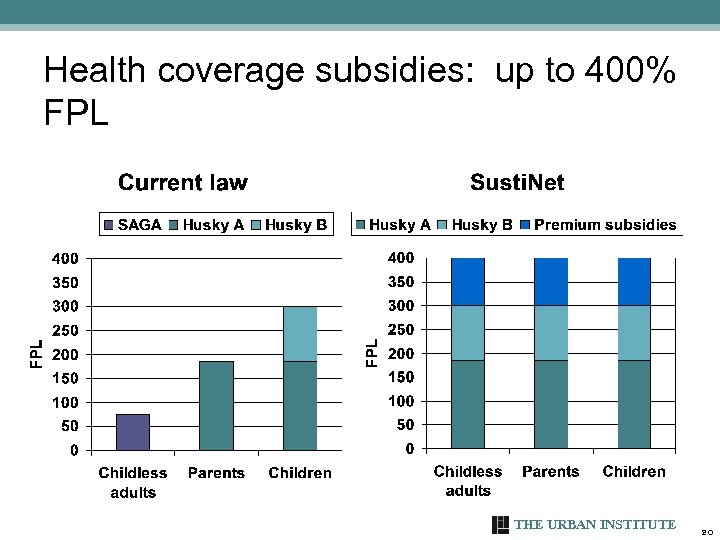 Health coverage subsidies: up to 400% FPL THE URBAN INSTITUTE 20
 D. Strengthening private choices THE URBAN INSTITUTE 21
 New options for individuals and firms • Employers can purchase Susti. Net – standard plan v. Start with small firms, municipalities, non-profits v. Eventually, any employer can purchase v. Multiple options can be offered Ø Benefits, cost-sharing Ø Network flexibility • v. Avoid adverse selection – same rating rules as with other ESI Individuals not offered ESI can choose between Susti. Net Standard and non-group coverage v Non-group market reform – apply small-group rules to: Ø Risk rating Ø Preexisting condition exclusions v Avoid adverse selection by: Ø Same rating rules for unsubsidized Susti. Net as for private plans Ø Incentives for early enrollment – premiums increase if enrollment is deferred (Medicare B/D model) THE URBAN INSTITUTE 22
 Enrollment and Marketing • Auto-enrollment following identification as uninsured v. Start school; v. File state income tax forms; v. Seek health care; etc. • Individual can “opt out” and remain uninsured v. Annual informed consent process • Susti. Net can be marketed through existing channels, including brokers and agents THE URBAN INSTITUTE 23
 Health plan information • Independent information clearinghouse v. Independent of Susti. Net v. Gathers and reports comprehensive data from state-licensed private plans and Susti. Net v. Self-insured plans have the option to participate v. More informed choices by employers and individuals = better health plan incentives • Evidence-based benefit packages v. Office of Health Care Advocate recommends incentives for adoption THE URBAN INSTITUTE 24
 Other information reforms • Annual disclosure forms in which Susti. Net providers list potential financial conflicts of interest • Academic counter-detailing from Susti. Net consultants provides objective perspectives on drugs and devices being marketed by private companies v. Susti. Net authorized to provide free samples of generic drugs THE URBAN INSTITUTE 25
 E. Financing THE URBAN INSTITUTE 26
 Intrinsic funding – not enough • Federal matching funds • Individual premium payments • Employer “voucher” payments for workers who shift from ESI to Susti. Net v. Capped based on average for firm of applicable industry and size • Shared responsibility payments from medium- sized and larger firms not offering coverage v 4% of payroll above average for 10 -person firm ($318, 000 in 2008 dollars) v. Employer pays 3%, workers pay 1% THE URBAN INSTITUTE 27
 Upshot for General Fund • Under current federal matching rules, $950 million in increased General Fund costs v. Approximately half for increased reimbursement rates v. Approximately half for more people receiving coverage through: ØIncreased HUSKY eligibility ØNew premium subsidies ØIncreased enrollment by people eligible under current law • If federal reforms increase federal matching percentages, state costs will decline THE URBAN INSTITUTE 28
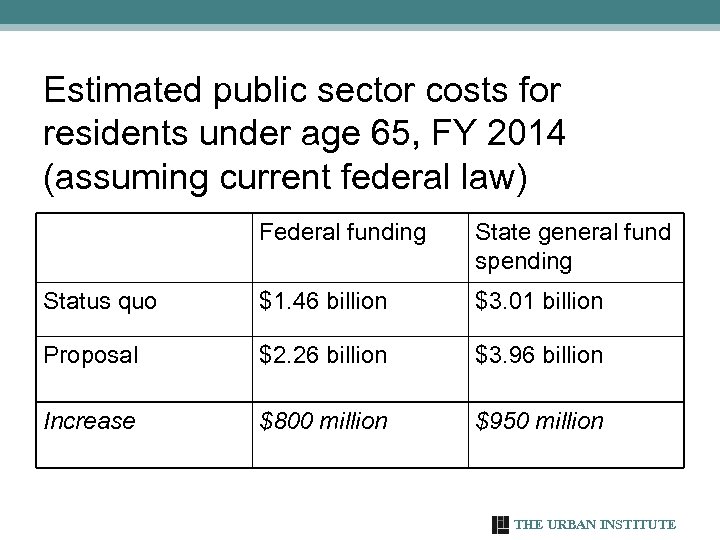 Estimated public sector costs for residents under age 65, FY 2014 (assuming current federal law) Federal funding State general fund spending Status quo $1. 46 billion $3. 01 billion Proposal $2. 26 billion $3. 96 billion Increase $800 million $950 million THE URBAN INSTITUTE 29
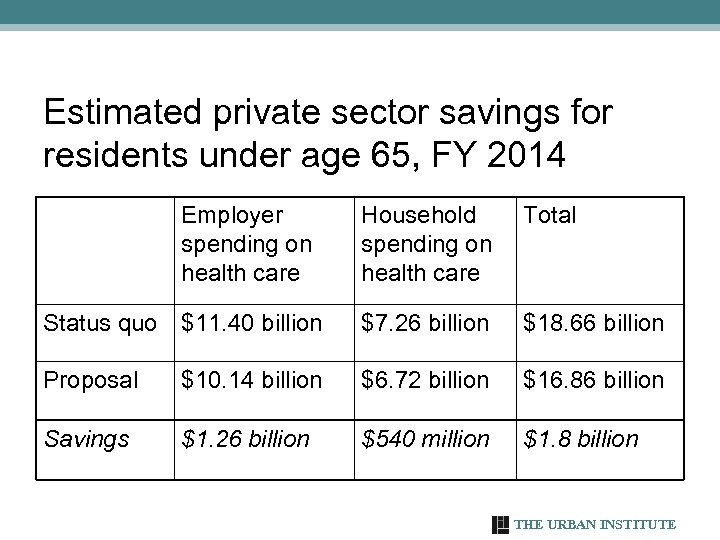 Estimated private sector savings for residents under age 65, FY 2014 Employer spending on health care Household spending on health care Total Status quo $11. 40 billion $7. 26 billion $18. 66 billion Proposal $10. 14 billion $6. 72 billion $16. 86 billion Savings $1. 26 billion $540 million $1. 8 billion THE URBAN INSTITUTE 30
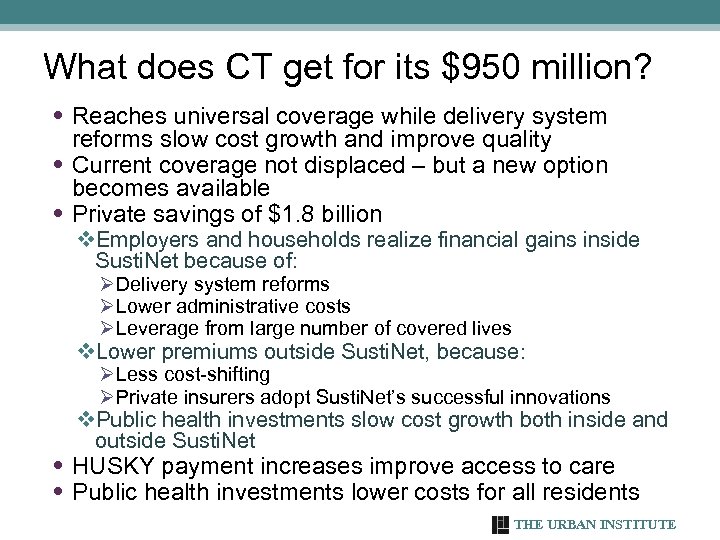 What does CT get for its $950 million? • Reaches universal coverage while delivery system • • reforms slow cost growth and improve quality Current coverage not displaced – but a new option becomes available Private savings of $1. 8 billion v. Employers and households realize financial gains inside Susti. Net because of: Ø Delivery system reforms Ø Lower administrative costs Ø Leverage from large number of covered lives v. Lower premiums outside Susti. Net, because: Ø Less cost-shifting Ø Private insurers adopt Susti. Net’s successful innovations v. Public health investments slow cost growth both inside and outside Susti. Net • HUSKY payment increases improve access to care • Public health investments lower costs for all residents THE URBAN INSTITUTE 31
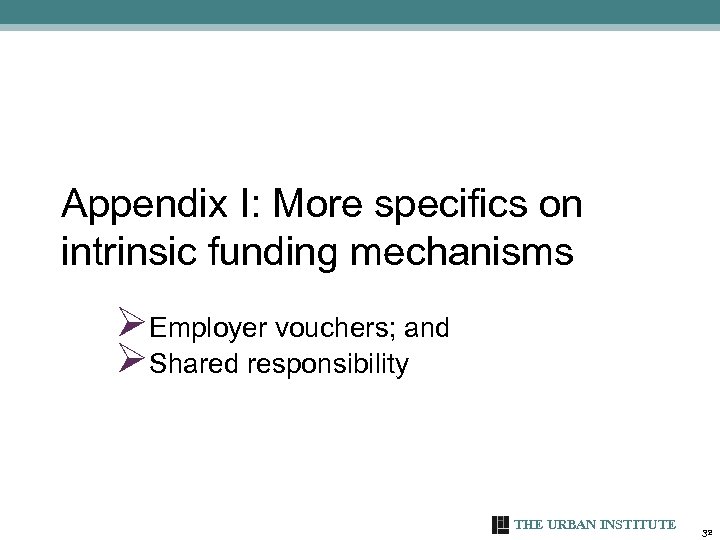 Appendix I: More specifics on intrinsic funding mechanisms ØEmployer vouchers; and ØShared responsibility THE URBAN INSTITUTE 32
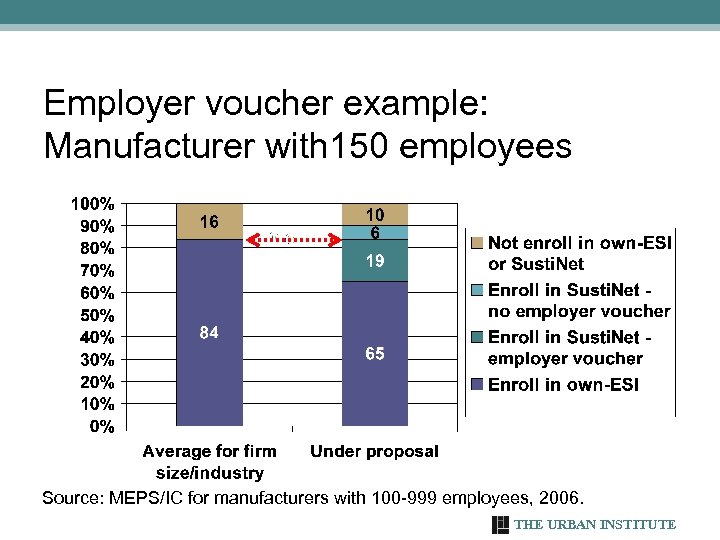 Employer voucher example: Manufacturer with 150 employees Source: MEPS/IC for manufacturers with 100 -999 employees, 2006. THE URBAN INSTITUTE 33
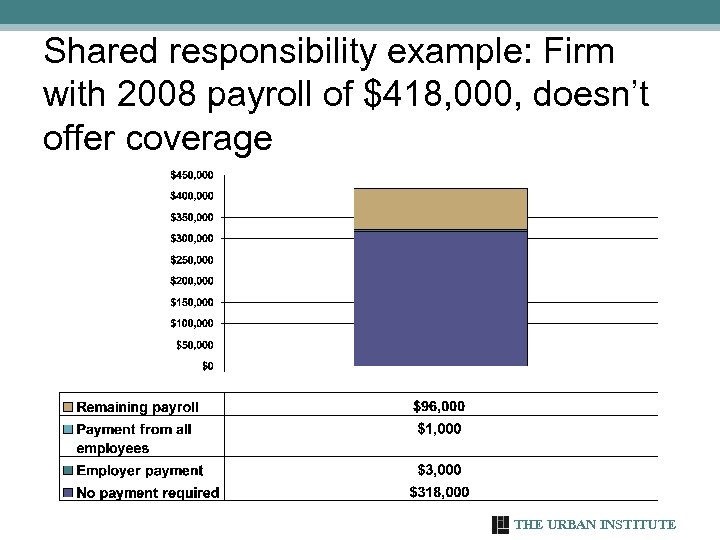 Shared responsibility example: Firm with 2008 payroll of $418, 000, doesn’t offer coverage THE URBAN INSTITUTE 34
 Appendix II: assumptions about the proposal's capacity to slow cost growth ØInside the Susti. Net plan; and ØOutside the Susti. Net plan THE URBAN INSTITUTE 35
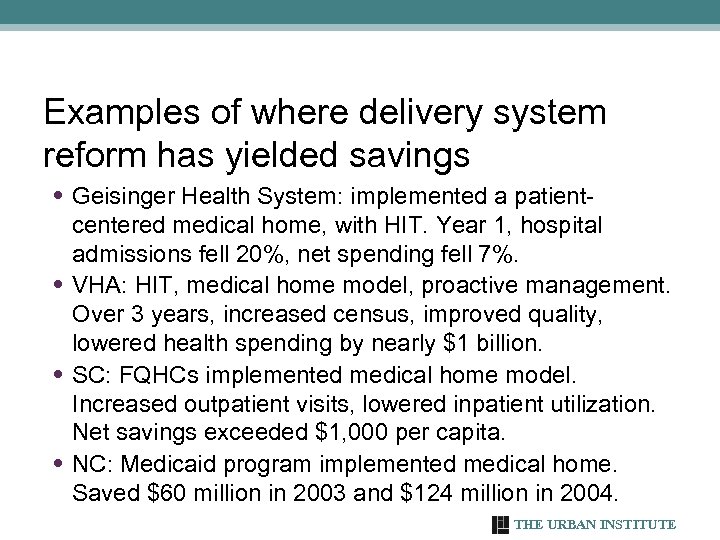 Examples of where delivery system reform has yielded savings • Geisinger Health System: implemented a patient • • • centered medical home, with HIT. Year 1, hospital admissions fell 20%, net spending fell 7%. VHA: HIT, medical home model, proactive management. Over 3 years, increased census, improved quality, lowered health spending by nearly $1 billion. SC: FQHCs implemented medical home model. Increased outpatient visits, lowered inpatient utilization. Net savings exceeded $1, 000 per capita. NC: Medicaid program implemented medical home. Saved $60 million in 2003 and $124 million in 2004. THE URBAN INSTITUTE 36
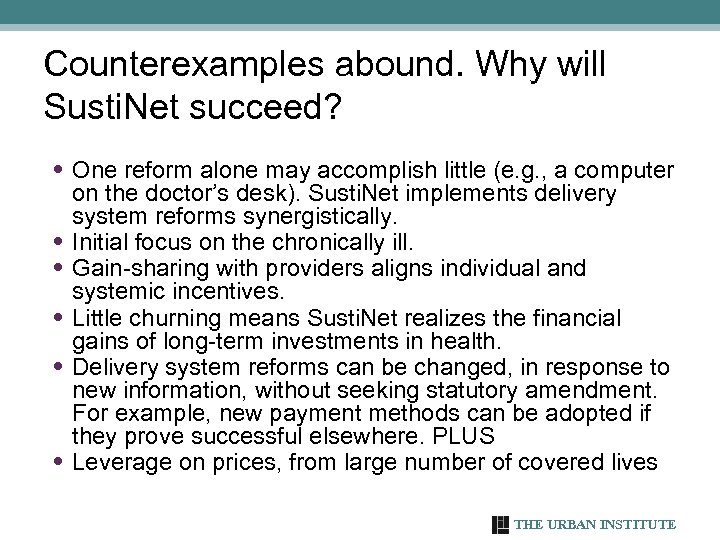 Counterexamples abound. Why will Susti. Net succeed? • One reform alone may accomplish little (e. g. , a computer • • • on the doctor’s desk). Susti. Net implements delivery system reforms synergistically. Initial focus on the chronically ill. Gain-sharing with providers aligns individual and systemic incentives. Little churning means Susti. Net realizes the financial gains of long-term investments in health. Delivery system reforms can be changed, in response to new information, without seeking statutory amendment. For example, new payment methods can be adopted if they prove successful elsewhere. PLUS Leverage on prices, from large number of covered lives THE URBAN INSTITUTE 37
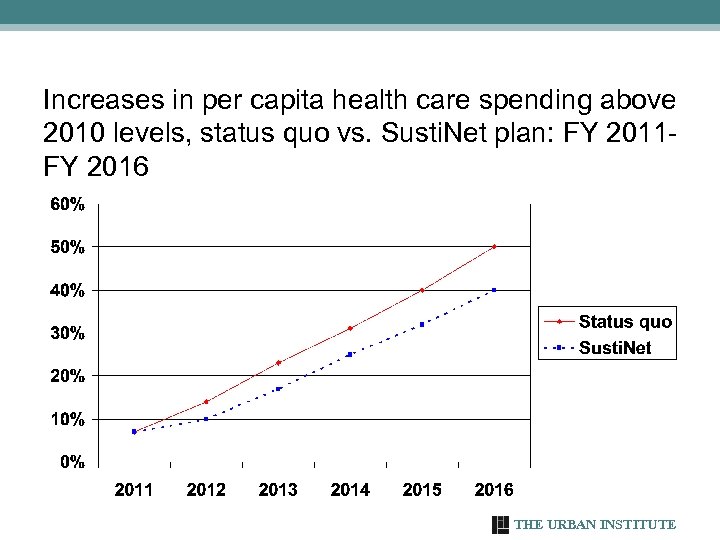 Increases in per capita health care spending above 2010 levels, status quo vs. Susti. Net plan: FY 2011 FY 2016 THE URBAN INSTITUTE 38
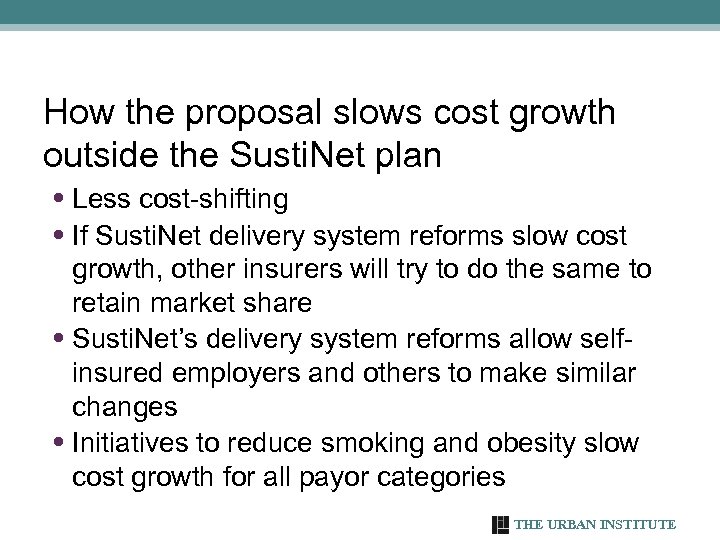 How the proposal slows cost growth outside the Susti. Net plan • Less cost-shifting • If Susti. Net delivery system reforms slow cost growth, other insurers will try to do the same to retain market share • Susti. Net’s delivery system reforms allow selfinsured employers and others to make similar changes • Initiatives to reduce smoking and obesity slow cost growth for all payor categories THE URBAN INSTITUTE 39
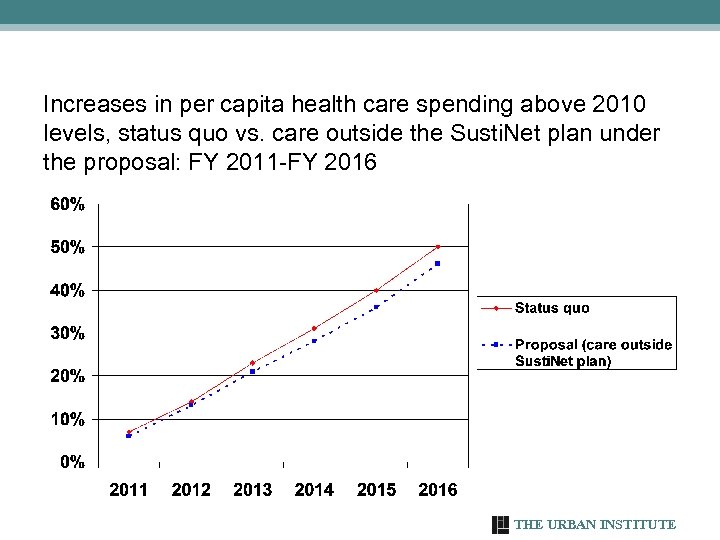 Increases in per capita health care spending above 2010 levels, status quo vs. care outside the Susti. Net plan under the proposal: FY 2011 -FY 2016 THE URBAN INSTITUTE 40
 Appendix III: cost and coverage estimates Source: Dr. Jonathan Gruber, MIT Notes: (1) Costs are stated in 2008 dollars. (2) Estimates assume that, without policy change, CT would have the same coverage as in 2004 -2006. That allows the effects of policy change to be seen more clearly. (3) Based on original timeline with start-up in 2011. 2014 chosen for illustrative purposes, representing plan “in full swing. ” THE URBAN INSTITUTE 41
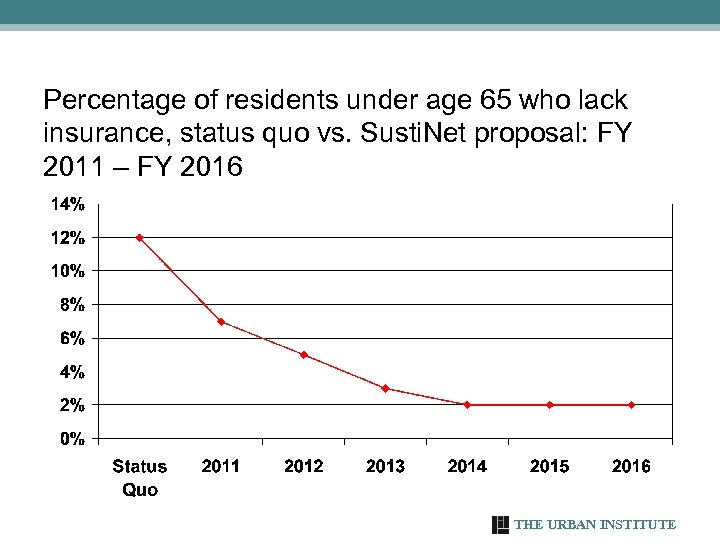 Percentage of residents under age 65 who lack insurance, status quo vs. Susti. Net proposal: FY 2011 – FY 2016 THE URBAN INSTITUTE 42
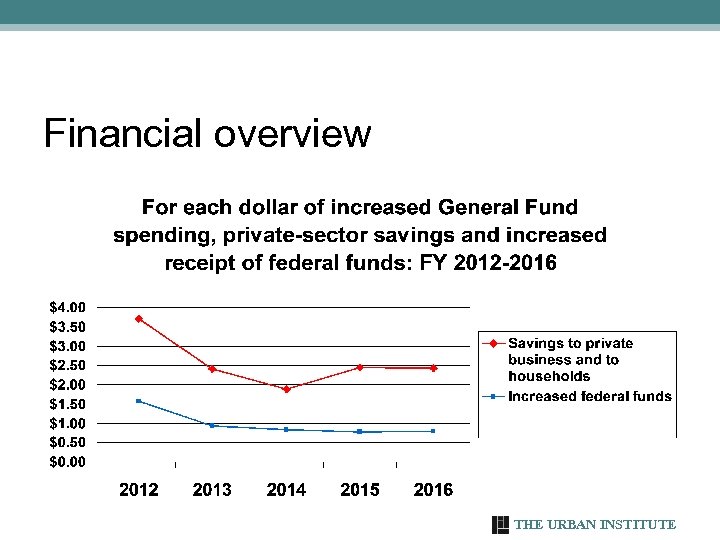 Financial overview THE URBAN INSTITUTE 43
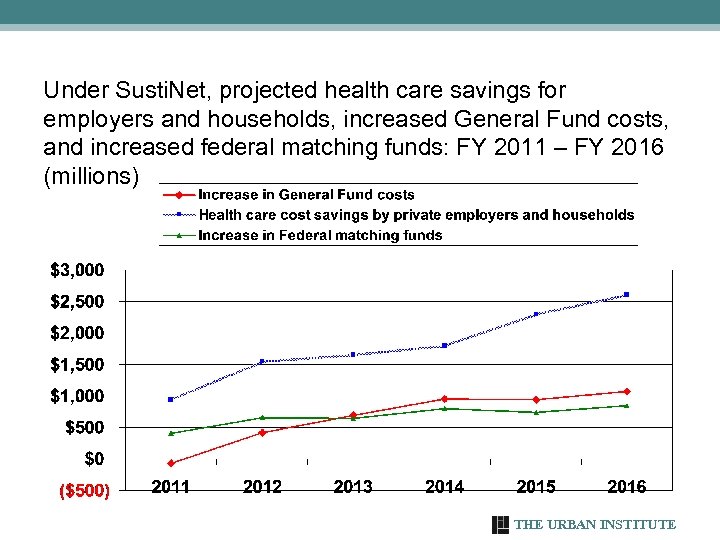 Under Susti. Net, projected health care savings for employers and households, increased General Fund costs, and increased federal matching funds: FY 2011 – FY 2016 (millions) THE URBAN INSTITUTE 44
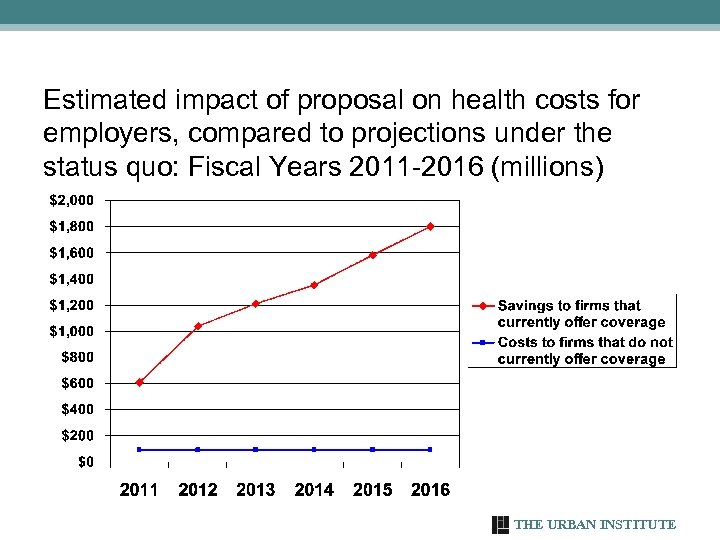 Estimated impact of proposal on health costs for employers, compared to projections under the status quo: Fiscal Years 2011 -2016 (millions) THE URBAN INSTITUTE 45
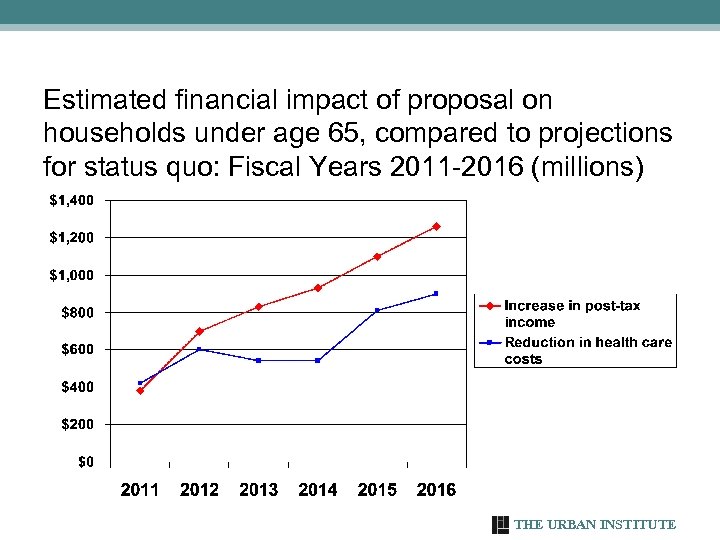 Estimated financial impact of proposal on households under age 65, compared to projections for status quo: Fiscal Years 2011 -2016 (millions) THE URBAN INSTITUTE 46
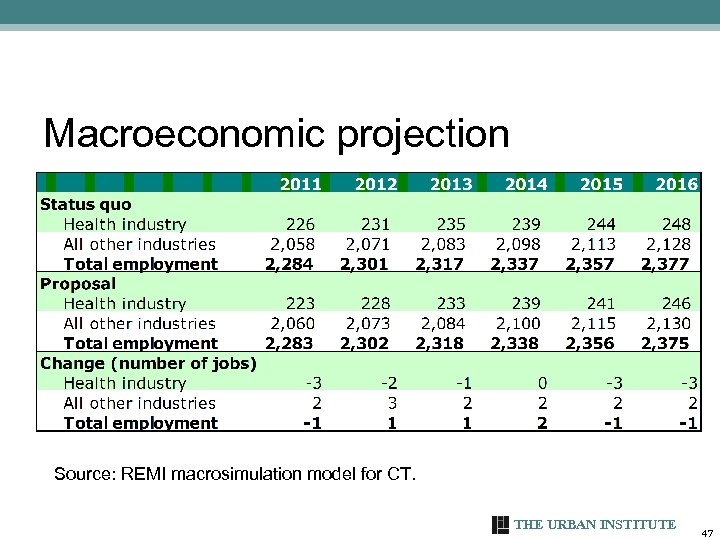 Macroeconomic projection Source: REMI macrosimulation model for CT. THE URBAN INSTITUTE 47
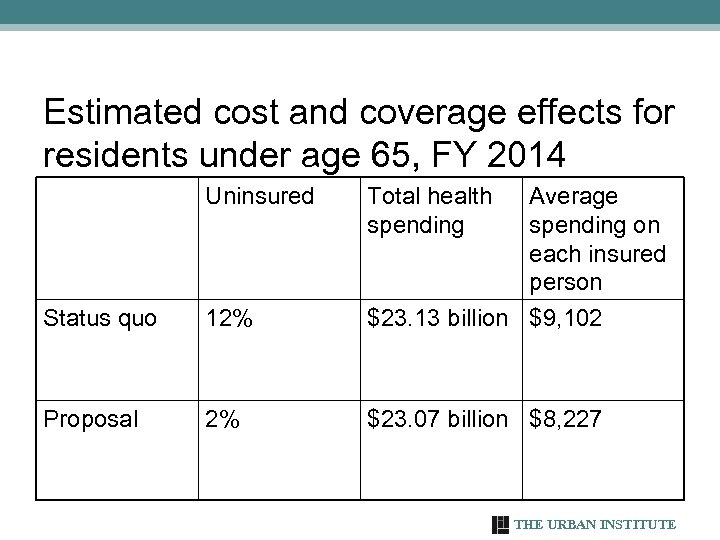 Estimated cost and coverage effects for residents under age 65, FY 2014 Uninsured Total health spending Status quo 12% Average spending on each insured person $23. 13 billion $9, 102 Proposal 2% $23. 07 billion $8, 227 THE URBAN INSTITUTE 48