 Скачать презентацию Sustainable Transport A Global Perspective TDM Report Card
2debfd456299c5957ddaacd7f7ce214a.ppt
- Количество слайдов: 39



Sustainable Transport: A Global Perspective TDM Report Card – understanding how to make the grade? TDM Summit, Calgary 2007 Dr Colin Black November 25 -28 Contemporary Transport™ ACT Canada 2008 November HALIFAX
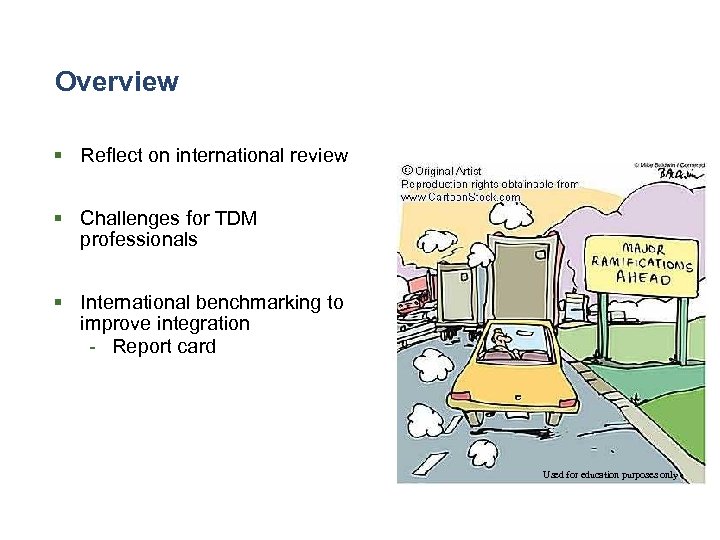
Overview § Reflect on international review § Challenges for TDM professionals § International benchmarking to improve integration - Report card Used for education purposes only
What is Transport Demand Management (TDM) § Original US TDM definition - referred to strategies to encourage commuters to shift to higher occupancy modes, such as ridesharing, vanpooling and public transport § Now generally accepted view of TDM is: “designed to better balance people’s needs to travel with the capacity of available facilities to efficiently handle this demand” - Smarter Choices (or Mobility Management) – subset of TDM
Understanding TDM § If ‘Predict and provide’ was the old way then TDM is the new way – an new paradigm in transport planning § BUT it means more than just ‘managing’ – implicit in the use of the term is the assumption that it is accompanied by the implementation of sustainable mobility, introduction of full cost pricing and organisational /structural measures to ensure a broad range of complementary interventions work effectively together to realise the benefits of integration § It is the unifying philosophy of TDM that underpins the policy objective of a more sustainable system of transport
TDM – more than just ‘restrictions’ § Accepts that meeting unfettered demand for travel is impractical and that therefore the system needs to be managed § This demand for travel needs to be managed by: - Expanding supply of (more sustainable) alternatives - Controlling demand (use of unsustainable modes) - Application of effective /full-cost pricing § Perhaps better understood simply as ‘transport management’ – i. e. obtaining a more appropriate balance in favour of needs over wants
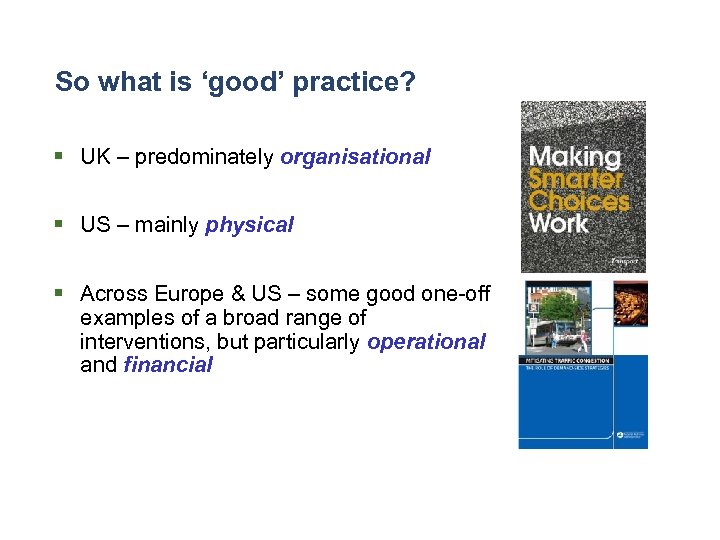
So what is ‘good’ practice? § UK – predominately organisational § US – mainly physical § Across Europe & US – some good one-off examples of a broad range of interventions, but particularly operational and financial
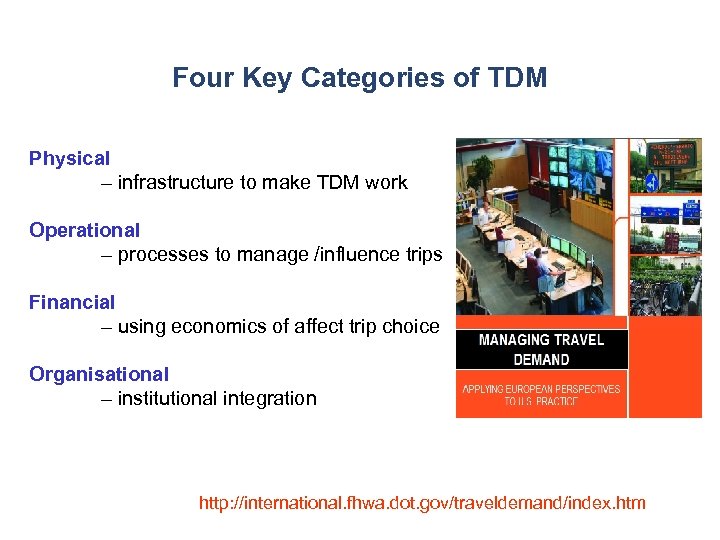
Four Key Categories of TDM Physical – infrastructure to make TDM work Operational – processes to manage /influence trips Financial – using economics of affect trip choice Organisational – institutional integration http: //international. fhwa. dot. gov/traveldemand/index. htm
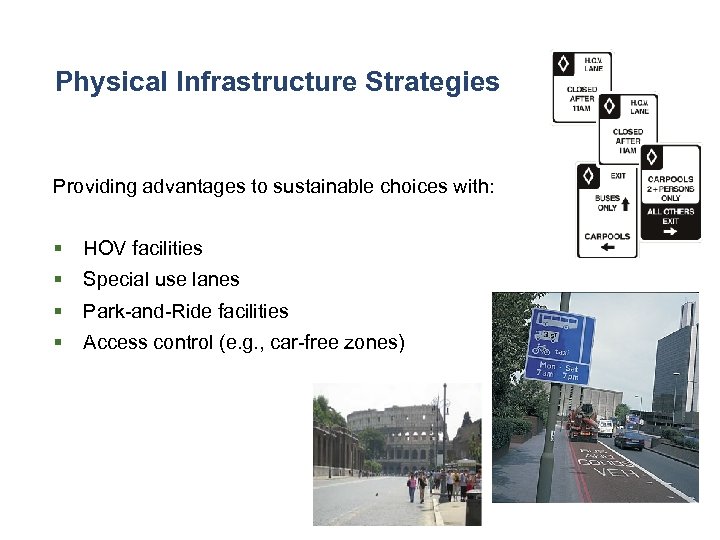
Physical Infrastructure Strategies Providing advantages to sustainable choices with: § HOV facilities § Special use lanes § Park-and-Ride facilities § Access control (e. g. , car-free zones)
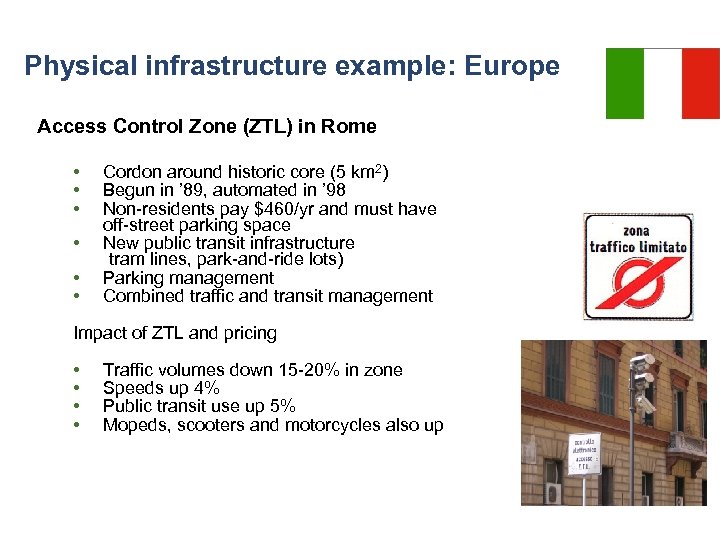
Physical infrastructure example: Europe Access Control Zone (ZTL) in Rome • • • Cordon around historic core (5 km 2) Begun in ’ 89, automated in ’ 98 Non-residents pay $460/yr and must have off-street parking space New public transit infrastructure tram lines, park-and-ride lots) Parking management Combined traffic and transit management Impact of ZTL and pricing • • Traffic volumes down 15 -20% in zone Speeds up 4% Public transit use up 5% Mopeds, scooters and motorcycles also up
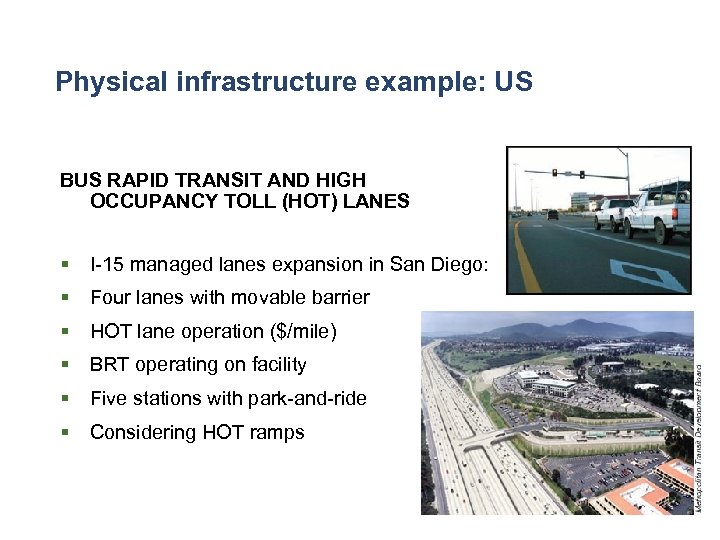
Physical infrastructure example: US BUS RAPID TRANSIT AND HIGH OCCUPANCY TOLL (HOT) LANES § I-15 managed lanes expansion in San Diego: § Four lanes with movable barrier § HOT lane operation ($/mile) § BRT operating on facility § Five stations with park-and-ride § Considering HOT ramps
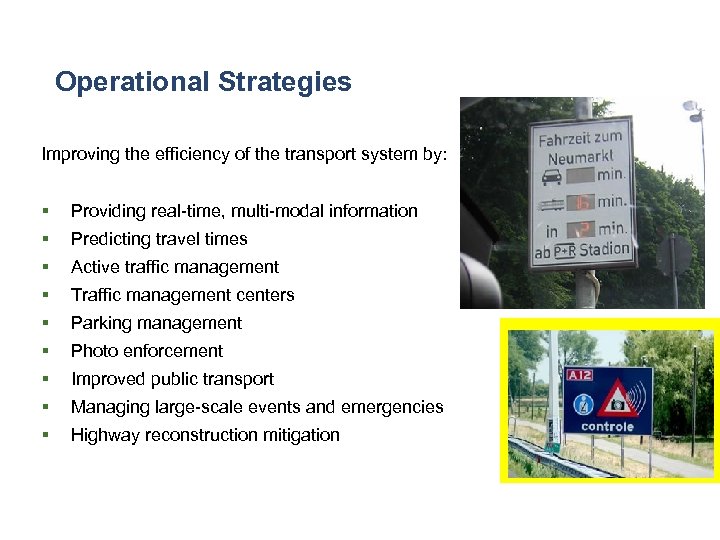
Operational Strategies Improving the efficiency of the transport system by: § Providing real-time, multi-modal information § Predicting travel times § Active traffic management § Traffic management centers § Parking management § Photo enforcement § Improved public transport § Managing large-scale events and emergencies § Highway reconstruction mitigation
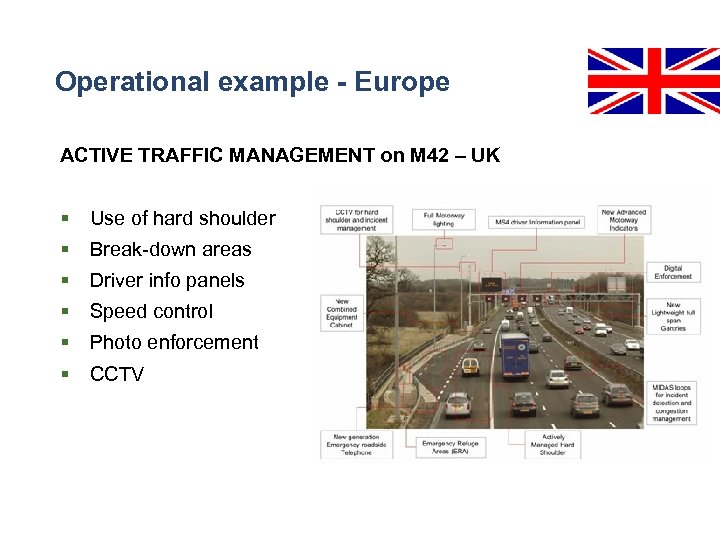
Operational example - Europe ACTIVE TRAFFIC MANAGEMENT on M 42 – UK § Use of hard shoulder § Break-down areas § Driver info panels § Speed control § Photo enforcement § CCTV §
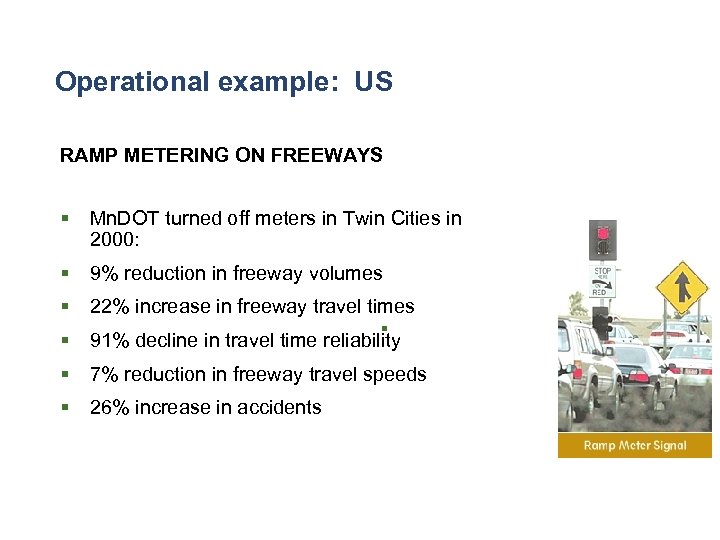
Operational example: US RAMP METERING ON FREEWAYS § Mn. DOT turned off meters in Twin Cities in 2000: § 9% reduction in freeway volumes § 22% increase in freeway travel times § 91% decline in travel time reliability § 7% reduction in freeway travel speeds § 26% increase in accidents §
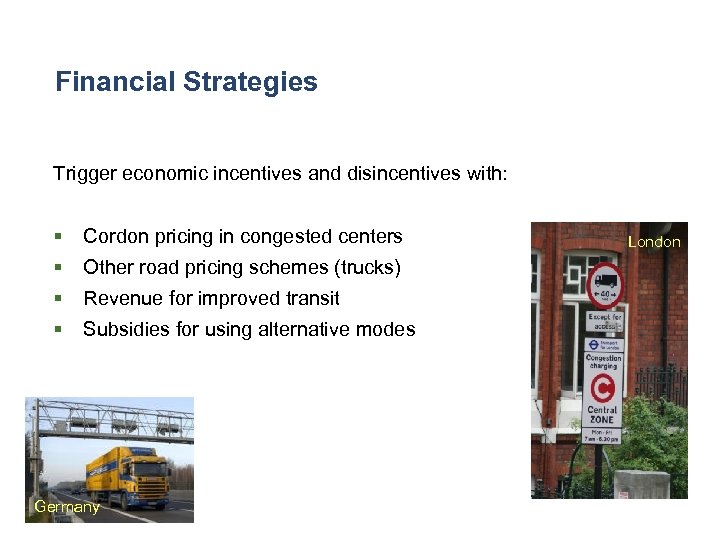
Financial Strategies Trigger economic incentives and disincentives with: § Cordon pricing in congested centers § Other road pricing schemes (trucks) § Revenue for improved transit § Subsidies for using alternative modes Germany London
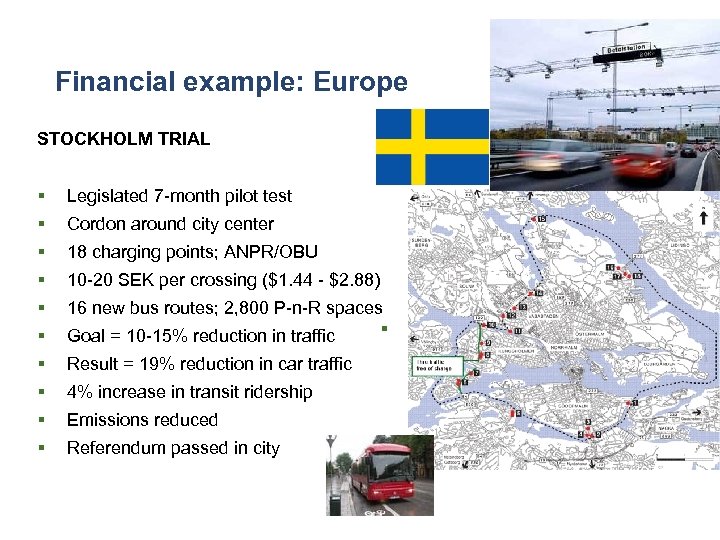
Financial example: Europe STOCKHOLM TRIAL § Legislated 7 -month pilot test § Cordon around city center § 18 charging points; ANPR/OBU § 10 -20 SEK per crossing ($1. 44 - $2. 88) § § 16 new bus routes; 2, 800 P-n-R spaces § Goal = 10 -15% reduction in traffic § Result = 19% reduction in car traffic § 4% increase in transit ridership § Emissions reduced § Referendum passed in city
Financial example: US COMMUTER FINANCIAL INCENTIVES Commuter Rewards Program in Atlanta § $3 per day to switch from driving alone § Up to three months § 1, 800 participants per day § Reduced 1, 200 veh. trips/day § Reduced 30, 000 VMT § Over 70% continued after cash expired
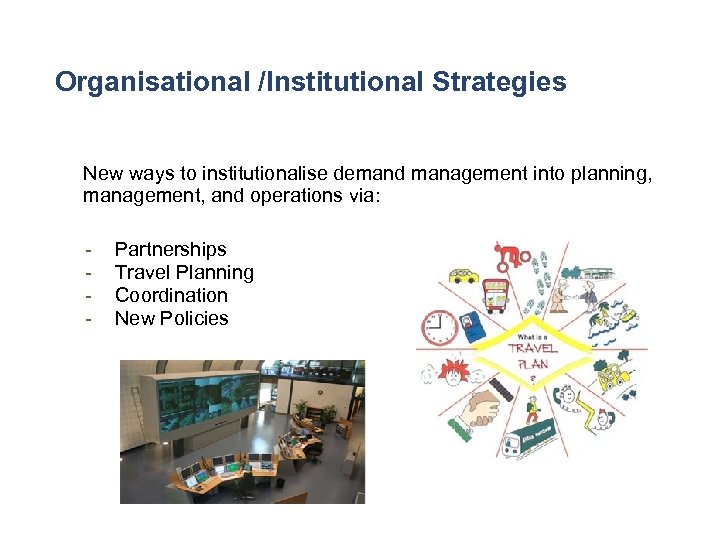
Organisational /Institutional Strategies New ways to institutionalise demand management into planning, management, and operations via: - Partnerships Travel Planning Coordination New Policies
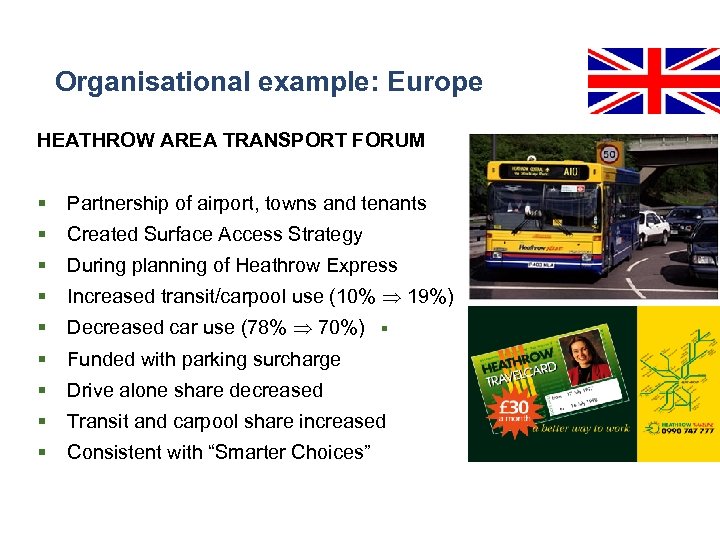
Organisational example: Europe HEATHROW AREA TRANSPORT FORUM § Partnership of airport, towns and tenants § Created Surface Access Strategy § During planning of Heathrow Express § Increased transit/carpool use (10% 19%) § Decreased car use (78% 70%) § § Funded with parking surcharge § Drive alone share decreased § Transit and carpool share increased § Consistent with “Smarter Choices”
Organisational example: US TRIP REDUCTION REQUIREMENTS FOR NEW DEVELOPMENT § Many US jurisdictions require or negotiate § conditional trip mitigation measures to include: § On-site rideshare coordinator § Info and promotion of alternatives § Links to bus, bike and walk paths § Shuttle to regional transit § Preferential parking § Regular reporting § Key is assuring programs get to commuters
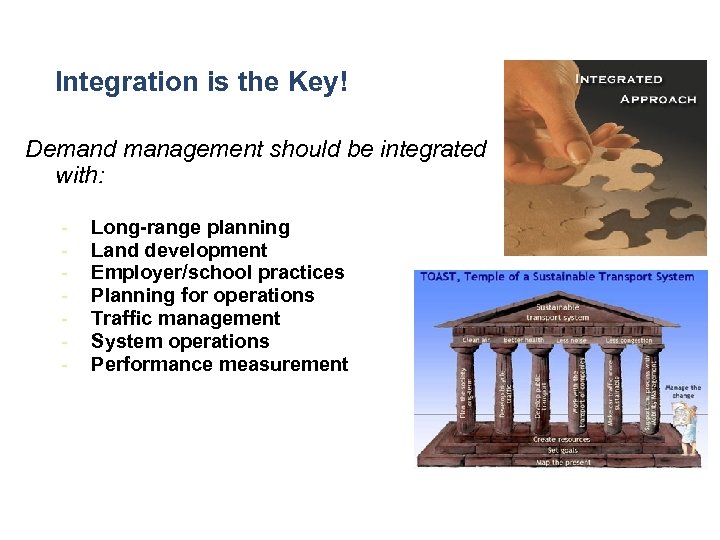
Integration is the Key! Demand management should be integrated with: - Long-range planning Land development Employer/school practices Planning for operations Traffic management System operations Performance measurement
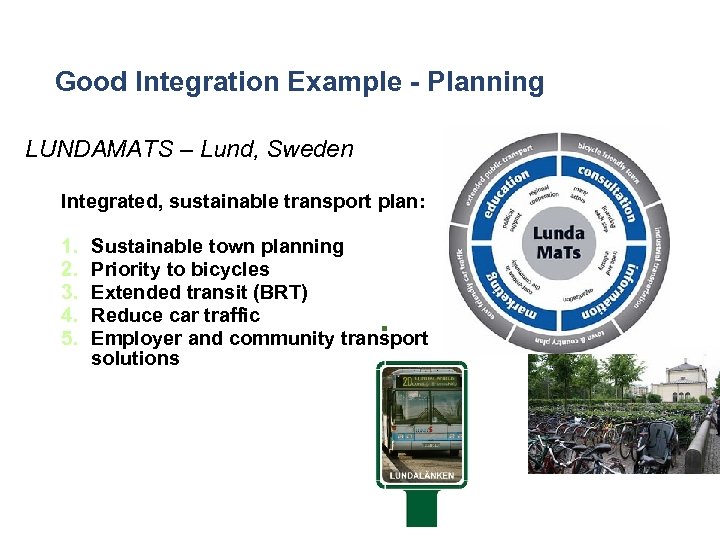
Good Integration Example - Planning LUNDAMATS – Lund, Sweden Integrated, sustainable transport plan: 1. 2. 3. 4. 5. Sustainable town planning Priority to bicycles Extended transit (BRT) Reduce car traffic § Employer and community transport solutions
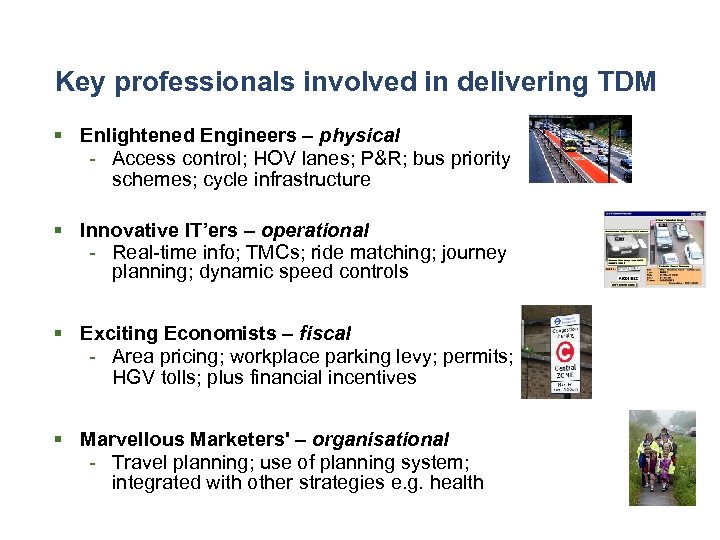
Key professionals involved in delivering TDM § Enlightened Engineers – physical - Access control; HOV lanes; P&R; bus priority schemes; cycle infrastructure § Innovative IT’ers – operational - Real-time info; TMCs; ride matching; journey planning; dynamic speed controls § Exciting Economists – fiscal - Area pricing; workplace parking levy; permits; HGV tolls; plus financial incentives § Marvellous Marketers' – organisational - Travel planning; use of planning system; integrated with other strategies e. g. health
But, current ‘silo thinking’ is constraint § Same concept, different perspectives - Engineers – traffic flow /congestion Economists – pricing IT specialists – technological fixes Travel planners – behaviour change § Concept of TDM has become confused as each discipline positions themselves to bring it under the jurisdiction of their silo
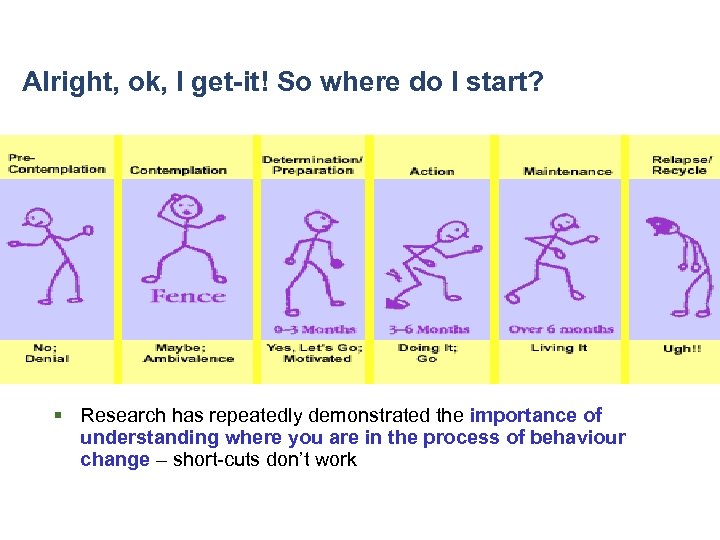
Alright, ok, I get-it! So where do I start? § Research has repeatedly demonstrated the importance of understanding where you are in the process of behaviour change – short-cuts don’t work
Organisational – a good place to start! § European approach has been focussed on need to move people from ‘pre-contemplation’ to ‘preparation’ § Travel awareness programmes e. g. § Sustainable towns pilots, London TDM budget of $70 m § Guidance galore e. g. London: - tfl. gov. uk/corporate/projectsandschemes/workplacetravelplanning/7680. aspx § National standards for accreditation - can send copy on request § Planning guidelines for Transport Assessments § Urban design guidelines
UK reality check! § Organisational measures are viewed as ‘soft factors’ - by those working in other silos § Policy rhetoric not matched by operational reality. Importance of TDM is still under-valued, as evidenced by: - Less than 5% travel plans required by planning process being enforced - lost opportunity for over 100, 000 travel plans - Lack of investment into developing the skills base - Substantial under-funding of TDM - Environmental Management Systems pay lip service - Politicians nervous about appearing to ‘victimise’ car users - Biased Vf. M “procedures” still favour road schemes § Whilst the symbiotic relationship between various elements of TDM might be recognised it is generally not yet acted upon
TDM Benchmarking – Raising Standards § Ongoing research is currently benchmarking progress of city municipalities around the world – eg. as used in PT and cycle planning § Summarises progress towards integrated TDM strategies § Provides a useful tool to enable comparisons to be made between different cities according to a common set of qualitative and quantitative criteria § The work is being used to elicit discussion and to identify opportunities for improving integration § Over time it will also help to identify the most vital ingredients of successful TDM strategies
METRIC – the assessment tool § METRIC - Mobility Enhancement and Trip Reduction Index to aide Comparison § Detailed assessment criteria brings together a broad range of different components of effective TDM interventions § Developed in response to requests for TDM benchmarking by several world cities - To identify opportunities for improvement and what to learn from whom
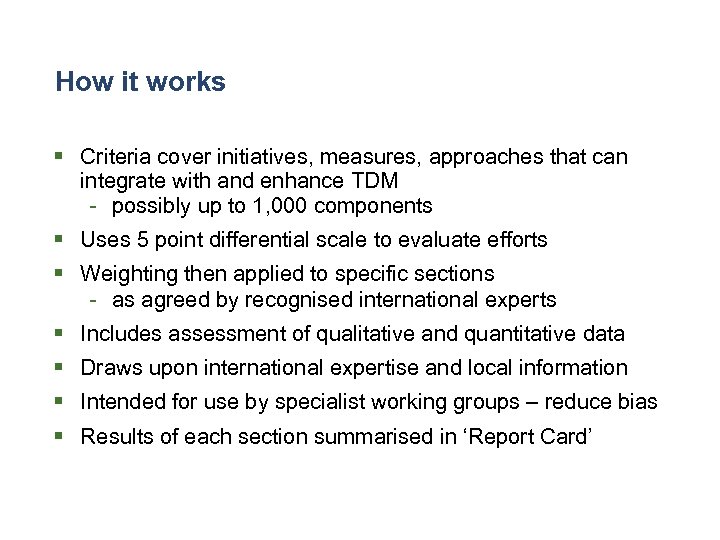
How it works § Criteria cover initiatives, measures, approaches that can integrate with and enhance TDM - possibly up to 1, 000 components § Uses 5 point differential scale to evaluate efforts § Weighting then applied to specific sections - as agreed by recognised international experts § Includes assessment of qualitative and quantitative data § Draws upon international expertise and local information § Intended for use by specialist working groups – reduce bias § Results of each section summarised in ‘Report Card’
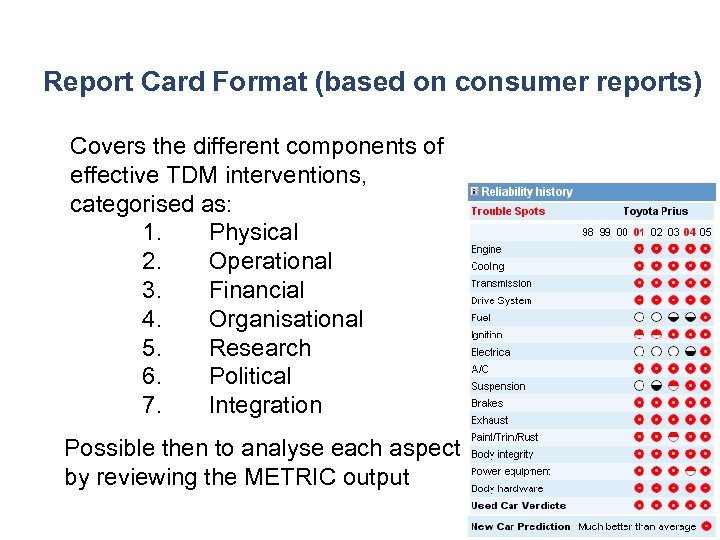
Report Card Format (based on consumer reports) Covers the different components of effective TDM interventions, categorised as: 1. Physical 2. Operational 3. Financial 4. Organisational 5. Research 6. Political 7. Integration Possible then to analyse each aspect in more detail by reviewing the METRIC output
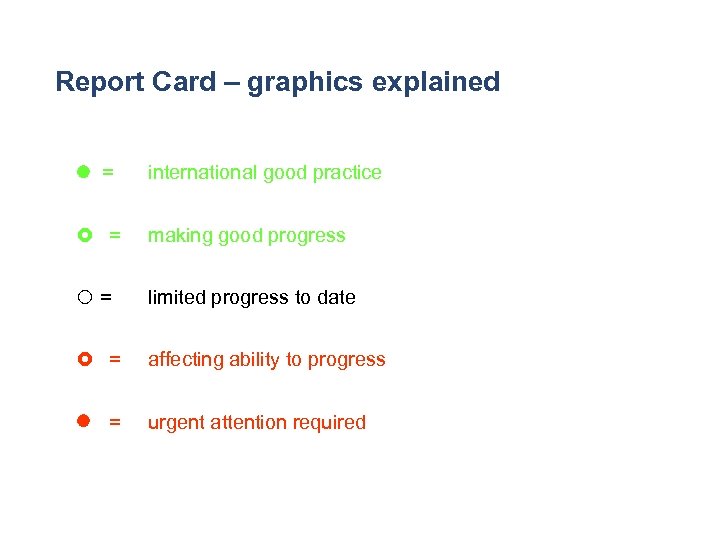
Report Card – graphics explained = international good practice = making good progress = limited progress to date = affecting ability to progress = urgent attention required
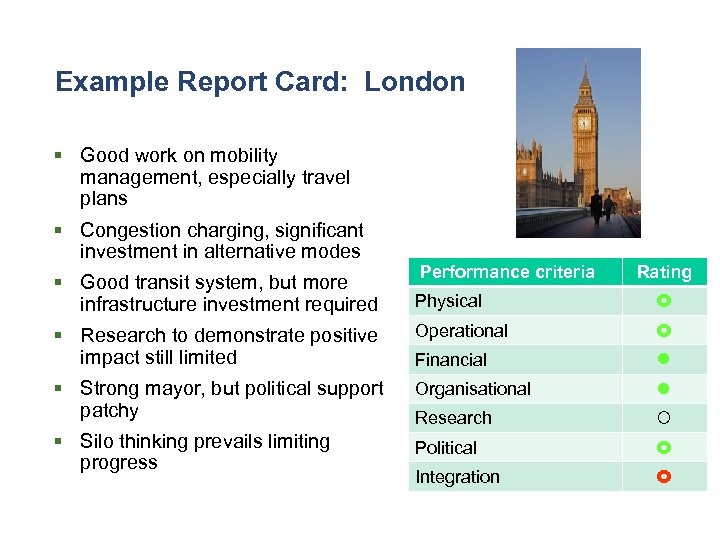
Example Report Card: London § Good work on mobility management, especially travel plans § Congestion charging, significant investment in alternative modes § Good transit system, but more infrastructure investment required Performance criteria Rating Physical § Research to demonstrate positive impact still limited Operational Financial § Strong mayor, but political support patchy Organisational Research § Silo thinking prevails limiting progress Political Integration
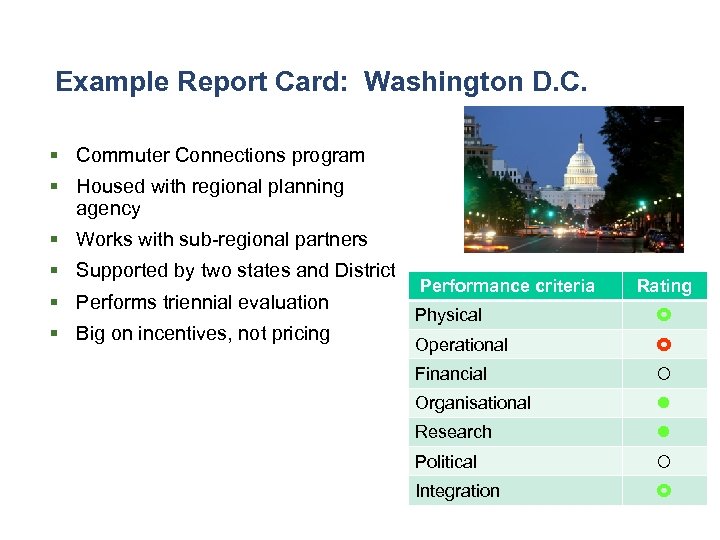
Example Report Card: Washington D. C. § Commuter Connections program § Housed with regional planning agency § Works with sub-regional partners § Supported by two states and District § Performs triennial evaluation § Big on incentives, not pricing Performance criteria Rating Physical Operational Financial Organisational Research Political Integration
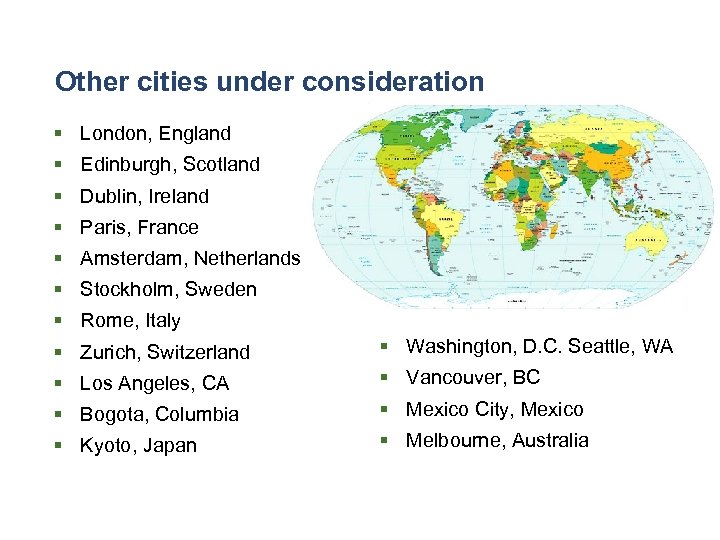
Other cities under consideration § London, England § Edinburgh, Scotland § Dublin, Ireland § Paris, France § Amsterdam, Netherlands § Stockholm, Sweden § Rome, Italy § Zurich, Switzerland § Washington, D. C. Seattle, WA § Los Angeles, CA § Vancouver, BC § Bogota, Columbia § Mexico City, Mexico § Kyoto, Japan § Melbourne, Australia

Some final thoughts. . .
Need to focus objectives – what is TDM for? § We need a way to frame the benefits of TDM in terms of a future vision of sustainability that goes beyond the current short term political and operational requirements § Assuming that TDM interventions are good simply because they offer a ‘foot-in-the-door’ approach (i. e. the hope that individuals can be led up a virtuous ladder of ever more far-reaching behavioural changes) are fraught with contradictions § Lift-sharing, for example, may not lead to net environmental benefits if the money that an individual saves by joining a ride-share scheme is spent on a city break!
Change focus of TDM. . . ? § Currently the emphasis is on changing attitudes – perhaps for a refocus on influencing values § New research emphasises the importance of engaging values and self-identity as basis for motivating pro-environmental behavioural change § Individuals who engage in behaviour in pursuit of ‘intrinsic goals’ (of personal growth, emotional intimacy or community involvement) tend to be more highly motivated and more persistent in engaging in this behaviour § Compared to individuals motivated by ‘extrinsic goals’ (for example, of acquisition of material goods, financial success, image and social recognition). § Evidence suggests that motivations which are intrinsic are more likely to lead to pro-environmental behaviour Crompton, T. (2008) Weathercocks and Signposts, WWF.

Thanks for listening! Want further information, or to include your city in the review…? Dr. Colin Black Contemporary Transport™ colin. black@contemporarytransport. co. uk
Скачать презентацию Sustainable Transport A Global Perspective TDM Report Card
2debfd456299c5957ddaacd7f7ce214a.ppt