 Скачать презентацию SUSTAINABLE HOSPITALITY AND TOURISM AT DIFFERENT AGES WOMEN S
4d841b9513745ea331efcc6be20bd2a7.ppt
- Количество слайдов: 36



SUSTAINABLE HOSPITALITY AND TOURISM AT DIFFERENT AGES: WOMEN’S AND MEN’S ATTITUDES IN ITALY Alessandra Fermani and Flavia Stara*, *Department of Education, Cultural Heritage and Tourism University of Macerata, Italy. Paper presented at the Ith Conference Guest on Earth, Stenden, Nederland, November 24 -25, 2015
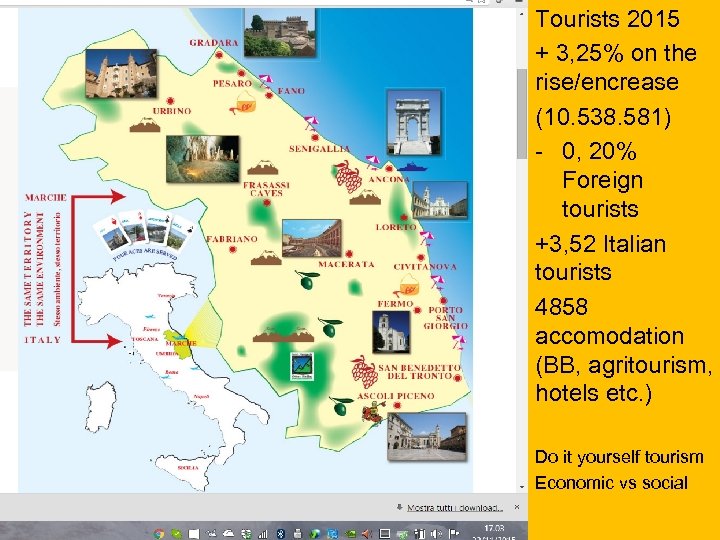
Tourists 2015 + 3, 25% on the rise/encrease (10. 538. 581) - 0, 20% Foreign tourists +3, 52 Italian tourists 4858 accomodation (BB, agritourism, hotels etc. ) Do it yourself tourism Economic vs social

University of Macerata Master’s Degree: International Tourism and Destination Management The Master degree in International Tourism and Destination Management (ITour. De. M) at the University of Macerata is a two-year postgraduate Degree which is equivalent to an M. A. /M. Sc. It aims to prepare managers and professionals able to tackle the global challenges of present tourism, being key-players of sustainable development, and cultural heritage promoters.
Introduction • The preferences for eco-tourism are partially explained by pro-environmental attitudes and values, because eco-tourist choice can be affected by additional motivational factors (Maeran, 2009). Gender is a significant variable, in this field, even if there are few researches on this aspect. Some research studies show a greater aptitude towards sustainable activities carried out by women, and in the management of hospitality and promotion of good practices. Others are more cautious.
• The effect of the interaction of gender with demographic, personal and social variables on sustainable attitude and proenvironment behaviour: all beneficiaries of tourism development should responsibly safeguard the environment and natural resources, with the prospect of healthy economic growth, continuous and tenable, so as to meet equitably the needs and aspirations of present and future generations.
• A balance between economic and cultural choices related to eco-tourism has resulted in many good practices and improvements that seem to reduce the desire to dominate other groups while enhancing empathy, altruism, and communality with others so to mitigate Social dominance attitudes.
Gap • Gender is a significant variable also in the field of sustainable tourism and hospitality, even if there are few researches on this aspect.
Students collected data Aim of this study • The main purpose of the present study is to examine the influence of gender identity of tourists, in terms of motivation/expectation, about sustainable hospitality and comparing gender and age differences with factors such as attitudes toward the environment, dominance orientation and responsibility propensity.
Participants 374 Italian emerging adults and adults (48% men and 52% women), aged between 18 and 74 years (Mean age = 36. 3 years; SD = 15, 4) educational level: 1% primary school, 9% Lower secondary school, 48% upper secondary school, 41% university, 1% post graduate job situation: 40% university students, 49% employed, 11% unemployed/retired. marital status: 51% never married, 32% married, 8% living together with partner, 7% divorced or separated 36% with children, 64% without children
Measures (1) first section which comprised of socio-demographic items (gender, age, educational level, job situation, marital status, yes/no children) 13 items about motivations/expectations and sustainable hospitality raised ad hoc (e. g. “The temporary accommodation or lodging is managed by a family”; “The accommodation promotes the local products”) likert 1 -5 1 item “Would you be willing to spend more to be in an ecofriendly accommodation” likert 1 -7
Measures (2) Attitudes toward the environment. We employed a short version from Bjerke and Kaltenborn (1999) a selection of 25 item from the scale published by Thompson and Barton (1994). ecocentric (interest in the ecological values of the species and its relationship to the environment), Cronbach’s alphas. 74 anthropocentric (interest in utilization of the environment or subordination of the habitat for the practical benefit of humans) , Cronbach’s alphas. 65 environmental apathy (indifference toward the species and environment). Cronbach’s alphas. 62 strongly disagree (1) to strongly agree (5). Sample items include: “One of the worst things about overpopulation is that natural areas are getting destroyed for development” (ecocentric); “One of the most important reasons to keep rivers and lakes clean is so that people can have a place to enjoy water sports” (anthropocentric); “It seems to me that most conservationists are pessimistic and somewhat paranoid” (apathy).
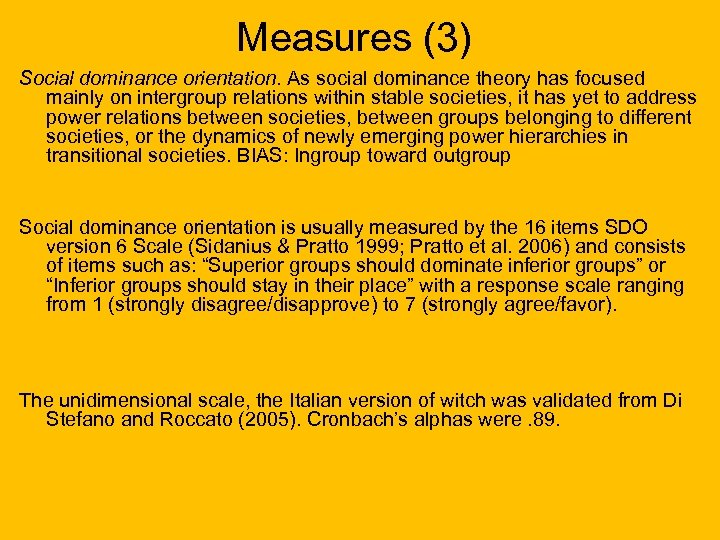
Measures (3) Social dominance orientation. As social dominance theory has focused mainly on intergroup relations within stable societies, it has yet to address power relations between societies, between groups belonging to different societies, or the dynamics of newly emerging power hierarchies in transitional societies. BIAS: Ingroup toward outgroup Social dominance orientation is usually measured by the 16 items SDO version 6 Scale (Sidanius & Pratto 1999; Pratto et al. 2006) and consists of items such as: “Superior groups should dominate inferior groups” or “Inferior groups should stay in their place” with a response scale ranging from 1 (strongly disagree/disapprove) to 7 (strongly agree/favor). The unidimensional scale, the Italian version of witch was validated from Di Stefano and Roccato (2005). Cronbach’s alphas were. 89.
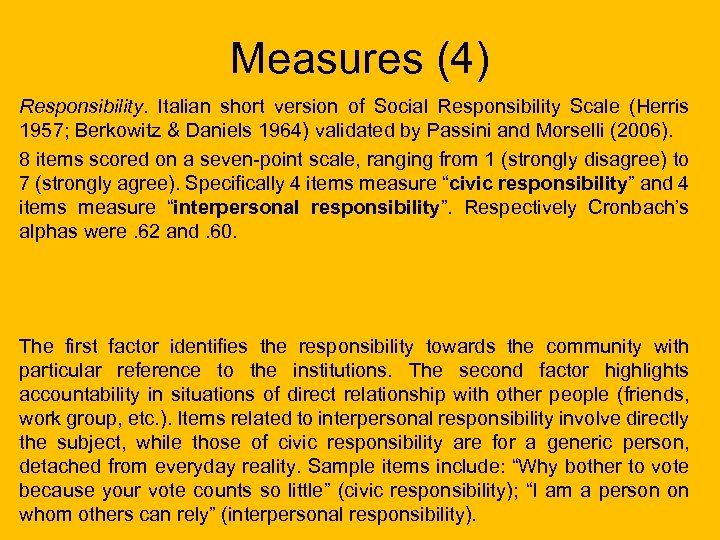
Measures (4) Responsibility. Italian short version of Social Responsibility Scale (Herris 1957; Berkowitz & Daniels 1964) validated by Passini and Morselli (2006). 8 items scored on a seven-point scale, ranging from 1 (strongly disagree) to 7 (strongly agree). Specifically 4 items measure “civic responsibility” and 4 items measure “interpersonal responsibility”. Respectively Cronbach’s alphas were. 62 and. 60. The first factor identifies the responsibility towards the community with particular reference to the institutions. The second factor highlights accountability in situations of direct relationship with other people (friends, work group, etc. ). Items related to interpersonal responsibility involve directly the subject, while those of civic responsibility are for a generic person, detached from everyday reality. Sample items include: “Why bother to vote because your vote counts so little” (civic responsibility); “I am a person on whom others can rely” (interpersonal responsibility).
Recod young males versus young females (19% and 30% were born after 1986) versus adult males versus adult females (29% and 22% were born before 1985)

Table 1 a. Mean-levels (Std. Deviation) of motivations/expectations in the four subgroups Note. Tukey Test *p<. 05. **p<. 01. ***p<. 001. Likert scale 1 -5
Table 1 b. Mean-levels (Std. Deviation) of motivations/expectations in the four subgroups
Table 2. Mean-levels (Std. Deviation) of motivation to spend more in the four subgroups (Likert 1 -7) Note. Tukey Test *p<. 05. **p<. 01. ***p<. 001. Likert scale 1 -7
Table 3. Mean-levels (Std. Deviation) of environment attitudes in the four subgroups Note. Tukey Test *p<. 05. **p<. 01. ***p<. 001. Likert scale 1 -5
Table 4. Mean-levels (Std. Deviation) of SDO and responsibility in the four subgroups Note. Tukey Test *p<. 05. **p<. 01. ***p<. 001. Likert scale 1 -7
Table 5. Results of the logistic regression model on demographic characteristics and propensity to pay more
Table 6. Results of the logistic regression model on demographic characteristics and environmental orientation.
Table 7. Results of the logistic regression model on demographic characteristics and social dominance orientation and responsivity.
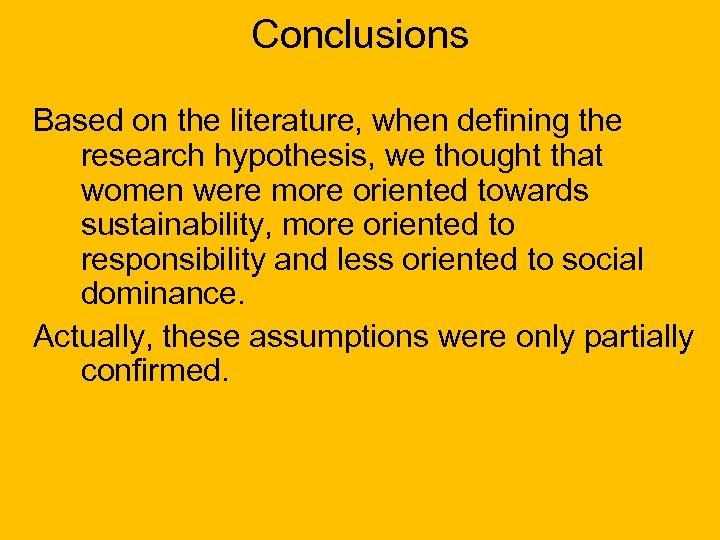
Conclusions Based on the literature, when defining the research hypothesis, we thought that women were more oriented towards sustainability, more oriented to responsibility and less oriented to social dominance. Actually, these assumptions were only partially confirmed.
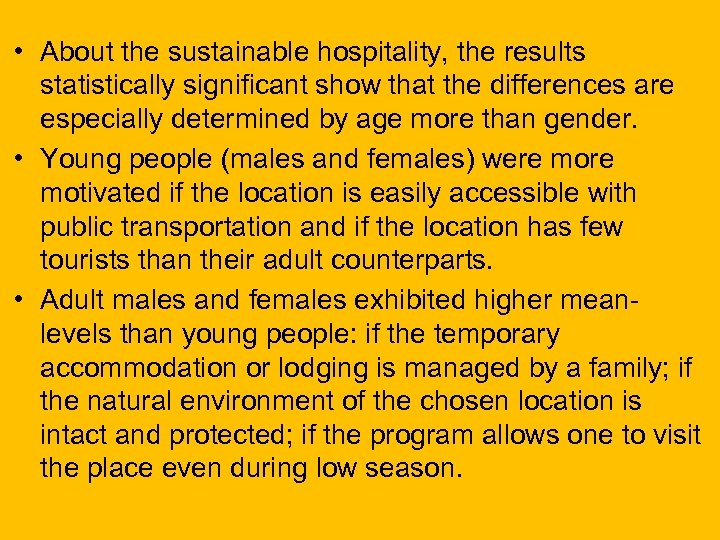
• About the sustainable hospitality, the results statistically significant show that the differences are especially determined by age more than gender. • Young people (males and females) were motivated if the location is easily accessible with public transportation and if the location has few tourists than their adult counterparts. • Adult males and females exhibited higher meanlevels than young people: if the temporary accommodation or lodging is managed by a family; if the natural environment of the chosen location is intact and protected; if the program allows one to visit the place even during low season.
• When Italy, at the political level, attaches great importance and invests to the certifications, the participants think it is not important if the accommodation is certified as environmentally-friendly.
• Participants showed good levels of ecocentrism and low level of environmental apathy; adult males and females proved to be more ecocentric as compared to young people. • In the logistic regression, males are less apathetic towards the environment than females. Adult score higher than young people on the ecocentrism • All people agree that this idea that environmental and social resources should be managed in a more sustainable way, not everyone is willing to give up the satisfaction of their personal needs to achieve that goal (Passafaro et al. , 2012)
• Adult females and males were motivated to spend more for sustainable hospitality compared to young males and females. In the regression, males and adults are associated positively to the willingness to pay more for sustainable hospitality • IPR Marketing (2012, 2013, 2014) confirms this result: young Italian participants claimed to be less willing to pay more because they represented sustainability as an obligation to the development of tourism. For adults it represents an opportunity. In the choice of travelling young people give priority to the economic advantage.
• Participants showed a low level of social dominance orientation. Scores associate males to at more social dominance orientation and confirm the hypothesis. • According to social dominance theory (Pratto et al. 2006), members of dominant arbitraryset groups are expected to have higher levels of SDO than members of subordinate groups (e. g. man and woman) because they want to sustain the privileged access to social and economic resources that their dominant position permits.
• Levels of civic and interpersonal responsibility are quite high, but males score are higher than females on interpersonal responsivity. Young people represented themselves less responsible on civic and interpersonal levels. • Interpersonal responsibility identifies a universe of values open to the other, antithetical to the dominance (Passini & Morselli 2006). So, according to the Authors, more responsibility in everyday relations would be fundamental to the realization of truly constructive relations between people and greater respect for outgroup and environment.
• Our data shows that women and in particular young women, are less eco-responsible compared to the male of the same age group. • The long process of women’s emancipation and changing attitudes towards themselves and others and also towards society (and environment) seems to be now fixed. Men’s identities are on the contrary experiencing a redefinition of roles and expectations. In this sense the reflexivity process and agency activities are stronger among men and especially young men.
• It is important to understand how increasing interpersonal responsibility and decreasing social dominance orientation, would be possible to implement the pro environmental behaviours, the demand the production of sustainable hospitality. In synthesis, the environmental trends of people explain limited tourism and ecotourism individual preferences (Passafaro, Cini, Bocchi, Pichini, 2012). • In Italy the union citizen-environmental awareness is yet to be built… What place for women and young people?
References • • • • • AAVV (2011). Global report on women in tourism 2010. Published by the World Tourism Organization (UNWTO) and the United Nations Entity for Gender Equality and the Empowerment of Women (UN Women). Printed by the World Tourism Organization, Madrid, Spain. Available at http: //dtxtq 4 w 60 xqpw. cloudfront. net/sites/all/files/pdf/global_report_on_women_in_tourism_2010. pdf [Accessed 23 July 2015]. Berkowitz, L. , & Daniels, L. R. (1964). Affecting the salience of the social responsibility norm: Effects of past help on the response to dependency relationships. Journal of Abnormal and Social Psychology, 68, 275 -281. Bjerke, T. , & Kaltenborn, B. P. (1999). The relationship of ecocentric and anthropocentric motives to attitudes toward large carnivores. ournal J Environmental Psychology, 19, 415– 421. Bonnes, M. , Carrus, G. , & Passafaro, P. (2006). Psicologia ambientale, sostenibilità e comportamenti ecologici. Roma: Carocci. Cavagnaro, E. , & Staffieri, S. (2014). Values and youth tourism, an exploratory study. In: Proceedings of the CHME Annual Conference for the Council of Hospitality Management Education. University of Derby, Buxton, Derby. Cavagnaro, E. , & Staffieri, S. (2015). A study of students’ travelers values and needs in order to establish futures patterns and insights. ournal J of Tourism Futures 03/2015, 1(2), 94 -107. Cialdella, F. M. (2015). L’implementazione della responsabilità sociale d’impresa attraverso lo strumento delle certificazioni ambientali. Available at http: //www. ambientediritto. it [accessed September 2015]. Collins, D. , & Tisdell, C. (2002). Gender and differences in travel life cycles. Journal of Travel Research. 41 (2), 133– 143. Comfrey, A. L. , & Lee, H. B. (1992). A First Course in Factor Analysis. Hillsdale, NJ: Lawrence Erlbaum Associates. Di Stefano, G. , & Roccato, M. (2005). Una banca di item per misurare l’orientamento alla dominanza sociale in Italia, PM, 12(1), 5 -20. T Diamantopoulos, A. , Schlegelmilch, B. B, Sinkovics, R. R. , & Bohlen, G. M. (2003). Can socio-demographics still play a role in profiling green consumers? A review of the evidence and an empirical investigation, Journal of Business Research, 56, 465– 480. Dietz, T. , Kalof, L. , & Stern, P. C. (2002). Gender, Values, and Environmentalism. Soc. Sci. Q. , 83, 353– 364. Donohoe, H. M. & Needham, R. D. (2006). Ecotourism: The Evolving Contemporary Definition. Journal of Ecotourism, 3, 192 -210. Ferguson, L. , & Moreno Alarcón, D. (2015). Gender and sustainable tourism: reflections on theory and practice. ournal of Sustainable Tourism, J 23 (3), 401 -416. Ferruzza, A. , Lucarelli, C. , Talucci, V. , & Ungaro, P (2014). Donne e ambiente: comportamenti, valutazioni e opinioni. Donne e agricoltura: un connubio di qualità. Available at http: //www. istat. it/it/files/2014/03/Ferruzza_Lucarelli_Talucci_Ungaro 1. pdf [accessed May 2015]. Frans, M. (2013). Sustainable hospitality: a meaningful notion? Journal of Sustainable Tourism, 21(6), 810 -824. Franz-Balsen, . (2014). A Gender and (Un)Sustainability—Can Communication Solve a Conflict of Norms? Sustainability, 6, 1973 -1991. Harris, D. B. (1957). A scale for measuring attitudes of social responsibility in children. Journal of Abnormal and Social Psychology, 55, 322 -326.
• IPR Marketing (2012). Italiani, turismo sostenibile e ecoturismo. Available at http: //www. fondazioneuniverde. it/wp-content/uploads/2012/02/2 -rapporto-Gli. Italiani-turismo-sostenibile-e-ecoturismo 2. pdf [accessed May 2015]. • IPR Marketing (2014). IV rapporto. Italiani, turismo sostenibile e ecoturismo. Available at http: //www. iprmarketing. it/sites/default/files/ecoturismosostenibile_0. pdf [accessed September 2015]. • Kaplan S (2000) Human Nature and Environmentally Responsible Behavior. Journal of Social Issues, 56 (3), 491 -508. • Kinnaird, V. , & Hall, D. (1994). Tourism: A Gender Analysis. Chichester, UK: Wiley. • Lashley, C. (2008). Studying Hospitality: Insights from Social Sciences. Scandinavian Journal of Hospitality and Tourism, 8(1), 69 -84. • Lashley, C. (2015). Hospitality and hospitableness. Research in Hospitality Management, 5(1) paper accepted, in press. • Lindenberg, S. , & Steg, L. (2007). Normative, Gain and Hedonic Goal Frames Guiding Environmental Behavior, Journal of Social Issues, 65: 1, 117 -37. • Meek, W. R. , & Sullivan, D. M. (2012). The influence of gender and self-identity on attitudes towards sustainability – Evidence from existing entrepreneurs (SUMMARY). Frontiers of Entrepreneurship Research. 32 (8) 2. Available at http: //digitalknowledge. babson. edu/fer/vol 32/iss 8/2 [accessed September 2015]. • Mellor, M. (1997). Feminism and Ecology. Cambridge, UK: John Wiley & Sons. • Meng, F. , & Uysal, M. (2008). Effects of Gender Differences on Perceptions of Destination Attributes, Motivations, and Travel Values: An Examination of a Nature-Based Resort Destination. Journal of Sustainable Tourism, 16 (4), 445 -466. • Mies, M. , & Shiva, V. (1993). Ecofeminism. NS, Canada: Fernwood Publications. • Norris, J. , & Wall G. (1994). Gender and tourism. In C. P. Cooper & A. Lockwood. Progress in Tourism, Recreation and Hospitality Management. New York: Wiley. pp. 57– 78. • Passafaro, P. , Cini, F. , Bocchi, D. , & Pichini, I. (2012). Atteggiamenti ecologici e preferenze per attività e servizi turistici nella prospettiva della psicologia ambientale. Turismo e Psicologia, 1, 27 -45. • Passini, S. , & Morselli, D. (2006). La responsabilità tra autoritarismo e valori. Psicologia Sociale, 3, 501 -516. • Plumwood, V. (1993). Feminism and the Mastery of Nature. London, UK: Routledge. • Prati, G. (2015). L’importanza della certificazione. Available at http: //www. confindustria. tn. it/confindustria/trento [accessed September 2015]. • Pratto, F. , Sidanius, J. , & Levin, S. (2006). Social dominance theory and the dynamics of intergroup relations: Taking stock and looking forward. uropean E Review of Social Psychology, 17, 271– 320. • Schwartz S. H. (1992). Universals in the content and structure of values: Theoretical advances and empirical tests in 20 countries. In M. P. Zanna, Advances in experimental social psychology, 25. San Diego: Academic Press, 1 -65. • Sidanius, J. , & Pratto, F. (1999). Social dominance: An intergroup theory of social hierarchy and oppression. New York: Cambridge University Press. • Sirakaya-Turk, E. , Baloglu, S. & Mercado, H. U. (2014), The Efficacy of Sustainability Values in Predicting Travelers’ Choices for Sustainable Hospitality Businesses, Cornell Hospitality Quarterly, 55(1) 115– 126 • Stevens, C. (2010). Are Women the Key to Sustainable Development? Sustain. Dev. Insights, 3, 1– 8. • Thompson, S. , & Barton, M. (1994). Ecocentric and anthropocentric attitudes toward the environment. ournal Environmental Psychology, 14, 199– 210. J • Warren, K. (2000). Ecofeminist Philosophy: A Western Perspective on What It Is and Why It Matters. Studies in social, political and legal philosophy. Lanham, MD, USA: Rowman & Littlefield.
Acknowledgments The authors would like to thank: Isabella Crespi (University of Macerata) Michelle Martinez (Berkeley University, USA) and students for their support to this research, as well as participants for sharing their time and thoughts.
Скачать презентацию SUSTAINABLE HOSPITALITY AND TOURISM AT DIFFERENT AGES WOMEN S
4d841b9513745ea331efcc6be20bd2a7.ppt