 Скачать презентацию Sustainable agriculture and water in California
8d3e44fa323d672deb5f821beac72ce7.ppt
- Количество слайдов: 26



Sustainable (? ) agriculture and water in California David A. Bainbridge Associate Professor Alliant International University San Diego, CA 92123 1

What does sustainable mean? It depends who you ask To many, including me, it means the ability to persist for a long time 2
Sustainability includes Ecological (environmental) and Cultural considerations (economics, politics, religion, community) 3
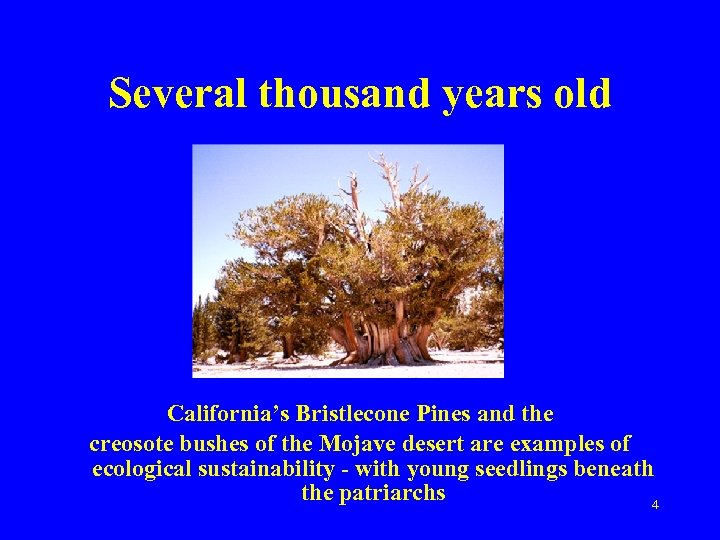
Several thousand years old California’s Bristlecone Pines and the creosote bushes of the Mojave desert are examples of ecological sustainability - with young seedlings beneath the patriarchs 4

Zorastrianism 2700 years young is a sustainable religious group The American Amish offer an example of a sustainable cultural/religious group (300 years). With the highest retention ever today (~90%) 5
With that as background let us consider water and agriculture in California 6
The ecological question: Is agriculture as currently practiced sustainable in California? In many areas it is not Water use exceeds reliable supply, there are drainage problems, salinity buildup, and pollution from overuse of biocides are common The existing water supply system has severely damaged California’s native ecosystems, degraded virtually every stream and river, destroyed the once massive salmon runs, and threatens many more 7
The cultural question: Is agriculture economically sustainable in California? Many farms survive thanks to enormous direct farm program payments, subsidized water and power (often at 10% of true cost), subsidized drainage, minimal pollution control, largely uncontrolled damage to ecosystem and species biodiversity, and destruction of valuable services once provided by Nature (flood control, pollution cleanup, oxygen, etc. ) 8
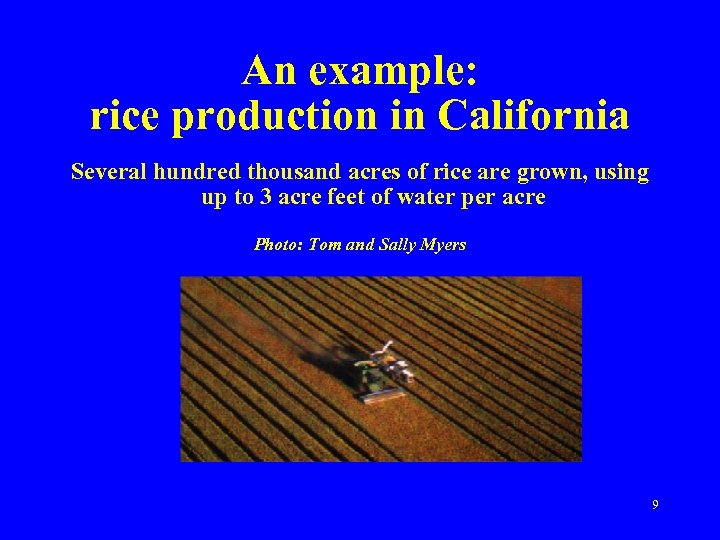
An example: rice production in California Several hundred thousand acres of rice are grown, using up to 3 acre feet of water per acre Photo: Tom and Sally Myers 9
California grew rice worth $485 million (1999 -2000) with support of $480 million in Federal farm payments More than a million acre feet of water with an open market value between $200 and $2000 per AF was used California rice consumed between $200 million and 2 billion dollars worth of water to make $5 million 10
Although most farmers are not yet willing to concede the point, most low value crops are on their way out Even high value crops like avocados can’t compete with urban water buyers - who currently spend more than $1 million dollars an acre foot for bottled water. Recent open market water sales have been up to $1850 AF in the Southwest $$$$$$$$$$$$$$$$ Water flows uphill to money! $$$$$$$$$$$$$$$$$ 11
Can politics save the farmers? The farm lobby is powerful, well-organized and has often been successful in defending illogical, expensive and environmentally damaging policies and programs They will resist and slow the change - but the pressure is too great 12
Agriculture in much of California is ephemeral- not sustainable It has always been so - the once profitable farms of Vermont and New Hampshire have vanished into history. The states are considering subsidies to keep a few fields open and mowed for scenic values A study of the European Union showed that 1/2 the farmland would fall out of production if some of the subsidies and supports were removed 13
If subsidies and support payments were removed much farmland would fall out of production Political pressure and special interest lobbying will slow down the process, but farmland abandonment will recreate the environmental and cultural problems of the Owens Valley and Antelope Valley on a massive scale in the San Joaquin and Imperial Valleys It will also create opportunities for environmental restoration and recreation of valuable native habitats including the almost vanished California grasslands and wetlands 14
The challenges ahead! 1. Create fair, visible and free markets for water (overcoming water rights problems, political shenanigans, and special interests) We do not really have a water supply problem: we have a water allocation problem Making water cost visible should include water meters in the living room or kitchen of every home built from now on 15
2. Develop true cost accounting for water (it is often considered a free good - with charges only for delivery). San Diego has among the highest costs $700 AF, but prices in Germany (where it rains!) are $1600 AF The value of Nature’ Services must be considered True cost accounting will drive efficiency improvement -- often dramatically When reporting about water and agriculture follow the money 16
3. Pay for the Colorado River water we have taken from Mexico, typically 10 -12 million acre feet a year with a value of between 1 and 2 billion dollars Payments could be earmarked for pollution control, water conservation, water harvesting, improved farm water use efficiency and building recycling and desalinization plants 17
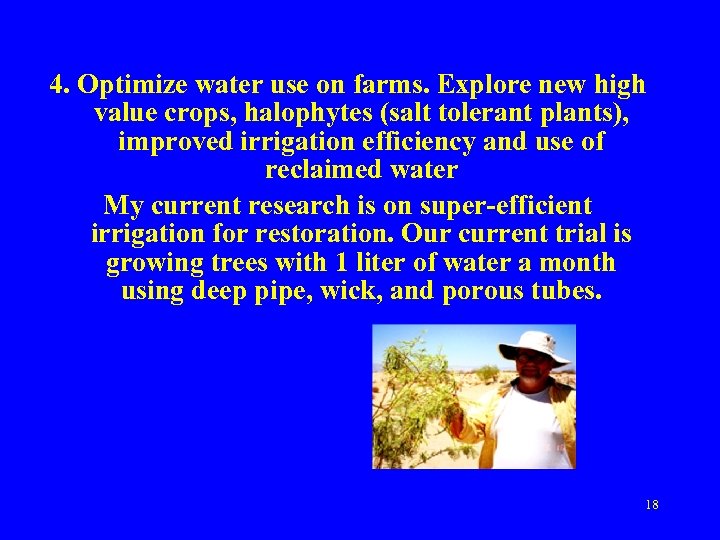
4. Optimize water use on farms. Explore new high value crops, halophytes (salt tolerant plants), improved irrigation efficiency and use of reclaimed water My current research is on super-efficient irrigation for restoration. Our current trial is growing trees with 1 liter of water a month using deep pipe, wick, and porous tubes. 18
5. Promote water harvesting and stormwater capture for urban area agriculture and landscaping 19

6. Higher prices will encourage dramatic efficiency improvements (up to 90%) and will encourage more environmentally appropriate landscaping If the Native Americans had conquered England would they graze buffalo on the lawns of Buckingham Palace? Raise saguaro cactus? 20

Our use of lawns in San Diego is equally inappropriate 21
7. Develop reclamation plans and programs before land is abandoned and irrigation systems are dismantled. Fallowed land in arid areas does not recover quickly - it may take a thousand years without intervention 8. Develop retraining and relocation programs to assist both farmers and farm workers adjust to new realities 22
9. Provide effective and continued support for water allocations to Nature to protect biodiversity, support ecological services and to protect future generation’s options and opportunities 10. Protect taxpayers and water users from more outrageous water payment schemes - where water is sold to the farmer and then resold to cities at cost multiples (or tie water profits to land restoration) 23

11. Provide meaningful and accurate information on water supply, use, cost and efficiency improvement in schools and colleges with demonstrations regionally or in every community. The Casa del Agua in Tucson is an excellent example. 24

What will Global Change bring? Hotter and drier is not a comforting trend! What else? • Increased fungal pests! • Increased pressure from alien pest species • Increased migration pressure 25

A Turkish proverb • Millions of men have lived without love - none have lived without water 26
Скачать презентацию Sustainable agriculture and water in California
8d3e44fa323d672deb5f821beac72ce7.ppt