 Скачать презентацию Sustainability of Fisheries By J -J Maguire For
880ec2d580b5864e3ef5cc19609ea37e.ppt
- Количество слайдов: 18



Sustainability of Fisheries By J. -J. Maguire For the North Sea Regional Advisory Council March 2 -3, 2006
Our Common Future n n The Report of the World Commission on Environment and Development (1987) first to propose the concept of sustainable development The report clearly describes (page 37) how environmental stresses are linked to one another, to the patterns of economic development, and how both are linked to social and political factors Continued (sustained) development is needed to reduce poverty and inequalities It is only by taking account of ecological, economic, and social factors in an integrated decision-making system (institutions) that development could continue without exhausting natural resources.
Definition of sustainability n Multidimensional concept: 4 components. • • n Bio-ecological Social Economic Institutional May change over time • Defined by society • Not a unique point on the yield or income vs effort curve
Nature of unsustainability n n Unsustainability often linked to overexploitation, but resources do fluctuate naturally Abundance, and presence of species dependent on hydro-climatic conditions External threats, voluntary or accidental Well managed fisheries do not imply absence of fluctuations in the resource abundance or availability
Has bio-ecological sustainability been achieved in large scale demersal fisheries in the North Atlantic? n n Has been the main focus of fishery management After 20+ years of intensive fishery management, most traditional demersal fisheries are in crisis: • severe restrictions on North Sea cod • Northeast Arctic cod outside safe biological limits with TACs set twice as high as the scientific advice • Icelandic cod also fished at twice the target fishing mortality rate • Canadian cod fisheries only a fraction of past landings • Georges Bank and Gulf of Maine cod overfished and overfishing is occurring n Some positive signs for haddock and yellowtail in the NW Atlantic
Has the economic component of sustainability been achieved? n n Difficult to say, data not collected, analysed and reported in a systematic way Number of offers in buy-back programs suggests it is not Increases in fuel prices have certainly had an effect Depends on the fishery
Has social sustainability been achieved? n n n Difficult to say, data not collected, analysed and reported in a systematic way Press reports would suggest that it is not: the number of boats (and fishermen) is decreasing, and fish processing plants are being closed Equity is not enhanced – lucrative snow crab fishery in the Southern Gulf of St. Lawrence
Has institutional sustainability been achieved? n n n Fishery management institutions in the North Atlantic mostly concerned with the bio-ecological component of sustainability (conservation) TACs main conservation tool, scientific advice main factor in determining TACs Landings, and particularly catches, believed to be unreliable by a large number of interested parties which undermines the credibility of the scientific advice Decision-making far from transparent, which further undermines the credibility of the entire system Although fishery management institutions do continue to exist, it is difficult to describe them as being sustainable Not clear that existing institutions are assets in achieving sustainability
Fishery management of large volume demersal fisheries has failed in the north Atlantic n n n Considerable human and financial resources have been invested in fishery management in all countries bordering the North Atlantic since at least the mid to late 1970 s Most direct result is depleted demersal stocks and unreliable fishery statistics May be that fishery management processes are focussing too much on the bio-ecological component of sustainability at the detriment of the other components
Fishery management successes do exist n Hilborn, Orensans, and Parma (2005) discuss • New Zealand lobster, Chilean artisanal fisheries, Canadian sablefish, West Australian rock lobster, Gulf of Carpentaria prawns, Tasmanian abalone, Northeast Chatham Rise orange roughy in NZ, Pacific halibut, US hake and pollock coops, Geoduck in British Columbia and in Puget Sound n Successful institutional systems provide incentives to individual operators leading to behaviours consistent with conservation
Fishery management objectives n n MSY identified at the 2002 Johannesburg Summit because the only one on the books Shortcomings of the concept have been known for at least 30 years (Larkin 1977) • Not stable over time, carrying capacity of the environment changes, natural mortality changes, form of the stock recruitment relationship may change n Non incorporation of multispecies interactions is a major shortcoming • Impossible to achieve MSY for all species of predators, preys and competitors at the same time in a changing environment • Recipe for failure because not achievable
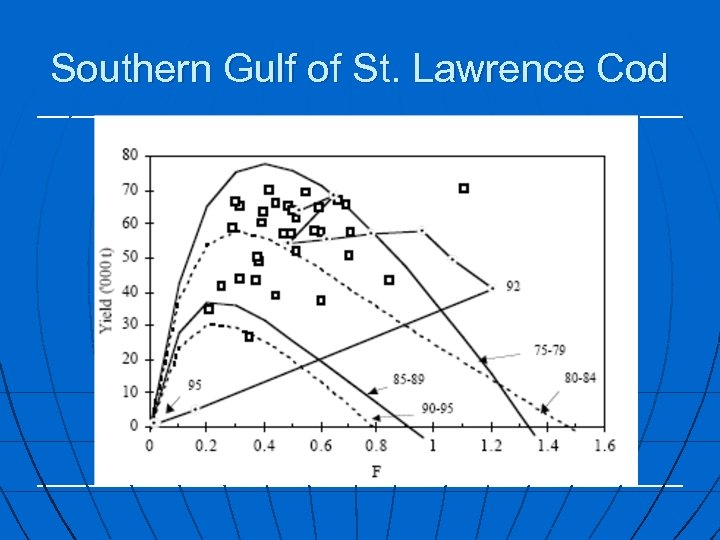
Southern Gulf of St. Lawrence Cod
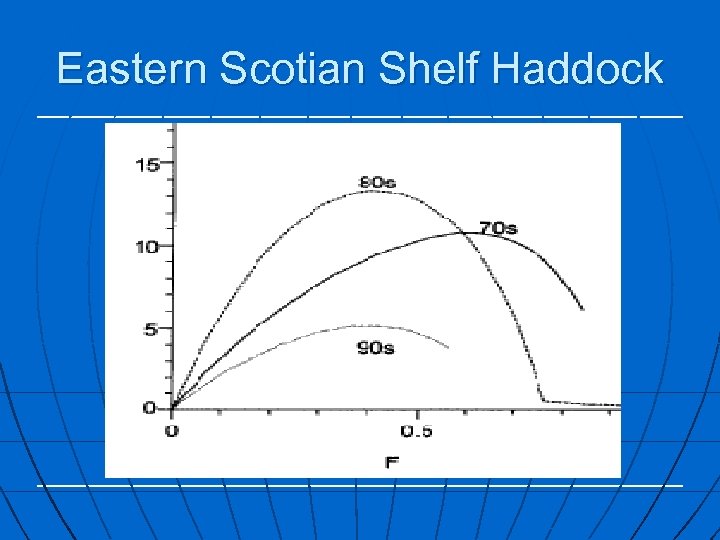
Eastern Scotian Shelf Haddock
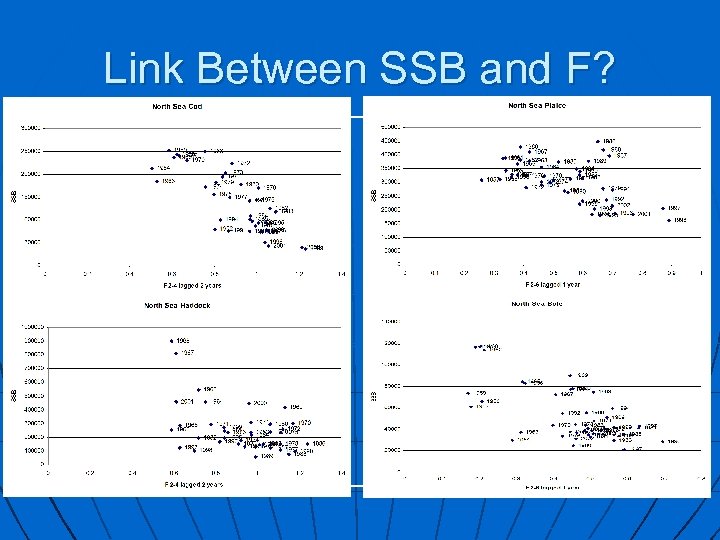
Link Between SSB and F?
How can sustainability help? n n Recognise that ecological system is dynamic and unpredictable with a major influence from environmental forcing Benefits should be sought for all four dimensions of sustainability (bio-ecological, economic, social, institutional) Improvements under the economic, social, and institutional components should be easier to measure and (possibly) achieve Improvements in the bio-ecological component will accrue as a fringe benefit
Summary n n n Sustainable development is clearly a multidimensional concept Fishery management in the North Atlantic has been overtly focused on the bio-ecological dimension of sustainability and it has failed under the four dimensions of sustainability It should be easier to agree on measures to improve the economic, social and institutional dimensions of sustainability and progress should also be easier to measure Directional approach: start improving and gather information to evaluate later Institutions need to change

Thank you
Transition n n Raise awareness among all interested parties of the benefits of changes Consult with all interested parties to determine how changes will be implemented, who will be affected and how Recognise and assess the cost and benefits of transition and allocate in an equitable manner Recognise that the impact of change may go beyond the fisheries sector Avoid delaying changes as delays will increase the cost
Скачать презентацию Sustainability of Fisheries By J -J Maguire For
880ec2d580b5864e3ef5cc19609ea37e.ppt